India is one of the world’s most mineral-rich nations — endowed with vast deposits of iron ore, coal, bauxite, mica, manganese, copper, zinc, lead, limestone, and many other critical minerals spread across its diverse geological terrains. The country holds the world’s #1 position in mica production, ranks among the top 5 in iron ore and bauxite reserves, and has the 4th largest coal reserves globally. Minerals are the backbone of India’s industrial economy — steel, aluminium, cement, fertilisers, electronics, and energy all depend on mineral extraction and processing. Understanding India’s mineral distribution, types, and economic significance is fundamental for UPSC, SSC, State PSC, Class 10–11 NCERT Geography, and all competitive examinations. This complete guide covers metallic minerals (iron, manganese, bauxite, copper, gold, zinc), non-metallic minerals (mica, limestone, gypsum), energy minerals (coal, petroleum, uranium), and India’s critical mineral challenges.
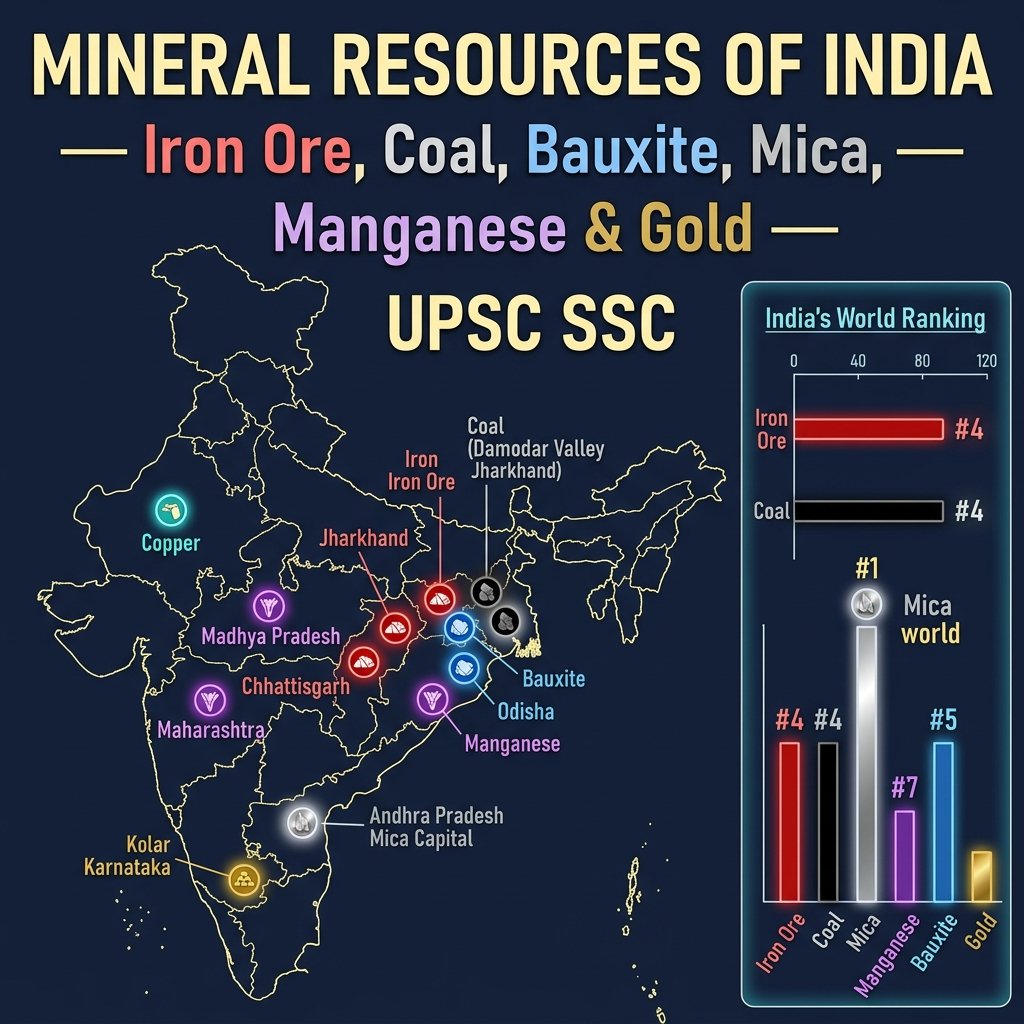
India’s Mineral Wealth — Overview & World Rankings
| Mineral | India’s World Rank (Reserves) | India’s World Rank (Production) | Primary States |
|---|---|---|---|
| Mica | 🥇 #1 | 🥇 #1 (historically) | Jharkhand, Andhra Pradesh, Rajasthan |
| Iron Ore | 🥈 Top 5 | 4th | Odisha, Jharkhand, Chhattisgarh, Karnataka, Goa |
| Bauxite | Top 5 | 5th | Odisha, Jharkhand, Gujarat, Maharashtra, MP |
| Coal | 4th (reserves) | 2nd | Jharkhand, Odisha, Chhattisgarh, WB, MP |
| Manganese | 7th | 7th | Odisha, Maharashtra, MP, Karnataka, Goa |
| Limestone | Top 10 | 2nd (cement production) | MP, Rajasthan, AP/Telangana, Karnataka, CG |
| Chromite | 3rd (reserves) | 3rd | Odisha (Sukinda Valley = 97% India’s chromite) |
| Copper | Moderate | Low (imports needed) | Rajasthan (Khetri = “Copper City”), Jharkhand, MP |
| Zinc-Lead | Top 5 (zinc reserves) | 6th (zinc) | Rajasthan (Zawar, Rampura Agucha = world’s largest zinc mine) |
| Gold | Low | Very Low | Karnataka (Kolar = “Gold Field”; Hutti), Andhra Pradesh, Jharkhand |
Iron Ore — The Foundation of Steel India
- 🔴 Types: Haematite (Fe₂O₃, 60–70% Fe, best quality, reddish-brown) and Magnetite (Fe₃O₄, 72% Fe theoretical, magnetic, found in some Karnataka deposits)
- 📊 India’s reserves: ~33 billion tonnes total; predominantly haematite
- 🏭 Uses: Steel production (primary), pig iron, cast iron; India = world’s 2nd largest steel producer (after China)
- 🇮🇳 State-wise distribution:
| State | Key Districts/Mines | Notes |
|---|---|---|
| Odisha (~55% of India) | Keonjhar, Sundargarh, Mayurbhanj; Bailadila-style high-grade deposits; Barbil-Joda belt | Largest producer; high-grade haematite; major export via Paradip port |
| Jharkhand | Singhbhum (Noamundi, Gua, Kiriburu mines); part of Singhbhum craton | Singhbhum district = major iron ore + copper belt |
| Chhattisgarh | Bastar (Bailadila = one of world’s largest haematite deposits; 14 hill ranges); Dantewada, Kanker | Bailadila iron ore exported to Japan via MoU since 1968 |
| Karnataka | Bellary-Hospet (Kudremukh now restricted); Chitradurga, Tumkur; Sandur | Karnataka had major illegal mining scandal 2010-11 (B. Sriramulu/Reddy brothers) |
| Goa | North Goa, South Goa; smaller deposits; mostly for export | Major iron ore exporter to China historically; Supreme Court stopped mining 2018, partially resumed |
Manganese — The Steel Alloy Mineral
- ⚫ Type: Pyrolusite (MnO₂ = most important ore), Psilomelane, Manganite
- 🏭 Uses: Steel alloying (essential — steel without manganese is brittle and unworkable; ~6–9 kg Mn per tonne of steel); dry cell batteries (MnO₂ as depolariser); fertilisers; glass and ceramics
- 🇮🇳 Distribution: Odisha (Koraput, Kalahandi, Bolangir, Sundergarh = largest); Maharashtra (Nagpur, Bhandara = 2nd; historically important; early 20th century mines); MP (Balaghat, Chhindwara); Karnataka (Bellary, Chitradurga, Tumkur — associated with iron ore belt); Goa (associated with iron ore); AP/Telangana (Vizianagaram, Srikakulam)
Bauxite — The Aluminium Ore
- 🟤 Composition: Hydrated aluminium oxides (gibbsite Al(OH)₃, boehmite, diaspore); formed by intense tropical chemical weathering (laterisation) of aluminium-rich rocks
- ⚙️ Processing: Bauxite → Alumina (Al₂O₃) via Bayer Process → Aluminium via Hall-Héroult electrolysis (very energy-intensive)
- 🏭 Uses: Aluminium metal (aircraft, packaging, construction, electrical wires, cookware), refractory materials, abrasives, aluminium chemicals
- 🇮🇳 Distribution: Odisha (Koraput, Kalahandi, Bolangir, Sambalpur = largest; Panchpatmali in Koraput = one of Asia’s largest bauxite deposits); Jharkhand (Lohardaga = largest single deposit; Ranchi plateau); Gujarat (Junagarh, Amreli — associated with Deccan Trap weathering); Maharashtra (Kolhapur, Satara, Ratnagiri — Deccan Trap laterite); MP (Balaghat, Mandla); Chhattisgarh (Ambikapur); Goa, Andhra Pradesh
- 🏭 Aluminium plants (India): NALCO (National Aluminium Co., Damanjodi/Angul Odisha, public sector); Hindalco (Renukoot UP, Hirakud Odisha, Aditya Group); Vedanta (Jharsuguda Odisha); BALCO (Chhattisgarh, now Vedanta)
Mica — India’s Shining Gem
- ✨ Types: Muscovite (white/potassium mica — best quality for industrial use), Biotite (black/iron-magnesium mica), Phlogopite (magnesian mica)
- 🔬 Properties: Perfect basal cleavage (splits into thin transparent sheets); flexible but elastic (springs back); excellent electrical insulator; heat-resistant (stable to 600°C+); transparent in thin sheets
- 🏭 Uses: Electrical and electronics industry (insulator in condensers, vacuum tubes, circuit boards — mica cannot be replicated by synthetics for some high-voltage applications), cosmetics (pearlescent shimmer in makeup, nail polish, lipstick), paints (metallic sheen), drilling fluids (oil/gas wells), fireproofing
- 🇮🇳 Distribution — The Mica Belt:
- Jharkhand (Koderma, Giridih, Hazaribagh = “Mica Capital of the World” — Koderma district; Jharkhand produces ~60–70% of India’s mica)
- Rajasthan (Ajmer, Bhilwara, Jaipur district — associated with Delhi Supergroup metamorphic rocks)
- Andhra Pradesh (Nellore district = world-quality sheet mica — Nellore historically among world’s finest mica)
- ⚠️ Child labour concern: India’s mica mining sector (especially informal/illegal mines in Jharkhand, Rajasthan) has faced serious international scrutiny for child labour — children as young as 5 working in unregulated mines; several global cosmetics companies have had to audit and overhaul their mica supply chains (L’Oréal, Revlon, etc.)
Copper — The Electrical Metal
- 🟤 Ores: Chalcopyrite (CuFeS₂ — most important; “fool’s gold”-looking yellowish; ~34% Cu in ore), Malachite, Azurite, Native copper
- 🏭 Uses: Electrical wiring (best conductor after silver; ~65% of all copper), plumbing, construction, electronics, alloys (brass = Cu+Zn; bronze = Cu+Sn)
- 🇮🇳 Distribution: Rajasthan (Khetri = “Copper City” of India; Alwar, Sikar districts; Hindustan Copper Ltd., India’s only public sector copper company, has mine here); Jharkhand (Singhbhum — Mosaboni, Surda, Rakha mines; oldest copper mines in India); MP (Balaghat district — Malanjkhand = India’s largest copper mine, operated by Hindustan Copper); Rajasthan-Gujarat (other smaller deposits)
- ⚠️ India’s copper deficit: India produces ~0.4% of world’s copper but is a significant consumer; imports ~85% of refined copper needs; Sterlite (Vedanta) copper smelter closure in Tuticorin (2018) after protests over pollution deepened shortage
Zinc & Lead — The Hidden Giants
- 🔵 Ores: Sphalerite/Zinc blende (ZnS — zinc ore), Galena (PbS — lead ore); usually found together
- 🏭 Uses: Zinc — galvanising steel (prevents rust; ~55% of all zinc), die casting, brass alloys, rubber vulcanisation, zinc oxide (sunscreen, paint, pharmaceuticals); Lead — batteries (90% of lead goes into lead-acid batteries), cable sheathing, radiation shielding
- 🇮🇳 Distribution: Rajasthan dominates entirely:
- Zawar (Udaipur district) = oldest zinc-lead mine in the world (smelted since 9th century CE! — Zawar ancient zinc distillation technology = world’s first industrial zinc smelting); now operated by Hindustan Zinc Ltd.
- Rampura-Agucha (Bhilwara district) = India’s largest zinc mine; one of world’s largest zinc deposits (Vedanta/Hindustan Zinc); ~6% Zn + 2% Pb grade
- Rajpura-Dariba (Rajsamand) = another major Rajasthan deposit
- 🏆 Hindustan Zinc Ltd. (Vedanta subsidiary, ~65% Vedanta + ~29.5% Govt. of India) = produces ~75% of India’s zinc; India is self-sufficient in zinc
Gold — India’s Ancient Treasure
- 🏅 Types: Lode/Reef gold (in quartz veins in rock — mined underground), Placer gold (in river alluvium — panned), Gold tellurides
- 🇮🇳 Distribution:
- Kolar Gold Fields (KGF), Karnataka — once Asia’s deepest and richest gold mine (reach ~3.2 km depth); operated by Government ("John Taylor” then Bharat Gold Mines Ltd.); closed in 2001 due to rising costs/low grade ore; 800+ tonnes gold extracted over 120 years; basis of famous KGF film
- Hutti Gold Mines (Raichur, Karnataka) — India’s only currently operating primary gold mine (state-owned, Hutti Gold Mines Ltd.); ~2.5 tonnes/year production
- Jonnagiri (Andhra Pradesh) — newer gold deposit; under development
- Jharkhand (Singhbhum — small placers and lode deposits)
- 📌 Key fact: India is the world’s 2nd largest consumer of gold (~800 tonnes/year — jewellery + investment) but one of the smallest producers (~2-3 tonnes/year); imports ~$45 billion in gold annually — one of India’s largest import items after crude oil
Non-Metallic Minerals
| Mineral | Key Uses | Top Indian States | Key Facts |
|---|---|---|---|
| Limestone | Cement (primary raw material), steel flux, agriculture (pH correction), chemicals | MP (largest), Rajasthan, AP/Telangana, Karnataka, CG | India = world’s 2nd largest cement producer; limestone essential for all construction |
| Gypsum | Plaster of Paris, construction (drywall), fertiliser (SO₄² source), cement retarder | Rajasthan (Nagaur, Barmer = largest; ~80% India’s gypsum), Gujarat, Jammu | Also found naturally at Sambhar Lake area |
| Dolomite | Steel making (flux), refractory bricks, agriculture, glass | Odisha, Rajasthan, Karnataka, Uttarakhand, MP | CaMg(CO₃)₂; associated with limestone deposits |
| Feldspar | Ceramics, glass, pottery, tile glazing | Rajasthan (Ajmer), AP, Karnataka, J&K | Rajasthan = dominant producer; feldspar from Precambrian pegmatites |
| Silica Sand/Quartz | Glass making, semiconductors (silicon from SiO₂), foundry casting, solar panels | Gujarat, Rajasthan, MP, UP, Tamil Nadu | High-purity quartz = solar panel grade = critical for India’s solar mission |
| Phosphorite | Phosphate fertilisers (DAP, SSP); essential for agriculture | Rajasthan (Jaisalmer, Udaipur), UP, MP | India imports ~80% phosphate fertiliser needs (rock phosphate from Morocco, Jordan) |
| Graphite | Pencils, lubricants, electrodes, lithium-ion battery anodes (EV future) | Jharkhand, Odisha, Tamil Nadu, Rajasthan | Natural graphite = critical mineral for EVs; India exploring graphite projects |
Energy Minerals — Powering India
- ⚫ Coal — covered in Geo-67 (Sedimentary Rocks); India’s primary energy source (70%+ electricity); 4th largest reserves; Gondwana belt (Jharia, Raniganj, Talcher, Korba, Singrauli)
- 🛢️ Petroleum & Natural Gas — Major sedimentary basins: Bombay High (Mumbai Offshore = India’s largest oil field, ~40% production, operated by ONGC); Assam (Digboi = first oil well in Asia 1889, Naharkatiya, Moran); Gujarat (Cambay/Khambhat basin, Ankleshwar); Rajasthan (Barmer basin = Cairn/Vedanta, now significant producer); Krishna-Godavari basin (Andhra offshore — KG-D6 block, Reliance; gas discovered 2002); Cauvery basin (TN), Andaman offshore
- ☢️ Uranium & Thorium: Uranium — Jaduguda (Jharkhand = India’s first uranium mine + processing plant); Tummalapalle (AP = one of world’s largest uranium deposits, low grade); Domiasiat (Meghalaya); Thorium — India has world’s largest thorium reserves (~25% global); concentrated in monazite sands on Kerala-Tamil Nadu coast (Chavara, Manavalakurichi beach placer deposits); thorium = key to India’s 3-stage nuclear programme for energy independence
- 🌙 Rare Earth Elements (REEs): Found in monazite (Kerala-TN coast), also in Rajasthan (Ajmer), Jharkhand; India has significant REE deposits but limited processing capacity; REEs essential for electric motors, wind turbines, smartphones, defence systems; India-specific: IREL (India) Ltd. processes monazite for thorium + REE separation
Critical Minerals — India’s Future Challenge
- ⚡ Lithium — EV batteries; India found ~5.9 million tonnes in Salal Haimana (J&K Reasi district) in 2023 — potentially world’s 5th largest deposit; also in Rajasthan (Degana); currently no domestic production; imports from Australia, Chile
- 🔵 Cobalt — EV batteries, superalloys; no significant Indian deposits; entirely imported
- 🟢 Nickel — EV batteries, stainless steel; small deposits Odisha (Sukinda area)
- 🔋 India’s Critical Mineral Mission (2023): Government listed 30 critical minerals; launched dedicated mining blocks auction; bilateral agreements with Australia, Argentina, Argentina for lithium; Deep Sea Mission targeting polymetallic nodules (Mn, Ni, Cu, Co) from Central Indian Ocean Basin (India has exclusive exploration rights to 75,000 km² of CIOB)
⭐ Important for Exams — Quick Revision
- 🔑 India = #1 in mica (reserves + historical production); Koderma (Jharkhand) = Mica Capital of World
- 🔑 Iron Ore: Odisha (#1 state, ~55%), Jharkhand, Chhattisgarh (Bailadila), Karnataka, Goa; Haematite = best quality; India = world’s 4th iron ore producer
- 🔑 Manganese: Odisha largest; Maharashtra (Nagpur, Bhandara) 2nd; used in steel alloying (steel without Mn = brittle)
- 🔑 Bauxite: Odisha largest; Jharkhand (Lohardaga); processed at NALCO (Damanjodi) + Hindalco + Vedanta (Jharsuguda)
- 🔑 Copper: Khetri (Rajasthan) = Copper City; Malanjkhand (Balaghat MP) = India’s largest copper mine; Hindustan Copper Ltd. = only public sector copper company
- 🔑 Zinc-Lead: Rajasthan = 100% dominance; Zawar (Udaipur) = world’s oldest zinc smelting (9th century CE!); Rampura-Agucha = India’s largest zinc mine; Hindustan Zinc (Vedanta) = 75% India’s zinc
- 🔑 Gold: Kolar Gold Fields (KGF, Karnataka) = closed 2001; Hutti (Karnataka) = only working gold mine; India imports ~$45B gold/year (world’s 2nd largest consumer)
- 🔑 Chromite: Sukinda Valley (Odisha) = 97% of India’s chromite; India = 3rd largest world reserves
- 🔑 Gypsum: Rajasthan (Nagaur, Barmer) = ~80% of India’s gypsum; used for plaster of Paris, cement
- 🔑 Petroleum: Bombay High (ONGC) = largest; Digboi (Assam) = first Asian oil well 1889; KG-D6 = Reliance gas discovery
- 🔑 Uranium: Jaduguda (Jharkhand) = first mine; Tummalapalle (AP) = largest low-grade; Thorium = India has world’s largest reserves (~25%); Kerala-TN coast monazite sands
- 🔑 Lithium: J&K (Reasi) = ~5.9 Mt found 2023; potentially world’s 5th largest deposit
- 🔑 Phosphate imports: India imports ~80% phosphate fertiliser from Morocco, Jordan — major agricultural vulnerability
- 🔑 Singhbhum (Jharkhand) = mineral treasure house — copper, iron ore, uranium all in one district
Frequently Asked Questions (FAQs)
1. Why does the Eastern India “mineral belt” (Jharkhand-Odisha-Chhattisgarh) have most of India’s minerals?
The extraordinary mineral concentration of eastern India — often called the “Mineral Heartland” or the Jharkhand-Odisha-Chhattisgarh (JOC) belt — is a direct result of geological history spanning billions of years. This region sits on the Singhbhum-Bastar craton — one of the world’s oldest and most stable continental blocks, dating back ~3.5 billion years. Three geological factors combine: (1) Ancient deep-seated igneous activity = the Singhbhum craton has experienced multiple episodes of magma intrusion over billions of years, each bringing metal-rich fluids from depth that deposited copper, uranium, and other metals in veins and contact zones. The famous Singhbhum copper belt = hydrothermal ore deposits along Singhbhum Shear Zone. (2) Precambrian sedimentary basins = iron-rich banded iron formations (BIFs) deposited ~2.5–3 billion years ago when Earth’s atmosphere was oxygen-poor — these are the source of India’s haematite iron ore. BIFs form when iron dissolved in ancient oceans precipitated as iron oxides when photosynthesising organisms began releasing oxygen. The iron-rich Dharwar-type BIFs of Odisha-Jharkhand-Karnataka are equivalent to Australia’s world-famous iron ore deposits in the Pilbara. (3) Gondwana sedimentary sequences = coal-bearing Gondwana rocks deposited in river/swamp environments 300–250 Ma; these are preserved in downward-faulted grabens of the Damodar Valley (Jharia, Raniganj, Bokaro) and other eastern Indian basins. Combined, these three geological stories — ancient iron formations, deep metal-bearing intrusions, and Gondwana coalfields — explain why this region has iron, coal, copper, uranium, mica, and bauxite all in proximity.
2. What made the Kolar Gold Fields (KGF) famous and why did they close?
The Kolar Gold Fields (KGF) in Karnataka is one of India’s most remarkable geological and industrial stories. Gold was discovered at Kolar in the 1870s during British rule; large-scale mining began in the 1880s. The deposits occur in the Kolar Schist Belt — a narrow band of ancient Archaean greenstone (metamorphosed ocean floor) containing gold-bearing quartz-carbonate veins. These veins were formed ~2.5–2.6 billion years ago when hydrothermal fluids percolating through the ancient ocean crust deposited gold from solution. Over 120 years of operation (1880s–2001), KGF produced approximately 900 tonnes of gold — making it historically one of Asia’s most productive goldfields. At peak operation in the early 20th century, it had the world’s deepest mines (Champion Reefs mine reached 3.2 km depth, making ventilation, temperature management, and pumping extremely challenging). By 2001, the mines were closed by the central government because: production had declined as shallow rich ore was exhausted, energy costs for pumping water from 3km depth and cooling mines were unsustainable, gold prices in the 1990s were low, and the public sector management (Bharat Gold Mines Ltd.) was unable to modernise economically. Post-closure, KGF has been studied for recommissioning; new technologies and rising gold prices make parts of the old field potentially viable again. The 2022 film KGF dramatised the social history of the mining town. The geological significance: KGF gold occurs in lode deposits of Archaean greenstone belts — geologically similar to the famous Witwatersrand goldfields in South Africa and the Yilgarn craton of Western Australia.
3. How important is India’s thorium reserve, and what is the 3-stage nuclear plan?
India has one of the most strategically important but underutilised mineral advantages in the world: the largest thorium reserves on Earth (~319,000 tonnes, approximately 25% of global reserves), concentrated primarily in monazite mineral-rich beach sands along the Kerala and Tamil Nadu coasts (Chavara in Kerala, Manavalakurichi in Tamil Nadu). Monazite is a phosphate mineral containing rare earth elements + thorium + uranium; these placer deposits were formed by wave concentration of heavy minerals from erosion of ancient Precambrian rocks. Unlike uranium-235 (which runs conventional nuclear reactors), thorium-232 is not fissile directly — it cannot sustain a chain reaction by itself. However, when bombarded with neutrons in a reactor, Th-232 converts to Uranium-233, which IS fissile. India designed its entire nuclear programme around exploiting this thorium advantage through a 3-Stage Nuclear Programme (conceived by Dr. Homi Bhabha, 1954): Stage 1 = Pressurised Heavy Water Reactors (PHWRs) burning U-235 + producing Pu-239 (plutonium) as byproduct (currently operating: 22 reactors). Stage 2 = Fast Breeder Reactors (FBRs) using Pu-239 from Stage 1 to breed more fissile material from U-238 AND begin using Th-232; first FBR at Kalpakkam (Tamil Nadu) was under construction for many years, commissioned in 2024. Stage 3 = Advanced Heavy Water Reactors (AHWRs) running primarily on U-233 bred from thorium; this would give India virtually unlimited nuclear fuel from domestic thorium. The programme is far behind original schedule (Bhabha hoped Stage 3 by 2000), but Stage 2 FBR commissioning is now underway. Once fully implemented, India’s thorium reserves could theoretically power the country for hundreds of years — a unique strategic asset that justifies India’s insistence on an independent nuclear fuel cycle despite international pressure.
Related Geology Articles on StudyHub
- ➡️ Sedimentary Rocks — Coal & Limestone in Detail
- ➡️ Metamorphic Rocks — Mica, Garnet & Slate from Metamorphic Terrain
- ➡️ Igneous Rocks — Granite & Kimberlite (Diamond Source)
- ➡️ Energy Resources of India — Coal, Petroleum, Solar, Wind
- ➡️ Plate Tectonics — Why Eastern India Has So Many Minerals