Agriculture is the foundation of Indian civilization — and remains the backbone of the modern Indian economy and society. India is the world’s second-largest producer of wheat, rice, cotton, sugarcane, groundnut, and many vegetables and fruits. Agriculture employs approximately 42–45% of India’s workforce (2023), contributes ~17–18% of GDP, and directly sustains the livelihoods of over 600 million people. India’s transformation from a famine-prone, food-importing nation in the 1960s to the world’s largest food exporter (rice exports) in 2021–22 is one of the 20th century’s most remarkable developmental achievements — driven by the Green Revolution. Yet Indian agriculture faces profound structural challenges: fragmented landholdings, dependence on monsoon, groundwater depletion, farmer debt and suicides, and the need for a “Second Green Revolution” that delivers climate-resilient sustainable productivity. Understanding India’s agricultural seasons, crop geography, irrigation systems, Green Revolution impacts, and food security architecture is essential for UPSC, SSC, Class 11 NCERT Geography, and all competitive examinations.
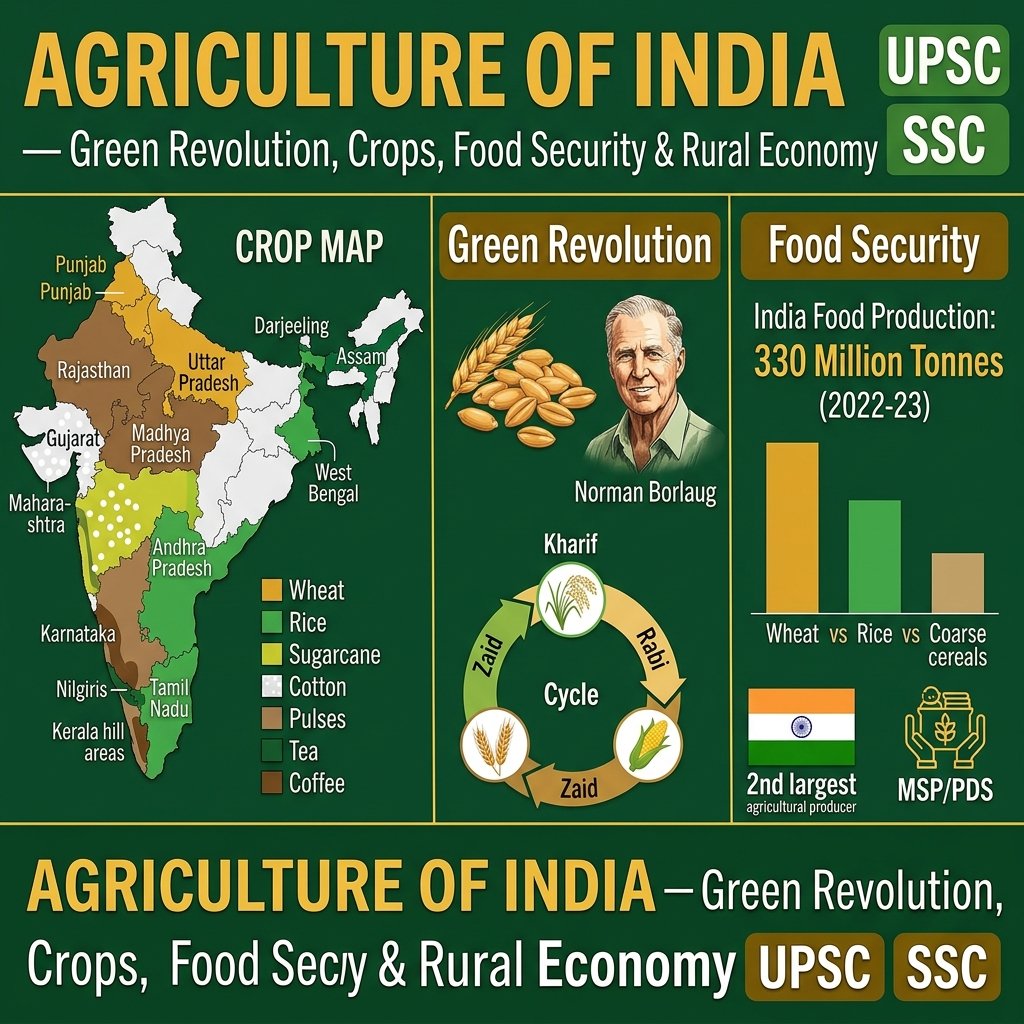
India’s Agricultural Statistics — Overview
| Parameter | Value | Global Context |
|---|---|---|
| Total food grain production (2022–23) | 330.5 million tonnes (MT) | Record high; USA ~350MT but India’s is primarily domestic consumption-driven |
| Net Sown Area | ~140 million hectares | 2nd largest in world after USA; ~42% of India’s total area |
| Irrigated Area | ~68 million hectares | World’s largest irrigated area |
| Share in GDP | ~17–18% (2023) | High for a country of India’s development level; agriculture remains critical |
| Workforce in agriculture | ~42–45% | Declining from 70% (1951) but still very high; disguised unemployment widespread |
| Rice export (2021–22) | ~21 MT = world’s largest rice exporter | India overtook Thailand; exports to 150+ countries |
| Average farm size | 1.08 hectares (2015–16) | Declining; 86% of farmers are small/marginal (<2 ha); primary structural challenge |
| Farmer suicides (2021) | 10,881 (NCRB) | Reflects distress; Maharashtra, Karnataka, Andhra, MP highest; debt + crop failure primary causes |
Agricultural Seasons — Kharif, Rabi & Zaid
| Season | Sowing | Harvest | Water Source | Key Crops | Major Producing States |
|---|---|---|---|---|---|
| Kharif (Autumn / Monsoon) | June–July (with monsoon onset) | September–October | Monsoon rainfall + irrigation | Rice, Maize, Jowar (Sorghum), Bajra (Pearl millet), Cotton, Groundnut, Soybean, Sugarcane (planted; harvested later), Turmeric, Arhar (Pigeon pea) | Rice: WB, UP, AP, TN, Punjab; Cotton: Maharashtra, Gujarat, Telangana; Maize: Karnataka, MP, Bihar |
| Rabi (Winter / Spring) | October–November | March–April | Irrigation (groundwater, canals) + Western Disturbances rain | Wheat (most important Rabi crop), Mustard (Sarson), Barley, Gram (Chickpea = India largest pulses crop), Linseed, Peas, Potato | Wheat: Punjab, Haryana, UP, Bihar, MP, Rajasthan; Mustard: Rajasthan, UP, Haryana, MP |
| Zaid (Summer) | February–March | May–June | Irrigation only (no monsoon) | Watermelon, Muskmelon, Cucumber, Bitter Gourd, Fodder crops, Some vegetables; Moong (green gram) in some areas | UP, Haryana, Punjab, Gujarat — irrigated areas only |
Major Crops of India — Geography & Characteristics
Rice
- 🌾 India’s position: 2nd largest producer (China 1st); world’s largest exporter (21 MT, 2021–22)
- 🌧️ Requirements: High rainfall (150–200cm) or intensive irrigation; high temperature (20–35°C); standing water for 3–4 months; clayey or loamy soils
- 📍 Major producing states: West Bengal (highest production), UP, Punjab, AP, Telangana, Odisha, Chhattisgarh (“Rice Bowl of India”), TN, Assam, Bihar
- 💧 Punjab paradox: Punjab is a major rice producer despite receiving only 600mm annual rainfall — because of extensive canal + tubewell irrigation; but paddy cultivation here is destroying groundwater aquifers (see Water Resources article — Punjab crisis)
- 🍚 Varieties: Basmati (Punjab, Haryana, Uttarakhand foothills = GI tagged; highly aromatic; premium export); IR-36, IR-64 (HYV introduced Green Revolution); BPT 5204 (Sona Masuri, AP-Telangana)
Wheat
- 🌾 India’s position: 2nd largest producer globally (after China); ~108 MT (2022–23 = record)
- 🌡️ Requirements: Cool, dry climate during growing (October–March); 50–75cm rainfall or irrigation; well-drained loamy soils; warm dry weather at harvest (April)
- 📍 Major producing states: Punjab (highest yield per hectare), Haryana, UP (largest area and volume), MP, Rajasthan, Bihar, Uttarakhand
- 🟡 Punjab-Haryana wheat belt = “Granary of India”: These two states together provide ~70% of wheat to the Food Corporation of India (FCI) buffer stock and PDS system — despite covering only ~4% of India’s farming area; highly mechanised with combine harvesters; HYV seeds (Sonalika, Kalyan Sona — introduced Green Revolution)
- ⚠️ Climate risk: March 2022 heat wave shortened grain filling period → wheat yield fell 6–8%; India banned wheat exports; highlights climate vulnerability of the wheat belt
Cotton — “White Gold”
- 🌿 India’s position: World’s largest cotton producer (surpassed China in recent years); ~6.6 million bales (2022–23)
- 🌡️ Requirements: Black cotton soil (Deccan Trap regur) = ideal; semi-arid climate (50–100cm rain); long frost-free season; high temperature at boll opening; well-drained
- 📍 Major states: Maharashtra (Vidarbha = most but also most farmer suicides), Gujarat (highest productivity), Telangana, AP, Karnataka, MP, Punjab-Haryana (irrigated)
- 🧵 Bt Cotton revolution: Bollgard I Bt Cotton introduced in India in 2002; within 10 years, ~95% of India’s cotton area shifted to Bt varieties; pesticide use fell dramatically; yields rose initially; however pink bollworm resistance emerged by 2015–2017; farmer debt + Bt seed costs + credit cycles = underlying factor in Maharashtra cotton farmer suicide crisis
Sugarcane
- 🌿 India’s position: World’s largest producer (surpassed Brazil); ~315 MT sugarcane (2022–23)
- 🌡️ Requirements: Tropical/subtropical climate; 75–150cm rainfall; high temperature; deep rich loamy soils; 12–18 months growing period
- 📍 Major states: Uttar Pradesh (45%+ of India’s production; Muzaffarnagar, Meerut, Shamli belt = “Sugar Belt of India”), Maharashtra (Pune, Nashik, Sangli = highest sucrose recovery), Karnataka, TN, Andhra Pradesh
- ⚠️ Sugar politics: UP’s sugar mills are politically powerful; Fair and Remunerative Price (FRP) for cane set by Centre; State Advised Price (SAP) by UP is usually higher; mills often delay payment to farmers (arrears reaching thousands of crores) = major political issue in UP elections
Pulses — India’s Protein Crisis
- 🫘 India’s position: World’s largest producer AND largest consumer AND largest importer of pulses — India accounts for 26% of world production and 29% of consumption; chronic supply-demand gap
- 📍 Major states: MP (largest — chickpea, lentil, urad); Rajasthan (moong, moth bean); Maharashtra (tur/pigeon pea); AP-Telangana (tur); UP (multiple varieties)
- 🌿 Types: Arhar/Tur (pigeon pea — kharif), Moong (green gram — kharif/zaid), Urad (black gram — kharif), Chana/Gram (chickpea — rabi = India’s largest pulse), Masur (lentil — rabi), Moth bean (Rajasthan)
- ⚠️ Why India imports: Pulses are rain-dependent (mostly dryland), less profitable than rice/wheat under MSP, and yield growth has been slow; chronic domestic shortfall = imports from Canada, Australia, Myanmar, Tanzania
Plantation Crops — Tea, Coffee, Rubber
| Crop | India Rank | Requirements | Major States | Key Facts |
|---|---|---|---|---|
| Tea | 2nd producer (China 1st); 4th exporter | Hot, humid; 150–300cm rain; acidic laterite hill soils; gentle slopes; cool nights for flavour | Assam (55% India’s tea), WB (Darjeeling — premium), Tamil Nadu (Nilgiris), Kerala, HP | Assam = world’s largest single tea growing region; Darjeeling Tea = GI tag (first Indian GI product); “Second flush” Darjeeling = most valued; declining due to climate change (changed monsoon timing) |
| Coffee | 7th largest producer; 3rd largest exporter (after Brazil, Vietnam) | Hot, humid; 150–250cm rain; loamy soils; altitude 900–1,800m; shade-grown under canopy | Karnataka (75% — Coorg/Kodagu, Chikmagalur, Hassan), Kerala (20%), TN (Nilgiris) | Indian coffee = Arabica (60%) + Robusta (40%); Coorg = “Scotland of India” + “Coffee Capital”; unique shade-grown under silver oak and jungle trees; “Monsooned Malabar” = unique sun-dried wet-processed variety prized in Europe |
| Rubber | 4th largest producer | Tropical; >200cm rain; 25–35°C; deep well-drained loamy soils | Kerala (90%+ of India’s rubber), TN, Karnataka, Andaman | Para rubber (Hevea brasiliensis); introduced by British 1876; Kerala rubber planters facing competition from cheaper Southeast Asian imports; NRM (Natural Rubber Mission); synthetic rubber competition |
The Green Revolution — Transformation of Indian Agriculture
- 🌱 Background: In 1943, the Bengal Famine killed 2–3 million people; in 1965–66, back-to-back droughts left India dependent on US PL-480 food aid (“ship-to-mouth” existence); food self-sufficiency was a matter of national survival
- 🌾 What was the Green Revolution? A package of agricultural technology: (1) High Yielding Varieties (HYV) of wheat (Sonalika, Kalyan Sona — developed by Norman Borlaug at CIMMYT; introduced in India by M.S. Swaminathan) and rice (IR-8 = “Miracle Rice”); (2) expanded chemical fertiliser use (urea, DAP); (3) expanded irrigation (tubewells, canals); (4) pesticides; (5) credit and procurement through nationalised banks + MSP + FCI
- 📍 Where? Initially concentrated in Punjab, Haryana, and western UP — wherever irrigation was available and farmers could afford inputs; phases expanded to AP (rice Green Revolution — rice HYV by IRRI/CRRI gave “Green Revolution for rice in AP”)
- 📈 Results: India’s wheat production: 11 MT (1960–61) → 108 MT (2022–23); rice: 35 MT → 135 MT in same period; India became food-self-sufficient by mid-1970s and food exporter by 1980s; M.S. Swaminathan called “Father of Green Revolution in India”; Norman Borlaug received Nobel Peace Prize (1970)
- ⚠️ Negative consequences: Groundwater depletion (Punjab crisis); soil salinization and waterlogging (canal-irrigated areas); monoculture replacing diverse farming systems (loss of millet, pulses from cropping patterns); chemical pollution (pesticide residues in Punjab — “Cancer Train” from Bathinda to Bikaner = cancer clusters linked to pesticide use); income inequality (Green Revolution benefits concentrated in large farmers with land + capital + irrigation access; small farmers and eastern India largely excluded initially); neglect of dryland agriculture in rain-fed areas
Food Security Architecture — MSP, FCI & PDS
- 📋 Minimum Support Price (MSP): Government-announced floor price for 23 crops (Kharif + Rabi); ensures farmers receive minimum price even if market prices fall; announced by Cabinet Committee on Economic Affairs (CCEA) on recommendation of Commission for Agricultural Costs and Prices (CACP); wheat and rice MSP = backbone of India’s food security; controversy: most farmers do not actually benefit from MSP (procurement concentrated in Punjab + Haryana; small farmers, remotely located, lack market access); major demand from farmer protests (2020–21 Farm Laws agitation) for statutory law guaranteeing MSP
- 🏭 Food Corporation of India (FCI): Established 1965; procures wheat and rice from farmers at MSP; maintains buffer stocks (strategic reserve); distributes to states for PDS; operates largest grain storage network in world; godowns across India; criticised for wastage (grain rotting in poorly maintained storage) and high operational costs
- 🏪 Public Distribution System (PDS) / NFSA: National Food Security Act (NFSA) 2013 = legal right to subsidised food grain for ~81 crore (800 million) beneficiaries; Priority Households (PHH): 5 kg rice/wheat/coarse cereal per person per month at ₹1–3/kg (now “free” under PMGKAY — Pradhan Mantri Garib Kalyan Anna Yojana, extended post-COVID); Antyodaya Anna Yojana (AAY) — poorest of poor, 35 kg/month per family at ₹2/kg wheat, ₹3/kg rice
- 🌾 PM-KISAN: Pradhan Mantri Kisan Samman Nidhi (PM-KISAN) 2019 — direct income support ₹6,000/year (₹2,000 per quarter) to all landholding farmer families; ~11 crore beneficiaries; replaces some subsidy channelling
⭐ Important for Exams — Quick Revision
- 🔑 India’s food grain production (2022–23): 330.5 MT = record; 2nd largest net sown area (140 MH); world’s largest irrigated area (68 MH)
- 🔑 3 agricultural seasons: Kharif (June–Oct; rice, cotton, maize, groundnut), Rabi (Oct–Apr; wheat, mustard, gram, barley), Zaid (Feb–Jun; summer vegetables, melon)
- 🔑 Rice: largest exporter (21 MT); WB = highest production; Punjab = highest yield but destroying groundwater; Basmati = GI tagged (Punjab, Haryana, Uttarakhand foothills)
- 🔑 Wheat: 2nd globally; 108 MT record (2022–23); Punjab = highest yield; UP = largest area; “Granary of India” = Punjab + Haryana supply 70% FCI procurement
- 🔑 Cotton = “White Gold”; Black cotton soil (regur) = ideal; Maharashtra Vidarbha = most area but highest farmer suicides; Gujarat = highest productivity; Bt Cotton 95% coverage from 2012
- 🔑 Sugarcane: World’s largest producer (surpassed Brazil); UP = 45% India’s production; Maharashtra = highest sucrose recovery; FRP vs SAP controversy in UP
- 🔑 Pulses: India = largest producer + consumer + importer; chronic deficit; MP = largest state; Chickpea (Chana) = largest pulse crop in India; imported from Canada, Australia, Myanmar
- 🔑 Tea: Assam = 55% India production; Darjeeling Tea = first Indian GI product; Nilgiris (TN) + Kerala important
- 🔑 Coffee: Karnataka = 75%; Coorg/Kodagu = “Coffee Capital”; Monsooned Malabar = unique variety; India = 3rd largest coffee exporter
- 🔑 Green Revolution: HYV seeds (Norman Borlaug/Swaminathan) + fertilisers + irrigation + MSP + FCI; 1965–1970s; Punjab-Haryana-western UP; wheat self-sufficiency by 1970s; M.S. Swaminathan = “Father of Green Revolution India”; negative: groundwater, soil salinity, pesticides (“Cancer Train” Bathinda), monoculture, inequality
- 🔑 MSP: 23 crops; set by CACP; announced by CCEA; controversy = only Punjab/Haryana farmers benefit from procurement; 2020–21 Farm Laws agitation demanded statutory MSP guarantee
- 🔑 NFSA 2013: Subsidised food to 800 million; PMGKAY (free grain post-COVID); Antyodaya (poorest − 35 kg/month); FCI = procurement and buffer stocks
- 🔑 Average farm size: 1.08 hectares; 86% small/marginal farmers; disguised unemployment = excess labour in agriculture
- 🔑 Farmer suicides: 10,881 (2021 NCRB); Maharashtra, Karnataka worst; debt + crop failure + price crash = causes; Vidarbha, Marathwada worst regions
Frequently Asked Questions (FAQs)
1. What is the “Cancer Train” from Bathinda — and how did the Green Revolution cause it?
The “Cancer Train” (officially the Bathinda-Bikaner Express) earned its grim nickname because of the extraordinary number of cancer patients who board it daily from Malwa region (south Punjab) to travel to Acharya Tulsi Regional Cancer Treatment & Research Institute in Bikaner, Rajasthan — one of the few affordable cancer treatment centres in the region. Studies by the Post-Graduate Institute of Medical Education & Research (PGIMER, Chandigarh) have documented cancer rates in Malwa (southern Punjab districts like Bathinda, Mansa, Muktsar, Ferozpur) that are 2–3x higher than national averages for specific cancers — particularly cancers of the brain, liver, kidney, stomach, and cervix. The Green Revolution connection is multidimensional: (1) Pesticide overuse: The Green Revolution’s HYV crops required protection from pests that traditional varieties were more resistant to. Farmers, with little training and strong marketing pressure from agrochemical companies, applied pesticides far in excess of recommended doses. Punjab uses ~67,000 tonnes of pesticides annually — among the highest in India despite being a small state. Many organochlorine pesticides (DDT, endosulfan, aldrin) used in the 1970s–90s are now banned but persist in soil and groundwater. (2) Contaminated groundwater: Pesticides, fertiliser nitrates, and heavy metals (arsenic, uranium — naturally occurring in sub-Himalayan sediments but mobilised by pump extraction) have contaminated Punjab’s tubewell water. Studies found nitrate levels 5–10x WHO safe limits in several villages; uranium in groundwater at 2–3x WHO guidelines in Bathinda and Faridkot districts. (3) Fertiliser residues: Excess nitrogen fertilisation creates nitrates in groundwater; nitrates convert to nitrosamines (carcinogenic) in the body. The National Green Tribunal (NGT) has repeatedly ordered Punjab government to address groundwater contamination; the Central Ground Water Board has confirmed elevated heavy metal levels. India’s agrochemical regulation regime has been widely criticised: many pesticides banned by the EU and USA continue to be sold legally in India; regulatory enforcement is weak. The Cancer Train remains a powerful and tragic symbol of how an agricultural success story created long-duration health tragedy in the very communities that drove India’s food revolution.
2. Why do Indian farmer suicides persist despite food security programmes — and what would actually fix it?
India has recorded over 300,000 farmer suicides between 1995 and 2022 — approximately 10,000–12,000 per year. This persistent crisis, despite multiple government programmes, reveals the structural nature of agricultural distress. The proximate triggers are remarkably consistent across studies: crop failure (due to drought, flood, or pest) combined with a debt burden that makes crop failure existential — a farmer who has borrowed ₹2–5 lakh against his 3-acre field for seeds, fertiliser, pesticides, and irrigation, then loses the crop, faces not just financial loss but social humiliation and predatory moneylender interest (typically 24–60% per year). The structural causes are deeper: (1) Extreme market price volatility: A good harvest that doubles production can halve the price, leaving farmers worse off than a poor harvest. Onion, tomato, and potato prices oscillate 500–1,000% within months; MSP protects wheat/rice but not most horticultural crops. (2) Input cost inflation: Seeds (especially hybrid/Bt), fertiliser, pesticide, diesel for pump-sets, and labour costs rise steadily; output prices are far more volatile. The “cost-price squeeze” steadily erodes farming viability. (3) Credit market failure: Only ~30–35% of farmers access institutional credit (banks, cooperatives); the majority depend on moneylenders, input dealers, and traders who provide credit at usurious rates in exchange for crop purchase rights at below-market prices. (4) Small farm sizes: India’s average 1.08 hectare farm simply cannot generate liveable income from agriculture alone at current productivity and price levels; consolidation is politically impossible because land is not just an economic asset but social identity (especially for SC/ST communities who received land under land reforms). What would actually fix it? Agricultural economists consistently point to: price deficiency payments (government pays farmers the difference between market price and MSP — eliminates the procurement geography problem); crop insurance reform (PM Fasal Bima Yojana has major implementation failures); rural non-farm employment expansion (farm income supplemented by MGNREGS, agro-processing); farmer producer organisations (FPOs) — groups of 500–1,000 farmers pooling resources for collective bargaining and direct market access; and ultimately, reducing agriculture’s share of workforce through rural industrialisation and skill development — so that each farmer has a larger, more viable holding.
3. What were the 2020–21 Farm Laws and why did farmers protest against them for over a year?
The Three Farm Laws of September 2020 were landmark agricultural legislation passed by the NDA government that triggered India’s largest and longest-sustained protest movement since Independence — the Farmers’ Protest of 2020–2021, centred at Delhi’s borders, primarily led by Punjab and Haryana farmers. The three laws were: (1) The Farmers’ Produce Trade and Commerce (Promotion and Facilitation) Act — allowed farmers to sell outside the APMC (Agricultural Produce Market Committee) mandis (regulated markets) to any buyer anywhere in India; (2) The Farmers (Empowerment and Protection) Agreement on Price Assurance and Farm Services Act — provided a framework for contract farming agreements between farmers and companies; (3) The Essential Commodities (Amendment) Act — removed onion, potato, cereals, pulses, oilseeds, and edible oils from Essential Commodities Act restrictions on stockholding, removing stockpiling limits. The government’s stated intention was to liberalise agricultural markets, reduce the APMC “middlemen,” allow farmers to sell at better prices to directly to processors and retailers, and encourage private investment in agricultural infrastructure and contract farming. Why farmers (especially from Punjab-Haryana) opposed: The core fear was the erosion of the MSP+FCI+APMC mandi system. Punjab and Haryana farmers benefit enormously from the current system — the government purchases essentially their entire wheat and rice output at guaranteed MSP through an extensive network of mandis. If private buyers (Reliance, Adani food businesses were specifically named in farmer rhetoric) could buy from outside mandis, the argument ran, competition would weaken — and ultimately — the mandi system, leaving small farmers negotiating alone against corporate buyers with far more information and market power. Farmers demanded a statutory guarantee of MSP for all crops as a precondition for accepting any liberalisation. Despite multiple rounds of talks between the government and farmer unions (BKU UG and 40+ unions coordinated under Samyukta Kisan Morcha), no agreement was reached. After over 13 months of protest and with Punjab assembly elections approaching, PM Modi announced the repeal of all three laws in November 2021 — a rare capitulation by the government on major economic legislation. A government committee on MSP guarantee was constituted but has not concluded by 2025–26.
Related Geology Articles on StudyHub
- ➡️ Water Resources — Irrigation Systems Supporting Agriculture
- ➡️ Soil Types India — Alluvial, Black Regur, Laterite Soils & Crops
- ➡️ Indian Monsoon — Lifeline of Indian Agriculture
- ➡️ Natural Disasters — Droughts, Floods & Agricultural Losses
- ➡️ Climate Change — Threat to Indian Agriculture