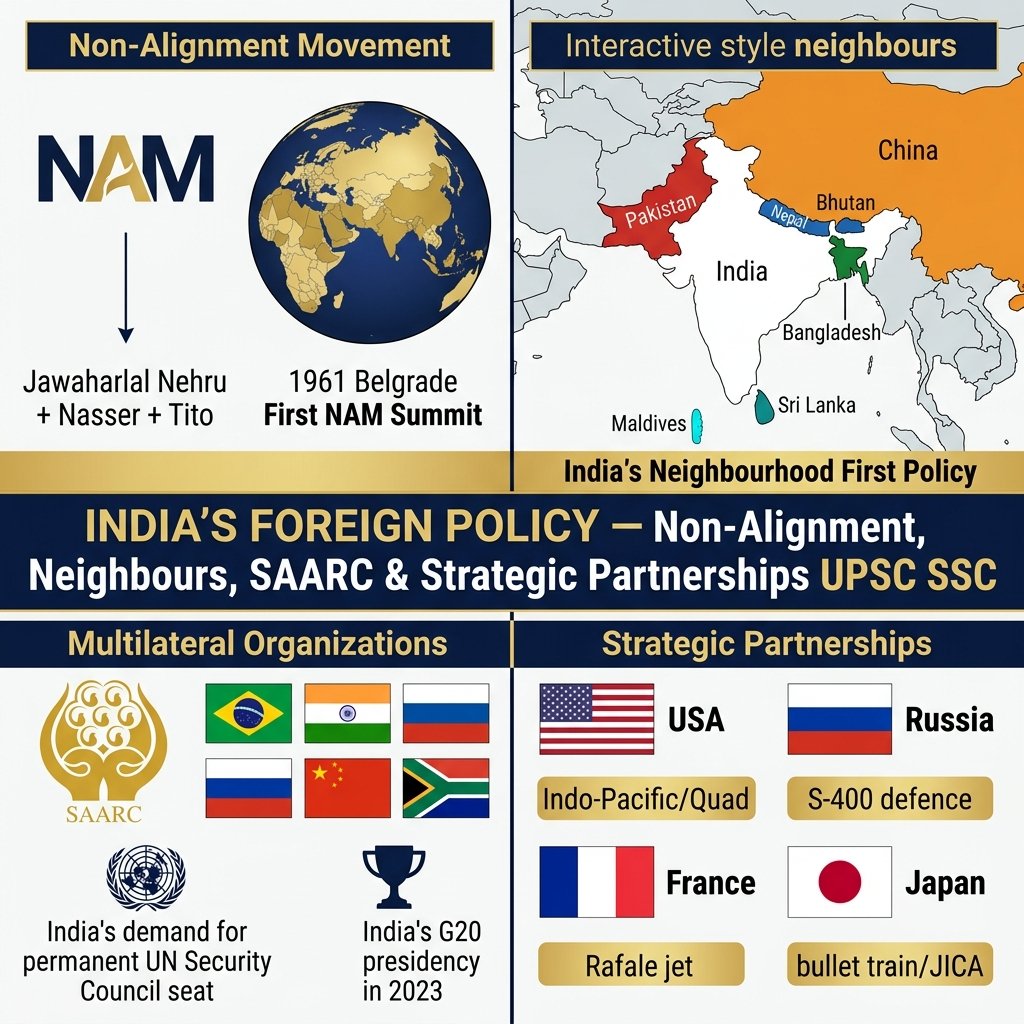
India’s foreign policy is one of the most distinctive in the world — shaped by its civilisational heritage, colonial experience, geostrategic position at the crossroads of Asia, and the unique challenge of managing relationships with nuclear-armed neighbours while simultaneously engaging every major power. From Jawaharlal Nehru’s foundational doctrine of Non-Alignment — refusing to join either the US-led Western bloc or the Soviet-led Eastern bloc during the Cold War — to Narendra Modi’s “Strategic Autonomy” and “Neighbourhood First Policy,” India has consistently sought to preserve its freedom of action in a multipolar world. India’s neighbourhood is arguably the world’s most complex: sharing borders with China (territorial disputes across 3,488 km), Pakistan (armed conflict, nuclear standoff, cross-border terrorism), Bangladesh (the world’s most densely populated nation and major trade partner), Nepal (cultural and water-sharing ties), Bhutan (defence relationship), Sri Lanka (Tamil minority issues), and Myanmar (border instability). Understanding India’s foreign policy principles, bilateral relationships, multilateral engagements, and strategic partnerships is essential for UPSC, SSC, and all competitive examinations.
Foundational Principles of India’s Foreign Policy
| Principle | Meaning | Constitutional Basis / Origin |
|---|---|---|
| Panchsheel (Five Principles of Peaceful Coexistence) | Mutual respect for territorial integrity; non-aggression; non-interference in internal affairs; equality and mutual benefit; peaceful coexistence | Signed India-China (1954 Nehru-Zhou Enlai); embedded in DPSP Article 51; basis of NAM |
| Non-Alignment | Independent foreign policy not aligned to any power bloc; freedom to judge each issue on merits | Nehru doctrine; Cold War context (1947-1991); NAM founded 1961 Belgrade; India played founding role |
| Strategic Autonomy | Modern evolution of Non-Alignment; multi-alignment — engaging USA, Russia, China simultaneously; refusing to be bound by any single partner | Modi-era term; reflects India’s increased power and confidence; enables S-400 from Russia + F-35 dialogue with USA simultaneously |
| Vasudhaiva Kutumbakam | “The World is One Family” — Sanskrit phrase from Maha Upanishad; India’s G20 2023 Presidency motto; reflects India’s civilisational approach to global engagement | G20 2023 India Presidency; New Delhi Declaration adopted; represents soft power projection through cultural heritage |
| South-South Cooperation | India as leader of developing world; technology, capacity, and knowledge sharing with Global South through ITEC (Indian Technical and Economic Cooperation) and IAFS (India-Africa Forum Summit) | Non-aligned legacy; India as “Vishwaguru” (World Teacher) in development cooperation |
| Neighbourhood First Policy | Prioritising SAARC neighbours through connectivity, trade, development assistance; India as preferred partner before China | Modi government (2014 onwards); all 8 SAARC leaders invited to 2014 inauguration; Indian Line of Credit to neighbours |
Non-Alignment Movement (NAM)
- 🌍 Founded: September 1961, Belgrade (Yugoslavia); founding leaders: Jawaharlal Nehru (India), Gamal Abdel Nasser (Egypt), Josip Broz Tito (Yugoslavia), Kwame Nkrumah (Ghana), Sukarno (Indonesia) = the “5 Founding Fathers” of NAM
- 🌍 Membership: 120 member states (2023) = world’s largest political grouping after UN; mainly developing nations of Asia, Africa, Latin America
- 📋 Key NAM principles: No military alliances with great powers; no foreign military bases on territory; peaceful resolution of disputes; decolonisation and anti-imperialism; right to self-determination; support for UN Charter
- ⚠️ Criticism of Indian NAM: India signed Indo-Soviet Treaty of Peace, Friendship and Cooperation (1971) — critics argued this was alignment with USSR; India justified it as defensive necessity during Bangladesh Liberation War (to deter US-China pressure); India voted with USSR far more than USA in UN during Cold War; NAM was effectively “non-alignment, but closer to Soviet positions”
- 🔄 Post-Cold War relevance: With USSR collapse (1991), NAM lost its original anti-bloc rationale; India shifted to economic engagement, distancing from traditional NAM positions; “Multi-alignment” or “Strategic Autonomy” replaced formal NAM doctrine; however India remains NAM member and hosts summits
India’s Bilateral Relations — Neighbours
India-China Relations
- 🇨🇳 “Hindi-Chini Bhai-Bhai” to Galwan (2020): Relations began with Panchsheel (1954) and friendship (“Hindi-Chini Bhai-Bhai”); collapsed with 1962 Sino-Indian War (China captured Aksai Chin; Indian army retreat; national trauma still shapes India-China diplomacy)
- 🗺️ Border disputes: 3,488 km LAC (Line of Actual Control) — not clearly demarcated; three sectors disputed: Western Sector (Aksai Chin — India claims but China administers; CPEC through Pakistan-Occupied Kashmir = India objects); Middle Sector (relatively quiet, Sikkim-Arunachal); Eastern Sector (Arunachal Pradesh — China calls it “South Tibet”, disputes 90,000 km²)
- ⚔️ Galwan Valley clash (June 2020): First combat deaths on India-China border since 1975; 20 Indian soldiers killed (official count); Chinese casualties not officially disclosed (Indian government estimated ~35–45); triggered by Chinese infrastructure buildup blocking Indian patrol points; India banned 200+ Chinese apps (TikTok, PUBG etc.); FDI from China restricted
- 🤝 Economic paradox: Despite military tensions, China is India’s largest trading partner in goods (~$136 billion bilateral trade, 2022–23); India runs massive trade deficit (~$83 billion) with China; core Indian imports from China: electronic goods, machinery, chemicals, APIs (pharmaceutical raw materials) — India structurally dependent on Chinese supply chains even while strategically competing
- 💰 Disengagement (2022–2024): After Galwan, both sides gradually pulled back troops at multiple friction points (Gogra-Hot Springs, Depsang Plains); India-China normal diplomatic engagement partially resumed; but LAC remains tense and additional infrastructure buildup continues on both sides
India-Pakistan Relations
- 🇵🇰 Wars and conflicts: 1947 (Partition war, J&K accession); 1965 (Operation Gibraltar); 1971 (Bangladesh Liberation War — India’s decisive victory, creation of Bangladesh, India’s finest military-diplomatic operation); 1999 (Kargil War — Pakistan regular army occupied Kargil heights; India dislodged; Pakistan withdrew under US pressure)
- 💣 Nuclear dimension: Both nations are nuclear-armed (India tested 1974 “Smiling Buddha” = first; 1998 Pokhran-II full weaponisation; Pakistan tested 1998 Chagai hills); India’s No First Use (NFU) nuclear doctrine vs Pakistan’s ambiguous first-use posture = significant strategic asymmetry
- 🌊 Indus Waters Treaty (1960): Brokered by World Bank; India gets Eastern rivers (Ravi, Beas, Sutlej); Pakistan gets Western rivers (Indus, Jhelum, Chenab); survived all three wars; called “one of the world’s most successful water treaties”; India threatened review post-Pulwama (2019) terror attack
- 💬 Current state: Relations effectively frozen since Pulwama attack (February 2019) — India declared Pakistan-based Jaish-e-Mohammed responsible for suicide bombing killing 40 CRPF personnel; India conducted Balakot airstrike (India’s first peacetime airstrike inside Pakistan since 1971); Pakistan revoked India’s MFN status; trade halted; High Commissioners recalled. Article 370 abrogation (August 2019) further deteriorated relations. No bilateral trade, no diplomatic engagement at meaningful level as of 2025–26.
India’s Other Neighbours — Summary
| Neighbour | Key Issue / Partnership | Status |
|---|---|---|
| Bangladesh | Teesta River water sharing; Rohingya refugee pressure; connectivity (India transit to Northeast); India’s largest neighbour for trade in South Asia; Hasina government removed Aug 2024 | Complex partnership; student revolution ousted Hasina Aug 2024; interim government; India’s strategic influence reduced temporarily |
| Nepal | Open border; Gorkha soldiers in Indian Army; Lipulekh-Kalapani boundary dispute; China’s BRI influence growing; Madhesi community rights | Formally friendly but episodic tensions; Nepal increasingly balancing India-China; new India-Nepal Power Trade Agreement valuable |
| Bhutan | India provides defence security + economic assistance; Doklam standoff (2017) — China-Bhutan-India tri-junction; India mediates Bhutan-China border talks | Strongest alliance in India’s neighbourhood; India-Bhutan Friendship Treaty 2007; geopolitically critical (Chicken’s Neck corridor) |
| Sri Lanka | Tamil minority rights (historical); 2022 economic crisis — India’s $4 billion assistance; China-Sri Lanka debt-trap (Hambantota Port 99-year lease to China); India’s Adani won energy contracts 2023 | Strategic importance growing; India provided $4B+ during 2022 economic crisis vs China’s debt-restructuring delays; India-Sri Lanka energy grid link planned |
| Maldives | “India Out” campaign (Muizzu govt elected 2023); India’s military personnel asked to leave; China ties deepening; India supplies 70% of food imports to Maldives | Strained under Muizzu; India replaced military with civilian personnel; economic dependency on India remains regardless of politics |
| Myanmar | 2021 military coup; insurgency spillover into Mizoram-Manipur; India’s Kaladan Multimodal Project; ASEAN connectivity gateway for Northeast India | Difficult — India must engage military junta for border security while managing ASEAN pressure; ethnic Chin refugees in Mizoram |
Multilateral Engagements
| Forum | India’s Role | Key Issues / Achievements |
|---|---|---|
| United Nations (UN) | Founding member (1945); 5th largest troop contributor to UN Peacekeeping (80,000+ troops deployed since 1950s); strong advocate for UNSC reform; demands Permanent membership | India demands UNSC reform (P5 + new permanent members including India, Brazil, Germany, Japan = G4 proposal); India elected non-permanent member 2021–22; contribution to 49 UN missions |
| SAARC | Founded 1985 (Dhaka); 8 member states; India is largest economy (80% of SAARC GDP); India-Pakistan tensions have effectively paralysed SAARC (no summit since 2016) | SAARC Summit 2016 cancelled after Uri attack; BIMSTEC (Bay of Bengal Initiative) seen as alternative without Pakistan; SAFTA trade agreement underutilised |
| BRICS | BRICS = Brazil, Russia, India, China, South Africa (2009); expanded 2024 to include Saudi Arabia, UAE, Ethiopia, Egypt, Iran, Argentina (some declined); India’s complex position — member with China despite LAC tensions | New Development Bank (NDB) = BRICS development bank headquartered Shanghai; India uses BRICS to advocate for Global South; tensions with China complicate joint statements; Johannesburg 2023 expansion = geopolitical significance |
| G20 | India held G20 Presidency (2022–23); “Vasudhaiva Kutumbakam” theme; New Delhi Declaration (Sep 2023) adopted by consensus despite Russia-Ukraine war divisions | India’s most successful multilateral diplomatic achievement in recent years; hosted 200+ meetings across India; G20 permanent membership for African Union = India’s key push; Global South voice amplification |
| SCO (Shanghai Cooperation Organisation) | Full member since 2017; includes China, Russia, Pakistan, Central Asian states; India joined despite Pakistan presence | Central Asian connectivity via SCO; India promoted Chabahar Port as alternative to CPEC; complex given India-Pakistan and India-China tensions within same forum |
| Quad (Quadrilateral Security Dialogue) | India, USA, Japan, Australia; revived 2017 (Doklam context); Quad Leaders’ Summit since 2021; India resists formalising as military alliance | Focus: free and open Indo-Pacific; COVID vaccine delivery (Quad Vaccine Partnership); technology coordination; critical minerals; cyber security; India insists Quad is not anti-China even as China sees it as containment |
| IBSA | India, Brazil, South Africa trilateral; Global South democracies forum; trade, technology cooperation | Lower profile than BRICS; more values-based dialogue forum |
India’s Strategic Partnerships
- 🇺🇸 India-USA: Designated a “Comprehensive Global Strategic Partnership” (2020); QUAD member; GSOMIA (General Security of Military Information Agreement, 2002); LEMOA (Logistics Exchange Memorandum of Agreement, 2016); COMCASA (Communications Compatibility and Security Agreement, 2018); BECA (Basic Exchange and Cooperation Agreement for Geospatial intelligence, 2020) — four foundational defence agreements signed; US is India’s largest single export destination; $200B+ bilateral trade target; India exempted from some Iran/Russia sanctions; bilateral tensions: trade disputes (data localisation, intellectual property); India’s continued Russia ties (S-400 purchase); immigration (H-1B visa quota debates)
- 🇷🇺 India-Russia: India’s largest defence supplier historically (60%+ of India’s arms imports from Russia over decades); S-400 Triumf missile defence system purchased despite US CAATSA sanctions threat (India received waiver); India buys Russian oil at discounted rates post-Ukraine invasion (2022); historically “tested and trustworthy friendship” (Nehru-Soviet era; 1971 Treaty prevented US-China intervention in Bangladesh war); India abstains in UN votes on Ukraine (does not condemn Russia); India-Russia trade in rupee mechanism; India trying to diversify defence away from Russia (US, France, Israel suppliers growing)
- 🇫🇷 India-France: “Special strategic partnership”; Rafale fighter jet deal (36 jets, ₹59,000 crore, 2016 — highly controversial inter-se pricing/offset dispute); joint naval exercises in Indian Ocean; collaboration in nuclear technology (Jaitapur Nuclear Power Plant — largest planned nuclear plant in world, Maharashtra, using French EPR reactors); France supports India’s UNSC permanent membership seat; French overseas territories in Indian Ocean (Reunion, Mayotte) create common strategic interests
- 🇯🇵 India-Japan: “Special Strategic and Global Partnership”; Japan’s JICA = largest single infrastructure investor in India (Mumbai-Ahmedabad bullet train, Delhi Metro Phase I); Official Development Assistance (ODA) on concessional terms; Japan’s “Free and Open Indo-Pacific” concept aligned with India’s; Quad partner; defence exercises (MALABAR naval exercise with US); Japan investing in India’s northeast states (Act East Policy); cultural ties (Buddhism, Indian philosophy in Japan)
- 🇮🇱 India-Israel: Diplomatic relations normalised 1992 (post-Cold War); now “Strategic Partnership”; Israel = India’s major defence supplier (UAVs, missile systems, surveillance equipment); India abstains or voted with Arab states on Israel at UN historically — now more balanced; India’s large Muslim population creates political sensitivity to overt Israel alignment; trade $10B+; technology cooperation in agriculture, water, cyber
⭐ Important for Exams — Quick Revision
- 🔑 Panchsheel (1954): 5 principles — mutual respect for sovereignty, non-aggression, non-interference, equality, peaceful coexistence; India-China agreement; Article 51 DPSP
- 🔑 NAM founded 1961, Belgrade; 5 founders: Nehru, Nasser, Tito, Nkrumah, Sukarno; 120 member states; India’s creation
- 🔑 Indo-Soviet Treaty (1971) = critics said India violated NAM; India says it was defensive; crucial in Bangladesh war
- 🔑 1962 Sino-Indian War: China captured Aksai Chin; India’s military defeat; still shapes India-China relations
- 🔑 LAC = 3,488 km; three sectors: Western (Aksai Chin), Middle (Sikkim), Eastern (Arunachal = China claims as “South Tibet”)
- 🔑 Galwan Valley clash (June 2020): 20 Indian soldiers killed; first combat deaths since 1975; India banned 200+ Chinese apps
- 🔑 China = India’s largest trading partner ($136B); India runs $83B trade deficit; economic dependence despite strategic competition
- 🔑 India-Pakistan wars: 1947, 1965, 1971 (Bangladesh creation — India’s victory), 1999 Kargil
- 🔑 India’s nuclear doctrine: No First Use (NFU); credible minimum deterrence; Pakistan has first-use posture
- 🔑 Indus Waters Treaty (1960): India = Eastern rivers; Pakistan = Western rivers (Indus, Jhelum, Chenab); World Bank brokered; survived all wars
- 🔑 SAARC founded 1985 Dhaka; 8 members; paralysed since 2016 Uri attack; BIMSTEC = alternative without Pakistan
- 🔑 BRICS (2009): India, Brazil, Russia, China, South Africa; NDB (New Development Bank) in Shanghai; expanded 2024
- 🔑 G20 India Presidency (2022–23): “Vasudhaiva Kutumbakam”; New Delhi Declaration Sep 2023; African Union made permanent G20 member
- 🔑 Quad: India, USA, Japan, Australia; free and open Indo-Pacific; not formal military alliance; Quad Leaders’ Summit annual
- 🔑 4 Foundational Defence Agreements with USA: GSOMIA (2002), LEMOA (2016), COMCASA (2018), BECA (2020)
- 🔑 India-France: 36 Rafale jets; Jaitapur Nuclear Power Plant (EPR); France supports India UNSC seat
- 🔑 India-Japan: Bullet Train JICA funded 88%; Delhi Metro ODA; MALABAR naval exercise; Japan’s largest ODA recipient
- 🔑 Neighbourhood First Policy (2014): SAARC leaders at inauguration; India Line of Credit to neighbours; Sri Lanka $4B crisis relief (2022)
Frequently Asked Questions (FAQs)
1. Why does India buy Russian weapons while also partnering with the USA — and can this continue?
India’s simultaneous purchase of the Russian S-400 Triumf missile defence system ($5.4 billion contract, 2018) while deepening its defence relationship with the United States — to the point of signing all four US foundational defence agreements (GSOMIA, LEMOA, COMCASA, BECA) — is the most visible expression of India’s Strategic Autonomy doctrine. This is not hypocrisy or inconsistency; it is a deliberate policy of multi-alignment designed to maximise India’s freedom of action. Why India retains Russia: Approximately 60–65% of India’s defence equipment inventory (fighter jets = Su-30MKI fleet of 272 aircraft; T-90 battle tanks; warship engines; submarines) is Russian-origin or Russian-licensed. These platforms require Russian spare parts, maintenance support, software upgrades, and ammunition supply chains. A sudden rupture with Russia would effectively ground a substantial portion of India’s air force, degrade tank divisions, and create serious operational readiness problems — not in theory, but operationally. Beyond legacy equipment, the S-400 air defence system (designed to neutralise advanced stealth aircraft and cruise missiles = specifically relevant to India’s threat assessment against Pakistan F-16s and Chinese 5th generation aircraft) represents capabilities India cannot currently source from Western suppliers at equivalent price-to-performance ratio. Moreover, Russia has historically provided technology transfers (licensed production of Su-30MKI, BrahMos cruise missiles jointly developed with India) that neither the USA nor Western Europe offers routinely. India’s strategic culture, shaped by the 1971 Treaty experience when Russia deterred a US carrier group from entering the Bay of Bengal during the Bangladesh war, sees Russia as a crisis-tested reliability factor. Why India deepens US ties: India’s primary long-term strategic challenge is China’s rise — territorial disputes, economic asymmetry, Chinese naval expansion in the Indian Ocean, String of Pearls (Chinese naval access in Gwadar/Pakistan, Hambantota/Sri Lanka, Kyaukpyu/Myanmar). The USA, through Quad, Indo-Pacific Command, and technology sharing (GE-414 jet engine manufacturing partnership signed 2023, for India’s AMCA fighter programme), offers capabilities and strategic balancing against China that Russia cannot. US technology — electronics, semiconductors, defence systems — is also at a different level from Russian equivalents in key domains like radar, communications, and cyber. Can this continue? The tension is real. The US CAATSA law (Countering America’s Adversaries Through Sanctions Act, 2017) mandates sanctions on countries purchasing Russian defence systems — India was granted waivers, but each waiver is a negotiation. As India diversifies its defence procurement (domestic development under DRDO, Israeli UAVs, French Rafales, US C-17/C-130J transport aircraft, P-8I maritime patrol), Russian dependence is slowly declining. The S-400’s integration with US-compatible systems will also be technically complex. The current balance is sustainable for another decade but requires India to steadily build manufacturing capacity and reduce single-source dependence — a process called Atmanirbhar Bharat (Self-Reliant India) in Defence, which is making measurable but slow progress.
2. Is SAARC dead — and is BIMSTEC India’s replacement strategy?
The South Asian Association for Regional Cooperation (SAARC), founded in December 1985 in Dhaka, was conceived as South Asia’s answer to ASEAN — a regional institution that could drive economic integration, trade liberalisation, and connectivity among Bangladesh, Bhutan, India, Maldives, Nepal, Pakistan, Sri Lanka, and Afghanistan (joined 2007). The hope was that economic interdependence would create peace incentives even between India and Pakistan. That hope has been largely unrealised. SAARC has not held a Heads of State Summit since the 18th Summit in Kathmandu (2014) — the 19th Summit scheduled in Islamabad (2016) was called off after India announced it would not attend, following the Uri attack (September 2016) in which Pakistan-based militants killed 19 Indian Army soldiers. No summit in 10 years is effectively functional paralysis for any regional organisation. The fundamental structural problem is India-Pakistan — no meaningful SAARC integration can occur when its two largest economies are in a state of near-total antagonism. SAARC’s consensus rule means Pakistan can veto any connectivity, trade, or transport agreement that India advances; in practice, South Asia has among the world’s lowest intra-regional trade as a share of total trade (less than 5%) despite geographic proximity, shared languages, and cultural ties. BIMSTEC (Bay of Bengal Initiative for Multi-Sectoral Technical and Economic Cooperation) — India, Bangladesh, Bhutan, Nepal, Sri Lanka, Myanmar, Thailand — is increasingly positioned as SAARC’s functional replacement because it excludes Pakistan while retaining India’s major neighbourhood partners plus Myanmar and Thailand (giving it ASEAN connectivity). India has prioritised BIMSTEC Summits (Kathmandu 2018, Colombo 2022), designated priority sectors (trade, technology, energy, transport, tourism, fisheries, people-to-people), and advanced the BIMSTEC Motor Vehicle Agreement and BIMSTEC Power Grid Interconnection. However, BIMSTEC is still a relatively young institution (founded 1997, formally BIMSTEC 2004) with limited secretariat capacity and no free trade agreement yet. For India, the most productive bilateral relationships in the neighbourhood — Bangladesh (power trade, transit), Nepal (hydropower, open border), Bhutan (defence, electricity imports) — are managed bilaterally rather than through multilateral architecture. The honest assessment: SAARC is clinically dead as a functional institution; BIMSTEC is growing but not yet a transformative regional framework; India’s most effective regional policy is bilateral engagement, infrastructure investment (development finance through EXIM Bank and Lines of Credit), and connectivity projects (Kaladan Multimodal Myanmar, Bangladesh-Bhutan-India-Nepal Motor Vehicles Agreement, diesel and LPG pipelines to Nepal/Bangladesh).
3. What is India’s position in the Russia-Ukraine war — and why does India refuse to condemn Russia?
India has maintained a consistent policy of abstention on all major UN votes condemning Russia’s invasion of Ukraine since February 24, 2022 — including the March 2022 UN General Assembly resolution demanding Russian withdrawal (143 countries voted for; India, China, and 33 others abstained) and subsequent votes. India has not condemned Russia in any bilateral or multilateral statement. This position has generated significant criticism from Western nations and praise (or at minimum understanding) from the Global South. India’s position rests on several distinct arguments. The historical/principled argument: India argues for the primacy of dialogue and diplomacy — consistent with its Non-Alignment and Strategic Autonomy tradition. India emphasises that it does not recognise “certain countries’ use of force” (a carefully worded phrase that acknowledges concern without naming Russia) and calls for respect for UN Charter principles including territorial integrity and sovereignty. The strategic interest argument: India’s weapons and energy dependencies on Russia (S-400, Su-30 fleet, discounted oil at $20-30 below market price) mean that antagonising Russia carries concrete national security costs. India imported approximately $46 billion of Russian oil in 2023–24 — at a discount of $10–20/barrel — generating very significant savings for its import bill (India is the world’s 3rd largest oil importer). This financial and strategic dependency is not eliminable in the short term. The Global South solidarity argument: India increasingly frames its position as representing the interests of developing nations who do not see Ukraine as their primary conflict — who are more immediately affected by food price inflation (Black Sea grain routes disruption), fertiliser shortages (Belarus and Russia supply 40% of global potassium fertilisers), and energy cost increases caused by the war and Western sanctions. India’s External Affairs Minister S. Jaishankar articulated this memorably: “Europe’s problems are not the world’s problems, but the world’s problems are Europe’s problems.” The anti-coercion argument: India explicitly rejects pressure to take sides — ministers have stated publicly that India will decide its positions based on Indian national interests, not Western expectations. This assertion of independent judgement is central to India’s Strategic Autonomy brand. PM Modi’s role: PM Modi met Putin in July 2024 (Moscow visit) in what was controversial timing; PM Modi also met Zelensky in August 2024 (Kyiv visit) — signalling India’s attempt at active mediation. India has consistently called for ceasefire, humanitarian corridors, and dialogue, though with limited concrete impact on the conflict.
Related Geology Articles on StudyHub
- ➡️ Physiographic Divisions — The Geography of India’s Borders
- ➡️ Human Development — India’s Soft Power Foundation
- ➡️ Transport India — Strategic Connectivity with Neighbours
- ➡️ Industries India — Economy Behind Foreign Policy
- ➡️ Natural Disasters — Regional Cooperation for Disaster Response