Food security — defined by the 1996 World Food Summit as the condition when “all people, at all times, have physical and economic access to sufficient, safe and nutritious food that meets their dietary needs and food preferences for an active and healthy life” — is India’s most complex and politically sensitive governance challenge. India is simultaneously one of the world’s top 3 agricultural producers (producing 330 million tonnes of foodgrains in 2022–23, a historic record), a country that runs the world’s largest food subsidy programme (PDS covering ~81 crore beneficiaries, spending Rs 2 lakh+ crore annually), and yet one that ranks 111th out of 125 countries in the Global Hunger Index 2023 — lower than Bangladesh (81st) and Nepal (69th). Understanding why India produces so much food yet cannot eliminate hunger requires grappling with the intersection of agricultural policy, procurement economics, storage infrastructure, distribution logistics, nutritional science, and political economy of subsidies. The key institutions and policies — FCI, MSP, PDS, NFSA 2013, PMGKAY, POSHAN Abhiyan — form the architecture of India’s food security system and are essential knowledge for UPSC, SSC, and all competitive examinations.
India’s Food Production — The Supply Side
- 🌾 Record production: India produces ~330 million tonnes (MT) of total foodgrains (2022–23) — 1st globally in rice (195 MT), 2nd in wheat (112 MT, after China), 1st in pulses (27 MT), 1st in millet (12 MT), 1st in sugarcane; total agriculture + allied sector = 18.6% of India’s GDP (2023–24) but employs ~46% of workforce — one of the largest structural imbalances in any major economy
- 🌾 Green Revolution legacy: India was a heavily food-deficit nation in the 1960s relying on US PL-480 food aid (“ship to mouth” existence); the Green Revolution (1966–68 onwards) — introduction of High Yielding Variety (HYV) seeds (IR-8 rice from IRRI, CIMMYT wheat varieties), chemical fertilisers, tube-well irrigation in Punjab-Haryana-western UP — transformed India from food-deficit to food-surplus in wheat and rice within a decade; Norman Borlaug (Nobel Prize 1970) + M.S. Swaminathan (Father of India’s Green Revolution) were architects; by 1980s India became a net food exporter
- 🌾 Structural problems persist: Green Revolution benefited only Punjab, Haryana, Western UP (irrigated belt) and only wheat + rice; 23 other state agricultural systems and crops like coarse cereals, pulses, oilseeds saw minimal Green Revolution benefit; Eastern India (Bihar, Jharkhand, Odisha, WB) with richest soil and rainfall remains food-insecure due to irrigation deficit, land fragmentation, and poor market access; India’s per-capita foodgrain availability (actual consumption availability = ~510 grams/day) is adequate calorically but nutrition per capita is severely deficient in protein (pulses at 45g/day vs recommended 80g), micronutrients (Vitamin A, D, B12, Iron, Zinc) and dietary diversity
MSP — Minimum Support Price
- 📊 What is MSP: Minimum Support Price = price announced annually by CCEA (Cabinet Committee on Economic Affairs) at which the Government of India (through FCI and state agencies) commits to purchase (procure) foodgrains from farmers; MSP is set for 23 crops — 14 kharif crops (paddy, jowar, bajra, maize, ragi, arhar, moong, urad, cotton, groundnut, sunflower, soyabean, sesame, nigerseed), 5 rabi crops (wheat, barley, gram, masur, rapeseed/mustard), 2 commercial crops (jute, copra), and VCF (fair average quality toria); MSP is India’s most politically sensitive agricultural policy instrument
- 📊 How MSP is calculated: CACP (Commission for Agricultural Costs and Prices) recommends MSP based on: A2 costs (actual paid-out costs: seeds, fertilisers, hired labour, irrigation, machine rental) + FL costs (imputed value of family labour) + C2 costs (A2+FL + imputed rent on owned land + imputed interest on owned capital); the Swaminathan Commission (2004–06) recommended MSP = at least 50% above C2; PM Modi government announced in Budget 2018 that MSP would be set at “1.5 times cost of production” — implemented for most crops
- 📊 The MSP paradox: Even though MSP is announced for 23 crops, actual procurement at MSP happens overwhelmingly only for wheat and rice (for the PDS buffer stock); for most other crops (pulses, oilseeds, millets), if market prices fall below MSP, farmers have no guarantee of government purchase; thus MSP for 21 of 23 crops is effectively a notional price, not an enforceable right; the 2020–21 Farm Laws controversy centred partly on farmers’ demand for a legal guarantee of MSP as a justiciable right — which the repealed laws did not provide; the Swaminathan Commission had recommended this in 2006
- 📊 Punjab-Haryana procurement dominance: Punjab contributes ~30–35% of all rice sent to PDS and ~25–30% of all wheat procured nationally; Haryana contributes ~15% each for wheat and rice; this is not because Punjab-Haryana produce the most food (they don’t — UP is India’s largest wheat and rice producer) but because their mandis (wholesale markets) are linked to the FCI procurement system, while UP/Bihar mandis are not; this geographic concentration of procurement creates food security risk (APMC reforms controversy) and distorts Punjab’s agriculture by financially incentivising rice cultivation in water-scarce areas
FCI — Food Corporation of India
- 🏭 Establishment: Founded January 14, 1965 under Food Corporations Act 1964; HQ New Delhi; established to overcome the food shortages of the 1960s; state-owned enterprise under Ministry of Consumer Affairs, Food & Public Distribution; world’s largest grain procurement and management agency
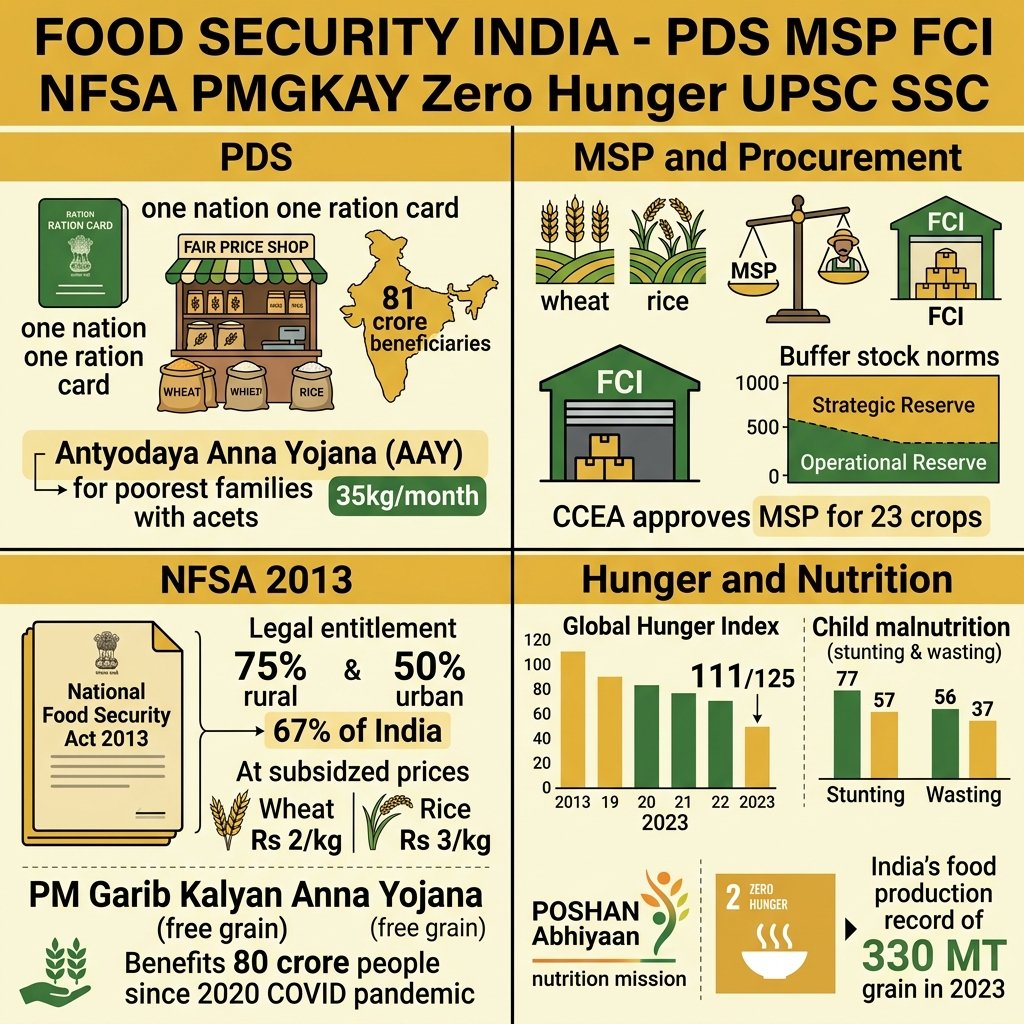
- 🏭 Three functions: (1) Procurement — purchases wheat and rice from farmers at MSP through mandis and registered procurement points in cooperation with state agencies (HAFED in Haryana, MARKFED in Punjab, agencies in MP, Odisha, Chhattisgarh etc.); procures ~80–90 million MT wheat + rice annually in recent years; (2) Storage — maintains grain stock in 1,400+ depots/warehouses across India with total capacity of 81 million MT (combination of FCI-owned and hired/rented private warehouses); manages buffer stock norms set by GOI; (3) Distribution — delivers grain to state governments for distribution through the PDS network of 5.3 lakh fair price shops
- 🏭 Buffer stock norms: GOI sets quarterly buffer stock norms = minimum grain that must be maintained in FCI stocks for food security; norms (April 2021) = Wheat: April 1 = 7.46 MT; July 1 = 26.20 MT; October 1 = 20.52 MT; January 1 = 13.79 MT; Rice: April 1 = 13.54 MT; July 1 = 7.61 MT; October 1 = 20.52 MT; January 1 = 11.22 MT; strategic reserve = 2 MT wheat + 1 MT rice at all times (above buffer norm); actual FCI stocks frequently far exceed norms — causing storage crisis (grain rotting) in good harvest years
- 🏭 FCI losses and reform: FCI incurs massive losses: procurement at MSP (above market price) + storage costs (Rs 500–700/MT/month in hired godowns) + transit losses (rat, moisture, pilferage = 0.36% officially recognised, actual may be higher) + inefficient distribution logistics = FCI’s annual subsidy requirement was ~Rs 1.5–2 lakh crore before PMGKAY free grain began; Shanta Kumar Committee (2015) recommended sweeping FCI reforms including decentralised procurement (states procure directly), direct benefit transfer (DBT) instead of grain distribution, and reduction of NFSA coverage from 67% to 40% of population — mostly not implemented due to political sensitivity
PDS — Public Distribution System
- 🏪 History: PDS originated during World War II rationing (1939); expanded post-Independence; restructured as Targeted PDS (TPDS) in 1997 targeting Below Poverty Line (BPL) families specifically at lower prices vs Above Poverty Line (APL) at near-market prices; TPDS problems = BPL identification errors enormous (leakage = non-poor getting BPL cards; exclusion = poor not getting BPL cards); 2011 Supreme Court direction + NFSA 2013 shifted basis from BPL/APL to NFSA beneficiary lists
- 🏪 NFSA 2013 (National Food Security Act): Most significant food policy legislation since Independence; signed September 12, 2013; 75% of rural population + 50% of urban population (total ~67% of India = ~81 crore persons) have a legal entitlement to subsidised foodgrains: Priority Households (PH) = 5 kg/person/month at Rs 2/kg wheat, Rs 3/kg rice, Rs 1/kg coarse cereals; Antyodaya Anna Yojana (AAY = the poorest of poor) = 35 kg/household/month at same subsidised prices; NFSA made food entitlement a legal right — states must provide grain or pay food security allowance
- 🏪 PM Garib Kalyan Anna Yojana (PMGKAY): Launched April 2020 during COVID-19 lockdown; provided additional 5 kg free grain per person per month (over and above NFSA entitlement) to all 81 crore NFSA beneficiaries; extended multiple times; from January 2023: PMGKAY merged with NFSA = all 81 crore NFSA beneficiaries now get grain completely free (zero cost) for 5 years (until January 2028); cost to Centre = Rs 2 lakh crore+ annually; largest free food programme in human history
- 🏪 One Nation One Ration Card (ONORC): Launched 2019; allows any NFSA beneficiary to access their PDS grain entitlement from ANY fair price shop in India (not just their home state); critical for migrant workers (35 crore+ internal migrants who previously could access PDS only in their home state); operationalised across all 36 states/UTs by 2021; uses Aadhaar-based biometric authentication at FPS
- 🏪 PDS leakage: Despite technology interventions, PDS leakage (grain diverted to open market instead of reaching beneficiaries) was estimated at 40–47% nationally (Economic Survey 2015–16); states with worst leakage: Bihar, Jharkhand, UP (traditionally); states with best performance: Tamil Nadu (universal PDS pre-NFSA, computerised, near-zero leakage), Chhattisgarh (digitised FPS, CCTV, GPS tracking), Himachal Pradesh. Digitisation of ration cards, Aadhaar-linking, electronic point-of-sale (ePoS) at FPS = key reform; leakage estimated to have dropped to ~20–25% nationally by 2021 (DBT and technology improvements)
Global Hunger Index — India’s Paradox
| GHI Year | India Rank | Score | Key Issues |
|---|---|---|---|
| 2023 | 111 / 125 | 28.7 (Serious) | Child wasting = 18.7% (highest in world); child stunting = 35.5%; child mortality = 3.1%; undernourishment = 16.6%; India disputes GHI methodology |
| 2022 | 107 / 121 | 29.1 (Serious) | India ranked below Pakistan, Bangladesh, Nepal, Sri Lanka; major political controversy; India’s government officially disputes GHI methodology |
| 2021 | 101 / 116 | 27.5 (Serious) | Post-COVID impact on food insecurity; urban informal workers hardest hit; PMGKAY partially mitigated |
| 2015 | 80 / 104 | 29.0 (Serious) | India’s GHI has been in “Serious” category consistently; child nutrition outcomes remain poor despite food surplus |
- 📉 India’s response to GHI ranking: India’s Ministry of Women and Child Development and Ministry of Food have repeatedly disputed the GHI methodology: (1) GHI uses undernourishment indicator based on FAO’s dietary energy supply data = India argues FAO data underestimates Indian food consumption; (2) Child wasting (low weight for height) indicator uses NFHS-5 data but India argues this does not capture the PMGKAY impact; (3) India argues GHI is based on a 3-year average food supply data that lags actual current situation; however, alternative India-commissioned surveys (NFHS-5, CNNS) confirm severe child malnutrition independent of GHI — the data on child stunting (35.5%), child wasting (18.7%), and anaemia (67% of children under 5) is from India’s own NFHS-5
- 📉 The food-nutrition paradox explained: India has adequate caloric food availability but poor nutritional outcomes because: (1) Dietary diversity is extremely low — PDS provides only rice/wheat (caloric staples) but no protein, fruits, vegetables, or dairy; a family on PDS grain is calorically fed but nutritionally deficient; (2) Open defecation links to malnutrition — Bangladesh has worse food supply than India but better child nutrition because of higher toilet coverage; gut infections from open defecation impair nutrient absorption even when food is adequate; (3) Women’s low status — intra-household food distribution in India is gender-unequal; women and girl children eat last and least; (4) Market access inequality — fresh vegetables, milk, eggs, pulses = expensive for the rural poor in eastern and central India’s low-wage economy even when nationally available
Key Nutrition & Food Programmes
| Programme | Launch | Target | Key Features |
|---|---|---|---|
| PM POSHAN (Mid-Day Meal Scheme) | 1995 (national); renamed PM POSHAN 2021 | 12 crore school children (Grades I–VIII) | One hot cooked meal/day at school; largest school meal programme globally; 11.2 lakh+ schools; improved school enrolment and retention; 40% of children’s daily protein from school meal; Rs 12,467 crore (2023–24) |
| POSHAN Abhiyan (National Nutrition Mission) | March 2018 | Children under 6, pregnant/lactating women, adolescent girls | Mission to reduce stunting, wasting, low birth weight, anaemia; POSHAN Tracker app (real-time monitoring of anganwadi services); convergence of ICDS, Health, Sanitation, Education; POSHAN Maah (Nutrition Month) September |
| ICDS (Integrated Child Development Services) | 1975 | Children 0–6 years + pregnant/nursing mothers | World’s largest child development programme; 14 lakh+ anganwadi centres; supplementary nutrition, vaccination, health check-up, pre-school education; 16.14 crore beneficiaries |
| PM Garib Kalyan Anna Yojana (PMGKAY) | April 2020; merged with NFSA Jan 2023 | 81 crore NFSA beneficiaries | Free grain (5 kg/person/month) from Jan 2023 for 5 years; zero cost to beneficiary; Rs 2 lakh crore+ annual cost; largest free food programme in human history |
| Antyodaya Anna Yojana (AAY) | December 2000 | 2.5 crore poorest households | Poorest of the poor; 35 kg grain/household/month (vs 5 kg/person for Priority Households); grain now free under PMGKAY; ensures maximum benefit for most vulnerable |
| National Food Security Mission (NFSM) | 2007–08 | Farmers in deficit districts | Increase production of rice, wheat, pulses, coarse cereals through area expansion + yield improvement; cluster demonstration + seed distribution + micronutrient management; 626 identified districts |
⭐ Important for Exams — Quick Revision
- 🔑 India’s food production: 330 MT foodgrains (2022–23); 1st in rice, 2nd in wheat, 1st in pulses, 1st in millet, 1st in sugarcane; 18.6% GDP but 46% workforce
- 🔑 Green Revolution: 1966–68; HYV seeds + chemical fertilisers + tube-well irrigation; Punjab-Haryana-western UP; Norman Borlaug + M.S. Swaminathan; India went from food-deficit to food-surplus
- 🔑 MSP: Minimum Support Price; CCEA announces; for 23 crops; CACP recommends; actual procurement only for wheat + rice; Swaminathan Commission recommended 50% above C2 cost; legal guarantee of MSP = key farmer demand
- 🔑 23 MSP crops: 14 kharif + 5 rabi + 2 commercial + VCF; but only wheat + rice procured at scale by FCI
- 🔑 FCI: Food Corporation of India; est 1965; HQ New Delhi; 3 functions = Procurement + Storage (81MT capacity, 1400+ depots) + Distribution; buffer stock norms set by GOI quarterly
- 🔑 TPDS 1997: Targeted PDS; BPL/APL classification; replaced NFSA 2013’s beneficiary lists
- 🔑 NFSA 2013: National Food Security Act; 75% rural + 50% urban = 81 crore = legal right to food; PH households = 5 kg/person/month at Rs2 wheat/Rs3 rice/Rs1 coarse cereal; AAY = 35 kg/household/month
- 🔑 PMGKAY: PM Garib Kalyan Anna Yojana; launched April 2020 COVID; free grain 5 kg/person/month ADDITIONAL to NFSA; from January 2023 merged with NFSA = all 81 crore get grain FREE for 5 years (till Jan 2028); Rs 2 lakh crore/year
- 🔑 AAY: Antyodaya Anna Yojana; December 2000; 2.5 crore poorest households; 35 kg/household/month (now free)
- 🔑 ONORC: One Nation One Ration Card; 2019; all states/UTs by 2021; Aadhaar-biometric at ePoS; migrant workers can access PDS anywhere
- 🔑 GHI 2023: India rank 111/125; score 28.7 (Serious); child wasting 18.7% = world’s highest; child stunting 35.5%; India disputes methodology
- 🔑 PDS leakage: Historically 40–47%; digitisation + Aadhaar + ePoS reduced to ~20–25%; Tamil Nadu (universal PDS) and Chhattisgarh = best implementation
- 🔑 POSHAN Abhiyan: National Nutrition Mission 2018; targets stunting, wasting, anaemia, low birth weight; POSHAN Tracker app; POSHAN Maah (September)
- 🔑 PM POSHAN: Mid-Day Meal Scheme renamed 2021; 12 crore children Grades I–VIII; 11.2 lakh schools; world’s largest school meal programme
- 🔑 ICDS: Integrated Child Development Services; 1975; 14 lakh+ anganwadis; 16 crore beneficiaries; supplementary nutrition + vaccination + pre-school
- 🔑 Food-nutrition paradox: India = food surplus + poor nutrition outcomes because PDS provides only calories (rice/wheat) not protein/micronutrients; OD = gut infections; intra-household gender inequality; market access
- 🔑 Shanta Kumar Committee 2015: Recommended DBT for food subsidy; reduce NFSA coverage from 67% to 40%; decentralised FCI procurement; mostly unimplemented
- 🔑 Swaminathan Commission 2006: Recommended MSP = C2 + 50%; legal guarantee of MSP; land reforms; watershed development; farmers’ rights; partially implemented
Frequently Asked Questions (FAQs)
1. How does the Minimum Support Price (MSP) system work — and why do farmers demand a legal guarantee?
The Minimum Support Price (MSP) system is the most consequential — and most debated — agricultural policy instrument in India. It is often misunderstood as a price at which farmers are guaranteed to sell their crop; in reality, for most crops, it is merely a notional price that functions as a floor in theory but not in practice. Understanding the gap between what MSP promises and what it delivers is essential to understanding why hundreds of thousands of Indian farmers have repeatedly demonstrated at Delhi’s borders demanding a legal guarantee. How MSP is set: The Commission for Agricultural Costs and Prices (CACP) — a statutory body under the Ministry of Agriculture — recommends MSP annually to the Cabinet after detailed data collection on: (A2 costs = actual expenditure by farmers on inputs: seeds, fertilisers, pesticides, hired labour, irrigation charges, machine rental); (FL = imputed value of unpaid family labour); (C2 = A2 + FL + imputed rent for owned land + interest on owned fixed capital). The Swaminathan Commission Report (2004–06) famously recommended that MSP should be set at at least 50% above the C2 cost — meaning farmers’ “profit margin” would be at least 50% above full cost including land rent. PM Modi’s government announced in Budget 2018 that MSP would be “1.5 times cost of production” — defined as 1.5 times A2+FL (not C2), not the Swaminathan definition — which critics argued understated true costs since land rent (C2 component) is excluded. Example: if A2+FL for wheat = Rs 1,000/quintal, then MSP = Rs 1,500/quintal. If C2 (including land opportunity cost) = Rs 1,400/quintal, then 1.5x C2 would be Rs 2,100 — significantly higher. CACP recommends MSP for 23 crops (14 kharif + 5 rabi + 2 commercial crops + VCF toria). CCEA (Cabinet Committee on Economic Affairs) approves and announces the MSP, typically in June-July for kharif crops and October-November for rabi crops. The procurement problem: The MSP guarantee is only meaningful where the government actually establishes procurement infrastructure. FCI (and state procurement agencies) have large-scale procurement systems in Punjab, Haryana, MP (wheat), and some states for rice — these states are traditionally strong recipients of MSP. But in UP (India’s largest wheat and rice producer), Bihar, Jharkhand, Odisha, and most NE states, the APMC (Agricultural Produce Market Committee) market linkages are weak, FCI procurement presence is limited, and farmers largely sell to private traders through informal channels at prices that are frequently below MSP. A 2020 SHANTA KUMAR report estimated that only 6% of India’s farming households actually sell at MSP prices in a typical year. For the remaining 94%, MSP is a price announced in New Delhi that their actual marketed surplus may never achieve. Why farmers demand a legal guarantee: The absence of a legal guarantee of MSP means: (1) Government is not legally obligated to purchase any farmer’s crop at MSP — it can simply allow market prices to fall below MSP without recourse; (2) Farmers have no right of action in court if their crop sells below MSP; (3) Private traders (and companies that would have purchased grain under the now-repealed 2020 Farm Laws) can negotiate prices freely below MSP; (4) FCI procurement quotas are set annually for budgetary reasons — if procurement is “sufficient” by FCI estimates, additional farmer sales at MSP are not guaranteed. The demand for a legal guarantee of MSP — making it justiciable and enforceable in court — is what the Punjab-Haryana farm protests of 2020–21 and 2024 primarily focused on. The economic challenge is that a legal guarantee of MSP for all 23 crops would require the government to be the “buyer of last resort” for all agricultural output = estimated fiscal cost of Rs 10–12 lakh crore annually = approximately 5–6% of GDP = 4–5x India’s current food subsidy bill = fiscally very difficult to sustain.
2. What is the National Food Security Act 2013 — and how did PMGKAY transform it during COVID?
The National Food Security Act 2013 (NFSA) is the first legislation in India’s history to recognise access to food as a legal right — transforming food welfare from an administrative discretion to a statutory entitlement enforceable in court. Signed in September 2013 after a decade of advocacy by the Right to Food Campaign (Jean Drèze, Aruna Roy et al.), civil society organisations, and the National Advisory Council (chaired by Sonia Gandhi), NFSA is arguably the world’s largest food entitlement programme by beneficiary count. What NFSA guarantees: Coverage = up to 75% of rural India’s population and up to 50% of urban India’s population (total ~67% of India ≈ 81 crore persons) — exact beneficiary lists determined by states within these upper limits. Two categories: (1) Priority Households (PH): 5 kilograms of foodgrain per person per month at heavily subsidised prices: wheat = Rs 2/kg; rice = Rs 3/kg; coarse cereals (jowar, bajra, ragi etc.) = Rs 1/kg — these prices were fixed at 2013 levels in the Act itself; (2) Antyodaya Anna Yojana (AAY) households (the “poorest of the poor” = about 2.5 crore households identified by states): 35 kilograms per household per month at the same subsidised prices. NFSA also provides: maternity benefit of Rs 6,000 to eligible women; mid-day meal entitlement for children in government schools (now PM POSHAN scheme); meal entitlement for children under 6 years at anganwadis. States are required to identify NFSA beneficiaries from their existing BPL/AAY/Antodaya lists and issue NFSA ration cards. The Act has a grievance redressal mechanism: District Grievance Redressal Officer (DGRO) and State Food Commission to handle complaints. PMGKAY — COVID transformation: When COVID-19 lockdown was announced on March 24, 2020 — instantly stopping income for ~400 million informal workers — the government realised that the subsidised PDS grain (Rs 2–3/kg) was still unaffordable for those who had lost all income. On April 2, 2020, PM Modi announced PMGKAY (Pradhan Mantri Garib Kalyan Anna Yojana): an additional 5 kg of grain per person per month, completely free, over and above the regular NFSA entitlement, to all 81 crore NFSA beneficiaries. Phase I ran April–June 2020 (3 months). Given the continued economic impact of COVID, the scheme was extended 8 times — Phase II (July-November 2020), Phase III-IV (May-September 2021), Phase V (October-March 2022), Phase VI (April-September 2022), Phase VII (October 2022-December 2022). Total grain distributed under PMGKAY Phase I-VII: approximately 450 lakh MT at a cost of Rs 3.91 lakh crore — the most expensive and extensive emergency food distribution programme in any country’s history. NFSA + PMGKAY merger (January 2023): From January 1, 2023, the government took a decisive step: rather than repeatedly extending PMGKAY, it was merged with NFSA itself — meaning all 81 crore NFSA beneficiaries now receive their grain completely free of charge (zero out-of-pocket cost, not even Rs 2–3/kg) for a declared period of 5 years (until January 2028). The previous subsidised prices of Rs 2/kg (wheat) and Rs 3/kg (rice) are effectively zeroed out. Annual cost = approximately Rs 2 lakh crore from the Central budget. This is the world’s largest free food distribution programme covering the world’s largest number of beneficiaries at zero cost — a genuinely unprecedented social welfare measure in scale.
3. Why does India rank 111th in the Global Hunger Index despite being a food-surplus nation?
This paradox — India is simultaneously among the world’s top agricultural producers AND ranks worse than Bangladesh, Nepal, Sri Lanka, and dozens of Sub-Saharan African countries on hunger indicators — is one of the most important structural questions in Indian development economics, and its answer reveals the difference between food availability and food security. The GHI methodology: The Global Hunger Index (produced by Concern Worldwide and Welthungerhilfe) measures hunger across 4 indicators, each weighted 1/4 of the score: (1) Undernourishment = share of population with insufficient caloric intake (FAO estimate); (2) Child wasting = share of children under 5 with low weight-for-height (acute malnutrition); (3) Child stunting = share of children under 5 with low height-for-age (chronic malnutrition); (4) Child mortality = under-5 mortality rate. India’s 2023 data: Undernourishment = 16.6% (167 million people); Child wasting = 18.7% (highest in world); Child stunting = 35.5%; Child mortality = 3.1%. The Swaminathan Research Foundation for Sustainable Development and India’s own NFHS-5 (National Family Health Survey, 2019–21) confirms similar data on child malnutrition — this is India’s own survey data, not external imposition. Why India has food surplus but nutritional deficiency: (1) PDS caloric tunnel vision: India’s public food distribution system has for 60+ years focused almost exclusively on caloric staples — wheat and rice. A family getting 5 kg wheat + 5 kg rice per month per person is calorically adequate. But wheat and rice provide carbohydrates — not protein (pulses, dairy, eggs, meat), not vitamins (A, C, D, B-complex from vegetables, fruits), not minerals (Iron, Zinc from legumes, dark vegetables, animal products). The human body needs 40+ nutrients; the PDS provides 2 crops’ worth of calories. The nutritional deficiency is structural to how India’s food security system was designed. (2) Open defecation and nutrient absorption: Bangladesh has a smaller food production base than India but significantly better child nutrition outcomes. The critical difference: Bangladesh achieved near-universal toilet coverage much earlier (female empowerment, NGO campaigns). Open defecation causes contaminated water and environmental pathogen load — children repeatedly exposed have chronic gut infections that impair nutrient absorption even when food is consumed. India’s Swachh Bharat Mission (declared ODF — Open Defecation Free — in October 2019) improved toilet availability, but actual use and hygiene behavior change is slower. (3) Intra-household gender inequality: India has deep-rooted cultural practices of women eating last and least in most households across rural north and central India. Women’s nutritional status directly determines birth outcomes and infant malnutrition. India’s levels of maternal anaemia (58.1% of pregnant women, NFHS-5) and low birth weight infants (27.4% of live births, NFHS-5) are structurally linked to women’s food access within households — a cultural-behavioral driver that food distribution schemes alone cannot fix. (4) Protein poverty: India’s per capita pulse consumption has fallen from ~60g/day in the 1950s to ~45g/day today — far below WHO recommendation of 80g. Pulses (dal) are India’s primary protein source for the vegetarian majority; their real prices have risen dramatically faster than incomes of the rural poor. Eggs, milk, and meat — excellent protein sources — are too expensive for regular consumption by the bottom 40%. The Green Revolution’s focus on wheat and rice explicitly avoided protein crops. India’s “protein deficiency” is nutritional and economic simultaneously. (5) WASH + agriculture + education convergence: Countries that have improved hunger rankings fastest (Thailand, Vietnam, Bangladesh, Brazil under Bolsa Familia) did so through simultaneously improving: food availability (production + distribution), WASH (water/sanitation/hygiene), maternal and child health services, female education and empowerment, and income support. India’s programmes are individually substantial but convergence between Agriculture ministry, Women & Child ministry, Health ministry, Water ministry = remains weak at the village implementation level. POSHAN Abhiyan (2018) explicitly tries to address this convergence gap — it is the most comprehensive attempt India has made at integrated nutrition improvement — but its results in NFHS-5 show only modest improvement over NFHS-4 (2015–16), indicating that the structural drivers are deeply embedded and require generational change.
Related Geology Articles on StudyHub
- ➡️ Agriculture of India — Crops, Green Revolution & Food Production
- ➡️ Water Resources — Irrigation & Agriculture Water Security
- ➡️ Population of India — Poverty & Nutrition Demographics
- ➡️ Disaster Management — Crop Damage & Food Security During Disasters
- ➡️ Biodiversity — Agro-biodiversity & Seed Security