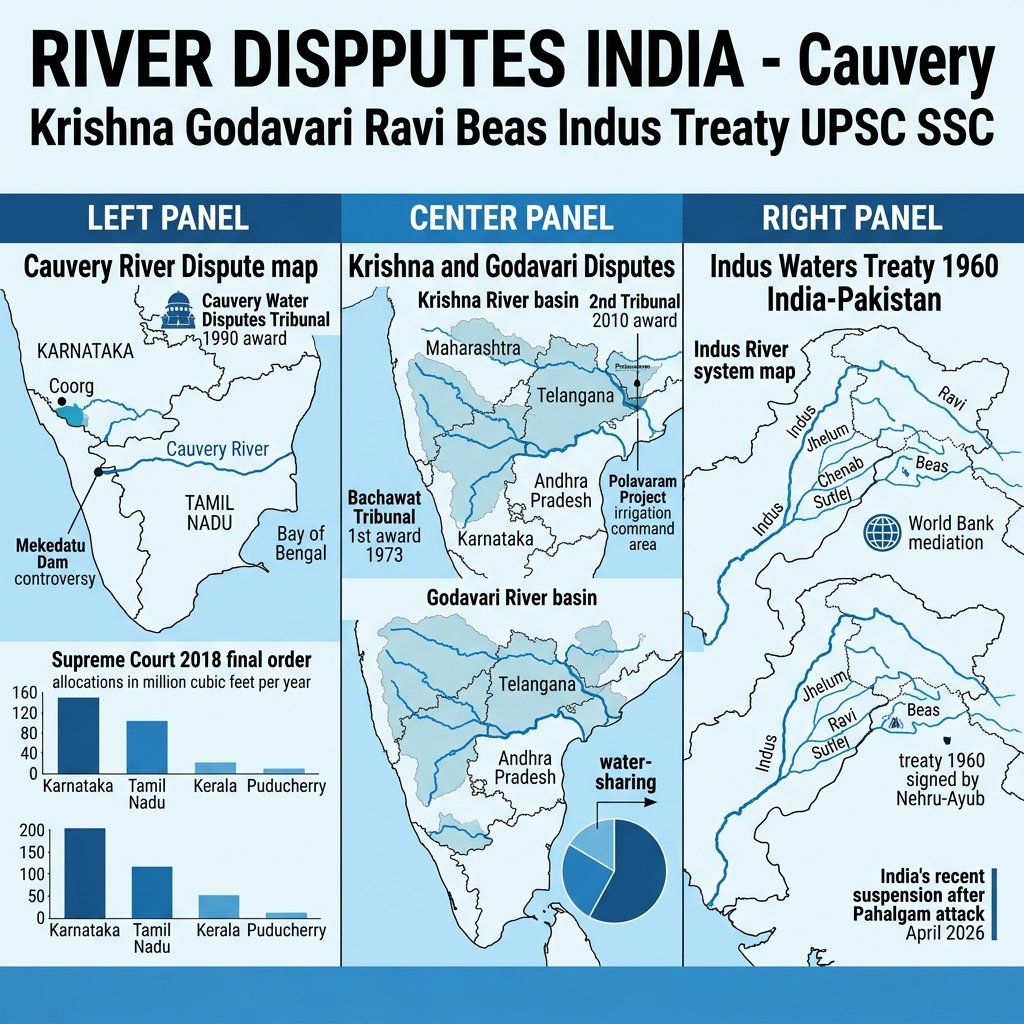
Water is India’s most contested natural resource — and river water sharing is the arena where states and nations fight their most protracted and emotionally charged battles. India’s rivers disregard state boundaries drawn in 1956 and international borders drawn in 1947, flowing through multiple jurisdictions and making water sharing inevitable but agreements elusive. The Inter-State River Water Disputes Act 1956 created a legal framework for adjudicating interstate river disputes through Tribunals; yet the Cauvery dispute took 62+ years from first dispute to final Supreme Court verdict (1924–2018), and the Ravi-Beas dispute remains unresolved after 70+ years. At the international level, the Indus Waters Treaty 1960 — often cited as the world’s most successful transboundary water treaty — survived three wars and decades of hostility between India and Pakistan, only for India to put it “in abeyance” after the April 22, 2026 Pahalgam Terror Attack, making it the most consequential water geopolitics event since the treaty was signed. Understanding India’s river disputes, their constitutional base (Article 262), Tribunal history, settlement terms, and the Indus Treaty’s current crisis is essential for UPSC, SSC, and all competitive examinations.
Constitutional & Legal Framework
- ⚖️ Article 262 (Parliament to adjudicate disputes): Empowers Parliament to enact legislation for adjudication of disputes relating to waters of inter-state rivers and river valleys; Parliament may exclude jurisdiction of Supreme Court or any other court in respect of such disputes; this is one of the rare areas where Parliament can constitutionally override the Supreme Court
- ⚖️ Inter-State River Water Disputes Act, 1956 (ISRWDA): The operative law under Article 262; provides for: any state government that has a water dispute with another state may request the Central Government to refer the dispute to a Tribunal; Central Government has discretion (not mandatory obligation) to constitute a Tribunal; the Tribunal’s award is final and binding (cannot be challenged in court); Tribunals are inter-governmental, not judicial — chaired by serving or retired Supreme Court judge with 2 members (High Court judges)
- ⚖️ Supreme Court vs Tribunal jurisdiction: Multiple Supreme Court judgments have refined the boundary: the SC cannot hear water quantity disputes (Parliament excluded this per Article 262); but SC can hear constitutional validity disputes (is the Tribunal constituted properly?), implementation of Tribunal awards (forcing states to comply), and matters not related to water quantity sharing; this distinction is crucial because states frequently move the SC to delay Tribunal awards
- ⚖️ Interstate River Water Disputes (Amendment) Act 2019: Amended ISRWDA; key changes: single permanent Tribunal replacing multiple ad-hoc tribunals (reducing proliferation); 2-year mandatory award timeline (extendable once to 3 years) — to prevent decades-long adjudication; Dispute Resolution Committee (DRC) to negotiate before Tribunal constitution; implementation of existing awards became mandatory within 3 years of award + no further disputes on same issue; as of 2026 fully operational framework envisioned but existing large disputes (Cauvery, Ravi-Beas) pre-date the amendment
Major Interstate River Disputes
1. Cauvery Water Dispute — Karnataka vs Tamil Nadu
| Aspect | Details |
|---|---|
| River | Cauvery (Kaveri) — originates in Talacauvery, Coorg (Karnataka); length 800 km; flows through Karnataka and Tamil Nadu; drains into Bay of Bengal at Poompuhar; total annual average flow = 740 TMC (Thousand Million Cubic Feet); basin states = Karnataka (52% basin area), Tamil Nadu (43%), Kerala (3%), Puducherry (1%) |
| Origin of dispute | First formal agreement = 1892 between Madras Presidency and Mysore Princely State; second agreement 1924 (60-year term, favouring Madras/Tamil Nadu who had established prior use of canals); 1924 agreement expired in 1974; Karnataka demanded renegotiation = Tamil Nadu refused = standoff for 30+ years |
| Cauvery Water Disputes Tribunal | Constituted 1990 under Justice Chittatosh Mookerjee; issued interim orders 1991, 1995, 2007; final award issued February 2007 (after 17 years!): Karnataka = 270 TMC; Tamil Nadu = 419 TMC; Kerala = 30 TMC; Puducherry = 7 TMC; Karnataka allocated less than the 1924 value = Karnataka objected |
| Supreme Court 2018 | Both states challenged Tribunal award in SC; SC final order February 2018: Tamil Nadu’s share slightly reduced (416.75 TMC); Karnataka’s share increased (284.75 TMC = 14.75 TMC increase); Bengaluru given 4.75 TMC separate allocation for drinking water; Cauvery Management Authority (CMA) and Cauvery Water Management Authority created for implementation; but implementation remains contested during drought years |
| Ongoing tensions | Annual flashpoint during southwest monsoon failure: if Cauvery is 30%+ below normal, Karnataka refuses to release per SC schedule saying it has no water; SC orders release = Karnataka partially complies under protest; riots in Bengaluru and Chennai; Oct 2023 = Karnataka HC vs SC standoff over Cauvery release during severe drought; Mekedatu Dam proposal (Karnataka wants new reservoir on Cauvery near Bengaluru = Tamil Nadu strongly opposes claiming it will reduce their water further) |
2. Krishna River Dispute — Maharashtra, Karnataka, Andhra Pradesh, Telangana
- 🌊 River: Krishna — originates near Mahabaleshwar (Maharashtra); flows through Maharashtra, Karnataka, Telangana, Andhra Pradesh; length 1,400 km; drains Bay of Bengal near Machilipatnam; total utilizable water = 2,130 TMC; India’s 4th longest river
- 🌊 Bachawat Tribunal (1st, 1969–1976): First Krishna Water Disputes Tribunal chaired by Justice R.S. Bachawat; award 1976: Maharashtra = 560 TMC; Karnataka = 700 TMC; AP (then undivided) = 800 TMC; valid until May 2000
- 🌊 Brijesh Kumar Tribunal (2nd, 2004–2013): Second Tribunal after states asked for re-adjudication post-2000; award 2010 (with further orders in 2013): Maharashtra = 666 TMC; Karnataka = 907 TMC; AP = 1,001 TMC; but all three states challenged the award in SC; award yet to be gazetted as of 2026 = effectively unimplemented = water sharing continues on interim arrangement basis
- 🌊 Post-bifurcation of AP: Andhra Pradesh bifurcated into Andhra Pradesh and Telangana in June 2014; Krishna and Godavari water shares of undivided AP now need to be divided between the two successor states; AP Reorganisation Act 2014 mandated a new tribunal for this; the Krishna-Godavari dispute is now a 4-state dispute (Maharashtra, Karnataka, AP, Telangana) with the additional complication of newly created Telangana asserting independent claims
- 🌊 Polavaram Project (Andhra Pradesh): A major multipurpose dam on the Godavari River (AP) declared a National Project; targeted to irrigate 4.36 lakh acres; partly submerges Chhattisgarh and Odisha territories = flashpoint for inter-state dispute; ongoing project but facing cost overruns (original Rs 16,010 crore, now Rs 50,000+ crore estimated)
3. Ravi-Beas Dispute — Punjab, Haryana & the SYL Canal
- 💧 Background: When Punjab was reorganised in 1966 (Punjab-Haryana-Himachal split), the river waters of Ravi and Beas (flowing through Punjab) needed to be divided between the successor states; the Eradi Tribunal (1986) awarded: Punjab = 3.5 MAF (million acre feet); Haryana = 3.5 MAF; Rajasthan = 8.6 MAF (from existing Bhakra allocations)
- 💧 SYL Canal (Sutlej-Yamuna Link): To deliver Haryana’s share of Ravi-Beas waters, the SYL Canal (214 km, linking Sutlej in Punjab to Yamuna in Haryana) was to be built; Punjab’s section (122 km) was to be dug by Punjab; Haryana’s section (92 km) is dug and complete; Punjab refused to build its section = Haryana gets none of its Ravi-Beas allocation; 1982 Punjab CM Darbara Singh laid SYL’s foundation stone = agitation; 1985 Rajiv-Longowal Accord = Punjab agreed to share; 2004 Punjab Assembly passed legislation terminating the water-sharing agreement = President’s reference to SC; SC ruled 2004 Punjab act unconstitutional 2016; still unbuilt as of 2026 — the world’s longest unfinished canal dispute
- 💧 Why Punjab refuses: Punjab farmers argue: Ravi and Beas carry less water now than in 1976 (due to upstream diversions, canal losses, climatic change); Punjab itself faces groundwater depletion (water table falling 0.5–1m/year in 80% of districts) due to paddy cultivation; giving Haryana its allocated share would worsen Punjab’s own water deficit; Punjab’s political parties cannot agree to SYL without losing farmer support; the dispute is as much political survival as it is hydrology
- 💧 Supreme Court intervention: SC constituted a Local Commissioner in 2016 to assess water availability; in 2017 SC asked Punjab to build its SYL section; Punjab appealed; as of 2026 status = constitutionally unresolved; Haryana keeps approaching SC for enforcement; Punjab keeps filing delays; the SYL is the longest-running unresolved interstate water dispute enforcement failure in Indian judicial history
4. Mahanadi Dispute — Chhattisgarh vs Odisha
- 🌊 River: Mahanadi — originates in Sihawa (Chhattisgarh); flows through Chhattisgarh and Odisha; length 858 km; Hirakud Dam (Odisha, 1957 = first major river project of independent India) = Odisha’s primary water storage
- 🌊 Dispute: Odisha claims Chhattisgarh’s construction of multiple dams, barrages and irrigation projects on Mahanadi upstream in the 2010s is reducing flow into Odisha; Odisha says Hirakud reservoir is filling less; Chhattisgarh says it is using water within its own territory for industrial and agricultural needs; in 2018 both states requested Central Government to constitute tribunal under ISRWDA; Mahanadi Water Disputes Tribunal constituted February 2018 under Justice A.M. Khanwilkar; proceedings ongoing; expected award 2026–27
Indus Waters Treaty 1960 — India-Pakistan
- 🌊 Background: After Partition in 1947, the Indus River system (6 rivers: Indus, Jhelum, Chenab = western rivers flowing through both India and Pakistan; Ravi, Beas, Sutlej = eastern rivers originating in India) became contentious; Pakistan depended on all 6 rivers for its agricultural heartland (Punjab irrigation); India’s construction of Bhakra Dam and Harike Barrage threatened Pakistan’s water supply; World Bank mediated 9 years of negotiations
- 🌊 Treaty provisions (September 19, 1960): Signed by Indian PM Jawaharlal Nehru and Pakistani President Ayub Khan in Karachi; World Bank President Eugene Black was cosignatory; key division: 3 Eastern Rivers (Ravi, Beas, Sutlej) allocated exclusively to India = India has unlimited use; 3 Western Rivers (Indus, Jhelum, Chenab) allocated exclusively to Pakistan = India may only use for limited non-consumptive uses (run-of-river hydropower, limited irrigation, navigation, flood control); India must let the full flow of Western Rivers pass into Pakistan; Permanent Indus Commission (PIC) = one commissioner from each side, meets annually, inspects projects, resolves disputes at technical level; neutral expert + Arbitral Court of Arbitration for legal disputes
- 🌊 Why the treaty survived wars: India and Pakistan fought wars in 1965, 1971, 1999 (Kargil); the Indus Waters Treaty survived all three — water was never weaponised even during hot war; Article XI of the treaty explicitly continues obligations during armed conflict; both sides recognised that treaty abrogation would harm both: India needs to divert Western Rivers to its own system (not yet engineering-complete) and Pakistan needs water security reassurance; the WTO called it “the most successful international water treaty in the world”
- 🌊 India’s disputes within the Treaty: India’s run-of-river hydropower projects on Western Rivers (Kishanganga HEP, Ratle HEP on Chenab) = Pakistan raised objections about reservoir designs reducing Pakistan’s water flows; Pakistan invoked arbitration at Permanent Court of Arbitration (The Hague), which in 2013 ruled it had jurisdiction; India contested the Court’s jurisdiction saying it violated treaty procedure (should go to Neutral Expert first); dual-track dispute ongoing; India’s Kishanganga project operational; Ratle under construction
- 🌊 India puts Treaty “in abeyance” (April 2026): On April 22, 2026, Pakistan-based terrorists killed 26 tourists in Pahalgam, Kashmir (Baisaran Valley) — India’s worst terror attack since 2008 Mumbai attacks; India’s diplomatic response included: suspension of Indus Waters Treaty (India notified Pakistan that it was placing the treaty “in abeyance” — not formally abrogating but suspending implementation, particularly the Permanent Indus Commission meetings and the obligation to share hydrological data with Pakistan); this is the first time India has formally suspended treaty implementation in 66 years; implications = India can begin accelerated construction of Western River storage infrastructure and divert more water than treaty allows; Pakistan faces existential agricultural water risk; geopolitical escalation
All Major Water Disputes — Summary Table
| Dispute | River / Basin | States / Countries | Tribunal / Agreement | Status 2026 |
|---|---|---|---|---|
| Cauvery | Cauvery (740 TMC) | Karnataka, Tamil Nadu, Kerala, Puducherry | CWDT 1990; SC 2018 final order | CMA operational; annual Kharif season flashpoints; Mekedatu Dam contested |
| Krishna | Krishna (2,130 TMC) | Maharashtra, Karnataka, AP, Telangana | Bachawat 1976; Brijesh Kumar 2013 award | Award not gazetted; 4-state dispute post AP bifurcation |
| Godavari | Godavari (3,000 TMC) | Maharashtra, AP, Telangana, Odisha, MP, Chhattisgarh | Godavari Water Disputes Tribunal 1969; award 1979 | Broadly dispute-free; Polavaram submergence = Chhattisgarh-Odisha contest |
| Ravi-Beas (SYL) | Ravi, Beas | Punjab, Haryana, Rajasthan | Eradi Tribunal 1986; SC 2016 ruling | SYL Canal unbuilt; Haryana seeking SC enforcement; Punjab resisting |
| Narmada | Narmada | MP, Gujarat, Maharashtra, Rajasthan | Narmada Water Disputes Tribunal 1969; award 1979; Sardar Sarovar Dam height controversy | Sardar Sarovar fully built; height raised to 138.68m (2017); ongoing rehabilitation issues |
| Mahanadi | Mahanadi | Chhattisgarh, Odisha | Mahanadi WDT constituted 2018 | Proceedings ongoing; award expected 2026–27 |
| Indus (international) | Indus, Jhelum, Chenab, Ravi, Beas, Sutlej | India, Pakistan | Indus Waters Treaty 1960 (World Bank mediated) | India placed treaty “in abeyance” April 2026 post-Pahalgam attack |
⭐ Important for Exams — Quick Revision
- 🔑 Article 262: Parliamentary power to adjudicate inter-state river disputes; can exclude SC jurisdiction; basis for ISRWDA 1956
- 🔑 ISRWDA 1956: Inter-State River Water Disputes Act; Central Govt constitutes Tribunal on state request; award is final + binding; cannot be challenged in court (per Art 262)
- 🔑 ISRWDA Amendment 2019: Single permanent Tribunal; 2-year (extendable to 3 year) award timeline; Dispute Resolution Committee (DRC) mandatory before Tribunal
- 🔑 Cauvery river: Originates Talacauvery, Coorg; 800 km; Karnataka-Tamil Nadu-Kerala-Puducherry; 740 TMC total; 1892+1924 Mysore-Madras agreements
- 🔑 Cauvery Water Disputes Tribunal (CWDT): Constituted 1990; award 2007: TN=419 TMC, Karnataka=270 TMC; SC 2018: Karnataka=284.75, TN=416.75, Bengaluru 4.75 TMC drinking water; CMA created
- 🔑 Mekedatu Dam: Karnataka proposal; new reservoir on Cauvery; Tamil Nadu opposes; CMA yet to approve; major current controversy
- 🔑 Krishna river: Mahabaleshwar origin; 1,400 km; 4th longest; 2,130 TMC; Bachawat Tribunal 1976 + Brijesh Kumar Tribunal 2013; post-AP bifurcation = 4-state dispute
- 🔑 Ravi-Beas dispute: Post-1966 Punjab reorganisation; Eradi Tribunal 1986: Punjab=3.5 MAF, Haryana=3.5 MAF; SYL Canal (214 km) = Punjab’s 122 km section unbuilt for 40+ years; 2004 Punjab legislature terminated agreement = SC ruled unconstitutional 2016
- 🔑 SYL = Sutlej-Yamuna Link Canal; world’s longest unbuilt infrastructure dispute; Haryana’s share of Ravi-Beas waters depends on it
- 🔑 Narmada Tribunal 1979: MP=18.25 MAF; Gujarat=9 MAF; Rajasthan=0.5 MAF; Maharashtra=0.25 MAF; Sardar Sarovar Dam (Gujarat) height controversy; raised to 138.68m in 2017
- 🔑 Mahanadi: Originates Sihawa, Chhattisgarh; Hirakud Dam (Odisha, 1957) = first major post-independence dam; Mahanadi WDT constituted 2018; Chhattisgarh vs Odisha over upstream dams
- 🔑 Indus Waters Treaty: Signed September 19, 1960; Nehru + Ayub Khan + World Bank; Eastern Rivers (Ravi, Beas, Sutlej) = India; Western Rivers (Indus, Jhelum, Chenab) = Pakistan; Permanent Indus Commission meets annually
- 🔑 IWT survived 3 wars: 1965 + 1971 + 1999 Kargil; Article XI continues during armed conflict; regarded as world’s most successful transboundary water treaty
- 🔑 Pahalgam Terror Attack (April 22, 2026): 26 tourists killed, Baisaran Valley; India placed IWT “in abeyance” = first suspension of treaty in 66 years; Permanent Indus Commission meetings suspended; hydrological data sharing suspended
- 🔑 Kishanganga HEP: Run-of-river on Kishanganga (tributary of Jhelum, Western River); India built it; Pakistan contested at PCA (The Hague), 2013; India contested PCA jurisdiction; operational
- 🔑 Polavaram Project: Godavari, AP; National Project; 4.36 lakh acres irrigation; partly submerges Chhattisgarh-Odisha; Rs 50,000+ crore revised cost
- 🔑 Hirakud Dam: Mahanadi, Odisha; completed 1957; first major river valley project of independent India
- 🔑 First inter-state water dispute: Mysore-Madras (Cauvery) = 1892 agreement = oldest inter-state water agreement in India
Frequently Asked Questions (FAQs)
1. Why has the Cauvery dispute lasted over a century — and what did the Supreme Court finally decide in 2018?
The Cauvery water dispute is the oldest and most emotionally charged inter-state water conflict in India — a dispute whose roots predate the Republic itself, stretching back to colonial-era agreements between British-administered Madras Presidency and the Princely State of Mysore. Its longevity (1892–2018 = 126 years from first agreement to SC final order) is a testament to how water scarcity, agricultural dependency, linguistic-regional identity, democratic politics, and judicial complexity can combine to make even technically solvable problems almost intractable. Why it started: The Cauvery basin has a fundamental asymmetry: Karnataka (then Mysore) is the upstream state controlling where and when water flows; Tamil Nadu (then Madras) is the downstream state that historically cleared and cultivated the Cauvery delta (Thanjavur, Tiruchy, Pudukottai districts) for rice cultivation over centuries. The delta farmers had established prior use — they were watering their fields long before Mysore built any dams. The 1892 Mysore-Madras Agreement and the 1924 Agreement formalised this prior-use principle giving Madras the larger share. But the 1924 agreement expired in 1974. Karnataka had by then built its own irrigation infrastructure (KRS Dam, 1931; Hemavathy, Harangi, Kabini projects) and argued that the 1924 agreement, which allocated only 260 TMC to Mysore (now Karnataka) vs 560 TMC to Madras (now Tamil Nadu), was fundamentally unjust — it had been negotiated by a Princely State under British pressure, not by an equal sovereign. Why negotiations failed for 16 years (1974–1990): After the 1924 agreement expired, Karnataka and Tamil Nadu attempted direct negotiations through multiple inter-state conferences. All failed. Karnataka demanded renegotiation from scratch based on “equitable apportionment” of a shared river; Tamil Nadu insisted on maintaining “vested rights” and prior use of the delta farmers. The political dynamics made compromise impossible — no Tamil Nadu Chief Minister could agree to reduced water shares (Cauvery is Tamil identity, not just agriculture); no Karnataka CM could agree to less water for Bengaluru’s growing population (Bengaluru had grown from 1 million in 1951 to 5 million by 1990). In 1986, Tamil Nadu approached the Supreme Court; SC said the ISRWDA Tribunal route was mandatory; Tamil Nadu filed with the Centre; Centre constituted the Cauvery Water Disputes Tribunal in 1990. The CWDT experience (1990–2007): The Tribunal under Justice Chittatosh Mookerjee issued interim orders that required Karnataka to release specific volumes of water to Tamil Nadu in each month of the irrigation season. Karnataka’s 1991 non-compliance with an interim order triggered riots in both states. The 1991 Karnataka riots against Tamil immigrants caused deaths and enormous property damage in Bengaluru. The 1992 anti-Karnataka agitations in Tamil Nadu destroyed Karnataka-owned buses. The Supreme Court had to intervene to enforce interim compliance. The Tribunal issued its final award in February 2007 — after 17 years — allocating: Tamil Nadu = 419 TMC; Karnataka = 270 TMC; Kerala = 30 TMC; Puducherry = 7 TMC; environmental flows = 10 TMC; total = 740 TMC (average annual flow). Karnataka challenged the award in the SC immediately. Tamil Nadu challenged it seeking more. Both states agreed on one thing: they disagreed with the tribunal. The Supreme Court’s 2018 verdict: The SC’s Constitution Bench (5 judges) delivered its final verdict in February 2018 — after another 11 years. The court increased Karnataka’s share by 14.75 TMC (to 284.75 TMC) primarily by allocating 4.75 TMC specifically for Bengaluru’s drinking water needs (recognising the city’s massive population growth since 1924). Tamil Nadu’s share was slightly reduced to 416.75 TMC. The court mandated: creation of a Cauvery Management Authority (CMA) as a permanent body to oversee water release schedules; creation of a Cauvery Water Management Authority (CWMA); monthly water release schedule for Karnataka to Tamil Nadu. The most important principle the SC articulated: water sharing must account for drinking water needs of cities (giving Bengaluru’s needs priority in drought years) and must be reviewed every 15 years to account for changed circumstances. But even the 2018 final order has not ended the dispute — in drought years (Karnataka’s reservoir levels critically low), Karnataka has refused to release the mandated schedule, forcing repeated SC interventions. The Mekedatu Dam proposal (Karnataka wants to build a new 67.16 TMC reservoir on Cauvery near Bengaluru) remains fiercely opposed by Tamil Nadu as a potential water trap that would give Karnataka control over timing of releases. Water, in the Cauvery basin, remains a annually recurring political and judicial crisis even 126 years after the first formal attempt to share it.
2. What is the SYL Canal — and why has it been unbuilt for 40+ years despite Supreme Court orders?
The Sutlej-Yamuna Link (SYL) Canal may be the most politically combustible piece of infrastructure in India — a 214-kilometre canal that has been legally mandated, partially constructed, court-ordered, state-legislation-blocked, constitutionally contested, and still unbuilt for more than four decades. Its unresolution is a case study in how democratic politics can override judicial authority when the political stakes are existential for the parties involved. The origin: When Punjab was reorganised on November 1, 1966 (Punjab Reorganisation Act 1966), the new states of Punjab, Haryana, and Himachal Pradesh were carved from the old Punjab. The rivers Ravi and Beas — flowing through the new Punjab — carried the water that the Bhakra-Nangal project had harnessed for undivided Punjab’s agriculture. Haryana argued it was the successor state to a significant part of old Punjab’s territory and population, and therefore to a proportional share of the river waters. The Eradi Tribunal (constituted 1986) awarded: Punjab = 3.5 MAF (out of total utilizable 7.2 MAF); Haryana = 3.5 MAF; Rajasthan got its share from the existing Bhakra system. For Haryana to actually receive its 3.5 MAF, water needed to flow from the Sutlej River (flowing through Punjab) into the Yamuna basin (Haryana). The solution = the SYL Canal: 214 km total, with 122 km through Punjab and 92 km through Haryana. Haryana’s 92-km section was completed. Punjab’s 122-km section was not built. The politics: Punjab’s resistance to the SYL is not primarily about water quantity (though Punjab farmers argue the Ravi-Beas themselves have less water now due to depletion and climate change). It is fundamentally about the political economy of Punjab agriculture: (1) Punjab’s paddy cultivation — the Green Revolution’s primary product — consumes enormous water; Punjab farmers fear that releasing 3.5 MAF to Haryana threatens their own supply; (2) In the context of the Punjab militancy and Khalistan movement of the 1980s–90s, the SYL became symbolically a Haryanvi (Hindu) demand vs a Punjabi (Sikh) identity issue — even though the dispute is really governmental, not communal; (3) Every Punjab government of every party has refused to build the SYL section because doing so would be electoral suicide — the farmer lobby in Punjab is the most powerful political force in the state. In 1982, CM Darbara Singh laid the foundation stone of SYL in Punjab = attack on engineer = canal construction stopped. The 1985 Rajiv Gandhi-Harchand Singh Longowal Accord (Punjab Accord) included Punjab agreeing to the SYL in exchange for the Sarkaria Commission on Centre-State relations. Longowal was assassinated months later; the accord collapsed. In 2004, the Punjab Assembly passed the Punjab Termination of Agreements Act 2004 — a state law that declared all river water sharing agreements with Haryana null and void. This act was referred to the Supreme Court by the Centre. The SC in 2016 ruled the 2004 Punjab Act constitutionally invalid — Punjab cannot unilaterally nullify an inter-state water award. Despite being told the act was invalid, Punjab still has not built its section of the SYL. Haryana keeps filing contempt applications against Punjab in the SC. The SC issued multiple directions — including ordering a Local Commissioner to assess the state of construction — Punjab’s response has been procedural delays. The water hydrology problem underlying the political deadlock: Independent hydrologists and the Central Water Commission (CWC) have documented that the Ravi River’s usable flow into India has declined significantly — partly because the 1960 Indus Waters Treaty allocated the full Ravi flow to India, but Pakistan’s construction of its Main Link Canal and diversion works on the Pakistani side of the border has reduced the actual water entering India from Ravi’s catchment; partly because precipitation patterns in the Himalayan headwaters of Ravi and Beas have changed. Punjab farmers’ argument that “there is no surplus water to give Haryana” has a partial hydrological basis — though the Eradi Tribunal’s 1986 numbers were based on lower historical flow data than the original Bhakra allocations assumed. The SYL dispute is likely to remain unresolved until either: India’s water crisis becomes so severe that SC enforcement becomes inescapable (courts ordering physical construction), or a political settlement emerges in the context of a broader Punjab-Haryana federal compact — neither of which appears imminent.
3. What is the Indus Waters Treaty — and what does India’s 2026 suspension mean for India-Pakistan relations?
The Indus Waters Treaty of 1960 has been described by the World Bank — which brokered it — as “one of the most successful international agreements in history.” For 66 years, it regulated water sharing between India and Pakistan across a system of six rivers (the Indus and its five tributaries: Jhelum, Chenab, Ravi, Beas, Sutlej) that form the hydrological heart of Pakistan’s agricultural economy. Pakistan’s Indus River System Authority (IRSA) manages water allocation to Punjab and Sindh provinces; the Indus and its western tributaries (Jhelum and Chenab) supply the bulk of Pakistan’s irrigation — the “breadbasket” that feeds 220 million people. The treaty’s singular achievement was its survival through three India-Pakistan wars (1965, 1971, 1999 Kargil) — a period in which practically every other bilateral instrument between the two countries was suspended or violated, yet both sides rigorously continued to exchange hydrological data (as required monthly under the treaty) and the Permanent Indus Commission met annually even during active armed conflict. The treaty structure: The genius of the treaty’s architecture was its river-by-river division rather than water-volume-sharing: the Eastern Rivers (Ravi, Beas, Sutlej — the three smaller tributary rivers flowing through the Indian Punjab before crossing into Pakistan) are allocated exclusively and completely to India; India has absolute sovereignty over their use — no volume restrictions, no Pakistani right to object to Indian upstream use. The Western Rivers (Indus, Jhelum, Chenab — the three major rivers, carrying ~80% of the system’s total flow) are allocated to Pakistan for consumptive use; India may build run-of-river hydropower projects on the Western Rivers within the treaty’s technical specifications, but may not build storage dams that significantly alter Pakistan’s water flow timing; any Indian project on the Western Rivers is subject to Pakistani review and objection. The treaty established a Permanent Indus Commission (PIC) — one commissioner from each country — meeting annually in India and Pakistan alternately, conducting joint inspections of hydraulic works, sharing hydrological data (river flow measurements at multiple stations), and resolving technical disputes; matters escalating beyond PIC go to a Neutral Expert (engineering specialist) or to an Arbitral Court of Arbitration (judicial); the PCA (Permanent Court of Arbitration in The Hague) has jurisdiction for the highest-level disputes. Growing tensions before 2026: Two Indian hydropower projects on Western Rivers caused serious bilateral friction: (1) Kishanganga Hydroelectric Project (330 MW, on Kishanganga River, a tributary of the Jhelum) — Pakistan complained about the storage design diverting water away from the Neelum-Jhelum project downstream in PoK; PCA in 2013 ruled the project needed minor design modifications; India completed it; operational. (2) Ratle Hydroelectric Plant (850 MW, on Chenab River in J&K) — Pakistan filed dispute at PCA in 2016; India says PCA lacks jurisdiction (should go to Neutral Expert first per treaty hierarchy); both the Neutral Expert process and the PCA arbitration were proceeding simultaneously as of 2025 — an unprecedented and legally unresolved dual-track dispute. Pakistan also periodically alleged that India was building additional storage works exceeding treaty limits. India has periodically raised the option of reviewing or abrogating the treaty, arguing: (a) the treaty was signed when J&K had a different Constitutional status; (b) Pakistan uses the treaty to internally fund Kashmiri separatism (no evidence for this legally but politically cited); (c) changed hydrological conditions (climate change, glacier melt) require treaty renegotiation. April 2026 — the suspension: On April 22, 2026, Pakistan-based militants killed 26 tourists (mostly Hindu tourists from other Indian states) in the Baisaran Valley near Pahalgam, Kashmir — the worst terrorist attack on Indian civilians since the 2008 Mumbai attacks. Within days, India’s Cabinet Committee on Security announced a package of diplomatic measures widely described as India’s most severe post-attack response in decades: suspension of the Simla Agreement (that governed diplomatic relationships), closure of the Wagah-Attari border, suspension of visas, and — the most consequential long-term measure — placing the Indus Waters Treaty “in abeyance.” “In abeyance” is legally distinct from “abrogation”: abrogation terminates the treaty permanently and requires formal notification (the treaty allows exit with 6 months notice); “in abeyance” means India is suspending implementation without formal termination, preserving legal flexibility to resume. Practically: India informed Pakistan it was suspending the annual PIC meetings, not sharing hydrological data (India had been sharing real-time monsoon and flow data with Pakistan; suspension means Pakistan loses this input for its own reservoir management), and that India considers itself no longer bound by the treaty’s restrictions on Western River storage works pending resolution of the cross-border terrorism issue. The implications for Pakistan are potentially severe: if India were to construct full-scale storage dams on the Chenab and Jhelum (now if freed from treaty constraints), it could theoretically regulate and reduce Pakistan’s water supply quite significantly though this would take decades of engineering; in the short term, the loss of hydrological data from India affects Pakistan’s flood forecasting ability. India’s position: the treaty’s Article XII(3) allows amendment by “duly ratified treaty between the parties” and India argues the changed security environment justifies invoking force majeure clause. Pakistan called the suspension an “act of war.” The World Bank called for both sides to continue treaty implementation. The suspension marks the end of one of the longest-lasting bilateral cooperation agreements between two nuclear-armed regional adversaries — and represents a fundamental escalation in India’s willingness to use water as a coercive instrument in bilateral relations with Pakistan.
Related Geology Articles on StudyHub
- ➡️ Indian Drainage System — River Systems & Basins
- ➡️ Water Resources — Dams, Irrigation & Groundwater
- ➡️ J&K & Ladakh — Indus River Geography & Pahalgam
- ➡️ Northeast India — Brahmaputra River & Water Security
- ➡️ Disaster Management — Flood Control & River Embankments