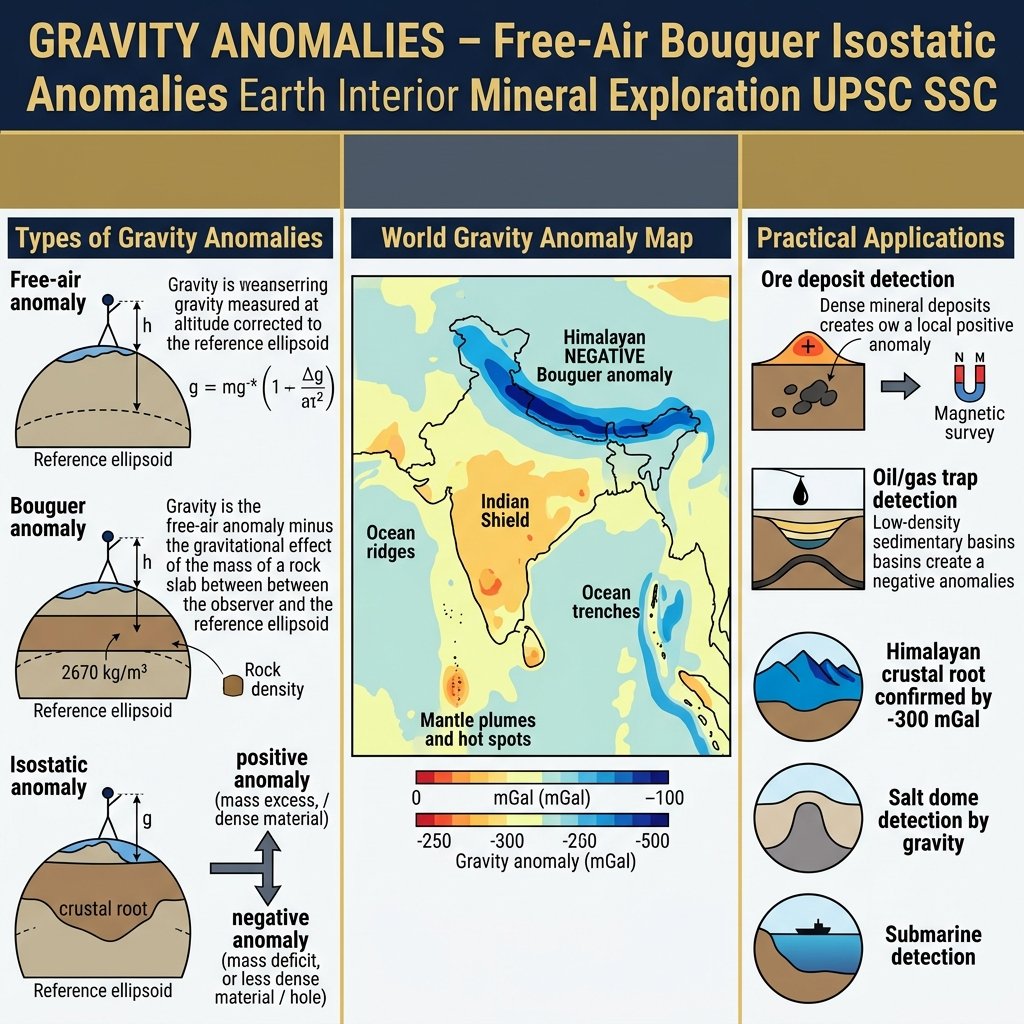
Gravity is not uniform across Earth’s surface. A highly sensitive gravimeter placed anywhere on the planet will record a value that deviates — sometimes dramatically — from the theoretical gravity expected at that latitude and elevation. These deviations, called gravity anomalies, are among the most powerful diagnostic tools in geophysics: they reveal hidden masses deep within Earth’s crust and mantle, locate buried ore deposits and petroleum reservoirs, confirm theories of isostasy, map the structure of ocean ridges and trenches, and even detect changes in ice sheet mass. The three primary types of gravity anomaly — Free-air anomaly, Bouguer anomaly, and Isostatic anomaly — each strip away different layers of correction to isolate different aspects of Earth’s mass distribution. A strongly negative Bouguer anomaly over the Himalayas (-250 to -500 mGal) confirms the existence of a massive crustal root predicted by Airy’s isostasy model; a strongly negative anomaly over ocean trenches reflects cool, dense oceanic slabs not yet in isostatic equilibrium; a near-zero free-air anomaly over mid-ocean ridges confirms that hot, low-density mantle compensates for the ridge’s reduced crustal thickness. Understanding gravity anomalies — their types, measurement, interpretation, and applications — is essential for UPSC, SSC and competitive examinations in Earth science and physical geography.
Earth’s Gravity — Basic Concepts
- ⚡ Theoretical gravity: Earth is not a perfect sphere — it is an oblate spheroid (slightly flattened at poles, bulging at equator), with equatorial radius ~6,378 km and polar radius ~6,357 km (difference ~21 km); gravity is stronger at the poles for two reasons: (1) the poles are closer to Earth’s centre (shorter distance, stronger gravity), and (2) the centrifugal effect of Earth’s rotation is zero at poles but maximum at the equator, partially cancelling gravity’s pull; theoretical gravity at poles ~9.832 m/s²; at equator ~9.780 m/s²; difference ~0.5%
- ⚡ Normal (reference) gravity: The theoretical gravity expected at any point on Earth’s surface based on latitude alone, calculated for a standard reference ellipsoid (GRS80 or WGS84); this is what gravity would be if Earth had perfectly uniform density throughout and the reference ellipsoid shape exactly; normal gravity increases from equator to poles following a well-known formula (Somigliana formula)
- ⚡ Observed gravity: What gravimeters actually measure; deviates from normal gravity due to: (a) topography (mountains = extra mass = more gravity); (b) elevation above sea level (farther from Earth’s centre = less gravity); (c) local density variations in the crust and mantle; (d) subsurface voids, ore bodies, salt domes, aquifers; (e) dynamic factors like ocean tides, atmospheric pressure, groundwater changes
- ⚡ Gravity units: SI unit = m/s² (metre per second squared); practical geophysics uses: 1 Gal (Galileo) = 0.01 m/s² = 1 cm/s²; 1 milligal (mGal) = 0.001 Gal = 10⁻⁵ m/s²; 1 gravity unit (g.u.) = 0.1 mGal; modern gravimeters measure gravity differences to ±0.001 mGal precision; Earth’s gravity variation across the globe = ~50,000 mGal range (5.0 Gal pole to equator); geophysically interesting anomalies typically = 1–500 mGal
- ⚡ Gravimeters: Instruments that measure gravity; absolute gravimeters = drop a mass and measure fall time (precision ~0.001 mGal); relative gravimeters = measure change from reference station (spring-mass systems; precision ~0.01 mGal for field use); superconducting gravimeters = levitate a niobium sphere in a superconducting field, measure position deviation (precision ~0.0001 mGal, used for tidal studies); GRACE satellite mission (2002–2017) and GRACE-FO (2018–present) = measured global gravity field changes from space to detect ice sheet mass loss, groundwater depletion, and sea level change
Types of Gravity Anomalies
| Anomaly Type | How Calculated | What It Reveals | Key Applications |
|---|---|---|---|
| Free-Air Anomaly (FAA) | Observed gravity − Normal gravity + Free-air correction (subtract gravity decrease due to elevation above sea level = −0.3086 mGal/m); no correction for the mass between the observer and sea level (the rock slab is ignored) | Net gravitational effect of all masses above the geoid (sea level surface); reveals whether a region is in isostatic equilibrium; near-zero FAA = isostatically compensated; large positive FAA = uncompensated mass excess (e.g., young mountain range not yet in equilibrium); large negative FAA = uncompensated mass deficit | First-pass isostasy test; ocean floor mapping (FAA maps ocean ridges, trenches, seamounts); satellite-derived global FAA maps show all major tectonic features; GRACE satellite data gives FAA-based ice sheet mass loss estimates |
| Bouguer Anomaly (BA) | Free-air anomaly − Bouguer correction (subtract the gravitational effect of the rock slab between the observer’s elevation and sea level, assuming density 2,670 kg/m³ for continental rocks); terrain correction added for irregular topography near the station | Reveals density anomalies in the crust and upper mantle after removing topographic effects; negative BA over mountains = crustal root (low density crust displacing high density mantle) = Airy isostasy; positive BA over flat areas = dense subsurface material (mantle upwelling, ore body); near-zero BA = uniform density distribution | Mineral exploration (ore body detection); petroleum exploration; mapping of crustal thickness; confirming Airy isostasy under mountain ranges; identifying salt domes (low density = negative BA); locating groundwater aquifers |
| Isostatic Anomaly (IA) | Bouguer anomaly − Isostatic correction (subtract the gravitational effect of the assumed isostatic compensation = either Airy root or Pratt density contrast); must choose a compensation model (Airy, Pratt, or Vening Meinesz) | Reveals regions out of isostatic equilibrium after applying a compensation model; near-zero IA = region is well compensated; positive IA = region is over-dense (too heavy relative to its topography = being supported dynamically by mantle flow or lithospheric strength, not isostasy); negative IA = region is under-dense | Identifying dynamic support for topography (mantle plumes, dynamic topography); mapping lithospheric flexural rigidity; understanding post-glacial rebound regions; identifying regions currently adjusting isostatically after deglaciation |
| Residual Gravity Anomaly | Bouguer anomaly − Regional gravity field (regional field estimated by polynomial smoothing, upward continuation, or wavelength filtering to separate deep/shallow sources) | Short-wavelength (shallow) gravity anomalies isolated from the long-wavelength (deep) regional trend; reveals small-scale near-surface density anomalies: buried ore deposits, voids, cavities, groundwater | Mineral deposit discovery; archaeological geophysics; void detection (sinkholes, karst); groundwater mapping; buried channel detection; engineering foundation assessment |
Gravity Anomalies at Key Geological Settings
- 🌍 Himalayas — strongly negative Bouguer anomaly: The Himalayan mountain range shows one of Earth’s most pronounced negative Bouguer anomalies: -250 to -500 mGal under the high Himalayas, peaking at approximately -600 mGal under the Tibetan Plateau; this massive negative anomaly directly confirms Airy isostasy — the crustal root under the Himalayas contains low-density crustal material (~2,700 kg/m³) replacing what would otherwise be higher density mantle (~3,300 kg/m³); the mass deficit of the root exactly (within error) compensates for the mass excess of the mountain range above; the INDEPTH project seismic surveys confirmed the Himalayan Moho at 70–80 km depth, consistent with the gravity anomaly’s magnitude
- 🌍 Mid-ocean ridges — near-zero free-air anomaly: Despite rising 2–2.5 km above the surrounding ocean floor, mid-ocean ridges have free-air anomalies near zero; this means the ridge is isostatically compensated; the mechanism is Pratt-style thermal isostasy: the hot, recently formed oceanic lithosphere at the ridge is thermally expanded (density ~3,100 kg/m³) vs old cold oceanic lithosphere (~3,300 kg/m³); the low-density hot mantle material beneath the ridge is buoyant enough to support the ridge topography without requiring a thick crustal root
- 🌍 Ocean trenches — strongly negative free-air anomaly: Ocean trenches show strong negative free-air anomalies (-200 to -300 mGal) despite being the lowest topography on Earth’s surface; this seems paradoxical (low areas should have less mass above = negative FAA makes sense) but the anomaly is much more negative than would be expected just from the topographic low; the excess negative anomaly reflects that the cold, dense subducting slab is pulling the ocean floor down out of isostatic equilibrium — the trench is isostatically undercompensated; the slab pull exceeds the buoyancy of lighter water filling the trench; this FAA signal directly reveals the active tectonic dynamics of subduction
- 🌍 Indian Shield — modest positive Bouguer anomaly: The Precambrian crystalline rocks of the Indian Shield (Peninsular India) show modest positive to near-zero Bouguer anomalies; the stable shield crust (~35–40 km thick) is in good isostatic equilibrium after billions of years of tectonic stability; local positive anomalies occur over denser mafic intrusions and over the Dharwar Craton’s greenstone belts; the Cuddapah Basin shows a local negative anomaly over its thick sedimentary sequence
- 🌍 Mantle plumes and hotspots — positive anomaly: Mantle plumes (narrow upwellings of hot, deep mantle material) cause positive Bouguer anomalies because rising hot mantle material is replaced by normal-temperature mantle — but the thermal buoyancy actually makes the surface topography higher (hotspot swells like Hawaii), and the denser surrounding mantle at depth creates the positive signal; the Hawaiian swell shows a broad positive free-air anomaly (~50 mGal) reflecting the dynamic support by the plume
GRACE Satellite — Measuring Gravity Changes from Space
- 🛰️ GRACE (Gravity Recovery and Climate Experiment): Twin NASA-DLR satellites launched 2002; two identical satellites flew 220 km apart in polar orbit at ~500 km altitude; precise microwave ranging system measured distance between the two satellites to within 1 micron (one millionth of a metre); as the leading satellite approached a region of extra mass (e.g., a mountain, ice sheet, or area of high groundwater), it was pulled slightly forward, increasing the distance between the satellites; the pattern of distance changes precisely mapped Earth’s gravity field and, more crucially, changes in Earth’s gravity field over time
- 🛰️ GRACE key discoveries: (1) Greenland ice loss: GRACE measured Greenland losing ~286 billion tonnes of ice per year (2002–2016); the loss of this mass caused a measurable decrease in gravity over Greenland; confirmed that Greenland is the largest single contributor to sea level rise (not thermal expansion as 2000s estimates assumed); (2) Antarctica ice loss: ~127 billion tonnes/year from West Antarctica and the Antarctic Peninsula; (3) Groundwater depletion: India’s Indo-Gangetic Plain losing ~17.7 billion tonnes of groundwater per year (2002–2008, Rodell et al. 2009); this was detected as a gravity decrease over northwestern India/Pakistan = first satellite measurement of large-scale groundwater depletion; (4) 2011 Tōhoku earthquake: The magnitude 9.0 earthquake and resulting crustal deformation caused a measurable gravity change over the rupture zone detected by GRACE; (5) Post-glacial rebound: Increasing gravity over former ice sheet areas (Scandinavia, Canada) as the crust rebounds and draws dense mantle upward
- 🛰️ GRACE-FO: GRACE Follow-On, launched May 2018; continues GRACE measurements; adds laser ranging inter-satellite link for higher precision; continuing ice sheet, groundwater, and sea level monitoring
Gravity Surveys in Mineral Exploration
- 🔍 Principle: Dense ore bodies (iron ore, chromite, copper sulphides, nickel) create local positive gravity anomalies; low-density features (salt domes, coal seams, petroleum-filled porous sandstones, limestone voids) create local negative anomalies; by mapping residual Bouguer anomalies over a survey area, geophysicists can detect and locate these features without drilling
- 🔍 Iron ore deposits: Magnetite and hematite iron ore (density ~4,000–5,000 kg/m³) vs surrounding sedimentary rock (~2,500 kg/m³) creates strong positive gravity anomalies; Iron ore deposits in Odisha, Jharkhand, and Chhattisgarh were identified partly through airborne gravity surveys before drilling confirmation; Kudremukh iron ore deposit (Karnataka) was partly delineated by gravity survey
- 🔍 Salt domes (petroleum exploration): Salt (halite, density ~2,100 kg/m³) is less dense than typical sedimentary rock (~2,500–2,700 kg/m³); when salt flows upward as a diapir (salt dome), it pushes denser rock aside; the result is a local negative Bouguer anomaly over the salt dome; petroleum geologists use gravity surveys to locate salt domes because salt domes often trap oil and gas in the rock structures flanking the dome; this technique has been used in the Gulf of Mexico (world’s largest salt-diapir petroleum region) and in India’s Cambay Basin
- 🔍 Chromite and chromium deposits: Chromite (density ~4,300–4,800 kg/m³) is extremely dense; layered chromite intrusions in ophiolite complexes (Sukinda Valley, Odisha; Orhaneli, Turkey) produce strong positive anomalies detectable by ground gravity survey; India’s Sukinda chromite deposits (world’s 3rd largest chromite reserve) were partly located using gravity anomaly mapping before drilling; chromite is used in steel making and India has strategic reserves
- 🔍 Subsurface void detection: Karst limestone dissolution creates underground cavities (caves, sinkholes in formation); these voids have density ~0 (air) vs surrounding limestone ~2,700 kg/m³; they produce small but detectable negative anomalies; micro-gravity surveys (measuring tiny gravity differences of 0.01 mGal) are used to map subsurface void networks for: tunnel safety assessment; dam foundation integrity; archaeological exploration (detecting underground chambers in temples, tombs)
⭐ Important for Exams — Quick Revision
- 🔑 Gravity anomaly: Difference between observed gravity and theoretical (normal) gravity at that point; caused by subsurface density variations
- 🔑 Units: 1 Gal = 1 cm/s² = 0.01 m/s²; 1 milligal (mGal) = 10⁻⁵ m/s²; gravimeters measure to ±0.001 mGal; Earth’s total gravity variation = ~50,000 mGal pole to equator
- 🔑 Free-air anomaly (FAA): Observed gravity − Normal gravity + Free-air correction (−0.3086 mGal/m elevation); removes elevation effect only; near-zero FAA = isostatic equilibrium
- 🔑 Bouguer anomaly (BA): FAA − Bouguer correction (remove mass of rock between observer and sea level at 2,670 kg/m³); reveals subsurface density anomalies after removing topography effect
- 🔑 Negative Bouguer anomaly: Low-density subsurface material (crustal root, salt dome, coal seam, petroleum reservoir, void); mountains always show negative BA (crustal root compensates)
- 🔑 Positive Bouguer anomaly: Dense subsurface material (mafic intrusion, ore body, exposed mantle, shallow dense basement); ocean floor (thin crust, dense mantle beneath) gives positive BA
- 🔑 Himalayas Bouguer anomaly: −250 to −600 mGal = world’s most negative land BA; confirms Airy crustal root 70–80 km deep; INDEPTH seismic survey confirmed it
- 🔑 Mid-ocean ridges: Near-zero FAA despite 2.5 km topographic high = thermally compensated by hot low-density mantle = Pratt-style thermal isostasy; young basalt ~3,100 kg/m³ vs old cold oceanic ~3,300 kg/m³
- 🔑 Ocean trenches: Large negative FAA (−200 to −300 mGal) despite being lowest topography = isostatically undercompensated; cold dense subducting slab pulled down by slab pull = dynamic, not isostatic equilibrium
- 🔑 GRACE satellite (2002–2017): Twin satellites 220 km apart; microwave ranging to 1 micron; detected: Greenland ice loss (~286 Gt/yr); Antarctica ice loss (~127 Gt/yr); India IGP groundwater depletion (17.7 Gt/yr, Rodell 2009); post-glacial rebound; Tōhoku earthquake crustal change
- 🔑 GRACE-FO (2018–present): Successor to GRACE; adds laser ranging; continues ice + groundwater + sea level monitoring
- 🔑 Salt domes: Low density (2,100 kg/m³) vs sedimentary rock (2,500 kg/m³) = local negative BA; used in petroleum exploration (salt traps oil and gas); Gulf of Mexico, Cambay Basin India
- 🔑 Iron ore exploration: Magnetite/hematite (~4,000–5,000 kg/m³) = strong positive anomaly; Odisha, Jharkhand, Chhattisgarh deposits identified by airborne gravity; Kudremukh identified by gravity survey
- 🔑 Chromite exploration: Density ~4,300–4,800 kg/m³ = very strong positive; Sukinda Valley chromite (Odisha, world’s 3rd largest) partly traced by gravity anomaly mapping
- 🔑 Isostatic anomaly: BA minus isostatic correction (assumed compensation model); near-zero = well compensated; positive = dynamically supported or lithospherically held; used for post-glacial rebound studies
- 🔑 India groundwater GRACE finding: Indo-Gangetic Plain (Punjab, Haryana, Rajasthan, UP) losing 17.7 billion tonnes groundwater/year detected by GRACE gravity decrease; most comprehensive evidence for India’s groundwater crisis
Frequently Asked Questions (FAQs)
1. What is the difference between Free-Air, Bouguer, and Isostatic gravity anomalies — and when do you use each?
Understanding the three main types of gravity anomaly requires understanding why each successive type of correction is applied — what each correction removes and what signal remains. Think of it as progressively peeling layers from an onion: each correction removes one class of gravitational effect, leaving behind the signal from progressively deeper, more subtle density variations. The starting point — observed gravity: A gravimeter placed anywhere on Earth’s surface measures the local gravitational acceleration. This measured value includes contributions from: (a) Earth’s overall mass and shape (latitude effect — poles have more gravity than equator); (b) the observer’s distance from Earth’s centre (elevation effect — higher elevation = less gravity); (c) the additional gravitational pull of rock masses between the observer and sea level (the rock slab effect — standing on a mountain adds gravity from the rock beneath your feet); (d) the true subsurface density anomaly we want to measure (the actual geological signal). To isolate the geological signal, corrections must be applied in layers. Free-air anomaly — correcting only for elevation: The free-air correction accounts for the fact that the observer is not at sea level. As you move 1 metre higher, you move farther from Earth’s centre. Gravity decreases with distance from Earth’s centre at a rate of approximately 0.3086 mGal per metre of elevation. The free-air correction adds back this “lost” gravity: Free-air corrected gravity = observed gravity + 0.3086(h) where h is elevation in metres. The free-air anomaly = Free-air corrected gravity − Normal gravity (at sea level for that latitude). Crucially, the free-air correction does NOT account for the rock mass between the observer and sea level — it imagines that the mountains are floating in air with no rock beneath them (hence “free air”). The free-air anomaly therefore reveals whether the total mass of rock from the surface down to some depth is more or less than normal. Near-zero free-air anomaly means the mountain region’s total mass (including any compensation at depth) equals the normal crustal mass at that latitude = isostatic equilibrium. Very positive free-air anomaly = too much mass for the elevation = active loading without compensation (e.g., a fresh volcanic island not yet depressed isostatically). Very negative free-air anomaly over non-topographic areas = mass deficit at depth (voids, low-density material). The free-air anomaly is the first and most directly measured gravity signal. Its global map (now derived from satellite gravity data) shows all major tectonic features: ridges (positive), trenches (negative), cratons (near-zero), subduction zones (complex negative-then-positive patterns). Bouguer anomaly — correcting for the topographic rock slab: The Bouguer correction (named after Pierre Bouguer, 18th-century French mathematician) removes the gravitational effect of the rock slab between the observer’s elevation and sea level. It calculates the expected gravity from a horizontal infinite slab of rock of thickness = observer’s elevation and density = 2,670 kg/m³ (the standard crustal rock density used globally, close to granite’s density of ~2,640–2,760 kg/m³). This Bouguer correction is subtracted from the free-air corrected gravity. The remaining signal = the Bouguer anomaly = reveals density anomalies below the topographic surface. If there were nothing unusual below ground (just standard-density rock everywhere), the Bouguer anomaly would be zero everywhere. Deviations from zero reveal: (a) low-density material below (negative BA = crustal roots, salt domes, coal seams, sedimentary basins, aquifers, voids); (b) high-density material below (positive BA = dense ore bodies, mafic intrusions, shallow mantle, stable cratons); Over mountains, the Bouguer anomaly is always negative — because Airy isostasy means mountains have low-density crustal roots that replace high-density mantle; the Bouguer correction removed the mountain’s positive mass contribution from above, but the negative root’s mass contribution remains in the signal. This is why negative Bouguer anomaly confirms Airy isostasy. A key subtlety: the simple Bouguer slab correction assumes the topography around the observation point is flat. For rugged terrain (like the Himalayas), a terrain correction must be added to account for the fact that neighbouring valleys have less rock than the infinite slab model assumed (valleys are missing rock = less gravity than assumed = positive correction) and neighbouring peaks have more rock (but they’re above the observer = pulling upward = reducing gravity = positive correction in both cases). Both valleys and peaks near the observer require positive terrain corrections, making the terrain-corrected Bouguer anomaly always slightly more positive than the simple Bouguer. Isostatic anomaly — correcting for expected compensation: The isostatic anomaly applies a third correction to the Bouguer anomaly: it removes the expected gravitational effect of the isostatic compensation mass (either an Airy crustal root or a Pratt density variation). This correction depends on which isostasy model you apply and requires knowing (or assuming) the compensation depth. If you choose the Airy model and calculate the expected root depth and mass for every topographic point, subtract its gravitational effect from the Bouguer anomaly, the result = isostatic anomaly. Near-zero isostatic anomaly = the topography is perfectly compensated by a root exactly as predicted by the chosen model. Positive isostatic anomaly = topography is supported by more mass than the root provides = dynamic support (mantle flow, lithospheric rigidity), or the compensation model is wrong. Negative isostatic anomaly = topography is over-compensated (root is too large for the surface topography = area was previously higher and root hasn’t adjusted yet, common in regions where erosion has removed mountains faster than the root has recovered). The isostatic anomaly is the most diagnostic tool for understanding what is supporting topography — isostatic equilibrium, dynamic mantle flow, or lithospheric flexural rigidity.
2. How did GRACE satellites detect India’s groundwater crisis from space?
One of the most powerful demonstrations of satellite gravity science’s real-world impact was the 2009 paper by Matthew Rodell and colleagues published in Nature, showing that India’s Indo-Gangetic Plain was losing approximately 17.7 cubic kilometres (km³) of groundwater per year — an accelerating depletion of one of Asia’s most important aquifer systems — detected entirely from changes in Earth’s gravity field measured by the GRACE satellite mission orbiting 500 km above the ground. This was not just a scientific curiosity: it was the first time a satellite had directly quantified large-scale groundwater depletion, validating concerns previously based only on declining well water levels. How GRACE worked: The GRACE mission (Gravity Recovery and Climate Experiment) used two identical satellites in polar orbit, separated by ~220 km, connected by an extremely precise microwave ranging system that continuously measured the distance between them to one micron (~0.0000001 metres, 200 times smaller than a human hair). As the leading satellite flew over a region of extra mass (e.g., a mountain range, ice sheet, or underground water reservoir), it was pulled slightly forward by the gravitational attraction of that mass, increasing its distance from the trailing satellite by a few microns. By mapping these minute distance variations as the satellites orbited Earth 15 times per day, teams at JPL and GFZ Potsdam computed the global gravity field with ~400 km spatial resolution every 30 days. By comparing monthly gravity maps, GRACE tracked changes in Earth’s gravity field — and therefore changes in Earth’s mass distribution — over time. Crucially, GRACE saw through everything: mountains, clouds, buildings, soil. It measured the gravitational effect of all mass, regardless of depth. How water-loss creates a gravity signal: Water has mass. One cubic kilometre of water = 1 billion tonnes (10⁹ tonnes, or 10¹² kg) of mass. Remove that mass from an aquifer (by pumping it out for agriculture) and the gravitational pull in that region decreases. GRACE could detect gravity changes corresponding to water mass changes of approximately 1 cm of water equivalent over 400 km × 400 km areas — far more than the actual well-level changes observable at individual wells, and far broader in spatial coverage than any ground-based monitoring network. The northwest India discovery: Rodell et al. analysed GRACE data from August 2002 to October 2008 over the states of Rajasthan, Punjab, and Haryana (the states of India’s Green Revolution — the intensive irrigation-dependent agricultural heartland). The gravity data showed a consistent, accelerating decrease in gravity over northwest India (Figure 1 in their paper) of approximately −0.7 cm/year equivalent water height (~28 mm/year) across the analysis area — equating to a groundwater loss rate of 17.7 km³/year (17.7 billion cubic metres per year) averaged over the 6-year study period, with the rate accelerating year by year. This was approximately twice the rate of ground-based estimates at the time. The depletion was almost entirely driven by agricultural irrigation pumping: India uses ~90% of its extracted groundwater for agriculture; the Green Revolution’s high-yield crop varieties (primarily wheat and rice) require significantly more irrigation water than traditional varieties; Punjab alone pumps ~30 million hectare-metres of groundwater annually. Why this mattered beyond the science: Before the GRACE result, groundwater depletion in northwest India was documented, but the scale was debated and difficult to quantify over large areas consistently. Village-scale well depth measurements were inconsistent; government data captured only licensed wells. The GRACE result provided a big-picture, unambiguous, satellite-verified rate of depletion that galvanised policy discussions. It directly informed: India’s National Water Mission (one of the 8 national missions under NAPCC); NITI Aayog’s water crisis assessments (2019 report flagging 21 cities running out of groundwater by 2020); World Bank and ADB lending decisions for water conservation; and scientific consensus on linking Himalayan glacier retreat (reducing dry-season river flows) with groundwater over-extraction creating a compound water crisis in the IGP.
3. How are gravity surveys used to find mineral deposits and oil — and what has been found in India?
Gravity surveying for mineral and petroleum exploration is one of the oldest and most widely applied techniques in economic geophysics — dating back to the 1930s oil exploration boom in the Gulf of Mexico. The principle is elegantly simple: different geological materials have different densities, and density differences produce gravity anomalies that can be measured with sensitive gravimeters at the surface. By mapping the pattern of gravity anomalies and mathematically modelling what combination of subsurface density distributions could explain the observed pattern, geophysicists can identify, locate, and size hidden economic targets — an oil-trapping salt dome, an iron ore body, a chromite layer, a sedimentary basin — without drilling a single well. The physics of mineral gravity signatures: Each type of mineral deposit has a characteristic density contrast with the surrounding host rock: Chromite (FeCr₂O₄): density 4,300–4,800 kg/m³ vs mafic host rock 3,000 kg/m³ = +1,300–1,800 kg/m³ contrast = very strong positive anomaly (easily detected at depths up to 500 m); Magnetite/Hematite iron ore: 4,000–5,000 kg/m³ vs sedimentary host 2,500 kg/m³ = +1,500–2,500 kg/m³ contrast = very strong positive anomaly; Copper sulphide (chalcopyrite, CuFeS₂): 4,200 kg/m³ vs surrounding granite/schist 2,700 kg/m³ = +1,500 kg/m³ positive anomaly; Coal/lignite: 1,200–1,400 kg/m³ vs surrounding sedimentary rock 2,500 kg/m³ = -1,000–1,300 kg/m³ contrast = negative anomaly; Salt (halite): 2,100 kg/m³ vs evaporite/carbonate host 2,600 kg/m³ = -500 kg/m³ contrast = negative anomaly; Petroleum/gas in porous sandstone: ~0.8–0.9 g/cc fluid vs water (~1.0 g/cc) in pore space = subtle negative anomaly requiring very sensitive instruments. Indian case studies: The Sukinda chromite valley (Odisha) — home to India’s largest chromite deposits and the world’s third largest chromite reserve — was geologically complex enough that surface mapping alone couldn’t define ore body boundaries at depth. Gravity surveys over Sukinda show strong positive anomalies (up to +20 to +30 mGal) over the chromite-bearing ultramafic intrusive rocks, reflecting the dense chromite layers embedded in the peridotite host. The survey data guided drilling to the high-anomaly zones, significantly reducing exploration cost and increasing hit rate. India’s chromite reserves (strategically vital for stainless steel and refractory production, including for India’s defence and nuclear industries) were substantially delineated using this approach by the Geological Survey of India (GSI) and TISCO (now Tata Steel). The Cambay Basin (Gujarat, India) — the primary onshore petroleum province — was first identified in the 1950s through a combination of seismic and gravity surveys. Salt diapirs (salt domes formed from evaporite sequences within the basin stratigraphy) create negative gravity anomalies over their crests because salt (~2,100 kg/m³) is lighter than the surrounding sedimentary rock. These negative anomalies guided ONGC’s early exploratory drilling in the 1960s–70s, leading to the discovery of the Ankleswar, Kalol, and Mehsana oil and gas fields. Iron ore exploration in Jharkhand-Odisha-Chhattisgarh belt: The Precambrian iron ore deposits of the Singhbhum–Bastar–Rajhara belt were systematically evaluated by GSI using airborne gravity (and magnetics) surveys in the 1970s–90s. The dense BIF (Banded Iron Formation) sequences containing hematite and magnetite produce positive gravity anomalies that allowed mapping of the ore horizon’s extent and depth, prioritising where surface sampling and drilling would be most productive. India’s 5+ billion tonne iron ore reserves (making it one of the world’s top 5 iron ore reserve holders) were substantially delineated using this approach. Beyond hard minerals, GRACE-derived gravity change data has redefined India’s groundwater management: the discovery of 17.7 km³/year groundwater loss from the Indo-Gangetic Plain (Rodell et al. 2009) was the first science-based, satellite-supported evidence that India’s agricultural groundwater was being mined at an unsustainable rate — a finding that has since been confirmed by multiple subsequent studies showing the depletion is accelerating. The combination of traditional ground gravity surveys (for mineral exploration) and space-based gravity change monitoring (for water and ice) makes gravity one of the most versatile geophysical tools available to India’s resource management and scientific community.
Related Geology Articles on StudyHub
- ➡️ Isostasy — Airy Model, Bouguer Anomaly & Himalayan Root
- ➡️ Seismic Waves — Revealing Earth’s Interior
- ➡️ Mineral Resources of India — Iron Ore, Coal, Chromite
- ➡️ Water Resources — India’s Groundwater Crisis & GRACE Data
- ➡️ Climate Change — Ice Sheet Mass Loss via GRACE