Every time an earthquake strikes anywhere on Earth, it sends ripples of energy propagating outward through Earth’s interior and along its surface — seismic waves that travel thousands of kilometres in minutes and are detected by sensitive instruments called seismographs positioned all around the globe. These waves are not merely a symptom of earthquakes; they are the primary scientific tools through which humanity has mapped Earth’s interior without ever physically entering it. The velocity, path, and behaviour of seismic waves — how fast they travel, whether they can pass through liquid regions, how they bend (refract) at material boundaries, and which ones arrive at what times at distant stations — have revealed the existence of Earth’s crust, mantle, outer core, and inner core, along with all four major internal discontinuities (Conrad, Moho, Gutenberg, Lehmann). Seismic waves are divided into two fundamental categories: body waves (P-waves and S-waves) that travel through Earth’s interior, and surface waves (Love waves and Rayleigh waves) that travel along Earth’s surface; each type has distinct physical properties, travel speeds, and effects on the ground that are recorded on seismograms and used both to locate earthquakes and to image Earth’s interior. Understanding seismic waves — their types, properties, the shadow zone, and what they reveal about Earth’s structure — is among the most important topics in physical geography and Earth science for UPSC, SSC and competitive examinations.
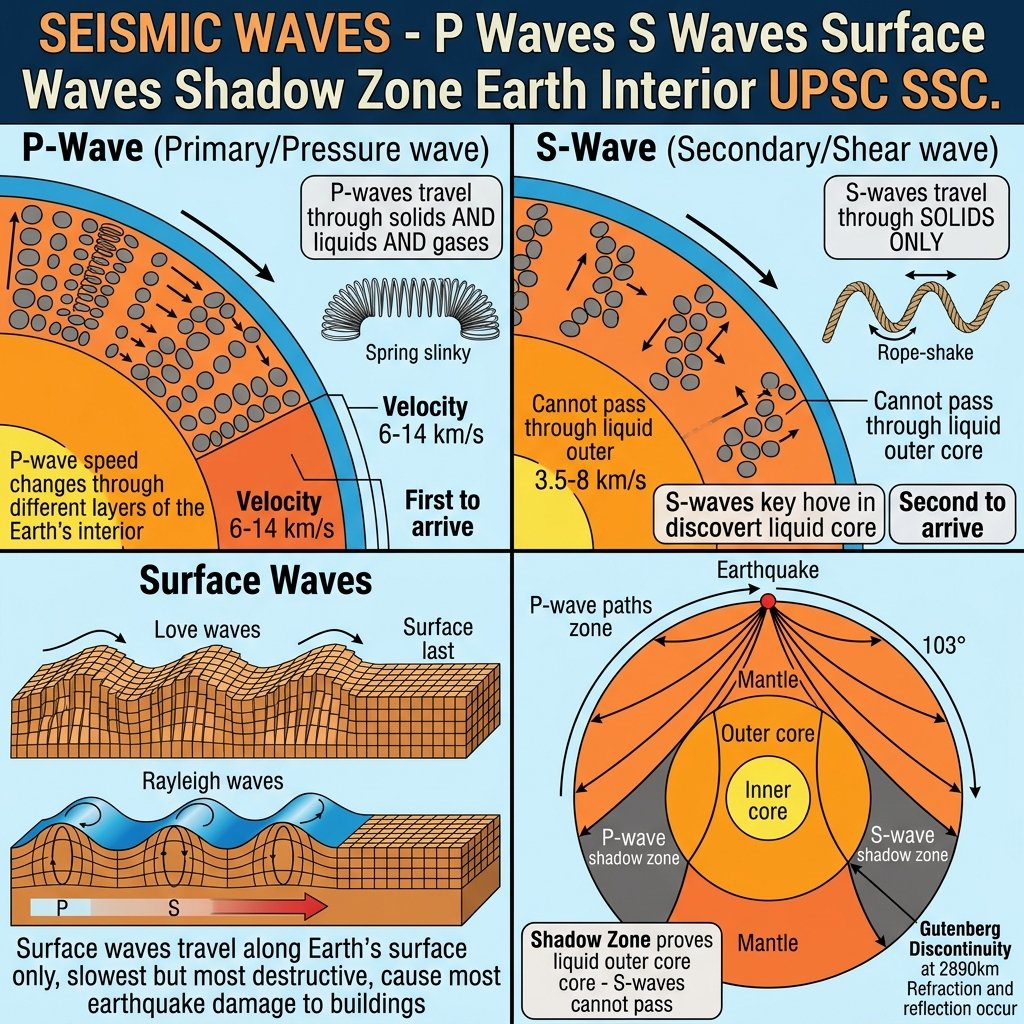
Types of Seismic Waves — Overview
| Wave Type | Class | Particle Motion | Speed | Medium | Key Property |
|---|---|---|---|---|---|
| P-wave (Primary / Pressure / Compressional) | Body wave | Parallel to wave travel direction (push-pull compression) | 6–14 km/s in crust-mantle; ~8 km/s at Moho; ~13.7 km/s at base of mantle; ~8 km/s at top of outer core | Solids, liquids, AND gases — passes through all states of matter | First to arrive at seismograph; analogous to sound wave; can pass through liquid outer core; refracted by Earth’s layers |
| S-wave (Secondary / Shear / Transverse) | Body wave | Perpendicular to wave travel direction (side-to-side or up-down shaking) | 3.5–8 km/s (approximately 1/√3 × P-wave velocity in same material) | Solids ONLY — cannot travel through liquids or gases (liquids have no shear rigidity) | Second to arrive; cannot pass through liquid outer core = S-wave shadow proves outer core is liquid; causes more building damage than P-waves in earthquakes |
| Love wave (LQ) | Surface wave | Horizontal, transverse to wave propagation (side-to-side snake-like motion) | 2–6 km/s (slower than body waves); faster than Rayleigh waves | Surface and shallow subsurface (requires layered crust); does not exist in a homogeneous half-space | Named after A.E.H. Love (1911); most damaging horizontal ground motion; causes foundations to shear horizontally; does not penetrate deep into Earth |
| Rayleigh wave (LR / ground roll) | Surface wave | Elliptical retrograde motion in the vertical plane (like a rolling ocean wave, but retrograde = particles move backward relative to wave direction) | ~0.92 × S-wave velocity in the shallow crust; ~2–5 km/s | Surface and shallow subsurface; penetrates slightly deeper than Love waves | Named after Lord Rayleigh (1885); responsible for the characteristic “rolling” ground motion felt in earthquakes; used in seismic exploration (MASW = Multichannel Analysis of Surface Waves) for shallow subsurface imaging |
P-Waves (Primary Waves) — In Detail
- 🔵 Physical mechanism: P-waves travel as alternating zones of compression and rarefaction (low density) moving through the material in the same direction as the wave propagates; imagine a slinky spring — push one end and a compression pulse travels along the spring; each particle in the medium oscillates back and forth in the direction of wave travel; the spring analogy is exact: P-waves = longitudinal compressional waves
- 🔵 Velocity formula: P-wave velocity (Vp) = √[(K + 4G/3) / ρ], where K = bulk modulus (resistance to compression), G = shear modulus (rigidity), ρ = density; P-wave velocity depends on both the material’s compressibility AND its rigidity; in the liquid outer core (G = 0, no rigidity), P-waves still travel because K ≠ 0 (liquids can be compressed); Vp drops from ~13.7 km/s at base of mantle to ~8 km/s at top of outer core (the Gutenberg Discontinuity) = the sharp velocity drop is the seismic signature of the core-mantle boundary
- 🔵 P-wave velocities by layer: Continental upper crust: ~6.0–6.5 km/s; Lower crust (basaltic): ~6.5–7.0 km/s; Moho boundary: velocity jumps to ~8.0–8.2 km/s (Pn wave = refracted head wave along Moho); upper mantle: ~8.0–9.0 km/s; asthenosphere low velocity zone: ~7.8–8.0 km/s (slightly slower due to partial melt); transition zone (410–660 km): velocity increases in steps at mineral phase transitions; lower mantle: increases 11–13.7 km/s; Gutenberg Discontinuity: drops to ~8 km/s; outer core: increases from 8 to 10.3 km/s; inner core: ~11 km/s
- 🔵 P-wave seismic phases (notation): P = P-wave through mantle only; PP = P-wave reflected from surface once; PPP = reflected twice; PcP = P-wave reflected from core-mantle boundary; PKP = P-wave through mantle + outer core + mantle; PKIKP = P-wave through mantle + outer core + inner core + outer core + mantle (the phase that crosses the centre of Earth); SKS = S-wave converted to P in outer core, back to S; all of these phases are identifiable on seismograms and collectively build our model of Earth’s interior
S-Waves (Secondary Waves) — In Detail
- 🔴 Physical mechanism: S-waves travel as alternating zones where the material shears (slides) perpendicular to the wave’s travel direction; imagine shaking a rope sideways — the wave of displacement travels along the rope but the rope itself moves up and down or side to side; S-waves have two polarisations: SH (horizontal shear) and SV (vertical shear); this shearing motion requires the material to have shear rigidity (elastic resistance to shape change) — a property that solids have but liquids and gases do not
- 🔴 S-wave velocity formula: Vs = √(G / ρ), where G = shear modulus and ρ = density; S-wave velocity depends only on shear rigidity, not bulk modulus; in the liquid outer core, G = 0 (liquid iron has no shear rigidity) therefore Vs = 0 — S-waves simply cannot propagate; this is why the discovery that S-waves are absent beyond 103° from an earthquake (in the “S-wave shadow”) proved that Earth has a liquid outer core
- 🔴 Key seismic phases: S = S-wave through mantle only (direct S); SS = reflected from surface once; ScS = reflected from core-mantle boundary back through mantle; SKS = S-wave converted to P-wave at outer core boundary, travels through liquid outer core as P, reconverts to S on the far side (the K phase notation = Kernwellen, German for “core wave”); SKS can pass through the outer core (as P) even though S-waves cannot = proves outer core converts shear energy to compression
- 🔴 Arrival time difference (S-P interval): The time difference between P and S wave arrivals at a seismograph (S-P time, also written as Ts-Tp) is proportional to the distance from the earthquake source; for every 100 km of epicentral distance, the S-P interval increases by approximately 8–10 seconds; this relationship allows earthquake epicentre location from as few as three seismograph stations (triangulation using S-P intervals from three stations)
Surface Waves — Love and Rayleigh
- 🌊 Why surface waves are most destructive: Surface waves carry most of the seismic energy in large earthquakes (by amplitude at the surface) and travel along the surface where all buildings, infrastructure, and people are located; they have lower frequency (longer period) than body waves and thus resonate with the natural frequency of large structures (buildings 2–20 stories tall), causing dramatic amplification of shaking for structures whose natural period matches the dominant surface wave period; the 1985 Mexico City earthquake (Mw 8.0) caused disproportionate damage in Mexico City 350 km from the epicentre because Lake Texcoco sediments under the city amplified Rayleigh waves to nearly 10× their regional amplitude
- 🌊 Love waves: Named after British mathematician A.E.H. Love who mathematically predicted their existence in 1911 (before they were measured seismically); Love waves require a layered crust — they exist because surface wave energy is trapped between the surface and a deeper, faster layer (the Moho or the asthenosphere); Love wave particle motion is purely horizontal and transverse (perpendicular to wave travel direction) = they shake buildings horizontally in a direction perpendicular to the propagation direction = this horizontal shear is the most damaging motion for masonry and unreinforced concrete structures; Love waves are slightly faster than Rayleigh waves in the same material
- 🌊 Rayleigh waves: Predicted mathematically by Lord Rayleigh in 1885 (decades before seismology became a developed science); Rayleigh waves involve retrograde elliptical particle motion in the vertical plane containing the wave propagation direction (particles move in an ellipse that is retrograde = opposite to normal wave orbital motion, similar to deep water ocean waves); they produce both vertical and horizontal ground motion; slower than Love waves; their velocity depends on crustal thickness and structure (they are dispersive — different frequencies travel at different speeds, allowing seismologists to image crustal and upper mantle structure from the dispersion curve)
The Seismic Shadow Zone — Earth’s Interior Revealed
| Zone | Angular Distance from Epicentre | P-waves | S-waves | Implication |
|---|---|---|---|---|
| Zone 1 — Direct waves | 0° to ~103° | Direct P-waves YES (curved paths through mantle) | Direct S-waves YES (curved paths through mantle) | Normal propagation through solid mantle; waves refract (bend) due to increasing velocity with depth = follow curved paths back to surface |
| Zone 2 — Shadow Zone | ~103° to ~143° | Direct P-waves NO (refracted sharply into core and emerge beyond 143°); weak PKIKP arrivals detectable (Lehmann 1936) | S-waves NO (cannot enter liquid outer core) | The core shadow zone; P-waves refracted by liquid outer core; S-waves blocked by liquid outer core; Gutenberg proved liquid outer core from this zone; Lehmann found solid inner core from anomalous PKIKP arrivals here |
| Zone 3 — PKP emergence | ~143° to 180° | PKP waves YES (P-waves that have travelled through outer core); arrive as distinct phase after the shadow zone gap | SKS waves YES (converted to P through outer core, back to S); direct S-waves NO beyond ~103° | P-waves refracted through liquid outer core emerge here; velocity inversion at core-mantle boundary causes refraction geometry; S-to-P-to-S conversion across outer core allows shear energy to cross the liquid zone |
How Seismic Waves Reveal Earth’s Interior — The Evidence Chain
- 🌍 P-wave refraction curves and Earth’s layers: P-wave travel time vs angular distance follows smooth curves that change slope at boundaries between Earth’s layers; each flat segment of the travel time curve corresponds to waves travelling primarily through one layer; kinks and discontinuities in the curve = boundaries between layers; by inverting many thousands of earthquake travel time observations (the Jeffreys-Bullen tables, 1940, and modern IASP91 and AK135 reference models), seismologists built mathematical models of Earth’s density and velocity structure with depth
- 🌍 S-wave absence proves liquid outer core: The complete absence of S-waves at angular distances greater than 103° (the S-wave shadow zone = the entire hemisphere beyond 103°, not just 103°–143°) is the most direct proof that Earth’s outer core is liquid; S-waves cannot transmit shear stress through liquid iron; Richard Oldham (1906) first reported this as evidence for a core; Harold Jeffreys (1926) formally confirmed the outer core is liquid
- 🌍 PKP (P-through-core) waves confirm liquid-solid core boundary: PKP waves arrive at 143°–180° after crossing the outer core; by comparing PKP travel times with predicted times for different core velocity models, Beno Gutenberg (1914) determined the core-mantle boundary depth at ~2,900 km. The sharp P-wave velocity drop at the Gutenberg Discontinuity (from ~13.7 km/s to ~8 km/s) causes extreme refraction analogous to light entering water from air — the entire P-wave shadow zone (103°–143°) results from this velocity inversion
- 🌍 PKIKP waves and the solid inner core: Anomalous weak P-waves detected in the shadow zone (103°–143°) that arrive at specific times matching refraction at a second velocity discontinuity at ~5,150 km depth led Inge Lehmann (1936) to propose the solid inner core; PKIKP phase = P through mantle (P) + outer core (K) + inner core (I) + outer core (K) + mantle (P); PKIKP waves travel slightly faster than PKP waves at the same distance = inner core has higher P-wave velocity than outer core (~11 km/s vs ~10.3 km/s), confirming it is solid (higher rigidity = higher velocity)
- 🌍 Normal modes (free oscillations): After Mw 9+ earthquakes (e.g., 2004 Indian Ocean Mw 9.1, 2010 Chile Mw 8.8, 2011 Tohoku Mw 9.0), Earth “rings” like a bell for days to weeks in very low frequency oscillations called normal modes or free oscillations; these can be measured on ultra-long-period seismographs; the frequencies of these oscillations are sensitive to Earth’s density and elasticity structure throughout its entire volume; normal mode observations provide independent constraints on Earth’s interior model (complementary to body wave travel times)
⭐ Important for Exams — Quick Revision
- 🔑 Two classes of seismic waves: Body waves (P and S, travel through Earth’s interior) + Surface waves (Love and Rayleigh, travel along surface)
- 🔑 P-waves: Primary + Pressure + Compressional; particle motion = parallel to propagation (push-pull); fastest (6–14 km/s); travel through SOLIDS, LIQUIDS and GASES; first to arrive
- 🔑 S-waves: Secondary + Shear + Transverse; particle motion = perpendicular to propagation; slower (~3.5–8 km/s, 1/√3 × Vp); travel through SOLIDS ONLY; second to arrive; CANNOT pass through liquid outer core
- 🔑 Love waves: A.E.H. Love 1911; horizontal transverse particle motion; faster than Rayleigh; requires layered crust; most damaging horizontal shear to buildings; surface wave
- 🔑 Rayleigh waves: Lord Rayleigh 1885; retrograde elliptical motion in vertical plane; slower than Love; dispersive (frequency-dependent velocity); produces rolling ground motion; surface wave
- 🔑 Arrival order: P (first) → S (second) → Surface waves (last, slowest but largest amplitude)
- 🔑 S-P interval: Time difference between S and P arrivals; proportional to epicentral distance; ~8–10 s per 100 km; used with 3 stations to locate earthquake epicentre
- 🔑 Shadow zone: 103°–143° from epicentre; no direct P or S waves; caused by refraction of P-waves into liquid outer core + S-waves cannot enter liquid; proved both liquid outer core (Gutenberg) and solid inner core (Lehmann)
- 🔑 P-wave shadow = 103°–143°: P-waves refracted sharply by liquid outer core emerge beyond 143° (PKP); shadow zone gap = result of Snell’s law refraction at Gutenberg Discontinuity
- 🔑 S-wave shadow = >103° (entire far hemisphere): S-waves cannot enter liquid outer core at all = shadow extends from 103° all the way around; complete absence proves liquid outer core
- 🔑 Seismic phases notation: P = mantle only; K = outer core (P in liquid); I = inner core (P in solid); c = reflected at CMB; i = reflected at ICB; S = mantle S; PKIKP = full Earth-crossing P wave
- 🔑 P-wave velocity at key boundaries: Moho: jumps 6.5 → 8.0 km/s; Gutenberg CMB: drops 13.7 → 8.0 km/s; Lehmann ICB: increases 10.3 → 11.0 km/s
- 🔑 Richard Oldham (1906): First distinguished P, S, and surface waves from seismogram records; proposed Earth has a core from S-wave observation
- 🔑 Normal modes / free oscillations: Earth rings like a bell after Mw 9+ quakes; days-weeks duration; ultra-low frequency; constrains full Earth density model
- 🔑 1985 Mexico City: Lake Texcoco sediments amplified Rayleigh waves 10× over bedrock; resonance with 2-second period buildings; 9,500+ deaths; classic surface wave amplification example
- 🔑 Seismic anisotropy (inner core): PKIKP waves arrive slightly earlier along Earth’s polar axis than equatorial path = inner core is seismically anisotropic = iron crystals preferentially aligned with rotation axis = solid inner core evidence
Frequently Asked Questions (FAQs)
1. Why can’t S-waves travel through liquids — and what does this prove about Earth’s outer core?
The reason S-waves cannot travel through liquids is rooted in fundamental physics — in the nature of shear stress and how different states of matter respond to deformation. Understanding this leads directly to the most important piece of evidence we have for the liquid state of Earth’s outer core. The physics of shear deformation: When a seismic shear wave (S-wave) propagates through any material, it alternately deforms the material by making adjacent layers slide relative to each other — a motion called shear. Consider a deck of cards stacked on a table: if you push the top card sideways while keeping the bottom card fixed, each intermediate card slides slightly relative to its neighbours — this is shear deformation. For a material to transmit shear waves, it must develop a restoring force when shear-deformed — a tendency to return to its original shape after shearing, analogous to the tension in a stretched string that drives string waves. The physical property that characterises this restoring tendency is the shear modulus (G), also called the modulus of rigidity — it measures how much force is needed to produce a given amount of shear deformation. In perfectly elastic solid materials, G > 0 (often substantially so): steel has G ≈ 79 GPa; granite has G ≈ 25 GPa; mantle peridotite has G ≈ 60–80 GPa. When you apply a shear force to rock, the atomic bonds between mineral grains or atoms resist the deformation and spring back when the force is released = restoring force = shear wave propagates. Why liquids have G = 0: In a liquid (or gas), the molecules are not in fixed positions relative to each other — they flow freely. When you apply a shear force to a liquid, the molecules simply rearrange themselves; there are no atomic bonds holding them in shear-resistant configurations; the liquid flows rather than deforming elastically. Therefore, liquids have a shear modulus G = 0: they provide no resistance to shear deformation and no restoring force for shear waves. Insert G = 0 into the S-wave velocity equation: Vs = √(G/ρ) = √(0/ρ) = 0. S-wave velocity in any liquid = 0 = S-waves cannot propagate through liquids. This is not a quirk of Earth science — it is a fundamental consequence of thermodynamics and molecular structure. How this proves the liquid outer core: Starting in the 1890s, when seismograph networks became sophisticated enough to record distant earthquakes globally, seismologists noticed that seismograph stations at angular distances greater than approximately 103° from an earthquake epicentre did not receive direct S-waves — not faint S-waves, not delayed S-waves, but literally no S-waves at all, even from the largest earthquakes. This is the complete S-wave shadow: from 103° to 180° (the entire far hemisphere), no direct S-waves arrive. In contrast, P-waves do arrive beyond 103° (albeit with a gap between 103° and 143° — the P-wave shadow zone — and as refracted PKP phases beyond 143°). The S-wave’s complete absence beyond 103° admits only one explanation consistent with wave physics: the S-waves’ path from earthquake focus to the far hemisphere must pass through a material where G = 0 — a liquid region. Richard Oldham (1906) was the first to clearly separate P, S, and surface waves on seismograms and to note the S-wave shadow as evidence for a core. Harold Jeffreys (1926) made this argument quantitative and rigorous, calculating the exact size and depth of the liquid outer core from the shadow zone geometry and the known P-wave travel times. The outer core’s depth (2,890 km from the surface = the Gutenberg Discontinuity) places it between where S-waves’ paths would begin entering the core (at 103° epicentral distance) and where they would re-emerge (at 103° on the far side = the complete hemisphere). No S-waves traverse the outer core because the outer core is liquid iron — and liquid iron, like all liquids, has G = 0 and cannot sustain shear waves. This simple physical reasoning, applied to global earthquake data, revealed one of the most extraordinary facts about our planet: Earth’s outer core — 2,260 km thick, containing ~30% of Earth’s mass — is a liquid sea of metallic iron.
2. What is the seismic shadow zone — and how does it reveal Earth’s deep structure?
The seismic shadow zone is a region on Earth’s surface where, after a major earthquake occurs on the opposite side of the globe, both direct P-waves and S-waves fail to arrive — even though earthquake energy travels throughout Earth’s interior. This “deaf spot” in the global pattern of earthquake wave arrivals was the observational puzzle that revealed, layer by layer, the structure of Earth’s deep interior. Why seismic waves bend (refract): Seismic waves do not travel in straight lines through Earth — they travel in curved paths, bending toward lower-velocity material and away from higher-velocity material. This is the same refraction that makes a straw look bent when inserted into water: light bends because it changes speed at the air-water interface. Similarly, as P-waves travel deeper into Earth’s mantle (where velocity generally increases with depth), they are continuously refracted (bent) away from the high-velocity region at depth and back toward the surface — resulting in curved ray paths that emerge at progressively greater angular distances from the epicentre as initial ray angle increases. This refraction in a medium with continuously increasing velocity (the mantle) causes P-waves from a single earthquake to emerge all around Earth at angles from 0° to approximately 103° from the epicentre, following smooth curved paths. The shadow zone boundary at 103°: For angular distances up to ~103°, direct P-waves take smooth curved paths through the mantle and arrive at surface stations. At approximately 103°, the most steeply departing P-waves begin to encounter the Gutenberg Discontinuity (core-mantle boundary at 2,890 km depth) — the boundary where P-wave velocity suddenly drops from ~13.7 km/s (base of mantle) to ~8 km/s (top of outer core). This velocity drop causes extreme refraction (bending) of the P-waves as they enter the outer core — Snell’s law dictates that waves are bent strongly toward the surface when velocity decreases. The geometry is such that P-waves entering the outer core are refracted so strongly that they emerge at angular distances beyond 143° on the far side of Earth — leaving the region between 103° and 143° without any direct P-waves. The shadow zone (103°–143°) is thus a geometrical shadow created by the velocity inversion (velocity decrease) at the core-mantle boundary. The shadow zone boundary at 143°: Beyond 143°, PKP waves (P through outer core) emerge from the outer core and reach the surface. Between 103° and 143°, no direct P-waves arrive — creating the P-wave shadow zone. Between 143° and 180°, PKP waves arrive as a distinct late phase. Inge Lehmann’s inner shadow zone discovery: In 1936, Lehmann noticed that weak P-wave arrivals were appearing on sensitive seismographs within the shadow zone (103°–143°) that should have been empty according to the then-prevailing two-layer model (mantle + liquid outer core). These weak arrivals were too faint and too slow to be surface-reflected waves (PP), yet were unmistakably real signals. By calculating exact ray paths through Earth models with various inner structures, Lehmann found that a solid inner core at radius ~1,220 km (depth 5,150 km) would cause PKIKP waves (crossing the inner core) to emerge within the shadow zone — arriving earlier than PKP waves from the same angular distance because the inner core’s higher P-velocity provides a faster path through the Earth’s centre. The travel time match between Lehmann’s inner core model and the observed shadow zone arrivals proved the existence of the solid inner core. Summary of what the shadow zone revealed: The S-wave shadow (>103° complete) = liquid outer core (G = 0, S-waves blocked). The P-wave shadow (103°–143° gap) = the refraction geometry at the core-mantle boundary velocity inversion = location and depth of the Gutenberg Discontinuity (2,890 km). The weak P-arrivals within the 103°–143° shadow zone = solid inner core at 5,150 km depth (Lehmann Discontinuity). Very faint P-arrivals from the near side of the shadow zone = reflections from the ICB surface (PKiKP waves) = confirm ICB as a sharp seismic boundary. The entire architecture of Earth’s deep interior — unveiled by tracking which waves arrive where, when, and at what strength — was revealed from the seismic shadow zone.
3. What is the difference between Love waves and Rayleigh waves — and why do they cause so much earthquake damage?
In any large earthquake — from the scale of a magnitude 5 local shake to a magnitude 9 subduction zone megaquake — the waves that cause the greatest structural damage to buildings, bridges, and infrastructure are not the fast-moving P-waves and S-waves that arrive first, but the slower surface waves — Love waves and Rayleigh waves — that arrive last but carry the most energy at the surface. Understanding why surface waves are more damaging than body waves, and what distinguishes Love from Rayleigh waves, is fundamental to earthquake engineering and risk assessment. Why surface waves carry more energy at the surface: Body waves (P and S) radiate energy in three dimensions — they spread out as expanding spheres from the earthquake source, so their energy per unit area decreases as the inverse square of distance (1/r²). Surface waves, on the other hand, are constrained to propagate along the two-dimensional surface — they spread as expanding circles, so their energy per unit area decreases only as the inverse of distance (1/r). At large distances from the earthquake, surface waves have substantially higher ground motion amplitude than body waves — which is why recordings of earthquakes at seismograph stations thousands of kilometres away show large-amplitude surface wave arrivals dwarfing the earlier P and S arrivals. Love waves — horizontal shear, most damaging for masonry: Love waves were mathematically predicted by British mathematician and geophysicist A.E.H. Love in 1911 — before the wave type was directly observed on seismograms. This prediction was an extraordinary theoretical achievement: using elasticity theory applied to a layered half-space (a model with two crustal layers of different seismic velocity), Love showed that a type of surface wave would exist in which particle motion is purely horizontal and perpendicular to the direction of wave travel. Think of a snake’s motion: the snake moves forward, but each point along the snake’s body moves sideways left and right as the wave of body curvature passes along it. Love waves give this identical motion to the ground surface. The critical feature: Love wave shaking is purely horizontal. The earth’s surface moves sideways while remaining flat. This horizontal shearing motion is precisely what causes the worst damage to: unreinforced masonry (brick walls not designed for lateral loads shear along mortar joints and collapse), building foundations (the foundation-soil interface shears, causing tilting or offset), and pipelines and underground infrastructure (horizontal ground deformation kinks or breaks pipes running perpendicular to the wave direction). Love waves require a layered crust to exist (they are guided by the velocity contrast between the upper crust and the underlying more-rigid mantle), so they are a specifically crustal phenomenon. Rayleigh waves — rolling motion, most visible to observers: Lord Rayleigh predicted Rayleigh waves in 1885 — 16 years before Love predicted his wave type — also purely from theoretical elasticity analysis, without observational data. Rayleigh waves produce retrograde elliptical particle motion in the vertical plane containing the wave propagation direction: each particle traces an ellipse tilted backward (retrograde) relative to the wave travel direction. The vertical-to-horizontal amplitude ratio of the ellipse varies with frequency and depth. At the surface, the vertical amplitude typically equals 1.5–2× the horizontal amplitude in soft sediments. This retrograde elliptical motion is the “rolling” feeling of the ground observed in large earthquakes — where the earth surface rises on one side and falls on the other as the wave passes, like an ocean swell passing under a ship. Rayleigh waves are responsible for: building resonance effects when the wave period matches a building’s natural period (as in the 1985 Mexico City earthquake, where 8–15 story buildings with ~2-second natural periods resonated catastrophically with 2-second period Rayleigh waves amplified by 40 m of soft lake sediment); liquefaction triggering (the intense cyclic shear in loose, water-saturated sediments pumps pore water pressure upward until the sediment loses all bearing strength = buildings sink or tilt, as seen in 2011 Christchurch, New Zealand); the distinctive visual wave-like ground motion photographed after large earthquakes in Japan and Turkey. Dispersion — frequency dependent velocity: Both Love and Rayleigh waves are dispersive: different frequency components travel at different speeds (lower frequencies/longer periods travel faster because they penetrate to greater depths where rock is faster). This dispersion means surface waves from distant earthquakes arrive as a series of ever-shortening period wave trains (called “wave groups”) rather than as a single impulsive arrival. This dispersion is not just a nuisance for seismologists — it is a tool: by measuring the group velocity of surface waves at different frequencies (dispersion curve), seismologists can invert for the S-wave velocity structure of the crust and upper mantle along the path, building tomographic images of continental and oceanic crust. This technique (surface wave tomography) is one of the primary methods for imaging the lithosphere at regional to global scales.
Related Geology Articles on StudyHub
- ➡️ Lehmann Discontinuity — PKIKP Waves & Inner Core Discovery
- ➡️ Earthquakes — Focus, Epicentre, Seismograph, Richter Scale
- ➡️ Seismic Zones of India — Zone I to Zone V
- ➡️ Isostasy — Crustal Floating & Mantle Properties
- ➡️ Earth’s Magnetic Field — Geodynamo & Seismic Evidence