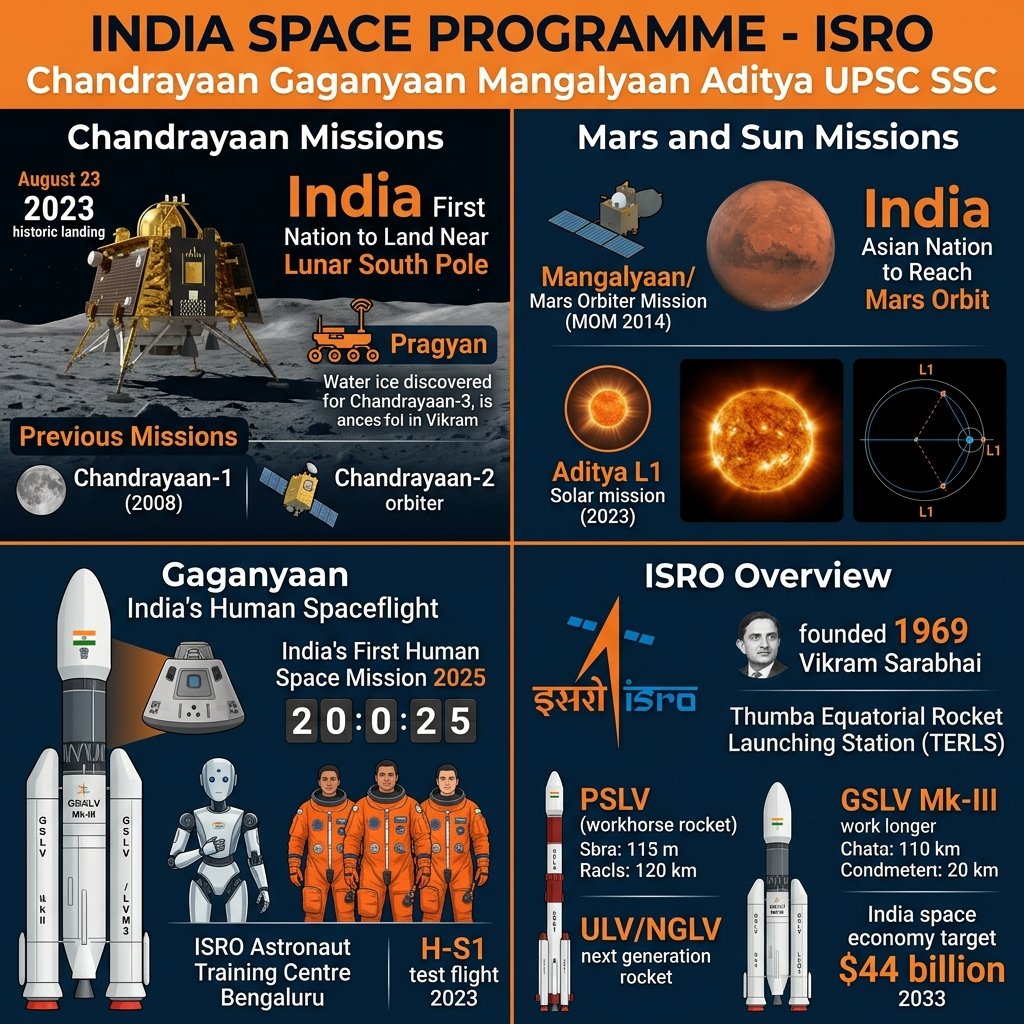
India’s space programme is one of the most extraordinary stories in 20th and 21st century science — a nation that launched its first rocket carrying components on a bicycle in 1963 has become the 4th country to soft-land a spacecraft on the Moon (Chandrayaan-3, August 23, 2023), the first nation to reach Mars orbit on its first attempt (Mangalyaan, 2014), the first to land near the lunar south pole, and the operator of one of the world’s most cost-effective launch programmes (PSLV at ~$15 million/launch vs SpaceX Falcon 9 at ~$67 million). ISRO (Indian Space Research Organisation), founded in 1969 under Vikram Sarabhai, operates the world’s largest commercial satellite launch record (PSLV-C37 launched 104 satellites in one mission, 2017) and is preparing India’s first crewed spaceflight mission Gaganyaan. The Indian space economy — valued at $8.4 billion in 2023 — is targeted to reach $44 billion by 2033, with the newly opened private space sector (IN-SPACe framework, 2020) expected to drive 5x growth. Understanding ISRO’s history, key missions, launch vehicles, Earth observation applications, and India’s space economy strategy is essential for UPSC, SSC, and all competitive examinations.
ISRO — Foundation & Historical Milestones
- 🚀 Inception: India’s space journey began under Dr. Vikram Sarabhai — the “Father of India’s Space Programme” — who convinced the government in 1962 that space technology was essential for India’s development (communications, weather forecasting, remote sensing for agriculture and floods); the Indian National Committee for Space Research (INCOSPAR) was established 1962 under Sarabhai
- 🚀 First rocket launch (November 21, 1963): A sounding rocket called Nike Apache was launched from Thumba Equatorial Rocket Launching Station (TERLS), Thiruvananthapuram, Kerala; the nose cone components were transported to the launch site on a bicycle (now iconic image in ISRO history); Thumba was chosen because it is near the magnetic equator — ideal for ionospheric research
- 🚀 ISRO established (August 15, 1969): Indian Space Research Organisation formally established by Dr. Vikram Sarabhai; headquartered in Bengaluru (Space Applications Centre also at Ahmedabad); Vikram Sarabhai passed away in December 1971; Prof. Satish Dhawan succeeded him — under Dhawan, ISRO built its first indigenous launch vehicle (SLV-3) and first experimental satellite (Aryabhata)
- 🚀 Aryabhata (April 19, 1975): India’s first satellite; 360 kg; designed and fabricated by ISRO; launched from Soviet Union (USSR’s Kapustin Yar); named after India’s ancient mathematician astronomer; carried X-ray astronomy and ionosphere experiments; April 19 is now celebrated as National Space Day
- 🚀 SLV-3 (July 18, 1980): India’s first indigenously developed satellite launch vehicle; first successful launch placed Rohini satellite RS-1 in orbit; India became the 6th country to achieve indigenous satellite launch capability; Dr. A.P.J. Abdul Kalam was Project Director of SLV-3 — the success launched his public profile; SLV-3 was a 4-stage solid-fuel rocket
- 🚀 Key chairmen legacy: Vikram Sarabhai (founder-vision); Satish Dhawan (institutional builder, SLV era); U.R. Rao (INSAT revolution); K. Kasturirangan (PSLV operational, IRS expansion); G. Madhavan Nair (Chandrayaan-1, PSLV-C11); K. Radhakrishnan (Mangalyaan, GSLV success); A.S. Kiran Kumar; K. Sivan; S. Somanath (Chandrayaan-3 success, current)
Launch Vehicles — PSLV, GSLV & LVM3
| Vehicle | Type | Payload Capacity | Key Facts |
|---|---|---|---|
| PSLV (Polar Satellite Launch Vehicle) | 4-stage rocket (alternating solid + liquid); 44m tall; 294 tonnes | 1,750 kg to Sun-Synchronous Orbit (SSO); 3,800 kg to Low Earth Orbit (LEO) | ISRO’s most reliable workhorse; 59 successful missions (as of 2026, out of 60 total); launched Chandrayaan-1, Mangalyaan, Aditya-L1; commercial launches for foreign satellites; PSLV-C37 (Feb 2017) = record 104 satellites in one launch (world record at time); launch cost ~$15M = world’s cheapest |
| GSLV Mk-II (Geosynchronous SLV Mk-II) | 3-stage (2 solid + cryogenic upper stage); 49m tall; 415 tonnes | 2,250 kg to Geosynchronous Transfer Orbit (GTO) | India mastered indigenous cryogenic engine (CE-7.5) after being denied technology by USA in 1990s; GSLV Mk-II = launcher for heavier communication satellites in higher orbits; 14 missions, 8 successes; used for GSAT satellites; critical indigenous capability |
| LVM3 / GSLV Mk-III (Launch Vehicle Mark-3) | 3-stage (2 strap-on solid + liquid core + cryogenic); 43.5m; 640 tonnes | 4,000 kg to GTO; 10,000 kg to LEO | India’s heaviest rocket; launched Chandrayaan-2 (2019), Chandrayaan-3 (2023), OneWeb commercial satellites; will carry Gaganyaan crew; CE-20 cryogenic engine (most powerful Indian engine); 7 missions, 7 successes; India’s entry into heavy commercial launch market |
| SSLV (Small Satellite Launch Vehicle) | 3-stage all-solid; 34m; 120 tonnes | 500 kg to LEO; 300 kg to SSO | New vehicle for small satellite market (proliferating commercial small sats); very fast integration time (72 hours vs 70 days for PSLV); low cost; SSLV-D1 failed 2022 (orbit mismatch); SSLV-D2 succeeded 2023; SSLV-D3 success 2024 |
| NGLV / Unified Launch Vehicle (ULV) | Next-generation semi-cryogenic; under development | 10,000 kg to GTO | India’s future heavy-lift rocket; reusable first stage goal; semi-cryogenic engine (SC-200) under development; will replace both PSLV and GSLV Mk-II; targeted for first flight ~2030; critical for Gaganyaan follow-on missions and lunar/deep space goals |
Key ISRO Missions
Chandrayaan Series — Moon Missions
- 🌙 Chandrayaan-1 (October 22, 2008): India’s first Moon mission; PSLV-C11; 1,380 kg spacecraft; entered lunar orbit Nov 2008; key payload: Moon Impact Probe (MIP) — crash-landed on lunar south pole (Shackleton Crater area) on November 14, 2008; Moon Mineralogy Mapper (M3) — NASA instrument; detected water ice molecules in permanently shadowed regions near lunar poles = first definitive detection of water on Moon; mission exceeded all objectives; contact lost August 2009 (29 months mission vs planned 2 years); legacy: confirmed lunar polar water = basis for all subsequent Moon base planning globally
- 🌙 Chandrayaan-2 (July 22, 2019): Composed of Orbiter + Vikram Lander + Pragyan Rover; GSLV Mk-III-M1; entered lunar orbit August 20, 2019; attempted soft landing September 7, 2019; Vikram lander crashed on landing (braking thrust anomaly caused loss of communication 2.1 km above surface); Orbiter continues to function perfectly — 96% of mission science objectives achieved by Orbiter alone; Chandrayaan-2 Orbiter mapped lunar surface with 1:100,000 scale precision; remains operational in lunar orbit
- 🌙 Chandrayaan-3 (July 14, 2023): ISRO’s triumphant mission; GSLV Mk-III-M4; Vikram lander + Pragyan rover (no orbiter — used Chandrayaan-2 orbiter for communication); HISTORIC: Vikram landed successfully at lunar south pole region on August 23, 2023 at 6:04 PM IST — India became the 4th country to achieve lunar soft landing (after USSR, USA, China) and the FIRST country to land near the lunar south pole; Pragyan rover deployed; operated for 14 Earth days (one lunar day); discoveries: confirmed sulphur, iron, oxygen in lunar south pole soil; detected temperature gradient (surface = 50°C, 80mm below = -10°C, exceptional for scientific understanding); seismic activity (moonquake) recorded; plasma environment measured; August 23 declared National Space Day by PM Modi at ISRO
Mangalyaan — Mars Orbiter Mission (MOM)
- 🔴 Launch: November 5, 2013; entered Mars orbit September 24, 2014; 5 November 2013 = Diwali day, ISRO scientists worked through the festival
- 🔴 Historic firsts: India = first Asian nation to reach Mars orbit; India = first nation to succeed in Mars on its first attempt (USA took 4 attempts, USSR 8+ attempts, ESA 1 failure before India); developed and executed in 15 months (typical Mars missions take 5–9 years); total cost = Rs 450 crore (~$74 million) = cheaper than the Hollywood film “The Martian” ($108M production budget) and cheaper than a New Delhi Metro rail extension; 5 scientific instruments measured Mars methane, upper atmosphere composition, surface morphology
- 🔴 Legacy: Proved India’s capability for deep space missions; demonstrated ISRO’s fiscal efficiency (same budget, same timeline, high success probability = Indian Space Model); MOM operated for 8 years in Mars orbit (planned 6 months); contact lost September 2022 when battery depleted
Aditya-L1 — Sun Mission
- ☀️ Launch: September 2, 2023 (PSLV-C57); entered Lagrange Point 1 (L1) halo orbit on January 6, 2024 = India’s first solar observatory mission in space
- ☀️ What is Lagrange Point 1: L1 is one of five Lagrange Points around Sun-Earth system where gravitational forces balance; located ~1.5 million km from Earth (between Earth and Sun); spacecraft at L1 maintains a stable position relative to Earth without fuel; ideal for continuous solar observation without Earth blocking the view; NASA’s SOHO and ACE missions also orbit L1
- ☀️ Science objectives: 7 payloads studying: solar corona heating (why corona at 1,000,000°C is hotter than solar surface at 5,500°C = an unsolved mystery); solar wind origin and dynamics; solar flares and Coronal Mass Ejections (CMEs) that affect Earth’s magnetic field and satellites (space weather prediction); photospheric and chromospheric dynamics; India’s first contribution to space weather monitoring network
Gaganyaan — India’s Crewed Mission
- 👨🚀 Overview: India’s first Human Space Flight programme; will make India the 4th nation to independently send humans to space (after USSR/Russia, USA, China); crew module designed for 3 astronauts; 400 km LEO orbit; 3-day mission; return via ocean splashdown (Bay of Bengal); LVM3 (GSLV Mk-III) as launch vehicle
- 👨🚀 Timeline: TV-D1 (Test Vehicle abort mission = October 21, 2023) — successfully tested crew escape system (Crew Escape System = CES = if rocket fails after launch, CES fires instantly pulling crew module away from rocket = most critical safety system); G1 (uncrewed Gaganyaan) planned 2025; G2 (Vyommitra robot + sensors) planned; G3 (crewed) planned 2026; 4 IAF pilots selected, trained in Russia (Gagarin Cosmonaut Training Centre)
- 👨🚀 Vyommitra: Humanoid robot developed by ISRO; name means “friend of space” (Vyom = sky in Sanskrit); will fly on uncrewed Gaganyaan missions; mimics human body functions, monitors cabin environment, operates systems; India’s first space robot; developed at ISRO’s Vikram Sarabhai Space Centre (VSSC), Thiruvananthapuram
- 👨🚀 Astronauts selected: Group Captain Prasanth Balakrishnan Nair (Mission Commander), Group Captain Ajit Krishnan, Group Captain Angad Pratap, Wing Commander Shubhanshu Shukla; all IAF test pilots; trained at GCTC Russia 2020–21; additional training at ISAC Bengaluru; Shubhanshu Shukla to fly on Axiom Space Mission (ISS) in 2025 as part of ISRO-NASA collaboration — making him the first Indian in space since Rakesh Sharma (1984)
Earth Observation & Applications — ISRO’s Development Mandate
- 🛰️ INSAT / GSAT (communication satellites): India’s INSAT series (Indian National Satellite System) revolutionised communication in India — launched from 1982 onwards; provides DTH TV, broadcast, telecommunications, internet backhaul, disaster warning dissemination; as of 2026 India operates 50+ communication satellites; INSAT-based cyclone warning system is part of the Odisha Model’s early warning infrastructure (satellite-transmitted warnings reaching villages)
- 🛰️ IRS (Indian Remote Sensing) — Earth observation: India’s IRS series = world’s largest civilian Earth observation constellation (35+ satellites in orbit); applications: crop acreage estimation (FASAL programme — estimates foodgrain production from satellite before harvest for MSP procurement planning); forest fire detection; flood inundation mapping (NDMA uses ISRO flood maps in real-time); urban sprawl monitoring; groundwater depletion assessment; coastal erosion mapping; glacier monitoring (National Glacier Inventory from ISRO data)
- 🛰️ Navigation — NavIC (Navigation with Indian Constellation): India’s own GPS equivalent; 7 satellites (3 geostationary + 4 geosynchronous); covers India and 1,500 km around India; accuracy = 10 metres (better than GPS’s 20-metre public accuracy) in South Asia; all Android phones sold in India after 2019 must include NavIC receiver (BIS standard); used for: fisherman distress alert system, public transport tracking, precision agriculture, emergency response
- 🛰️ Meteorological satellites — INSAT-3D/3DR: India’s meteorological satellites; provide data to IMD (India Meteorological Department) for weather forecasting and cyclone tracking; 30-minute image frequency over India; the 5-day advance cyclone track that IMD now provides (dramatically improving Odisha Model’s evacuation window) is entirely based on ISRO satellite data; India’s cyclone preparedness was impossible without indigenous weather satellites
Private Space & New Space Economy
- 🏭 IN-SPACe (Indian National Space Promotion and Authorisation Centre): Established 2020; single-window regulator for private sector space activities in India; before IN-SPACe, India’s space sector was entirely government (ISRO) monopoly; IN-SPACe allows private companies to build rockets, launch satellites, operate ground stations; game-changer for India’s space economy
- 🏭 NSIL (New Space India Limited): ISRO’s commercial arm; markets PSLV/LVM3 launches globally; manufactures PSLV (80% private sector components now); commercial launch revenue; launched OneWeb satellites (UK), Amazon Kuiper satellites (planned)
- 🏭 Private space startups: Agnikul Cosmos (Chennai, developed world’s first fully 3D-printed rocket engine Agnibaan SOrTeD, test launched 2024), Skyroot Aerospace (Hyderabad, Vikram-S = India’s first private rocket launch November 2022 — a suborbital milestone), Pixxel (Earth observation small satellites), Dhruva Space (satellite services), Bellatrix Aerospace (satellite propulsion), GalaxEye (multi-sensor satellite imaging); 400+ space-tech startups registered by 2026
- 🏭 India’s space economy target: Current: $8.4 billion (2023); target: $44 billion by 2033; India’s share of global space economy = currently 2–3%; target = 9–10% by 2033; key growth areas: satellite manufacturing (export), launch services (commercial), Earth observation data analytics, satellite communication services
Future Missions — India’s Space Roadmap
| Mission | Target | Timeline | Objective |
|---|---|---|---|
| Gaganyaan G1 (uncrewed) | Low Earth Orbit (400 km) | 2025 | First orbital test of full Gaganyaan system without crew; validate life support, navigation, splashdown |
| Gaganyaan G3 (crewed) | Low Earth Orbit (400 km) | 2026 | India’s first crewed spaceflight; 3 IAF astronauts; 3-day mission; Bay of Bengal splashdown |
| Chandrayaan-4 | Moon (sample return) | 2027–28 | Collect lunar samples from south pole and return to Earth; India’s first sample-return mission; precursor to human Moon landing |
| NISAR (NASA-ISRO SAR) | Earth orbit (Low) | 2025 | Joint NASA-ISRO Synthetic Aperture Radar satellite; most expensive Earth-observation satellite India-USA have collaboratively built; maps Earth’s surface every 12 days; agriculture, disaster, glaciology |
| Shukrayaan-1 | Venus orbit | 2028 | India’s first Venus orbiter; study Venus atmosphere, surface, volcanic activity; ISRO to join NASA VERITAS + ESA EnVision in Venus exploration decade |
| Bharatiya Antariksha Station (BAS) | Low Earth Orbit | 2035 | India’s own space station; first module target 2028; PM Modi announced as national goal; follows ISS retirement plans; crewed permanently |
| India Moon Landing (crewed) | Lunar south pole | 2040 | PM Modi announced India’s moon landing target 2040; requires NGLV heavy rocket + Chandrayaan-4 sample return + Gaganyaan crewed capability; lander design to begin post-Gaganyaan success |
⭐ Important for Exams — Quick Revision
- 🔑 ISRO founded: August 15, 1969; by Dr. Vikram Sarabhai (“Father of India’s Space Programme”); HQ Bengaluru; INCOSPAR preceded it (1962)
- 🔑 First rocket: November 21, 1963; Nike Apache sounding rocket from TERLS, Thumba, Kerala; components carried on bicycle; Thumba = near magnetic equator
- 🔑 Aryabhata: India’s first satellite; April 19, 1975; launched from USSR; National Space Day = April 19
- 🔑 SLV-3: India’s first indigenous rocket; July 18, 1980; Rohini satellite RS-1; Dr. APJ Abdul Kalam = Project Director; 4-stage solid fuel; India = 6th country indigenous satellite launch
- 🔑 PSLV: 4-stage solid+liquid alternating; 1,750 kg SSO; most reliable workhorse; PSLV-C37 = 104 satellites in one launch (2017, world record at time); cost ~$15M; launched Chandrayaan-1, Mangalyaan, Aditya-L1
- 🔑 LVM3 / GSLV Mk-III: 10,000 kg to LEO; 4,000 kg GTO; CE-20 cryogenic engine; launched Chandrayaan-2, Chandrayaan-3; will launch Gaganyaan; 7/7 success rate
- 🔑 Chandrayaan-1 (2008): First Moon mission; Moon Impact Probe landed November 14, 2008; M3 (NASA) detected water ice in lunar poles = historic discovery; contact lost 2009
- 🔑 Chandrayaan-2 (2019): Vikram lander crashed (2.1 km above surface); Orbiter fully operational; 96% mission objectives achieved by Orbiter alone
- 🔑 Chandrayaan-3 (August 23, 2023): Vikram landed at 6:04 PM IST at lunar south pole; India = 4th soft-landing country AND first at south pole; Pragyan rover confirmed S, Fe, O in soil; temperature gradient, moonquake, plasma detected; August 23 = National Space Day
- 🔑 Mangalyaan / MOM (September 24, 2014): India = first Asian nation in Mars orbit; first nation to succeed on first attempt; Rs 450 crore (~$74M); 15 months development; contact lost September 2022 after 8 years
- 🔑 Aditya-L1 (September 2, 2023): India’s first solar observatory; PSLV-C57; entered L1 halo orbit January 6, 2024; studies solar corona heating mystery, solar wind, CMEs, space weather
- 🔑 Gaganyaan: India’s first crewed mission; 4th country to independently send humans to space; LVM3 rocket; 3 astronauts; 400 km LEO; 3-day mission; TV-D1 crew escape test = October 2023 (success); 4 IAF pilots selected
- 🔑 Vyommitra: ISRO humanoid robot; “friend of space”; will fly on uncrewed Gaganyaan; developed at VSSC Thiruvananthapuram
- 🔑 Shubhanshu Shukla: IAF Wing Commander; selected for Axiom Space Mission (ISS) 2025 = first Indian in space since Rakesh Sharma (1984); part of ISRO-NASA collaboration
- 🔑 Rakesh Sharma: First Indian in space; April 2, 1984; Soviet Soyuz T-11; spent 7 days, 21 hours, 40 minutes in space; famous quote to Indira Gandhi = “Sare Jahan Se Achha” (India looks best from space)
- 🔑 NavIC: India’s GPS equivalent; 7 satellites; 10m accuracy; 1,500 km coverage around India; mandatory in new Android phones sold in India since BIS 2019 standard
- 🔑 IN-SPACe (2020): Opens space to private sector; single-window regulator; Skyroot Vikram-S = first Indian private rocket (November 2022); Agnikul Cosmos 3D-printed rocket engine
- 🔑 India space economy: $8.4B (2023); target $44B by 2033; India moon landing target 2040; Indian Space Station (BAS) by 2035; Chandrayaan-4 sample return 2027; Shukrayaan-1 Venus 2028
Frequently Asked Questions (FAQs)
1. Why did India land at the lunar south pole — and what minerals did Chandrayaan-3 discover?
When India’s Chandrayaan-3 mission placed Vikram lander down on the lunar south pole region on August 23, 2023, the choice of landing site was not arbitrary or nationalistic — it was the most scientifically and strategically significant location on the Moon. Understanding why requires understanding what the lunar south pole is, what makes it geologically and economically unlike any other part of the Moon, and what Chandrayaan-3’s instruments actually found once they were there. Why the lunar south pole: The Moon’s axial tilt is only 1.5 degrees (compared to Earth’s 23.5 degrees). This means the Sun always shines nearly horizontally on the lunar poles. In polar craters where the Sun never rises above the crater rim (called “Permanently Shadowed Regions” or PSRs), temperatures fall to -230°C to -250°C — among the coldest naturally occurring temperatures in the Solar System. At these extreme cold temperatures, volatile compounds (water ice, methane, ammonia, carbon dioxide) that landed on the Moon from comets, asteroids, and solar wind over billions of years cannot escape — they are thermally trapped in the PSR regolith. This means the lunar south pole potentially contains billions of tonnes of water ice — confirmed initially by Chandrayaan-1’s Moon Impact Probe (2008) and NASA’s LCROSS impact mission (2009). Why does water ice matter? H2O can be split into hydrogen and oxygen — rocket propellant. A Moon base with access to lunar water could manufacture its own rocket fuel, dramatically reducing the cost of further space exploration (no need to carry propellant from Earth). The lunar south pole may effectively be the “gas station” for all future deep space exploration from the Earth-Moon system. This is why every major space power (NASA with Artemis programme, China with CNSA Chang’e 6/7, Russia with Luna 25, ISRO with Chandrayaan-3) has prioritised the lunar south pole. What Chandrayaan-3 discovered: The Vikram lander deployed the Pragyan rover for 14 Earth days (one lunar day) before it entered dormant mode (India had designed it only for one lunar day; it did not revive as hoped after the 14-day lunar night). During this active period, Pragyan’s instruments — LIBS (Laser-Induced Breakdown Spectroscopy) and APXS (Alpha Particle X-ray Spectrometer) — made direct in-situ measurements of the lunar south pole soil: (1) Sulphur (S) confirmed in far higher concentrations than expected — suggesting volcanic processes different from elsewhere on Moon; (2) Iron (Fe), Oxygen (O), Silicon (Si), Calcium (Ca), Aluminium (Al), Chromium (Cr), Titanium (Ti), Manganese (Mn) detected as expected (all known lunar minerals); (3) Temperature gradient: Vikram’s ChaSTE probe found the lunar surface temperature at the south pole = approximately 50°C in sunlit hours; just 80mm below the surface = approximately -10°C to -20°C (astonishing 60–70°C gradient over just 80mm depth = very low thermal conductivity of lunar regolith); this data is critical for future Moon base design (insulation requirements); (4) Plasma density: RAMBHA measured near-surface plasma ion and electron density; (5) Seismic activity: The ILSA instrument recorded a “moonquake-like event” on August 26, 2023 — and separately recorded the impact of what appeared to be another celestial object hitting the Moon. Chandrayaan-3’s most important finding in context: by being the first spacecraft to operate at the south pole’s surface, India established ground truth for all the orbital data from previous missions — confirming that the south pole’s surface is geologically distinctive and justifying the global focus on this location for future human bases.
2. How did India build the Mars Orbiter Mission for less than the cost of a Hollywood film?
The Mars Orbiter Mission (MOM) / Mangalyaan is one of the most studied cases in modern project management and engineering economics — a mission that achieved what only the USA, USSR, and ESA had managed before, at a price point that provoked disbelief in the international space community. Its total cost of Rs 450 crore (~$74 million USD) was less than the production budget of the Hollywood film “The Martian” ($108 million) — a film whose premise was the difficulty of surviving on Mars — and significantly less than a single New Delhi Metro line extension. How did ISRO do it? Technology heritage maximisation: ISRO did not build Mangalyaan’s spacecraft from scratch. Every subsystem — onboard computers, attitude control, solar panels, communication antennas, propulsion systems — was adapted from the existing PSLV and IRS (Indian Remote Sensing) satellite repertoire. ISRO engineers had decades of experience with these components; they knew their failure modes, maintenance requirements, and operational limits. Rather than developing purpose-built Mars hardware, they systematically asked: “what existing ISRO component can do this function, modified to Mars mission requirements?” This heritage-based approach dramatically reduced both development cost and schedule risk. The 15-month development sprint: MOM was announced in August 2012 and launched November 5, 2013 — a 15-month development period for an interplanetary mission compared to typical development times of 5–9 years for Mars missions by other agencies. This was only possible because: (a) ISRO co-located all project teams in one building at ISAC Bengaluru eliminating coordination delays; (b) Heritage hardware reduced design iterations; (c) Indian engineers were paid Indian salaries (cost-of-living differential = significant factor; Indian aerospace engineer salary = $8,000–15,000/year vs NASA equivalent = $80,000–120,000/year at comparable experience levels); (d) ISRO has a culture of long working hours and mission dedication that compressed timelines organisationally. Minimalist but sufficient science payload: Rather than carrying heavy, high-cost science instruments, MOM carried 5 relatively simple and lightweight instruments (total payload mass = 15 kg): Methane Sensor for Mars (MSM), Mars Exospheric Neutral Composition Analyser (MENCA), Mars Color Camera (MCC), Thermal Infrared Imaging Spectrometer (TIS), Lyman Alpha Photometer (LAP). These instruments achieved meaningful science: the Mars Color Camera provided the highest-resolution Indian planetary images; MSM searched for methane (a potential biosignature, though no definitive detection was made); LAP studied deuterium/hydrogen isotope ratio suggesting how Mars lost its water over geological time. Trajectory design innovation: India’s scientists at ISAC Bengaluru, working with limited computing resources compared to NASA’s Jet Propulsion Laboratory, used a particularly elegant “slingshot” Earth gravity assist trajectory design — performing multiple orbit-raising manoeuvres in Earth orbit before the Trans-Mars Injection burn — which allowed PSLV (a much smaller rocket than would normally be used for a Mars mission) to provide the initial energy, using Earth gravity to reach Mars escape velocity. This trajectory design would not have been feasible without extremely precise calculation — a testament to ISRO’s mathematical competence. The broader lesson: Mangalyaan’s success has been studied by space agencies globally as a model for cost-effective space exploration. The Indian Model — heritage hardware + co-located teams + salary differential + minimalist but adequate science + innovative trajectory design — suggests that space exploration need not cost billions to be scientifically valuable. India’s subsequent demonstration of Chandrayaan-3’s success (also achieved at far lower cost than NASA or ESA equivalent missions) reinforces that cost-effective excellence is a replicable approach, not a one-off achievement.
3. What is Gaganyaan — and why is crewed spaceflight important for India’s space ambitions?
Gaganyaan (from Sanskrit: Gagana = sky, Yaan = vehicle = “Sky Vehicle”) is India’s first human spaceflight programme — a mission that, when successful, will make India only the 4th nation in history to independently send human beings into space (after the Soviet Union/Russia in 1961, the United States in 1962, and China in 2003). But Gaganyaan’s significance goes far beyond national prestige — it is the technical foundation for every other space ambition India has articulated for the 2030s and 2040s, including a Moon landing and an Indian space station. The mission profile: Gaganyaan will carry 3 Indian Air Force astronauts in a crew module to Low Earth Orbit at 400 km altitude — the same orbital altitude as the International Space Station (ISS). The crew will spend 3 days in orbit before the crew module re-enters Earth’s atmosphere and splashes down in the Bay of Bengal, to be recovered by Indian Navy ships. The launch vehicle is GSLV Mk-III (now officially renamed LVM3) — India’s heaviest rocket with a CE-20 cryogenic upper stage; this will be LVM3’s first human-rated flight. Before any crew flies, the mission sequence includes: (1) TV-D1 (Test Vehicle Pad Abort Demonstration): completed October 21, 2023 — successfully tested the Crew Escape System (CES), which uses a 35-second solid rocket burst to pull the crew module safely away from the main rocket in case of a launch failure; this is the most critical safety technology; (2) G1 (Uncrewed Gaganyaan): planned 2025 — full orbital mission without crew to validate all systems (life support, attitude control, re-entry, parachute, sea recovery); (3) G2: Vyommitra humanoid robot mission; (4) G3 (Crewed): planned 2026. The 4 astronauts: Group Captain Prasanth Balakrishnan Nair, Group Captain Ajit Krishnan, Group Captain Angad Pratap, and Wing Commander Shubhanshu Shukla — all IAF test pilots who underwent 13 months of cosmonaut training at Russia’s Gagarin Cosmonaut Training Centre (GCTC) in Star City (2020–21) followed by extensive India-based training at ISRO’s Human Space Flight Centre (HSFC) in Bengaluru. Shubhanshu Shukla was additionally selected for NASA’s Axiom Space Mission 4 to the ISS (planned 2025) — making him the first Indian in space since Rakesh Sharma’s iconic 1984 Soviet mission; this ISS flight serves as pre-Gaganyaan experience for ISRO in human spaceflight operations. Why crewed spaceflight matters for India’s space vision: (1) Technology forcing: Gaganyaan requires India to master 19 “critical technologies” it previously lacked: environmental control and life support systems (ECLSS — maintaining breathable air, temperature, humidity for humans in vacuum); human-rated propulsion (rocket reliability requirements are dramatically stricter for crew than for satellites — a satellite failure is a commercial loss; a crew failure is a national tragedy); emergency abort systems; crew module re-entry thermal protection; biomedical monitoring; space food and waste management; advanced rendezvous and docking (for future space station operations). Each of these technologies has both pure space applications and potential dual-use or civilian industrial applications. (2) Space station prerequisites: India’s announced Bharatiya Antariksha Station (BAS) — planned first module by 2028, full operational by 2035 — requires continuous human presence capability. BAS will support both pure science (microgravity physics, biology, materials science) and Earth observation, and serve as a diplomatic and commercial platform for cooperation with other nations (similar to how ISS serves US soft power). Without Gaganyaan first, BAS is impossible. (3) Moon landing prerequisite: India’s 2040 Moon landing goal requires everything Gaganyaan develops plus substantially more — a heavier rocket (NGLV/ULV or multiple LVM3 launches with on-orbit assembly), a cislunar transport capability, a Moon lander, and surface operation systems. The sequential logic: Gaganyaan proves India can keep humans alive in LEO; BAS proves India can operate humans in space for extended periods; Moon mission proves India can extend that to cislunar space. Each mission builds on the last. (4) Economic and talent ecosystem: India’s $44 billion space economy target by 2033 requires world-class space engineering talent to remain in India rather than emigrating to NASA, ESA, or SpaceX. An Indian astronaut programme — with the aspiration of India as a crewed spaceflight nation — creates inspirational pull for STEM careers in India at a scale that no amount of government recruitment advertising can replicate. Chandrayaan-3’s August 23, 2023 landing was watched live by 80 million people on YouTube — more than any India-cricket match at peak — and applications to ISRO’s recruitment cycles surged 400% in the following weeks.
Related Geology Articles on StudyHub
- ➡️ Glaciers — ISRO Satellite Monitoring of Himalayan Glaciers
- ➡️ Natural Disasters — ISRO Flood Maps & IMD Satellite Cyclone Data
- ➡️ Disaster Management — ISRO Remote Sensing in NDMA Operations
- ➡️ Island Territories — NavIC Maritime & INSAT Cyclone Warning
- ➡️ J&K & Ladakh — ISRO Satellite Intelligence & Border Monitoring