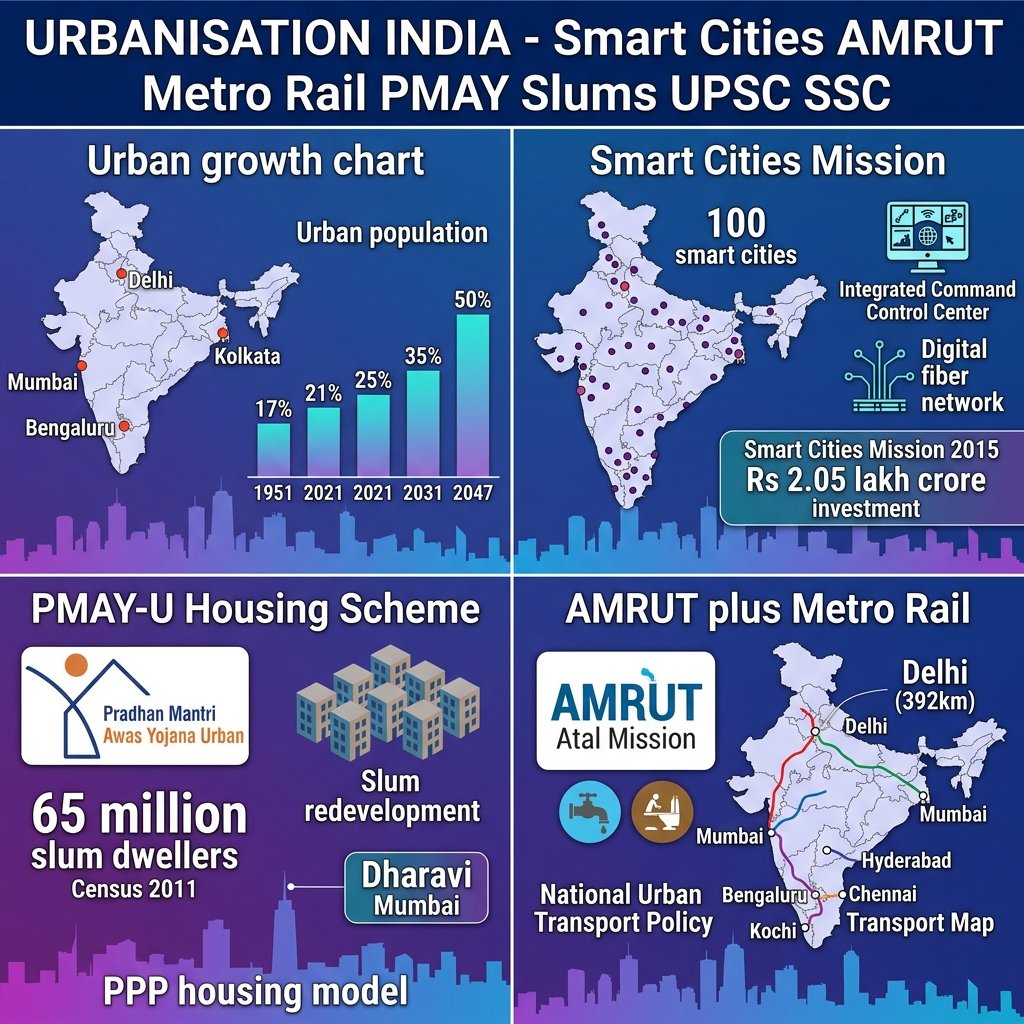
India is undergoing the largest urban transition in human history — a shift from a predominantly rural society (83% rural in 1951) to a country where 600 million people are projected to live in cities by 2031 (approximately 40% of India’s population). Urban India already contributes 63% of India’s GDP while housing only 35% of its population — a productivity differential that makes urbanisation India’s single most important economic lever. Yet India’s cities are simultaneously sites of extraordinary dynamism and profound failure: Mumbai has both Asia’s most expensive property market and Asia’s largest slum (Dharavi); Delhi adds 700,000 people annually but cannot provide piped water to a quarter of its existing residents; Bengaluru hosts 7,000+ technology startups but loses Rs 20,000 crore annually to traffic congestion. The Smart Cities Mission (2015), AMRUT, PMAY-U, and Metro Rail policy represent India’s most ambitious attempts at planned urban transformation. Understanding India’s urbanisation patterns, urban policy framework, challenges, and the constitutional basis of urban governance (74th Constitutional Amendment) is essential for UPSC, SSC, and all competitive examinations.
India’s Urbanisation — Trends & Profile
| Year / Indicator | Data |
|---|---|
| Urban population trend | 1901 = 10.8% urban; 1951 = 17.3%; 1981 = 23.7%; 2001 = 27.8%; 2011 = 31.2% (377 million urban); 2021 census = estimated 35–36%; projected 2031 = 38–40%; projected 2047 = 50% |
| Urban centres 2011 | 7,935 urban centres total: 4,041 statutory towns (corporations, municipalities) + 3,894 census towns (non-municipal agglomerations that meet census urban criteria: population 5,000+, density 400/sq km+, 75%+ male workers in non-agri); 468 Class-I cities (population 1 lakh+) account for 70% of India’s urban population |
| Million-plus cities 2011 | 53 cities with population over 1 million; 3 megacities over 10 million: Delhi Urban Agglomeration (~32 million, world’s 2nd largest), Mumbai UA (~20 million), Kolkata UA (~14 million); Bengaluru (~12M), Chennai (~10M), Hyderabad (~9M), Ahmedabad (~7M), Pune (~6M) |
| GDP contribution | Urban India = 63% of GDP from 35% of population; Services sector (IT, finance, trade) overwhelmingly urban; India’s urban productivity = 4–5x rural productivity; urbanisation = India’s highest-leverage economic multiplier |
| Urbanisation type | India’s urbanisation is not primarily rural-to-urban migration (as in classical urbanisation theory); 30%+ of India’s urban growth since 2001 is from “census towns” — villages reclassified as urban because they’ve grown economically without getting civic infrastructure (called “hidden urbanisation” or “urbanisation without governance”) |
| Regional patterns | Most urbanised states: Goa (62%), Mizoram (52%), Tamil Nadu (48%), Kerala (48%), Maharashtra (45%); Least urbanised: Himachal Pradesh (10%), Assam (14%), Bihar (11%), Odisha (17%); Delhi = 98% urban (de facto city-state); Chandigarh = 97% |
74th Constitutional Amendment Act 1992 — Urban Governance
- 🏛️ The 74th CAA: Passed in 1992; inserted Part IX-A (Articles 243P to 243ZG) into the Constitution; established constitutional status for Urban Local Bodies (ULBs); mandated 3-tier urban governance: Nagar Panchayat (transitional rural-to-urban areas), Municipal Council / Nagar Palika (smaller urban areas), Municipal Corporation / Nagar Nigam (larger cities)
- 🏛️ 12th Schedule (Article 243W): Lists 18 functions that may be transferred to Urban Local Bodies: urban planning including town planning; regulation of land-use and building construction; planning for economic and social development; roads and bridges; water supply; public health, sanitation; fire services; urban forestry, environment; safeguarding interests of weaker sections; slum improvement; solid waste management; regulation of slaughterhouses; vital statistics; public amenities; regulation of tanneries; maintenance of burial grounds; cattle pounds; registration of births and deaths; note that the 12th Schedule functions are discretionary transfers, not mandatory — states decide what to transfer, leading to massive variation in ULB powers across India
- 🏛️ Ward Committees (Article 243S): Mandatory for municipalities with population over 3 lakh; ward committees at the ward level for direct citizen participation; implementation patchy across states
- 🏛️ State Finance Commissions (Article 243Y): Each state must constitute a State Finance Commission every 5 years to recommend devolution of taxes, duties, tolls, fees from state to ULBs; counterpart to Central Finance Commission for panchayats; 15th Finance Commission directly devolved Rs 8,000 crore to ULBs (tied grants for water/sanitation)
- 🏛️ Problems with 74th CAA implementation: Despite 30+ years since amendment, most Indian ULBs are financially dependent (80%+ revenue from state grants, not own taxes); property tax = main ULB own-revenue source but poorly administered (only 5% of potential property tax collected in most cities); ULB staff salaries often paid by states not ULBs (reducing accountability); parallel bodies (development authorities like DDA, HDMA, BDA) handle planning and land outside ULB jurisdiction = fragmented urban governance
Key Urban Development Schemes
1. Smart Cities Mission (2015)
- 🏙️ Launch: June 25, 2015; Ministry of Housing and Urban Affairs (MoHUA); 100 cities selected over 4 rounds through “City Challenge Competition” (cities proposed their vision; top scorers selected); total investment = Rs 2.05 lakh crore (Central + State + ULB + PPP combined); Central share = Rs 48,000 crore (Rs 500 crore/city/year for 5 years)
- 🏙️ SPV model: Each Smart City operates through a Special Purpose Vehicle (SPV) — a joint venture company with city municipality as majority stakeholder; SPV can raise bonds, take bank loans, sign contracts without state government approval = gives cities financial autonomy; Pune Smart City, Bhopal Smart City etc. = separate companies
- 🏙️ Area-Based Development (ABD): Each city selects one area for intensive development (retrofitting existing area, greenfield development, or pan-city smart solutions); not city-wide but concentrated “seed” of excellence; examples: Pune’s ABD focused on Aundh-Baner-Balewadi (IT corridor); Bhopal’s ABD = 940 km historic core with smart infrastructure
- 🏙️ Integrated Command and Control Centre (ICCC): Every smart city built an ICCC = a real-time urban data centre monitoring: traffic signals (adaptive signal control), CCTV network, solid waste collection trucks (GPS), water meters, flood sensors, emergency services; Surat’s ICCC during 2017 floods detected drainage blockages and rerouted emergency vehicles within minutes; 100 cities built ICCCs by 2023; mission extended and completed March 2024 with Rs 1.64 lakh crore work completed
- 🏙️ Critique and outcomes: Smart Cities Mission was criticised for: selecting already-well-performing cities rather than most-distressed ones; ABD model = island of excellence in sea of poor infrastructure (core city unchanged); SPV creates parallel authority outside municipal democracy; digital solutions without basic infrastructure (CCTV before sewage coverage = wrong priority). Positives: built India’s first ICCC institutional model; Rs 2+ lakh crore investment in city infrastructure anchored; 100 cities now have better cycle tracks, walking infrastructure, and data systems than before 2015
2. AMRUT — Atal Mission for Rejuvenation and Urban Transformation
- 🚰 AMRUT 1.0 (2015–2020): 500 cities (all cities with population 1 lakh+); focus on water supply (universal piped water connections), sewerage and septage management, storm water drains (reducing flooding), non-motorised transport (cycling tracks, pedestrian paths), parks and green spaces; budget Rs 50,000 crore; achieved: 139 lakh water connections, 126 lakh sewer connections; coverage of cities but not all households within cities (aspirational vs delivery)
- 🚰 AMRUT 2.0 (2021–2026): 4,800+ cities (expanded to all statutory towns); “har ghar jal” (water to every household) focus; sewage recycling (Zero Liquid Discharge concept for cities); Rs 2.99 lakh crore total (Central Rs 77,000 crore); water body preservation (rejuvenating lakes and ponds in cities); focus on “water security” for cities in drought-prone regions; performance-based funding (states rewarded for outcomes, not just spending)
3. Pradhan Mantri Awas Yojana — Urban (PMAY-U)
- 🏠 Launch: June 25, 2015; “Housing for All by 2022” (now extended to 2024 and beyond); target: 1.12 crore houses for urban poor including slum dwellers; 4 components: (1) In-Situ Slum Redevelopment (ISSR) — redevelop slum in-place using land as resource, private developer builds for slum dwellers + cross-subsidy from market-rate housing sold to others; (2) Credit Linked Subsidy Scheme (CLSS) — interest subsidy (3–6.5%) on home loans for EWS (Economically Weaker Section), LIG (Low Income Group), MIG (Middle Income Group); (3) Affordable Housing in Partnership (AHP) — government pays Rs 1.5 lakh/unit to state/ULB/private developers for affordable housing; (4) Beneficiary-Led Construction (BLC) — individual grant of Rs 1.5 lakh to EWS families to build/enhance their own house
- 🏠 Progress: As of March 2024: 1.18 crore houses sanctioned, 85 lakh completed and delivered; largest affordable housing programme in the world by number of units; key challenge = slum in-situ redevelopment (ISSR) slowest component because it requires relocating slum residents during construction, complex negotiations with private developers, long legal processes; CLSS component most popular (middle class take-up high)
- 🏠 India’s slum profile: India’s slum population = 65 million (Census 2011) — largest slum population in absolute numbers globally; concentrated in: Maharashtra (12M slum dwellers), Andhra Pradesh (10M), West Bengal (10M), Uttar Pradesh (9M); Dharavi, Mumbai = Asia’s largest slum (population ~1 million in 2.39 sq km = world’s highest population density for any locality); Dharavi’s GDP = Rs 7,500 crore (would be world’s 50th largest city if it were a city); ISSR for Dharavi = politically contested since 2004; latest plan (2023) = Adani Group slum redevelopment contract = controversy over rehabilitation eligibility cutoff date
4. Metro Rail — India’s Urban Mass Transit Revolution
| Metro System | Network Length | Daily Ridership | Key Feature |
|---|---|---|---|
| Delhi Metro (DMRC) | 392 km / 286 stations (2025) — India’s largest + world’s 7th largest | 60+ lakh (6 million)/day | Phase 4 under construction; connects Delhi NCR (Noida, Gurgaon, Faridabad, Ghaziabad); E. Sreedharan = “Metro Man” built Delhi Metro on time + budget; Airport Express Line; green metro (regenerative braking, solar panels) |
| Mumbai Metro (MMRC/MMRDA) | ~80 km operational (2025); 337 km planned | 8–10 lakh/day Line 1; Line 2A, 7 added 2023; Line 3 (underground, Colaba-Bandra-SEEPZ) opened 2024 | Multiple agencies (MMRC for underground, MMRDA for elevated); world’s most complex metro in terms of geology (Line 3 through Mumbai’s basalt rock); Colaba-Bandra-SEEPZ Line 3 = India’s first fully underground metro line |
| Bengaluru Namma Metro (BMRCL) | 73 km (2025); Phase 2 and 2A adding 56 km | 7–8 lakh/day | Purple Line + Green Line; Phase 2 connecting outer ring road IT corridor; Whitefield extension opened 2023; critical for Bengaluru’s Rs 20,000 crore/year traffic congestion loss |
| Chennai Metro (CMRL) | 54 km Phase 1; Phase 2 = 118 km under construction | 3–4 lakh/day | India’s first underground + elevated combined 2-corridor system; Phase 2 = largest single metro expansion in India at Rs 63,246 crore |
| Hyderabad Metro (L&T) | 69 km (3 corridors) — India’s largest PPP metro | 4–5 lakh/day | World’s largest PPP metro project; built by L&T on Design-Build-Finance-Operate-Transfer (DBFOT) model; 30-year concession; integrates commercial real estate (Transit Oriented Development) at stations |
| Kochi Metro (KMRL) | 28 km Phase 1; Phase 2 under construction | 60,000–80,000/day | India’s first metro built along a waterway (Periyar river); first metro to employ transgender persons (social inclusion initiative 2017); solar powered stations; Water Metro (electric boat service) integration at Aluva |
⭐ Important for Exams — Quick Revision
- 🔑 India’s urban population: 1951=17.3%; 2011=31.2% (377M); projected 2031=40%; 2047=50%; 63% of GDP from cities
- 🔑 7,935 urban centres (2011): 4,041 statutory towns + 3,894 census towns; census town criteria = 5,000+ population + 400/sq km density + 75%+ male workers non-agri
- 🔑 Megacities: Delhi UA = ~32M (world 2nd largest); Mumbai UA = ~20M; Kolkata = ~14M; 53 million-plus cities (2011)
- 🔑 74th CAA (1992): Part IX-A Articles 243P–243ZG; constitutionalised ULBs; 12th Schedule = 18 functions; Ward Committees (3L+ cities); State Finance Commissions every 5 years
- 🔑 12th Schedule functions: 18 functions including urban planning, water supply, public health, slum improvement, solid waste management, vital statistics — but states decide how much to transfer
- 🔑 Smart Cities Mission (2015): 100 cities; Rs 2.05 lakh crore; SPV model; ICCC = Integrated Command and Control Centre; Area-Based Development (ABD); City Challenge Competition selection; completed March 2024
- 🔑 AMRUT 1.0 (2015–20): 500 cities; water + sewerage + drains + parks; Rs 50,000 crore; 139 lakh water connections
- 🔑 AMRUT 2.0 (2021–26): 4,800+ cities; har ghar jal; water body rejuvenation; Rs 2.99 lakh crore
- 🔑 PMAY-U (2015): Housing for All; 1.18 crore houses sanctioned, 85 lakh completed (2024); 4 components: ISSR + CLSS + AHP + BLC; each component grant Rs 1.5 lakh
- 🔑 India slum population: 65 million (Census 2011); largest absolute globally; Maharashtra (12M) largest; Dharavi Mumbai = Asia’s largest slum (1M in 2.39 sq km)
- 🔑 Dharavi: Population ~1M; area 2.39 sq km; GDP Rs 7,500 crore; ISSR plan = Adani Group 2023; eligibility cutoff date controversy
- 🔑 JNNURM (2005–14): Jawaharlal Nehru National Urban Renewal Mission; predecessor to Smart Cities + AMRUT; 65 cities; basic services + infrastructure; made urban reforms (property tax, e-governance, community participation) mandatory
- 🔑 Delhi Metro: 392 km (India’s largest); 286 stations; 60+ lakh/day; E. Sreedharan “Metro Man”; Phase 4 ongoing; Airport Express Line; regenerative braking + solar
- 🔑 Hyderabad Metro: 69 km; world’s largest PPP metro; L&T DBFOT model; 30-year concession; Transit Oriented Development at stations
- 🔑 Kochi Metro: India’s first metro employing transgender persons (2017); Water Metro (electric boat) integration; solar stations; Periyar river waterway route
- 🔑 Transit Oriented Development (TOD): High-density mixed-use development within 500m-800m of metro/rail stations; increases ridership + reduces car use; Delhi, Hyderabad, Mumbai Metro policies include TOD zones
- 🔑 Census town problem: 3,894 census towns have urban population but no municipal governance; “urbanisation without governance”; 30%+ of India’s urban growth since 2001; key policy gap
- 🔑 ULB finances: 80%+ revenue from state grants; property tax = primary own-source but ~5% collection efficiency; parallel development authorities (DDA, BDA, HUDA) fragment urban governance
Frequently Asked Questions (FAQs)
1. What is India’s “urbanisation without governance” problem — and why do census towns matter?
One of the most important but least understood features of India’s urbanisation is what urban economists call “urbanisation without governance” — the phenomenon where large populations are living urban lives (working in factories and services, living in dense settlements, consuming non-agricultural goods) but are governed as rural villages, receiving rural-quality infrastructure, and counted as “rural” in official planning. The vehicle for this mismatch is the census town — and understanding it reveals why India’s urban infrastructure challenge is far larger than official statistics suggest. What is a census town: The Census of India classifies a settlement as “urban” if it meets three criteria simultaneously: population of at least 5,000; population density of at least 400 persons per square kilometre; and at least 75% of male main workers employed in non-agricultural pursuits. A settlement meeting these criteria but lacking a statutory municipal body (corporation, municipality, town panchayat) is called a census town. It is statistically urban but administratively rural — governed by a Gram Panchayat (village government), not a municipality. The contrast with a statutory town is fundamental: statutory towns have ULBs (Urban Local Bodies) with constitutional status under the 74th Amendment, can levy property tax, issue building permits, manage water supply and sewage systems, and receive Urban Development grants. Census towns have none of these: they are governed by Gram Panchayats (rural bodies under the 73rd Amendment) designed for agricultural villages, without powers, staff capacity, or budgets appropriate for dense urban settlements. The scale of the problem: India had only 1,362 census towns in 2001. By 2011, this number exploded to 3,894 census towns — an increase of 2,532 settlements reclassified as urban in a single decade. This means that in the 2000s, India was creating new urban population at a faster rate outside its cities (in periurban and small-town agglomerations) than inside them. The 3,894 census towns housed an additional 21 million people in 2011 — a population larger than Delhi. These 21 million people were living in settlements with no piped water systems, no sewage networks, no municipal solid waste collection, no building permit systems, and no Urban Local Body to plan their growth. Any planning they received was from Gram Panchayats applying rural standards to what were functionally small cities. Why states delay converting census towns to statutory towns: Converting a census town to a statutory municipality requires: state government legislation; establishment of a new municipal body (staff, offices, budget); transfer of properties and assets; beginning property tax collection (politically unpopular); and accepting financial responsibility for providing urban services. State governments frequently avoid this because: (a) expanding municipal coverage means admitting to a responsibility to fund urban services; (b) property tax imposition alienates voters who enjoyed rural tax exemptions; (c) Gram Panchayats (which lose territory) and their political networks resist change; (d) state urban development departments are under-staffed and under-resourced to manage governance transition. The result: millions of Indians living in dense, non-agricultural settlements with no adequate governance, no property title security, no building standards enforcement, and no urban service delivery framework — the invisible urbanisation that national statistics disguise. This is why official “urban percentage” statistics (31% urban in 2011) substantially undercount India’s actual functional urbanisation level, which some researchers estimate is closer to 40–45% when census town populations are considered on economic-activity terms.
2. What is the Smart Cities Mission — and has it actually worked?
The Smart Cities Mission (SCM), launched by PM Modi on June 25, 2015, was one of India’s most ambitious urban development experiments — and also one of its most debated. Understanding both its design theory and its practical outcomes is essential for assessing where India’s urban policy has succeeded and where it must evolve. The conceptual model: The Smart Cities Mission rejected the conventional Indian approach of trying to incrementally improve all cities everywhere simultaneously (which historically spread resources too thin and achieved minimal visible improvement anywhere). Instead, SCM was based on three principles: (1) Competitive selection: Cities had to compete to be selected (a “City Challenge Competition” where each city submitted a Smart City Proposal demonstrating vision, financial sustainability, community participation, and self-financing capacity); the top-scoring cities received Central funding; this was designed to reward ambition and institutional capacity over population size; (2) Area-Based Development: Rather than attempting city-wide transformation (financially impossible with Rs 500 crore/year/city), each Smart City selected one specific area (1–5 sq km) for comprehensive, integrated development — retrofitting it with underground electrical lines, smart water meters, fiber optic networks, smart street lights, CCTV, redesigned public spaces, bike lanes, and storm drains simultaneously; the theory was that demonstrating excellence in one area would create a “beacon” inspiring replication across the city; (3) Special Purpose Vehicle (SPV): Each Smart City formed an SPV company (not a municipal department) to implement projects — enabling faster procurement (Companies Act vs Public Procurement Act), access to commercial financing, and operational autonomy from state government bureaucratic delays. What was actually built across 100 cities by 2024 (when mission concluded): The 100 Smart Cities collectively built: 100 Integrated Command and Control Centres (ICCCs) — real-time data rooms monitoring city systems; 8,000+ km of roads with smart street lighting; 1,200+ km of cycling tracks and pedestrian infrastructure; 500+ public parks and plazas redesigned; 15 lakh smart water meters installed; dozens of solar-powered bus stands; digital health, education, and civic service kiosks; significant fibre optic underground cabling; total investment by mission close = Rs 1.64 lakh crore (against Rs 2.05 lakh crore planned; some delayed projects being funded from state budgets post-Central mission). The ICCCs proved particularly valuable: Surat’s ICCC during floods, Pune’s ICCC for traffic management, Bhopal’s ICCC for COVID-19 patient tracking (patients were mapped on the ICCC dashboard enabling ambulance routing) — these demonstrated that real-time city data management creates emergency response capability that did not exist before. The legitimate critiques: SCM attracted important criticisms: (1) Selection bias: The competitive model selected cities that already had better institutional capacity and financial resources; the 100 selected cities include Bhopal, Pune, Ahmedabad — not Patna, Lucknow (in early rounds), or most distressed Tier 3 cities; AMRUT was supposed to address smaller cities, but Smart Cities’ glamour diverted policy attention; (2) The island problem: ABD creates high-quality islands in a sea of poor urban infrastructure; if you can only afford to fix 2 sq km of a 500 sq km city’s worst-serviced areas, the 498 sq km outside the ABD remain as bad as before; the “beacon” replication theory has not been demonstrated — no Smart City ABD has visibly triggered a larger municipal transformation outside its boundaries; (3) SPV and democratic deficit: The SPV is a company, not an elected body; it is not directly accountable to city residents; its Board is composed of government officials and technocrats; critics argue SCM substituted technocratic governance for democratic municipal accountability; (4) Digital before basic: Some SCM projects prioritised digital infrastructure (smart waste bins with sensors, AI traffic signals) in cities where even basic infrastructure (24-hour piped water, full sewage coverage) was absent; sensors on uncollected garbage are a grotesque priority inversion. The verdict: The Smart Cities Mission built important infrastructure, demonstrated the ICCC model’s value, and created an institutional vocabulary (SPV, ABD, city-level data management) that has influenced subsequent urban policy. But it did not transform Indian cities — it improved specific areas in specific cities, created useful urban data infrastructure, and proved that competitive selection produces faster implementation than entitlement-based grants. India’s next urban programme (MoHUA’s Cities 2.0 framework under discussion) is expected to incorporate SCM’s institutional lessons while addressing its equity and coverage gaps.
3. Why is urban housing India’s most complex governance challenge — and what makes Dharavi so difficult to redevelop?
The challenge of providing adequate housing for India’s urban poor is not primarily a financial or technical problem — India has the money, the technology, and the construction industry to build the required housing. It is fundamentally a governance and political economy problem, shaped by the interplay of land rights, political incentives, livelihood dependencies, and the extraordinary economic activity embedded within informal settlements like Dharavi. Understanding why Dharavi has resisted redevelopment plans for 40+ years reveals the full complexity of India’s urban housing crisis. The numbers: India’s urban housing shortage as of 2022 (official PMAY-U assessment): 1.02 crore dwelling units. Of this, 96% is in the EWS (Economically Weaker Section) and LIG (Low Income Group) categories — the formal housing market serves only the top 10–15% of India’s urban population. 65 million people live in slums nationally. 11.09 million slum households in 2,543 cities (Census 2011). These are not temporary encampments awaiting displacement — they are multi-generational communities with established social networks, local trade, small businesses, temples, schools, and political representation. The typical Mumbai slum household has lived in its location for 30–40 years; children were born there; local employment (construction, domestic work, small trade) is located nearby; social insurance (informal community credit systems, community kitchens during illness) operates within the slum neighbourhood. Any redevelopment that displaces this community — even to better physical housing — destroys economic and social capital that took decades to build. Dharavi — the world’s most studied slum: Dharavi’s scale is extraordinary: approximately 1 million people in 2.39 square kilometres = over 400,000 persons per square kilometre (compared to Manhattan at ~70,000/km or Mumbai’s broader density of ~32,000/km). But Dharavi is not merely a dense residential area. It is an industrial hub: leather goods manufacturing, pottery, recycling (Dharavi processes 80% of Mumbai’s recyclable waste), food processing, garment manufacturing, and 15,000+ single-room factories together generate an estimated Rs 7,500 crore in annual output. Dharavi is as much an economic zone as a residential area — and its productivity comes precisely from the density and social networks that formal urban planning would “solve” by dispersal. Redevelopment plans for Dharavi date to the 1980s. Every plan has failed or stalled. The 2023 plan (Adani Group as lead developer under Maharashtra government’s slum rehabilitation scheme) faces the same fundamental tensions: (1) Eligibility cut-off controversy: Only residents who can prove occupancy before a specific date (the latest proposal uses 2000 as cut-off, whereas Dharavi has been growing since the 1940s) are eligible for free rehabilitation housing; residents arriving after the cut-off receive nothing = 20–30% of Dharavi’s population excluded; political battles over the cut-off date have lasted years; (2) Livelihood displacement: Dharavi’s factories produce at competitive costs because land rent is effectively zero (slum land has no formal market rent) and commuting time is minimal (workers live where they work); redeveloping Dharavi into high-rise residential towers relocates workers away from their jobs and removes the zero-rent space that makes their production competitive; no formal industrial estate can replicate this cost structure; (3) Social disruption: Dharavi houses multiple religious communities (Hindus, Muslims, Christians), caste groups, regional migrants. Decades of cohabitation have created specific social arrangements. High-rise redevelopment breaks up ground-floor community meeting spaces, eliminates the informal credit networks that operate at ground level, and separates apartment-floor neighbors who may be culturally incompatible; (4) Developer economics: Under the Maharashtra slum rehabilitation model, a developer who builds free housing for eligible slum dwellers gets the right to sell market-rate housing on the remaining land (cross-subsidy). Dharavi’s extraordinarily valuable land (33 sq km in central Mumbai, accessible to Bandra-Kurla Complex = India’s most expensive business district) makes the cross-subsidy potential enormous — hence private sector interest. But the developer’s profit maximisation (maximum saleable area) and the slum residents’ welfare maximisation (minimum disruption, maximum space per unit, keep existing livelihoods) are fundamentally in tension, requiring intensive regulatory oversight that Maharashtra’s housing bureaucracy has historically been unable to provide. This is why India needs not just PMAY-U as a subsidy scheme but a complete reimagination of slum governance — involving tenure security (giving existing slum dwellers formal property rights in-place without displacement), participatory planning (residents design their own redevelopment), and livelihood-integrated development.
Related Geology Articles on StudyHub
- ➡️ Population Geography — Urbanisation, Literacy & Demographics
- ➡️ Water Resources — Urban Water Supply & AMRUT
- ➡️ Disaster Management — Urban Floods (Mumbai 2005, Chennai 2015)
- ➡️ Air Pollution — Urban Air Quality (AQI, Delhi Smog, Vehicular)
- ➡️ Food Security — Urban Poor & PDS Access in Cities