India is one of the world’s most disaster-prone countries — a consequence of its vast geography, diverse climate, active tectonic setting, and the world’s 2nd largest population concentrated in high-hazard zones. India faces all 38 types of disasters listed in the UN’s classification, including floods, cyclones, droughts, earthquakes, tsunamis, landslides, avalanches, urban floods, heat waves, and cold waves. Between 1900 and 2023, India recorded approximately 556 major disaster events causing 1.43 million deaths and affecting over 4.5 billion person-instances (CRED EM-DAT). Economic losses from disasters cost India approximately 2% of GDP annually on average. The paradigm shift in how India manages disasters — from relief-centric (“respond after disaster”) to risk-reduction-centric (“prevent and prepare before disaster”) — was formalised by the Disaster Management Act 2005, following the 2004 Indian Ocean Tsunami, which killed approximately 10,000 people in India’s coastal states. Understanding India’s disaster types, risk profile, institutional framework (NDMA, NDRF, SDRF), policy architecture (Sendai Framework), and landmark events is essential for UPSC, SSC, and all competitive examinations.
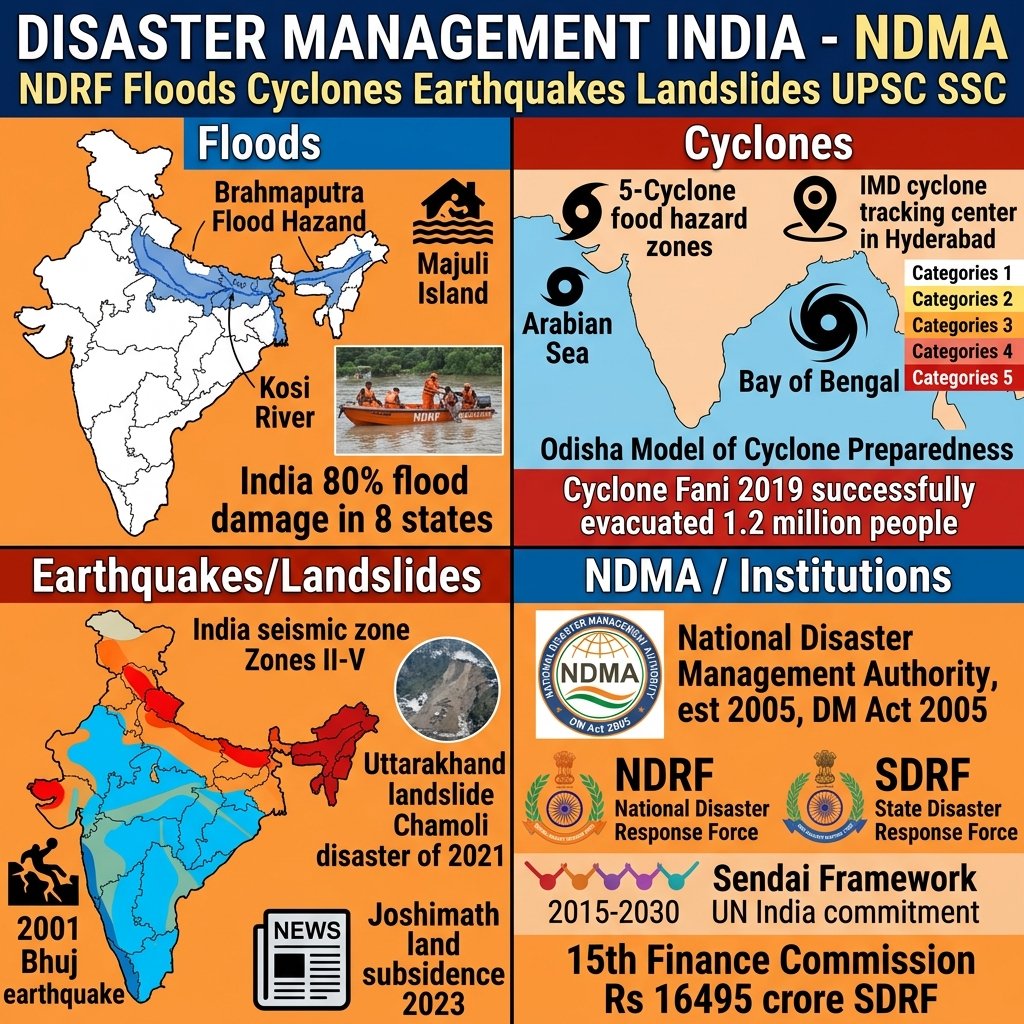
Institutional Framework — DM Act 2005 & NDMA
| Institution | Level | Established | Role & Composition |
|---|---|---|---|
| NDMA (National Disaster Management Authority) | National | DM Act 2005; formally constituted 2006 | Apex body for disaster management policy; Chairperson = PM of India; 9 members (including Vice-Chairperson); issues National Disaster Management Guidelines for each hazard type; approves National Disaster Management Plan (NDMP); oversees NDRF; powers to coordinate all central ministries during disasters |
| NDRF (National Disaster Response Force) | National (but deployed to states) | DM Act 2005; operational 2006 | Specialised force for disaster response; 16 battalions (each ~1,149 personnel) drawn from CRPF, BSF, ITBP, CISF, SSB, Assam Rifles; total ~15,000 personnel; pre-positioned in disaster-prone regions; trained in flood rescue, urban search and rescue (USAR), chemical/biological/radiological/nuclear (CBRN) response; interoperable with UN OSOCC (international coordination) |
| SDMA (State Disaster Management Authority) | State | DM Act 2005 | State-level equivalent of NDMA; Chairperson = Chief Minister; prepares State Disaster Management Plan (SDMP); oversees SDRF; coordinates district-level response; responsible for State Disaster Response Fund (SDRF) management |
| SDRF (State Disaster Response Fund) | State | DM Act 2005; constituted via Finance Commission | Primary fund for disaster relief; financed 75:25 Centre:State ratio (90:10 for NE/hill states); 15th Finance Commission allocated Rs 1,60,153 crore for SDRF (2021–26) = India’s largest SDRF allocation; used for rescue, relief, temporary shelter, food, clothing after notified disasters |
| DDMA (District Disaster Management Authority) | District | DM Act 2005 | Chairperson = District Collector/DM; coordinates actual on-ground response; District Disaster Management Plan (DDMP); first responder coordination; local early warning dissemination |
| NIDM (National Institute of Disaster Management) | National training/research | Established 2003; statutory body under DM Act 2005 | Training, research, and capacity development; trained 1 lakh+ personnel; conducts master trainer programmes; develops curriculum; international cooperation (UN OCHA, ADPC); located in New Delhi |
Major Disaster Types — India’s Risk Profile
1. Floods
- 🌊 Scale: India’s most frequent and costliest disaster; ~40 million hectares flood-prone (12.4% of India’s land area); 80% of annual flood damage concentrated in 8 states; approximately 1,600 deaths/year on average; economic loss Rs 5,000–10,000 crore/year; total economic loss from floods 1953–2020 = Rs 4.69 lakh crore (Govt estimate)
- 🌊 Flood-prone zones: Assam + Brahmaputra valley (world’s most flood-prone river; annual monsoon floods normal; Majuli Island = world’s largest river island, shrinking due to erosion); Bihar + Kosi River (Kosi = “Sorrow of Bihar” — shifts course + destroys embankments; 2008 Kosi breach = 2.7 million displaced); UP + Ganga-Ghagra-Yamuna confluence zone; West Bengal (cyclone-driven coastal floods); Odisha; Maharashtra (urban floods — Mumbai 2005 = 1,094mm rainfall in 24 hours = worst urban flood); Gujarat (Surat flooding); Kerala (2018 floods = worst in 100 years, 483 deaths, Rs 20,000 crore loss)
- 🌊 Causes specific to India: South-West Monsoon intensity variability (ENSO, IOD influence); deforestation in Himalayan headwater regions increasing peak flow; encroachment on floodplains for agriculture and urban development (natural flood storage removed); failure and obsolescence of embankments (Bihar has 3,600 km of embankments — many breached annually); cloudbursts in Himalayan region causing flash floods (Kedarnath 2013 = 5,000+ deaths, glacial lake burst + cloudburst combination)
- 🌊 National Flood Risk Mitigation Project: NCMC (National Crisis Management Committee) + National Flood Management Programme; Brahmaputra Board (for NE rivers); NDMA Flood Guidelines 2013; focus shifting to floodplain zoning (restricting construction in flood zones) and flood early warning systems
2. Cyclones
- 🌀 India’s cyclone exposure: India’s ~7,516 km coastline is highly cyclone-prone; Bay of Bengal generates approximately 5–6 cyclones/year; Arabian Sea generates 1–2/year; Bay of Bengal cyclones more intense (warm water, low wind shear); India’s east coast (Odisha, AP, Tamil Nadu, WB) most vulnerable; west coast (Gujarat, Maharashtra, Kerala) less frequent but intensity increasing
- 🌀 IMD (India Meteorological Department): Cyclone warning authority; 5-tier warning system (Pre-Cyclone Watch, Cyclone Alert, Cyclone Warning, Post-Landfall Outlook); IMD issues landfall location 12 hours before with 100 km precision; IMD Cyclone Warning Centre Hyderabad + Regional Specialised Meteorological Centre New Delhi; quality of India’s cyclone prediction has improved dramatically since 2004
- 🌀 Odisha Model: After the 1999 Super Cyclone killed 10,000 people (Odisha had no early warning + zero evacuation), Odisha built the world’s most effective cyclone preparedness system: Cyclone Shelters network (900+ multi-purpose shelters at 1.5 km intervals along coastline, each holding 1,000+ people), Odisha Disaster Rapid Action Force (ODRAF), last-mile warning systems; Cyclone Phailin (2013, wind speed 220 km/h) = India evacuated 9.7 lakh people in 48 hours; 45 deaths; if same storm had hit in 1999 = estimated 20,000+ deaths; Cyclone Fani (2019, wind 250 km/h, strongest East Indian Ocean cyclone since 1999) = 1.2 million evacuated in 48 hours; 89 deaths; internationally recognised as a model preparedness achievement
- 🌀 Arabian Sea intensification: Cyclone Tauktae (2021, 220 km/h, Gujarat + Maharashtra) = strongest Arabian Sea cyclone to hit Gujarat since records began; Cyclone Biparjoy (2023) = extremely severe; climate scientists document increasing Arabian Sea cyclone intensity linked to Indian Ocean warming
3. Earthquakes
- 🌍 Seismic zones: India = 60% of land area earthquake-prone; 10% in very high damage risk zone (Zone V); Zone IV = 17.5%; Zone III = 30% (see Geo-43 for detailed seismic zone map); Himalayan arc (Zone V) + NE India (Zone V) + Andaman Islands (most seismically active part of India)
- 🌍 2001 Bhuj Earthquake (January 26, Republic Day): Mw 7.7; Gujarat; 20,000+ dead; 1.67 lakh injured; 6 lakh houses destroyed; Bhuj city 90% destroyed; economic loss Rs 21,000 crore; caused complete overhaul of India’s disaster management framework — directly led to DM Act 2005 and NDMA formation; earthquake preparedness week held each year in January; Gujarat Earthquake Reconstruction and Rehabilitation Authority (GERRA) model for post-disaster reconstruction
- 🌍 1993 Latur Earthquake (September 30): Mw 6.2; Marathwada, Maharashtra; 9,748 dead; epicentre in Stable Continental Region (SCR) = NOT near plate boundary = India’s most dangerous earthquake type (no warning, affects areas not considered high-risk); wattle-and-daub construction collapsed; highlighted vulnerability of construction quality in India
- 🌍 Urban earthquake risk: Delhi, Mumbai, Kolkata, Chennai = massive cities in active seismic zones; rapid unplanned construction without earthquake-resistant design; millions live in buildings that would collapse in moderate earthquakes; National Building Code 2016 mandates earthquake-resistant design but enforcement = near zero in most cities; NDMA urban earthquake vulnerability assessment ongoing
4. Landslides & Mountain Disasters
- ⛰️ Scale: India = 4th most landslide-prone country; ~0.42 million km² high landslide susceptibility (12.6% of land area); Himalayan states (J&K, Himachal, Uttarakhand, Sikkim), NE states (Manipur, Mizoram, Nagaland), Western Ghats (Kerala, Karnataka) = most prone
- ⛰️ Kedarnath Disaster (June 2013): Cloudbursts + glacial lake burst (Chorabari Lake) in Uttarakhand; 5,000+ dead (pilgrims and locals); 100,000+ stranded at multiple pilgrimage sites; largest helicopter rescue operation in Indian history (IAF + private); Kedarnath valley completely ravaged by debris flow; highlighted over-development in sensitive Himalayan valleys; Supreme Court guidelines on no construction within flood zones of Himalayan rivers
- ⛰️ Joshimath Land Subsidence (2023): Ancient landslide mass in Joshimath town (Uttarakhand) began accelerating subsidence; hundreds of houses cracked; attributed to uncontrolled construction + NTPC Tapovan hydro project tunnelling + natural geological instability; highlighted the conflict between infrastructure development and fragile Himalayan geology; 600+ families evacuated
- ⛰️ Chamoli GLOF (February 2021): Glacial lake / rock-ice avalanche burst in Chamoli district (Uttarakhand) sent a massive debris flood down the Rishiganga and Dhauliganga valleys; destroyed 2 hydropower projects; 200+ workers killed or missing; India’s worst mountain disaster since Kedarnath; triggered review of all hydropower projects in Himalayan valleys for GLB (Glacial Lake Burst) risk
Sendai Framework 2015–2030
- 📋 What is it: The Sendai Framework for Disaster Risk Reduction 2015–2030 is the successor to the Hyogo Framework (2005–2015); adopted at the Third UN World Conference on Disaster Risk Reduction in Sendai, Japan (March 2015); India was a key contributor to the framework’s development; 4 Priorities, 7 Global Targets
- 📋 4 Priorities for Action: (1) Understanding disaster risk; (2) Strengthening disaster risk governance; (3) Investing in DRR for resilience; (4) Enhancing disaster preparedness for effective response, “Build Back Better”
- 📋 7 Global Targets (to achieve by 2030 vs 2005–2015 baseline): (A) Reduce global disaster mortality; (B) Reduce number of affected people; (C) Reduce direct economic loss; (D) Reduce damage to critical infrastructure; (E) Increase countries with national/local DRR strategies; (F) Increase international cooperation to developing states; (G) Increase multi-hazard early warning systems
- 📋 India’s contribution: India championed the “Coalition for Disaster Resilient Infrastructure” (CDRI) — launched at UN Climate Action Summit 2019; co-founded by India and supported by 39 countries + multiple international organisations; CDRI focuses on making new infrastructure climate-resilient and disaster-proof; headquartered in New Delhi; India also proposed International Solar Alliance (ISA) at COP21 — which reduces climate change-driven disaster risk
Key Disasters Timeline — India
| Year | Disaster | Deaths | Impact & Legacy |
|---|---|---|---|
| 1970 | Bhola Cyclone (Bangladesh, Bay of Bengal) | 300,000+ | Deadliest cyclone in history; triggered Bangladesh liberation war context; drove early warning investment across Bay of Bengal |
| 1984 | Bhopal Gas Tragedy (industrial, not natural) | 3,787–15,000+ | MIC gas leak from Union Carbide plant; world’s worst industrial disaster; drove industrial disaster preparedness law in India; Bhopal Gas Leak Disaster Act 1985 |
| 1993 | Latur Earthquake, Maharashtra | 9,748 | Stable Continental Region (SCR) earthquake = no plate boundary = surprised seismologists; triggered earthquake-resistant construction awareness; Mw 6.2 = relatively moderate but catastrophic due to poor construction |
| 1999 | Odisha Super Cyclone | 10,000+ | Wind speed 260 km/h; zero early warning in villages; directly created Odisha Model of cyclone preparedness; India’s most impactful cyclone in recent history for policy |
| 1999 | Chamoli Earthquake, Uttarakhand | 100 | Mw 6.6; Himalayan Zone V; triggered comprehensive seismic hazard mapping of Himalayan states |
| 2001 | Bhuj Earthquake, Gujarat (Republic Day) | 20,000+ | Mw 7.7; devastated Gujarat; directly caused Disaster Management Act 2005 + NDMA creation; most policy-shaping earthquake in modern Indian history |
| 2004 | Indian Ocean Tsunami (Andaman, Tamil Nadu, Kerala, AP) | ~10,000 India | 9.1 Mw near Sumatra; India’s worst tsunami; triggered Indian Ocean Tsunami Warning System (IOTWS) and Indian Tsunami Early Warning Centre (ITEWC) at INCOIS Hyderabad; DM Act 2005 directly catalysed |
| 2005 | Mumbai Urban Floods (26 July) | 1,094 | 944mm rainfall in 24 hours (Santacruz); paralysed entire city; worst urban flood in India; exposed urban drainage infrastructure inadequacy; triggered National Urban Flood Management Guidelines |
| 2013 | Kedarnath Disaster, Uttarakhand | 5,000+ | Cloudbursts + GLOF + landslides; worst mountain disaster in modern India; exposed over-development in Himalayan valleys; SC guidelines on river zone development |
| 2018 | Kerala Floods | 483 | Worst Kerala floods in 100 years; economic loss Rs 20,000 crore; Idukki / Mullaperiyar dam management controversy; national disaster fund response |
| 2019 | Cyclone Fani, Odisha | 89 (India) | 1.2 million evacuated in 48 hours = world’s largest peacetime evacuation; Odisha Model validated globally; Category 5 equivalent; WMO commendation |
| 2021 | Chamoli GLOF, Uttarakhand | 200+ missing | Rock-ice avalanche + glacial water burst; 2 hydropower projects destroyed; triggered review of all Himalayan hydropower for GLOF risk |
| 2023 | Sikkim GLOF (South Lhonak Lake) | 100+ | Glacial lake outburst on October 4; flash flood destroyed Teesta III Hydropower Dam (510 MW, operational); 100+ soldiers+civilians killed; India’s worst GLOF disaster |
⭐ Important for Exams — Quick Revision
- 🔑 DM Act 2005: Triggered by 2004 Tsunami + 2001 Bhuj; created NDMA (PM chairs) + NDRF + SDMA + SRDF architecture; paradigm shift from relief-centric to risk-reduction-centric
- 🔑 NDMA: National Disaster Management Authority; Chairperson = PM of India; 9 members; apex DM policy body; approves NDMP; oversees NDRF
- 🔑 NDRF: 16 battalions (~15,000 personnel); drawn from CRPF/BSF/ITBP/CISF/SSB/Assam Rifles; USAR + CBRN + flood rescue; pre-positioned in state capitals
- 🔑 SDRF: 75:25 Centre:State ratio (90:10 for NE/hill states); 15th Finance Commission allocated Rs 1,60,153 crore (2021–26)
- 🔑 India’s most flood-prone: 40 million hectares; 80% damage in 8 states; Kosi = “Sorrow of Bihar”; 2008 breach displaced 2.7 million
- 🔑 Cyclone warning: IMD 5-tier; 12 hours advance notice with 100 km precision; Bay of Bengal = 5–6 cyclones/year; Arabian Sea = 1–2/year
- 🔑 Odisha Model: 900+ cyclone shelters; ODRAF; Cyclone Fani 2019 = 1.2 million evacuated in 48 hours = 89 deaths; WMO-commended; gold standard globally
- 🔑 2001 Bhuj earthquake: January 26 (Republic Day); Mw 7.7; Gujarat; 20,000+ deaths; directly created DM Act 2005 + NDMA
- 🔑 1993 Latur earthquake: September 30; Mw 6.2; Maharashtra; 9,748 deaths; Stable Continental Region (non-plate-boundary) earthquake
- 🔑 2004 Tsunami: 9.1 Mw near Sumatra; ~10,000 deaths India; created ITEWC at INCOIS Hyderabad (Indian Tsunami Early Warning Centre)
- 🔑 Kedarnath 2013: Cloudburst + GLOF + landslides; 5,000+ deaths; India’s worst mountain disaster; SC guidelines on Himalayan river zone construction
- 🔑 Chamoli GLOF (Feb 2021): Rock-ice avalanche + glacial water burst; 200+ missing; 2 hydropower projects destroyed; Uttarakhand
- 🔑 Sikkim GLOF (Oct 2023): South Lhonak Lake burst; Teesta III dam (510 MW) destroyed; 100+ deaths; India’s worst GLOF
- 🔑 Sendai Framework 2015–2030: Successor to Hyogo Framework; 4 priorities; 7 global targets; adopted Sendai Japan; India key contributor
- 🔑 CDRI: Coalition for Disaster Resilient Infrastructure; India-launched at UNGA 2019; 39+ countries; HQ New Delhi; makes infrastructure climate/disaster-resilient
- 🔑 NIDM: National Institute of Disaster Management; New Delhi; training + research; statutory body under DM Act 2005
- 🔑 Joshimath 2023: Land subsidence; NTPC tunnelling controversy; Uttarakhand; 600+ families evacuated; Himalayan geology fragility
- 🔑 India’s seismic exposure: 60% land area earthquake-prone; 10% in Zone V (highest risk); Himalayan arc + NE India + Andaman = Zone V
Frequently Asked Questions (FAQs)
1. How did the 2001 Bhuj earthquake transform India’s disaster management system?
The Bhuj Earthquake of January 26, 2001 — occurring on India’s Republic Day morning (8:46 AM, when people were watching parade broadcasts and much of Gujarat’s administration was at formal events) — is the single most consequential natural disaster in terms of reshaping India’s disaster management architecture. Its impact was not just in lives lost (20,000+) and cities flattened (Bhuj city 90% destroyed, Anjar, Bhachau, Morbi severely damaged), but in the government and institutional failures it exposed that made the tragedy so much worse than it needed to be. What went wrong in Bhuj: India had no dedicated disaster-response force — the Army was the primary responder, and Army units took 24–48 hours to mobilise from distant cantonments. India had no standardised urban search and rescue (USAR) capability; foreign USAR teams (from Switzerland’s SARA, UK’s International Rescue Corps, USA’s FEMA Urban Search and Rescue teams) arrived and began finding survivors in collapsed buildings using technology and protocols that Indian responders did not have. There was no coordinated command structure for civilian emergency response; the Collector/DM of Bhuj was himself trapped for hours after the earthquake. There was no national communications backup — landlines and mobile networks failed completely in the first 72 hours; the Gujarat government struggled to get accurate casualty reports from Bhachau and Anjar districts for 48+ hours. The early warning (from IMD’s seismographic network) gave no warning of the future earthquake — which it could not, given no earthquake prediction technology exists — but there was zero preparedness for “what if a major earthquake hits a major city on a public holiday morning.” What changed through policy: The High-Powered Committee (HPC) on Disaster Management (1999) had already produced a comprehensive report acknowledging India’s disaster management deficit — but pre-Bhuj, it had not been acted upon. After Bhuj, an Emergency Action Plan was put in force. But real structural change came with the Disaster Management Act 2005 — passed in the wake of both Bhuj (2001) and the Indian Ocean Tsunami (2004). The DM Act was transformative: it created a statutory, permanent, institutional structure for disaster management at national, state, and district levels simultaneously; it established NDMA as a permanent apex body with legal standing (not just an ad-hoc committee); it created NDRF as a specialised force (replacing the army as first responder) trained and equipped specifically for disaster response; it mandated that every state and district prepare disaster management plans updated periodically; it established the State Disaster Response Fund (SDRF) and National Disaster Response Fund (NDRF) as permanent fiscal mechanisms — ending the previous practice of disaster funding being ad-hoc “relief” announcements; it shifted India’s constitutional framework from “disaster relief” (Article 282 discretionary grants) to “disaster management” as a statutory responsibility. The Gujarat Earthquake Reconstruction and Rehabilitation Authority (GERRA) model also pioneered the “Build Back Better” principle in India’s reconstruction: owner-driven reconstruction (give money to affected family to rebuild their house with technical support) rather than contractor-driven relocation (build standard government housing in different location = social and economic disruption); GERRA’s model was later adopted globally as evidence-based post-disaster reconstruction practice and influenced the Sendai Framework’s “Build Back Better” priority.
2. What is the “Odisha Model” of cyclone preparedness — and why is it studied globally?
Few stories in modern disaster management are as dramatic and instructive as Odisha’s transformation from the worst cyclone tragedy in India’s history (1999) to the world’s most celebrated model of cyclone preparedness (2013–2019). In October 1999, a super cyclone with wind speeds of 260 km/h made landfall near Paradip (Odisha), directly hitting the most densely populated coastal districts. The casualty count: approximately 10,000 deaths. The reasons were entirely preventable: zero mass warning system (villagers did not know the cyclone was coming until it hit); zero evacuation infrastructure (no designated safe shelters anywhere near the coast); zero coordination between IMD, state government, and district administration; infrastructure collapse (all roads flooded, no emergency vehicles able to reach coastal areas); fishing communities had gone to sea and could not return; coastal embankments failed, flooding low-lying villages. The tragedy was entirely the result of system failure, not cyclone uniqueness — the cyclone was devastating but survivable with preparation. What Odisha built after 1999: The Odisha government, under a succession of governments but sustained across political cycles, made cyclone preparedness a non-negotiable investment: (1) Cyclone Shelter Network: 879 permanent, multi-purpose cyclone shelters along Odisha’s 480 km coastline, spaced so that every coastal resident is within 1.5 km of a shelter; each shelter = pucca (reinforced concrete) structure on elevated ground, holds 1,000–1,500 people, has toilet blocks, water tanks, food storage, diesel generator, and radio communication; shelters are used as schools and community halls in non-disaster times = social and economic value between disasters; (2) ODRAF (Odisha Disaster Rapid Action Force): State-level specialised response force with boats, chainsaws, ropes, medical kits, pre-positioned at block headquarters in coastal districts before cyclone season each year; (3) Last-mile early warning: Digital message boards in coastal villages showing cyclone track in local language Odia; coastal district collectors empowered to mandate evacuation by specific “flag colours” (red = mandatory evacuation); end-to-end communication chain from IMD forecast to village sarpanch verified within 3 hours; (4) Mass evacuation rehearsal: Odisha conducts mock cyclone evacuations every year before cyclone season — testing the entire chain from warning to shelter occupancy; identifies breakdown points before they occur in a real event; (5) Fishing community engagement: Fishermen given handheld GPS devices; prohibited from going to sea 72 hours before a cyclone warning; insurance for boats lost in cyclones; SMS alerts to fishermen in local languages. The results: Cyclone Phailin (October 2013, wind 220 km/h, equivalent strength to the 1999 super cyclone) = 9.7 lakh people evacuated in 48 hours; reported deaths = 45 (vs 10,000+ in 1999 with weaker storm). Cyclone Fani (May 2019, wind 250 km/h, most intense East Indian Ocean cyclone since 1999, equivalent Cat 5) = 1.2 million people evacuated in 48 hours — the largest peacetime evacuation in Indian history; deaths in India = 89 (Bangladesh suffered more, with 300+, as weaker warning infrastructure). The World Meteorological Organisation and UNDRR commended Odisha’s cyclone preparedness as a global model for effective early warning and community-based disaster risk reduction — precisely what the Sendai Framework calls for. The lesson the Odisha Model teaches is fundamental: deaths from cyclones are not a function of cyclone intensity; they are a function of warning time, evacuation infrastructure, community trust in warnings, and administrative coordination. India’s federal structure means Odisha’s model cannot automatically replicate nationally — but NDMA has used Odisha’s approach as the template for cyclone preparedness guidelines for all coastal states.
3. What are Glacial Lake Outburst Floods (GLOFs) — and why is Himalayan hydropower at risk?
Glacial Lake Outburst Floods (GLOFs) represent one of the most complex and rapidly growing disaster risks in the Himalayas — and one that is almost entirely driven by climate change at its source and development decisions in its impact zone. A GLOF occurs when a lake formed by, or dammed by, a glacier suddenly releases its stored water — producing a flash flood of devastating speed and volume that can travel hundreds of kilometres downstream within hours, typically carrying enormous amounts of sediment, boulders, and woody debris (making it a hyperconcentrated flow, far more destructive per unit volume than ordinary floodwater). How glacial lakes form (and fail): As Himalayan glaciers retreat under climate warming, they leave behind hollows in their terminal moraines (the piles of rocks, gravel and soil deposited at a glacier’s leading edge) or behind ice dams. These hollows fill with meltwater, forming glacial lakes that can grow rapidly — sometimes adding millions of cubic metres of water per year directly following a warm summer. The dam holding the lake is typically a moraine (unconsolidated debris) or ice wall — both structurally unstable. Failure triggers include: (1) Ice avalanche onto the lake surface creating waves that overtop and erode the moraine dam; (2) Piping — water seeping through the moraine dam, gradually eroding it from the inside; (3) Earthquake destabilising the moraine dam; (4) Rapid warming melting the ice core within the moraine, causing sudden structural collapse. Himalayan GLOF inventory: The Himalayas and Hindu Kush have approximately 15,000+ glacial lakes mapped by satellite (ISRO, NASA, Chinese Academy of Sciences); of these, approximately 200+ are classified as “potentially dangerous” by the NDMA/National Remote Sensing Centre (NRSC); the highest density is in Uttarakhand, Himachal Pradesh, Sikkim, and Arunachal Pradesh. Recent GLOFs in India: (1) Kedarnath 2013: The Chorabari glacial lake (also called Gandhi Sarovar) experienced a partial outburst coinciding with extreme cloudbursts, sending a massive debris-laden flow that destroyed Kedarnath town; geologists debate whether the primary trigger was the GLOF or the cloudburst — likely combined; (2) Chamoli GLOF 2021: A large mass of ice and rock detached from the face of Ronti Peak (6,063m) in Chamoli district; the impact of this rock-ice avalanche hitting the valley floor instantly vaporised ice (creating a surge of water + debris) and mobilised the existing snow and glacial water — producing a flash flood wave moving at 60–80 km/h down the Rishiganga and Dhauliganga river valleys; destroyed Rishiganga Hydropower Plant (13.2 MW, fully operational) and Tapovan-Vishnugad Hydropower Plant (520 MW, NTPC, partially constructed, tunnel workers killed); 200+ people missing (mostly tunnel workers who had retreated into construction tunnels for safety but were trapped when water entered); (3) Sikkim GLOF 2023: South Lhonak Lake in North Sikkim (which had been growing rapidly for 3 decades and classified as potentially dangerous by multiple studies) released catastrophically on October 4, 2023; the flood wave destroyed the Teesta III Hydropower Project (510 MW, fully operational since 2017; ~Rs 3,000 crore invested); army camps along the river were swept away (100+ soldiers and civilians killed or still missing); the flood reached Siliguri (500 km downstream) within 12 hours, filling the Teesta canal system and flooding agricultural districts of West Bengal. Why Himalayan hydropower is structurally at risk: India has over 20,000 MW of operational hydropower in the Himalayan states and tens of thousands of MW under construction or planned. The river valleys where these projects are located are exactly the valleys down which GLOF events travel. The projects cannot practically be relocated — they are where they are because that is where the hydraulic head exists. But they can be better protected: (a) GLOF early warning systems connected to project control rooms, with automated gate opening protocols; (b) Lake drainage interventions — SDRF teams and ISRO use controlled breaching (drilling through moraine dams to slowly drain dangerous glacial lakes before they fail catastrophically) — has been done at several Uttarakhand and Sikkim lakes; (c) Reservoir design standards incorporating GLOF hydrographs (the peak flow expected from an upstream GLOF) in dam safety calculations; historically, many dams were not designed with GLOF scenarios because the lakes they face were small then. The 2021 and 2023 incidents have now made GLOF risk a mandatory consideration in all new Himalayan infrastructure Environmental Impact Assessments (EIAs) — a policy shift driven by catastrophic loss.
Related Geology Articles on StudyHub
- ➡️ Natural Disasters — General Overview & Types
- ➡️ Seismic Zones of India — Zone V to Zone II
- ➡️ Glaciers — Himalayan Glaciers & GLOF Risk
- ➡️ J&K & Ladakh — Chamoli GLOF & Mountain Disaster Risk
- ➡️ Climate Change — Glacier Retreat Driving GLOF Frequency