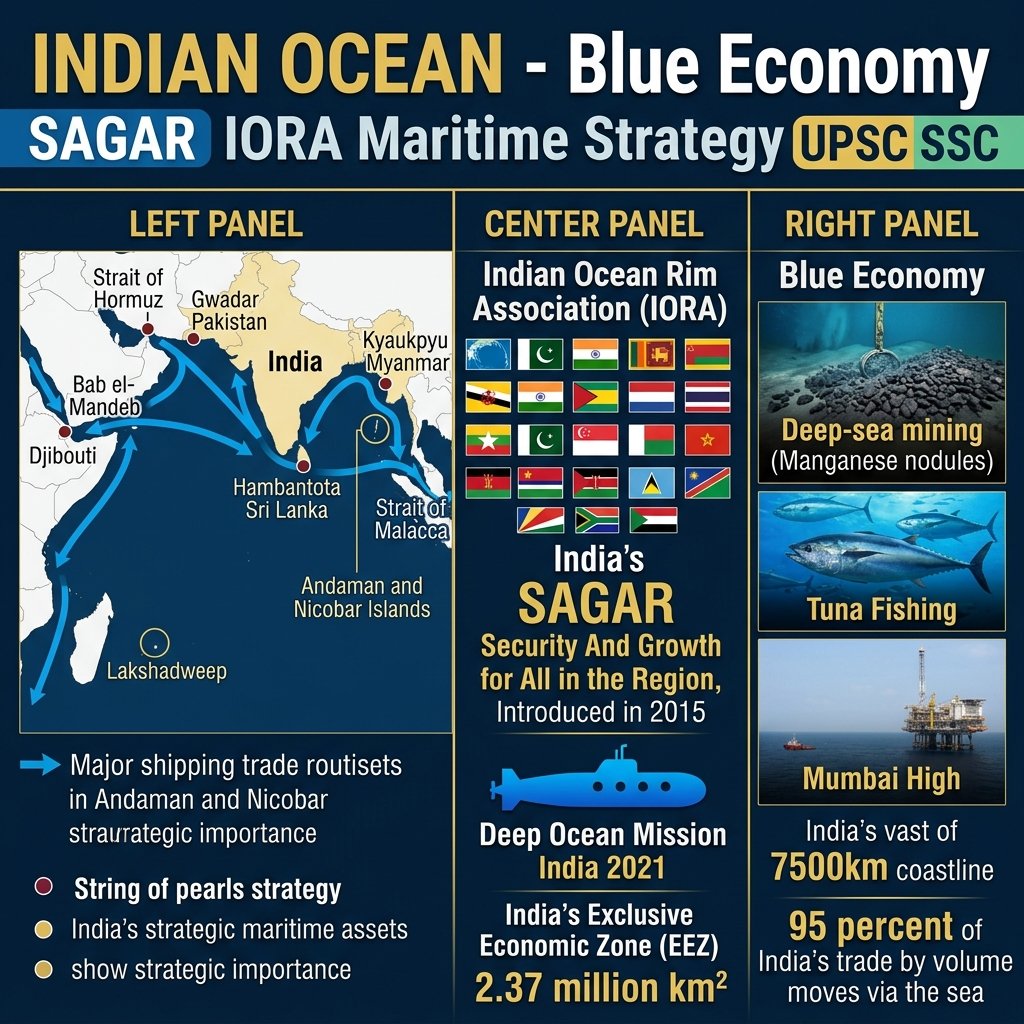
The Indian Ocean is not just a water body — it is the world’s most strategically consequential ocean basin: the only ocean named after a country (India), the only ocean with land on three sides limiting free circulation, the conduit for 80% of global oil trade, the route for 70% of container shipping, and the source of livelihood for over 2.5 billion people in its rim countries. India sits at the centre of the Indian Ocean Region (IOR) — with 7,516 km of coastline, an Exclusive Economic Zone (EEZ) of 2.37 million km², and island territories (Andaman & Nicobar, Lakshadweep) that extend India’s maritime presence across both the Bay of Bengal and the Arabian Sea. 95% of India’s trade by volume and 68% by value passes through the Indian Ocean. India’s strategic doctrine — SAGAR (Security And Growth for All in the Region), launched by PM Modi in 2015 — reframes India’s role from a passive coastal state to a net security provider in the IOR, countering China’s expanding naval presence through the String of Pearls and claiming leadership of the Indian Ocean Rim Association (IORA). Understanding the Indian Ocean’s geography, resources, trade routes, choke points, Blue Economy, and India’s maritime strategy is essential for UPSC, SSC, and all competitive examinations.
Indian Ocean — Physical Geography & Key Facts
| Feature | Data / Description |
|---|---|
| Area | 70.56 million km² — 3rd largest ocean (after Pacific 165M km² and Atlantic 106M km²); only ocean bounded on three sides by land (Asia north, Africa west, Australia east) |
| Average Depth | 3,741m average; deepest point = Java Trench (Sunda Trench) at 7,258m, south of Java, Indonesia; Indian Ocean has no circumpolar circulation (unlike Pacific/Atlantic) because land mass blocks north |
| Marginal Seas | Arabian Sea (northwest); Bay of Bengal (northeast); Red Sea (northwest arm); Persian/Arabian Gulf; Andaman Sea; Laccadive Sea; Mozambique Channel; Timor Sea |
| Major Island Groups | Maldives (coral atolls, lowest country by average elevation 1.5m); Seychelles (granitic islands — only granite oceanic islands in world); Madagascar (world’s 4th largest island; Gondwana fragment); Mauritius; Reunion (French, active volcano Piton de la Fournaise); Sri Lanka; Andaman & Nicobar (India); Lakshadweep (India) |
| Unique oceanography | Seasonal reversal of currents due to monsoon: NE Monsoon (Nov–Mar) drives North Equatorial Current westward; SW Monsoon (Jun–Sep) reverses it (Somali Current, Indian Monsoon Current eastward); this makes the Indian Ocean uniquely linked to monsoonal climate of South Asia |
| Critical Chokepoints | Strait of Hormuz (21 million bbl/day oil, 20% of global oil, 30% of LNG); Strait of Malacca (90,000 ships/year, 25% of global trade, 80% of China’s oil imports); Bab el-Mandeb (Red Sea gateway, 4.8 million bbl/day); Cape of Good Hope (alternative if Suez closed); Lombok Strait (Java-Bali, alternative to Malacca) |
| Strategic significance | 80% of global petroleum trade; 70% of global container traffic; 100% of Middle East oil exports to Asia via Indian Ocean; all India-Europe trade via Red Sea/Suez Canal; China imports 80% of oil via Malacca (its “Malacca Dilemma”) |
Critical Choke Points — Deep Dive
- 🚢 Strait of Hormuz: 54 km wide at narrowest; between Iran and Oman; gateway to Persian Gulf oil from Saudi Arabia, UAE, Kuwait, Iraq, Qatar, Iran; 21 million barrels/day pass through (2023); any closure = immediate global oil price spike; Iran has repeatedly threatened to mine or block it; US 5th Fleet (Bahrain) + US carrier group presence specifically to guarantee freedom of navigation; India imports ~65% of its crude oil from the Gulf region — all via Hormuz
- 🚢 Strait of Malacca: 800 km long, 2.7 km at narrowest (Phillip Channel near Singapore); between Malaysia/Sumatra/Singapore; 90,000+ ships/year (2023); 25% of global traded goods; China’s singular strategic vulnerability — 80% of China’s oil imports, 60% of China’s total trade transits Malacca; if US Navy blocked Malacca, China’s economy would be severely impacted within weeks; this is why China calls it the “Malacca Dilemma” and is building overland pipelines (CPEC to Gwadar, Myanmar pipelines) as alternatives; India’s Andaman & Nicobar Islands sit at the northern entrance = India can theoretically monitor or interdict all Malacca-bound shipping
- 🚢 Bab el-Mandeb: “Gate of Tears” (Arabic); 30 km wide; between Yemen/Djibouti; gateway between Red Sea and Gulf of Aden; 4.8 million bbl/day oil + all Europe-Asia container traffic via Suez Canal; Yemen Houthi attacks on shipping (Oct 2023 onwards) caused shipping lane disruption — forcing ships to reroute around Cape of Good Hope (adding 10+ days, 40%+ fuel cost increase); India’s food oil imports from Malaysia/Indonesia also affected; demonstrated that Bab el-Mandeb closure has immediate global supply chain consequences
- 🚢 Lombok Strait: Between Lombok and Bali islands, Indonesia; 40 km wide; 18m deep (deeper than Malacca); alternative for large tankers and submarines (submarines can transit submerged unlike shallow Malacca); PLAN (Chinese Navy) submarines use Lombok to transit between Pacific and Indian Ocean without transiting through Malacca/US naval monitoring zones
India’s Strategic Framework — SAGAR & Beyond
- 🌊 SAGAR (Security And Growth for All in the Region): Articulated by PM Modi during his visit to Mauritius in March 2015; India’s strategic vision for the Indian Ocean — emphasising that India will (1) enhance its maritime security capabilities while ensuring a peaceful, stable, and prosperous Indian Ocean region for all; (2) act as a “net security provider” for island nations and smaller IOR states that cannot protect themselves; (3) deepen economic and security ties with maritime neighbours (Maldives, Sri Lanka, Mauritius, Seychelles, Comoros); (4) ensure freedom of navigation for all in accordance with international law (UNCLOS)
- 🌊 IORA (Indian Ocean Rim Association): Founded 1997; originally Indian Ocean Rim Association for Regional Cooperation (IOR-ARC); 23 member states + 11 dialogue partners (including USA, China, Japan, EU); India held chairmanship 2011–2013; headquarters in Ebène, Mauritius; mandate: maritime safety and security, trade facilitation, fisheries management, disaster risk management, tourism and cultural exchange, Blue Economy; India advocates for IORA as an alternative multilateral architecture to Western-controlled forums for IOR governance
- 🌊 String of Pearls (China): Term coined in 2004 US DoD report; describes China’s strategy of establishing commercial (but strategically dual-use) ports/facilities in IOR countries: Gwadar (Pakistan, CPEC anchor), Hambantota (Sri Lanka, 99-year lease 2017, China Merchants Port), Kyaukpyu (Myanmar, SEZ + pipeline), Chittagong (Bangladesh, Chinese-funded port expansion), Djibouti (China’s first overseas military base since 1949, operational 2017), Seychelles, Tanzania; India views these as coordinated encirclement of India’s maritime space; SAGAR is partly India’s response to the String of Pearls
- 🌊 India’s naval presence: Indian Navy = 3rd largest navy in Indo-Pacific; 2 aircraft carriers (INS Vikramaditya operational, INS Vikrant commissioned 2022 = India’s first domestically built carrier); 10 destroyers; 15 frigates; 16 submarines (including 1 nuclear-powered SSBN INS Arihant); Indian Navy maritime patrol aircraft cover the entire IOR; Resident Mission in Mauritius (Agalega Islands, Indian military infrastructure); base access in Oman (Duqm port, SOFA agreement), Seychelles (Assumption Island, cooperation agreement), France (Reunion); Mission-Based Deployment of Indian Navy ships 24/7 in key IOR sectors
- 🌊 Indo-Pacific framework: India joined the Quad (Quadrilateral Security Dialogue — India, USA, Japan, Australia) — first meeting 2007, revived 2017, elevated to leaders’ summit level 2021; Quad focuses on free and open Indo-Pacific, maritime domain awareness, technology cooperation, vaccine diplomacy; India’s position = Quad is not a military alliance (India resists formal treaty obligations) but a strategic coordination forum; AUKUS (Australia-UK-US nuclear submarine deal) is US-led framework India is not part of but coordinates with
Blue Economy — India’s Marine Resource Potential
| Blue Economy Sector | India’s Status / Potential | Key Policy |
|---|---|---|
| Fisheries | India = 3rd largest fish producer globally; 14.7 million MT (2022–23); 4.8 lakh mechanised fishing vessels; Andhra Pradesh, Gujarat, Kerala, Tamil Nadu, Maharashtra = top marine fishing states; exports ~17 billion USD/year; shrimp = India’s No.1 marine export | Pradhan Mantri Matsya Sampada Yojana (PMMSY, Rs 20,050 crore); Sagarmala programme; deep sea fishing vessel subsidy scheme; Kisan Credit Card for fishers |
| Offshore Oil & Gas | Mumbai High (Arabian Sea) = India’s largest offshore oilfield (ONGC); Bassein gas field; KG Basin (Bay of Bengal) = Reliance-operated D6 block (declining); total offshore production = ~25 million MT oil equivalent; huge untapped potential in deep water blocks (>1000m) | OALP (Open Acreage Licensing Policy); HELP (Hydrocarbon Exploration Licensing Policy); Ease of Doing Business for exploration; deepsea exploration blocks offered to international companies |
| Deep Sea Mining | Polymetallic nodules (manganese nodules containing Mn, Ni, Cu, Co) on Indian Ocean floor; India allocated 150,000 km² exploration zone in Central Indian Ocean Basin by International Seabed Authority (ISA); estimated: 380 million tonnes nodules = significant reserves of battery metals (critical for EVs); Deep Ocean Mission (2021, Rs 4,077 crore) specifically targets seabed exploration | Deep Ocean Mission (DOM, 2021); Matsya 6000 (India’s deep sea submersible to 6,000m depth = under development, NIOT); ISA contractor status since 1987; Cobalt-rich crust exploration zone in IOR |
| Offshore Wind / Marine Renewables | India’s offshore wind potential = 127 GW+ (Tamil Nadu and Gujarat coast); 1 GW offshore tenders issued (2024); tidal energy potential (Gulf of Kutch, Bay of Bengal) = ~9,000 MW; Ocean Thermal Energy Conversion (OTEC) pilot at Kavaratti (Lakshadweep, NIOT); wave energy R&D | National Offshore Wind Energy Policy (2015); SECI offshore tenders; viability gap funding (VGF) for first projects; MNRE target 30 GW offshore wind by 2030 |
| Coastal Tourism | India’s coastal tourism contributes ~5% of India’s tourism GDP; major coastal tourism states: Goa, Kerala (backwaters), Andaman, Lakshadweep; cruise tourism growing (Mumbai, Goa, Kochi cruise terminals); marine sports (scuba, surfing — Andaman, Varkala, Tarkarli) | Sagarmala coastal development; UDAN maritime connectivity; Andaman-Lakshadweep tourism infrastructure investment; cruise terminal upgrades at major ports |
| Maritime Trade / Ports | India has 13 major ports + 200 non-major ports; total cargo handled = 2.4 billion MT (2023–24); JNPT (Mumbai) = India’s busiest container port; Mundra (Gujarat, Adani) = India’s largest overall port by capacity; Sagarmala (2016) = Rs 6 lakh crore port-led development programme connecting ports to hinterland by road, rail, waterways | Sagarmala Programme (2016); National Waterways expansion (111 NWs declared); Inland Vessel Act 2021; Coastal Shipping Policy; Maritime India Vision 2030; Major Port Authorities Act 2021 |
Deep Ocean Mission (2021) — India’s Deep Sea Push
- 🔬 Launched: June 2021; budget Rs 4,077 crore over 5 years; nodal ministry = Ministry of Earth Sciences (MoES); India’s first comprehensive deep ocean exploration programme; six pillars:
- 🔬 Pillar 1 — Matsya 6000: Development of India’s own manned submersible capable of diving to 6,000 metres (covering 90% of the world’s oceans including India’s EEZ and extended continental shelf); NIOT (National Institute of Ocean Technology, Chennai) developing; titanium pressure sphere (1.5m diameter) for 3 crew; will conduct deep ocean scientific survey, polymetallic nodule surveying, and biological research
- 🔬 Pillar 2 — Deep Sea Mining: Development of mining technology for polymetallic nodules in the CIB (Central Indian Ocean Basin); integrated mining system design (collector vehicle + vertical transport + surface station); India’s 150,000 km² ISA exploration licence area targeted
- 🔬 Pillar 3 — Deep Sea Survey: Detailed mapping of India’s extended continental shelf (ECS) beyond 200 nautical miles; India filed a submission with the UN Commission on the Limits of the Continental Shelf (CLCS) to extend its continental shelf — additional seabed rights beyond EEZ in certain areas
- 🔬 Pillars 4–6: Ocean climate change advisory services; coral reef restoration and environmental monitoring; marine biodiversity conservation and survey of deep-sea flora and fauna
Key IOR Relationships — India’s Maritime Diplomacy
| Country | Strategic Significance | India’s Engagement |
|---|---|---|
| Maldives | Sits astride India’s western SLOCs (Sea Lanes of Communication); China has increased presence post-Mohamed Muizzu election (Oct 2023); 200 km from Lakshadweep (Minicoy); critical for India’s western flank maritime security; “India Out” campaign by Muizzu government | India’s largest bilateral development partner in Maldives; Greater Male Connectivity Project (bridge); coastguard cooperation; asked to withdraw ~89 Indian military personnel (Mar 2024); India complied but maintained diplomatic/coast guard engagement |
| Sri Lanka | Palk Strait proximity (22 km at narrowest = Adam’s Bridge); Hambantota Port (Chinese 99-yr lease = strategic concern); Trincomalee harbour (world’s 2nd deepest natural harbour, strategic value); economic crisis 2022 opened India-China competition for Sri Lanka’s alignment | India = largest bilateral creditor during 2022 crisis (Rs 4 billion emergency credit); fuel supply; Adani-operated Colombo West Container Terminal; Trincomalee oil tank farm joint development with Lanka IOC; Sampur solar power; underscores India’s “neighbour first” policy |
| Mauritius | IORA HQ; Indian-origin majority population (70%); strategic location in southwestern Indian Ocean; Agalega Islands (India built runway + jetty for Indian Navy use = effectively forward base) | India’s closest IOR ally; Comprehensive Economic Cooperation Agreement (CECA); submarine cable connectivity; maritime domain awareness radar stations; Agalega infrastructure = forward basing without formal “base” declaration |
| Seychelles | Mid-Indian Ocean; straddles southern SLOCs; Assumption Island (India-Seychelles joint development for maritime infrastructure — coast guard, helipad; parliament initially blocked) | Coast guard vessel gifted; patrol aircraft; maritime surveillance; Assumption Island cooperation agreement; India’s maritime presence in westernmost Indian Ocean via Seychelles |
| Oman | Gateway to Persian Gulf; controls Strait of Hormuz southern shore; Duqm Port (deep water, Indian access agreement for naval logistics and maintenance) | Duqm Port SOFA (Status of Forces Agreement); significant bilateral trade; Indian workers diaspora in Oman; defence cooperation; access to Duqm enables Indian Navy to project power in Arabian Sea without dependence on domestic port logistics |
⭐ Important for Exams — Quick Revision
- 🔑 Indian Ocean: 3rd largest ocean (70.56M km²); only ocean named after a country; bounded on three sides by land; Java Trench = deepest (7,258m)
- 🔑 India’s maritime stats: 7,516 km coastline; EEZ = 2.37 million km²; 95% of trade by volume via sea; 13 major ports + 200 non-major ports
- 🔑 Strait of Hormuz: 54 km wide; Iran-Oman; 21 million bbl/day (20% global oil); India imports 65% crude oil via it; US 5th Fleet protects
- 🔑 Strait of Malacca: 2.7 km at narrowest; 90,000 ships/year; 25% global trade; 80% China’s oil; China’s “Malacca Dilemma”; Andaman Islands = India’s monitoring point
- 🔑 Bab el-Mandeb: “Gate of Tears”; Yemen-Djibouti; 30 km; Red Sea-Gulf of Aden gateway; Houthi attacks 2023–24 disrupted global shipping
- 🔑 SAGAR: Security And Growth for All in the Region; launched by PM Modi in Mauritius March 2015; India = “net security provider” in IOR
- 🔑 IORA: Indian Ocean Rim Association; founded 1997; 23 members + 11 dialogue partners; HQ Mauritius (Ebène); India chaired 2011–13
- 🔑 String of Pearls: China’s IOR port strategy; Gwadar (Pakistan) + Hambantota (Sri Lanka, 99-yr lease 2017) + Kyaukpyu (Myanmar) + Djibouti (China’s first overseas military base 2017)
- 🔑 Quad: India + USA + Japan + Australia; first 2007; revived 2017; leaders’ summit 2021; free and open Indo-Pacific; NOT a formal military alliance (India’s position)
- 🔑 India’s navy: 3rd largest Indo-Pacific; INS Vikrant (2022, India’s first domestically built carrier); INS Vikramaditya; INS Arihant (SSBN, nuclear-powered submarine)
- 🔑 India fisheries: 3rd largest globally; 14.7 million MT; PMMSY (Rs 20,050 crore); shrimp = No.1 marine export
- 🔑 Mumbai High: India’s largest offshore oilfield (ONGC); Arabian Sea; KG-D6 = Reliance block, Bay of Bengal (declining)
- 🔑 Deep Ocean Mission (2021): Rs 4,077 crore; MoES; Matsya 6000 (submersible to 6,000m); polymetallic nodule mining; India has 150,000 km² ISA exploration zone in Central Indian Ocean Basin
- 🔑 Polymetallic nodules: Mn, Ni, Cu, Co on ocean floor; battery metal source; India’s ISA zone since 1987; DOM targets them
- 🔑 Sagarmala (2016): Rs 6 lakh crore port-led development; port modernisation + road/rail connectivity + industrial clusters near ports; JNPT = India’s busiest container port; Mundra (Adani) = largest capacity
- 🔑 Hambantota Port (Sri Lanka): Built by China + financed by China; Sri Lanka couldn’t repay; 70% stake + 99-year operational lease to China Merchants Port 2017 = “debt trap” example cited globally
- 🔑 Agalega Islands (Mauritius): India built runway + jetty for Indian Navy = effective forward base without declaring it a “base”
- 🔑 Duqm Port (Oman): India has SOFA = Indian Navy logistics access; deep water; Arabian Sea presence extension point for Indian Navy
Frequently Asked Questions (FAQs)
1. What is the “Malacca Dilemma” — and why does it shape India-China strategic competition in the Indian Ocean?
The “Malacca Dilemma” is a phrase coined by Chinese President Hu Jintao in 2003 to describe China’s most dangerous strategic vulnerability: the fact that approximately 80% of China’s oil imports and 60% of its total trade by value transit the Strait of Malacca — a 2.7-km-wide chokepoint near Singapore controlled by three nations (Indonesia, Malaysia, Singapore) and routinely patrolled by the US Navy’s 7th Fleet. If the US Navy were to implement a naval blockade of the Strait of Malacca in a conflict scenario — a scenario that military planners in Washington and Beijing both game — China’s economy would face severe fuel shortages within weeks and economic paralysis within months. Why the Malacca Dilemma is China’s central strategic vulnerability: China’s economic model requires continuous and uninterrupted supply of Middle Eastern and African oil (Saudi, UAE, Iraqi, Angolan, Nigerian crude — roughly 65% of China’s oil imports by 2025) and the export of manufactured goods to global markets. Both inbound energy and outbound manufactured goods transit the Strait of Malacca. China has no realistic domestic alternative (China’s domestic oil production is about 200 million MT/year vs consumption of 700+ million MT/year = importing 500+ million MT). Unlike the US, China has no global chain of friendly port access, no “network of alliances” in the IOR, and its growing naval force still cannot match the US Navy’s deep IOR presence. China’s responses to the Malacca Dilemma: China has pursued a multi-pronged strategy to reduce Malacca dependence: (1) String of Pearls ports — building commercial (dual-use) port facilities in IOR countries (Gwadar, Hambantota, Kyaukpyu, Djibouti) to create logistics access points and potentially naval bases for Chinese warships; (2) Overland pipelines — CPEC (China-Pakistan Economic Corridor: Kashgar-Gwadar pipeline allowing China to receive Gulf oil via Gwadar without transiting Malacca, then transfer overland to Xinjiang); China-Myanmar pipeline (Kyaukpyu-Kunming pipeline, operational since 2013, carries ~12 million MT oil/year); (3) Expanding Chinese naval presence in IOR — PLAN has been deploying vessels in the Indian Ocean, conducting anti-piracy missions off Somalia, and using each deployment to refine long-distance blue-water naval operations; Chinese submarines have docked at Sri Lanka, Pakistan, and Myanmar ports; (4) First overseas military base at Djibouti (2017) — only 8 miles from US Camp Lemonnier (America’s Africa Command hub) = direct military presence in the critical Bab el-Mandeb area. Why India is central to the Malacca Dilemma story: India’s Andaman & Nicobar Islands sit at the northern entrance to the Strait of Malacca. India’s INS Baaz (Car Nicobar) naval air station and the Andaman & Nicobar Command (India’s only tri-service theatre command) give India the ability to monitor — and theoretically interdict — all shipping entering or exiting the Strait of Malacca from the north. This makes India a passive participant in the Malacca Dilemma: China knows that any conflict with India over the Himalayan border or the Indian Ocean could translate into India threatening China’s energy supply line. This structural linkage between India’s island geography and China’s energy vulnerability is the underlying driver of India-China strategic competition in the Indian Ocean — far more fundamental than rhetoric about “friendship” or “all-weather partnership.”
2. What is India’s “Blue Economy” — and what is the Deep Ocean Mission trying to achieve?
India’s Blue Economy refers to the sustainable use of ocean resources — fisheries, offshore energy, deep sea minerals, coastal tourism, maritime trade, marine biotechnology — for economic growth, improved livelihoods, and ocean ecosystem health. The term emphasises that the ocean is not just a strategic asset or a trade corridor but an economic frontier: India’s 2.37 million km² EEZ and the Indian Ocean seabed beneath it contain resources whose commercial and strategic value may rival or exceed India’s land-based resource endowment. India’s Blue Economy contributes approximately 4% of GDP currently (fisheries + maritime trade + offshore energy); the government target is to increase this to 10% by 2030 — which would require unlocking offshore wind energy, deep sea mining, marine aquaculture, and high-value coastal tourism at scale. The Deep Ocean Mission (DOM, 2021): Launched on June 16, 2021 by the Cabinet Committee on Economic Affairs (CCEA) with a budget of Rs 4,077 crore over 5 years, the Deep Ocean Mission is India’s first systematic programme to scientifically survey, technologically develop, and ultimately exploit resources in the deep ocean (below 200 metres = “deep ocean” technically; DOM targets down to 6,000m). The Mission has six interlinked pillars, all coordinated by the Ministry of Earth Sciences (MoES): Pillar 1 — Matsya 6000: India’s own manned deep sea submersible. NIOT (National Institute of Ocean Technology, Chennai) is developing a 3-person submersible capable of diving to 6,000m — covering 90% of the world’s seabed. It features a titanium alloy 1.5m pressure sphere, 8 hours of life support endurance, scientific instruments for geological sampling, video imaging, and water sampling. Designed specifically to enable India to conduct its own deep-sea surveys without dependence on foreign submersibles. First dive expected 2025–26. Pillar 2 — Polymetallic nodule mining technology: India’s ISA (International Seabed Authority, Kingston, Jamaica) exploration contract covers 150,000 km² of the Central Indian Ocean Basin (CIOB) — allocated in 1987, making India one of the earliest nations with an ISA mining site. The CIOB nodules contain significant concentrations of manganese (Mn), nickel (Ni), copper (Cu), and cobalt (Co) — precisely the battery metals needed for lithium-ion batteries, EV motors, and clean energy infrastructure. Estimated quantity: 380 million tonnes of nodules (not all extractable). DOM Pillar 2 funds development of an integrated mining system: a tracked vehicle that crawls on the seabed, collects nodules by hydraulic suction, and pumps them through a riser pipe to a surface vessel. The environmental challenge is severe: deep sea mining disturbs sediment plumes that can spread hundreds of km, destroying habitat of organisms (many undiscovered) that have evolved over millions of years in complete darkness. ISA is developing environmental regulations but no commercial deep sea mining licenses have yet been issued globally (as of 2026) — the technology, economics, and environmental framework are all still being developed. Pillar 3 — Extended Continental Shelf: India has submitted a claim to CLCS (Commission on the Limits of the Continental Shelf) for an extended continental shelf beyond its 200 nautical mile EEZ — specifically in the Arabian Sea and Bay of Bengal areas where the seabed’s geological character allows extension per UNCLOS Article 76. Accepted ECS claims would give India sovereign rights to seabed resources in additional areas beyond the EEZ. Pillars 4–6: Climate advisory services (Indian Ocean warming, monsoon prediction, sea level monitoring); coral reef restoration (Lakshadweep, Gulf of Mannar, Andaman); and marine biodiversity census — India aims to survey and catalogue deep sea biological species in its EEZ, combining scientific mission with potential for marine bioprospecting (medicinal compounds found in deep sea organisms).
3. How has the Hambantota Port “debt trap” reshaped India’s engagement in the Indian Ocean?
The Hambantota Port story has become the defining cautionary tale of the 21st century infrastructure financing era — the most widely cited example globally of alleged “debt trap diplomacy,” though the story is more complex than it appears at first glance, and its consequences for India’s Indian Ocean strategy have been profound. What happened at Hambantota: Hambantota is a small fishing town on Sri Lanka’s southern coast, 240 km southeast of Colombo, strategically positioned near major Indian Ocean shipping lanes (roughly 10 nautical miles from the major shipping lane between the Suez Canal and the Strait of Malacca). President Mahinda Rajapaksa (2005–2015) — who had his political home base in the Hambantota district — secured a Chinese loan of $301 million from China EXIM Bank at 6.3% interest for Phase 1 of the Hambantota Port construction. The rate was notably higher than comparable World Bank or ADB loans (~2–4%). Phase 2 followed with additional Chinese financing. The port opened in 2010. In its first several years of operation, the port was commercially unviable — handled fewer than 40 ships/month (vs JNPT’s 350+ per day) because the shipping lane was 10 nautical miles offshore, ships did not need to actually call at Hambantota, and the Sri Lankan government had built infrastructure before establishing commercial demand. Sri Lanka’s overall debt burden from multiple projects and the 2015–2017 economic slowdown made debt servicing difficult. After multiple rounds of negotiation, the new Sirisena-Wickremesinghe government reached a deal in 2017: China Merchants Port Holdings obtained a 70% equity stake in the port-operating entity plus a 99-year operating lease in exchange for a $1.12 billion debt relief package (CMPH invested fresh capital, reducing Sri Lanka’s debt burden). The Sri Lankan Navy retained operational control of a separate naval zone within the port. The “debt trap” debate: Proponents of the debt trap thesis (including researchers at Harvard, US State Department, India’s MEA) argue: China deliberately provided unserviceable loans knowing the collateral (the port) would be forfeited; the 99-year lease mirrors Hong Kong’s history (ceded to Britain 1898 for 99 years); China now has potential naval access in the port whose location overlooks India’s southern coast and a major shipping lane; Sri Lankan policymakers were misled about true costs. Critics of the debt trap thesis (AidData, Deborah Brautigam at Johns Hopkins) argue: Sri Lanka’s leaders chose Hambantota knowing the risks; the lease was negotiated by a different government that had choices; Sri Lanka has debt problems with many lenders (Japan, World Bank, bond markets) — singling out China is selective; China EXIM Bank did not explicitly target the port as collateral in the original loan documents. What it changed for India: Regardless of the actual debt trap mechanics, Hambantota’s outcome was deeply alarming to India’s strategic establishment: a Chinese-operated port with potential dual-use military access is now 240 km from India’s southern tip (Cape Comorin), controlling a position that overlooks Indian naval movements between the Arabian Sea and Bay of Bengal. This directly accelerated India’s response strategy: (1) Emergency economic engagement in Sri Lanka — India was first responder during Sri Lanka’s 2022 economic collapse (Rs 4 billion credit line in forex crisis = India’s largest single emergency assistance package); (2) India secured the Colombo West Container Terminal (Adani Group + John Keells) to maintain commercial presence in Sri Lanka’s primary port; (3) India fast-tracked the Trincomalee Oil Tank Farm deal (joint India-Sri Lanka development) to establish a strategic oil storage and supply presence in Trincomalee harbour; (4) India developed the Agalega Islands (Mauritius) runway and jetty — widely understood as India establishing its own “String of Pearls” type forward presence in the southwestern Indian Ocean specifically to counter Chinese IOR expansion. The Hambantota lesson is now fundamental to how India designs both its own assistance programmes (SAGAR, “neighbour first”) and its alertness to Chinese infrastructure projects in IOR countries: India reads every Chinese port project in the region through the lens of potential future strategic leverage.
Related Geology Articles on StudyHub
- ➡️ Island Territories — India’s IOR Strategic Assets
- ➡️ J&K & Ladakh — Siachen & India-China Maritime Strategy
- ➡️ Renewable Energy — Offshore Wind & Blue Economy Link
- ➡️ Water Resources — Coastal & Marine Pollution
- ➡️ Northeast India — Act East & Bay of Bengal Strategy