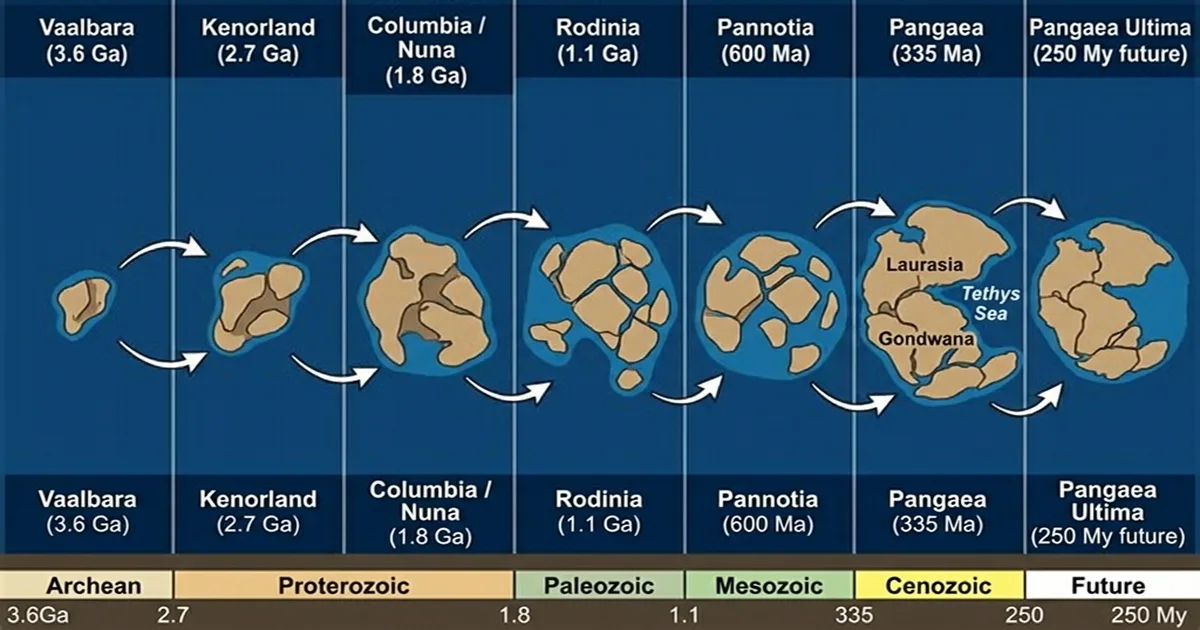
Throughout Earth’s 4.6-billion-year history, the continents have repeatedly assembled into vast landmasses called supercontinents and then broken apart again. This rhythmic process — assembly, stability, fragmentation, dispersal, and reassembly — is known as the supercontinent cycle. The most recent supercontinent, Pangaea, existed roughly 335–200 million years ago before breaking into Laurasia and Gondwana. But Pangaea was not the first. At least six supercontinents preceded it: Vaalbara, Kenorland, Columbia (Nuna), Rodinia, and Pannotia. The cycle has a periodicity of roughly 400–600 million years and is driven by mantle convection, slab pull, and ridge push — the same forces that drive plate tectonics today.
What is the Supercontinent Cycle?
The supercontinent cycle (also called the Wilson Cycle in its broader sense) describes the quasi-periodic aggregation and dispersal of continental crust. The concept was first proposed by Canadian geophysicist J. Tuzo Wilson in 1966 and later refined by R. Damian Nance, Thomas R. Worsley, and Judith B. Moody in 1988, who demonstrated the cyclical pattern in the geological record.
- A supercontinent is defined as a single landmass containing all or nearly all of Earth’s continental crust. The term was introduced by Alfred Wegener in 1912 when he proposed the existence of Pangaea.
- The cycle has a periodicity of approximately 400–600 million years — the time from the breakup of one supercontinent to the assembly of the next.
- The driving mechanism is mantle convection. When a supercontinent forms, it acts as a thermal blanket over the mantle, trapping heat beneath it. This eventually causes the underlying mantle to heat up, dome upward, and rift the supercontinent apart.
- The cycle involves five stages: (1) dispersal of fragments, (2) opening of new ocean basins, (3) subduction and closure of ocean basins, (4) continental collision and assembly, (5) stability and thermal blanketing — which then triggers a new cycle of rifting.
- Evidence for the cycle comes from palaeomagnetic data (magnetic minerals in rocks record latitude of formation), matching geological formations across now-separated continents, fossil distributions, and isotopic dating of mountain belts formed by continental collisions.
Known Supercontinents in Earth’s History
Geologists have identified at least seven supercontinents in the geological record. Each assembled through continental collisions (orogenies) and broke apart through rifting driven by mantle plumes and thermal blanketing.
| Supercontinent | Age (Approximate) | Key Features | Breakup Products |
|---|---|---|---|
| Vaalbara | ~3.6–2.8 Ga | Earliest proposed supercontinent; evidence from matching cratons of Kaapvaal (South Africa) and Pilbara (Western Australia); shared greenstone belt sequences and similar stratigraphic records | Separated into individual Archaean cratons |
| Kenorland | ~2.7–2.1 Ga | Named after the Kenoran orogeny; included cratons of Laurentia, Baltica, Western Australia, and Kalaharia; formed during Late Archaean | Breakup coincided with the Great Oxidation Event (~2.4 Ga) |
| Columbia (Nuna) | ~1.8–1.3 Ga | First well-documented supercontinent; assembled during Palaeoproterozoic; included nearly all of Earth’s continental blocks; named by Rogers and Santosh (2002) | Fragmented into multiple cratons; preceded assembly of Rodinia |
| Rodinia | ~1.1 Ga–750 Ma | Assembled during Grenville orogeny; all continents clustered near the equator; name means “to give birth” in Russian; India was located between East Antarctica and Australia | Broke apart ~750 Ma; fragments include Laurentia, Baltica, Amazonia, West Africa, Congo, India, Australia, Antarctica |
| Pannotia | ~600–540 Ma | Short-lived supercontinent; also called the Vendian supercontinent; assembled at the close of the Neoproterozoic; overlaps with Snowball Earth glaciation events | Broke apart near the start of the Cambrian; rapid breakup may have triggered the Cambrian Explosion of life |
| Pangaea | ~335–200 Ma | Most recent and best-known supercontinent; proposed by Alfred Wegener (1912); surrounded by the superocean Panthalassa; Tethys Sea between Laurasia and Gondwana; India was part of Gondwana | Split into Laurasia (north) and Gondwana (south) ~200 Ma; Gondwana further fragmented releasing India, Africa, South America, Antarctica, Australia |
| Pangaea Ultima / Amasia | ~200–250 My (future) | Predicted next supercontinent; Atlantic Ocean will close (introversion model — Pangaea Ultima) or Pacific Ocean will close (extroversion model — Amasia); current plate motions suggest reassembly in 200–250 million years | Not yet formed |
Mechanism — What Drives the Supercontinent Cycle?
The supercontinent cycle is driven by the interaction between mantle convection and the insulating effect of continental crust. The process can be understood in four stages:
- Thermal blanketing: When a supercontinent assembles, the thick continental crust acts as an insulating lid over the mantle. Heat from the mantle cannot escape efficiently through continental crust (continental crust has lower thermal conductivity than oceanic crust). Over tens of millions of years, heat accumulates beneath the supercontinent.
- Mantle upwelling and rifting: The trapped heat generates large-scale mantle upwelling (superplumes). These superplumes dome up the overlying crust, creating tensional stresses that rift the supercontinent apart. Volcanic activity intensifies along the rift zones. The East African Rift System is a modern example of continental rifting that may eventually split Africa.
- Dispersal and new ocean formation: As the rift widens, new oceanic crust is created at mid-ocean ridges (seafloor spreading). Continental fragments drift apart, carried by convection currents. New ocean basins open (e.g., the Atlantic Ocean opened as Pangaea broke apart).
- Subduction and reassembly: As oceanic crust ages, it cools, becomes denser, and eventually subducts beneath continental or younger oceanic crust. Subduction consumes old ocean basins. Continental fragments are drawn together again by slab pull and ridge push. Collision of continents produces mountain belts (orogens) and a new supercontinent is assembled.
Pangaea — The Most Recent Supercontinent
Pangaea (Greek: “all lands”) is the most recent and best-documented supercontinent. It was first proposed by Alfred Wegener in his 1912 paper “Die Entstehung der Kontinente” (The Origin of Continents). Pangaea existed from approximately 335 Ma (Late Carboniferous) to 200 Ma (Early Jurassic).
- Pangaea was surrounded by a single global ocean called Panthalassa (Greek: “all seas”).
- A wedge-shaped embayment of Panthalassa called the Tethys Sea separated the northern landmass (Laurasia) from the southern landmass (Gondwana). The Tethys Sea is significant because sediments deposited in it were later folded and uplifted to form the Himalayas, Alps, and other Tethyan mountain belts.
- Laurasia comprised present-day North America, Europe, and Asia (excluding India).
- Gondwana (named after the Gond tribe of central India) comprised South America, Africa, India, Madagascar, Australia, and Antarctica.
- India was positioned adjacent to East Africa, Madagascar, and Antarctica in eastern Gondwana. After Gondwana’s breakup (~180–130 Ma), India separated and drifted northward at an unusually fast rate (~15 cm/yr) before colliding with Eurasia ~50 Ma to form the Himalayas.
- Evidence for Pangaea includes: matching coastlines (South America and Africa), identical Permian-age Glossopteris flora fossils on all Gondwanan continents, the distribution of Mesosaurus (a freshwater reptile) in both Brazil and South Africa, matching Precambrian rock belts, and glacial striations in Permian rocks of India, Australia, Africa, and South America — all pointing to a single ice sheet over Gondwana.
Rodinia — The Supercontinent Before Pangaea
Rodinia (Russian: “to give birth” or “motherland”) assembled approximately 1.1 billion years ago during the Mesoproterozoic era through a series of collisions collectively called the Grenville orogeny. It remained stable for approximately 350 million years before breaking apart around 750 Ma.
- Rodinia was centred on the Laurentian craton (ancestral North America), which formed its core.
- India was located between East Antarctica and Australia in the SWEAT (South-West US–East Antarctica) configuration.
- The breakup of Rodinia (~750–700 Ma) coincided with the Snowball Earth glaciations — the most severe ice ages in Earth’s history when glaciers may have reached the equator.
- The breakup released massive volumes of volcanic CO₂, which eventually ended the Snowball Earth episodes through greenhouse warming.
- The Grenville orogen (the mountain belt formed by Rodinia’s assembly) is preserved today in the Appalachian basement (eastern North America), the Sveconorwegian belt (Scandinavia), and the Eastern Ghats belt (India).
- After Rodinia’s fragmentation, the continental pieces briefly reassembled into Pannotia (~600 Ma) before breaking apart again near the start of the Cambrian period.
Columbia (Nuna) — Earth’s First Well-Documented Supercontinent
Columbia (also called Nuna) assembled approximately 1.8 billion years ago during the Palaeoproterozoic and persisted until about 1.3 Ga. It was the first supercontinent for which robust palaeomagnetic and geological evidence exists. The name Columbia was proposed by Rogers and Santosh in 2002.
- Columbia included virtually all of Earth’s major cratons: Laurentia, Baltica, Amazonia, West Africa, India, North China, and Siberia.
- India’s position in Columbia is debated, but most reconstructions place the Dharwar Craton and Bastar Craton adjacent to western Australia or East Antarctica.
- Evidence for Columbia includes matching 1.8 Ga orogenic belts (Trans-Hudson orogen in North America matches the Nagssugtoqidian belt in Greenland), similar sedimentary sequences, and palaeomagnetic pole positions.
- The breakup of Columbia (~1.3 Ga) initiated a long period of continental dispersal before the fragments reassembled into Rodinia (~1.1 Ga).
The Future Supercontinent — Pangaea Ultima or Amasia?
Based on current plate motions, geologists predict that a new supercontinent will form in approximately 200–250 million years. Two competing models exist:
| Model | Proposed By | Mechanism | Outcome |
|---|---|---|---|
| Pangaea Ultima (Proxima) | Christopher Scotese (2003) | Introversion — the Atlantic Ocean closes as new subduction zones form along its margins. The Americas rotate eastward and collide with Africa and Europe. | Supercontinent centred near the equator; Mediterranean, Caribbean, and Atlantic all close; Pacific remains as the dominant ocean |
| Amasia | Paul Hoffman (1992), Mitchell et al. (2012) | Orthoversion — the next supercontinent forms 90° from the previous one’s centre. The Arctic Ocean and Caribbean close as the Americas drift north toward Asia. | Supercontinent centred over the North Pole; Arctic Ocean closes; Pacific shrinks but persists |
| Novopangaea | Roy Livermore (2003) | Extroversion — the Pacific Ocean closes (it is already shrinking via Ring of Fire subduction). The Americas drift westward into eastern Asia and Australia. | Supercontinent centred in the present-day Pacific region; Atlantic becomes the dominant ocean |
Current evidence slightly favours the Amasia model. Studies by Mitchell et al. (2012) in Nature showed that each successive supercontinent has formed approximately 90° from the previous one, supporting the orthoversion hypothesis. Australia is already moving northward at ~7 cm/yr toward Southeast Asia, and the Pacific is shrinking.
Supercontinent Cycle and India
- India has been part of every known supercontinent. The Indian craton (Dharwar, Bastar, Singhbhum, and Bundelkhand cratons) contains rocks dating back to 3.6 Ga — among the oldest on Earth.
- In Rodinia (~1.1 Ga), India was positioned between East Antarctica and Australia. The Eastern Ghats mobile belt (Odisha-AP) preserves the Grenville-age orogen from this collision.
- In Gondwana, India was situated adjacent to East Africa and Madagascar. Matching Gondwana fossils (Glossopteris, Mesosaurus) and Permo-Carboniferous glacial deposits (Talchir Formation) confirm this.
- India separated from Gondwana ~130 Ma and drifted northward over the Réunion hotspot (forming the Deccan Traps ~66 Ma) before colliding with Eurasia ~50 Ma to create the Himalayas.
- The Aravalli Range (~1.8–0.9 Ga) preserves evidence of collisions during the Columbia and Rodinia cycles.
- The Gondwana coal deposits (98% of India’s coal reserves) formed in synclinal troughs when India was part of Gondwana during the Permian period.
Supercontinent Cycle and Climate
- The formation and breakup of supercontinents profoundly affects global climate, sea level, ocean chemistry, and biodiversity.
- Glaciations: Both Rodinia’s breakup (~750 Ma, Snowball Earth) and Gondwana’s position over the South Pole (~300 Ma, Permo-Carboniferous glaciation) triggered major ice ages. Continental positions control ocean circulation patterns, which in turn regulate heat distribution.
- Sea level: During supercontinent assembly, ocean basins expand and sea levels fall (regression). During breakup, new mid-ocean ridges displace ocean water, causing sea levels to rise (transgression). The Cretaceous period (~100 Ma) saw sea levels 200–300 m higher than today, partly because of active rifting and abundant mid-ocean ridges.
- Volcanism and CO₂: Supercontinent rifting generates large igneous provinces (LIPs) that release massive CO₂, warming the climate. The Deccan Traps (India, 66 Ma) and the Central Atlantic Magmatic Province (CAMP, 201 Ma — Pangaea’s initial breakup) are examples.
- Biodiversity: Supercontinent assembly reduces shallow marine habitats (coastline length decreases) and creates harsh continental interiors with extreme temperatures, often triggering mass extinctions. Breakup creates new coastlines, shallow seas, and isolated continents that promote speciation through geographic isolation.
⭐ Important for Exams — Quick Revision
- 🔑 Supercontinent cycle: Quasi-periodic (~400–600 My) assembly and breakup of all continental crust into a single landmass. Driven by mantle convection and thermal blanketing.
- 🔑 Known supercontinents (oldest to youngest): Vaalbara (3.6 Ga) → Kenorland (2.7 Ga) → Columbia/Nuna (1.8 Ga) → Rodinia (1.1 Ga) → Pannotia (600 Ma) → Pangaea (335 Ma).
- 🔑 Pangaea: Most recent supercontinent. Proposed by Alfred Wegener (1912). Existed ~335–200 Ma. Surrounded by Panthalassa ocean. Tethys Sea between Laurasia (north) and Gondwana (south). India was part of Gondwana.
- 🔑 Rodinia: Assembled ~1.1 Ga during Grenville orogeny. Broke apart ~750 Ma. Breakup coincided with Snowball Earth glaciations. India between Antarctica and Australia.
- 🔑 Columbia/Nuna: First well-documented supercontinent (~1.8–1.3 Ga). Named by Rogers and Santosh (2002). Indian Dharwar and Bastar cratons were part of it.
- 🔑 Thermal blanketing mechanism: Supercontinent insulates mantle → heat builds up → superplumes rise → rifting → breakup → new oceans form → old oceans subduct → continents reassemble.
- 🔑 Future supercontinent: Predicted in ~200–250 My. Three models: Pangaea Ultima (Atlantic closes), Amasia (Arctic closes, 90° from Pangaea), Novopangaea (Pacific closes).
- 🔑 India connection: Part of every supercontinent. Eastern Ghats = Grenville orogen (Rodinia). Gondwana coal = Permian synclinal deposits. Deccan Traps = Réunion hotspot during northward drift. Himalayas = India-Eurasia collision (~50 Ma).
- 🔑 Climate link: Supercontinents trigger ice ages (Snowball Earth after Rodinia, Permo-Carboniferous over Gondwana). Breakup causes sea level rise, volcanic CO₂ release, and biodiversity changes.
- 🔑 Evidence: Palaeomagnetic data, matching orogens across continents, fossil distributions (Glossopteris, Mesosaurus), glacial striations, and isotopic dating of collision belts.
Frequently Asked Questions (FAQs)
1. How do we know supercontinents existed before Pangaea if there were no humans to observe them?
The evidence is encoded in the rocks themselves. Geologists use four primary lines of evidence to reconstruct ancient supercontinents:
- Palaeomagnetism: When igneous rocks cool, magnetic minerals (like magnetite) align with Earth’s magnetic field and become locked in place. By measuring the magnetic orientation in ancient rocks, geologists can determine the latitude at which the rock formed. If two continents now separated by thousands of kilometres have rocks of the same age with identical palaeomagnetic signatures, they were once joined.
- Matching orogenic belts: Mountain-building events leave distinctive signatures in the rock record — specific types of metamorphic rocks, deformation patterns, and ages. When the same orogenic belt (e.g., the 1.1 Ga Grenville orogen) can be traced across multiple continents (eastern North America, Scandinavia, India’s Eastern Ghats), it indicates those continents were once connected.
- Fossil correlations: Land organisms that cannot cross oceans (like the Permian reptile Mesosaurus or the seed fern Glossopteris) are found on multiple continents — proving those continents were once connected.
- Isotopic dating: Radiometric dating (U-Pb zircon dating, Sm-Nd dating) allows precise determination of when rocks formed and when they were deformed by collisions. Matching ages across continents indicate shared geological events.
2. Why does the supercontinent cycle have a periodicity of 400–600 million years?
The periodicity is controlled by the speed of mantle convection and the time required for the thermal blanketing effect to reach its maximum intensity. When a supercontinent forms, it takes approximately 100–200 million years for enough heat to accumulate beneath it to generate superplumes capable of rifting it apart. After breakup, the continental fragments take another 200–300 million years to disperse, for old ocean basins to be consumed by subduction, and for the fragments to reassemble into a new supercontinent.
The total cycle time also depends on plate velocities (typically 2–10 cm/yr), the size of the ocean basins that must be consumed, and the geometry of subduction zones. The Pacific Ocean, for example, is currently shrinking at its margins (Ring of Fire subduction), while the Atlantic is widening — this process alone will take at least 200 million years to bring the continents back together.
3. What role did the supercontinent cycle play in triggering mass extinctions?
The supercontinent cycle has been linked to at least three of the five major mass extinctions in Earth’s history:
- End-Permian extinction (252 Ma, 96% species lost): Occurred when Pangaea was fully assembled. The formation of a single landmass reduced shallow marine habitats (shorter total coastline), created extreme continental climates with vast deserts in the interior, and disrupted ocean circulation. The eruption of the Siberian Traps (a large igneous province associated with supercontinent dynamics) released catastrophic volumes of CO₂ and SO₂, causing runaway greenhouse warming, ocean acidification, and ocean anoxia.
- End-Triassic extinction (201 Ma, ~76% species lost): Coincided with the initial breakup of Pangaea and the eruption of the Central Atlantic Magmatic Province (CAMP) — one of the largest LIPs in Earth’s history. The massive CO₂ release caused rapid global warming.
- End-Cretaceous extinction (66 Ma, ~76% species lost): While primarily caused by the Chicxulub asteroid impact, the Deccan Traps volcanism (India, associated with the Réunion hotspot during Gondwana breakup) contributed to environmental stress. The Deccan eruptions released enormous volumes of CO₂ and SO₂ over approximately 800,000 years, weakening ecosystems before the asteroid delivered the final blow.
Related Geology Articles on StudyHub
- ➡️ What is Pangaea? — The Supercontinent, Breakup & Evidence
- ➡️ Plate Boundaries — Divergent, Convergent & Transform
- ➡️ Mid-Ocean Ridges — Seafloor Spreading & New Crust
- ➡️ Rift Valleys — Continental Breakup in Action
- ➡️ Deccan Traps — India’s Volcanic Legacy from Gondwana Breakup