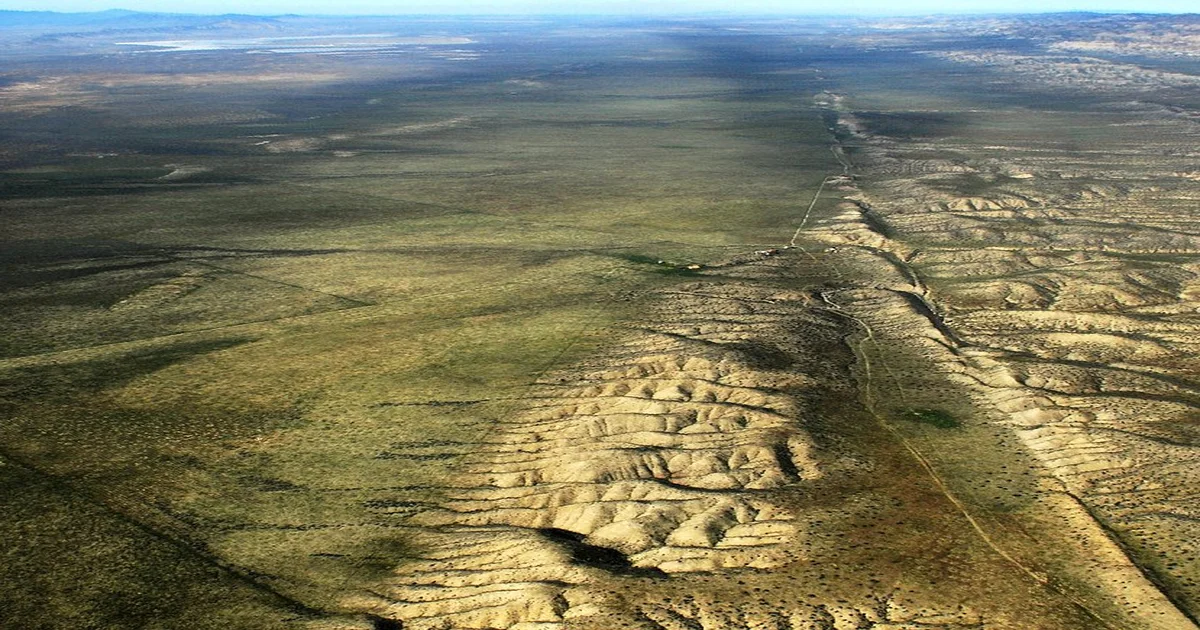
A transform fault is a type of plate boundary where two plates slide past each other horizontally. Unlike convergent or divergent boundaries, no crust is created or destroyed here — the plates simply grind past one another. The most famous example is the San Andreas Fault in California, which runs for about 1,300 km and is responsible for many of the state’s devastating earthquakes. Transform faults are also called conservative boundaries because the Earth’s crust is conserved — neither created nor destroyed.
What is a Transform Fault?
A transform fault is a plate boundary along which two lithospheric plates slide horizontally past each other. The term was coined by the Canadian geophysicist J. Tuzo Wilson in 1965. These faults are characterized by shallow-focus earthquakes (typically less than 25 km deep) and an absence of volcanic activity.
- Transform faults are also known as conservative plate boundaries because no lithosphere is created or destroyed.
- The motion along a transform fault is predominantly horizontal (lateral). This type of faulting is called strike-slip faulting.
- They connect segments of mid-ocean ridges, subduction zones, or other transform faults.
- Most transform faults are found on the ocean floor, offsetting mid-ocean ridges. A few, like the San Andreas Fault, occur on land.
- Earthquakes along transform faults are typically shallow (less than 25 km deep) because the fault zone is confined to the brittle upper crust.
How do Transform Faults form?
Transform faults form because mid-ocean ridges do not run in continuous straight lines. Instead, ridges are broken into segments that are offset from each other. Transform faults connect these offset segments.
- A mid-ocean ridge begins spreading. Due to variations in the rate of spreading and pre-existing fractures in the crust, the ridge develops in disconnected segments.
- Between these segments, a transform fault develops where the two plates slide past each other in opposite directions.
- On either side of the ridge, the newly formed oceanic crust moves away. Between the two offset ridge segments, the plates move in opposite directions — creating the active transform fault zone.
- Beyond the offset ridge tips, the crust on both sides of the fracture moves in the same direction and at the same speed. This inactive portion is called a fracture zone.
Types of Transform Faults
J. Tuzo Wilson classified transform faults based on the type of plate boundary they connect. There are six possible combinations, but three are the most common:
| Type | Connects | Example | Key Feature |
|---|---|---|---|
| Ridge-Ridge | Two mid-ocean ridge segments | Most oceanic transform faults (e.g., fracture zones on the Mid-Atlantic Ridge) | Most common type; offsets ridge segments; shorter and simpler |
| Ridge-Trench | A mid-ocean ridge to a subduction zone | Queen Charlotte Fault (British Columbia) | Connects a spreading center to a consumption zone |
| Trench-Trench | Two subduction zones | Alpine Fault (New Zealand) | Connects two convergent boundaries; often long and complex |
Transform Fault vs Fracture Zone
This is a common point of confusion. Here is the difference:
| Feature | Transform Fault (Active) | Fracture Zone (Inactive) |
|---|---|---|
| Location | Between the two offset ridge segments | Beyond the ridge tips, extending into the plate interior |
| Plate motion | Plates move in opposite directions | Both sides move in the same direction and speed |
| Earthquakes | Frequent, shallow, often strong | Rare and weak (no relative motion) |
| Length | Typically 10–500 km | Can extend thousands of km across the ocean floor |
| Example | Active portion between ridge offsets | Romanche Fracture Zone (935 km, equatorial Atlantic) |
Major Transform Faults of the World
| Transform Fault | Location | Length | Key Details |
|---|---|---|---|
| San Andreas Fault | California, USA | ~1,300 km | Pacific Plate slides NW past North American Plate at ~46 mm/yr; right-lateral; 1906 San Francisco (Mw 7.9, ~3,000 killed), 1989 Loma Prieta (Mw 6.9), 1857 Fort Tejon (Mw 7.9); future “Big One” expected |
| Dead Sea Transform | Middle East | ~1,000 km | Arabian Plate slides north past African Plate; left-lateral; created the Dead Sea (~430m below sea level, lowest point on land), Jordan Valley, Sea of Galilee, Beqaa Valley |
| Alpine Fault | New Zealand | ~600 km | Pacific Plate slides past Australian Plate; right-lateral; ~27 mm/yr; last major earthquake 1717; seismic gap — major earthquake expected; created the Southern Alps (highest peak Aoraki/Mt Cook, 3,724m) |
| Queen Charlotte Fault | British Columbia, Canada | ~900 km | Pacific Plate slides past North American Plate; right-lateral; ~50 mm/yr (one of fastest on Earth); 1949 Mw 8.1 earthquake (largest Canadian earthquake) |
| North Anatolian Fault | Turkey | ~1,500 km | Anatolian Plate slides west past Eurasian Plate; right-lateral; 1999 Izmit earthquake (Mw 7.6, 17,127 killed); 2023 Turkey-Syria earthquakes (Mw 7.8, 59,000+ killed — though on the nearby East Anatolian Fault) |
| Chaman Fault | Pakistan-Afghanistan | ~860 km | Indian Plate slides north past Eurasian Plate; left-lateral; ~33 mm/yr; major seismic hazard; 1935 Quetta earthquake (Mw 7.7, 35,000 killed) |
The San Andreas Fault — California’s Most Dangerous Geological Feature
The San Andreas Fault is the most studied and most famous transform fault on Earth. It runs for about 1,300 km through California, from the Salton Sea in the south to Cape Mendocino in the north. Along this fault, the Pacific Plate is moving northwestward relative to the North American Plate at an average rate of about 46 mm per year (roughly the speed at which your fingernails grow).
- The fault was first recognized by geologist Andrew Lawson in 1895 and named after San Andreas Lake, a small reservoir near San Francisco.
- It is a right-lateral strike-slip fault — if you stand on one side and look across, the opposite side moves to the right.
- The fault passes through two of America’s largest cities: San Francisco and Los Angeles. These cities are on opposite sides of the fault and are moving closer together at ~46 mm/yr. In about 15 million years, Los Angeles will be alongside San Francisco.
- The fault is divided into three segments: Northern (last major quake 1906), Central (creeping section — slides smoothly without major earthquakes), and Southern (last major quake 1857 — most overdue for a large earthquake).
Major earthquakes on the San Andreas Fault
| Year | Earthquake | Magnitude | Impact |
|---|---|---|---|
| 1857 | Fort Tejon | Mw 7.9 | Rupture ~350 km along southern segment; sparse population limited casualties; last major earthquake on southern San Andreas |
| 1906 | San Francisco | Mw 7.9 | Ruptured 477 km on northern segment; 296 km of surface offset; 3,000+ killed; 80% of San Francisco destroyed by earthquake and resulting fire; insurance losses drove economic changes |
| 1989 | Loma Prieta | Mw 6.9 | Near Santa Cruz; 63 killed; Cypress Street Viaduct collapse; Bay Bridge section collapsed; 10 billion USD damage; broadcast live during World Series baseball game |
The Dead Sea Transform — Middle East
The Dead Sea Transform (also called the Dead Sea Rift or Levant Fault) is a left-lateral transform fault that runs for about 1,000 km from the spreading center in the Red Sea northward to the Taurus Mountains in southern Turkey. Along this fault, the Arabian Plate is moving northward relative to the African Plate at about 5 mm per year.
- This transform fault has created the Jordan Rift Valley, which includes the Dead Sea, the Jordan River valley, the Sea of Galilee, and the Beqaa Valley of Lebanon.
- The Dead Sea lies at approximately 430 metres below sea level — the lowest point on the Earth’s land surface. It occupies a pull-apart basin created by a slight bend in the transform fault. Where the fault bends, extension occurs, and the crust drops down to form a deep basin.
- The Dead Sea has a salinity of about 34.2% (roughly 10 times saltier than normal seawater) because water flows into it but has no outlet — it can only lose water through evaporation.
- Historically, major earthquakes have occurred along this fault: 1202 AD (estimated Mw 7.5, one of the strongest in recorded Middle Eastern history), 1837 Galilee earthquake (~5,000 killed), and 1927 Jericho earthquake (Mw 6.3).
How are Transform Faults different from other plate boundaries?
| Feature | Divergent | Convergent | Transform |
|---|---|---|---|
| Motion | Plates move apart | Plates move together | Plates slide past each other |
| Crust | New crust created | Crust destroyed (subducted) | Crust conserved |
| Volcanism | Yes (mid-ocean ridges) | Yes (volcanic arcs) | No (generally absent) |
| Earthquakes | Shallow, weak-moderate | Shallow to deep, weak-extreme | Shallow, moderate-strong |
| Topography | Ridge, rift valley | Trench, mountain, island arc | Linear fault trace, offset streams |
| Examples | Mid-Atlantic Ridge | Himalayas, Andes | San Andreas, Dead Sea |
⭐ Important for Exams — Quick Revision
- 🔑 Transform fault: A plate boundary where two plates slide horizontally past each other. Also called conservative boundary. No crust is created or destroyed.
- 🔑 J. Tuzo Wilson (1965): Coined the term “transform fault” and classified them into six types based on the boundaries they connect (ridge-ridge, ridge-trench, trench-trench being the three main types).
- 🔑 Strike-slip faulting: The type of faulting at transform boundaries. Motion is predominantly horizontal. Two sub-types: right-lateral (San Andreas, Alpine) and left-lateral (Dead Sea, Chaman).
- 🔑 San Andreas Fault: ~1,300 km; California; Pacific Plate slides NW past North American Plate at ~46 mm/yr; right-lateral; 1906 San Francisco earthquake (Mw 7.9, 3,000+ killed).
- 🔑 Dead Sea Transform: ~1,000 km; Middle East; Arabian Plate moves north past African Plate at ~5 mm/yr; left-lateral; created the Dead Sea (430m below sea level, lowest land point on Earth).
- 🔑 Alpine Fault: ~600 km; New Zealand; Pacific past Australian Plate at ~27 mm/yr; right-lateral; created Southern Alps; overdue for a major earthquake.
- 🔑 North Anatolian Fault: ~1,500 km; Turkey; right-lateral; 1999 Izmit earthquake (Mw 7.6, 17,127 killed); one of the world’s most seismically active transform faults.
- 🔑 Transform fault vs fracture zone: Active transform = between offset ridge segments, plates move in opposite directions, earthquakes common. Fracture zone = beyond ridge tips, plates move same direction, seismically inactive.
- 🔑 No volcanism: Transform faults generally lack volcanism because no crust is being subducted (no water release into mantle) and no crust is being pulled apart (no decompression melting).
- 🔑 Shallow earthquakes only: Transform fault earthquakes are typically less than 25 km deep because the fault zone is confined to the brittle upper lithosphere.
Frequently Asked Questions (FAQs)
1. What is the expected “Big One” on the San Andreas Fault?
The southern segment of the San Andreas Fault has not ruptured since 1857 — over 168 years ago. Based on the average recurrence interval (roughly 150 years for major earthquakes on this segment), seismologists consider a major earthquake (Mw 7.5 or greater) on the southern San Andreas to be overdue.
The USGS estimates a 60% probability of a magnitude 6.7 or greater earthquake striking Southern California within the next 30 years. A full rupture of the southern San Andreas could produce a Mw 7.8–8.0 earthquake affecting Los Angeles, San Bernardino, and Riverside — home to over 20 million people. The ShakeOut scenario (a scientific simulation) estimates such an earthquake would cause approximately 1,800 deaths, 50,000 injuries, and $213 billion in economic losses.
2. Why is the Dead Sea the lowest point on land?
The Dead Sea sits at ~430 metres below sea level because of a geological feature called a pull-apart basin. Here is how it forms:
- The Dead Sea Transform runs roughly north-south. But the fault is not perfectly straight — it has a slight bend near the Dead Sea.
- At this bend, the left-lateral motion of the plates creates a zone of extension — the crust is pulled apart.
- The extended crust thins and drops down, forming a deep depression (a graben within the transform system).
- Over millions of years, this pull-apart basin has subsided to create the deepest land surface on Earth.
The Dead Sea is shrinking — its surface level has dropped by about 1 metre per year in recent decades due to diversion of Jordan River water for irrigation by Israel, Jordan, and Syria.
3. How did the 1906 San Francisco earthquake change earthquake science?
The 1906 earthquake was a turning point. After the earthquake, H.F. Reid of Johns Hopkins University studied the deformation of the ground near the fault and proposed the Elastic Rebound Theory (1910) — the idea that earthquakes occur when accumulated elastic strain along a fault is suddenly released as the rocks snap back to their undeformed positions.
- Before 1906, the cause of earthquakes was poorly understood. Many scientists still attributed them to underground explosions or volcanic activity.
- Reid showed that the ground on both sides of the San Andreas Fault had been slowly deforming (bending) for decades before the earthquake. The earthquake occurred when the accumulated strain exceeded the frictional strength of the fault, and the rocks suddenly slipped.
- The maximum horizontal displacement measured after the 1906 earthquake was about 6 metres near Olema, north of San Francisco.
- The Elastic Rebound Theory remains the fundamental model for understanding tectonic earthquakes worldwide.
Related Geology Articles on StudyHub
- ➡️ Plate Boundaries — Divergent, Convergent, Transform
- ➡️ Earthquakes — Causes, Seismic Waves, Measurement
- ➡️ Mid-Ocean Ridges — Transform Faults Offset These Ridges
- ➡️ Rift Valleys — Extension at Divergent Boundaries
- ➡️ Island Arcs — What Happens at Convergent Boundaries