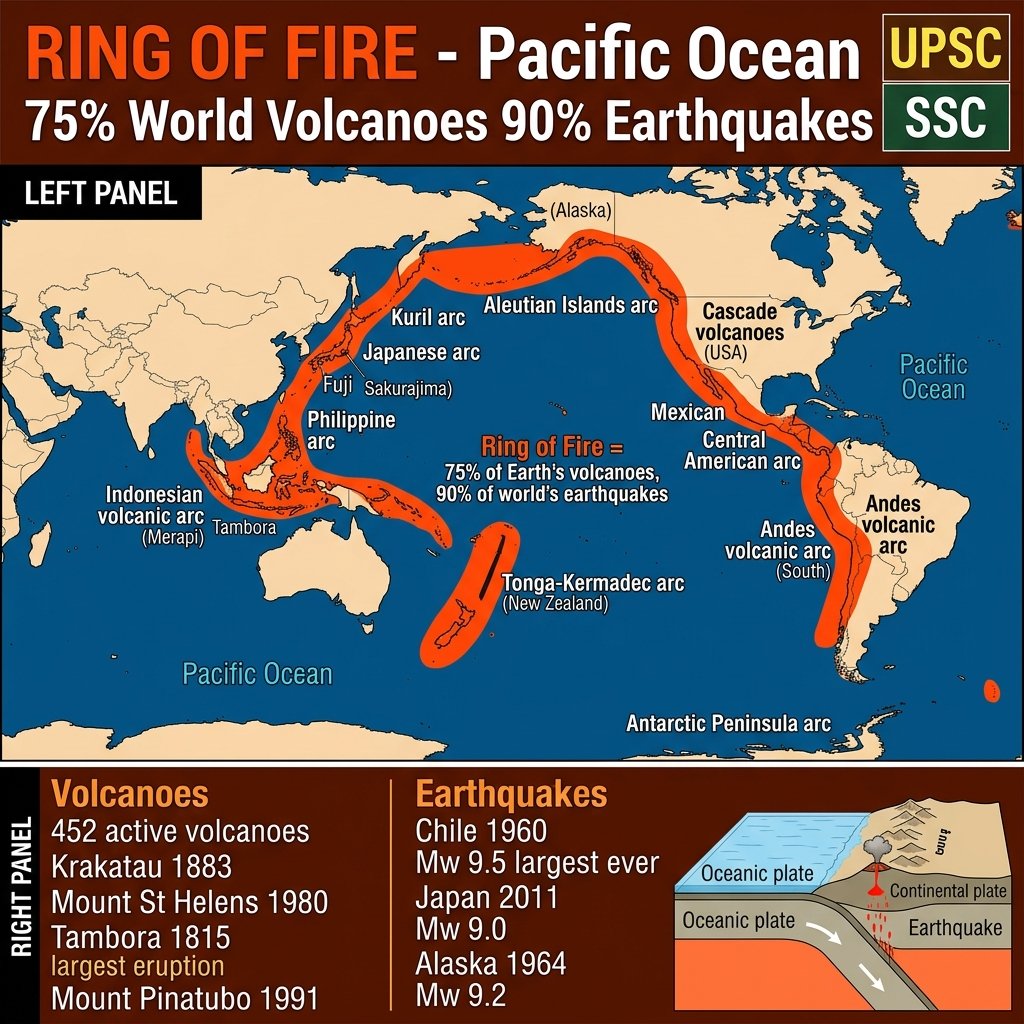
Encircling the Pacific Ocean in a vast horseshoe arc stretching 40,000 kilometres, the Ring of Fire is the most geologically active zone on Earth — home to approximately 452 active volcanoes (75% of the world’s total), responsible for around 90% of the world’s earthquakes by frequency, and the site of every single earthquake of magnitude 9.0 or greater ever recorded. From the Andes volcanic chain in South America, through Central America and Mexico, up the Cascades of the USA and Canada, across the Aleutian Islands of Alaska, down through Japan and the Kuril Islands, through the Philippines and Indonesia, and finally south through Tonga-Kermadec to New Zealand — the Ring of Fire traces precisely the boundaries of the Pacific Plate with surrounding plates. Its geological violence is entirely explained by plate tectonics: the Pacific Plate and several smaller oceanic plates surrounding it are continuously subducting under adjacent continental and oceanic plates, driving relentless volcanism, megathrust earthquakes, and tsunamis. The Ring of Fire is not a ring of coincidence — it is a ring of subduction.
What Is the Ring of Fire?
- 🔥 Definition: The Ring of Fire (also called the Circum-Pacific Belt) is a horseshoe-shaped zone of intense volcanic and seismic activity encircling the Pacific Ocean; it is approximately 40,000 km long; it is not a perfect ring — it is open at the Antarctic end and has gaps in the western Pacific
- 🔥 Cause — subduction: The Ring of Fire exists because the Pacific Plate (and several associated plates — Nazca, Cocos, Juan de Fuca, Philippine, Australian) is being subducted under surrounding continental plates (North American, South American, Eurasian) and oceanic plates (Caribbean, Scotia); subduction generates both volcanism (water from the sinking slab lowers mantle melting point = arc volcanoes) and megathrust earthquakes (plates lock and slip at subduction interfaces)
- 🔥 Key statistics: ~452 active volcanoes; ~75% of all active volcanoes on Earth; ~90% of all earthquakes by count; 100% of all Mw 9.0+ earthquakes ever recorded; ~81% of the world’s largest earthquakes (USGS data)
- 🔥 Pacific Plate dynamics: The Pacific Plate is the world’s largest tectonic plate (~103 million km²); it moves NW at 7–10 cm/yr; its margins are mostly convergent (subducting) rather than divergent; it is bordered by subduction zones on three sides (Aleutian, Japan-Kuril, Mariana, Tonga-Kermadec, Chile-Peru) = intense seismic activity along its entire perimeter
Major Volcanic Arcs of the Ring of Fire
| Volcanic Arc | Location | Notable Volcanoes | Subduction |
|---|---|---|---|
| Andes Volcanic Zone | South America (Colombia to Chile) | Cotopaxi (Ecuador, 5,897m active), Villarrica (Chile), Nevado del Ruiz (Colombia — 1985 lahar killed 23,000) | Nazca Plate under South American Plate |
| Central American Volcanic Arc | Guatemala to Panama | Santa María (Guatemala), Arenal (Costa Rica), Poás (Costa Rica) | Cocos Plate under Caribbean Plate |
| Mexican Volcanic Belt (Trans-Mexican) | Mexico | Popocatépetl (5,426m, near Mexico City), Colima, Paricutin (born 1943, grew 424m in 1 year) | Cocos and Rivera plates under North American Plate |
| Cascade Volcanic Arc | USA and Canada (California to British Columbia) | Mount St Helens (erupted 1980, lateral blast killed 57), Mount Rainier, Mount Hood, Lassen Peak | Juan de Fuca Plate under North American Plate (Cascadia Subduction Zone) |
| Aleutian Arc | Alaska, USA | Augustine, Pavlof, Shishaldin; 80 volcanoes, ~40 active; remote but aviation hazard | Pacific Plate under North American Plate |
| Kamchatka Arc | Russia | Klyuchevskaya Sopka (4,750m, most active in Northern Hemisphere by erupted volume), Shiveluch | Pacific Plate under Eurasian/Okhotsk Plate |
| Japanese Arc | Japan | Mount Fuji (3,776m, last eruption 1707), Sakurajima (erupts ~1,000×/year), Aso (world’s largest caldera by area), Unzen (1991 pyroclastic flow) | Pacific and Philippine plates under Eurasian Plate |
| Philippines Arc | Philippines | Mount Pinatubo (1991 eruption = 2nd largest 20th century; 20 million tonnes SO₂ injected into stratosphere; cooled Earth 0.5°C for 2 years), Mayon (most active Philippine volcano) | Philippine Plate under Eurasian Plate |
| Indonesian Arc | Indonesia (Sumatra-Java-Bali-Flores) | Krakatau (1883 eruption = heard 4,800 km away; tsunami killed 36,000); Tambora (1815 = largest eruption in recorded history, VEI 7, Year Without a Summer 1816); Merapi (most dangerous volcano in Java) | Australian-Indian Plate under Eurasian Plate |
| Tonga-Kermadec Arc | South Pacific (Tonga, New Zealand) | Hunga Tonga-Hunga Ha’apai (Jan 2022 eruption = fastest atmospheric shockwave ever recorded, 490 km/h, caused tsunami in Japan and Peru); White Island (NZ, 2019 eruption killed 22 tourists) | Pacific Plate under Australian Plate |
Major Earthquakes of the Ring of Fire
| Earthquake | Year | Magnitude | Key Facts |
|---|---|---|---|
| Valdivia, Chile | 1960 | Mw 9.5 | Largest earthquake ever recorded; generated tsunami that killed 61 in Hawaii, 138 in Japan; total deaths ~5,700; Cascadia fault equivalent could produce similar event |
| Good Friday, Alaska | 1964 | Mw 9.2 | Second largest earthquake ever recorded; subsidence/uplift of land up to 11.5m; triggered submarine landslides; tsunami killed 131 |
| Indian Ocean (Sumatra-Andaman) | 2004 | Mw 9.1 | Deadliest tsunami in recorded history; 227,898 killed across 14 countries; occurred on Sunda Megathrust (Ring of Fire boundary near Indonesia); ruptured 1,200 km of fault |
| Tōhoku, Japan | 2011 | Mw 9.0 | Most powerful earthquake in Japan’s recorded history; triggered tsunami (max wave height 40.5m); Fukushima Daiichi nuclear disaster; ~19,747 deaths; Japan moved 2.4m eastward; Earth’s rotation slightly sped up |
| Maule, Chile | 2010 | Mw 8.8 | 5th largest ever; shifted Earth’s axis by ~8 cm; 525 deaths; triggered Pacific-wide tsunami warning |
| Mexico City | 1985 | Mw 8.0 | Classic surface wave amplification: 350 km from epicentre; 9,500+ killed in Mexico City; demonstrated Rayleigh wave resonance in Lake Texcoco soft sediment |
The Cascadia Subduction Zone — America’s Hidden Megathrust
- ⚠️ What it is: The Cascadia Subduction Zone is a 1,000 km long convergent plate boundary off the coast of the Pacific Northwest USA and British Columbia, Canada; the Juan de Fuca Plate (a small remnant of the ancient Farallon Plate) is subducting under the North American Plate at ~3–4 cm/year; the subduction zone runs from northern California through Oregon, Washington, and into British Columbia
- ⚠️ The great earthquake risk: The last full Cascadia megathrust rupture occurred on January 26, 1700 (dated precisely from Japanese tsunami records and Native American oral histories); it was estimated at Mw 8.7–9.2; it generated a tsunami that struck Japan 10 hours later; the Pacific Northwest has not had a full rupture since — but geological evidence (layers of buried coastal marshes “drowned” suddenly during ancient megathrust events) shows it ruptures approximately every 200–500 years; the region is now overdue
- ⚠️ Cascades volcanic chain: The subducting Juan de Fuca Plate releases water at depth, lowering the mantle melting point = volcanism above the subduction zone = the Cascade volcanoes (Mount St Helens, Mount Rainier, Mount Hood, Crater Lake, Shasta); Mount St Helens erupted catastrophically in May 1980 — a lateral blast destroyed 600 km² of forest, killed 57 people, and reduced the mountain’s height by 400m
Ring of Fire vs Other Seismic Zones
| Zone | Earthquake % | Mechanism | Examples |
|---|---|---|---|
| Ring of Fire (Circum-Pacific Belt) | ~90% | Subduction of Pacific and related plates; megathrust earthquakes; volcanic arc formation | Chile 1960, Japan 2011, Alaska 1964, Indonesia 2004 |
| Alpide Belt (Mediterranean-Himalayan) | ~6–7% | Continental collision (India-Eurasia, Africa-Eurasia); no subduction = no arc volcanoes; thrust and strike-slip earthquakes | Turkey 2023 Mw 7.8, Afghanistan, Iran, Italy, Pakistan |
| Mid-Ocean Ridge System | ~2–3% | Divergent boundary; shallow extensional earthquakes; no megathrust; submarine volcanism | Mid-Atlantic Ridge, Iceland; spreading earthquakes |
| Intraplate Zones | ~1% | Reactivated ancient faults within plates; no plate boundary; lower magnitude but locally damaging | New Madrid (USA), Koyna (India), Bhuj 2001 India |
⭐ Important for Exams — Quick Revision
- 🔑 Ring of Fire: 40,000 km horseshoe arc around Pacific Ocean; 452 active volcanoes (75% of world total); ~90% of world’s earthquakes; 100% of all Mw 9.0+ earthquakes
- 🔑 Cause: Subduction of Pacific Plate (and Nazca, Cocos, Juan de Fuca, Philippine plates) under surrounding plates; subduction = volcanism + megathrust earthquakes
- 🔑 Largest earthquake ever: Valdivia, Chile — May 22, 1960 — Mw 9.5; killed ~5,700; tsunami reached Hawaii and Japan
- 🔑 Deadliest tsunami: 2004 Indian Ocean (Sumatra-Andaman) — Mw 9.1 — 227,898 killed in 14 countries; Sunda Megathrust (Ring of Fire)
- 🔑 Tōhoku Japan 2011: Mw 9.0; largest in Japan’s recorded history; 40.5m max tsunami wave; Fukushima nuclear disaster; Japan shifted 2.4m eastward
- 🔑 Tambora 1815: Indonesia; VEI 7; largest eruption in recorded history; Year Without a Summer 1816 (global cooling); estimated 71,000–92,000 deaths from eruption + famine
- 🔑 Krakatau 1883: Indonesia; VEI 6; heard 4,800 km away (loudest sound in recorded history); tsunami killed ~36,000; cooled Earth ~1.2°C for 5 years
- 🔑 Mount Pinatubo 1991: Philippines; VEI 6; 2nd largest 20th-century eruption; 20 Mt SO₂ injected into stratosphere; cooled Earth 0.5°C for 2 years
- 🔑 Mount St Helens 1980: USA Cascades; lateral blast; 600 km² forest destroyed; 57 killed; mountain height reduced 400m; Juan de Fuca subduction
- 🔑 Cascadia Subduction Zone: Pacific Northwest USA/Canada; Juan de Fuca Plate; last megathrust = January 26, 1700 (Mw 8.7–9.2); overdue; risk to Seattle, Portland, Vancouver
- 🔑 Hunga Tonga 2022: Tonga; underwater volcanic eruption; fastest atmospheric shockwave ever (490 km/h); tsunami affected Peru and Japan; one of largest eruptions in 30 years
- 🔑 Paricutin 1943: Mexico; born in a cornfield February 20, 1943; grew 424m in first year; one of seven natural wonders of the world; still active
- 🔑 Nevado del Ruiz 1985: Colombia; eruption triggered lahar (volcanic mudflow); buried town of Armero; 23,000 killed; second deadliest volcanic disaster of 20th century
- 🔑 Alpide Belt: Second most seismically active zone (~6–7% of earthquakes); Mediterranean to Himalaya; continental collision (no arc volcanoes); Turkey, Iran, Pakistan, India
- 🔑 Klyuchevskaya Sopka: Kamchatka, Russia; 4,750m; most active volcano in Northern Hemisphere by erupted volume; has erupted almost continuously since 1700
Frequently Asked Questions (FAQs)
1. Why does the Ring of Fire have so many volcanoes and earthquakes?
The Root Cause: Subduction
The Ring of Fire’s extraordinary concentration of geological activity has a single root cause: subduction. The Pacific Ocean floor is being consumed — subducted — beneath the surrounding continental and oceanic plates all around its perimeter. This process simultaneously generates two types of hazard: volcanic arcs and megathrust earthquakes.
How Subduction Creates Volcanoes
As an oceanic plate descends into the mantle, it carries with it large quantities of water — water stored in hydrated minerals (serpentine, amphibole, chlorite) in the oceanic crust and sediments. At depths of approximately 80–150 km, the increasing temperature and pressure cause these minerals to break down and release their water into the overlying mantle wedge.
This released water dramatically lowers the melting temperature of the mantle rock above the subducting slab. Mantle that would normally remain solid at that temperature begins to melt, producing magma. This magma is less dense than the surrounding rock; it rises through the overlying plate and eventually erupts at the surface as a volcanic arc — a chain of volcanoes running parallel to the subduction trench, typically 100–200 km inland from it. Every single volcanic arc in the Ring of Fire (Andes, Central America, Cascades, Aleutians, Kamchatka, Japan, Philippines, Indonesia, Tonga) formed by this same water-fluxed melting process above a subducting slab.
How Subduction Creates Megathrust Earthquakes
The subducting plate does not slide smoothly into the mantle. The interface between the subducting oceanic plate and the overlying plate is rough and partially locked — friction holds the two plates together over areas hundreds to thousands of km². As the plates continue trying to move relative to each other, elastic strain energy builds up in the locked zone over decades to centuries.
When the frictional resistance is finally overcome, the locked zone ruptures suddenly — the overriding plate snaps upward and seaward. This sudden displacement of thousands of km² of ocean floor generates the most powerful type of earthquake on Earth: a megathrust earthquake. All five of the largest earthquakes ever recorded — Chile 1960 (Mw 9.5), Alaska 1964 (Mw 9.2), Sumatra 2004 (Mw 9.1), Japan 2011 (Mw 9.0), Chile 2010 (Mw 8.8) — were megathrust events on Ring of Fire subduction zones.
Why the Pacific Is Special
- Large, old, dense oceanic crust: The Pacific Plate is the world’s largest plate; much of its oceanic crust is old (80–180 Ma), cold, and dense = strongly negatively buoyant = sinks readily into the mantle = strong subduction driving force
- Surrounded by subduction on three sides: Unlike the Atlantic (bounded mostly by passive margins with no active subduction), the Pacific is being consumed around most of its perimeter; this gives the Ring of Fire its nearly complete circular geometry
- High convergence rates: The Pacific Plate converges with surrounding plates at 7–10 cm/yr (Japan, Tonga) — among the fastest convergence rates on Earth; faster convergence = larger strain accumulation = larger potential earthquakes
2. What was the Tambora eruption of 1815 — and how did it cause the “Year Without a Summer”?
The Eruption
On April 10–11, 1815, Mount Tambora on the island of Sumbawa (now Indonesia) erupted in the most powerful volcanic eruption in recorded human history. The eruption had a Volcanic Explosivity Index (VEI) of 7 — releasing approximately 160 km³ of magma and ash, and ejecting an estimated 60 million tonnes of sulfur dioxide (SO₂) into the stratosphere. The sound of the eruption was heard 2,600 km away. The mountain’s summit collapsed, reducing Tambora’s height from ~4,300m to ~2,851m and creating a 6 km-wide, 1.1 km-deep caldera.
The immediate death toll from the eruption, pyroclastic flows, and resulting tsunamis was approximately 10,000–11,000 people. But the far greater death toll came from the famine and disease that followed — estimated at 60,000–80,000 additional deaths across Indonesia as crops were destroyed by ash fallout.
The Stratospheric Mechanism
The global climate impact came from Tambora’s sulfur dioxide injection into the stratosphere. SO₂ in the stratosphere reacts with water vapour to form tiny droplets of sulfuric acid (H₂SO₄ aerosols). These aerosols remain in the stratosphere for 1–3 years (unlike tropospheric aerosols which rain out in days) and form a global reflective veil that reflects incoming solar radiation back to space, reducing the amount of sunlight reaching Earth’s surface.
Tambora’s stratospheric aerosol injection reduced global average temperatures by approximately 0.4–0.7°C over the following year — small in absolute terms but catastrophic for agriculture, which depends on stable seasonal temperature patterns.
The Year Without a Summer — 1816
- New England and Canada: Frosts occurred in every month of 1816; snow fell in June in Quebec; crop failures destroyed harvests across the northeastern USA and eastern Canada; food prices rose 300%; widespread famine
- Europe: The summer of 1816 was the coldest since 1601; persistent rains, fog, and cold destroyed grain harvests across France, Germany, Switzerland, and the British Isles; bread prices tripled; food riots broke out in France and Switzerland; estimated 200,000 deaths from famine across Europe
- China and India: Monsoon patterns were disrupted; summer floods occurred in China (Yangtze River flooding); cholera pandemic began in Bengal, India in 1817 (linked to climate disruption of the monsoon) — the first of the seven global cholera pandemics
- Cultural legacy: Mary Shelley wrote Frankenstein during the cold, dark summer of 1816 while stranded in Switzerland with Percy Shelley and Lord Byron; Lord Byron wrote “Darkness” (a poem describing the sun going out); Tambora indirectly gave the world some of its greatest gothic literature
3. What is the Cascadia Subduction Zone — and why is it called North America’s biggest earthquake threat?
The Zone
The Cascadia Subduction Zone (CSZ) is a convergent plate boundary running ~1,000 km along the Pacific coast of North America — from Cape Mendocino in northern California, up through Oregon and Washington states, and into British Columbia in Canada. The Juan de Fuca Plate (a small remnant of the ancient Farallon Plate, ~250,000 km²) converges with and subducts under the North American Plate at approximately 3–4 cm/year.
The 1700 Earthquake
The last full rupture of the Cascadia Subduction Zone occurred on the night of January 26, 1700. Its magnitude is estimated at Mw 8.7–9.2 based on: Japanese written records of an “orphan tsunami” (tsunami with no recorded local earthquake in Japan = it came from far away) arriving on January 27–28, 1700; Native American oral histories (Huu-ay-aht people of Vancouver Island describe a catastrophic overnight flood); geological evidence (ghost forests of drowned red cedars in coastal Oregon and Washington, where trees died suddenly in saltwater as the coast subsided 0.5–2m in the earthquake); and sand sheets deposited inland by the tsunami.
The Current Threat
- Return period: Full CSZ ruptures (Mw 8.7–9.2) occur approximately every 200–500 years; the current gap (2026 − 1700 = 326 years) puts the region within its expected recurrence window
- Population at risk: Seattle (750,000), Portland (650,000), and Vancouver (2.5 million metro) all lie within the expected high-shaking zone; the I-5 corridor between them contains critical infrastructure built before modern seismic codes
- Tsunami hazard: A full CSZ rupture would generate a tsunami reaching the Oregon and Washington coast in approximately 15–30 minutes — too fast for effective evacuation for coastal residents; inundation zones reach 1–4 km inland in places; the FEMA/Oregon DOGAMI modelling shows potential for 10,000+ tsunami casualties in Oregon alone
- Preparedness: Oregon and Washington states have published detailed CSZ hazard maps; vertical evacuation towers (tsunami-resistant structures accessible in minutes) have been built in coastal towns; ShakeAlert early warning system now operational across the Pacific Northwest
Why Cascadia Gets Less Attention Than Expected
Unlike California’s San Andreas Fault, which produces frequent magnitude 6–7 earthquakes and keeps seismic risk in public consciousness, the Cascadia Subduction Zone has been seismically quiet for 326 years. This silence is not reassuring — it means the locked fault zone is accumulating strain energy. GPS measurements show the Pacific Northwest coast being compressed and uplifted at measurable rates, consistent with elastic strain building toward the next megathrust event. When it comes, it will be unlike anything in the recorded experience of the region.
Related Geology Articles on StudyHub
- ➡️ Mantle Plumes — Intraplate Volcanism Beyond the Ring
- ➡️ Seismic Waves — How Earthquakes Are Detected
- ➡️ Tsunamis — 2004 Indian Ocean & Subduction Tsunamis
- ➡️ Earthquakes — Focus, Epicentre & India Seismic Zones
- ➡️ Plate Boundaries — Subduction & Arc Formation