Beneath the slowly moving tectonic plates, certain fixed points within Earth’s mantle burn with extraordinary heat — stationary fountains of super-hot rock called mantle plumes that punch upward through the entire mantle and blast through the overlying plate as it drifts above. The volcanic islands of Hawaii, the geysers of Yellowstone, the catastrophic Deccan Traps flood basalts that blanketed a third of India 66 million years ago, the enormous Columbia River Basalt fields of the Pacific Northwest, and the volcanic island of Iceland sitting on the Mid-Atlantic Ridge — all are products of mantle plumes, also called hotspots. Unlike the volcanic activity at plate boundaries (where volcanism is driven by slab dehydration in subduction zones or decompression melting at divergent ridges), hotspot volcanism occurs in the middle of tectonic plates, far from any plate boundary — and it leaves a trail: as the plate moves over the fixed hotspot, a chain of progressively older volcanoes is produced, recording the plate’s direction and speed of motion with extraordinary precision. The Hawaiian-Emperor Seamount Chain stretches 6,000 km across the Pacific, with volcano ages increasing systematically from 0 on the Big Island to over 80 million years at the Emperor Seamounts near Kamchatka — the most precise plate motion record on Earth. Understanding mantle plumes and hotspots — their structure, origin, identification, and relationship to flood basalts and mass extinctions — is essential for UPSC, SSC and competitive examinations in geology and physical geography.
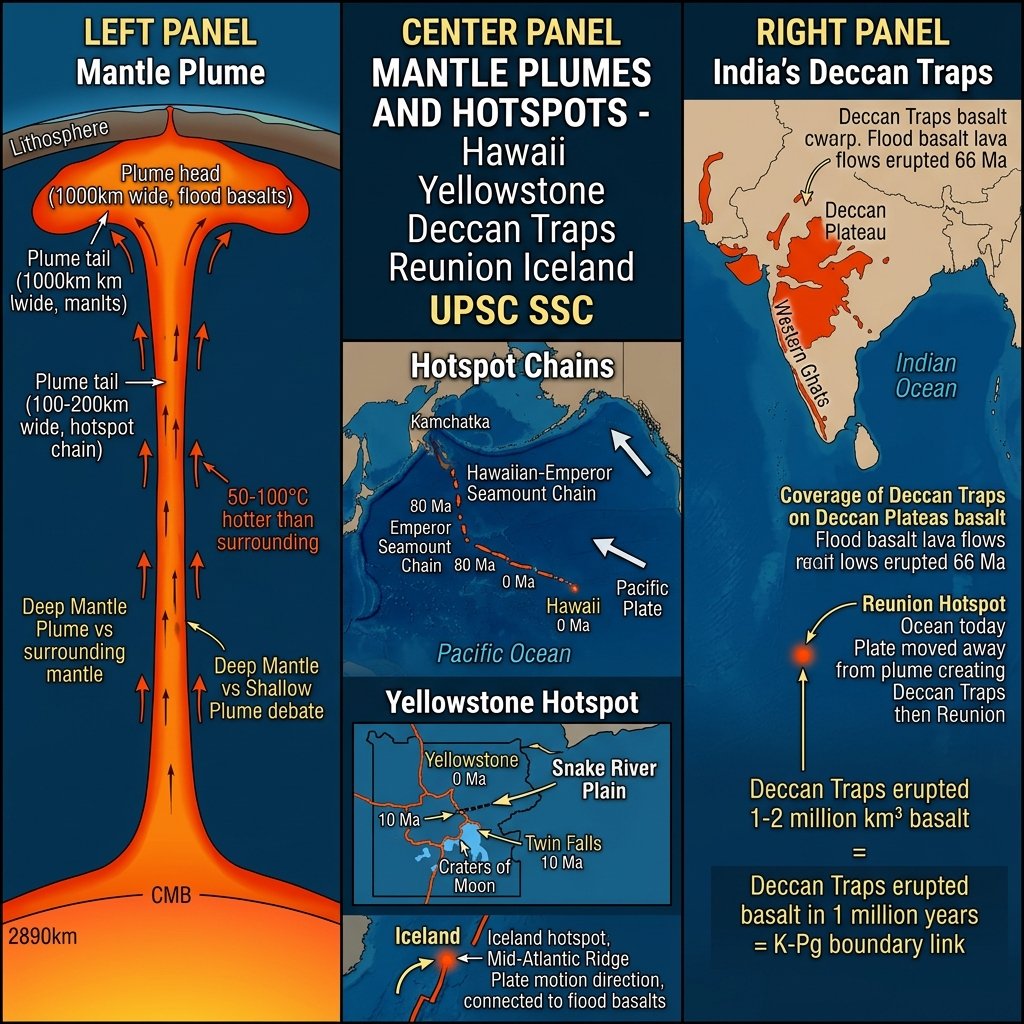
What Are Mantle Plumes? — Core Concept
- 🌋 Definition: A mantle plume is a narrow, buoyant upwelling of anomalously hot mantle material rising from deep within Earth — either from the core-mantle boundary (CMB) at 2,890 km depth (deep plumes) or from the upper-lower mantle transition zone at ~660 km depth (shallow plumes); plume material is typically 100–300°C hotter than the surrounding mantle at equivalent depth; this thermal buoyancy causes it to rise slowly (cm/year) through the solid-but-slowly-flowing mantle
- 🌋 Plume head vs plume tail: When a plume first initiates, it has a large mushroom-shaped structure: the plume head is a bulbous mass of hot material 500–2,000 km in diameter that ascends relatively rapidly (geologically speaking), partially melting as it rises and decompresses; the plume head produces massive flood basalt eruptions when it arrives under a plate; the plume tail is a narrower conduit (~100–200 km wide) of ongoing hot mantle flow that continues to feed the hotspot after the head has arrived; it is the plume tail that produces the continuing volcanic chain as the plate moves overhead
- 🌋 Wilson’s hotspot hypothesis (1963): Canadian geophysicist J. Tuzo Wilson first proposed (1963) that the Hawaiian Islands were produced not by a moving volcanic source but by the Pacific Plate moving over a stationary hot spot in the mantle; the age progression of islands (Kauai older than Oahu older than Maui older than Hawaii Big Island = currently over the hotspot) perfectly matched this model; Wilson’s hotspot hypothesis was one of the key contributions that established plate tectonics as the unifying framework of geology
- 🌋 How hotspot volcanoes differ from plate boundary volcanoes: Plate boundary volcanoes (subduction zones, mid-ocean ridges) are driven by plate tectonics — water released from subducting slabs lowers the mantle melting point (subduction volcanism), or pressure decreases as plates diverge (ridge volcanism); hotspot/plume volcanoes are driven by deep heat — exceptionally hot mantle material that melts through decompression as it rises; the magma chemistry is different (more alkaline, richer in incompatible elements), and the volcano type is typically a broad shield volcano (like Mauna Loa/Mauna Kea = world’s largest volcanoes by volume) rather than steep composite volcanoes
Major Mantle Plumes / Hotspots — Global Examples
| Hotspot | Location | Current Volcanic Activity | Chain / Trail | Key Facts |
|---|---|---|---|---|
| Hawaiian Hotspot | Central Pacific Ocean under the Big Island of Hawaii | Kilauea (most active volcano on Earth); Mauna Loa (largest volcano by volume, 75,000 km³ above ocean floor); Loihi Seamount (new island forming underwater) | Hawaiian-Emperor Seamount Chain; 6,000 km long; ages 0 Ma (Hawaii) to 80+ Ma (Emperor Seamounts near Kamchatka); bend at 47 Ma records change in Pacific Plate motion direction | Used to calculate Pacific Plate speed (~7.2 cm/year northwestward); hotspot ~100 km below base of lithosphere; produces alkalic basalt; subsidence of older islands creates atolls → coral reefs → seamounts |
| Yellowstone Hotspot | Yellowstone Plateau, Wyoming, USA | Yellowstone supervolcano (last major eruption 640,000 years ago); 10,000+ hydrothermal features; ground uplift/subsidence ongoing (GPS monitored); 1,000–3,000 small earthquakes/year | Snake River Plain volcanic chain; Columbia River Basalt Group (16 Ma, 170,000 km²); hotspot trail leads SW from Yellowstone through Idaho to Oregon (older ages eastward = plate moves SW over hotspot) | Supervolcano = magma chamber under Yellowstone 90 km × 40 km × 14 km deep; three mega-eruptions in 2.1 Ma, 1.3 Ma, 0.64 Ma; monitored by USGS Yellowstone Volcano Observatory; not due for eruption imminently |
| Reunion Hotspot | Indian Ocean near Reunion Island (21°S, 56°E) | Piton de la Fournaise (Reunion Island) = one of world’s most active volcanoes | Chagos-Laccadive Ridge–Mascarene Plateau–Reunion Island chain; Deccan Traps (India, 66 Ma) = plume head flood basalts; as India moved northeast, trail progressed through Laccadive Islands, Maldives, Chagos Bank to present Reunion position | Plume head produced Deccan Traps; linked to K-Pg boundary extinction debate; India drifted northward over the plume at ~15–20 cm/year (highest plate velocity on record) creating long trail |
| Iceland Hotspot | Sits beneath Mid-Atlantic Ridge at Iceland | Most active volcanic region on Earth by erupted volume; Holuhraun 2014–15 (largest eruption in Iceland since 1783); Fagradalsfjall eruptions 2021–2024 | Greenland-Iceland-Faeroes Ridge; North Atlantic Igneous Province (NAIP) flood basalts ~55 Ma = plume head that caused the North Atlantic to open; ongoing volcanism where plume meets diverging ridge = anomalously thick oceanic crust (~30 km vs normal 7 km) | Iceland is the only island that sits on both a hotspot and a mid-ocean ridge simultaneously; this combination produces exceptional volcanic output; Laki eruption 1783 = 14 km³ basalt in 8 months = caused European crop failures and famine |
| Afar / East Africa Hotspot | Afar Triangle, Ethiopia/Djibouti/Eritrea | Erta Ale (Ethiopia) = one of few permanent lava lakes; Dallol geothermal field (hottest inhabited place on Earth average +35°C); active rifting in Afar Depression (below sea level) | Ethiopian Flood Basalts 30 Ma = plume head; split into three rift arms (Red Sea, Gulf of Aden, East African Rift) = classic triple junction (RRR triple junction = three rift ridges) = embryonic ocean forming; may be the future ocean separating East Africa from the rest of Africa | Ethiopia’s Blue Nile gorge cut through flood basalts; Danakil Depression = lowest exposed land in Africa at -155 m; geological record of continent-to-ocean transition in real time |
| Tristan da Cunha Hotspot | South Atlantic Ocean (37°S, 12°W) | Tristan da Cunha volcanic island (most remote inhabited island on Earth); Nightingale Island volcanic eruption 2004 | Paraná-Etendeka Flood Basalts (130 Ma, South America + Namibia) = plume head correlated with opening of South Atlantic; trail leads to present Tristan position | Model hotspot trail used to reconstruct South America-Africa separation; one of clearest examples of plume head flood basalt + continental breakup correlation |
Flood Basalts — When Plume Heads Arrive
- 🌋 What flood basalts are: When a mantle plume head (~500–2,000 km diameter) first arrives beneath a continent or ocean floor, its enormous volume of superheated material partially melts the base of the lithosphere at a catastrophic rate; eruptions occur from thousands of fissure vents simultaneously across areas of hundreds of thousands of square kilometres; basaltic lava pours out at rates orders of magnitude greater than any modern volcanic system; these are called Large Igneous Provinces (LIPs) or flood basalts; they represent the most geologically violent events Earth produces apart from meteorite impacts
- 🌋 Scale of flood basalt eruptions: The Siberian Traps (252 Ma) = 2–4 million km³ of basalt erupted in ~1 million years; the Ontong-Java Plateau (120 Ma, oceanic) = 50 million km³ — largest LIP on Earth; the Deccan Traps (66 Ma) = 500,000–1 million km³ in ~1 million years covering 500,000 km² of India; the Columbia River Basalts (16 Ma, USA) = 170,000 km²; all represent the most catastrophic single volcanic events in their respective geological periods
- 🌋 Flood basalt and mass extinctions — the Siberian Traps: The Siberian Traps (252 Ma) coincide precisely with the end-Permian mass extinction — the most severe extinction event in Earth’s history (96% of marine species, 70% of terrestrial species extinct); the eruptions released enormous volumes of SO₂ (causing global cooling), CO₂ (causing warming and ocean acidification), HCl (depleting ozone layer), and volatile organic compounds from cooking of Siberian coal seams and sedimentary rocks beneath the basalt; the environmental cascades lasted millions of years; the Siberian Traps are now widely accepted as the primary trigger of the end-Permian extinction
- 🌋 Deccan Traps and K-Pg mass extinction: The Deccan Traps (66 Ma) coincide with the K-Pg boundary extinction that killed the non-avian dinosaurs; however, the Chicxulub meteorite impact (66.0 Ma) also occurred at precisely the same time; current scientific consensus is that the Chicxulub impact was the primary cause, but the Deccan Traps volcanism likely contributed to environmental stress before the impact and may have prolonged recovery afterward; the debate continues — both events were real and both occurred at the K-Pg boundary
Yellowstone Supervolcano — Detailed Facts
- 🌋 What is a supervolcano: A volcano capable of producing an eruption with ejecta volume >1,000 km³ (Volcanic Explosivity Index = 8, the maximum); these are caldera-forming eruptions where the magma chamber roof collapses after rapid eruption; no supervolcano has erupted in recorded human history; known supervolcanoes: Yellowstone (USA), Toba (Indonesia, 74 ka eruption = potentially caused human bottleneck to ~10,000 individuals), Taupo (New Zealand), Long Valley (California), Campi Flegrei (Italy)
- 🌋 Yellowstone eruption history: Three supereruptions in 2.1 Ma, 1.3 Ma, and 640,000 years ago; the 2.1 Ma eruption deposited ash as far as Iowa and Texas; the three caldera collapses are preserved as the nested calderas visible at Yellowstone; the current hotspot under Yellowstone has a magma chamber imaged by seismic tomography: upper chamber ~10 km deep, 90 km × 40 km, ~5–15% molten; lower reservoir 20–50 km deep, ~2% crystallised melt; total melt volume insufficient for a supereruption in the near future without significant new input
- 🌋 Yellowstone today: >10,000 hydrothermal features (geysers, hot springs, fumaroles, mud pots); Old Faithful geyser erupts every 44–125 minutes; ground uplift/subsidence monitored by GPS and InSAR satellites; the Yellowstone plateau has risen ~0.5–1 cm/year in some periods and fallen in others as magma and hydrothermal fluids shift; no magmatic eruption considered imminent; USGS Yellowstone Volcano Observatory issues real-time monitoring data
Deccan Traps — India’s Plume Head Legacy
- 🇮🇳 What are the Deccan Traps: One of the world’s largest flood basalt provinces; stepped lava flows (traps = Swedish for stairs, referring to the stepped landscape) covering approximately 500,000 km² of the Deccan Plateau (Maharashtra, Gujarat, Karnataka, Madhya Pradesh); original extent was much larger (possibly 1.5 million km²) — much has been eroded; thickness up to 2,400 m in the Sahyadri ranges (Western Ghats); volume erupted = 500,000–1,000,000 km³ of basalt in approximately 1 million years centred on 66 Ma
- 🇮🇳 Connection to Reunion Hotspot: The Deccan Traps are the plume head product of the Reunion Hotspot; 66 million years ago, the Indian Plate (then moving rapidly northward at ~15–20 cm/year, the fastest plate velocity ever recorded) passed over the Reunion plume; the plume head arrived beneath northwestern India and erupted catastrophically; as India continued moving northeast, the trail of volcanism progressively migrated south through the Laccadive-Maldive-Chagos Ridge until the plume presently sits under Reunion Island in the southwestern Indian Ocean
- 🇮🇳 Significance for India: The Deccan basalts form the parent rock of India’s most fertile agricultural soil — the Regur (black cotton soil / Vertisol); the basalt weathers under monsoon conditions to produce clay-rich, moisture-retaining, high-iron black soils ideal for dryland agriculture (cotton, sorghum, wheat in Maharashtra, Gujarat, Karnataka); the Deccan Trap basalt terrain forms the Deccan Plateau and the Western Ghats escarpment (Western Ghats = the lateral edge of the original lava field, now an erosional scarp); the Mumbai-Pune corridor sits entirely on Deccan basalt
⭐ Important for Exams — Quick Revision
- 🔑 Mantle plume: Hot buoyant column of mantle material rising from deep Earth; 100–300°C hotter than surrounding mantle; produces intraplate (mid-plate) volcanism = hotspot
- 🔑 Plume head vs tail: Head = large mushroom (500–2,000 km) = flood basalts when it arrives; Tail = narrow conduit (100–200 km) = ongoing hotspot chain as plate moves overhead
- 🔑 Wilson’s hotspot hypothesis (1963): J. Tuzo Wilson proposed Hawaiian Islands formed by Pacific Plate moving over fixed hotspot; age progression confirms — Kauai (5.1 Ma) to Hawaii Big Island (0 Ma) to Loihi (future island)
- 🔑 Hawaiian-Emperor Seamount Chain: 6,000 km long; 0 Ma (Hawaii) to 80 Ma (Emperor Seamounts near Kamchatka); bend at 47 Ma = Pacific Plate changed direction; Pacific Plate speed = ~7.2 cm/year NW
- 🔑 Loihi Seamount: Underwater volcano south of Hawaii Big Island; future Hawaiian island forming; will emerge from sea in ~10,000–100,000 years
- 🔑 Yellowstone supervolcano: Three supereruptions at 2.1 Ma, 1.3 Ma, 640 Ka; Snake River Plain = hotspot trail; Columbia River Basalts (16 Ma) = plume head; magma chamber 90×40 km imaged seismically
- 🔑 Toba eruption (74,000 years ago): Largest volcanic eruption in past 2 million years; caused global volcanic winter; potentially reduced human population to ~10,000 (genetic bottleneck debate); Toba caldera (100×30 km) = Sumatra, Indonesia
- 🔑 Deccan Traps: 500,000 km², Maharashtra+Gujarat+MP+Karnataka; 500,000–1,000,000 km³ basalt; ~66 Ma; product of Reunion Hotspot plume head; linked to K-Pg mass extinction (+ Chicxulub impact)
- 🔑 Reunion Hotspot trail: Deccan Traps (66 Ma) → Laccadive Islands (~60 Ma) → Maldives (~55 Ma) → Chagos Bank (~50 Ma) → Mascarene Plateau → Reunion Island (present)
- 🔑 Regur soil from Deccan basalt: Black cotton soil (Vertisol) = from basalt weathering under monsoon; covers Maharashtra, Gujarat, MP; highly fertile for cotton, sorghum, wheat
- 🔑 Iceland Hotspot: Sits on Mid-Atlantic Ridge; North Atlantic Igneous Province (55 Ma) = plume head; anomalously thick crust (~30 km vs normal 7 km); most active hotspot by erupted volume
- 🔑 Afar Hotspot: Ethiopia; Ethiopian Flood Basalts (30 Ma = plume head); Red Sea + Gulf of Aden + East African Rift = triple junction; ocean forming in real time
- 🔑 Siberian Traps (252 Ma): 2–4 million km³ basalt; coincides with end-Permian mass extinction (96% marine species lost = largest extinction ever); SO₂ + CO₂ + HCl environmental catastrophe
- 🔑 Flood basalt (LIP): Large Igneous Province; produced by plume head; erupts 10,000s km² in <1 million years; most catastrophic volcanic events; correlate with mass extinctions
- 🔑 Tristan da Cunha Hotspot: Paraná-Etendeka Flood Basalts (130 Ma) = plume head correlated with South Atlantic opening; currently under Tristan da Cunha Island
Frequently Asked Questions (FAQs)
1. How do mantle plumes work — and how do we know they come from the deep mantle?
The Basic Mechanism
A mantle plume begins when a region at the base of the mantle — near the core-mantle boundary at 2,890 km depth — becomes anomalously hot, either through heat released directly from the liquid iron outer core or through the accumulation of radioactive heat-generating elements (uranium, thorium, potassium) in a heterogeneous mantle region. This hot material, even though it is technically solid rock, is buoyant relative to the surrounding cooler mantle and slowly rises through the mantle by solid-state creep — the same slow plastic flow that drives mantle convection.
Plume Head and Plume Tail: Two Stages
The ascent of a new plume creates two distinct phases. The plume head is the initial large bulbous mass of hot material (500–2,000 km wide) that rises relatively quickly through the mantle. When it reaches the base of the lithosphere, it flattens out and partially melts catastrophically, producing the enormous flood basalt eruptions (Large Igneous Provinces) — the Deccan Traps, Siberian Traps, Columbia River Basalts. After the head is spent, a narrower plume tail (100–200 km wide) continues to feed hot material upward through the same conduit, producing the smaller but ongoing volcanic hotspot that we see at places like Hawaii, Yellowstone, and Reunion Island today.
How Mantle Plumes Were First Identified
J. Tuzo Wilson’s 1963 observation that the Hawaiian Islands show a perfect age progression — youngest at the southeast (active Big Island) and oldest at the northwest — was the first recognition of hotspot trails. Morgan (1971) formalised the plume model, arguing that approximately 20 fixed “hot spots” in the deep mantle controlled intraplate volcanism globally. The fixity of hotspots relative to each other (and their slow motion relative to tectonic plates, which move at cm/year) became a tool for reconstructing absolute plate motions — not just plates moving relative to each other, but moving relative to the deep mantle itself.
Evidence for Deep Mantle Origin
Several lines of evidence support a deep-mantle origin for at least some plumes:
- Seismic tomography: High-resolution P-wave and S-wave tomographic models (using thousands of earthquake paths) image low-velocity anomalies (slower = hotter rock) rising from the CMB under Hawaii, Iceland, and Afar; these thermal conduits are 100–300 km wide and can be traced from the CMB to the surface, though imaging the narrow plume tail is at the edge of current resolution
- Helium isotope ratios: Hotspot basalts consistently show elevated ³He/⁴He ratios compared to mid-ocean ridge basalts (MORB); ³He is primordial (trapped since Earth’s accretion); enriched ³He in hotspot magmas indicates the mantle source has been less degassed over geological time = it samples deep, primitive mantle that has not been through the mantle convection cycle multiple times
- Chemical composition: Hotspot basalts are enriched in incompatible elements (potassium, barium, niobium, titanium) relative to mid-ocean ridge basalts; this OIB (Ocean Island Basalt) signature reflects melting of a geochemically distinct, deeper mantle reservoir
- Heat flux anomalies: Surface heat flow over hotspot regions is measurably elevated above background, consistent with an anomalously hot source at depth; the Hawaiian swell (a broad regional uplift ~1,000 km wide around Hawaii) reflects thermally buoyant mantle material in the plume’s influence zone
The Deep vs Shallow Plume Debate
Not all geophysicists agree that all hotspots require plumes from the CMB. Some argue that shallow plumes from the 660 km discontinuity (the upper-lower mantle boundary) are sufficient to explain many hotspots. Iceland, for example, may be sustained partly by the excess temperature of the mid-ocean ridge spreading combined with a relatively shallow upper mantle anomaly. The distinction between “deep” and “shallow” plumes remains an active research area with new seismic tomography models published regularly.
2. What is the Hawaiian-Emperor Seamount Chain — and what does it tell us about plate tectonics?
Overview of the Chain
The Hawaiian-Emperor Seamount Chain is a 6,000 km-long trail of volcanoes and volcanic seamounts (submerged volcanoes) stretching across the Pacific Ocean floor from the active Big Island of Hawaii in the southeast to the Emperor Seamounts near the Aleutian Islands and Kamchatka in the northwest. Every single volcanic edifice in this chain was formed by the same Hawaiian hotspot — the Pacific Plate has been moving northwestward over this fixed mantle plume for at least 80 million years, and each new volcano forms as the plate carries the previous one off the hotspot.
Age Progression and Plate Speed Calculation
The age progression is precisely documented by radiometric dating (primarily K-Ar and ⁴⁰Ar/³⁹Ar dating):
- Hawaii (Big Island) = 0 Ma (currently active)
- Maui = 0.8–1.3 Ma
- Oahu (Koolau) = 2.5–3.7 Ma
- Kauai = 5.1 Ma
- Midway Atoll = 27 Ma
- Nintoku Seamount = 56 Ma
- Suiko Seamount (Emperor Chain) = 64 Ma
- Meiji Seamount (near Kamchatka) = 82 Ma
Using the distance between any two volcanoes divided by the difference in their ages gives the plate speed. For the Hawaiian section: Kauai is ~500 km from the Big Island and ~5 million years older = Pacific Plate speed ≈ 500/5 = 100 km/million years = 10 cm/year (approximately; recent GPS measurements give ~7.4 cm/year accounting for current motion). This is the most precise plate motion record available anywhere on Earth.
The Emperor-Hawaii Bend at 47 Ma
The chain makes a dramatic ~60° bend at approximately 47 Ma — the point where the Emperor Seamounts (running north-south, NNW) meet the Hawaiian chain (running NW–SE). This bend was long interpreted as evidence that the Pacific Plate changed its direction of motion ~47 million years ago. More recent research (Tarduno et al. 2003, 2009) using palaeomagnetic data from Emperor Seamount cores drilled by IODP suggests that the “bend” may partly reflect the Hawaiian hotspot itself moving southward at ~3–5 cm/year during the 80–47 Ma period (most plumes are not perfectly fixed; they drift slowly), with the plate direction change being less dramatic than originally thought.
Island Subsidence and Atoll Formation
As each Hawaiian island is carried away from the hotspot by plate motion, it undergoes progressive subsidence — the newly formed volcanic island slowly sinks because: (a) it cools and contracts as it moves away from the hot mantle plume; (b) the oceanic lithosphere itself thermally contracts and subsides as it ages and cools. Simultaneously, coral reefs grow around the subsiding island margin. Over millions of years, the sequence progresses: volcanic island → fringing reef → barrier reef → atoll (ring of coral with central lagoon where the island has submerged) → seamount (flat-topped = guyot, submerged below wave erosion level). Midway Atoll (27 Ma old, no land above sea level except the reef) and the Northwest Hawaiian Ridge seamounts are the Hawaiian chain in its later evolutionary stages.
3. What are the Deccan Traps — and did they cause the dinosaur extinction?
What Are the Deccan Traps?
The Deccan Traps are one of the largest flood basalt provinces on Earth — a vast accumulation of layered basaltic lava flows covering approximately 500,000 km² of peninsular India (Maharashtra, Goa, Karnataka, Madhya Pradesh, Gujarat), with thicknesses reaching 2,400 metres in the Western Ghats. The name “Traps” comes from the Swedish word trappa meaning “stair,” referring to the stepped landscape created by alternating hard basalt lava flow layers and softer weathered horizons that erode differentially. The Deccan Trap basalts were erupted approximately 66 million years ago — right at the Cretaceous-Palaeogene (K-Pg) boundary — in a catastrophic volcanic episode driven by the plume head of the Reunion Hotspot arriving beneath the Indian subcontinent.
Scale of the Deccan Traps Volcanism
- Volume erupted: Estimated 500,000 to 1,000,000 km³ of basaltic lava
- Eruption duration: Approximately 1 million years (66.5–65.5 Ma), though eruption rate was not constant — pulse rates varied dramatically
- Original areal extent: Possibly up to 1.5 million km² before erosion removed up to two-thirds of the original deposit
- Eruption mechanism: Fissure eruptions (not point-source volcanoes) across thousands of kilometres of fractures; individual lava flows can be traced hundreds of kilometres; some single flows have volumes of 1,000–10,000 km³
- Current expression: The Western Ghats = the lateral (eroded) edge of the original lava plateau; the step-like Sahyadri ranges reflect individual basalt flow layers; Mumbai city is built on Deccan Trap basalt
Connection to the K-Pg Mass Extinction
The Deccan Traps eruptions coincide with one of the five major mass extinctions in Earth’s history — the end-Cretaceous extinction 66 million years ago that killed approximately 75% of all species, including all non-avian dinosaurs. This coincidence has generated one of geology’s most passionate scientific debates: did the Deccan Traps cause the extinction, was it the Chicxulub asteroid impact, or was it both acting together?
The Impact vs Volcanism Debate
- Chicxulub impact evidence: A ~10 km diameter asteroid struck the Yucatan Peninsula (southern Mexico) at precisely 66.043 Ma; the impact released energy equivalent to 1 billion Hiroshima bombs; ejected material caused global wildfires; a dust cloud blocked sunlight (“impact winter”) for months to years; iridium anomaly (enriched iridium at K-Pg boundary worldwide = extraterrestrial origin); shocked quartz and glass spherules in K-Pg sediments globally; the Chicxulub crater is 180–200 km in diameter and has been dated to exactly the K-Pg boundary
- Deccan Traps evidence: Some palaeontologists argue that ecosystem decline and species stress was already occurring before the Chicxulub impact due to Deccan volcanism releasing SO₂ (acid rain, cooling), CO₂ (warming, ocean acidification), and fluorine gas (poisoning food chains); certain marine microfossil data shows gradual decline before the impact layer
- Intriguing finding — impact may have triggered Deccan: Richards et al. (2015) proposed that the Chicxulub impact’s seismic energy (Mw ~11) may have triggered a dramatic pulse in Deccan Traps eruption rate; magnetostratigraphic data suggests that eruption rates approximately doubled in the 50,000 years after the impact — suggesting a complex interaction between the impact and the ongoing volcanism
- Current scientific consensus: The Chicxulub impact was the primary and immediate cause of the mass extinction (the “killing blow”); the Deccan Traps volcanism contributed to background environmental stress before and after the impact, and may have prolonged recovery, but was not sufficient alone to cause a mass extinction of this magnitude; the combined effect was more catastrophic than either event alone would have been
Agricultural Legacy of the Deccan Traps in India
The Deccan Traps have a profoundly positive agricultural legacy that continues to shape India’s economy. Basalt weathers under tropical monsoon conditions to produce Regur — the black cotton soil (Vertisol) — that covers most of Maharashtra, Gujarat, parts of Madhya Pradesh, and northern Karnataka. Regur is highly fertile, moisture-retaining (it swells when wet, sealing itself), rich in calcium, magnesium, iron, and aluminium, and ideal for dryland cultivation of cotton, sorghum (jowar), sugarcane, and rabi wheat. The Indian cotton industry — historically the backbone of Gujarat’s and Maharashtra’s economy and the source of the raw material for Manchester’s mills during the British Raj — is built on the agricultural productivity of soil derived from 66-million-year-old Deccan Trap basalt that erupted in one of the most violent volcanic episodes in Earth’s history.
Related Geology Articles on StudyHub
- ➡️ Deccan Traps — Flood Basalts & Regur Soil
- ➡️ Plate Tectonics — Ridge Push, Slab Pull & Hotspot Trails
- ➡️ Volcanoes of India & the World — Types & Activity
- ➡️ Earth’s Magnetic Field — Core-Mantle Boundary Dynamics
- ➡️ Kola Superdeep Borehole — Drilling Into the Mantle