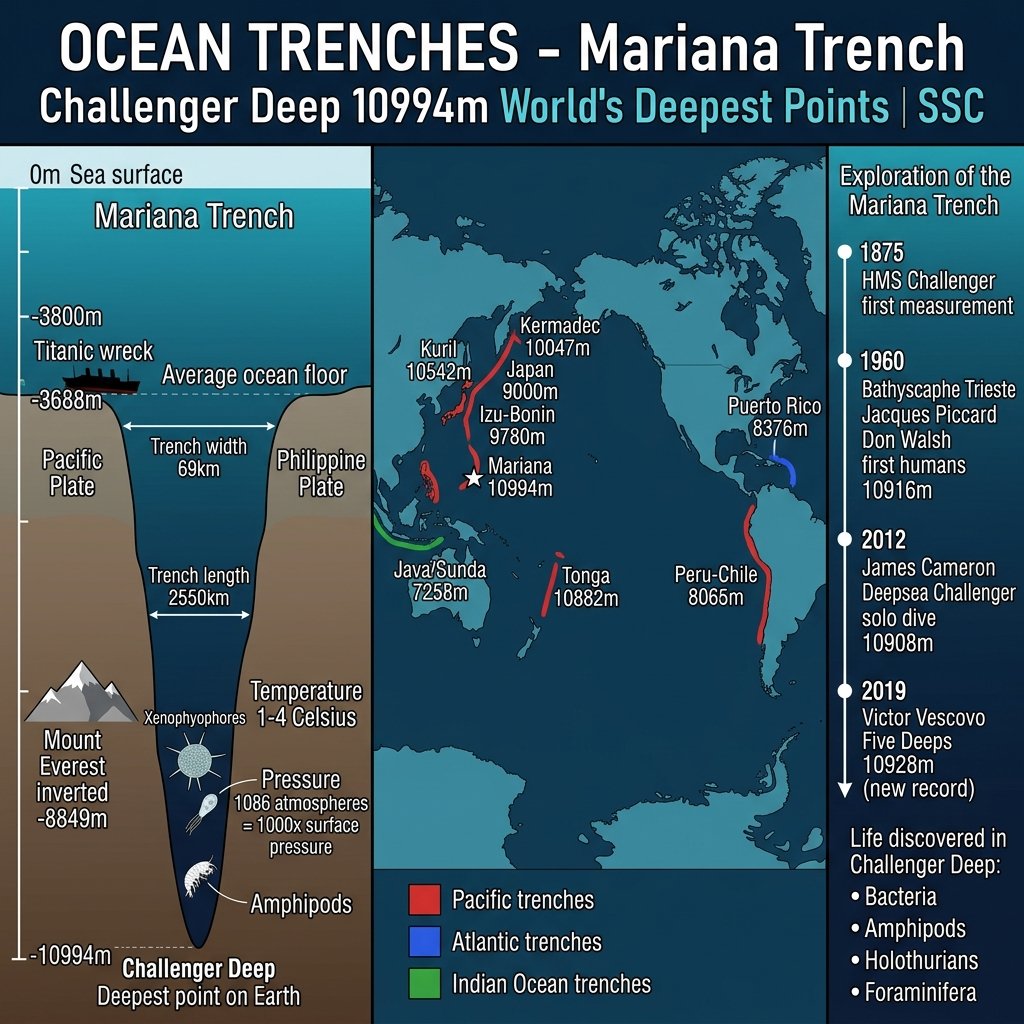
At the bottom of every ocean trench lies a world of crushing pressure, near-freezing darkness, and — surprisingly — abundant life. Ocean trenches are the deepest structures on Earth’s surface, formed where one tectonic plate dives beneath another in the process of subduction. The deepest of them all, the Mariana Trench’s Challenger Deep in the western Pacific, plunges to 10,994 metres below sea level — deep enough to submerge Mount Everest (8,849m) with over two kilometres of ocean still above its peak. At that depth, the pressure is 1,086 atmospheres — more than 1,000 times the pressure at sea level — yet scientists have found bacteria, crustaceans, sea cucumbers, and even microplastics at the bottom. Ocean trenches are not just geological curiosities: they are the sites of the world’s deadliest earthquakes and tsunamis, the primary zones where oceanic crust is recycled back into the mantle, and the least-explored environments on Earth (we have better maps of Mars than of the ocean trench floor). Understanding ocean trenches — their formation, distribution, exploration, and life — is essential for UPSC, SSC and competitive examinations.
What Are Ocean Trenches? — Formation and Structure
- 🌊 Definition: Ocean trenches are narrow, elongated depressions in the ocean floor formed at convergent plate boundaries where one plate (always the denser oceanic plate) subducts beneath another; they are the deepest parts of the ocean and the deepest topographic features on Earth’s surface; trenches are typically 60–100 km wide but thousands of kilometres long; the trench floor is called the hadal zone (below 6,000m)
- 🌊 Formation mechanism: As the subducting oceanic plate bends downward to enter the mantle, the bending creates a topographic depression at the surface — the trench; the plate bends at a radius of ~200 km, creating a characteristic “outer rise” (a gentle bulge just seaward of the trench) before the steep descent; the trench depth depends on the age and density of the subducting plate and the rate of subduction; older, colder, denser plates create deeper trenches
- 🌊 Physical conditions: Temperature at trench bottom: 1–4°C (cold but not freezing due to pressure); Pressure at Challenger Deep (10,994m): 1,086 atm = 108.6 MPa = equivalent to ~50 Boeing 747 aircraft on each square metre; Darkness: complete absence of sunlight below ~200m; Salinity: ~34.7 ppt (similar to average ocean); Dissolved oxygen: variable — some trenches have poor oxygen at mid-depths, but the bottom water is well-oxygenated by cold, dense water that sinks from polar regions
- 🌊 Sediment in trenches: Trench floors accumulate sediment from multiple sources: terrigenous sediment (eroded land material carried by rivers and turbidity currents), pelagic sediment (marine snow — organic particles settling from above), and material scraped off the subducting plate; organic carbon concentrations in trench sediments are often higher than the surrounding abyssal plain because trenches act as “sediment traps” focusing material from vast surrounding areas; this enrichment supports the surprisingly high biological productivity found in trenches
World’s Major Ocean Trenches — Ranked by Depth
| Rank | Trench | Ocean | Deepest Point | Depth (m) | Plates Involved | Key Facts |
|---|---|---|---|---|---|---|
| 1 | Mariana Trench | Pacific | Challenger Deep | 10,994m | Pacific under Philippine | Deepest point on Earth; 2,550 km long, 69 km wide; Trieste (1960), Cameron (2012), Vescovo (2019) dives |
| 2 | Tonga Trench | Pacific | Horizon Deep | 10,882m | Pacific under Australian/Tonga | Fastest subduction on Earth (~24 cm/yr); Benioff Zone to 700km depth; Hunga Tonga 2022 eruption |
| 3 | Kuril-Kamchatka Trench | Pacific | unnamed | 10,542m | Pacific under Okhotsk | Off Russia/Japan; Kuril Islands volcanic arc; major seismicity; Klyuchevskaya Sopka nearby |
| 4 | Philippine Trench | Pacific | Galathea Depth | 10,540m | Philippine under Eurasian | Off eastern Philippines; Galathea expedition 1951 discovered bottom fauna; site of 2013 Bohol earthquake |
| 5 | Kermadec Trench | Pacific | unnamed | 10,047m | Pacific under Australian | NE of New Zealand; part of Tonga-Kermadec arc system; New Zealand exclusive research area |
| 6 | Izu-Bonin (Ogasawara) Trench | Pacific | unnamed | 9,780m | Pacific under Philippine | South of Japan Trench; Izu-Bonin arc islands; connects to Mariana system |
| 7 | Japan Trench | Pacific | unnamed | ~9,000m | Pacific under Okhotsk/North American | 2011 Tohoku Mw 9.0 earthquake originated here; Fukushima; most studied trench seismically |
| 8 | Puerto Rico Trench | Atlantic | Milwaukee Deep | 8,376m | North American under Caribbean | Deepest point in Atlantic Ocean; between Puerto Rico and the Dominican Republic; major earthquake threat to Caribbean |
| 9 | Peru-Chile (Atacama) Trench | Pacific | unnamed | 8,065m | Nazca under South American | Valdivia 1960 Mw 9.5 (largest ever); 5,900 km long (longest trench); Andes volcanic arc above |
| 10 | Java (Sunda) Trench | Indian | unnamed | 7,258m | Australian/Indian under Eurasian | Deepest point in Indian Ocean; 2004 Indian Ocean tsunami (Mw 9.1, 227,898 killed); Krakatau, Tambora above |
The Mariana Trench — The Deepest Place on Earth
- 🌊 Location and dimensions: The Mariana Trench lies in the western Pacific Ocean, approximately 200 km east of the Mariana Islands (a US territory); it is 2,550 km long and 69 km wide; the deepest point — Challenger Deep — is located at approximately 11°22’N, 142°35’E; it was formed by the subduction of the Pacific Plate (world’s largest plate, ~130–170 Ma old here, very cold and dense) beneath the smaller, younger Philippine Plate
- 🌊 Challenger Deep depth: The exact depth has been measured multiple times with improving technology: HMS Challenger 1875 (first measurement, ~8,184m — inaccurate), 1951 HMS Challenger II (11,034m by echo sounding), 1960 Trieste dive (10,916m reported), 1995 Kaiko ROV (10,911m), 2010 Nereus ROV (10,902m), 2019 Victor Vescovo DSV Limiting Factor dive (10,928m — new deepest manned dive), 2021 multibeam sonar (10,994m — current best estimate); the variation reflects improving measurement technology and acoustic refraction corrections
- 🌊 Depth perspective: Mount Everest (8,849m) placed in Challenger Deep would have 2,145m of water above its summit; the world’s tallest building (Burj Khalifa, 828m) would need to be stacked 13 times to equal Challenger Deep’s depth; light penetrates only ~200m into the ocean; Challenger Deep is in permanent darkness 55× deeper than where sunlight disappears
- 🌊 Physical conditions at Challenger Deep: Pressure = 1,086 atm (108.6 MPa); temperature = 1–4°C; complete darkness; sound travels faster at these pressures (sound speed ~1,560 m/s vs 1,500 m/s at surface); water is slightly more compressible than at surface; the seafloor sediment is beige-coloured foraminifera ooze mixed with volcanic material from the Mariana Arc above
Exploration of the Mariana Trench — Timeline
| Year | Mission | Achievement | Key People |
|---|---|---|---|
| 1875 | HMS Challenger (Britain) | First measurement of Mariana Trench depth by sounding line; recorded ~8,184m (inaccurate but historic) | John Murray, expedition scientist |
| 1951 | HMS Challenger II | Echo sounder measured ~11,034m; named the deepest area “Challenger Deep” in honour of the original expedition | British Royal Navy survey |
| 1960 | Bathyscaphe Trieste | First and only manned descent to Challenger Deep; reached ~10,916m; saw flatfish and shrimp (later disputed — may have been sea cucumbers); 20-minute bottom time | Jacques Piccard (Switzerland), Don Walsh (USN) |
| 1995 | Kaiko ROV (Japan) | First remotely operated vehicle to reach bottom; collected sediment samples; confirmed biological communities; depth 10,911m | JAMSTEC (Japan Agency for Marine-Earth Science) |
| 2009 | Nereus ROV (USA) | Hybrid vehicle (ROV + autonomous); video of hadal zone; depth 10,902m; later lost at Kermadec Trench 2014 | Woods Hole Oceanographic Institution |
| 2012 | Deepsea Challenger | Second manned dive to Challenger Deep; 10,908m; 3-hour bottom time; collected biological and sediment samples; HD video footage of bottom | James Cameron (filmmaker) |
| 2019 | DSV Limiting Factor (Five Deeps) | New record deepest manned dive: 10,928m; first to map full Challenger Deep with multibeam sonar; found plastic bag and candy wrapper at bottom | Victor Vescovo (investor/explorer), Caladan Oceanic |
| 2021 | Multibeam sonar survey | Most precise depth measurement: 10,994m (±25m); current official depth of Challenger Deep | NOAA + international consortium |
Life in Ocean Trenches — The Hadal Zone
- 🦐 Hadal zone definition: The hadal zone (from the Greek Hades = underworld) covers ocean depths below 6,000m; it comprises less than 1–2% of the ocean floor area but receives disproportionately large amounts of organic carbon (because trenches act as topographic sediment traps); this organic enrichment supports surprisingly dense biological communities despite the extreme pressure, cold, and darkness
- 🦐 Amphipods (Hirondellea gigas): The most abundant macrofauna in hadal trenches; small crustaceans (shrimp-like, 2–8 cm); found in enormous densities (thousands per trap baited at Challenger Deep); adapted to extreme pressure through flexible cell membranes enriched in unsaturated fatty acids; they feed on organic detritus settling from above; the baited trap experiments from Kaiko (1995) showed Challenger Deep has abundant amphipod populations
- 🦐 Xenophyophores: Giant single-celled organisms (foraminifera) up to 10 cm across — among the largest single cells ever found; discovered at Challenger Deep by James Cameron’s 2012 dive; they build a test (shell) from sediment particles and organic material; despite being single cells, they are large enough to see with the naked eye
- 🦐 Holothurians (sea cucumbers): Found at all depths including hadal trenches; some species at Challenger Deep were observed moving across the sediment surface; they ingest sediment to extract organic matter
- 🦐 Bacteria and microbial life: The deepest life on Earth; piezophilic (pressure-loving) and psychrophilic (cold-loving) bacteria thrive in hadal sediments; bacteria are the dominant form of life by biomass in trenches; they process organic matter through chemosynthesis and heterotrophy; some species are potential sources of novel enzymes stable under extreme conditions (industrial applications)
- 🦐 Microplastics at Challenger Deep: Victor Vescovo’s 2019 dive and subsequent sampling found high concentrations of microplastics (polyethylene, polypropylene, nylon fibres) in Challenger Deep sediments — among the highest concentrations of microplastics found anywhere on Earth; a plastic bag and sweet wrapper were visually observed on the bottom; this demonstrates that even the most remote place on Earth has been contaminated by human plastic waste
India’s Andaman Trench
- 🇮🇳 Location: The Andaman Trench (also called the Andaman-Nicobar Trench) lies in the northeastern Indian Ocean, running along the western side of the Andaman-Nicobar Island chain; it is part of the Sunda Trench system that caused the 2004 Indian Ocean tsunami
- 🇮🇳 Depth: Maximum depth approximately 4,200–4,500m — shallow compared to Pacific trenches because the subducting Indian Plate in this region is relatively young and warm, and convergence rates are lower than in the Pacific; the Andaman Trench is also partially filled with sediment from the Irrawaddy and Salween river systems of Myanmar
- 🇮🇳 Seismicity and 2004 connection: The Andaman segment of the Sunda Megathrust participated in the 2004 Mw 9.1 earthquake rupture — the northernmost ~500 km of the ~1,200 km rupture extended through the Andaman segment; the Andaman Islands themselves were displaced horizontally by up to 1.2m and vertically by up to 1m in the earthquake; the Andaman and Nicobar Islands are the surface expression of the subducting plate’s volcanic arc above the Andaman Trench
- 🇮🇳 Strategic significance: India’s Andaman and Nicobar Islands (572 islands, only 37 inhabited) are India’s strategic maritime frontier in the Indian Ocean; the islands’ location at the western entrance to the Strait of Malacca (through which ~80% of China’s oil imports pass) gives India significant strategic leverage; the Andaman Trench and associated geology make the islands highly seismically and volcanically active — Barren Island is India’s only active volcano (located just north of the trench)
⭐ Important for Exams — Quick Revision
- 🔑 Ocean trench: Deepest topographic features on Earth; formed at subduction zones where oceanic plate bends and descends; hadal zone = below 6,000m depth
- 🔑 Mariana Trench — Challenger Deep: 10,994m depth; deepest point on Earth; western Pacific; Pacific Plate subducting under Philippine Plate; 2,550 km long, 69 km wide
- 🔑 Challenger Deep depth history: HMS Challenger 1875 (8,184m, inaccurate) → Trieste 1960 (10,916m, first manned dive) → Cameron 2012 (10,908m) → Vescovo 2019 (10,928m, deepest manned) → 2021 sonar survey (10,994m, current best)
- 🔑 Trieste 1960: First manned descent to Challenger Deep; Jacques Piccard + Don Walsh; bathyscaphe; 20-minute bottom time; reached ~10,916m
- 🔑 James Cameron 2012: Second manned dive to Challenger Deep; solo; Deepsea Challenger submersible; 10,908m; 3 hours at bottom; collected samples; made documentary
- 🔑 Victor Vescovo 2019: Five Deeps expedition; DSV Limiting Factor; 10,928m (deepest manned dive record); found microplastics and plastic bag at bottom
- 🔑 Pressure at Challenger Deep: 1,086 atmospheres (108.6 MPa); ~1,000× surface pressure; equivalent weight of ~50 Boeing 747s per m²
- 🔑 Depth ranking (Pacific): Mariana 10,994m > Tonga 10,882m > Kuril 10,542m > Philippine 10,540m > Kermadec 10,047m > Izu-Bonin 9,780m > Japan ~9,000m
- 🔑 Atlantic deepest: Puerto Rico Trench — Milwaukee Deep = 8,376m (deepest in Atlantic)
- 🔑 Indian Ocean deepest: Java/Sunda Trench = 7,258m (site of 2004 tsunami)
- 🔑 Longest trench: Peru-Chile Trench = 5,900 km long (also called Atacama Trench)
- 🔑 Fastest subduction: Tonga Trench = ~24 cm/yr (Pacific under Tonga/Australian plates)
- 🔑 Life at Challenger Deep: Amphipods (Hirondellea gigas), xenophyophores (10cm giant single-celled organisms), holothurians (sea cucumbers), piezophilic bacteria, foraminifera; microplastics found (2019)
- 🔑 Hadal zone: Below 6,000m; <2% of ocean floor; receives disproportionate organic carbon (sediment trap); supports dense life despite extreme conditions
- 🔑 India’s Andaman Trench: ~4,200–4,500m depth; part of Sunda Trench system; participated in 2004 tsunami rupture; Barren Island (India’s only active volcano) sits above this trench
- 🔑 Ocean trench vs rift valley: Trench = convergent boundary (compression, subduction, deepest points); Rift = divergent boundary (extension, normal faults, shallow compared to trenches)
Frequently Asked Questions (FAQs)
1. What makes the Mariana Trench so deep — why is Challenger Deep deeper than all other trenches?
The Geological Reason: Age of the Subducting Plate
The primary reason Challenger Deep is the deepest point on Earth is the extraordinary age and density of the Pacific Plate at the point where it subducts. The portion of the Pacific Plate entering the Mariana Trench is approximately 130–170 million years old — some of the oldest oceanic crust on Earth. As oceanic crust ages after formation at a mid-ocean ridge, it progressively cools, contracts, and becomes denser through thermal subsidence. Very old oceanic crust is very cold, very dense, and highly negatively buoyant — it sinks aggressively into the mantle.
This extreme negative buoyancy of the old Pacific Plate causes it to pull downward with enormous force, bending the crust sharply and creating an exceptionally deep trench. Trenches where younger, warmer, less dense oceanic crust subducts (like the Cascadia Subduction Zone, where the Juan de Fuca Plate is relatively young at ~5–10 Ma) are much shallower — the Cascadia trench is partially filled with sediment and barely forms a topographic depression.
Additional Factors
- High convergence rate: The Pacific Plate and Philippine Plate converge at approximately 2.5 cm/year in the Mariana region — slow by Pacific standards but sufficient to maintain active subduction of the old, dense plate
- Sediment fill: Unlike some trenches (the Cascadia trench is nearly filled with sediment from the Cascades and Pacific Northwest rivers), the Mariana Trench receives very little terrigenous sediment — it is far from any continent; the thin sediment layer allows the trench to maintain its maximum depth
- Back-arc spreading: The Mariana Trough (a back-arc basin) behind the Mariana Arc is actively spreading, pulling the arc and overriding plate away from the trench and maintaining the steepness of the subduction angle (approximately 60–70°); this steep subduction geometry deepens the trench
- No mountain load: Some trenches are shallower because the overriding plate has a massive volcanic arc mountain chain whose weight isostatically suppresses the arc side of the trench; the Mariana Arc is relatively low-relief, reducing this effect
2. How can life exist at Challenger Deep — what adaptations allow organisms to survive 10,994m depth?
The Challenge: Extreme Pressure
The most extreme challenge for life at Challenger Deep is pressure — 1,086 atmospheres, approximately 1,000 times the pressure at sea level. Pressure affects biological systems primarily by compressing cell membranes and denaturing proteins (changing their shape and inactivating their function). The protein enzymes that drive all biochemical reactions in living cells have evolved to function at specific pressures — surface-adapted enzymes literally stop working at hadal pressures because pressure changes their three-dimensional shape.
Membrane Adaptations
The cell membranes of piezophilic (pressure-adapted) organisms in trenches are enriched in polyunsaturated fatty acids (PUFAs), particularly docosahexaenoic acid (DHA, the same omega-3 fatty acid important in human brain function). Unsaturated fats have kinked carbon chains that maintain membrane fluidity under high pressure — where saturated fats would solidify the membrane, unsaturated fats keep it appropriately fluid. This is the same principle as why olive oil stays liquid in a cold refrigerator while butter solidifies.
Protein Adaptations: TMAO
Deep-sea fish and crustaceans counteract pressure-induced protein denaturation using trimethylamine N-oxide (TMAO) — an organic osmolyte that accumulates in cells at high concentrations and stabilises proteins against pressure denaturation. TMAO concentrations in fish increase with depth — a fish living at 3,000m has more TMAO than one at 1,000m. However, above ~8,200m depth, the TMAO concentration needed to counteract pressure becomes so high that it would make the fish tissue too dense and osmotically imbalanced to function. This is thought to be one reason why no fish have been confirmed below about 8,200m — a hypothetical “fish barrier” at the hadal zone.
Food Sources in the Abyss
- Marine snow: The primary food source; organic particles (dead plankton, faecal pellets, mucus, dead fish) that continuously settle from the sunlit surface ocean; it takes days to weeks for marine snow to sink to hadal depths; by the time it arrives, much of the labile organic matter has been consumed by mid-water organisms, leaving a refractory residue
- Trench focusing effect: Trenches act as topographic funnels — organic matter and sediment from a vast area of surrounding abyssal plain are funnelled into the trench by turbidity currents (underwater avalanches) and sediment gravity flows; this concentrates food resources and explains why trenches often have higher biological densities than the surrounding abyssal plain
- Chemosynthesis: Some trench bacteria derive energy from chemical reactions (hydrogen sulfide oxidation, methanogenesis) rather than photosynthesis; these bacteria form the base of chemosynthetic food webs independent of surface sunlight
3. What is the Puerto Rico Trench — and why is it a major earthquake threat to the Caribbean?
Location and Structure
The Puerto Rico Trench is located in the northeastern Caribbean, about 75 km north of Puerto Rico and the Dominican Republic. With a maximum depth of 8,376m at Milwaukee Deep, it is the deepest point in the Atlantic Ocean and the deepest in the Caribbean Sea. It forms at the boundary where the North American Plate subducts beneath the Caribbean Plate — though the motion here is complex: it involves both subduction (plate going under) and transform motion (plates sliding past each other), creating a heterogeneous stress environment.
Tectonic Complexity
- Mixed boundary: The Puerto Rico Trench is not a pure subduction zone; the North American Plate is moving approximately east-southeast relative to the Caribbean Plate, with components of both oblique subduction and strike-slip motion; this makes the seismic hazard assessment more complex than a pure Benioff Zone system
- Gravity anomaly: The Puerto Rico Trench has one of the most negative gravity anomalies on Earth (-380 milligals measured by the GRACE satellite) — indicating that the dense North American Plate subducting beneath is pulling the crust downward faster than isostatic rebound can compensate; this large negative Bouguer anomaly is itself diagnostic of active subduction
- Historical earthquakes: The region has produced major earthquakes: 1918 Puerto Rico earthquake and tsunami (Mw 7.1, killed ~116); 1943 Mona Passage earthquake; 2010 Haiti earthquake (Mw 7.0, killed ~200,000+) occurred on the Enriquillo-Plantain Garden Fault related to this same plate boundary system
The Tsunami Threat
NOAA and USGS consider the Puerto Rico Trench one of the most significant tsunami sources for the United States — a major subduction earthquake (Mw 7.5–8.5) could generate a tsunami reaching Puerto Rico’s northern coast in less than 15 minutes, before any warning system could issue alerts. The 1918 Puerto Rico tsunami (generated by an Mw 7.1 earthquake on the Mona Canyon fault) killed 40 people from tsunami waves reaching 6m. A larger event on the Puerto Rico Trench proper could generate significantly larger waves affecting Puerto Rico, the US Virgin Islands, the Dominican Republic, and the eastern US Atlantic coast (with several hours of warning for the mainland).
Related Geology Articles on StudyHub
- ➡️ Subduction Zones — How Ocean Trenches Form
- ➡️ Ring of Fire — Pacific Trench Distribution
- ➡️ Tsunamis — Sunda Trench and 2004 Indian Ocean
- ➡️ Gravity Anomalies — Puerto Rico Trench Negative Anomaly
- ➡️ Isostasy — Trench Deflection and Crustal Loading