When two tectonic plates converge, one does not simply stop — if one plate is denser than the other, it dives beneath, plunging into the mantle in a process called subduction. Subduction zones are the most geologically violent environments on Earth: they generate the planet’s largest earthquakes (megathrust earthquakes up to Mw 9.5), the most explosive volcanic chains (the Ring of Fire’s andesitic stratovolcanoes), the deepest ocean trenches (Mariana Trench at 10,994m), and they are the primary mechanism by which oceanic crust is recycled back into the mantle. Subduction also drives the dominant force moving tectonic plates — slab pull — making it literally the engine of plate tectonics. The Benioff Zone, a plane of earthquake foci extending from shallow depths to over 700 km as the subducting slab descends, provides the clearest seismic evidence for subduction. From the Andes to the Himalayas, from the Mariana Trench to the Sunda Trench that produced the deadly 2004 tsunami, subduction zones shape the landscapes, hazards, and mineral wealth of Earth’s most populated regions. Understanding subduction zones in depth is essential for UPSC, SSC and competitive examinations in geology and physical geography.
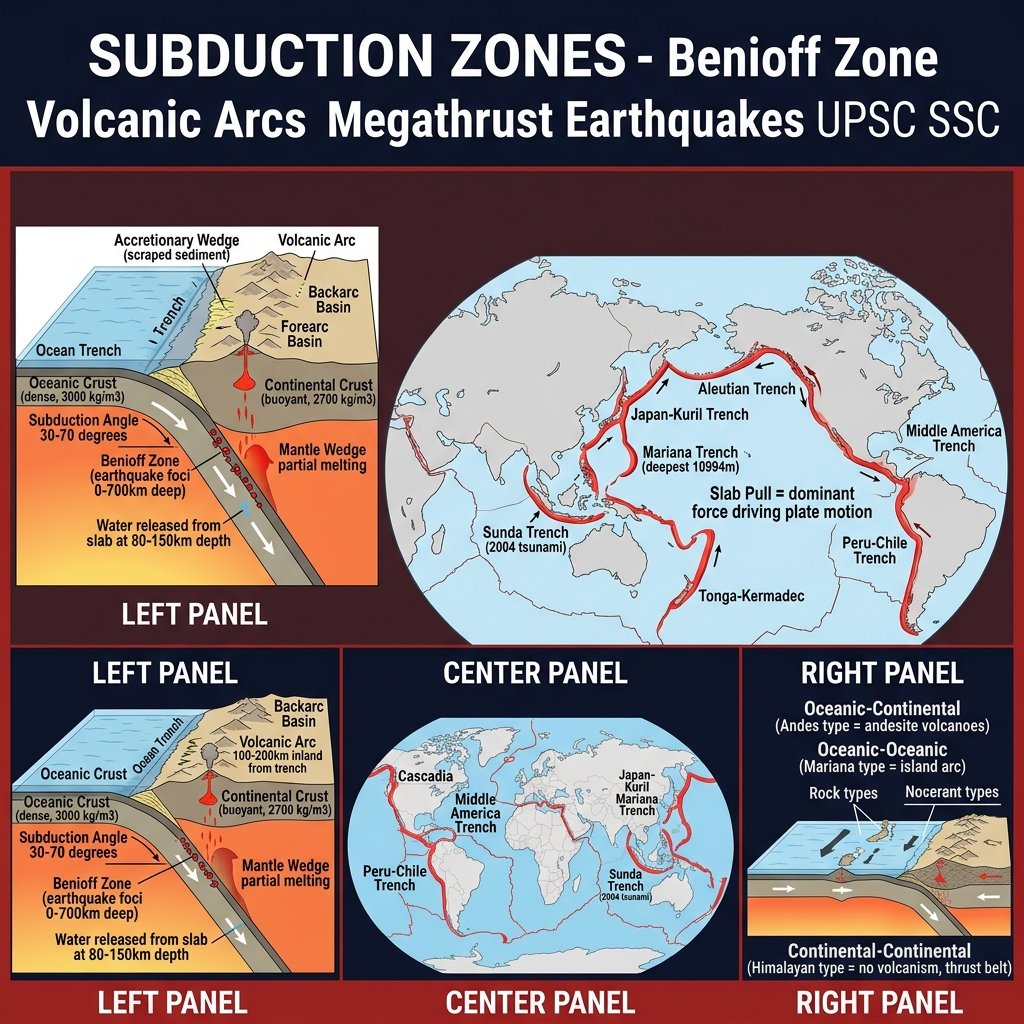
What Is Subduction? — Core Mechanism
- 🌊 Definition: Subduction is the process by which one tectonic plate descends beneath another into the mantle at a convergent plate boundary; it occurs when oceanic lithosphere (density ~3,000–3,300 kg/m³) collides with either continental lithosphere (density ~2,700 kg/m³) or older, denser oceanic lithosphere; the denser plate subducts; continental crust is too buoyant to subduct
- 🌊 Why oceanic crust subducts: Oceanic crust forms hot and buoyant at mid-ocean ridges (~3,000 kg/m³); as it ages and moves away from the ridge, it cools, contracts, and becomes denser; by 80–100 Ma, oceanic crust is denser than the underlying asthenosphere (~3,200 kg/m³) and gravitationally unstable — it wants to sink; at subduction zones, this cold, dense slab sinks into the mantle, pulling the rest of the plate behind it (slab pull)
- 🌊 Subduction angle: The angle at which the slab descends into the mantle varies significantly: shallow subduction (10–20°) — the slab scrapes along the base of the overriding plate over a wide area, creating broader deformation and compression far inland from the trench (example: flat-slab subduction under western South America produces Andean compression far inland); steep subduction (50–70°) — the slab plunges steeply, creating deep Benioff zone earthquakes, back-arc extension, and marginal seas (example: Mariana Trench and Mariana back-arc spreading)
- 🌊 Slab pull as dominant force: The weight of the cold, dense subducting slab is the dominant force driving plate motion (~3 × 10¹³ N/m, vs ridge push ~2–3 × 10¹² N/m = 10× weaker); plates with long active subduction margins (Pacific at 28,000 km of trenches) move fastest (7–10 cm/yr); plates without subduction (Antarctic) move slowest (1–2 cm/yr)
Types of Subduction Zones
| Type | Plates Involved | Results | Examples |
|---|---|---|---|
| Oceanic-Continental (Andean Type) | Oceanic plate subducts under continental plate; oceanic is denser | Continental volcanic arc (stratovolcanoes); accretionary wedge; fold-thrust belt; forearc + backarc basins; magma is andesitic (silica-rich, explosive) | Andes (Nazca under South America); Cascades (Juan de Fuca under North America); Japan (partly); Sunda Arc (Australian/Indian under Eurasian) |
| Oceanic-Oceanic (Mariana Type) | Older/denser oceanic plate subducts under younger/less dense oceanic plate | Oceanic island arc; deep ocean trench; backarc basin; magma is basaltic to andesitic; no continental crust thickened | Mariana Trench (Pacific under Philippine Plate); Tonga-Kermadec; Aleutian Islands; Japan Trench (partly); Caribbean Arc (Antilles) |
| Continental-Continental | Two continental plates converge; neither can subduct (both buoyant) | NO VOLCANISM; massive mountain building (collision orogeny); thick crustal root (Airy isostasy); thrust fault belts; metamorphic core complexes; eclogite formation in lower crust | Himalayas (India-Eurasia collision); Alps (Africa-Europe); Zagros Mountains (Arabia-Iran); Tibetan Plateau = world’s highest and largest plateau (average 4,500m elevation) |
| Ocean-Continent with Flat Slab | Oceanic plate subducts at a very shallow angle (10–20°); slab slides under continent horizontally | No volcanic arc directly above; compression extends far inland from trench; basement thrusting hundreds of km inland; Laramide-style deformation | Central Andes (Pampean flat slab); Sierra Nevada (Laramide orogeny, USA, caused by Farallon flat slab 80–50 Ma); Cascadia southern segment |
Anatomy of a Subduction Zone — Key Features
- 🔬 Ocean Trench: The surface expression of the subduction zone — a deep, narrow trough in the ocean floor where the subducting plate bends and descends; the world’s deepest ocean trenches are all at subduction zones; Mariana Trench (10,994m, Pacific-Philippine subduction); Tonga Trench (10,882m); Philippine Trench (10,540m); Peru-Chile Trench (8,065m); Indian Ocean’s Java/Sunda Trench (7,258m, site of 2004 tsunami)
- 🔬 Accretionary Wedge: As the oceanic plate subducts, the sediments on its surface (marine sediments, pelagic clays, cherts) are too buoyant to subduct and are scraped off the descending slab and piled up against the overriding plate; this forms a wedge-shaped mass of deformed sediment called the accretionary prism or wedge; it consists of imbricate thrust sheets; in erosive margins (common in the Pacific), sediment is actually dragged down with the slab (subduction erosion) and the wedge is small or absent
- 🔬 Forearc Basin: The relatively flat, sediment-filled basin between the accretionary wedge and the volcanic arc; receives sediment eroded from the volcanic arc; may be onshore (the Puget Sound basin in Washington USA is partly forearc) or submarine; may contain petroleum accumulations (e.g., the Cook Inlet basin in Alaska)
- 🔬 Volcanic Arc: The chain of volcanoes produced by partial melting of the mantle wedge above the subducting slab; located typically 100–200 km inland from the trench (above the point where the slab reaches ~100–150 km depth and releases water); in oceanic-oceanic subduction = island arc; in oceanic-continental subduction = continental volcanic arc; arc volcanoes are typically andesitic (silica-rich, viscous, explosive) — much more dangerous than basaltic mid-ocean ridge or hotspot volcanoes
- 🔬 Backarc Basin: The extensional basin behind (landward of) the volcanic arc; forms when trench suction pulls the overriding plate toward the subduction zone faster than convergence rate, stretching the backarc region; produces new oceanic crust or thinned continental crust; examples: Japan Sea (behind Japanese Arc), Mariana Trough (behind Mariana Arc), Aegean Sea (behind the Hellenic Arc, Greece)
- 🔬 Benioff Zone: The inclined plane of earthquake foci defined by earthquakes within the subducting slab as it descends into the mantle; earthquakes occur because the subducting slab is cold and brittle (it takes millions of years for the heat of the mantle to warm the slab); Benioff Zone earthquakes range from shallow (0–70 km = near the trench, brittle upper part of slab) through intermediate (70–300 km) to deep (300–700 km); deeper than 700 km, the slab has been so compressed by mantle pressure that it undergoes phase transitions that end seismicity
Major Subduction Zones of the World
| Subduction Zone | Plates | Trench Depth | Key Events / Features |
|---|---|---|---|
| Mariana Subduction Zone | Pacific Plate under Philippine Plate | Mariana Trench: 10,994m (deepest point on Earth) | Oceanic-oceanic; oldest Pacific crust subducting; Mariana Island Arc; Mariana Trough backarc spreading; convergence ~2.5 cm/yr |
| Japan-Kuril Subduction Zone | Pacific Plate under Okhotsk (Eurasian) Plate | Japan Trench: 9,000m; Kuril Trench: 10,542m | 2011 Tohoku Mw 9.0 on Japan Trench (Fukushima); Japan subduction = mixed oceanic-continental-oceanic; Kuril Arc volcanic islands |
| Sunda Megathrust | Australian-Indian Plate under Eurasian Plate | Java/Sunda Trench: 7,258m | 2004 Indian Ocean tsunami (Mw 9.1, 227,898 killed); Krakatau, Merapi, Tambora; Sumatra-Java-Bali volcanic arc; major threat to Indian Ocean basin |
| Peru-Chile (Atacama) Trench | Nazca Plate under South American Plate | Peru-Chile Trench: 8,065m | Valdivia 1960 Mw 9.5 (largest ever); Andes volcanic arc (Cotopaxi, Villarrica); world’s driest desert (Atacama) in rain shadow of Andes; Chilean subduction rate 7 cm/yr |
| Cascadia Subduction Zone | Juan de Fuca Plate under North American Plate | ~3,000m offshore (no deep trench — sediment-filled) | Last megathrust: January 26, 1700 (Mw 8.7–9.2); Cascade volcanoes (Mt Rainier, Mt St Helens, Mt Hood); threatens Seattle, Portland, Vancouver |
| Aleutian Subduction Zone | Pacific Plate under North American Plate | Aleutian Trench: 7,822m | Alaska 1964 Mw 9.2 (second largest ever); 80 Aleutian volcanoes; aviation hazard (North Pacific flight paths); rapid convergence ~7 cm/yr |
| Tonga-Kermadec | Pacific Plate under Australian Plate | Tonga Trench: 10,882m (second deepest) | Fastest subduction on Earth (~24 cm/yr); deepest Benioff Zone earthquakes (Fiji deep zone ~700km); Hunga Tonga 2022 eruption/tsunami |
Subduction Volcanism — Why It Is More Explosive Than Other Volcanism
- 🌋 The water-flux melting mechanism: At 80–150 km depth, the subducting slab reaches temperatures and pressures that cause hydrous minerals (amphibole, serpentine, chlorite) in the oceanic crust and sediments to break down, releasing water into the overlying mantle wedge; water dramatically lowers the melting point of peridotite (from ~1,300°C to ~900°C at those depths); the mantle wedge partially melts, producing basaltic magma that rises into the overlying crust
- 🌋 Andesite production: As this basaltic magma rises through the thick continental crust, it assimilates crustal material (becoming more silica-rich), differentiates (iron and magnesium minerals crystallise out, leaving silica-enriched residual melt), and mixes with pre-existing magmas; the result is andesite — the characteristic magma of continental arc volcanoes (named after the Andes); andesite is ~58–62% SiO₂, more viscous and gas-rich than basalt (~50% SiO₂)
- 🌋 Why explosive: Higher silica = higher viscosity = gas cannot escape easily from the magma as it rises = pressure builds = explosive eruptions (Plinian eruption columns reaching 40km height; pyroclastic flows; ash fall over thousands of km); subduction zone volcanoes produce VEI 5–7 eruptions (e.g., Pinatubo 1991 VEI 6, Tambora 1815 VEI 7) — the most destructive volcanic events; in contrast, hotspot basalt volcanoes (Hawaii, Iceland) erupt quietly as lava flows with low explosivity (VEI 1–2)
- 🌋 Porphyry copper deposits: Subduction zone magmas are the primary source of the world’s copper, gold, and molybdenum; as hydrothermal fluids rising from the magma chamber cool in the overlying crust, they deposit copper sulphides (chalcopyrite, bornite) in fractures — creating porphyry copper deposits; Chile and Peru (Andean arc) = world’s largest copper producers (Chile = 27% of world copper production); Philippines, Papua New Guinea, and Indonesia also major producers from their arc systems
The Benioff Zone — Earthquake Architecture of Subduction
- 📊 What it is: Named after Hugo Benioff (who mapped earthquake foci systematically in 1949–1954), the Benioff Zone (also called the Wadati-Benioff Zone, crediting Japanese seismologist Kiyoo Wadati who first described it in 1935) is the inclined plane of seismicity within a subducting slab, dipping from the trench toward greater depth under the overriding plate
- 📊 Depth zones: Shallow Benioff (0–70 km) = brittle fracture of the upper slab at shallow depths; interface megathrust earthquakes (largest in world = Mw 9+) occur at shallow depths on the plate interface, not within the slab; intermediate Benioff (70–300 km) = earthquakes within the cold slab interior as it is compressed; deep Benioff (300–700 km) = rare deep-focus earthquakes in the deepest parts of the slab; maximum depth ~700 km (below which phase transitions change the slab’s mechanical behaviour)
- 📊 Deep-focus earthquakes: Earthquakes at 300–700 km depth are remarkable because at these depths the confining pressure should prevent brittle fracture (which is how most earthquakes work); the mechanism for deep-focus earthquakes is debated — leading hypotheses include: (1) metastable olivine transforming suddenly to denser spinel structure releasing energy (transformational faulting); (2) dehydration embrittlement — even at depth, residual water releases in high-pressure mineral transformations allow transient brittle failure; deep-focus earthquakes (e.g., Bolivia 1994 Mw 8.2 at 637 km depth = largest deep-focus earthquake ever) cause no tsunamis because the slab is deep below the ocean floor
- 📊 Seismic gaps: A seismic gap is a segment of a subduction zone boundary that has NOT produced a major earthquake in historical time even though the surrounding segments have; seismic gaps indicate accumulated strain awaiting release; the Cascadia Subduction Zone (no megathrust since 1700) is one of the world’s most significant seismic gaps; identification of seismic gaps has become a major tool in probabilistic seismic hazard assessment
⭐ Important for Exams — Quick Revision
- 🔑 Subduction: Dense oceanic plate descends under less dense plate at convergent boundary; driven by slab pull (dominant force = ~3 × 10¹³ N/m); oceanic crust density ~3,000–3,300 kg/m³ vs continental ~2,700 kg/m³
- 🔑 Benioff Zone (Wadati-Benioff Zone): Inclined plane of earthquake foci within subducting slab; shallow (0–70 km) → intermediate (70–300 km) → deep (300–700 km); below 700 km = no seismicity
- 🔑 Megathrust earthquake: Occurs at shallow plate interface (not within slab); largest type of earthquake on Earth; Valdivia 1960 Mw 9.5, Alaska 1964 Mw 9.2, Sumatra 2004 Mw 9.1, Tohoku 2011 Mw 9.0
- 🔑 Oceanic-continental subduction: Andes type; continental volcanic arc; andesitic explosive volcanoes; Nazca under South America → Andes; Juan de Fuca under N America → Cascades
- 🔑 Oceanic-oceanic subduction: Mariana type; island arc; deeper trench; Mariana Trench 10,994m (deepest on Earth); Pacific under Philippine → Mariana Arc; Tonga 10,882m second deepest
- 🔑 Continental-continental: No subduction possible (both buoyant); no volcanism; mountain building only; Himalayas (India-Eurasia), Alps (Africa-Europe), Zagros (Arabia-Iran)
- 🔑 Ocean trench: Surface expression of subduction; all world’s deepest points are trenches: Mariana (10,994m) > Tonga (10,882m) > Philippine (10,540m) > Kuril (10,542m) > Peru-Chile (8,065m) > Sunda/Java (7,258m)
- 🔑 Accretionary wedge: Sediments scraped off subducting plate piled against overriding plate; imbricate thrust sheets; contains marine cherts, limestones, basalts (ophiolites)
- 🔑 Volcanic arc: 100–200 km from trench (above slab at 100–150 km depth); water from slab causes mantle wedge melting; andesitic magma; explosive VEI 5–7 eruptions
- 🔑 Backarc basin: Extensional basin behind volcanic arc; Japan Sea (behind Japanese Arc), Mariana Trough, Aegean Sea; forms by trench rollback/suction pulling overriding plate
- 🔑 Sunda Megathrust: Australian-Indian Plate under Eurasian; 2004 Indian Ocean tsunami Mw 9.1 = 227,898 killed; Java/Sunda Trench 7,258m; Krakatau, Tambora, Merapi, Pinatubo
- 🔑 Porphyry copper: Subduction zone hydrothermal deposit; Chile (27% world copper = Andean arc); Philippines, Papua New Guinea, Indonesia also major copper from arc systems
- 🔑 Andesite: ~58–62% SiO₂; characteristic rock of continental arc volcanoes; more silicic, viscous, explosive than basalt (50% SiO₂); named after Andes Mountains
- 🔑 Deep-focus earthquakes: 300–700 km depth; within cold slab; no tsunamis (too deep); Bolivia 1994 Mw 8.2 at 637 km = largest deep-focus ever; mechanism debated (transformational faulting/dehydration embrittlement)
- 🔑 Tonga-Kermadec: Fastest subduction on Earth (~24 cm/yr); Pacific under Australian; Tonga Trench 10,882m; Benioff Zone earthquakes to ~700 km depth (Fiji deep zone)
Frequently Asked Questions (FAQs)
1. Why does subduction produce such explosive volcanoes — and what is the role of water?
The Central Role of Water
The key to understanding subduction zone volcanism is water — not as a liquid, but as chemically bound water stored within hydrous minerals in the oceanic crust. When oceanic crust forms at mid-ocean ridges, seawater percolates into the fresh basalt through fractures and reacts with it, creating water-bearing (hydrous) minerals such as serpentine, chlorite, and amphiboles. These minerals can hold 2–15 wt% water within their crystal structures.
As the oceanic plate subducts and descends to 80–150 km depth, the increasing temperature and pressure destabilise these hydrous minerals, causing them to break down in a series of dehydration reactions. The water released — as a hot, supercritical fluid — migrates upward into the overlying mantle wedge.
From Water to Magma
Water dramatically lowers the melting point of mantle peridotite. Dry peridotite at 100 km depth would require ~1,300–1,400°C to melt — temperatures not normally reached at that depth in the mantle wedge above a subduction zone. But water-saturated peridotite can begin melting at just ~900–1,000°C. Because the mantle wedge above the slab is already close to its dry melting point (being heated by the surrounding mantle), even a modest reduction in melting temperature is enough to trigger partial melting. The resulting magma is basaltic but enriched in water and incompatible elements from the subducting slab and sediments.
Why Subduction Magma Is Explosive
- High silica content: As basaltic magma rises through thick continental crust, it assimilates silica-rich crustal rocks and differentiates (mafic minerals crystallise first, leaving progressively silica-enriched melt); the result = andesite (~60% SiO₂) or even dacite/rhyolite (65–75% SiO₂) at more evolved stages
- High viscosity: Higher silica content = longer Si-O polymer chains = much higher melt viscosity; Hawaiian basalt lavas flow like thick syrup; Andean andesite magma is almost paste-like; high viscosity prevents gas from escaping gradually as the magma rises
- Dissolved gases: Subduction magmas carry large amounts of dissolved water (2–6 wt%), CO₂, SO₂, and HCl — far more than mid-ocean ridge basalts; as magma rises and pressure drops, these gases try to exsolve (come out of solution) rapidly; in low-viscosity basalt, gas bubbles escape harmlessly; in high-viscosity andesite, gas pressure builds until it overcomes the magma strength = explosive fragmentation = Plinian eruption column
- Comparison: Mauna Loa (Hawaii, hotspot basalt, VEI 1–2) vs Mount Pinatubo (Philippines, subduction andesite, VEI 6 in 1991) = the difference is primarily silica content and associated viscosity and gas retention
2. What is the Benioff Zone — and what do deep-focus earthquakes tell us about subducting slabs?
Discovery and Basic Structure
The Wadati-Benioff Zone (WBZ) was independently described by Japanese seismologist Kiyoo Wadati in 1935 and American seismologist Hugo Benioff in 1949–1954. Both noticed that earthquake foci near ocean trenches were not distributed randomly but fell along an inclined plane that dipped from shallow depths near the trench to depths of hundreds of kilometres beneath the overriding plate — directly tracing the path of the subducting slab.
The WBZ is now recognised as one of the most powerful pieces of evidence for plate tectonics: it directly maps the position of the subducting oceanic lithosphere within the mantle to depths of 700 km, far beyond any drilling or direct sampling. In effect, earthquake foci illuminate the subducting slab the way X-rays illuminate bones inside a body.
Three Depth Zones of Seismicity
- Shallow seismicity (0–70 km): Two sources — interplate seismicity (the megathrust interface between the two plates = locked zone that produces Mw 9+ earthquakes) and intraplate seismicity within the bending slab (outer rise earthquakes as the slab bends downward before the trench); this is the most hazardous zone for tsunamis
- Intermediate seismicity (70–300 km): Within the cold interior of the descending slab; the slab is still cold and brittle enough to fracture; earthquake magnitudes typically Mw 5–7.5; these earthquakes can cause severe shaking in overlying continental areas (e.g., 2001 Nisqually earthquake Mw 6.8 at 52 km depth under Puget Sound, Washington, caused $1 billion in damage)
- Deep seismicity (300–700 km): The most enigmatic; at these depths, confining pressure should prevent brittle fracture; several mechanisms are proposed: transformational faulting (metastable olivine → spinel phase transition releases energy in a sudden volume change), dehydration embrittlement (residual water releases in high-pressure mineral reactions), and shear instability; earthquakes below 300 km produce no tsunamis (slab is too deep to displace ocean floor); Bolivia 1994 (Mw 8.2 at 637 km) is the largest deep-focus earthquake ever recorded
What Benioff Zone Geometry Tells Us
- Subduction angle: The dip of the Benioff Zone reveals whether subduction is shallow (flat slab) or steep; Tonga has a very steep (~65°) Benioff Zone; central Chile has a flat (~10°) Benioff Zone (flat-slab subduction)
- Slab age: Old, cold, dense slabs typically subduct more steeply (high negative buoyancy); young, warm, buoyant slabs subduct at shallower angles; the subducting slab’s age at the trench correlates with subduction dip angle globally
- Double seismic zones: In some subduction zones, the Benioff Zone shows two parallel planes of seismicity separated by ~30 km — the upper plane in the upper oceanic crust (under compression) and the lower plane in the lower crust/upper mantle (under tension from slab bending); this double-plane structure provides information about the thermal state and stress distribution within the slab
3. How does the 2004 Indian Ocean tsunami connect to subduction zones — and could it happen again?
The 2004 Sumatra-Andaman Earthquake
On December 26, 2004, at 7:58 AM local time (00:58 UTC), a magnitude Mw 9.1 earthquake ruptured approximately 1,200–1,300 km of the Sunda Megathrust — the subduction zone boundary where the Australian-Indian Plate dives beneath the Eurasian Plate along the Sunda Trench west of Sumatra and the Andaman Islands. The rupture propagated northward from the earthquake’s epicentre (off the northwestern tip of Sumatra) at 2.5–3 km/second, taking approximately 8–10 minutes to complete.
Why It Generated Such a Devastating Tsunami
- Vertical seafloor displacement: The overriding Eurasian Plate, which had been slowly pushed down (“loaded”) by decades of strain accumulation, suddenly rebounded upward by up to 5–15 metres over an area approximately 1,200 km × 150 km; this enormous vertical displacement of the ocean floor displaced an estimated 30 km³ of water instantaneously = the energy source for the tsunami
- Shallow rupture depth: The megathrust interface ruptured at shallow depths (5–30 km below the ocean floor) — crucially, within the zone that directly couples to the ocean water above; deeper earthquakes (e.g., deep Benioff zone events at 300–700 km depth) produce no tsunamis because the seafloor displacement is negligible at the surface
- Long rupture length: 1,200 km of fault rupture = enormous area of seafloor displaced = massive water column displacement; the energy released was equivalent to 23,000 Hiroshima atomic bombs
- Open ocean propagation: Tsunami waves travel at ~800 km/hr in deep water (speed = square root of g × depth); the 2004 tsunami took 15 minutes to reach Banda Aceh (100 km away), 2 hours to reach Sri Lanka, 3.5 hours to reach India, 7 hours to reach the Maldives, and 10 hours to reach the coast of Africa (Somalia, 8,000 km away)
Could It Happen Again?
Yes — subduction megathrust earthquakes on the Sunda Megathrust will certainly recur. The Australian-Indian Plate continues to subduct under the Eurasian Plate at 5–7 cm/year. Strain is accumulating again on the locked portions of the Sunda Megathrust that did not fully rupture in 2004. Palaeoseismic evidence (coral microatolls that rise or fall in response to strain accumulation and release) shows that Sunda Megathrust ruptures with return periods of 200–400 years in different segments.
Since 2004, the Indian Ocean Tsunami Warning System (IOTWS) has been established — 26 nations participate; seismometers, DART (Deep-ocean Assessment and Reporting of Tsunamis) buoys, and tide gauges provide real-time data; warning centres in India (INCOIS, Hyderabad), Australia, and Indonesia issue tsunami alerts within minutes of a major earthquake. India’s INCOIS (Indian National Centre for Ocean Information Services) issued its first operational tsunami warning for the 2012 Indian Ocean earthquake (Mw 8.6) within 22 minutes.
Related Geology Articles on StudyHub
- ➡️ Ring of Fire — All Major Subduction Zones
- ➡️ Tsunamis — 2004 Indian Ocean & Sunda Megathrust
- ➡️ Slab Pull — The Dominant Engine of Plate Tectonics
- ➡️ Seismic Waves — Imaging Benioff Zones
- ➡️ Rift Valleys — Divergent Plate Tectonics