India’s economy is one of the most remarkable development stories of the 21st century — and one that defies simple narrative. In 1991, India was on the brink of sovereign default, with foreign exchange reserves barely sufficient for two weeks of imports, necessitating a humiliating gold transfer to the Bank of England as collateral for an IMF loan. Today, India is the world’s 5th largest economy (nominal GDP ~$3.7 trillion, 2024) and the 3rd largest by Purchasing Power Parity (PPP), home to a $800+ billion digital payments ecosystem (UPI), a $245 billion IT industry, and the world’s fastest-growing major economy (GDP growth 7.6% in FY 2023–24). India is expected to become the world’s 3rd largest economy by 2027–2030 (surpassing Japan and Germany). Yet the same economy hosts the world’s largest number of underemployed agricultural workers, a vast informal sector (~90% of workforce), significant income inequality (Gini ~0.35–0.38), and a youth unemployment rate that threatens to squander the demographic dividend. Understanding India’s economic structure, historical reforms, fiscal architecture, monetary policy, and key indicators is essential for UPSC, SSC, and all competitive examinations.
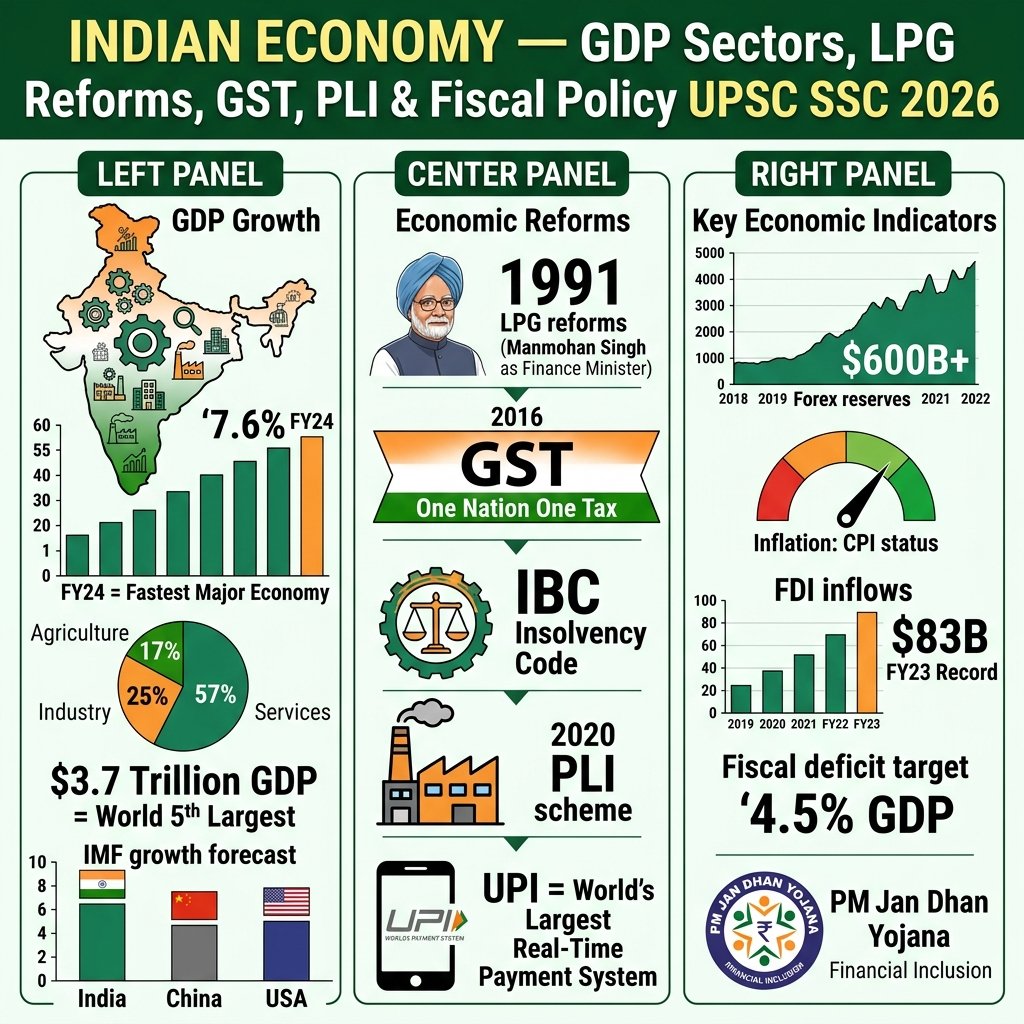
India’s Economic Profile — Key Indicators (2024)
| Indicator | Value | Global Context |
|---|---|---|
| Nominal GDP | ~$3.7 trillion (FY 2023–24) | 5th largest globally; behind USA($28T), China($17T), Germany($4.5T), Japan($4.2T) |
| GDP by PPP | ~$14.6 trillion (2024) | 3rd largest globally (behind USA, China); PPP adjusts for lower price levels in India |
| GDP Growth Rate | 7.6% (FY 2023–24) | Fastest among G20 majors; IMF projects 6.5–7% for 2025–26 |
| Per Capita GNI (PPP) | ~$8,475 (2022, World Bank) | Lower-middle income country; well below China ($21,000 PPP) and global average |
| GDP Sectoral Share | Agriculture 17% + Industry 25% + Services 57% | Services-dominated economy; agriculture employs 42% but contributes only 17% = productivity gap |
| Forex Reserves | ~$620–640 billion (2024) | 4th largest globally; sufficient for ~11 months of imports vs minimum 3-month threshold |
| FDI Inflows | $83.6 billion (FY 2021–22, record); $71 billion (FY 2022–23) | Among world’s top 3 FDI destinations; Mauritius, Singapore, USA = top sources |
| Fiscal Deficit | 5.8% of GDP (FY 2023–24); target 4.9% (FY 2024–25) | Higher than ideal; government spending-revenue gap; consolidated fiscal deficit (Centre+States) ~8–9% GDP |
| Inflation (CPI) | ~4.9% (FY 2023–24 average) | RBI target 4% (+/-2%); food inflation volatile (vegetable, pulse prices spike seasonally) |
| Current Account Deficit | ~$25–30 billion / ~0.7–1.2% of GDP (FY 2023–24) | Manageable; oil and gold imports main drivers; services surplus (IT exports) partially offsets goods deficit |
| UPI Transactions | ~$2.5 trillion/year volume (2023) | World’s largest real-time payment system; India processes more real-time digital transactions than any other country |
| GST Collections | ~₹18.7 lakh crore (FY 2023–24, record) | Formalisation of economy visible; GST collections rising consistently year on year since 2017 |
India’s Economic Sectors
1. Agriculture (17% GDP, 42–45% Employment)
- 🌾 India’s agriculture sector contributes 17% of GDP but employs 42–45% of the workforce — this productivity gap is the central structural challenge of the Indian economy; average agricultural income per farm household = ~₹10,218/month (NABARD NAFIS 2016–17) — barely survivable
- 🌾 Agriculture’s share of GDP has fallen steadily (72% at Independence, 17% today) but its employment share has not declined correspondingly — meaning surplus labour remains trapped in low-productivity farming
- 🌾 Allied sectors: Animal husbandry (India = world’s largest milk producer, 214 MT, 2022–23); fisheries (2nd largest fish producer — $17B exports); horticulture (2nd largest fruit+vegetable producer)
2. Industry (25% GDP)
- 🏭 Includes manufacturing (17% GDP), construction (8% GDP), mining, utilities; India’s manufacturing share (17%) is lower than target (25% by 2025 under Make in India)
- 🏭 MSMEs (Micro, Small, Medium Enterprises): 63 million MSMEs; contribute 30% of GDP, 45% of exports, 110 million jobs — India’s employment engine; but starved of formal credit (only 16% access formal credit), lack technology, and face regulatory compliance burden
- 🏭 Manufacturing GVA growth: Volatile; spikes (8–9%) during capex cycles, contracts during demand slumps; PLI scheme targeting 14 sectors to build export-competitive manufacturing base
3. Services (57% GDP)
- 💼 India’s services sector dominates: IT ($245B), financial services, retail trade, real estate, and other services; India is the world’s back-office — providing information services, BPO, KPO, legal process outsourcing, medical transcription, and engineering services to global companies
- 💼 Services exports = $338 billion (FY 2023–24): Software services ($194B) + travel + transport + financial services; India’s services surplus is what makes the current account manageable despite large goods trade deficit
- 💼 Financial services: Banking sector dominated by public sector banks (PSBs) historically — burdened by NPAs (Non-Performing Assets = bad loans); RBI’s Bank Recapitalisation programme (₹3.5 lakh crore 2017–2022) stabilised PSBs; IBC (Insolvency and Bankruptcy Code) 2016 resolved bad loans worth ₹3+ lakh crore
Landmark Economic Reforms
| Reform | Year | What Changed | Impact |
|---|---|---|---|
| LPG Reforms — Liberalisation, Privatisation, Globalisation | 1991 | PV Narasimha Rao PM + Dr. Manmohan Singh Finance Minister; abolished industrial licensing (License Raj); opened FDI; devalued rupee; reduced import tariffs; dismantled MRTP; opened capital markets | GDP growth accelerated from ~3.5% (Hindu rate of growth) to 5–8%; FDI from near zero to $70B+; IT boom enabled; middle class expansion; however agricultural and informal sector workers saw slower benefits |
| GST — Goods and Services Tax | 2017 (July 1) | Replaced 17 central and state taxes (Excise, Service Tax, VAT, CST, Octroi etc.) with uniform GST across India; 4 slabs (5%, 12%, 18%, 28%); GSTN (GST Network) digital platform; dual structure (CGST + SGST / IGST) | “One Nation One Tax”; eliminated inter-state checkpoints; formalised economy (GST registration = traceability); record collections ₹18.7 lakh crore (FY 2023–24); compliance still challenging for small businesses; petroleum products outside GST = anomaly |
| IBC — Insolvency & Bankruptcy Code | 2016 | Created time-bound (180+90 days) resolution process for corporate insolvency; established NCLT (National Company Law Tribunal); IRP (Insolvency Resolution Professional) system; replaced decade-long winding-up court processes | Resolved ₹3+ lakh crore bad loans by 2024; improved ease of doing business rank; changed India’s credit culture (“you will pay or lose your company”); still slow in practice vs 180-day ideal |
| UPI — Unified Payments Interface | 2016 (NPCI) | Real-time interbank payment system on mobile; built on IMPS (Immediate Payment Service); PhonePe, GPay, Paytm built on UPI; linked to Aadhaar and bank accounts | ~$2.5 trillion annual transactions (2023); world’s largest real-time payment system by volume; financial inclusion for unbanked; India exports UPI technology to Singapore, UAE, France, UK, Nepal |
| RERA — Real Estate Regulation Act | 2016 | Mandatory registration of real estate projects; escrow of 70% of buyer funds; disclosure norms; fast-track dispute resolution; prior to RERA, developers routinely misused buyer funds with no accountability | Investor protection improved; informal/unregistered developers squeezed out; state implementation uneven; ~95,000 projects registered; ~1 lakh crore stuck projects partially resolved |
| PLI — Production Linked Incentive | 2020 | Cash incentives (4–20%) for incremental production above base year over 5 years across 14 sectors: electronics, pharma, telecom, textiles, auto, food, solar, ACC, speciality steel | Apple iPhone exports $17.4B (India, 2024); semiconductor fab announced (Tata-PSMC, Micron OSAT); ₹1.97 lakh crore committed; actual disbursements still a fraction (performance-linked); medium-term strategy |
| Demonetisation | Nov 2016 | PM Modi announced withdrawal of Rs 500 and Rs 1000 notes (86% of currency in circulation) with 4-hour notice; rationale: black money elimination, counterfeit currency, digital payment push | Most controversial economic decision; short-term GDP growth dip (Q3 FY17 = 6.1% vs 7.5%); informal economy severely disrupted; cash-dependent agriculture/labour markets hit; long-term: digital payment acceleration (UPI adoption jumped), GST compliance improved; black money seizure far below expectations; economists divided on net benefit |
Fiscal Policy & Union Budget
- 📋 Union Budget: India’s annual financial statement presented to Lok Sabha (constitutionally by Finance Minister); two components: Revenue Budget (tax + non-tax receipts vs revenue expenditure) and Capital Budget (capital receipts + capital expenditure); presented on February 1 since 2017 (earlier February 28/March 1)
- 📋 FRBM Act (Fiscal Responsibility and Budget Management Act, 2003): Targets for fiscal deficit (3% GDP) and revenue deficit (0%) for central government; repeatedly amended and breached; COVID expanded deficit to 9.5% GDP (FY 2020–21); medium-term consolidation path ongoing
- 📋 Finance Commission: Constitutional body (Article 280); constituted every 5 years; recommends horizontal and vertical tax devolution between Centre and States; 15th Finance Commission (2021–26) devolved 41% of central taxes to states (from 32% previously — increased devolution reflects states’ developmental role)
- 📋 Direct Taxes: Income Tax (progressive rates; personal income tax + corporate tax); Corporate Tax cut from 30% to 22% basic (15% for new manufacturing companies) in September 2019 — major FDI attraction; Direct Tax Code reform pending; India’s direct-to-indirect tax ratio ~35:65 (developed countries typically 60:40 — India relies too heavily on indirect taxes burdening lower-income groups)
- 📋 Indirect Taxes: Post-GST, GST + Customs Duty = primary indirect taxes; GST subsumed most indirect taxes; petroleum products (petrol, diesel, ATF, natural gas) still outside GST — generating significant central and state revenue (Basic Excise + State VAT on petrol = ~55–60% of pump price)
Monetary Policy — Reserve Bank of India (RBI)
- 🏦 RBI’s mandate: Price stability (inflation target 4% CPI, +/-2% band) while keeping growth objectives in view; Monetary Policy Committee (MPC) — 6-member committee (3 RBI + 3 external) sets repo rate by majority vote
- 🏦 Key rates (2024): Repo Rate = 6.5% (rate at which RBI lends to commercial banks); Reverse Repo = 3.35% (rate at which RBI borrows from banks); CRR (Cash Reserve Ratio) = 4.5%; SLR (Statutory Liquidity Ratio) = 18%; Bank Rate = 6.75%
- 🏦 Inflation Targeting Framework (2016): India adopted formal inflation targeting (4% CPI, +/-2%) in 2016; previously RBI balanced multiple objectives; this framework improved RBI’s credibility and reduced inflation expectations; high food inflation (especially vegetable prices) periodically breaches the upper 6% band
- 🏦 External Sector: Rupee is partially convertible — fully convertible on Current Account (trade in goods and services) since 1994; not fully convertible on Capital Account (financial investments — FDI allowed, portfolio flows regulated, loan destinations restricted); capital account convertibility (CAC) remains a long-term goal; managed float exchange rate (RBI intervenes to limit volatility)
⭐ Important for Exams — Quick Revision
- 🔑 India’s GDP (2024): $3.7 trillion nominal = 5th largest; $14.6 trillion PPP = 3rd largest; growth 7.6% FY24 = fastest G20
- 🔑 GDP sectors: Agriculture 17% + Industry 25% + Services 57%; but Agriculture employs 42% = productivity paradox
- 🔑 1991 LPG Reforms: Narasimha Rao PM + Manmohan Singh FM; abolished License Raj; opened FDI; devalued rupee; gold pledged to IMF; turned India around from sovereign default
- 🔑 GST (July 1, 2017): Replaced 17 taxes; 4 slabs (5/12/18/28%); CGST+SGST+IGST; record ₹18.7 lakh crore collections (FY24); petroleum still outside GST
- 🔑 IBC (2016): 180+90 days insolvency; NCLT; resolved ₹3+ lakh crore bad loans; changed credit culture
- 🔑 UPI (2016): $2.5 trillion transactions/year; world’s largest real-time payment system; India exports UPI tech to 10+ countries
- 🔑 Demonetisation (Nov 2016): 86% currency withdrawn; short-term GDP dip; long-term digital payment acceleration; controversial — economists divided
- 🔑 PLI scheme (2020): 14 sectors; ₹1.97 lakh crore committed; Apple iPhone $17.4B exports (2024) = success story
- 🔑 FRBM Act (2003): Fiscal deficit target 3% GDP; repeatedly breached; COVID peak = 9.5%; FY25 target 4.9%
- 🔑 Finance Commission = Article 280; every 5 years; 15th FC = 41% central tax devolution to states
- 🔑 Corporate Tax cut 2019: 30% to 22% basic; 15% for new manufacturing = major FDI attraction
- 🔑 Indian direct:indirect tax ratio = 35:65 (should be 60:40); regressive burden on lower-income groups
- 🔑 RBI MPC (6 members): Sets repo rate; CPI inflation target 4% (+/-2%); repo rate = 6.5% (2024)
- 🔑 Rupee = current account convertible (1994); NOT fully capital account convertible; managed float
- 🔑 Forex reserves ~$620–640B: 4th largest globally; ~11 months import cover
- 🔑 UPI exported to: Singapore (2023), UAE, France, UK, Nepal, Bhutan, Sri Lanka — India’s digital diplomacy
- 🔑 MSMEs: 63 million units; 30% GDP; 45% exports; 110M jobs; only 16% access formal credit = constraint
- 🔑 India to become 3rd largest economy: Expected by 2027–2030 (surpassing Japan and Germany per IMF/World Bank projections)
Frequently Asked Questions (FAQs)
1. What was the 1991 economic crisis — and how did it transform India?
The 1991 Balance of Payments crisis is the pivotal moment in modern Indian economic history — the inflection point that separates the socialist, licence-raj India from the liberalised, globally integrated India of today. What happened: By January 1991, India’s foreign exchange reserves had fallen to approximately $1.2 billion — barely sufficient for two weeks of imports (the minimum safe threshold is typically 3 months). India was facing sovereign default — the prospect of being unable to pay for essential imports like oil, fertiliser, and industrial inputs. The immediate triggers: (1) The Gulf War (1990–91) disrupted oil supply and prices (India imports ~85% of oil), while simultaneously cutting off remittances from the 1.5 million Indian workers in Kuwait who fled Saddam Hussein’s invasion; (2) The collapse of trade with the Soviet Union (India’s major trading partner) following USSR’s disintegration; (3) Political instability (India had three prime ministers in 1989–1991). To prevent default, India took an emergency IMF loan conditioned on structural adjustment reforms; as collateral, 47 tonnes of gold was airlifted secretly to the Bank of England and Bank of Japan (news leaked, causing political embarrassment to PM Chandra Shekhar’s caretaker government). The response: The new Narasimha Rao government (elected June 1991) appointed Dr. Manmohan Singh as Finance Minister. Singh’s July 1991 Budget presented the most comprehensive economic reform package in Indian history: devaluation of the rupee (by 25% in two tranches); abolition of the industrial licensing system (the “License Raj” that required government permission to expand or diversify production); reduction of import tariffs (average from 87% to 40%); opening to foreign direct investment; freedom for companies to expand without MRTP Act approval. Singh’s Budget speech famously quoted Victor Hugo: “No power on earth can stop an idea whose time has come.” The transformation: India’s GDP growth accelerated from the “Hindu rate of growth” (~3.5% per year, 1950s–1980s, so-called because it barely exceeded population growth) to 5–8% through the 1990s and 2000s. FDI inflows rose from near zero to $70B+ annually. IT exports, barely $150 million in 1991, reached $194B by 2023–24. India transformed from an aid-recipient to a capital-exporting nation (Indian companies buying Jaguar Land Rover, Corus Steel, Novelis etc.). The middle class — defined as households earning $10–50/day — expanded from ~25 million to 300+ million. By 2022, India repaid the 1991 IMF loan many times over and built $640 billion of forex reserves — a complete reversal of the 1991 position. The 1991 reforms are also credited with creating the conditions for India’s startup ecosystem, pharma export competitiveness, and infrastructure investment capacity that are visible today.
2. How did UPI become the world’s largest payment system — and why can’t developed countries replicate it?
The Unified Payments Interface (UPI), launched by the National Payments Corporation of India (NPCI) in April 2016, processed approximately $2.5 trillion in transactions during 2023 — making it the world’s largest real-time digital payments system by volume. It processes more transactions than the USA, UK, and EU combined in real-time digital payments. The story of how India built this in under a decade — and why rich countries haven’t — is one of the most interesting in modern economic history. The technical innovation: UPI is built on a three-layer architecture: (1) The Aadhaar biometric identity system (800 million+ linked accounts) provides identity verification; (2) NPCI’s UPI protocol creates a universal “Virtual Payment Address” (VPA) — a simple address like name@bank — that maps to your bank account; any UPI-capable app (PhonePe, Google Pay, Paytm, BHIM) can send money to any VPA regardless of which bank either party uses, in real-time, 24/7 including holidays; (3) The Jandhaan accounts (52 crore bank accounts, 55% women) provided the last-mile banking infrastructure. The payment itself is rail-on-rail — the money moves directly between bank accounts (not through an intermediary wallet), which is why there is no credit risk and why UPI transactions cost effectively zero for users. Why the innovation was possible in India specifically: Paradoxically, India’s financial underdevelopment enabled the leap. Britain, USA, and EU had elaborate existing payment infrastructure (cheque systems, card networks, SWIFT wires) with entrenched networks of banks, card companies, and intermediaries with powerful lobbying positions; they could not easily switch to a new system that would eliminate their fee income. India in 2016 had very low card penetration (~5% of population) and no entrenched card lobby. The government could build UPI as a public utility from scratch on top of the existing banking system without disrupting incumbent profits. The global export: India’s UPI has now been integrated with Singapore’s PayNow (2023), UAE, France (QR code acceptance at Eiffel Tower area), UK (2024), Nepal, Bhutan, and Sri Lanka. Indian travellers can pay with UPI in 10+ countries. The G20 Presidency (2023) advanced cross-border UPI interoperability as India’s contribution to global payment inclusion. NPCI International is commercialising UPI globally, potentially generating licence revenue for India. What started as a domestic crisis response (demonetisation’s cash shortage drove UPI adoption) has become India’s most significant soft power export in financial technology.
3. Is India’s economic growth “jobless growth” — and what is the real unemployment picture?
The phrase “jobless growth” — high GDP growth without commensurate formal job creation — has been applied to India’s economy since the early 2000s, and the debate intensified when unemployment data became more rigorously collected. The picture is genuinely complex and contested. The data: India’s Periodic Labour Force Survey (PLFS) — started 2017–18 at NSSO/MoSPI — provides quarterly and annual employment data. Overall unemployment rate (PLFS 2022–23): 3.2% — which sounds low. However, this is misleadingly reassuring because India’s labour market has two distinct distortions: (1) Most people cannot afford to be “unemployed” in the Western sense (i.e., not working and actively job-seeking) — they must do something to eat. So “self-employed” farmers (including those who work on family farms earning near nothing), street vendors, daily wage earners — all count as “employed” in official statistics. India’s self-employment rate = ~55% of workforce. This includes massive disguised unemployment — especially in agriculture, where removing 20–30% of agricultural workers would not reduce agricultural output, because the marginal labour productivity is near zero or even negative; the work is “shared” among more people than the task requires. (2) Urban educated youth unemployment is distinctly high: PLFS 2022–23 found urban unemployment rate for persons aged 15–29 with secondary education and above = ~18%; for graduate-level youth, estimates range from 28–42% (Centre for Monitoring Indian Economy / CMIE data). These are graduate engineers, MBAs, and post-graduates unable to find jobs matching their qualifications — the education-jobs mismatch crisis (see Geo-82 ASER discussion). The formal-informal divide: EPFO (Employees’ Provident Fund Organisation) data is often cited to show “formal job creation” — 17–19 million net EPFO additions per year. However, EPFO measures formalisation of existing employment (workers getting formal employment for the first time) as well as new job creation — the two cannot be easily separated. India’s Labour Force Participation Rate (LFPR) for women stands at only 25% (rising from 23% in 2017–18) — well below global averages; bringing women into formal employment at scale is the single largest lever for both solving youth unemployment AND capturing the demographic dividend. What is actually happening: India’s economy IS creating jobs — PLFS shows agricultural employment share declining from 54% (2017–18) to 45.7% (2022–23), with construction, trade, and transport absorbing most: these are real but predominantly informal, low-productivity jobs. The quality of employment — formal contracts, social security, stable income, skill utilisation — is the crisis, not quantity per se. The structural transformation from agricultural surplus labour to high-value formal manufacturing and services employment is occurring but slowly relative to the ~5–8 million new labour force entrants per year. The PM’s vision of India as a global manufacturing hub (Atmanirbhar Bharat + PLI) is precisely designed to create high-quality formal manufacturing jobs — but as the PLI experience shows, capital-intensive electronics manufacturing (iPhones in Foxconn’s Tamil Nadu factory) does not create as many jobs per unit of investment as labour-intensive garment or footwear manufacturing.
Related Geology Articles on StudyHub
- ➡️ Industries India — Manufacturing, IT, Pharma Economy
- ➡️ Agriculture India — Agricultural Economy & Food Security
- ➡️ Human Development — The Human Face of GDP Growth
- ➡️ Transport India — Infrastructure Investment & Economic Growth
- ➡️ Foreign Policy — Trade & Economic Diplomacy