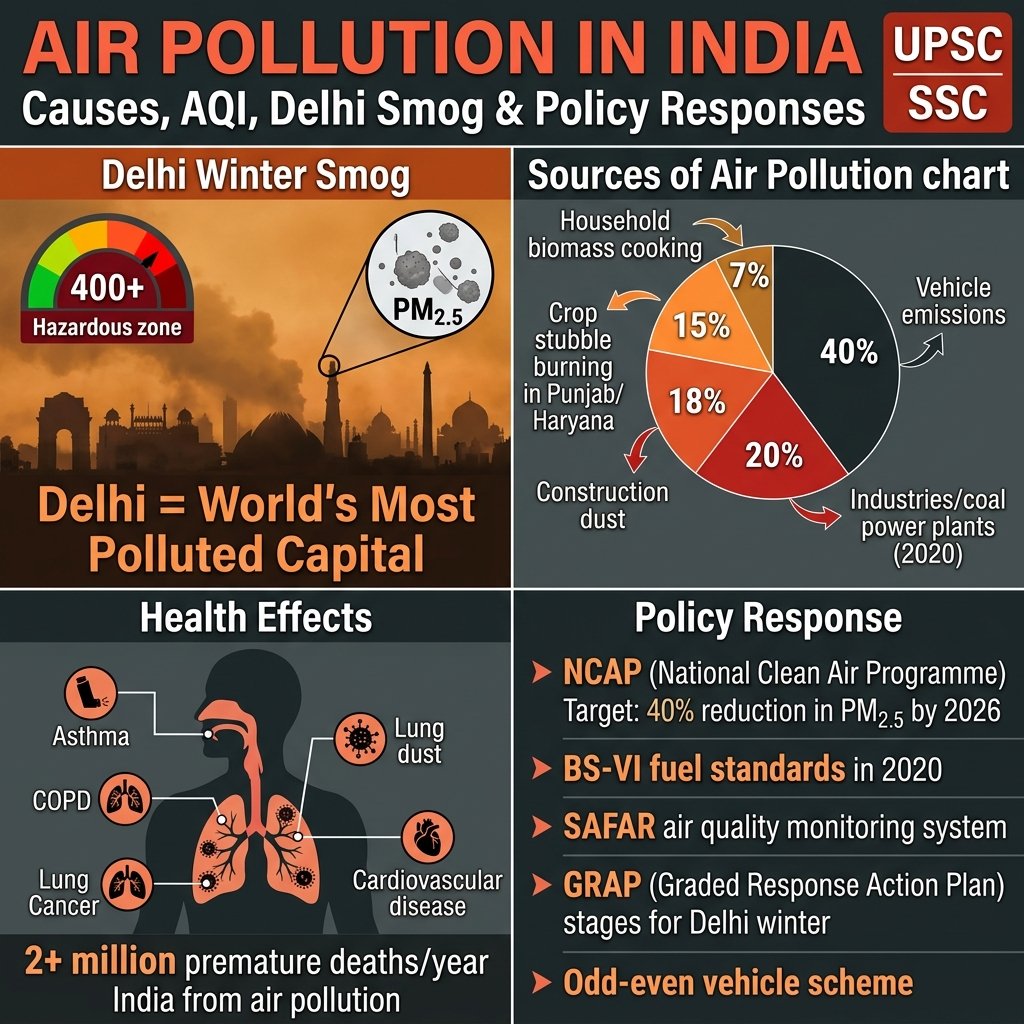
Every winter, Delhi transforms into a gas chamber. AQI readings breach 400, 500, sometimes touching 999 — “Hazardous” on every scale. Schools close, construction halts, airports ground flights. Residents — 33 million of them — breathe air containing particulate matter at concentrations 30–40 times the WHO safe limit. India is home to 39 of the world’s 50 most polluted cities (IQAir 2023 World Air Quality Report). Air pollution kills an estimated 2.18 million Indians every year (State of Global Air Report 2023) — more than malaria, tuberculosis, and HIV/AIDS combined — making it India’s largest environmental health crisis. Yet the sources, policy responses, and solutions to India’s air pollution problem are deeply misunderstood. This article covers the complete picture — from PM2.5 and AQI science to the political economy of stubble burning to NCAP and GRAP frameworks — essential for UPSC, SSC, and all competitive examinations.
Understanding Air Pollutants & AQI
Key Air Pollutants
| Pollutant | Source | Health Impact | Indian Context |
|---|---|---|---|
| PM2.5 (Particulate Matter <2.5 micrometres) | Vehicle exhaust, coal combustion, crop burning, secondary formation from NOx+SO2+NH3 reactions | Penetrates deep into alveoli; enters bloodstream; causes lung cancer, heart attacks, strokes, premature births; most dangerous pollutant | India’s annual PM2.5 average = 53.3 µg/m³ (2022, IQAir); WHO safe limit = 5 µg/m³; Delhi winter peaks = 300–450 µg/m³ |
| PM10 (Particulate Matter <10 micrometres) | Dust (construction, road, agricultural), coarse industrial emissions | Triggers asthma, bronchitis; irritates eyes and throat; causes less systemic damage than PM2.5 | NAAQS standard = 60 µg/m³ annual average; dust is major PM10 source in Rajasthan, Delhi, UP |
| NO2 (Nitrogen Dioxide) | Vehicle exhaust (especially diesel); thermal power plants | Respiratory irritant; contributes to smog formation; secondary PM2.5 formation with NH3 | Delhi, Mumbai, Bengaluru vehicle density driving NO2; BS-VI fuel (2020) targets NOx reduction |
| SO2 (Sulphur Dioxide) | Coal burning (power plants, industries); petcoke use in industry | Acid rain; respiratory irritant; damages stone monuments; secondary sulphate PM2.5 formation | India = world’s largest SO2 emitter from coal (Greenpeace 2019); Singrauli, Korba, Jharsuguda = hotspots; Taj Mahal yellowing from nearby petcoke/coal use |
| CO (Carbon Monoxide) | Incomplete combustion: traffic, household cooking, open burning | Binds haemoglobin (300x stronger than O2); reduces oxygen delivery; causes headaches, heart strain at chronic low levels | High in low-income urban households using biomass/kerosene; PM Ujjwala Yojana (LPG) reduces household CO exposure |
| Ozone (O3) — Ground Level | Secondary pollutant: formed from NOx + VOCs (Volatile Organic Compounds) + sunlight; different from stratospheric ozone layer | Lung irritant; reduces lung function; crop yield damage ($4B+ annual crop loss India from ozone, research shows) | South Indian cities (Bengaluru, Hyderabad, Chennai) have significant ground-level ozone due to high solar radiation and vehicle density |
| NH3 (Ammonia) | Agricultural fertiliser (urea) volatilisation; livestock manure; India = world’s largest NH3 emitter from agriculture | Reacts with NOx and SO2 to form secondary PM2.5 ammonium nitrate and ammonium sulphate = Delhi winter smog’s chemical glue | Punjab-Haryana agricultural NH3 + vehicle NOx + industrial SO2 = complex chemical cocktail; ammonia scrubbers absent in India’s thermal plants |
Air Quality Index (AQI) — India’s System
- 📊 India’s AQI: Launched 2014 under NCAP; calculated from 8 pollutants (PM2.5, PM10, NO2, SO2, CO, O3, NH3, Pb); scale 0–500; six categories: 0–50 Good; 51–100 Satisfactory; 101–200 Moderate; 201–300 Poor; 301–400 Very Poor; 401–500 Severe/Hazardous
- 📊 WHO AQI vs India NAAQS: India’s National Ambient Air Quality Standards (NAAQS) for PM2.5 = 40 µg/m³ annual average (8x WHO limit of 5 µg/m³); even India’s own standard is difficult to meet — most cities fail it; WHO’s 2021 revised guidelines are effectively aspirational for India
- 📊 SAFAR (System of Air Quality and Weather Forecasting and Research): India’s specialised air quality early warning system developed by IITM (Indian Institute of Tropical Meteorology) Pune; provides city-specific AQI forecasts 72 hours ahead; operational in Delhi, Mumbai, Pune, Ahmedabad; integrated with GRAP trigger
Sources of Air Pollution in India
| Source | PM2.5 Contribution (Delhi winter estimate) | Key Facts |
|---|---|---|
| Vehicular Emissions | ~28–40% (annual); spikes less in winter relative to stubble season | Delhi has ~13 million registered vehicles (2024) — world’s highest per capita; 2-wheelers = highest VOC; diesel trucks = highest NOx; BS-VI standards mandate 80% less PM from 2020 |
| Biomass/Crop Residue Burning (Stubble) | ~40–55% during Oct–Nov stubble season (Punjab, Haryana, UP burning) | Punjab farmers burn ~20 million tonnes of paddy stubble annually (Oct–Nov); Haryana ~8 MT; smoke travels 300–500 km to Delhi; satellite fire counts = 35,000–50,000 fire events per season; Punjab government subsidises Happy Seeder machines to reduce burning but adoption incomplete |
| Industrial & Coal Power Plants | ~12–25% (varies seasonally) | TPPs (Thermal Power Plants) without FGD (Flue Gas Desulphurisation) emit massive SO2; Delhi NCR has Badarpur (closed 2018), Dadri, Unchahar TPPs; industrial belt in Faridabad, Gurgaon, NOIDA adds particulates; 7 large TPPs still violating emission norms within 300 km of Delhi (CEA data, 2023) |
| Construction Dust | ~10–18% | Delhi-NCR = one of world’s largest construction zones; dust management norms (anti-smog guns, cover nets, road sweeping) routinely violated; NGT orders anti-dust norms but enforcement patchy |
| Household Cooking & Heating | ~5–10% urban; much higher rural | 750 million Indians still cook on biomass/dung/coal (NSSO 2018); indoor PM2.5 from biomass cooking = 3–10x outdoor; Ujjwala Yojana (10 crore LPG connections) partially addresses this; coal-burning in Delhi slums and jhuggi clusters adds wintertime PM |
| Garbage & Solid Waste Burning | ~5–8% | Ghazipur (Delhi), Bhalswa, Okhla landfills periodically catch fire; informal waste burning at colony level; plastick burning = highly toxic dioxins and furans; NGT banned garbage burning but enforcement is absent |
| Road/Construction Dust Resuspension | ~15–20% (annual average PM10) | Unpaved roads, poorly maintained roads, open ground areas; major year-round contribution; Municipal anti-dust measures (mechanised sweepers, water sprinklers) underinvested |
Delhi’s Winter Smog — The Perfect Storm
- 🌫️ Why winter specifically? Meteorology turns against Delhi during October–February: (1) Temperature Inversion: Cold air near the surface traps warm polluted air above it (normally, warm air rises and disperses pollution upward; in inversion, the atmosphere is stable and pollution accumulates near ground level); (2) Low mixing height: The layer in which pollutants can mix falls from ~2,000m (summer) to 200–400m in winter = compressed zone; (3) Calm winds: Delhi’s meteorology becomes stagnant under high-pressure systems; wind speed often falls below 2 m/s = no dispersion; (4) Low relative humidity fog: Fog droplets absorb water-soluble PM2.5 and serve as condensation nuclei for secondary aerosol formation
- 🌫️ The stubble timing coincidence: Paddy harvesting in Punjab-Haryana completes in late October; farmers must clear fields for winter wheat planting within 2–3 weeks; the cheapest and fastest method is burning; satellite images show fire counts spiking exactly when Delhi’s AQI peaks; stubble smoke contributes ammonium ions that react with Delhi’s NOx (from its vehicle fleet) and SO2 (from industrial emissions) to form ammonium nitrate and ammonium sulphate PM2.5 = the extremely fine, hygroscopic particles that characterise Delhi’s worst winter smog episodes
- 🌫️ Chemical complexity: Delhi’s winter PM2.5 is not simple soot — it is a complex chemical mixture: black carbon (from diesel/biomass combustion), organic carbon, secondary inorganic aerosols (ammonium nitrate/sulphate), heavy metals (from industrial processes), and biological particles (fungal spores, pollens); different sources require different solutions — no single intervention eliminates Delhi’s problem
Policy Responses
| Policy / Measure | Year | Details & Status |
|---|---|---|
| NCAP — National Clean Air Programme | 2019 | India’s first comprehensive national air quality programme; target: 40% reduction in PM10 and PM2.5 concentrations by 2026 in 131 “non-attainment cities” (cities consistently failing NAAQS); City Action Plans; ₹10,566 crore allocated 2019–24; progress mixed — some cities improved, most still far from target |
| GRAP — Graded Response Action Plan (Delhi NCR) | 2016 (implemented), 2022 (revised) | AQI-triggered action framework for Delhi: Stage I (AQI 201–300 Poor) = mechanical sweeping, anti-dust; Stage II (301–400) = diesel generator ban, construction restrictions; Stage III (401) = BSIV diesel trucks banned, schools online; Stage IV (AQI 450+) = BSIII petrol/BSIV diesel private vehicles banned, essential services only; managed by CAQM |
| CAQM — Commission for Air Quality Management in NCR | 2021 (statutory body replacing Environment Pollution Control Authority) | Statutory body with powers to issue legally binding directions; can fine violators ₹1 crore + 5-year jail; jurisdiction: Delhi, UP, Rajasthan, Haryana, Punjab; issues GRAP triggers; monitors stubble burning compliance; more powerful than previous EPCA |
| BS-VI Emission Standards | 2020 (India leapfrogged BS-V) | Bharat Stage VI = equivalent to Euro VI; mandatory for all new vehicles April 1, 2020; requires ultra-low sulphur fuel (10 ppm vs 50 ppm BS-IV); reduces PM from diesel by 82%, NOx by 68%; retrofitting older vehicles not mandated; fleet renewal is slow (India scraps vehicles at low rates) |
| Electric Vehicles (EV) Policy & FAME | FAME I (2015), FAME II (2019), PM e-Bus (2023) | FAME II = ₹10,000 crore subsidy; 10 lakh 2-wheelers + 5 lakh 3-wheelers + 55,000 4-wheelers; aggressive EV targets (30% EV share by 2030 for all vehicles); EV penetration fast in 2-wheelers and 3-wheelers (e-rickshaws = 15 lakh+ on road, Delhi alone); PLI for advanced battery chemistry |
| Stubble Burning Solutions | 2018–ongoing | Happy Seeder machine (plants wheat directly into paddy stubble without burning; subsidised at 50–80% by Punjab/Haryana govts + CAQM); Bioconversion (Pusa decomposer capsules, IARI — microbial solution that converts stubble to compost in 20–25 days); Ex-situ management (biomass power plants, cardboard/paper industry use); Supreme Court monitoring since 2019; progress slow — farmers cite economic incentives to burn |
| Odd-Even Scheme (Delhi) | 2016 (first implemented by AAP government) | Alternate-day road restriction for private cars (odd registration plate = Monday/Wednesday/Friday; even = Tuesday/Thursday/Saturday; Sunday = all); effectiveness debated — private cars = only 4–6% of PM2.5 in Delhi; exemptions (women driving alone, CNG vehicles, emergency vehicles) reduce impact; optics vs impact discussion |
Air Pollution Laws & Institutions in India
- ⚖️ Air Prevention and Control of Pollution Act, 1981: Main legislation; establishes Central Pollution Control Board (CPCB) and State PCBs (SPCBs); requires consent to establish/operate polluting industries; prescribes ambient air quality standards; penalty: imprisonment up to 6 years + fine; frequently criticised for weak enforcement
- ⚖️ CPCB (Central Pollution Control Board): Under MoEFCC; sets NAAQS; monitors national air quality through NAMP (National Ambient Monitoring Programme) — 900+ automatic continuous monitoring stations (CAAQMS) across 300+ cities; publishes real-time AQI at https://app.cpcbccr.com/
- ⚖️ Environment Protection Act, 1986: Umbrella legislation with broad powers for central government to issue notifications; used to restrict Taj Trapezium Zone industries (petcoke/coal use), create GRAP (via EPCA before CAQM), and regulate polluting vehicles
- ⚖️ National Green Tribunal (NGT): Specialist environmental court; has taken suo motu cognisance of Delhi’s AQI multiple times; fined states for stubble burning (Punjab ₹900 crore fine order, 2019); directed GRAP implementation; rapid adjudication (3–6 months target) but still overwhelmed by cases
⭐ Important for Exams — Quick Revision
- 🔑 India = 39 of world’s 50 most polluted cities (IQAir 2023); 2.18 million deaths/year from air pollution
- 🔑 PM2.5 most dangerous: Penetrates alveoli, enters bloodstream; WHO limit = 5 µg/m³; India national average = 53.3 µg/m³; Delhi winter peaks = 300–450 µg/m³
- 🔑 India AQI scale: 0–500; 6 categories (Good to Severe); calculated from 8 pollutants; launched 2014 under NCAP
- 🔑 India = world’s largest SO2 emitter from coal (Greenpeace 2019); coal thermal plants primary source
- 🔑 India = world’s largest NH3 emitter from agriculture; urea fertiliser + livestock; reacts with NOx/SO2 to form secondary PM2.5
- 🔑 Delhi winter smog causes: Temperature inversion + low mixing height + calm winds + stubble burning smoke (Oct–Nov) + vehicle NOx + industrial SO2
- 🔑 Stubble burning: Punjab 20 MT + Haryana 8 MT paddy residue burned annually (Oct–Nov); contributes 40–55% PM2.5 during peak season; Happy Seeder + Pusa Decomposer = solutions
- 🔑 NCAP (2019): 40% PM reduction target in 131 cities by 2026; ₹10,566 crore budget
- 🔑 GRAP: 4-stage action plan for Delhi NCR; AQI-triggered; Stage IV = vehicle ban; managed by CAQM
- 🔑 CAQM (2021): Statutory body replacing EPCA; ₹1 crore fine + 5 years jail powers for violations in NCR
- 🔑 BS-VI standards (2020): India leapfrogged BS-V; 82% less PM from diesel; 10 ppm sulphur fuel; equivalent Euro VI
- 🔑 FAME II: ₹10,000 crore EV subsidy; 30% EV by 2030 target; e-rickshaws = fastest growing segment
- 🔑 Air Act 1981: CPCB + SPCBs; NAAQS; penalty up to 6 years imprisonment
- 🔑 NAAQS PM2.5 = 40 µg/m³ (India standard = 8x higher than WHO’s 5 µg/m³ recommendation)
- 🔑 SAFAR system: AQI forecast 72 hours ahead; IITM Pune; linked to GRAP triggers
- 🔑 Taj Mahal threatened by SO2: From Mathura Refinery (closed/reduced), petcoke industries in Taj Trapezium Zone; NGT order banned petcoke in TTZ 2018
Frequently Asked Questions (FAQs)
1. Why don’t Punjab farmers just stop burning stubble — and what would actually solve this?
Every October, as satellite fire counts spike across Punjab and Haryana and Delhi’s AQI plummets, the question is asked with increasing exasperation: why do farmers keep burning stubble when they know it is poisoning 33 million people in Delhi? The answer is an instructive case study in agricultural political economy. The farmer’s constraint: Punjab grows paddy (rice) in kharif season (June–October). The switch from traditional local rice varieties to high-yield Green Revolution varieties (specifically PR-126, PUSA 44) was made because these varieties are more productive and procured at MSP by government agencies. However, these varieties have long straw — the combine harvester cuts the grain off the top but leaves 30–45 cm of straw in the field. After harvest, the farmer has approximately 2–3 weeks before rabi season wheat must be sown. Leaving the straw in the field and ploughing it in requires 4–5 tractor passes (extra cost of ₹4,000–6,000 per acre) and takes 10–12 days. Burning takes 30 minutes and costs nothing. Happy Seeder machines (which plant wheat directly into stubble without burning) are available — at ₹1.5–2.5 lakh each — far beyond the reach of small farmers (average Punjab farm = 3.5 acres). The government subsidises Happy Seeders at up to 80%, but fleet availability is insufficient for the compressed 2–3 week window across millions of acres simultaneously. Pusa Decomposer (IARI’s microbial capsule dissolved in water and sprayed on stubble) converts it to compost in 20–25 days — but Punjab farmers would miss the rabi wheat sowing window if they waited that long. The deeper structural problem: Punjab’s paddy dominance itself is the root cause. Punjab has extensive canal irrigation and MSP procurement infrastructure built for the Green Revolution. Farmers grow paddy because the State Government guarantees procurement — the paddy-wheat crop rotation is the only fully assured income source. Diversification to less water-intensive, shorter-straw crops (basmati rice, pulses, maize) would reduce stubble volume, but requires assured buyers, supply chain development, and in some cases infrastructure for processing — none of which exist at scale. What would actually work: (1) Mandatory short-straw paddy variety adoption (PR-121 instead of PUSA-44 — produces 35% less straw); (2) Real subsidy for custom-hiring Happy Seeders at scale and mandatory advance booking system; (3) Biomass power plants in Punjab that buy paddy straw at remunerative prices (currently only 5–6 such plants exist, consuming <10% of stubble); (4) Extending MSP support to alternative crops to break paddy dominance; (5) Real-time satellite monitoring + fines per fire event that exceed the cost of Happy Seeder (CAQM fines are routinely postponed or waived under political pressure). The Supreme Court noted in 2023 that “stubble burning will not stop till farmers get a viable economic alternative.” That alternative requires structural agricultural policy reform — not just fines on already-distressed farmers — and has not yet materialised.
2. Why is India the world’s largest SO2 emitter from coal — and what are the health consequences?
In 2019, Greenpeace and researchers using NASA’s Ozone Monitoring Instrument (OMI) satellite data identified India as the world’s single largest emitter of sulphur dioxide (SO2) from anthropogenic sources — accounting for approximately 21% of global SO2 emissions, ahead of China (which had drastically cut SO2 through aggressive flue gas desulphurisation requirements), Russia, and the USA. India’s dominance stems from a specific combination: coal’s central role in India’s electricity generation (approximately 70% of India’s electricity is coal-based, consuming ~1 billion tonnes of coal annually at thermal power plants) coupled with the almost complete absence of Flue Gas Desulphurisation (FGD) technology at most Indian thermal power plants. FGD systems remove 90–95% of SO2 from plant exhaust by reacting it with limestone slurry to produce gypsum (a useful byproduct — gypsum is used in cement manufacturing and construction). China mandated FGD on all large coal thermal plants by 2014, reducing SO2 emissions by approximately 75% over a decade. India notified new SO2 emission norms for thermal plants in 2015 with a 2017 compliance deadline — which was extended to 2022, then to 2025, then to 2027 as utilities pleaded cost and time constraints. Progress remains exceptionally slow: as of 2024, fewer than 20% of India’s total coal thermal plant capacity has FGD operational. The worst SO2 hotspots include: Singrauli (UP-MP border — 11 power plants clustering = one of the world’s largest SO2 concentration zones); Korba (Chhattisgarh); Jharsuguda (Odisha); Mundra, Kutch (Gujarat — Adani Power + Tata Power coastal plants). The health consequences of SO2 at these concentrations are severe: SO2 is a powerful respiratory irritant that triggers asthma attacks at concentrations above 500 µg/m³ in ambient air; at chronic exposure levels, it damages lung tissue and reduces lung function in children exposed during development years. Communities within 5–10 km of uncontrolled SO2 sources show elevated rates of chronic respiratory disease, tuberculosis severity (SO2 damages mucociliary clearance — the respiratory tract’s defence mechanism against bacteria), and child stunting through growth interference via chronic hypoxia. Perhaps less directly but equally damaging, SO2 converts to sulphuric acid in the atmosphere through oxidation — generating acid deposition (acid rain) that damages agricultural crops (India’s SO2 hotspots are near breadbasket regions of MP, Chhattisgarh, and Odisha), forest ecosystems, freshwater bodies, and historic monuments. The economic cost of delayed FGD installation — medical costs, agricultural damage, monument restoration — almost certainly exceeds the capital cost of installing FGD itself, though this calculation is rarely made in India’s energy policy discussions, which focus on electricity tariff implications of additional capital investment.
3. Does the Odd-Even scheme actually work — and what would genuinely reduce Delhi’s air pollution?
The Odd-Even scheme — introduced by Delhi’s AAP government under CM Arvind Kejriwal in January 2016 — alternately restricts private cars with odd and even registration plate numbers from Delhi’s roads on alternate days. It has been implemented 5–6 times since 2016 and generates enormous media attention, political debate, and traffic management challenges. The scientific evidence on its effectiveness is sobering. Why it has limited impact: Multiple studies (including by IIT Delhi, TERI, and CPCB) have assessed Delhi’s odd-even data. The consistent finding: private cars contribute only approximately 4–6% of Delhi’s PM2.5 load. This is because Delhi’s vehicle fleet — while enormous — is numerically dominated by two-wheelers (which are typically exempt from odd-even) and commercial vehicles (trucks, buses, auto-rickshaws — all exempt or not covered). The PM2.5 contribution of passenger cars is relatively small compared to diesel trucks, two-stroke two-wheelers, diesel buses, industrial sources, and particularly stubble burning during the October–November peak. Restricting 50% of the passenger car fleet reduces PM2.5 by approximately 2–3% in the best case — measurable but small relative to the scale of Delhi’s pollution problem. Moreover, exemptions are extensive (women driving alone, government vehicles, CNG vehicles, emergency vehicles, vehicles with children in school uniform) — significantly reducing the effective vehicle restriction. Studies in 2016 found no statistically significant PM2.5 reduction during odd-even periods when controlling for meteorological confounders (wind direction, temperature, rainfall can change AQI by 100+ points independently). What would actually work: The scientific literature on Delhi’s air pollution converges on a different set of interventions: (1) Stubble burning elimination — the single largest seasonal source; requires the agricultural policy reforms described above; (2) Accelerated FGD installation at NCR-region thermal power plants — Dadri, Unchahar, Obra, Anpara — which continue emitting SO2 (precursor to secondary PM2.5) at massive rates; (3) Accelerated BS-VI fleet transition — retire pre-BS-IV diesel trucks and auto-rickshaws (which contribute disproportionately to PM); congestion charging on diesel vehicles is more effective than odd-even; (4) Construction dust management — mandatory anti-smog guns on ALL construction sites above 500 sq.m.; real-time dust sensors with automatic penalties; (5) Expanding Delhi Metro + bus rapid transit — reducing private vehicle dependence requires genuine public transit alternatives (Delhi Metro’s Phase IV expansion, electric bus fleet expansion); (6) Garbage burning elimination through waste-to-energy or composting at the Ghazipur/Bhalswa/Okhla landfill sites. The odd-even scheme’s political value as a visible government response to public outrage about air quality is not zero — it signals political urgency and may increase public awareness. But as a pollution control measure, it is, as the ARAI (Automotive Research Association of India) noted, a “feel-good measure with limited air quality impact.”
Related Geology Articles on StudyHub
- ➡️ Environment & Ecology — Atmospheric Chemistry & Nutrient Cycles
- ➡️ Climate Change — Greenhouse Gas Emissions & India’s NDC
- ➡️ Natural Disasters — Environmental Hazard Context
- ➡️ Agriculture India — Stubble Burning & Farm Policy
- ➡️ Industries India — Industrial Pollution Sources