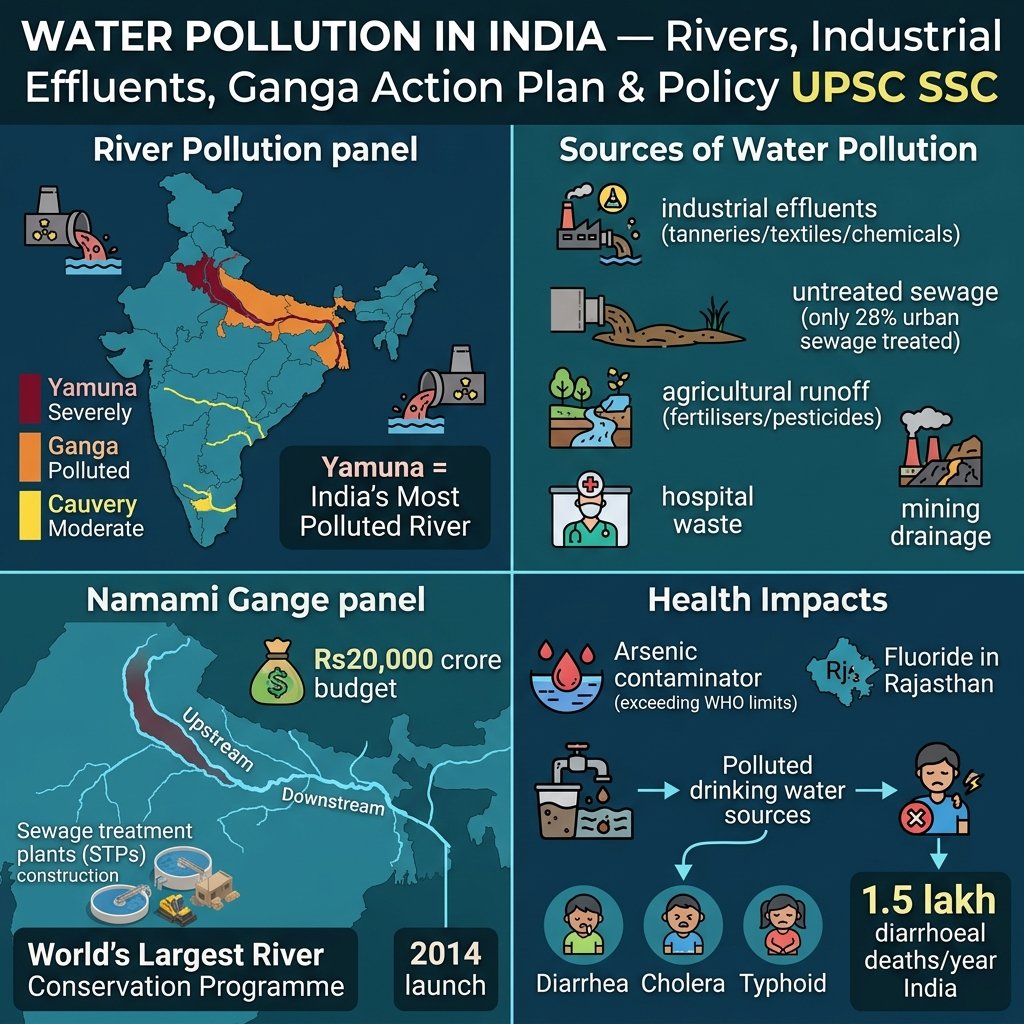
India is a water-rich country that is simultaneously experiencing a water crisis — and much of that crisis is self-inflicted through pollution. India receives approximately 4,000 billion cubic metres of precipitation annually, hosts 14 major river systems, and has the world’s largest groundwater extraction system. Yet 600 million Indians face high to extreme water stress (NITI Aayog, 2019), 163 million lack access to clean water near their homes (WaterAid, 2019), and an estimated 1.5 lakh people die annually from waterborne diseases — diarrhoea, cholera, typhoid, hepatitis A — directly linked to polluted water. The Yamuna River in Delhi carries nearly 58% of Delhi’s pollution load despite being only 2% of the Ganga’s total length. The Ganga — holiest river in Hinduism, drinking water source for 500 million people — carries the sewage of 118 towns and the effluents of thousands of industries along its 2,525 km journey. Understanding water pollution sources, river health data, groundwater contamination, and India’s policy frameworks (Namami Gange, Water Act 1974) is essential for UPSC, SSC, and all competitive examinations.
Key Water Pollution Parameters
| Parameter | What It Measures | Safe Limit | Indian River Context |
|---|---|---|---|
| BOD (Biochemical Oxygen Demand) | Oxygen consumed by microorganisms to decompose organic matter; high BOD = high organic pollution = low oxygen for fish | <3 mg/L for drinking; <6 mg/L for bathing; <2 mg/L for healthy aquatic life | Yamuna at Delhi: BOD 70–140 mg/L (20–40x safe limit); Ganga at Kanpur: 20–35 mg/L; Sabarmati at Ahmedabad: 55 mg/L |
| DO (Dissolved Oxygen) | Oxygen dissolved in water; fish need minimum 5 mg/L; <2 mg/L = “dead zone” where most aquatic life cannot survive | >6 mg/L for aquatic life; healthy rivers: 7–9 mg/L | Yamuna at Delhi reaches near-zero DO in summer; drain stretches are biologically dead; Cooum River Chennai = 0 DO in dry season |
| Coliform Count | Faecal coliforms (E. coli) = indicator of sewage contamination; 0 per 100 mL for drinking water; presence indicates pathogen risk | 0 per 100 mL (drinking); <500 per 100 mL (bathing) | Ganga at Varanasi ghats: 8,000–1,00,000 MPN/100 mL (CPCB data); should be under 500 for ritual bathing; effectively all major Indian rivers near urban centres fail |
| Heavy Metals (As, Pb, Cr, Hg, Cd) | Toxic metals from industrial effluents; bioaccumulate in food chain; cause cancer, neurological damage, kidney failure | Arsenic <0.01 mg/L; Lead <0.01 mg/L; Chromium <0.05 mg/L (WHO) | Arsenic: Bengal groundwater (23 districts above WHO limit); Lead: Kanpur leather tanneries in Ganga; Chromium: Vapi (Gujarat industrial zone) groundwater; Mercury: Kodaikanal thermometer factory (Tamil Nadu) |
| Nitrates / Phosphates | Agricultural runoff (fertilisers); cause eutrophication (algal blooms, oxygen depletion); excess nitrates in drinking water = methemoglobinaemia (“blue baby syndrome”) in infants | Nitrate <45 mg/L (India BIS); <50 mg/L (WHO) | Punjab-Haryana groundwater: widespread nitrate excess; Rajasthan rural wells: nitrate above 45 mg/L in many districts; Chilika Lake + Loktak outflows affected by agricultural nutrient runoff |
| Fluoride | Natural geological contamination (fluorite minerals) in groundwater; low = tooth decay; high = dental/skeletal fluorosis | 0.5–1.5 mg/L (BIS); >4 mg/L = skeletal fluorosis | Rajasthan, AP, Telangana, Karnataka groundwater: 2–20 mg/L fluoride; estimated 66 million people in India drink water with excess fluoride; Rajasthan has most severe skeletal fluorosis burden |
Sources of Water Pollution in India
- 🏭 Untreated Sewage (largest source): India generates ~72,368 million litres per day (MLD) of sewage; total sewage treatment capacity = ~26,869 MLD (37%); actual operational treatment = ~20,236 MLD (28% of generated); meaning 72% of India’s sewage enters rivers and waterbodies untreated (CPCB, 2021); 118 towns on Ganga banks alone discharge untreated sewage directly to river
- 🏭 Industrial Effluents: Major polluting industries: tanneries (Kanpur, Vellore — chromium, sulphides), textiles (Tiruppur, Surat — dyes, BOD), paper/pulp mills (bleaching chemicals, COD), thermal power plants (fly ash slurry, thermal pollution), electroplating (heavy metals), pharmaceuticals (active pharmaceutical ingredients / APIs entering water = emerging concern), sugar mills (high BOD); India has ~3.7 lakh industrial units discharging effluents; only ~60,000 have effluent treatment plants (ETPs); actual functioning ETPs lower
- 🌾 Agricultural Runoff: Excess fertiliser (urea, DAP) not absorbed by crops runs off into rivers and groundwater; pesticides (organochlorines, organophosphates) in runoff; animal waste from intensive livestock operations; irrigation return flows carrying salt and agricultural chemicals; Punjab + Haryana + Western UP = major agricultural runoff hotspots
- ⛏️ Mining Drainage: Acid Mine Drainage (AMD) from coal mines (Jharia, Raniganj) — sulphuric acid + heavy metals; iron ore mining in Odisha-Jharkhand sedimentation of rivers; sand mining from riverbeds disturbs sediment and increases turbidity; Jadugoda uranium mine (Jharkhand) — radiation contamination in nearby streams claimed by local communities, disputed by UCIL
- 🏥 Biomedical/Hospital Waste: Needles, blood, pathogens, pharmaceuticals; estimated 616 tonnes/day of biomedical waste in India (MoEFCC 2019); many smaller clinics discharge to municipal drains; hospital effluents = pharmaceutical residues + antibiotic-resistant bacteria entering rivers = Antimicrobial Resistance (AMR) spread through water
- 🕌 Religious/Cultural Practices: Idol immersion (Ganesh Chaturthi, Durga Puja) = plaster of paris (not biodegradable) + paint (heavy metals) in rivers and lakes; body/ash immersion in Ganga (ritual cremation, asthi visarjan); plastic offerings, floral waste at ghats; mass bathing events (Kumbh Mela) with inadequate sanitation = coliform spike; however, these are seasonal and volume-limited compared to year-round sewage
India’s Most Polluted Rivers
| River | Key Pollution Stretch | Primary Pollutants | Status |
|---|---|---|---|
| Yamuna | Delhi stretch (22 km, Wazirabad to Okhla) = 58% of Yamuna’s pollution load; 19 major drains discharge here from Delhi | Sewage (BOD 70–140 mg/L), ammonia, phosphates, heavy metals from Wazirabad industrial area; Yamuna literally “foams” at Kalindi Kunj from phosphates in detergents | India’s single most polluted river stretch despite Rs10,000+ crore spent on cleaning since 1993; Delhi’s 18 STPs nominally in place but many underperforming; Yamuna Action Plan I, II, III all partially failed; SC monitoring ongoing |
| Ganga | Kanpur (tannery stretch), Allahabad-Varanasi (sewage + ghats), Patna (urban sewage); multiple critical sections | Tannery chromium (Kanpur Jajmau = 400 tanneries historically), sewage, industrial effluents from Rishikesh-Haridwar pharma/chemical industries, thermal discharge, heavy metals | Namami Gange (2014, Rs20,000 crore budget); significant STP capacity added; some stretches show DO improvement; however Kanpur tannery stretch remains critically polluted; real-time biological oxygen monitoring at ghats |
| Sabarmati | Ahmedabad city stretch; receives 85% of city’s wastewater | Industrial dyes (Ahmedabad textile industry), sewage (BOD 55+ mg/L), heavy metals from electroplating; river effectively a wastewater canal through city centre | Sabarmati Riverfront Project (beautification) has banks developed as promenades but river itself still heavily polluted; some dry-season diversion (SSNNL water) gives visual improvement |
| Cooum (Chennai) | Entire urban stretch through Chennai city (12 km) | Sewage, industrial effluents, solid waste dumping; zero DO in dry season = biologically dead waterway; open sewer through city centre | Rs2,300 crore Clean Cooum project underway (2023–26); STP capacity expansion; encroachment removal on banks; progress slow |
| Mithi (Mumbai) | Urban stretch from Powai Lake to sea | Airport/ industrial effluents, Dharavi slum drainage, solid waste; 2005 Mumbai floods severely exposed Mithi’s encroachment/blockage problem | MMRDA Mithi River Development project; some encroachments cleared; improved but still significantly polluted |
| Damodar (WB/Jharkhand) | Coalfield stretch; Dhanbad-Asansol industrial zone | Coal mine drainage (acid, heavy metals), thermal power plant fly ash, industrial effluents = “Sorrow of Bengal” historically; dam system controls flooding but water quality remains poor | DVC (Damodar Valley Corporation) manages dams; pollution from upstream coal mining and downstream industries remains; CPCB monitoring |
Namami Gange Programme
- 🌊 Launch: 2014 (Modi government); declared Flagship Programme; budget = Rs 20,000 crore (2015–2021), further extended to Rs 22,500 crore (2021–26); world’s largest river rejuvenation programme
- 🌊 Five pillars (NMCG approach): (1) Sewage Treatment Infrastructure — 169 STPs totalling 4,978 MLD capacity sanctioned (as of 2024: 134 STPs completed = 4,015 MLD); (2) Industrial Effluent Treatment — 1,113 gross polluting industries identified on Ganga; 165 closed, 865 ETPs installed; (3) River Surface Cleaning — 11 Integrated Command and Control Centres (ICCC), 20 Ganga Prahari boats for real-time monitoring; (4) Biodiversity (Dolphin conservation — Gangetic River Dolphin recovery programme; Hilsa fish return monitoring); (5) Afforestation — 30,000 ha of plantation in Ganga basin
- 🌊 Progress (mixed results): CPCB 2019 data showed DO improvement to >5 mg/L at 27 of 36 monitoring locations; BOD <3 mg/L at 16 of 36 locations; coliform reduction at some Haridwar-Rishikesh stretches; however Kanpur, Allahabad-Varanasi, Patna stretches remain critically polluted; 30–40% of sanctioned STPs still under construction or underperforming
- 🌊 Key milestones: PM Modi announced in 2022 that Gangetic River Dolphin sightings have increased (140+ dolphins sighted in specific stretches); Haridwar ghat water quality improved for bathing; Uttarakhand High Court (2017) declared Ganga a “living entity” with legal rights (later stayed by Supreme Court); India-UK Joint Clean Ganga programme; real-time sensor network at 36 monitoring stations
- 🌊 Ganga Action Plans history: GAP-I (1986, Rs 462 crore, Rajiv Gandhi): 261 STPs including 35 on Ganga main stem; limited success — plants built but many failed without operational budgets. GAP-II (1993): extended to tributaries. National River Conservation Plan (NRCP, 1995): expanded to 31 rivers. All failed to achieve Ganga goals. Namami Gange learnt from failures: (1) paid operational costs (not just capital), (2) O&M contracts for 15 years with STP builders, (3) real-time monitoring with public disclosure, (4) district-level Ganga Committees for accountability
Groundwater Contamination in India
| Contaminant | Affected Areas | Health Impact | Scale |
|---|---|---|---|
| Arsenic | West Bengal (23 districts), Bihar (Bhojpur, Buxar, Bhagalpur), UP (eastern districts), Assam, Manipur — all in Ganga-Brahmaputra alluvial plains | Skin lesions, skin/internal cancers (bladder, lung, liver), neuropathy; “arsenicosis” = chronic arsenic poisoning syndrome; no safe low dose | ~3 crore people in WB alone drink arsenic-contaminated water above WHO limit (0.01 mg/L); natural geogenic source (arsenic in alluvial sediments oxidised as water table drops) |
| Fluoride | Rajasthan (most severe), AP, Telangana, Karnataka, Gujarat, UP, MP — igneous/metamorphic rock zones with fluorite minerals | Dental fluorosis (brown/pitted teeth); skeletal fluorosis (joint pain, bone deformity — crippling in severe cases); endemic in 20 states | ~6.6 crore people drink water with excess fluoride (BIS limit 1.5 mg/L); Rajasthan Nalgonda district historically most affected; defluoridation plants (Nalgonda technique) partially deployed |
| Nitrates | Punjab, Haryana, Rajasthan, Gujarat, Tamil Nadu — all intensive agriculture zones with heavy fertiliser use | Blue Baby Syndrome (methemoglobinaemia) in infants: nitrates convert haemoglobin to methemoglobin, reducing oxygen-carrying capacity; intestinal cancer links at chronic exposure | ~100 districts across India have nitrate above 45 mg/L in groundwater (CGWB); Punjab’s agricultural intensity drives highest contamination levels; reverse osmosis only practical treatment |
| Heavy Metals (Cr, Pb, Cd) | Industrial zones: Vapi (Gujarat = CPCB-listed “most polluted city 1997”), Ankleshwar (Gujarat), Bichhri (Rajasthan), Kanpur surroundings | Kanpur tannery chromium: kidney damage, cancer risk in communities; Rajasthan Bichhri case (1999 SC ruling) = landmark environmental order — industries held liable for contamination cleanup | Site-specific; extremely high concentrations in industrial zones; CPCB’s 113 “Critically Polluted Areas” list includes industrial zones with severe groundwater impact |
Legal Framework for Water Pollution Control
- ⚖️ Water (Prevention and Control of Pollution) Act, 1974: India’s primary water pollution legislation; establishes CPCB and SPCBs; requires consent to discharge effluents; sets standards for industrial and sewage discharge; penalty: 3 months–7 years imprisonment + fine; amended 1988 to include more powers for Board
- ⚖️ Environment Protection Act, 1986: Umbrella legislation; empowers Central Government to issue site-specific regulations; used to create Environmental Protection Zones (EPC); “Polluter Pays Principle” applied via this act in major court judgments
- ⚖️ Polluter Pays Principle: Established in Indian environmental law through Supreme Court judgments; Vellore Citizens Welfare Forum vs Union of India (1996) — tanneries of Vellore ordered to pay compensation for water pollution; S. Jagannath vs Union of India (1997) — shrimp aquaculture near coast regulated; Indian Council for Environment Legal Action vs Union of India (1996) — Bichhri village chemical industries ordered to pay Rs 37.385 crore cleanup costs
- ⚖️ CPCB’s Grossly Polluting Industries (GPI) list: Industries discharging significant pollutants to rivers classified as GPI; 17 categories (distilleries, sugar mills, tanneries, paper mills, thermal plants, electroplating etc.); real-time monitoring (online connector to CPCB servers) mandatory for GPI industries since 2018; shutdown powers if violations detected
- ⚖️ National Water Policy 2012: Prioritises water for drinking (first priority) over agriculture, industry; promotes pricing of water to curb waste; advocates watershed management; advocates reviving traditional water conservation systems (stepwells, talab, johad); not legally binding — a policy framework only
⭐ Important for Exams — Quick Revision
- 🔑 India = 72% sewage untreated; 72,368 MLD generated vs 20,236 MLD actually treated; 118 Ganga-bank towns discharge untreated sewage
- 🔑 BOD: High BOD = high organic pollution = low oxygen; Yamuna Delhi = 70–140 mg/L vs safe <3 mg/L; 20–40x over limit
- 🔑 DO (Dissolved Oxygen): <2 mg/L = dead zone for aquatic life; Yamuna Delhi reaches near-zero DO in summer
- 🔑 Yamuna Delhi stretch (22 km): = 58% of Yamuna’s total pollution load; 19 drains discharge here; foam at Kalindi Kunj = phosphate detergents
- 🔑 Kanpur tanneries: 400 leather tanneries; chromium discharge in Ganga; Jajmau stretch = most industrially polluted Ganga section
- 🔑 Namami Gange (2014): Rs 20,000 crore budget; 169 STPs sanctioned; 134 completed (4,015 MLD); world’s largest river rejuvenation programme
- 🔑 GAP-I (1986, Rajiv Gandhi, Rs 462 crore): Failed because operational costs not covered; Namami Gange learnt this lesson (15-year O&M contracts)
- 🔑 Arsenic: West Bengal (23 districts) = natural geogenic contamination in alluvial plains; ~3 crore people affected; WHO limit 0.01 mg/L
- 🔑 Fluoride: Rajasthan (most severe) + AP + Karnataka; ~6.6 crore people drink excess fluoride; skeletal fluorosis crippling in severe cases
- 🔑 Nitrates: Punjab-Haryana-Rajasthan agricultural zones; infant Blue Baby Syndrome; ~100 districts above BIS limit
- 🔑 Bichhri village case (1996, SC): Industries paid Rs 37 crore cleanup = Polluter Pays Principle landmark; Vapi Gujarat = “most polluted city” CPCB 1997
- 🔑 Water Act 1974: CPCB + SPCBs; consent to discharge; penalty up to 7 years imprisonment; amended 1988
- 🔑 GPI (Grossly Polluting Industries): 17 categories; real-time online monitoring to CPCB mandatory since 2018
- 🔑 Gangetic River Dolphin: National Aquatic Animal of India; indicator species for Ganga health; Namami Gange dolphin conservation; increased sightings 2022
- 🔑 Uttarakhand HC (2017): Declared Ganga a “living legal entity”; stayed by SC but landmark judicial activism
- 🔑 Antimicrobial Resistance (AMR): Hospital effluents with antibiotics + resistant bacteria entering rivers = global AMR spread from river systems in India (Hyderabad pharmaceutical waste in Musi River = global AMR hotspot, published in Nature 2010)
Frequently Asked Questions (FAQs)
1. Why is the Yamuna so polluted in Delhi despite decades of river cleaning plans?
The Yamuna’s pollution in Delhi is one of India’s most studied, most funded, and most spectacularly unsuccessful environmental management problems. Understanding why requires examining both the technical and political economy dimensions. The technical problem: Delhi generates approximately 3,800 million litres per day (MLD) of sewage. Delhi’s installed sewage treatment plant (STP) capacity is nominally ~3,600 MLD — apparently nearly sufficient. However, actual sewage treated effectively is only approximately 2,400 MLD for several reasons: (1) About 30–40% of Delhi’s sewage infrastructure consists of dilapidated lines from the 1960s–80s that leak, overflow, or are clogged; (2) 18 of Delhi’s drains (Najafgarh, Barapullah, Supplementary, Shahdara etc.) collect both sewage AND stormwater run-off; during monsoon, the combined volume overwhelms STPs which then bypass untreated sewage directly to the Yamuna; (3) Several STPs were built without adequate feeder sewerage networks — they sit underutilised because sewage from informal settlements never reaches them through proper sewer lines; (4) Power supply to STPs is intermittent — STPs running on diesel generators in power cuts = higher operating cost + less reliable treatment. The 22-km Delhi stretch alone — from Wazirabad barrage (where water is diverted for Delhi’s drinking supply, leaving minimal dilution flow in the river) to Okhla barrage — receives the combined discharge of 19 major drains carrying Delhi’s raw sewage, industrial effluents from Wazirabad industrial area, surface runoff, and dead animals and solid waste. There is almost no residual river flow in this stretch during non-monsoon months to dilute this load. The political economy problem: Yamuna cleaning has been planned and funded since 1993 (Yamuna Action Plan I, II with Japan’s JICA funding and its own Delhi/Centre budgets). Over Rs 10,000 crore has been spent. The Supreme Court has been monitoring Yamuna cleanup since 1994. The NGT has given repeated directions. The results remain poor because: (1) Responsibility is fragmented — Delhi Jal Board (water supply/sewage), Delhi government (drains), Central Government (National River Conservation Directorate), Haryana and UP (for upstream flow and pollution). No single authority owns the outcome; (2) The real-estate and construction lobby has repeatedly resisted full implementation of floodplain demarcation that would require removing encroachments from Yamuna’s floodplain — these encroachments include unauthorized colonies, sports facilities, and even legally constructed infrastructure that blocks the river’s natural flood path; (3) STPs require operational budgets for chemicals, power, and staff — these are chronically underfunded after the capital investment is made, leading to plants running at reduced capacity or stopping. The biological reality: Yamuna gathers sufficient dilution only during monsoon (July–September) when its BOD improves temporarily. Haridwar and Uttarakhand stretches (upstream) are relatively clean. The pollution accumulates entirely in the 22-km Delhi stretch and the subsequent UP stretch. The fish that once populated this stretch — Mahseer, Rohu, Catla — have been absent for 20+ years. The foam visible at Kalindi Kunj during festivals (especially Chhath Puja) — when lakhs of devotees wade into the Yamuna — is formed from phosphates in household detergents, which are not removed by biological STPs (conventional activated sludge treatment removes BOD and suspended solids but not phosphates).
2. What is the arsenic contamination crisis in Bengal — why is it happening and what is being done?
The arsenic contamination of groundwater in West Bengal and Bangladesh is described by epidemiologists as the largest mass poisoning in human history — affecting an estimated 50–70 million people across the Bengal delta (including Bangladesh) who regularly consume water with arsenic levels above WHO’s safe limit of 0.01 mg/L. India’s component alone includes 23 districts of West Bengal plus eastern districts of Bihar and UP along the Ganga-Brahmaputra alluvial plains. How it happened — the tragic irony: The arsenic crisis is a direct consequence of a successful public health intervention. In the 1960s–70s, diarrhoeal disease (cholera, typhoid) killed vast numbers of children in Bengal who drank polluted surface water from ponds and rivers. International organisations (UNICEF, WHO, Government of India) embarked on a massive programme to sink tube wells to pump groundwater — which was assumed to be clean because it did not contain the faecal bacteria of surface water. By the 1970s–80s, millions of tube wells had been installed across rural Bengal and Bangladesh. The tube wells indeed eliminated cholera and typhoid — a genuine life-saving achievement. But the groundwater they tapped was not clean — it contained naturally occurring arsenic. Arsenic exists in the alluvial sediments of the Gangetic-Brahmaputra delta in two forms: insoluble, bound to iron oxide minerals under oxidising conditions; and soluble, released from those minerals under the reducing conditions created when organic matter in sediments consumes oxygen. When the water table drops (due to intensive pumping), air enters the sediments, oxidising conditions change, and arsenic is released into dissolving groundwater. The precise geochemical mechanism is debated but the outcome is consistent: groundwater at 20–50m depth in Bengal’s alluvial plains contains arsenic at 100–400 µg/L — 10–40 times WHO’s safe limit of 10 µg/L. Health consequences: Arsenicosis follows a characteristic progression: after 5–10 years of exposure, skin lesions appear (melanosis — dark spots, and leucomelanosis — white spots); keratosis (rough skin, especially on palms and soles); and then, after 10–20 years, internal cancers (bladder, lung, skin, liver). The prevalence of arsenicosis in 12 worst-affected Bengal districts (Murshidabad, Malda, Nadia, Bardhaman, North 24 Parganas etc.) has been documented by the School of Tropical Medicine, Kolkata, and multiple international research consortia. Importantly, chronic low-dose arsenic exposure also impairs child cognitive development, reduces lung function, causes diabetes, and increases cardiovascular disease risk — effects that are less visible than skin lesions but affect many more people. What is being done: (1) Arsenic removal units (ARU) — ferric chloride/iron coagulation-based systems that precipitate arsenic; deployed at community tube wells; effective but require maintenance and chemical supply chains that often fail in rural areas; (2) Piped surface water supply (Jal Jeevan Mission) — the long-term solution is to supply treated surface water from non-contaminated sources rather than groundwater; West Bengal’s PHED (Public Health Engineering Department) is expanding piped water coverage under JJM; (3) Deep aquifer drilling (below 200m depth in clean aquifers) — effective in some locations but not universal; (4) Simple household filters (Zero-B, Grahlaxmi etc.) with iron-based media; slow adoption due to cost and awareness gaps. The arsenic crisis illustrates a broader lesson: environmental interventions can have unintended consequences that emerge only decades later; comprehensive hydrogeological assessment before any large-scale groundwater extraction programme is essential.
3. How did the Hyderabad pharmaceutical industry create a global antimicrobial resistance hotspot — and why does it matter for India?
In 2004, researchers from Uppsala University, Sweden, sampling effluent from a pharmaceutical manufacturing cluster in Patancheru, near Hyderabad, made a discovery that would trigger a decade of international alarm: the Musi River receiving industrial effluents from this cluster contained concentrations of ciprofloxacin (a broad-spectrum antibiotic) at 31 mg/L — roughly equal to half a standard therapeutic dose in every litre of river water. The Patancheru cluster (Jeedimetla, Bollaram, Pashamylaram industrial areas) contains hundreds of Active Pharmaceutical Ingredient (API) manufacturing units that together supply a significant fraction of the world’s generic antibiotics, antiretrovirals, and other medicines. Their effluent treatment plants remove BOD and suspended solids; they do not remove pharmaceutical residues. A 2010 paper in Nature Medicine found that the sediments of the Musi River near Hyderabad contained genes for resistance to last-resort antibiotics (New Delhi Metallo-beta-lactamase — NDM-1 — which confers resistance to carbapenems, the antibiotics of last resort for multi-drug-resistant infections, was found in large quantities in Hyderabad’s water supply and Musi River sediment). This finding established India’s pharmaceutical manufacturing cluster as a global hotspot for the evolution and spread of Antimicrobial Resistance (AMR) — a threat that WHO has described as “one of the biggest threats to global health, food security, and development.” Why this matters extraordinarily for India: India has the world’s highest burden of antimicrobial-resistant infections — approximately 58,000 neonatal deaths per year from antibiotic-resistant bacteria (ICMR data); India’s overall AMR mortality is estimated at 50,000–100,000 deaths per year (conservative estimate). India loses 13+ hours of antibiotic efficacy each year to resistance — meaning infections that were treatable in 2010 are becoming harder to treat in 2026. The pharmaceutical waste entering rivers is one of three drivers of India’s AMR crisis (the others being antibiotic over-prescription/self-medication in humans and prophylactic antibiotic use in poultry/livestock). Policy response: In 2019, India’s Ministry of Environment notified new effluent discharge standards for pharmaceutical industry including limits on specific antibiotic concentrations — but actual monitoring and enforcement of these limits requires sophisticated analytical equipment (liquid chromatography-mass spectrometry) that most SPCBs do not operationally deploy. The Bulk Drug Parks scheme (under PLI for pharmaceuticals) designs new industrial parks with centralised common effluent treatment systems (CETPs) that can include advanced treatment for pharmaceutical residues — but existing legacy clusters (Patancheru, Vapi, Baddi/Himachal Pradesh) remain problematic. International pressure has grown: European drug regulatory agencies (EMA) have begun requiring Environmental Risk Assessments (ERA) for generic medicines sourced from Indian manufacturers, which indirectly pressures Indian API manufacturers to improve effluent standards to maintain EU market access.
Related Geology Articles on StudyHub
- ➡️ Water Resources India — Rivers, Dams & Groundwater Systems
- ➡️ Air Pollution India — Parallel Environmental Crisis
- ➡️ Ecology — Nutrient Cycles & Water Quality Context
- ➡️ Agriculture India — Fertiliser Runoff & Water Quality
- ➡️ Natural Disasters — Floods & River System Vulnerability