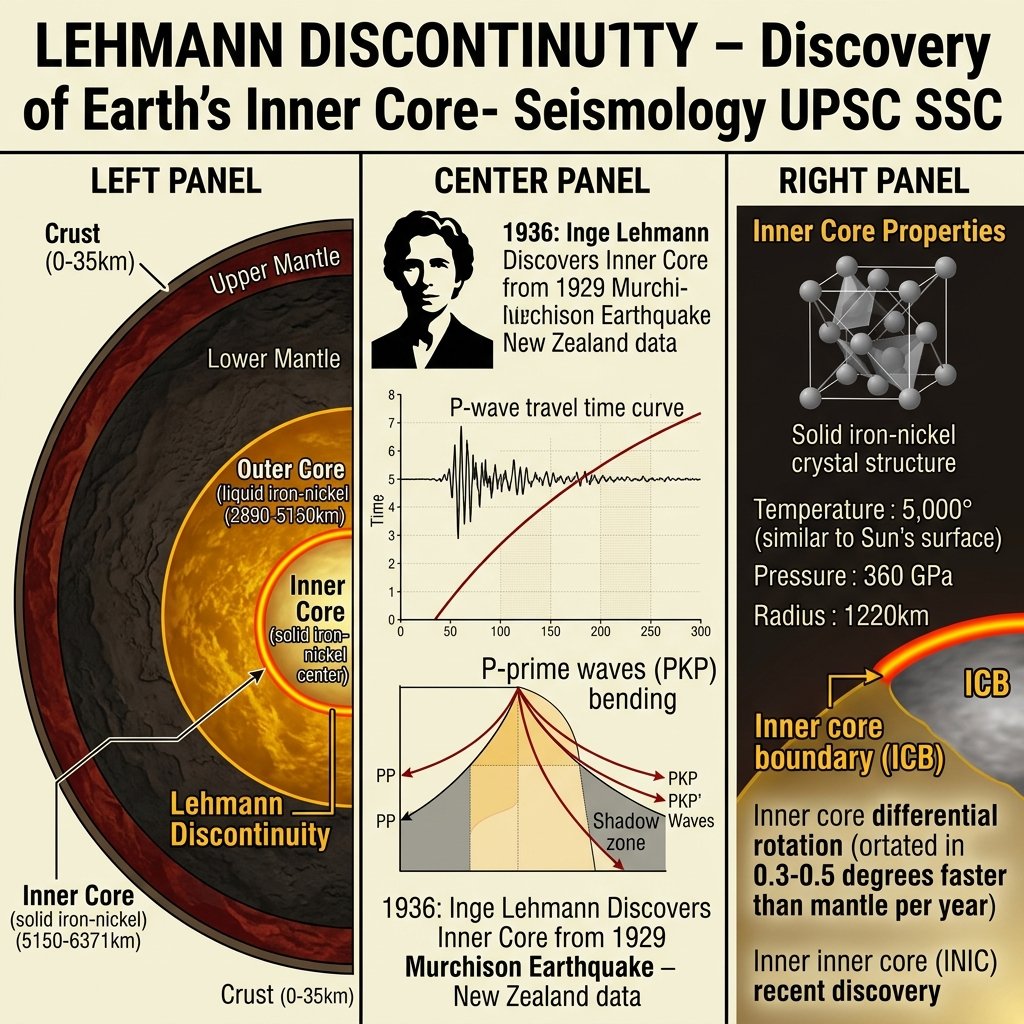
In 1936, a Danish seismologist named Inge Lehmann published a paper titled simply “P'” — and in doing so, changed humanity’s understanding of our own planet’s interior forever. By analysing the puzzling arrival of seismic waves from a 1929 New Zealand earthquake at stations throughout the world, Lehmann deduced that Earth must have a solid inner core inside its liquid outer core — separated by a boundary that now bears her name: the Lehmann Discontinuity, located approximately 5,150 km below Earth’s surface. This discovery was remarkable for two reasons: first, it was made entirely from mathematical analysis of seismograph data — Lehmann had never been anywhere near Earth’s interior; and second, it was made by a woman working in the 1930s, when female scientists rarely received institutional recognition. The Lehmann Discontinuity — the boundary between Earth’s liquid outer core and solid inner core — is one of the four major internal boundaries of Earth (with the Mohorovičić Discontinuity, Conrad Discontinuity, and Gutenberg Discontinuity) and is one of the most geologically significant features of our planet. Understanding what it is, how it was discovered, and what it tells us about Earth’s magnetic field and evolution is essential for UPSC, SSC, and competitive examinations in geology and physical geography.
Earth’s Internal Structure — The Four Major Layers
| Layer | Depth Range | Composition | State | Temperature |
|---|---|---|---|---|
| Crust | 0 to 5–70 km (oceanic 5–10 km; continental 30–70 km) | Oceanic: basalt (SIMA — Silicon + Magnesium); Continental: granite (SIAL — Silicon + Aluminium) | Solid | Surface ~15°C; base ~600–900°C |
| Mantle | 35 km to 2,890 km; divided into Upper (35–660 km) and Lower (660–2,890 km) | Silicate rocks rich in Fe, Mg, Ca, Al; peridotite, pyroxenite; Upper Mantle includes the partially molten Asthenosphere (100–350 km) | Solid (but plastic in Asthenosphere); convection currents drive plate tectonics | 660°C at top; ~3,700°C at base (CMB) |
| Outer Core | 2,890 km to 5,150 km; thickness 2,260 km | Liquid iron and nickel (Fe-Ni) alloy; contains 5–10% lighter elements (sulphur, oxygen, carbon, silicon); density ~10,000–12,000 kg/m³ | Liquid — S-waves cannot pass through; this was proven by Richard Oldham (1906) and confirmed by Harold Jeffreys (1926); the liquid outer core is why Earth has a Gutenberg Discontinuity | ~3,700°C at top to ~5,000°C at inner core boundary (ICB) |
| Inner Core | 5,150 km to 6,371 km (Earth’s centre); radius = 1,220 km; approximately the size of the Moon (Moon radius = 1,737 km) | Solid iron-nickel alloy; predominantly face-centred cubic (FCC) or hexagonally close-packed (HCP) iron crystal structure; likely contains some nickel and lighter elements; density ~12,000–13,000 kg/m³ | Solid despite extremely high temperature — because of enormous confining pressure (360 GPa = 3.6 million atmospheres); the Lehmann Discontinuity marks the outer boundary of the inner core | ~5,000°C (comparable to surface temperature of the Sun) |
The Four Major Discontinuities of Earth
| Discontinuity | Depth | Boundary Between | Discovery / Evidence |
|---|---|---|---|
| Conrad Discontinuity | ~15–20 km (within continental crust) | Upper crust (granitic SIAL) and Lower crust (basaltic SIMA) | V. Conrad 1925; identified from P-wave velocity change; not universally present — absent in oceanic crust and some continental regions |
| Mohorovicic Discontinuity (Moho) | ~35 km (continental); ~5–10 km (oceanic) | Crust and Mantle | Andrija Mohorovicic 1909 (Croatia); from Kupa Valley earthquake 1909; P-wave velocity jumps from ~6.5 km/s to ~8 km/s at Moho; most clearly defined internal Earth boundary |
| Gutenberg Discontinuity (CMB) | ~2,890 km | Mantle and Outer Core (Core-Mantle Boundary) | Beno Gutenberg 1914; S-waves disappear (cannot travel through liquid outer core); P-waves refract sharply; creates seismic shadow zone (103°–143° from epicentre); most dramatic change in Earth’s interior |
| Lehmann Discontinuity (ICB) | ~5,150 km | Outer Core (liquid) and Inner Core (solid) — Inner Core Boundary (ICB) | Inge Lehmann 1936; explained unexpected P-wave arrivals in shadow zone by proposing a solid inner core that refracts P-waves; confirmed by multiple subsequent studies; also sometimes the name “Lehmann Discontinuity” is used for a shallower boundary at ~220 km depth in the upper mantle (see below) |
The Discovery — Inge Lehmann’s Scientific Detective Work
- 🔬 The puzzle: When seismologists in the early 20th century mapped where earthquake waves arrived around the globe, they noticed a puzzling “seismic shadow zone” between approximately 103° and 143° angular distance from an earthquake’s epicentre (angular distance measured as arc angle from Earth’s centre); in this zone, no direct P-waves or S-waves should arrive — according to the then-prevailing two-layer Earth model (mantle + liquid core). S-waves didn’t arrive there at all (confirming the liquid outer core), but weak P-wave arrivals were detected in the shadow zone — arriving too late and too weak to be direct P-waves, but present nonetheless
- 🔬 Harold Jeffreys vs Inge Lehmann: British geophysicist Harold Jeffreys (who had confirmed the liquid outer core in 1926) initially dismissed these weak P-wave arrivals in the shadow zone as observational error or scattering. Inge Lehmann, working as a seismologist at the Danish Geodetic Institute in Copenhagen, was less dismissive. She worked meticulously with data from seismograph stations across Europe and North America, particularly revisiting data from the Murchison Earthquake (New Zealand, June 16, 1929, Mw 7.8) — which produced clear seismograph records at stations in Europe at precisely the angular distances where the shadow zone anomalies were strongest
- 🔬 Lehmann’s model (1936): After careful ray-tracing calculations (done by hand — no computers existed), Lehmann proposed a radical solution: Earth has not one but two core regions — an outer liquid core (as Gutenberg had identified) AND a distinct solid inner core at a radius of approximately 1,220 km (depth 5,150 km from surface). Seismic P-waves that penetrate to the outer-inner core boundary would partially refract (bend) at this interface and re-emerge into the shadow zone — arriving as the “anomalous” P-wave signals. She published this as a single-page paper titled simply “P'” (P-prime = the notation for seismic P-waves that have passed through the outer core) in a Danish seismological journal in 1936
- 🔬 Confirmation and legacy: Lehmann’s model was gradually accepted as better seismograph data from more earthquakes confirmed the inner core’s P-wave velocity signature; by the 1970s–80s, the inner core was established geological fact. Lehmann continued working in seismology until her death at age 104 (1888–1993); she received the William Bowie Medal (highest geophysics honour) in 1971; an asteroid (5632 Ingelehmann) is named after her
The Inner Core — Properties & Scientific Significance
- 🌍 Why solid despite extreme heat: The inner core’s temperature (~5,000°C) is similar to the Sun’s photosphere and vastly exceeds iron’s melting point at surface pressure (~1,538°C). Normally this would mean liquid — but the inner core is solid because of the enormously high pressure (approximately 360 GPa = 360 billion Pascals = 3.6 million times atmospheric pressure at Earth’s surface) that compresses iron atoms so tightly that the solid crystalline phase is thermodynamically more stable than liquid, even at these temperatures. This is the concept of pressure-induced solidification — same principle that makes ice harder to melt under very high pressure
- 🌍 Inner core crystal structure: The inner core is not simple amorphous solid iron — it has a distinct crystal fabric (anisotropy): seismic waves travel faster along the north-south polar axis than the equatorial plane; this anisotropy suggests the iron crystals are preferentially aligned parallel to Earth’s rotation axis; the mechanism is unclear — proposed explanations include crystallisation from the outer core (slowest crystallisation direction becomes polar aligned), magnetic field forcing, or differential rotation
- 🌍 Inner core differential rotation: Multiple studies suggest the inner core rotates slightly faster than Earth’s mantle and crust — by approximately 0.3° to 0.5° per year (some recent studies in 2023 suggested the differential rotation may have paused or reversed temporarily); this differential rotation contributes to the dynamics of the geodynamo (Earth’s magnetic field generator in the outer core)
- 🌍 Inner inner core (INIC): Recent seismological studies (2010s–2020s) suggest the innermost ~600 km of the inner core (sometimes called the “inner inner core” or INIC) may have a different crystal structure (possibly body-centred cubic iron rather than hexagonally close-packed) and different seismic wave velocity anisotropy direction; this remains scientifically debated but has been published in peer-reviewed journals
- 🌍 Geodynamo link: The inner core’s solidification from the liquid outer core as Earth slowly cools over geological time releases latent heat (heat of crystallisation) and buoyancy-driven compositional convection (lighter elements expelled as Fe-Ni solidifies into the inner core rise through the outer core, driving vigorous convection); this convection of electrically conducting liquid iron in Earth’s magnetic field generates Earth’s magnetic field by dynamo action — this is the geodynamo. Without the inner core solidification process, Earth’s geodynamo would be significantly weaker or non-existent, Earth’s magnetic field would decline, and cosmic radiation (normally deflected by the magnetosphere) would bombard Earth’s surface — threatening life as we know it
The “Other” Lehmann Discontinuity — At 220 km Depth
- ⚠️ Naming confusion: In some seismological literature (and in some NCERT/UPSC contexts), the name “Lehmann Discontinuity” refers to a different boundary — a shallow upper mantle seismic discontinuity at approximately 190–220 km depth, also identified by Inge Lehmann (in 1959); this shallower discontinuity is within the upper mantle, below the asthenosphere (low velocity zone); it marks a boundary where seismic wave velocities increase with depth (the low velocity zone of the asthenosphere ends and velocities return to normal upper mantle values)
- ⚠️ Exam clarity: For UPSC, SSC, and most competitive examinations: when “Lehmann Discontinuity” is discussed in the context of Earth’s interior layers and the core — it refers to the 5,150 km depth Inner Core Boundary (ICB); when discussed in the context of mantle layers and asthenosphere — it may refer to the 220 km depth upper mantle discontinuity; the specific NCERT Class 11 Geography text uses “Lehmann Discontinuity” for the inner core boundary; both are real boundaries identified by Inge Lehmann
⭐ Important for Exams — Quick Revision
- 🔑 Lehmann Discontinuity: Boundary between liquid outer core and solid inner core; depth = ~5,150 km; discovered by Inge Lehmann (Denmark) in 1936; Inner Core Boundary (ICB)
- 🔑 Inge Lehmann (1888–1993): Danish seismologist; “P'” paper 1936; worked at Danish Geodetic Institute; William Bowie Medal 1971; lived to 104; asteroid 5632 Ingelehmann named after her
- 🔑 Key evidence: Anomalous P-wave arrivals in the seismic shadow zone (103°–143°); 1929 Murchison Earthquake (New Zealand) data was key; P-waves refracting at ICB re-emerge in shadow zone
- 🔑 Seismic shadow zone: 103°–143° from epicentre; no direct P-waves or S-waves; S-waves prove liquid outer core; anomalous P-waves in shadow zone prove solid inner core
- 🔑 Inner core properties: Radius 1,220 km (about size of Moon); depth 5,150–6,371 km; solid Fe-Ni; temperature ~5,000°C; pressure 360 GPa; seismic anisotropy (N-S faster); differential rotation (0.3–0.5° faster/year)
- 🔑 Why solid at 5,000°C: Pressure-induced solidification; 360 GPa pressure stabilises solid phase despite temperatures above iron’s surface-pressure melting point (1,538°C)
- 🔑 4 discontinuities in order from surface: Conrad (~20 km, within continental crust) → Moho (~35 km, crust-mantle) → Gutenberg (2,890 km, Core-Mantle Boundary) → Lehmann (5,150 km, ICB)
- 🔑 Conrad Discontinuity: V. Conrad 1925; ~15–20 km; upper (granitic) to lower (basaltic) crust; not universally present
- 🔑 Mohorovicic Discontinuity (Moho): Andrija Mohorovicic 1909; Croatia; Kupa Valley earthquake 1909; P-wave velocity jumps 6.5→8 km/s; crust-mantle boundary
- 🔑 Gutenberg Discontinuity (CMB): Beno Gutenberg 1914; 2,890 km; mantle-outer core boundary; S-waves stop; creates shadow zone 103–143°
- 🔑 Inner core geodynamo link: Inner core solidification releases latent heat + lighter elements → drives outer core convection → generates Earth’s magnetic field (geodynamo); without inner core, magnetic field weakens → cosmic radiation reaches surface
- 🔑 Outer core: Liquid Fe-Ni; 2,890–5,150 km; S-waves cannot pass; generates geodynamo; Richard Oldham (1906) first proposed liquid core from S-wave data; Harold Jeffreys (1926) confirmed
- 🔑 NCERT context: NCERT Class 11 Geography Book 1 (Fundamentals of Physical Geography) Chapter 3 covers Earth’s interior layers and discontinuities; uses Lehmann Discontinuity for ICB
- 🔑 Inner inner core (INIC): Innermost ~600 km may have different crystal structure; recent seismological research 2010s-2020s; scientifically debated
- 🔑 Geothermal gradient: Earth’s temperature increases with depth; average 25–30°C per km in crust; steeper near hot spots; Moho temperature ~600–900°C; CMB temperature ~3,700°C; inner core centre ~5,000°C
Frequently Asked Questions (FAQs)
1. How do we know Earth has a solid inner core — if no one has ever been there?
The deepest hole humans have ever drilled — the Kola Superdeep Borehole in Russia — penetrated only 12.26 km into Earth’s crust. Earth’s inner core begins at 5,150 km depth — over 400 times deeper than the Kola borehole. No drill, no probe, no instrument has ever physically entered Earth’s mantle, let alone the core. Yet seismologists know the inner core is solid with high confidence. How? The answer is seismic tomography — the science of using earthquake waves as natural probes to image Earth’s interior, much as a CT scanner uses X-rays to image the interior of a human body. When an earthquake occurs anywhere on Earth, it sends seismic waves radiating in all directions through Earth’s interior. These waves travel at different speeds through different materials (just as sound travels at different speeds through air, water, and steel), and they bend (refract) as they pass through material of changing density (just as light bends when it passes from air to water). Seismographs — instruments that measure the tiny ground movements caused by earthquake waves — are positioned all around Earth’s surface. By recording exactly which waves arrive at each station, when they arrive relative to the earthquake origin time, and at what amplitude, seismologists can mathematically reconstruct the properties of the material the waves passed through — including its density, rigidity (resistance to shearing), and physical state (solid vs liquid). The smoking gun for the solid inner core: Two types of seismic body waves are key: P-waves (Primary or Pressure waves) = compression waves that can travel through any material (solid, liquid, gas); they are analogous to sound waves. S-waves (Secondary or Shear waves) = shear waves that can only travel through solid material — they cannot propagate through liquid, because liquid has no resistance to shearing forces. When the great 1929 Murchison Earthquake (New Zealand, Mw 7.8) produced seismic waves that propagated around the globe, seismologists at stations in Europe noted: (1) S-waves stopped at approximately 103° angular distance from the epicentre — confirming the liquid outer core (Gutenberg had already determined this); (2) P-waves also mostly disappeared in the “shadow zone” between 103° and 143°, as expected from the liquid outer core refracting them away; (3) BUT — Inge Lehmann noticed that some seismograph stations in the shadow zone were recording weak but real P-wave arrivals that arrived too late to be surface-reflected waves and too early to be other known wave paths. Lehmann calculated that if Earth had a separate, denser and faster-velocity solid core inside the liquid outer core, P-waves hitting the boundary between the two core layers (the ICB) would partially reflect back into the outer core and refract into the shadow zone — arriving exactly when and where the anomalous signals were detected. She also calculated the radius of this inner core (approximately 1,220 km) from the travel time data. Since 1936, multiple additional lines of evidence have confirmed the inner core’s existence and solidity: (1) PKiKP waves: P-waves that reflect off the inner core boundary and return to the surface — their reflection coefficient matches a solid-liquid interface; (2) PKP wave splitting: P-waves that penetrate the inner core directly (PKIKP = P through outer core, inner core, and outer core back) travel at detectably different speeds along the polar axis vs the equatorial plane — proving crystal anisotropy in a solid material (liquids are isotropic); (3) Free oscillations (Earth’s normal modes): After the largest earthquakes (magnitude 9+), Earth “rings” like a bell for days in extremely low frequency oscillations; the frequencies of these oscillations are sensitive to the mechanical properties throughout Earth’s interior; the observed frequencies match models with a solid inner core and do not match models without one; (4) Inner core boundary reflection coefficient: The percentage of seismic energy that reflects off a boundary depends on the impedance contrast (velocity × density change) across the boundary; measured reflection coefficients at the ICB match the expected contrast between liquid iron and solid iron. The convergence of all these independent lines of evidence — none of which requires physically drilling to the core — gives seismologists complete scientific confidence that Earth’s inner core is solid. This is the power of indirect observation in Earth science.
2. Why does the solid inner core matter — what does it have to do with life on Earth?
At first glance, a solid ball of iron 5,150 km below Earth’s surface seems utterly irrelevant to biology and civilisation. In reality, the inner core’s existence and its ongoing solidification process may be one of the most important factors in making Earth habitable — and understanding this connection requires tracing the chain of causation from the inner core to Earth’s magnetic field to the survival of life. The geodynamo mechanism: Earth’s magnetic field — the magnetosphere that extends tens of thousands of kilometres into space and deflects the solar wind (the constant stream of high-energy charged particles flowing outward from the Sun at 400–800 km/s) — is generated in the liquid outer core by a process called the geodynamo. The basic principle: the liquid outer core is an electrically conducting fluid (molten iron). When this conducting fluid moves, it generates electric currents (Faraday’s law of electromagnetic induction). These electric currents generate magnetic fields. The magnetic fields in turn exert forces on the moving conducting fluid, affecting how it moves. The result is a self-sustaining electromagnetic dynamo — provided there is sufficient fluid motion to maintain the process against ohmic (resistive) losses. What drives outer core convection: Two heat sources drive convection in the liquid outer core: (1) Secular cooling — Earth as a whole is slowly losing heat left over from its formation 4.56 billion years ago; as the outer core cools from below (the inner core) and loses heat through the mantle above, temperature differences drive thermal convection; (2) Compositional convection from inner core solidification — as the inner core slowly grows by solidifying from the surrounding liquid outer core, the iron and nickel preferentially enter the solid crystal structure at the ICB, leaving behind lighter elements (sulphur, oxygen, silicon, carbon) which are less soluble in solid iron. These light elements create compositionally buoyant “blobs” that rise vigorously through the outer core — driving compositional convection that is even more energetically powerful than thermal convection alone. This compositional convection is directly driven by the inner core’s existence and growth. If there were no inner core (or inner core solidification had not yet begun), Earth’s outer core convection and therefore its geodynamo would be significantly weaker. The magnetic field’s role in habitability: Earth’s magnetic field (magnetosphere) performs a crucial shielding function: it deflects most of the solar wind’s charged particles (mostly protons and electrons) around Earth rather than allowing them to hit the atmosphere directly. Without this shielding: (a) solar wind gradually strips atmospheric molecules away (this is what happened to Mars — Mars has no magnetosphere because its core solidified and geodynamo died ~4 billion years ago; Mars has lost nearly all its atmosphere to solar wind erosion over geological time, leaving its surface with 1% of Earth’s atmospheric pressure and no liquid water); (b) ionising radiation from solar particle events (solar flares, coronal mass ejections) would reach Earth’s surface directly; over geological time, high-level radiation would cause DNA damage rates incompatible with complex life; (c) the ozone layer (itself critical for blocking UV radiation) is maintained partly by the magnetosphere protecting the upper atmosphere from ion chemistry changes caused by charged particle bombardment. The inner core’s age and Earth’s magnetic field history: The inner core is geologically young — it is estimated to have begun solidifying approximately 0.5 to 1.5 billion years ago (geoscientific debate continues on the exact timing). Before the inner core began solidifying, Earth still had a magnetosphere (geologic record shows continuous magnetic field for at least 3.5 billion years), but the geodynamo was powered solely by thermal convection, which is less robust. The initiation of inner core solidification introduced the powerful compositional convection component, potentially stabilising and strengthening the geodynamo. Geomagnetic reversals (when the magnetic north and south poles flip — which has happened roughly 170 times in the last 100 million years, most recently about 780,000 years ago in the Brunhes-Matuyama reversal) are caused by the geodynamo’s self-sustaining dynamics becoming temporarily unstable — not by any pause in inner core solidification, which is a continuous, slow process. During geomagnetic reversals (which take thousands to tens of thousands of years to complete), the magnetic field’s strength drops to 10–25% of its normal value, and cosmic radiation reaching Earth’s surface increases accordingly — some scientists have linked reversal periods to enhanced biological extinctions and evolutionary pressures, though this remains scientifically debated. The bottom line: the Lehmann Discontinuity — the surface of the inner core — is not merely an interesting seismological curiosity. It marks the interface where Earth’s ongoing solidification process generates the compositional buoyancy that drives the geodynamo, which generates the magnetosphere, which makes Earth habitable for complex life.
3. What is the “seismic shadow zone” — and why did it lead to the discovery of Earth’s core structure?
The seismic shadow zone is a region on Earth’s surface where direct earthquake waves do not arrive after a major seismic event — a “deaf spot” in the global seismograph network that was the primary observational puzzle that revealed Earth’s deep internal structure, layer by layer, between 1906 and 1936. Understanding the shadow zone requires first understanding how seismic waves travel through Earth. When an earthquake occurs, it releases energy as seismic waves that radiate outward from the focus in all directions. Body waves (waves that travel through Earth’s interior) follow curved (not straight) paths through Earth because Earth’s density and seismic wave velocity increase with depth — and waves refract (bend) toward lower velocity regions, just as light bends toward denser media. This continuous bending of seismic waves in the deep Earth curves them back toward the surface in an arc pattern. For any earthquake, there are three detectable zones on Earth’s surface: (1) Zone of direct P and S waves (0°–103° from epicentre): both P-waves and S-waves arrive on direct curved paths; stations in this zone feel both types of body waves; (2) Seismic shadow zone (approximately 103°–143° from epicentre): neither direct P-waves nor S-waves arrive; this is the zone where Earth’s core “shadows” the earthquake waves; (3) Zone of refracted P-waves only (143°–180° from epicentre): P-waves that have passed all the way through Earth’s liquid outer core (being refracted by it) re-emerge on the far side of Earth and can be detected; S-waves never arrive in this zone because S-waves cannot travel through the liquid outer core. Why does the shadow zone form: The liquid outer core has dramatically lower P-wave velocity than the mantle (P-velocity drops from ~13.7 km/s at the base of the mantle to ~8 km/s at the top of the outer core at the Gutenberg Discontinuity). This sudden velocity drop causes extreme refraction (bending) of P-waves entering the core — they bend so sharply into the outer core that they emerge on the far side of Earth at angular distances greater than 143°, leaving a “gap” (the shadow zone) between 103° and 143°. S-waves cannot enter the liquid outer core at all (no shear propagation in liquid) so they create their own complete (not partial) shadow on the entire far side of Earth beyond 103°. Richard Oldham’s contribution (1906): Irish seismologist Richard Dixon Oldham first formally proposed in 1906 that Earth has a distinct core (based on anomalous P-wave travel times at large angular distances) — but he thought the core was smaller than it actually is and his model was imprecise. Beno Gutenberg’s refinement (1914): German-American seismologist Beno Gutenberg used more precise travel time data to determine the core-mantle boundary at approximately 2,900 km depth (now known to be 2,890 km) and confirmed that P-waves entering the core are dramatically refracted, explaining the shadow zone boundaries; he also confirmed (with Harold Jeffreys in 1926) that the outer core is liquid by demonstrating that S-waves cannot pass through it. Inge Lehmann’s refinement (1936): The shadow zone was supposed to be “deaf” — but it wasn’t completely. Seismograph stations in the shadow zone were sometimes recording weak but real P-wave signals. These were initially dismissed as instrument anomalies or surface-reflected waves. Lehmann proved they were caused by refraction at a distinct solid inner core inside the liquid outer core — P-waves entering the outer core and then hitting the ICB (Inner Core Boundary) at 5,150 km depth were partially refracted into the solid inner core and back out, emerging in the shadow zone as PKIKP waves (P through outer core K, inner core I, outer core K, to the far surface). The time delay of these PKIKP arrivals in the shadow zone precisely matched Lehmann’s inner core model. The shadow zone thus went from being merely an unexplained “deaf spot” to being the observational key that revealed not just one but two internal boundaries of Earth’s core — the Gutenberg Discontinuity (outer core surface) and the Lehmann Discontinuity (inner core surface) — entirely from the surface, using natural earthquakes as probes.
Related Geology Articles on StudyHub
- ➡️ Seismic Zones of India — Earthquake Risk & Zone Maps
- ➡️ Earthquakes — Types, Focus, Epicentre & Seismic Waves
- ➡️ Earth’s Structure — Crust, Mantle, Outer & Inner Core
- ➡️ Plate Tectonics — How Plates Move & Why
- ➡️ Volcanoes — Inner Earth Heat at the Surface