Earth is wrapped in an invisible magnetic shield that extends tens of thousands of kilometres into space, deflecting deadly charged particles from the Sun that would otherwise strip our atmosphere bare and bombard our DNA with ionising radiation. This magnetosphere — generated deep within Earth by the motion of liquid iron in the outer core — is one of the primary reasons complex life exists on our planet. The geophysical process that generates it, called the geodynamo, is among the most mathematically complex self-sustaining systems in nature: a swirling sea of electrically conducting molten iron, 2,260 km thick, rotating with Earth, influenced by the Coriolis effect, convecting due to both thermal and compositional buoyancy, generating an intrinsically unstable magnetic field that periodically — and unpredictably — reverses its polarity. The study of past magnetic field directions recorded in ancient rocks (palaeomagnetism) has provided crucial evidence for both continental drift and sea floor spreading, making Earth’s magnetic field history fundamental to our understanding of plate tectonics. Understanding Earth’s magnetic field — its structure, generation, periodic reversals, and effects on navigation, satellites, and life — is essential for UPSC, SSC, and all competitive examinations in physical geography and Earth science.
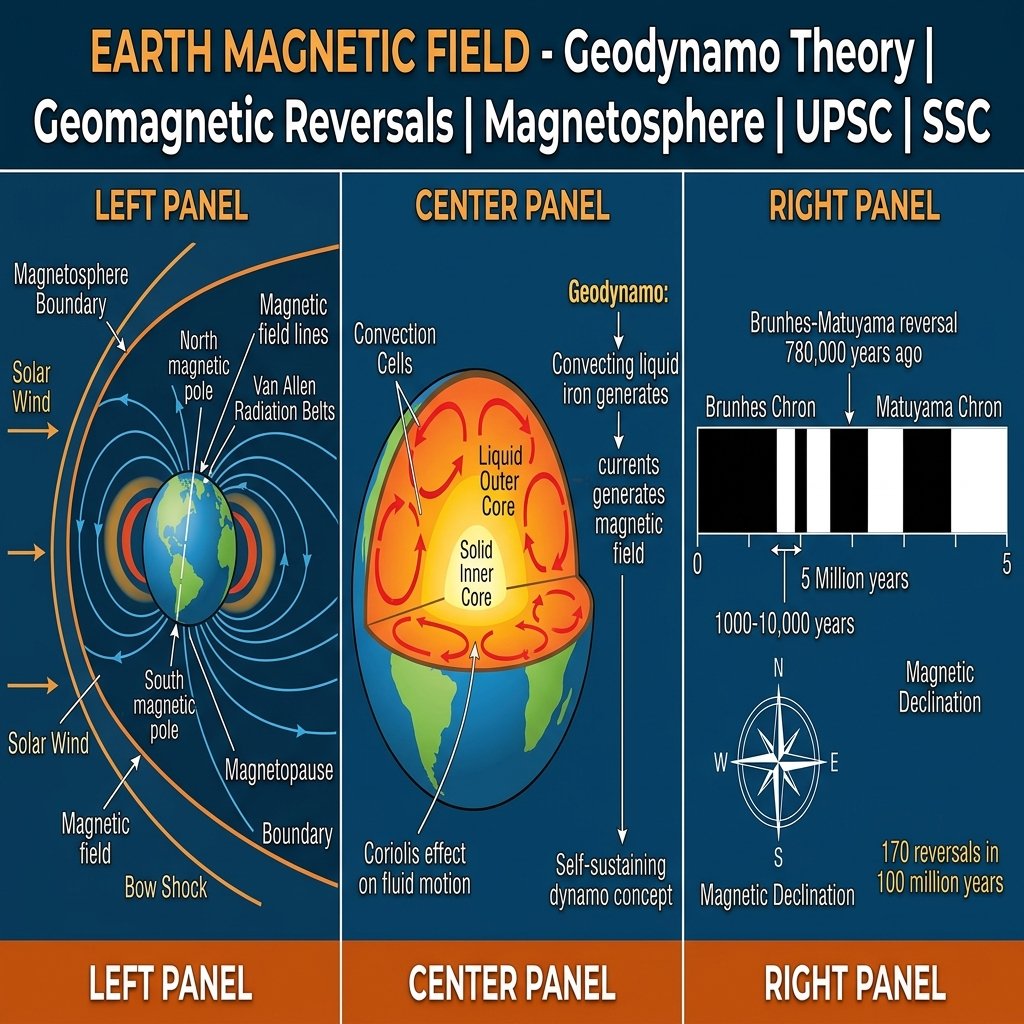
Earth’s Magnetic Field — Structure & Properties
- 🧲 What is Earth’s magnetic field: A dipole magnetic field generated in Earth’s outer core; resembles the field of a bar magnet tilted approximately 11° from Earth’s rotation axis; the magnetic north pole (where compass needles point) is actually a geographic south magnetic pole by convention — it attracts compass north-seeking poles; magnetic north pole in 2026 is located in the Canadian Arctic/Siberia region, having drifted from Canada towards Russia at ~55 km/year since 1990s
- 🧲 Magnetic elements: (1) Magnetic declination = angle between geographic North and magnetic North at any location; varies from -180° to +180°; must be corrected in navigation (compasses point to magnetic north, not true north); declination in Mumbai ~0°, Delhi ~0.5°W, varies significantly across India; (2) Magnetic inclination (dip) = angle of magnetic field lines with horizontal; 0° at magnetic equator; 90° at magnetic poles; (3) Magnetic intensity (F) = total strength of field; approximately 25–65 microtesla (µT) globally; strongest at poles (~65 µT); weakest at South Atlantic Anomaly (~22 µT)
- 🧲 Field strength variability: Earth’s magnetic field is not uniform; the South Atlantic Anomaly (SAA) = a region off the coast of Brazil where the field is anomalously weak (~22 µT vs global average ~45 µT) and extends from South America to southwest Africa; SAA causes satellite and spacecraft electronics to experience higher radiation exposure (more cosmic rays penetrate the thin field); the International Space Station transits the SAA several times per day, requiring spacecraft hardening and operational precautions
- 🧲 Dipole vs non-dipole components: Earth’s field is not a perfect dipole; approximately 90% is dipole; the remaining 10% is multipole (quadrupole, octupole etc.) and non-dipole; the non-dipole components cause complex regional patterns in declination and inclination; the dipole component has been weakening at ~5% per century for the past 170 years (first measured quantitatively by Carl Friedrich Gauss in the 1830s); this secular variation is natural geodynamo behaviour, not necessarily a reversal precursor
The Magnetosphere — Earth’s Protective Shield
| Region / Feature | Details |
|---|---|
| Magnetosphere | The region around Earth where Earth’s magnetic field dominates over the solar wind’s magnetic field; extends 6–10 Earth radii (RE) on the sunward side; stretched to 100–200 RE on the night side (magnetotail) by solar wind pressure |
| Bow Shock | The outermost boundary where the supersonic solar wind (400–800 km/s) is suddenly slowed to subsonic speeds by Earth’s magnetic field; located ~14 RE from Earth on the sunward side; analogous to the bow wave of a ship |
| Magnetopause | The true boundary between the magnetosphere and the solar wind plasma; pressure balance boundary between solar wind dynamic pressure and Earth’s magnetic pressure; can be compressed to ~6 RE during strong solar storms; ISRO’s Mars Orbiter Mission measured Mars’s equivalent (Mini-Magnetosphere) |
| Van Allen Radiation Belts | Two doughnut-shaped regions of energetic charged particles (protons + electrons) trapped by Earth’s magnetic field; Inner Belt (1,000–6,000 km altitude): mostly energetic protons; Outer Belt (13,000–60,000 km): mostly energetic electrons; discovered by James Van Allen using data from Explorer 1 satellite (1958); belts damage satellites and endanger astronauts; a third temporary belt was detected by NASA’s Van Allen Probes in 2013 |
| Magnetotail | The night-side extension of the magnetosphere, stretched by solar wind to 100–200 RE; contains the plasma sheet; magnetic reconnection events in the magnetotail cause magnetospheric substorms = sudden releases of energy into the ionosphere = cause of auroras |
| Aurora Borealis/Australis | Visible light phenomena caused by charged particles from solar wind entering the atmosphere along magnetic field lines at polar regions; particle collisions with oxygen (green, red) and nitrogen (blue, purple) molecules emit light; auroras occur in oval rings around magnetic poles; visible from Ladakh and high-altitude Indian locations during strong geomagnetic storms |
Geodynamo Theory — How Earth Generates Its Magnetic Field
- ⚡ The fundamental problem: Earth’s core temperature (3,700–5,000°C) is far above the Curie temperature of iron (~770°C) — the temperature above which iron loses its permanent magnetism. This means Earth cannot be a permanent magnet. The magnetic field must be actively generated. The geodynamo theory (also called magnetohydrodynamic or MHD dynamo theory) explains this generation
- ⚡ Seed field + amplification: The geodynamo requires an initial “seed” magnetic field (possibly from the early solar nebula or from remnant magnetism as Earth cooled from accretion); this seed field, combined with an electrical conductor in motion, generates electric currents (Faraday induction); these currents generate new magnetic fields; if the geometry and fluid motions are right, the new fields can amplify the original seed field — creating a self-sustaining dynamo. The key mathematical condition: the magnetic Reynolds number (Rm = UL/η, where U = fluid velocity, L = length scale, η = magnetic diffusivity) must exceed a critical threshold (Rm >> 1) for the dynamo to sustain itself against ohmic dissipation
- ⚡ Convection in the outer core: Two separate convection mechanisms drive fluid motion in the liquid outer core: (1) Thermal convection: heat flows from the hotter inner core boundary outward through the outer core (secular cooling + radioactive heating from trace elements like potassium, uranium, thorium in the core); temperature differences create buoyant upwellings and cool downwellings; (2) Compositional convection: as the inner core slowly solidifies, iron and nickel preferentially enter the solid crystal structure, releasing lighter elements (sulphur, oxygen, silicon, carbon) that are less dense and rise buoyantly through the outer core — this compositional buoyancy is believed to be the more energetically important driver of geodynamo convection
- ⚡ Role of Coriolis effect: Earth’s rotation creates a Coriolis effect that organises the chaotic convective motions in the outer core into systematic columnar flows aligned with Earth’s rotation axis (called “Taylor columns”); this organisation is crucial for the dynamo — random chaotic convection would not sustain a large-scale dipole field; the Coriolis effect is why Earth’s magnetic field resembles a dipole aligned with (but slightly tilted from) the rotation axis rather than a random multipole
- ⚡ Cowling’s anti-dynamo theorem (1933): T.G. Cowling proved mathematically that a perfectly axisymmetric magnetic field cannot be maintained by a self-sustaining dynamo; Earth’s field must have non-axisymmetric components (which it does — magnetic declination varies across the globe) to be maintained; this theorem guided all subsequent dynamo theory
- ⚡ Alpha-omega dynamo model: The most accepted model for Earth’s geodynamo: the “omega effect” = differential rotation in the outer core stretches poloidal (meridional) magnetic field lines into toroidal (equatorial) field lines; the “alpha effect” = helical convective motions (Coriolis-organised) convert toroidal fields back into poloidal fields; the combination sustains both field components indefinitely; modern numerical simulations (Glatzmaier-Roberts model, 1995) have successfully reproduced geomagnetic reversals in computer models using these principles
Geomagnetic Reversals — When North Becomes South
- 🔄 What is a geomagnetic reversal: A complete reorientation of Earth’s magnetic dipole — magnetic north becomes magnetic south and vice versa; during a reversal, the magnetic north pole migrates from one geographic hemisphere to the other; compass needles that today point north would point south; auroras would occur above the opposite poles
- 🔄 How reversals are recorded: When lava erupts and cools through the Curie temperature (~770°C for iron), magnetic minerals (magnetite, hematite) in the rock align with the prevailing magnetic field direction and are “locked in” permanently; this thermoremanent magnetisation records both the direction and polarity of the field at the time of cooling; by dating lava flows and measuring their magnetic direction, geologists can reconstruct Earth’s field reversal history — this is palaeomagnetism
- 🔄 Polarity timescale (GPTS — Geomagnetic Polarity Time Scale): The GPTS records all known reversals; major terminology: Chrons = longer polarity periods (lasting 200,000 years to several million years); Subchrons = shorter polarity periods within chrons; key chrons: Brunhes Chron (current normal polarity, began 780,000 years ago); Matuyama Chron (reverse polarity, 780,000 to 2.6 million years ago); Gauss Chron (normal, 2.6 to 3.6 million years ago); Gilbert Chron (reverse, 3.6 to 5.6 million years ago); in the last 100 million years, approximately 170 reversals have occurred; in the last 5 million years = 11 reversals
- 🔄 Brunhes-Matuyama reversal (780,000 years ago): The most recent complete geomagnetic reversal; the transition from reversed (Matuyama) to current normal (Brunhes) polarity; the reversal took approximately 1,000–10,000 years to complete; during the transition, the field weakened significantly (to 10–25% of normal strength); some evidence of multiple polarity excursions (partial reversals) within the Matuyama Chron (e.g., Jaramillo Subchron = brief normal episode ~1.07 million years ago)
- 🔄 Sea floor spreading evidence: Marine geologists Vine and Matthews (1963) discovered that magnetic anomaly stripes on either side of the Mid-Atlantic Ridge are mirror images of each other = as new oceanic crust forms at the ridge and spreads outward, it records the ambient magnetic polarity at the time of formation; the stripes match the GPTS reversal pattern = direct confirmation of both sea floor spreading and the geomagnetic reversal record; this became one of the most powerful proofs of plate tectonics
- 🔄 Duration and frequency: Reversals are not periodic — they are irregular (geodynamo is chaotic); average frequency is roughly 1–5 per million years; superchrons = very long periods without reversals: Cretaceous Normal Superchron (83–121 million years ago = 38 million years without a reversal); Kiaman Reverse Superchron (262–316 million years ago = 54 million years of constant reversed polarity); each reversal takes 1,000–10,000 years
Palaeomagnetism — Reading Ancient Climate from Rocks
- 🪨 What palaeomagnetism revealed: When geologists measured the magnetic direction recorded in rocks of different ages from the same location, they found the direction changed dramatically over geological time — “apparent polar wander paths” (APWPs) showed the magnetic pole seemingly wandering across the globe; when APWPs from different continents were compared, they only matched if those continents were moved back to their former Pangaea positions = first direct quantitative evidence for continental drift (independent of Wegener’s qualitative arguments)
- 🪨 Magnetic inclination and palaeolatitude: The inclination (dip) of the magnetic field with horizontal depends on latitude (0° at equator, 90° at poles); by measuring inclination in ancient rocks and comparing to today’s latitude, geologists can calculate the palaeolatitude of the rock’s origin; coal deposits in Antarctica (formed from tropical swamp forests) have magnetic inclination showing they formed near the equator = Antarctica was once tropical; this is direct geological evidence of continental drift
- 🪨 Curie temperature and recording: Different magnetic minerals have different Curie temperatures: magnetite (Fe₃O₄) = 580°C; hematite (Fe₂O₃) = 675°C; titanohematite in basalts = most efficient recorder; as magma cools, these minerals crystallise and become magnetised in the ambient field direction; once below Curie temperature, the magnetisation is stable for billions of years unless the rock is reheated or chemically altered
Effects of Geomagnetic Changes on Modern Technology & Life
- ⚠️ Satellite and GPS effects: During geomagnetic storms (caused by solar flares and CMEs interacting with the magnetosphere), energetic particles reach the inner magnetosphere + ionosphere; GPS signals are disrupted by ionospheric scintillation (signal paths bent by ionised particles); satellite drag increases as the atmosphere expands (heating from particle bombardment); satellite electronics experience SEUs (Single Event Upsets) in the Van Allen belts and SAA; solar storm of May 2024 (strongest geomagnetic storm since 2003 Hallowe’en storms) caused widespread GPS disruption globally
- ⚠️ Power grid effects: Geomagnetically Induced Currents (GICs) are caused by rapid changes in Earth’s magnetic field during storms; they flow through long conductors (power transmission lines, pipelines, railway tracks); GICs can saturate power transformers and cause partial or complete grid blackouts; the 1989 Quebec blackout (9 hours, 6 million people) was caused by a geomagnetic storm; India’s northern power grid is theoretically vulnerable to strong geomagnetic events
- ⚠️ Animal navigation: Many species navigate using Earth’s magnetic field: homing pigeons (cryptochrome molecules in eyes sense field direction); sea turtles (magnetite crystals give head-to-tail polarity sense = detect latitude); migratory birds (magnetic sense helps maintain migratory direction); sharks (ampullae of Lorenzini detect field changes); honeybees (magnetite in abdomen); a geomagnetic reversal would theoretically disrupt all magnetically navigating animals during the transition
- ⚠️ Compass navigation: Magnetic declination must be accounted for in navigation; ships, aircraft, and GPS systems correct for local declination; magnetic poles migrate over decades (secular variation); nautical charts and aviation charts are updated every 5 years to account for declination changes; the Indian Hydrographic Office and Survey of India maintain magnetic variation data for all Indian ports and survey points
⭐ Important for Exams — Quick Revision
- 🔑 Earth’s magnetic field: Generated by geodynamo in liquid outer core; dipole field tilted ~11° from rotation axis; magnetic north pole ≠ geographic North Pole; currently drifting toward Siberia at ~55 km/year
- 🔑 Magnetic declination: Angle between geographic North and magnetic North; varies by location; must be corrected in navigation
- 🔑 Magnetic inclination (dip): Angle of field with horizontal; 0° at magnetic equator; 90° at poles; used to determine palaeolatitude
- 🔑 South Atlantic Anomaly (SAA): Anomalously weak field region off Brazil-southwest Africa; ~22 µT vs global 45 µT; causes satellite radiation exposure; ISS transits it multiple times daily
- 🔑 Magnetosphere: Earth’s magnetic field region dominating solar wind; extends 6–10 RE sunward, 100–200 RE nightside; boundary = magnetopause; outer boundary = bow shock
- 🔑 Van Allen Belts: Two doughnut-shaped radiation belts; Inner Belt (1,000–6,000 km, protons); Outer Belt (13,000–60,000 km, electrons); discovered James Van Allen, Explorer 1, 1958
- 🔑 Aurora: Solar wind particles entering atmosphere at poles along field lines; oxygen = green/red; nitrogen = blue/purple; visible in Ladakh during strong geomagnetic storms
- 🔑 Geodynamo: Self-sustaining electromagnetic dynamo in liquid outer core; requires: electrically conducting fluid + fluid motion + initial seed field; Rm = UL/η must exceed critical threshold
- 🔑 Two convection types in outer core: (1) Thermal convection (heat from inner core cooling); (2) Compositional convection (light elements expelled as inner core solidifies — more energetically important)
- 🔑 Coriolis effect + dynamo: Earth’s rotation organises outer core convection into Taylor columns aligned with rotation axis → sustains dipole field; without rotation, geodynamo collapses to random multipole
- 🔑 Alpha-omega dynamo: Omega effect (differential rotation stretches poloidal to toroidal field) + Alpha effect (helical convection converts toroidal back to poloidal) = self-sustaining geodynamo
- 🔑 Geomagnetic reversal: Complete polarity flip (N becomes S, S becomes N); duration 1,000–10,000 years each; frequency 1–5 per million years (not periodic); recorded in thermoremanent magnetisation of volcanic rocks
- 🔑 Brunhes-Matuyama reversal: Most recent complete reversal = 780,000 years ago; current Brunhes Chron (normal polarity) started; Matuyama Chron (reversed) = 780,000–2.6 million years ago
- 🔑 Cretaceous Normal Superchron: 83–121 million years ago; 38 million years without reversal; Kiaman Reverse Superchron: 262–316 million years ago; 54 million years constant reversed polarity
- 🔑 Vine-Matthews hypothesis (1963): Magnetic anomaly stripes on ocean floor = mirror-symmetrical record of reversals + sea floor spreading; proved plate tectonics; Vine, Matthews + J. Tuzo Wilson key figures
- 🔑 Palaeomagnetism uses: Continental drift evidence (APWPs match Pangaea); palaeolatitude calculation (inclination → latitude); stratigraphy (magnetostratigraphy for dating rocks); sea floor spreading rates
- 🔑 1989 Quebec blackout: Classic example of Geomagnetically Induced Currents (GICs) from geomagnetic storm causing power grid failure; 9 hours, 6 million people; transformers saturated
- 🔑 Curie temperature: Temperature above which iron loses permanent magnetism; ~770°C (iron); magnetite 580°C; hematite 675°C; essential for palaeomagnetism recording
Frequently Asked Questions (FAQs)
1. What is the geodynamo — how does a liquid iron core generate a magnetic field?
The geodynamo is one of the most remarkable natural phenomena on Earth — a self-sustaining electromagnetic generator operating continuously for at least 3.5 billion years, buried 2,890 km below our feet in a sea of liquid iron at 3,700–5,000°C, generating the magnetic field that makes our planet habitable. Understanding it requires bringing together fluid dynamics, electromagnetic theory, thermodynamics, and the physics of rotating systems — which is precisely why it took until the mid-20th century to formulate a credible theory, and why numerical simulations only successfully reproduced it in 1995. The basic electromagnetic principle (Faraday’s Law): Any conductor moving through a magnetic field generates an electric current. Conversely, any electric current flowing through a conductor generates a magnetic field (Ampere’s Law). If these two effects can be arranged so that the motion of a conductor in an existing magnetic field generates currents whose magnetic fields reinforce and maintain the original field — then you have a self-sustaining dynamo. An automobile alternator operates on this principle mechanically. The challenge in Earth’s core is that there is no mechanical driving mechanism — the fluid motions must be maintained by natural thermodynamic forces. What drives the outer core fluid motions: The liquid outer core (2,890–5,150 km depth; approximately 2,260 km thick) is a mixture of iron (~85%), nickel (~5%), and lighter elements sulphur, oxygen, silicon, carbon, hydrogen (~10%). This mixture has two separate sources of buoyancy-driven convection: (1) Thermal convection: The inner core boundary (ICB) at 5,150 km is hotter than the core-mantle boundary (CMB) at 2,890 km. Heat flows from the ICB outward through the outer core. Parcels of hot fluid at the ICB are buoyant and rise; cool fluid at the CMB sinks. This thermal convection would occur in any fluid with a temperature gradient — the outer core is no exception; (2) Compositional convection: The inner core is slowly growing (by approximately 1 mm per year over the entire ICB) as the Earth cools and the solid-liquid phase boundary creeps outward. As iron and nickel crystallise into the growing inner core, they preferentially incorporate Fe-Ni into the solid crystal structure, leaving behind the lighter elements (sulphur, oxygen etc.) which are less soluble in solid iron. These light elements, now enriched in the fluid just above the ICB, are significantly less dense than the surrounding outer core fluid — they form vigorously buoyant compositional updrafts. Modern geodynamo models suggest compositional convection provides more energy to outer core fluid motions than thermal convection. The Coriolis effect — why the dynamo makes a dipole, not noise: Earth rotates at one revolution per 24 hours. For the large-scale motions of the outer core fluid (horizontal scales of hundreds to thousands of kilometres, typical velocities ~0.1–1 mm/s), the Coriolis effect is very significant. The Coriolis force deflects rising plumes of buoyant fluid into cyclonic spirals (rotating opposite to Earth’s rotation in the northern hemisphere, and in the direction of rotation in the southern hemisphere). Mathematically, these Coriolis-organised flows can be described as “geostrophic turbulence” and tend to self-organise into columnar flows aligned with Earth’s rotation axis — called “Taylor columns” after G.I. Taylor who derived the theorem governing rotating fluid dynamics. These Coriolis-organised Taylor column flows are helical — spiralling as they flow along the rotation axis. Helical flows are exactly what the “alpha effect” in dynamo theory requires to convert toroidal (equatorial) magnetic field lines into poloidal (meridional) field lines. Without Earth’s rotation and the resulting Coriolis organisation, outer core convection would be turbulent and chaotic, and the magnetic field it generated would be a disorganised multipole rather than an organised dipole. The alpha-omega dynamo mechanism: The most accepted model for Earth’s geodynamo involves two complementary processes: The Omega effect operates because different parts of the outer core rotate at slightly different speeds (differential rotation within the liquid core). This differential rotation draws out and stretches pre-existing poloidal magnetic field lines (those running north-south through Earth’s interior) into long toroidal field lines wrapped around Earth’s equator, like winding a ball of yarn. The Omega effect is very efficient at generating strong toroidal field from weak poloidal field. The Alpha effect operates because the Coriolis-organised helical convection columns in the outer core twist toroidal field lines into poloidal field lines. As a helical flow column rises and rotates, it wraps around toroidal field lines and tilts them into the poloidal (north-south) orientation, regenerating the poloidal component. The combination: toroidal field → (alpha effect) → poloidal field → (omega effect) → toroidal field → (alpha effect) → poloidal field… creates a self-sustaining loop. The mathematics of this require that the inductive (field-amplifying) effects must overcome the ohmic (resistive, field-dissipating) effects — this condition is expressed as requiring the magnetic Reynolds number to exceed a critical value, which the outer core comfortably satisfies given its large scale and finite (though very small) magnetic diffusivity.
2. What happens during a geomagnetic reversal — and could one happen soon?
A geomagnetic reversal — an event where Earth’s magnetic north and south poles completely exchange positions — is one of the most dramatic geophysical events Earth experiences, even though it happens too slowly for any human or even any human civilisation to witness in real-time. The last complete reversal (the Brunhes-Matuyama reversal, 780,000 years ago) took thousands to tens of thousands of years. Yet the changes during a reversal would have profound effects on navigation, technology, animal behaviour, and potentially on life itself. What physically happens during a reversal: Based on palaeomagnetic records from volcanic and sedimentary rocks, the sequence of events during a geomagnetic reversal appears to be: (1) Field strength decline: The dipole magnetic field strength begins declining — sometimes to 10–25% of its normal value. The field does not simply disappear during this period, but it weakens substantially over thousands to tens of thousands of years; (2) Multipole transition: As the dipole component weakens, it breaks up into a complex multipole configuration — multiple magnetic north and south poles appear at various locations around the globe simultaneously. Compasses during this period would give wildly inconsistent readings depending on location. The field geometry becomes extremely complicated; (3) Pole migration and flip: The new dominant dipole gradually emerges with opposite polarity from the transitional multipole state and strengthens; the magnetic poles migrate toward the opposite hemisphere; (4) Field recovery: The new dipole polarity strengthens back to near-normal intensity; the transition is complete. The total duration from start to finish = approximately 1,000 to 22,000 years based on different records (the typical estimate is ~5,000 years for the active transition). Effects on life during a reversal: The weakening of the dipole field during a reversal means the magnetosphere shrinks and weakens. More cosmic rays and energetic solar particles reach Earth’s upper atmosphere and, to some degree, the surface. The evidence for catastrophic effects on life during past reversals is mixed: some studies find correlations between reversal periods and enhanced biodiversification or extinction rates; others find no statistically significant correlation. The consensus is that reversals do not cause mass extinctions — geomagnetic reversals have occurred roughly 170 times in the last 100 million years, but major mass extinctions have occurred only 5 times (K-Pg, Permian-Triassic, Triassic-Jurassic, Late Devonian, Ordovician-Silurian) and there is no clear alignment between extinction events and reversal timing. The most plausible impact of a reversal on modern human civilisation would be through technology: with a weakened and multipole magnetic field, satellite operations would become much more difficult (expanded radiation belts, GPS disruption, satellite failures); power grids would be chronically vulnerable to Geomagnetically Induced Currents; migratory animal populations would be severely disoriented. Is a reversal happening now: Three lines of evidence cause some scientists to raise the possibility of an impending reversal: (1) The dipole field is currently weakening at ~5% per century for the past 170 years; (2) The South Atlantic Anomaly (the weak-field region off Brazil) has been growing and deepening; (3) The magnetic north pole is migrating unusually rapidly toward Siberia at ~55 km/year since the 1990s. However, these observations are ambiguous indicators of reversal versus a more modest “excursion” (a partial or temporary polarity departure that recovers without completing a full reversal). The Laschamp Excursion (~41,000 years ago) caused the magnetic field strength to drop to about 5% of normal and the field became multipole — but it recovered without completing a reversal. The current rate of dipole weakening, extrapolated linearly, would reach zero in ~2,000 years — but the rate of change itself is not constant, and the geodynamo is chaotic enough that projections over centuries are unreliable. Most geophysicists believe we are as likely experiencing a geomagnetic excursion (possibly similar to Laschamp) as a precursor to a full reversal — and that predicting reversals more than a few hundred years in advance is currently beyond Earth science’s capability.
3. How did palaeomagnetism prove continental drift — and what are magnetic anomaly stripes?
Palaeomagnetism — the study of Earth’s ancient magnetic field recorded in rocks — played a pivotal role in the plate tectonics revolution of the 1960s, providing the most direct quantitative evidence for both continental drift and sea floor spreading. Before palaeomagnetism, Alfred Wegener’s continental drift hypothesis (1912) was largely rejected by the geological establishment despite compelling geographical (jigsaw-fit of continents) and palaeontological (same fossils on separated continents) evidence — primarily because Wegener proposed no credible mechanism. Palaeomagnetism provided the mechanism’s evidence. The apparent polar wander (APW) discovery: In the 1950s, British and American geophysicists including Patrick Blackett, Edward Bullard, Stanley Runcorn, and colleagues systematically measured the magnetic direction recorded in rocks of different geological ages from Britain and North America. They found something extraordinary: rocks of the same age from Britain and North America recorded completely different magnetic directions. If Earth’s magnetic poles had been in the same position for all of history (as was assumed at the time), both continents should show the same magnetic north direction in rocks of any given age. The discrepancy could only be explained in two ways: either Earth had multiple magnetic poles throughout its history (implausible), or the continents had moved relative to each other (continental drift). When the magnetic direction records were used to calculate the position of the magnetic pole that would explain each continent’s record at each geological time — these calculated pole positions traced smooth paths (Apparent Polar Wander Paths, APWPs) that were different for each continent, but which converged to a common path when the continents were repositioned to their pre-Pangaea configuration. This was the first quantitative, physically rigorous evidence for continental drift — and it convinced many previously sceptical geologists. The sea floor magnetic anomaly stripes: The ocean floor discovery came from a completely unexpected direction. In the 1950s and early 1960s, the US Navy was mapping the ocean floor with magnetometers (primarily for submarine detection). When oceanographers looked at the magnetic data from the ocean floor — particularly from the Mid-Ocean Ridges — they discovered a remarkable pattern: alternating strips of ocean floor with higher-than-normal magnetic field (positive anomaly) and lower-than-normal magnetic field (negative anomaly), running parallel to the ridge axis, and perfectly mirror-symmetrical on both sides of the ridge. Fred Vine and Drummond Matthews at Cambridge University (1963), and independently Lawrence Morley in Canada (1963), proposed the Vine-Matthews-Morley hypothesis to explain this: as new ocean floor is created at mid-ocean ridges by submarine volcanic eruptions, the freshly cooled basalt records the ambient magnetic field direction at the time of cooling. If Earth’s field reverses periodically (which was being simultaneously established from continental lava sequences), then stripes of ocean floor recording normal polarity and stripes recording reversed polarity would form symmetrically on both sides of the ridge as the sea floor spreads outward over millions of years. The positive magnetic anomaly stripes = basalt recording the current (normal Brunhes Chron) polarity = adds to today’s ambient field = magnetic field measured above them is stronger than background; negative anomaly stripes = basalt recording reversed polarity = subtracts from today’s ambient field = measured field is weaker. The widths of the stripes, when matched to the known GPTS reversal timescale (being built simultaneously from continental lava records), directly give the rate of sea floor spreading (for example, the Mid-Atlantic Ridge spreads at ~2.5 cm/year per side = matching the width of the Brunhes Chron positive anomaly stripe). This was a triumphant convergence of three independent lines of evidence: (1) The polarity reversal timescale from continental lava sequences; (2) The sea floor magnetic anomaly stripe widths from ocean floor surveys; (3) The sea floor age dates from deep sea drilling. All three converged to give consistent sea floor spreading rates, proving that new ocean floor is continuously created at mid-ocean ridges and spreads outward symmetrically — the central mechanism of plate tectonics. J. Tuzo Wilson added the transform fault concept to complete the plate tectonics model. The 1966 Penrose Conference established plate tectonics as the consensus framework for understanding Earth’s geology — and palaeomagnetism was the data that made the revolution possible.
Related Geology Articles on StudyHub
- ➡️ Lehmann Discontinuity — Inner Core Discovery & Seismic Evidence
- ➡️ Pangaea — Continental Drift & Palaeomagnetic Evidence
- ➡️ Plate Tectonics — Sea Floor Spreading & Magnetic Anomalies
- ➡️ Earthquakes — Seismic Waves & Earth’s Interior
- ➡️ ISRO Aditya-L1 — Solar Wind & Magnetic Field Monitoring