
In 1912, a German meteorologist named Alfred Lothar Wegener (1880–1930) presented one of the most audacious and ultimately correct scientific ideas of the 20th century: that all the continents had once been joined together in a single supercontinent, which he named Pangaea (Greek: pan = all, gaia = Earth), and had since slowly drifted apart to create the current world map. He called his idea “Kontinentalverschiebung” — Continental Drift. The idea was compelling, backed by remarkable evidence from multiple independent scientific disciplines (palaeontology, geology, palaeoclimatology, and physical geography), and it would eventually prove entirely correct. Yet it was systematically rejected by the geological establishment for approximately 50 years — until the discovery of sea floor spreading in 1960 provided the missing mechanical explanation that even Wegener had failed to supply. Understanding continental drift — its evidence, its mechanism problem, and its particular relevance to India’s geological history — is essential for all competitive exams including UPSC, SSC, NDA, and state PCS geography papers.
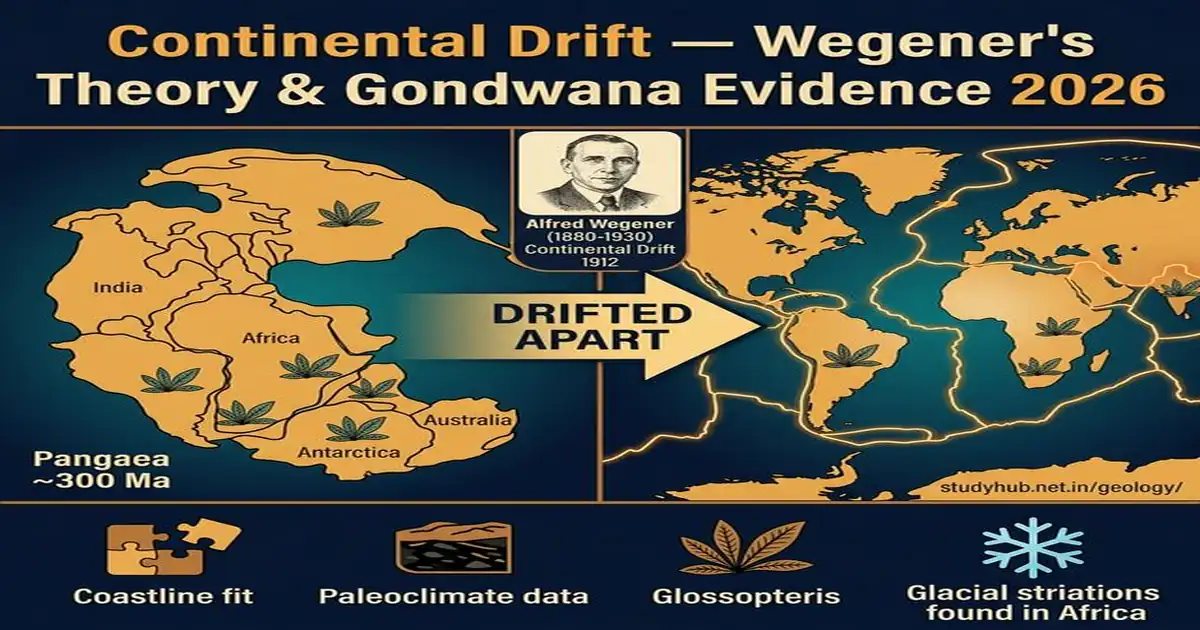
Continental Drift Theory — Wegener’s Evidence & Gondwana Explained 2026
Alfred Wegener — Biography & the Development of Continental Drift
Alfred Wegener was born in Berlin in 1880 and trained as an astronomer and meteorologist — not a geologist. This outsider status would both sharpen his perspective (he was not confined by geological orthodoxy) and contribute to his rejection by the geological establishment. He first noticed the jigsaw fit of the Atlantic coastlines while studying a world atlas in 1911, and quickly realised the significance — what he saw was not coincidence but a geological trace of former continental unity. Over the next year he systematically gathered evidence from geology, palaeontology, climatology, and oceanography, publishing his comprehensive theory in January 1912 in two lectures (Frankfurt and Marburg) and then in a landmark book: Die Entstehung der Kontinente und Ozeane (The Origin of Continents and Oceans, 1915; 4th edition 1929, which is the version most widely translated and read). Wegener proposed the following: approximately 300 million years ago (Late Carboniferous-Early Permian), all the Earth’s landmasses were united in a single supercontinent, Pangaea, surrounded by a single global ocean he called Panthalassa. An ancient ocean — the Tethys Sea — partially separated Pangaea into a northern block (Laurasia: North America + Europe + Asia) and a southern block (Gondwana or Gondwanaland: South America + Africa + India + Australia + Antarctica). Beginning around 200 million years ago (Jurassic), Pangaea began breaking up — Laurasia and Gondwana separated, and Gondwana itself subsequently fragmented piece by piece. Wegener recognised that Gondwana’s fragmentation is recorded in multiple independent lines of evidence that are impossible to explain if the continents were always in their current positions.
Wegener’s Evidence for Continental Drift — Full Analysis
| Evidence | Details | India / Gondwana Specific | Strength |
|---|---|---|---|
| 1. Geometric Fit of Coastlines (Jigsaw Fit) | The Atlantic coastlines of South America and Africa match remarkably well. Wegener noted this fit; Edward Bullard (1965) proved it mathematically using computer fit at the 500-fathom (900 m) continental shelf edge — not the modern coastline, but the true continental margin edge. The fit is dramatically better than chance | India’s western margin (Konkan coast / Arabian Sea continental shelf) fits against Somalia-Tanzania-Madagascar east coast when Gondwana is reassembled. The Eastern Ghats metamorphic belt aligns with the Mozambique Belt (East Africa) and Eastern Antarctica in Gondwana reconstructions | Strong visual/geometric evidence, but critics noted imprecision of coastline matching. Bullard’s computer fit (1965) silenced most critics on this point |
| 2. Fossil Evidence — Glossopteris | Glossopteris (a seed fern, ~300–250 Ma, Permian): found as fossils in India, South America, Africa, Australia, and Antarctica. This plant had seeds too large and heavy to be carried across open oceans by wind. It grew in cooler climates near glacial regions → its presence on all five now-separated southern landmasses proves they were once connected in a cold southern continent (Gondwana) | Gondwana Supergroup in India — Permian coal-bearing sedimentary sequences containing Glossopteris fossils are found in almost every Indian coalfield: Damodar Valley (West Bengal/Jharkhand), Singrauli (MP/UP border), Son-Mahanadi (Odisha/Chhattisgarh), Godavari Valley (AP/Telangana), Pranhita-Wardha (Maharashtra). These same coalfields connect to Gondwana coal sequences in Karoo Basin (South Africa), Paraná Basin (Brazil), Beaufort Group (Antarctica) | Strongest fossil evidence. No alternative explanation (land bridges, seed dispersal) can account for the distribution pattern on all five landmasses |
| 3. Fossil Evidence — Mesosaurus | Mesosaurus (small freshwater reptile, ~280 Ma, Early Permian): found only in Uruguay/Brazil (South America) and southern Africa. Being a freshwater reptile, it could not have crossed the salt-water South Atlantic Ocean (then or now). Its distribution proves South America and Africa were directly connected at this time | Mesosaurus itself is not found in India. However, India’s Gondwana position beside Africa in the reconstruction means India was part of the same landmass where Mesosaurus’s parent connections lay. Similar megafolra (Glossopteris) + fauna connections (Lystrosaurus in India and Antarctica + Africa) link India to the same Gondwana continent | Very strong — freshwater organisms cannot cross salt-water oceans. Definitive evidence for South America-Africa land connection |
| 4. Fossil Evidence — Lystrosaurus | Lystrosaurus (a mammal-like reptile, dicynodont therapsid, ~250 Ma, Early Triassic): found in South Africa, India, and Antarctica. This ground-dwelling reptile could not have swum between these continents — its presence proves all three were connected. The India specimens come from the Panchet Formation of the Damodar Valley | Panchet Formation fossils (Damodar Valley, West Bengal/Jharkhand) = India’s Lystrosaurus specimens. The Panchet Formation is the Triassic age Gondwana sequence directly above the Permian Glossopteris-bearing coal measures. Same Lystrosaurus found in Antarctica’s Fremouw Formation and South Africa’s Beaufort Group — direct Gondwana land connection proof | Strong — terrestrial vertebrate distribution across Antarctica-India-Africa = indisputable land connections |
| 5. Palaeoclimate Evidence — Glacial Striations in Tropical Africa & India | Glacial striations (grooves scratched into bedrock by advancing glaciers) and tillites (solidified glacial till = rock deposited by glaciers) are found in tropical and subtropical regions: central Africa (Congo, Zambia), Brazil, India (Talchir, Odisha), Australia, and Antarctica. These regions today have tropical or subtropical climates — glaciation is impossible at current latitudes. The glacial striations indicate ice sheets moved from south to north over the then-connected southern continent | Talchir Formation (Odisha, India) — Permian tillites with polished and striated pebbles, glacially faceted boulders, and dropstones = definitive evidence that India experienced glaciation ~300 Ma. The striations indicate the ice moved from south → north = India was near the South Pole. Talchir tillites correlate exactly with Dwyka tillites (Karoo Basin, South Africa), Itararé Group (Brazil), and Cape Supergroup (South Africa). Together they outline the Gondwana ice sheet | Very strong — impossible to explain without continental drift placing these regions near a polar ice sheet |
| 6. Palaeoclimate Evidence — Coal in Arctic Regions | Coal (= compressed ancient tropical/subtropical forests) is found in Svalbard (Spitsbergen, Norway, 78°N), Alaska, and Antarctica — regions today far too cold and dark for tropical forest growth. These regions must have been positioned near the equator when the coal forests grew (~300 Ma) | India’s vast coal reserves (world’s 4th largest: ~300 billion tonnes) in the Gondwana Supergroup represent ancient Permian forests growing ~60°S latitude (southern sub-tropics). As India drifted north over 130 Ma, these coal-bearing strata moved with it to current position | Strong palaeoclimate evidence — coal in polar/sub-polar regions proves continental displacement |
| 7. Matching Rock Sequences and Mountain Belts | The Appalachian Mountains (eastern USA-Canada) align with the Caledonian Mountains (Scotland, Norway) when the Atlantic Ocean is closed — same age, same rock types, same structural orientation. The Cape Fold Mountains (South Africa) align with the Sierra de la Ventana (Argentina) when the South Atlantic is closed | Eastern Ghats Granulite Belt (India) aligns with the Mozambique Belt and Lurio Belt (East Africa) and Prydz Bay shear zone (East Antarctica) in Gondwana reconstructions. Precambrian basement ages (800–1,000 Ma Eastern Ghats mobile belt) match East African Orogen ages exactly. Southern Granulite Terrain of India aligns with East African terrain and Sri Lanka’s metamorphic basement | Strong geological evidence — independent of fossils and climate |
India’s Gondwana Journey — From South Pole to Himalayas
| Time (Ma = million years ago) | India’s Position & Event | Geological Record in India |
|---|---|---|
| 700–550 Ma | India part of Gondwana (Pan-African/East African Orogeny assembles Gondwana near South Pole). India latitude: ~60–70°S | Eastern Ghats granulite belt: 800–1,000 Ma ultrahigh-temperature metamorphism = Gondwana assembly event. Southern Granulite Terrain: 2.5–0.5 Ga metamorphic rocks = Gondwana basement |
| ~300 Ma | India near South Pole in Gondwana. Gondwana ice sheet covers much of India, Africa, Australia, Antarctica, S. America | Talchir Formation (Odisha) = tillites and glacial sediments = Gondwana glaciation peak. Glacial striations on Precambrian basement rocks in Rajasthan, Chattisgarh, Odisha = ice movement from south |
| ~300–260 Ma | Ice melts as Gondwana drifts north. India moves into sub-polar then sub-tropical latitudes. Warm swampy forests grow on coal swamps | Barakar Formation (Permian, Damodar/Singrauli/Godavari coalfields): Glossopteris-rich coal — world-class coal seams up to 100m thick. Panchet Formation (Triassic): Lystrosaurus land vertebrates. Gondwana Supergroup strata record this entire Permian-Jurassic Gondwana time |
| ~200–180 Ma | Pangaea / Gondwana begins breaking up. India + Madagascar + Antarctica + Australia still connected but Tethys Ocean widening. India latitude: ~40–50°S | Rajmahal Traps (Jharkhand): ~117 Ma flood basalt = Kerguelen plume triggering India-Australia initial separation. Marine Jurassic sediments in Rajasthan (Jaisalmer Basin) = Tethys Ocean transgression |
| ~130 Ma | India separates from Africa (East Africa margin). Begins northward journey across Tethys Ocean. India latitude: ~40–45°S | Onset of Indian Ocean seafloor spreading (western sector). Carlsberg Ridge begins forming. Arabian Sea oceanic crust begins being produced |
| ~88 Ma | India separates from Madagascar. Rapid northward acceleration begins (~18 cm/yr). India latitude: ~30°S | Madagascar separation = India’s western margin (now western Ghats) rifts from Madagascar eastern margin. Massive westward tilting of Peninsular India = activation of Western Ghats escarpment |
| ~65.5 Ma | Réunion plume impacts base of Indian lithosphere. Massive flood basalt eruption. India traveling at ~20 cm/yr (peak speed). India latitude: ~15–20°S | Deccan Traps: 500,000 km² flood basalt plateau, up to 3,000 m thick in some places (Mahabaleshwar, Maharashtra). One of world’s largest volcanic events. India-Seychelles separation at this time |
| ~55–50 Ma | India-Eurasia collision begins. Tethys Ocean fully subducted. India slows dramatically to ~5 cm/yr as continental crust resists subduction | Himalayan Orogeny begins: ophiolites (Tethys Ocean floor remnants) squeezed onto suture zone = Indus-Yarlung Tsangpo Suture Zone + Ladakh Ophiolite Complex. Oldest Himalayan sedimentary sequences begin deforming |
| ~50 Ma–Present | Continental collision ongoing. India pushes 2,000 km into Eurasia. Himalayas grow, Tibetan Plateau rises. India still moves NNE at 5 cm/yr today | Himalayas: MCT (Main Central Thrust), MBT (Main Boundary Thrust), MFT (Main Frontal Thrust) = stacked thrust sheets from collision. Siwalik Group (Miocene–Pliocene): continental sediments from Himalayan erosion = foreland basin fill in Indo-Gangetic Plain. GPS: 44–52 mm/yr (NNE) measured at Mumbai, Bangalore, Hyderabad, Dehradun stations |
Frequently Asked Questions
What was Wegener’s proposed mechanism for continental drift — and why did it fail?
Wegener understood that a theory of continental motion required a driving mechanism — what force could possibly move an entire continent? He proposed two: (1) Polfluchtkraft (pole-fleeing force) — a centrifugal force arising from Earth’s rotation that he suggested would push continents away from the poles toward the equator. (2) Tidal forces — gravitational attraction of the Moon and Sun, which he suggested might drag continents westward (explaining why the Americas appear to have drifted west relative to Europe and Africa). Both mechanisms were immediately and correctly demolished by geophysicists: Harold Jeffreys (British geophysicist) calculated that the Polfluchtkraft is approximately 100 million times too weak to move continents through oceanic rock; tidal forces are similarly far too small — by many orders of magnitude. The fundamental problem was that Wegener imagined continents ploughing through solid oceanic basalt — and there is no known force sufficient to do this. This is an entirely different model from the correct one (where the entire lithosphere — ocean floor plus continents — moves together as rigid plates over the weak asthenosphere, driven by mantle convection and slab pull). Wegener never conceived of sea floor spreading — that the ocean floor itself moves along with the continents — and this conceptual gap left his theory mechanically untenable until Hess filled it in 1960. The lesson: having the right conclusion (continents have moved) but the wrong mechanism (ploughing through ocean floor) is not sufficient for scientific acceptance — the mechanism must also be physically plausible. This highlights the importance of mechanism in scientific theory, not just pattern-matching evidence.
Important for Exams — Continental Drift Facts for UPSC, SSC & State PCS
Wegener basics: German meteorologist (NOT geologist). Published 1912 (lectures), 1915 (book). Proposed Pangaea (all continents, ~300 Ma) + Panthalassa (global ocean) + Tethys Sea (between Laurasia and Gondwana). Pangaea began breaking: ~200 Ma. Gondwana = S. America + Africa + India + Australia + Antarctica. Laurasia = N. America + Europe + Asia. Evidence (7 types): (1) Jigsaw fit (Bullard 1965); (2) Glossopteris fossils (India/Africa/Australia/Antarctica/S.America); (3) Mesosaurus (S.America + S.Africa only = freshwater reptile); (4) Lystrosaurus (India Panchet Formation + Antarctica + S.Africa); (5) Talchir tillites (India) = Gondwana glaciation; (6) Coal in Spitsbergen/Antarctica = tropical forests now in polar regions; (7) Matching mountain belts (Appalachians-Caledonians; Eastern Ghats-Mozambique Belt). Why rejected: No credible mechanism — Polfluchtkraft and tidal forces were orders of magnitude too weak. Vindicated by: Hess (1960) sea floor spreading provided mechanism. Vine-Matthews (1963) magnetic stripes proved it. India Gondwana: Talchir Formation (glaciation ~300 Ma), Barakar Formation (coal, Permian), Panchet Formation (Lystrosaurus, Triassic), Rajmahal Traps (117 Ma, separation), Deccan Traps (65.5 Ma, Réunion plume), Himalayan Orogeny (50 Ma–present). India now: 5 cm/yr NNE (GPS). Gondwana coalfields: Damodar, Singrauli, Son-Mahanadi, Godavari, Pranhita-Wardha = world’s 4th largest coal reserves.
What to Read Next
- Plate Tectonics — Full Theory, History & Evidence from Wegener to GPS 2026
- Sea Floor Spreading — Harry Hess, Magnetic Stripes & Ocean Floor Age 2026
- Lithosphere — Tectonic Plates, Plate Boundaries & Indian Plate Motion 2026
- Himalayan Formation — How India-Eurasia Collision Built the World’s Highest Mountains 2026
- Continental vs Oceanic Crust — SIAL vs SIMA, Age & Why Oceanic Crust Subducts 2026
🎔 Exam Quick Reference — Continental Drift: Wegener: German meteorologist, 1912/1915. Pangaea (~300 Ma) + Panthalassa (ocean) + Tethys Sea (between Laurasia and Gondwana). Gondwana = India+Africa+Australia+Antarctica+S.America. Broke up ~200 Ma. Evidence: jigsaw fit; Glossopteris (5 continents); Mesosaurus (S.America+S.Africa only); Lystrosaurus (India Panchet+Antarctica+Africa); Talchir tillites (India, glaciation ~300Ma); coal in Spitsbergen; Eastern Ghats = Mozambique Belt match. Mechanism failed: Polfluchtkraft + tidal forces = too weak. Vindicated by Hess 1960 (sea floor spreading). India: separated from Africa 130 Ma → 20 cm/yr north → Deccan Traps 65.5 Ma → Himalayan collision 50 Ma → 5 cm/yr today.
🌍 India Gondwana Heritage: Gondwana Supergroup strata (Permian-Jurassic, India): Talchir Fm. (glaciation) → Barakar Fm. (coal + Glossopteris) → Barren Measures → Raniganj Fm. (coal) → Panchet Fm. (Lystrosaurus) → Supra-Panchet Fm. → Rajmahal Traps (117 Ma, Kerguelen plume). Damodar Valley = India’s largest coalfield = Gondwana coalfield. Gondwana region of MP is named after Gondwana = linguistic evidence. India’s 4th-largest coal reserves = entirely Gondwana origin. Eastern Ghats Belt (800-1000 Ma) = Gondwana Assembly metamorphic belt = connects to Mozambique Belt (E.Africa) in plate reconstruction. Ladakh Ophiolite = Tethys Ocean floor remnant = direct geological record of the ocean India crossed to reach Eurasia.
About This Guide: Written by the StudyHub Geology Editorial Team (studyhub.net.in/geology/) based on NCERT Class 11 Physical Geography Chapter 4 (Distribution of Oceans and Continents), Wegener (1929) “The Origin of Continents and Oceans” (4th ed.), Bullard, Everett & Smith (1965) computer fit paper (Phil. Trans. Roy. Soc.), GSI Special Publication on Gondwana geology of India, and Dasgupta & Mukhopadhyay (Eastern Ghats geological correlations). Last updated: March 2026.