
Last Updated: March 2026 | Reading Time: 10 minutes | ~2,200 words | Category: Indian Geology & Volcanology
The Deccan Traps — from the Sanskrit/Hindi word ḍakkan (south) and the Swedish trapp (staircase, referring to the step-like landscape created by eroded lava flows) — constitute one of the most spectacular geological features on Earth and the most important volcanic event in the Indian subcontinent’s geological history. Erupting approximately 65.5 million years ago (end of the Cretaceous, beginning of the Palaeogene), the Deccan Traps poured out an estimated 500,000–1,000,000 km³ of basaltic lava over a period of roughly 30,000 years at peak eruption rate, covering an area of approximately 500,000 km² of what is now the Deccan Plateau of Maharashtra, Madhya Pradesh, Gujarat, Karnataka, and Telangana with up to 3,000 metres of horizontally stacked basalt flows (greatest thickness at Mahabaleshwar, Maharashtra, where 37 flows totalling ~3,000 m are exposed in the escarpment). The eruptions coincided closely — in geological time — with the Chicxulub asteroid impact (~66 Ma, Yucatán Peninsula, Mexico) and the Cretaceous-Palaeogene (K-Pg) mass extinction event, which wiped out approximately 75% of all species on Earth including all non-avian dinosaurs. The relative roles of the Deccan Traps and Chicxulub impact in causing the mass extinction remains one of the most debated questions in geology and palaeontology. For UPSC, SSC, and state PCS exams, the Deccan Traps — their origin (Réunion mantle plume), geological features, resources (black cotton soil, mineral wealth), and connection to plate tectonics — are regularly tested.
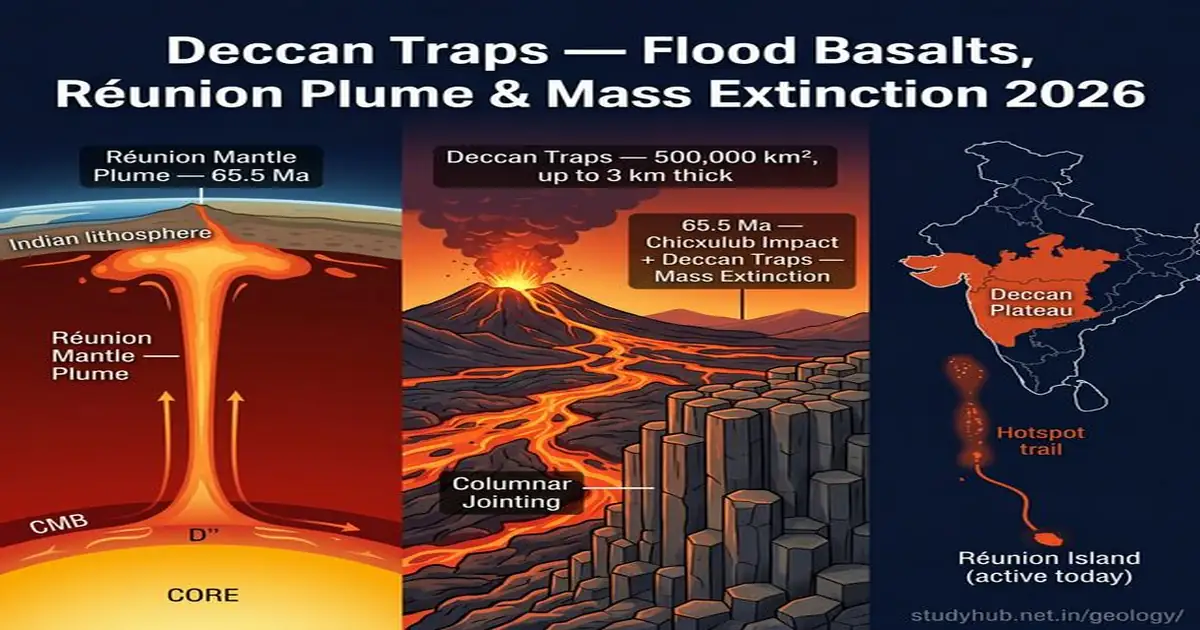
Deccan Traps — Flood Basalts, Réunion Plume & K-Pg Extinction 2026
Deccan Traps — Complete Reference Table
| Parameter | Details |
|---|---|
| Age | ~65.5–66 Ma (end-Cretaceous / K-Pg boundary). Peak eruption rate ~65.5 Ma. Pre-boundary phase: ~68–66 Ma (smaller volume). Main phase: ~65.5 Ma (90%+ of total volume). Post-boundary phase: ~65.5–63 Ma (declining eruptions). Precise U-Pb zircon and ⁴⁰Ar/³⁹Ar dating: 65.5 ± 0.1 Ma |
| Area (current extent) | ~500,000 km² (slightly smaller than Spain). But original extent before erosion estimated at 1,500,000–2,000,000 km² — much of what is now the Arabian Sea shelf, peninsular India’s offshore, and other areas now eroded. Current outcrop: Maharashtra (most extensive), parts of Madhya Pradesh, Gujarat (Saurashtra, Kutch basalts), Andhra Pradesh, Karnataka, Telangana |
| Volume | ~500,000 km³ preserved (current estimates from seismic profiling). Original volume likely 1,000,000–2,000,000 km³ — large fraction now eroded or offshore. One of Earth’s 5 largest Large Igneous Provinces (LIPs) but not the largest (Siberian Traps at 66 Ma = 2–4 million km³; Ontong Java Plateau = 60 million km³) |
| Thickness | Maximum: ~3,000 m (Mahabaleshwar Plateau escarpment, Maharashtra — 37 distinct lava flow units visible). Average: 1,000–2,000 m across the Deccan Plateau. Thins toward margins. Individual flow units: 5–50 m thick, each representing a single eruption episode |
| Eruption Rate | Peak: ~1–2 km³/yr during main phase (~30,000 years for most of the volume). Compare: current global volcanic eruption rate = ~3 km³/yr total; Deccan peak = nearly equivalent to ALL of Earth’s current volcanism concentrated in one location. Rate declined significantly after K-Pg boundary |
| Rock Type | Tholeiitic flood basalt (low silica ~50%, high Mg, Fe; plagioclase, pyroxene, olivine phenocrysts). Composition: typical mantle plume basalt (OIB = Ocean Island Basalt chemistry, different from MORB). Rare picrite basalts at the base (high Mg, direct mantle melt). Intertrappean beds: thin layers of limestone, chert, siliceous sinter between lava flows = evidence of lakes/wetlands between eruption episodes (contain freshwater fossils + dinosaur eggshell fragments) |
| Geophysical Signature | Heavy Neodymium (Nd) and Strontium (Sr) isotopic ratios confirm Réunion mantle plume origin. Long-range magnetic anomaly signature from flood basalt (entire Deccan plateau has characteristic magnetic pattern). High heat flow in western peninsular India = residual Réunion plume signature. Seismic tomography: slow velocity anomaly beneath western India = plume-modified mantle lithosphere |
| Economic Significance | Black cotton soil (regur/vertisol): weathered Deccan basalt → rich in montmorillonite clay → high fertility, water retention, crack-forming → ideal for cotton, soybean, sorghum → cotton growing states Maharashtra, MP, Gujarat, AP have productive regur soils partly from Deccan Traps weathering. Construction: Deccan basalt used in road construction, building stone. Zeolite minerals in vesicular basalts (industrial adsorbents, catalysts), agate and chalcedony from amygdaloidal basalts (gems/minerals industry, Ratnapuri, Maharashtra) |
The Réunion Mantle Plume — From CMB to Réunion Island: The Hotspot Trail
| Location Along Hotspot Trail | Age (Ma) | Feature | Significance |
|---|---|---|---|
| D″ Layer / Core-Mantle Boundary (CMB) | >100 Ma (plume initiation) | Large Low-Shear-Velocity Province (LLSVP) under African/Indian Ocean sector of CMB = thermochemical pile from which Réunion plume is thought to originate | Deep mantle origin of the hotspot — possibly a reservoir of primordial mantle material or ancient subducted slabs. Seismic tomography reveals this slow anomaly |
| Deccan Traps (Peninsular India) | 65.5–68 Ma | Main flood basalt eruption. 500,000 km² basalt covering Deccan Plateau. Plume head impact on base of Indian lithosphere as India moved rapidly NNE (18-20 cm/yr) over the plume | India’s largest volcanic event; K-Pg boundary coincidence; creation of black cotton soil; Seychelles separation triggered by plume-thinned lithosphere |
| Lakshadweep (Laccadive) Ridge / Islands | ~60–55 Ma | Shallow-water coral-capped volcanic seamount ridge = Réunion plume trail as Indian Plate moved NNE over the fixed plume. Lakshadweep Islands: coral atolls built on volcanic seamount foundations of this age | India’s only coral atoll territory (union territory). Seamount chain proves Indian Plate motion over Réunion plume. Age progression confirms plate velocity (~5 cm/yr in this period) |
| Maldives Ridge | ~50–35 Ma | Long volcanic ridge (now partially submerged, with Maldive Islands built on it) = continued Réunion hotspot trail as Indian plate moved further north | Maldive Islands: coral atolls on Réunion plume-created volcanic foundations. One of world’s lowest-lying nations (climate change vulnerability directly linked to geological origin) |
| Chagos-Laccadive Ridge / Chagos Archipelago | ~35–10 Ma | Continuation of the hotspot trail across the Indian Ocean as the Indian-Australian Plate moved north | Diego Garcia (British Indian Ocean Territory) = atoll on this ridge. Chagos Archipelago = most remote part of the hotspot trail. Confirms long-term hotspot stationarity |
| Réunion Island (active today) | 2 Ma–Present | The current surface expression of the Réunion mantle plume. Piton de la Fournaise (“Peak of the Furnace”) = one of Earth’s most active volcanoes, erupting nearly every year. Basaltic shield volcano. Located at ~21°S, ~55°E in the Indian Ocean near Mauritius | Living proof that the Réunion mantle plume is still active. Same plume that created Deccan Traps 65.5 Ma ago. Direct connection between India’s geological past and present volcanic activity 5,000 km away in Indian Ocean |
Deccan Traps & the K-Pg Mass Extinction — The Great Debate
The Cretaceous-Palaeogene (K-Pg) mass extinction at 65.5 Ma — which ended the reign of the dinosaurs and wiped out ~75% of all species on Earth — occurred at virtually the same time as both the Chicxulub asteroid impact and the peak of Deccan Traps volcanism. This coincidence has generated one of the most productive and contentious debates in modern geology and palaeontology. The Chicxulub Impact hypothesis (Alvarez et al., 1980): Luis and Walter Alvarez (Berkeley) discovered a global layer of iridium (a platinum-group element rare in Earth’s crust but abundant in asteroids) precisely at the K-Pg boundary in rock sequences worldwide — from Italy to Denmark to New Zealand. Iridium concentration at K-Pg boundary = 20–160 times background levels. The Chicxulub crater (180 km diameter, Yucatán Peninsula, Mexico) was subsequently identified as the impact site. Impact scenario: a ~10 km asteroid struck at ~20 km/s → released energy equivalent to ~1 billion atomic bombs → ejecta + vapourised asteroid sent iridium globally + created a “impact winter” (dust + SO₂ + soot blocked sunlight for months to years → photosynthesis collapse → food chain collapse → mass extinction). The Deccan Traps role (ongoing debate): Volcanological evidence shows the Deccan eruptions were not a single steady event — they had a dramatic pulse structure. High-precision ⁴⁰Ar/³⁹Ar dating (Schoene et al., 2019, Science) and U-Pb zircon dating show: (1) Eruptions began ~400,000 years BEFORE the K-Pg boundary (releasing SO₂, CO₂ → volcanic winter + ocean acidification → environmental stress); (2) The main eruption pulse (~66% of total Deccan volume) occurred within 200,000–600,000 years AFTER the K-Pg boundary — interestingly, some researchers hypothesise the Chicxulub impact may have actually accelerated Deccan eruptions (impact seismic waves reaching India → increasing magma flux in active plume system). Current consensus: Most palaeontologists now favour a “double-blow” or “one-two punch” model: the Deccan eruptions were causing environmental stress (ocean acidification, temperature swings, reduced biodiversity) for ~400,000 years before the K-Pg boundary; then the Chicxulub impact delivered the acute kill mechanism (impact winter, global wildfires, acid rain) that pushed already-stressed ecosystems over the edge. The Chicxulub impact is considered the primary “killing mechanism” for the instantaneous die-offs, while Deccan volcanism contributed to the prolonged ecological disruption. The debate continues with each new high-precision dating study.
Frequently Asked Questions
What makes the Deccan basalt different from regular volcanic rock?
Several features distinguish Deccan flood basalt from ordinary volcanic rock. Scale: Individual lava flow units in the Deccan can be traced for hundreds of kilometres from their source — single flows covering up to 15,000 km² at thicknesses of 5–30 m. Compare to typical Hawaiian lava flows (a few km² to tens of km²). This immense lateral continuity requires eruption rates far exceeding anything in the historic record. Deccan flow rates: estimated at up to 10,000 km³ per eruption episode — compared to the 1783 Laki fissure eruption in Iceland (Earth’s largest historic eruption: 14 km³ over 8 months). Columnar jointing: As thick lava flows cool from above and below simultaneously, the basalt contracts and fractures into regular hexagonal (5–7 sided) columns — typically 30–50 cm in diameter, up to several metres tall. These “columnar joints” are visible at many Deccan escarpments and are one of the most striking features of flood basalts globally (also found in Giant’s Causeway, Northern Ireland and Fingal’s Cave, Scotland = Paleogene North Atlantic Igneous Province, ~56 Ma). Visible in Deccan at St. Mary’s Islands (Malpe beach, Udupi, Karnataka) — hexagonal basalt columns of ~88 Ma age from initial India-Madagascar separation rifting. Vesicular and amygdaloidal texture: Gas bubbles (mainly CO₂, SO₂, H₂O) trapped in lava create vesicles (cavities). These vesicles are later infilled by mineral-rich hydrothermal fluids → producing amygdales filled with zeolite minerals (stilbite, heulandite, chabazite), calcite, quartz, agate, and chalcedony. The Ratnapuri / Idar-Oberstein (Gujarat) area is famous for agate-filled Deccan basalt vesicles — mined and polished as semi-precious stones. Intertrappean beds: Between individual lava flows, thin horizons of limestone, chert, diatomite, and lacustrine shale represent periods of quiescence when lakes and swamps colonised the cooled lava surface before the next eruption. These intertrappean beds contain: freshwater fossils (fish, molluscs), dinosaur eggshell fragments (proving dinosaurs survived into the early Deccan eruption period), plant fossils, and the K-Pg boundary iridium layer at specific horizons.
Important for Exams — Deccan Traps Facts for UPSC, SSC & State PCS
Key facts: Age: 65.5 Ma (K-Pg boundary). Area: 500,000 km² (current), originally 1.5-2 million km². Volume: 500,000 km³ preserved, originally up to 2 million km³. Max thickness: 3,000 m (Mahabaleshwar, Maharashtra, 37 flows). Origin: Réunion mantle plume (hotspot) impacting base of Indian lithosphere as India moved NNE at 18-20 cm/yr. States covered: Maharashtra (main), Madhya Pradesh, Gujarat, Andhra Pradesh, Karnataka, Telangana. Réunion hotspot trail (N→S): Deccan (65.5 Ma, India) → Lakshadweep Ridge (55-60 Ma) → Maldives (35-50 Ma) → Chagos (10-35 Ma) → Réunion Island (active, today). Rock type: Tholeiitic flood basalt. Features: columnar jointing (hexagonal); vesicular/amygdaloidal texture; intertrappean limestone beds (dinosaur eggshells, freshwater fossils). Black cotton soil: Regur/vertisol from Deccan basalt weathering → montmorillonite clay → cracks in summer, swells in monsoon → Maharashtra, MP, Gujarat cotton cultivation. K-Pg extinction: Both Chicxulub impact (asteroid, 180 km crater, Yucatán) + Deccan Traps (volcanism) at 65.5 Ma = “double-blow” mass extinction (75% species lost). Chicxulub = acute kill mechanism (impact winter); Deccan = chronic environmental stress. Economic importance: Black cotton soil for cotton/soybean; basalt for road/building stone; zeolites in vesicular basalts; agate in amygdaloidal basalts (Gujarat-Ratnapuri); St. Mary’s Islands (Karnataka) = hexagonal columnar basalt (protected UNESCO candidate). Seychelles: India-Seychelles separated at 65.5 Ma due to Réunion plume. Seychelles = continental fragment (not oceanic) = granite island in Indian Ocean, remnant of Indian lithosphere.
What to Read Next
- Plate Tectonics — History & Evidence including Mantle Plumes & Hotspots 2026
- Himalayan Formation — Continental Collision & India’s Journey from Gondwana 2026
- Earth’s Mantle — Convection, Plumes & Large Igneous Provinces 2026
- Gutenberg Discontinuity — D″ Layer, LLSVPs & Mantle Plume Origins 2026
- Continental Drift — Gondwana, India’s Tectonic History & Gondwana Coalfields 2026
🎔 Exam Quick Reference — Deccan Traps: Age: 65.5 Ma (K-Pg boundary). Area: 500,000 km². Volume: 500,000 km³ preserved. Max thickness: 3,000 m (Mahabaleshwar, 37 flows). Type: tholeiitic flood basalt (OIB chemistry). Origin: Réunion mantle plume. Hotspot trail (old→young): Deccan (65.5 Ma) → Lakshadweep (55-60 Ma) → Maldives (35-50 Ma) → Chagos (10-35 Ma) → Réunion (active). Black cotton soil = regur/vertisol from Deccan basalt weathering → cotton, soybean belt. Features: columnar jointing, vesicular/amygdaloidal, intertrappean beds (dinosaur eggshells). K-Pg extinction: Chicxulub (asteroid impact, 180 km crater) + Deccan Traps = double-blow, 75% species extinct. Seychelles separated from India at 65.5 Ma (same event). St. Mary’s Islands (Udupi, Karnataka) = columnar basalt (88 Ma, India-Madagascar rift). Agate from Gujarat amygdaloidal basalts.
🌍 India’s Volcanic Geology — Other Events: Rajmahal Traps (Jharkhand, ~117 Ma): earlier flood basalt from Kerguelen plume = triggered India-Australia separation. Sylhet Traps (Meghalaya/Bangladesh border, ~117 Ma): part of same Kerguelen plume event. Barren Island (Andaman, ongoing): India’s only historically active volcano (subduction-related arc volcano, NOT a plume). Narcondam Island (Andaman): dormant stratovolcano. Dhosi Hill (Haryana): eroded ancient volcanic plug (pre-Gondwana). Precambrian komatiites in Dharwar Craton (Karnataka) = very high-temperature ancient volcanics (only form at mantle temperatures >1600°C, only common in Archaean). St. Mary’s Islands (Karnataka): 88 Ma hexagonal columnar basalt = preserved India-Madagascar rift magmatism. India’s volcanic legacy connects every part of its geological history from Archaean to present.
About This Guide: Written by the StudyHub Geology Editorial Team (studyhub.net.in/geology/) based on NCERT Class 11 India Physical Environment Chapter 2, Coffin & Eldholm (1994) Large Igneous Provinces review, Schoene et al. (2019) Deccan Traps U-Pb dating (Science), Courtillot et al. (1988) Deccan Traps and mass extinction, GSI Records on Deccan Trap geology, and Pandit et al. on Deccan geochemistry. Last updated: March 2026.