
Last Updated: March 2026 | Reading Time: 11 minutes | ~2,400 words | Category: Earthquakes & Seismology
An earthquake is the sudden release of energy stored in Earth’s lithosphere, primarily along fault zones at or near plate boundaries, producing seismic waves that radiate outward in all directions and cause ground shaking. More precisely: as tectonic plates move slowly relative to each other, stress (strain energy) accumulates in rocks along fault planes because the rocks are locked together by friction. When the accumulated stress exceeds the shear strength of the rocks, the fault slips suddenly — releasing decades or centuries of stored elastic energy in seconds to minutes — generating seismic waves felt as ground shaking. This mechanism, described by the elastic rebound theory (H.F. Reid, 1906, following study of the 1906 San Francisco earthquake), is the foundation of modern seismology. India sits in one of the world’s most seismically active regions: bounded on the north by the active continental-continental Himalayan collision, on the northeast by the subduction-related Andaman-Nicobar arc, and on the west by the Owen Fracture Zone transform boundary. India has suffered some of the world’s most destructive earthquakes, including the 1950 Assam earthquake (8.6 Mw) — one of the largest continental earthquakes ever recorded — and the 2001 Bhuj earthquake (7.7 Mw) which killed ~20,000 people in Gujarat. Understanding earthquake types, the India seismic zone map, major historical India earthquakes, and earthquake hazard mitigation is one of the highest-frequency topics in UPSC, SSC, NDA, and state PCS competitive exam geography sections.
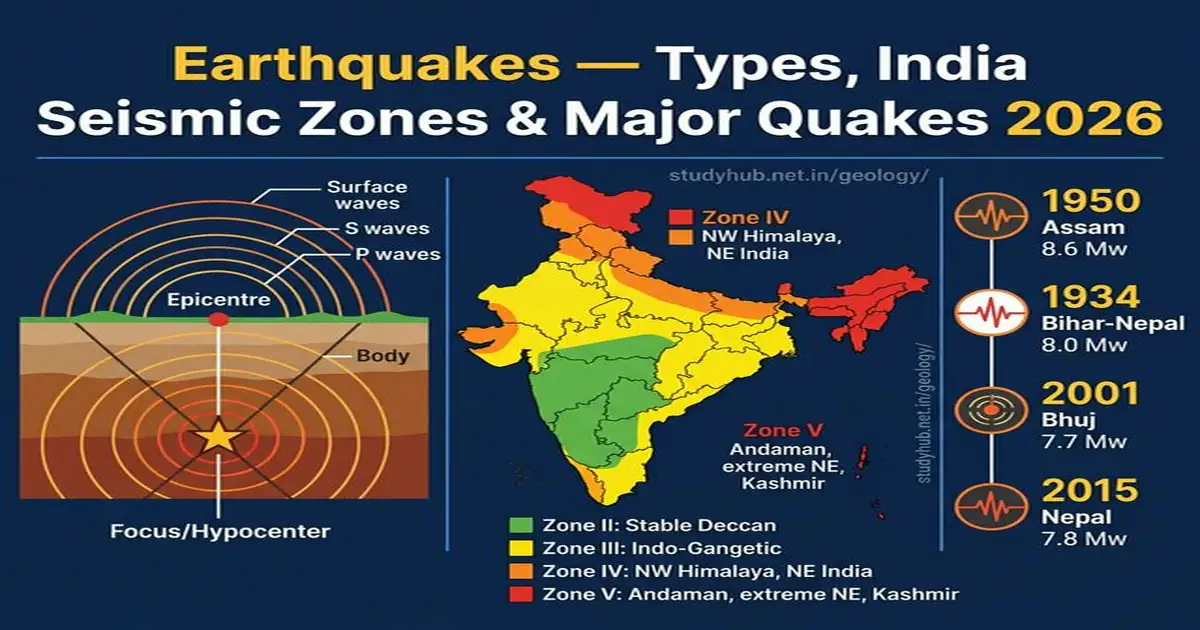
Earthquakes — Types, Causes, India Seismic Zones & Major Events 2026
Earthquake Terminology — Complete Reference Table
| Term | Definition & Details |
|---|---|
| Focus (Hypocenter) | The point WITHIN Earth’s interior where the earthquake originates — where fault slip first begins and seismic energy is first released. Can be at any depth from <1 km to 700 km. Depth classifications: Shallow focus = 0–70 km (most damaging, greatest ground shaking at surface, ~75% of all earthquakes); Intermediate focus = 70–300 km; Deep focus = 300–700 km (occur only in subducting oceanic slabs — the slab must be cold and brittle enough to fracture at these depths; below 700 km the slab likely transforms to denser minerals and can no longer store elastic strain) |
| Epicentre | The point on Earth’s SURFACE directly above the focus. Maximum ground shaking usually (but not always) occurs at/near the epicentre. Distance from epicentre to any seismograph station is the “epicentral distance” (Δ) measured in degrees of arc (1° = ~111 km on surface). The epicentre is what is reported in news (“earthquake near Delhi” means the epicentre is near Delhi) |
| Seismic Waves | Four main types: (1) P waves (Primary/compressional) — fastest, travel through solids + liquids, first to arrive at seismograph. (2) S waves (Secondary/shear) — slower (~0.6× P speed), only through solids, stopped by liquid outer core — proves outer core is liquid. (3) Love waves (surface, horizontal shear, cause side-to-side motion) — most damaging to tall structures. (4) Rayleigh waves (surface, retrograde elliptical motion, cause both horizontal + vertical motion, create rolling ground motion) — most damaging to broad foundations. Surface waves travel slower than body waves but have larger amplitudes close to the epicentre |
| Magnitude | Measure of energy released. Richter Scale (ML, local): logarithmic — each unit = 10× ground motion amplitude, ~31.6× energy. Used for small-moderate local earthquakes. Moment Magnitude (Mw): based on seismic moment (Mo = rigidity × fault area × slip distance); now standard for large earthquakes; no upper limit. Body Wave Magnitude (mb), Surface Wave Magnitude (Ms): for specific wave types. An Mw 8.0 earthquake releases ~31.6× energy of Mw 7.0, ~1,000× energy of Mw 6.0 |
| Intensity | Measure of shaking felt at a specific location. NOT a fixed value for an earthquake — varies with distance from epicentre, local geology, soil type, construction quality. Scales: Modified Mercalli Intensity (MMI) Scale: I (imperceptible) to XII (total destruction). Bureau of Indian Standards seismic intensity mapping for India uses MSK-64 (Medvedev-Sponheuer-Karnik) scale correlated to BIS IS 1893. Soft sediments (alluvium, river flood deposits = most of Indo-Gangetic Plain) amplify shaking by 2–5× compared to bedrock — called site amplification |
| Elastic Rebound Theory | H.F. Reid (1906), California: elastic strain accumulates in rocks along a locked fault over decades-centuries as plates move. When strain exceeds rock strength → sudden fault slip → elastic rebound (both sides spring back to new unstrained position) → seismic energy released. This explains: why earthquakes recur on the same faults; why the Himalayan MFT will produce a future great earthquake; why GPS strain accumulation predicts earthquake hazard |
| Aftershocks | Smaller earthquakes following the mainshock on the same fault system, as stress redistributes. Frequency and magnitude decay following Omori’s Law (aftershock rate ∝ 1/time after mainshock). Can continue for months to years (the Bhuj 2001 earthquake produced aftershocks for >1 year). Largest aftershock is typically 1.2 magnitude units below the mainshock (Båth’s Law) |
| Foreshocks | Smaller earthquakes preceding the mainshock. Not always present but can serve as warning (Nepal 2015 Gorkha earthquake had minor foreshocks). Currently cannot reliably predict mainshock from foreshocks alone — seismology’s greatest challenge |
India Seismic Zone Map — Zones II to V Explained
| Zone | Hazard Level | Peak Ground Acceleration (PGA) | States / Regions | Major Tectonic Setting |
|---|---|---|---|---|
| Zone II | Low (Previously Zone I merged into II) | 0.10 g | Most of Peninsular India: southern Maharashtra, Karnataka, most of Tamil Nadu, Andhra Pradesh (interior), Odisha, stable parts of MP and Rajasthan. Parts of Kerala and Goa (western) | Stable Precambrian craton (Dharwar Craton, Bastar Craton, Singhbhum Craton). Far from active plate boundaries. Low strain rates. Rare intraplate earthquakes possible (e.g., Latur 1993, 6.2 Mw — technically in Zone III but demonstrates intraplate hazard in stable craton) |
| Zone III | Moderate | 0.16 g | Kerala coastline, Goa, Lakshadweep, Andaman (some parts historically mapped here, now Zone V for Andaman). Much of Maharashtra interior (north of Deccan), MP north, UP-Bihar plains (parts), West Bengal, Orissa coastal | Moderate plate boundary influence at distance. Kerala rifted margin. UP/Bihar portion of Indo-Gangetic Plain — foreland basin over underthrusting Indian Plate (moderate hazard from blind thrust faults). West Bengal — proximity to NE India seismic zone. Latur 1993 Killari earthquake (6.2 Mw, ~10,000 deaths) occurred here — intraplate event on unrecognised fault on Deccan basalt-cratonic contact |
| Zone IV | High | 0.24 g | J&K (non-Himalayan parts), much of Himachal Pradesh, Uttarakhand (foothills), most of Punjab, Haryana, Delhi, UP (Himalayan foreland), Bihar, West Bengal (north), most of NE India states (Meghalaya, parts of Assam), Rann of Kutch (Gujarat), Andaman & Nicobar (some islands historically Zone IV) | Himalayan collision zone (MBT/MFT stress accumulation); Delhi region (NW Himalayan foreland, proximity to active faults); NE India convergence (India-Burma collision = Shillong Plateau seismic zone); Rann of Kutch (Gujarat, Kachchh rift zone — produced 2001 Bhuj 7.7 Mw earthquake) |
| Zone V | Very High (Highest) | 0.36 g | All of Andaman & Nicobar Islands; extreme NE India (Arunachal Pradesh-Assam border, extreme NE Assam, Mizoram, Manipur); Kashmir Valley (J&K); parts of western Himachal Pradesh; Tehri Dam region (Garhwal); parts of extreme NE Himalayas | Most seismically dangerous zone in India. Andaman-Nicobar: active subduction zone (Indian plate → Burma/Sunda Plate) + Barren Island active volcano — 2004 Indian Ocean tsunami (9.1 Mw Sumatra quake) epicentre in this subduction zone. NE India: India-Burma collision + Shillong Plateau microseismic zone (1897 Shillong earthquake, 8.1 Mw, one of world’s largest intraplate events). Kashmir: proximity to Main Himalayan Thrust + Karakoram-Himalayan convergence (2005 Kashmir earthquake, 7.6 Mw, ~87,000 deaths in Pakistan/PoK/India) |
Major Historical Earthquakes in India — Complete Table
| Year | Location | Magnitude | Deaths (~) | Significance |
|---|---|---|---|---|
| 1897 | Shillong, Assam (Meghalaya Plateau) | 8.1 Mw (some sources 8.7) | ~1,500 | One of the largest continental intraplate earthquakes ever recorded globally. Destroyed nearly all brick structures in Shillong. Indian plate overriding Burma plate + Shillong Plateau uplift as mechanism. Relatively low deaths due to sparse population |
| 1905 | Kangra, Himachal Pradesh | 7.8 Mw | ~20,000 | Deeply destructive Himalayan earthquake. Kangra Fort (1905 hp) collapsed. Highlighted vulnerability of unreinforced masonry in Himalayan foothills. Caused by slip on Himalayan thrust fault system |
| 1934 | Bihar-Nepal border | 8.0 Mw | ~30,000 | One of the largest Himalayan earthquakes recorded. Massive liquefaction in Bihar plains (sand boils). Nepal and North Bihar devastated. Mahatma Gandhi publicly attributed the earthquake to God’s punishment for untouchability — beginning a famous controversy with Rabindranath Tagore who protested the antiscientific statement |
| 1950 | Assam (Indo-Myanmar border) | 8.6 Mw | ~4,000 | India’s largest recorded earthquake. One of the largest continental earthquakes in recorded history globally. Massive landslides in Arunachal-Assam hills. Massive river course changes (Brahmaputra temporarily dammed and redirected). Felt across South Asia. Caused by India-Burma plate collision + complex transpressional faulting |
| 1967 | Koyna, Maharashtra | 6.5 Mw | ~200 | World’s most notorious example of Reservoir-Induced Seismicity (RIS): earthquake triggered by filling of Koyna dam reservoir (Shivajisagar Lake). Killed ~180 people, damaged dam. Koyna region still experiences regular minor seismicity from reservoir loading onto Deccan craton (stable region — demonstrates that even stable cratons can have seismicity induced) |
| 1988 | Bihar-Nepal border (Udayapur region) | 6.9 Mw | ~1,000 | Major Himalayan earthquake causing significant destruction in North Bihar (Darbhanga, Madhubani districts) — demonstrating ongoing Himalayan seismic hazard to densely populated IGP |
| 1991 | Uttarkashi, Uttarakhand | 6.8 Mw | ~768 | Himalayan earthquake highlighting vulnerability of mountain communities. Difficult rescue access in Himalayan terrain |
| 1993 | Latur (Killari), Maharashtra | 6.2 Mw | ~10,000 | Most deadly moderate earthquake in India’s history per unit magnitude. Occurred at 3:56 AM — people asleep in unreinforced stone/mud houses. Stable Deccan craton intraplate event on unrecognised fault. Woke India up to seismic hazard outside the Himalayan zone. Led directly to revision of BIS seismic zonation maps and building codes in Maharashtra |
| 1999 | Chamoli, Uttarakhand | 6.8 Mw | ~103 | Himalayan earthquake near Badrinath pilgrim route. Demonstrated repeated seismic vulnerability of same Garhwal Himalayan zone |
| 2001 | Bhuj (Kachchh), Gujarat | 7.7 Mw | ~20,000 | Most economically devastating earthquake in India’s history (estimated ₹10,000–21,000 crore damage). Republic Day (26 January) morning earthquake. Entire town of Bhuj partially destroyed. 400,000 buildings damaged/destroyed. Kachchh rift basin — seismically active despite being far from active plate boundary (intraplate reactivation of old Precambrian suture/rift zones). Led to complete overhaul of Gujarat building regulations and India’s disaster management framework (NDMA established 2005) |
| 2004 | Sumatra (Indian Ocean), felt across India | 9.1 Mw | ~15,000 in India (~227,000 globally) | 2004 Indian Ocean Tsunami earthquake — subduction of Indian Plate under Sunda (Burma) Plate. Largest earthquake since 1964 Alaska. India losses mainly in Tamil Nadu (Nagapattinam ~6,000 deaths), Andaman-Nicobar Islands (~4,000 deaths). Led to establishment of Indian Tsunami Early Warning Centre (ITEWC) at INCOIS Hyderabad |
| 2005 | Kashmir (Pakistan-administered Kashmir, PoK) | 7.6 Mw | ~87,000 total (Pakistan + India) | Devastating Himalayan earthquake. Muzaffarabad (PoK) most affected. India: ~1,300 deaths in J&K (Uri, Tangdhar sectors). One of world’s deadliest earthquakes of the 2000s. Triggered major seismic risk assessment of Himalayan arc |
| 2015 | Nepal Gorkha (near Pokhara) | 7.8 Mw + 7.3 aftershock | ~9,000 in Nepal, ~80 in India | Major Himalayan earthquake felt strongly across North India. Landslides from Himalayan slopes. Indian states affected: Uttar Pradesh, Bihar, West Bengal. Caused by slip on Main Himalayan Thrust (MHT) — confirmed that large-magnitude Himalayan earthquakes are still ongoing hazard |
Frequently Asked Questions
What is the difference between the Richter Scale and Moment Magnitude (Mw)?
The Richter Scale (technically the Local Magnitude Scale, ML) was developed by Charles F. Richter at Caltech in 1935 as a practical tool to compare the relative sizes of earthquakes in southern California. It is based on the maximum amplitude of seismic waves recorded on a specific type of seismograph (Wood-Anderson torsion seismograph) at a standard distance of 100 km from the epicentre, with a logarithmic correction for distance. It is highly practical and easy to calculate quickly — which is why it became universally known by the public. Key properties: each 1-unit increase in ML = 10× increase in ground motion amplitude = ~31.6× increase in energy released. However, the Richter Scale has fundamental limitations: (1) It was calibrated for southern California geology and short-period seismographs — not globally applicable without modification. (2) It “saturates” at magnitude 7–8 — meaning it cannot distinguish between very large earthquakes above this range because the short-period seismic waves it measures are not proportional to total energy for very large events. (3) It cannot measure deep earthquakes accurately. The Moment Magnitude Scale (Mw), developed by Hiroo Kanamori (1977) and Thomas Hanks & Kanamori (1979), solves these problems. Mw is based on the seismic moment (Mo = shear modulus × fault rupture area × average fault slip distance) — which directly measures the total mechanical energy released by the earthquake without saturation at high magnitudes. Mw and ML agree well for small-moderate earthquakes (Mw 3–7), but diverge for large events where Mw is more accurate. All large earthquakes (>Mw 7) are now reported in Mw by international agencies (USGS, IMD). The 2004 Sumatra earthquake was initially reported as Mw 9.0, later revised to 9.1–9.3 using long-period seismic waves and geodetic data. For exam: Richter Scale = ML = amplitude based, logarithmic, saturates >7. Moment Magnitude = Mw = energy-based (fault area × slip × rigidity), does not saturate, now standard for all large earthquakes. Both give same values for Mw/ML 1–7 approximately.
Important for Exams — Earthquake Facts for UPSC, SSC & State PCS
Earthquake anatomy: Focus/Hypocenter = origin point inside Earth. Epicentre = surface point directly above focus. Shallow (<70 km) = most damaging. Deep (300–700 km) = only in subducting slabs. Seismic waves: P wave (fastest, solids+liquids). S wave (slower, solids only, stops at liquid outer core = proves liquid outer core). Love wave + Rayleigh wave = surface waves, most damaging near epicentre. Magnitude vs intensity: Magnitude = fixed energy value for earthquake. Intensity = varies by location (MMI scale I–XII, BIS uses MSK-64). Elastic rebound theory: H.F. Reid 1906 = strain accumulates on locked fault → rupture → rebound. India seismic zones (BIS IS 1893:2016): Zone II (low, stable craton, Deccan), Zone III (moderate, Kerala coast, parts of IGP, Latur 1993), Zone IV (high, Delhi, UP Himalayan foreland, Bihar, NE India), Zone V (very high = highest, Andaman-Nicobar, extreme NE Assam-Mizoram, Kashmir, Garhwal). Note: Andaman-Nicobar = Zone V (Indian plate subducting under Burma/Sunda plate = active subduction, Barren Island volcano). Major India earthquakes (memorise key ones): 1897 Shillong (8.1, Meghalaya craton); 1905 Kangra (7.8, 20,000 deaths, Himachal); 1934 Bihar-Nepal (8.0, 30,000 deaths, IGP liquefaction); 1950 Assam (8.6, India’s largest, Indo-Myanmar border); 1967 Koyna (6.5 RIS — Reservoir Induced Seismicity); 1993 Latur (6.2, 10,000 deaths, intraplate, woke India to stable-craton hazard); 2001 Bhuj (7.7, 20,000 deaths, Republic Day, led to NDMA); 2004 Sumatra (9.1, tsunami, 15,000 India deaths, ITEWC established); 2005 Kashmir (7.6, 87,000 deaths total); 2015 Nepal Gorkha (7.8, MHT slip). NDMA: National Disaster Management Authority established 2005 (post-Bhuj and Tsunami). PM chairs NDMA. ITEWC: Indian Tsunami Early Warning Centre, INCOIS, Hyderabad. Reservoir Induced Seismicity: Koyna 1967 (world’s notable example) — dam reservoir loading triggers faults in stable crust. Liquefaction: Bihar 1934 — loose saturated sand loses strength during shaking → becomes quicksand → buildings sink. Largest India earthquake: 1950 Assam = 8.6 Mw. Deadliest India intraplate earthquake: 1993 Latur = 6.2 Mw but 10,000 deaths (non-engineered construction). Most economically devastating: 2001 Bhuj.
What to Read Next
- Seismic Waves — P Waves, S Waves & Shadow Zones Reveal Earth’s Interior 2026
- Plate Boundaries — Why Earthquakes Occur at Specific Locations 2026
- Himalayan Formation — MCT/MBT/MFT Thrust Faults & Himalayan Seismicity 2026
- Volcanoes — Types, Distribution & India’s Barren Island Active Volcano 2026
- Deccan Traps — Flood Basalts, Réunion Plume & K-Pg Extinction 2026
🎔 Exam Quick Reference — Earthquakes: Focus = origin inside Earth. Epicentre = surface above focus. Shallow <70 km (most damaging). Body waves: P (fastest, solids+liquids), S (solids only, STOPS at liquid outer core). Surface waves: Love + Rayleigh (most damaging near epicentre). Richter Scale (ML): logarithmic, saturates >7. Moment Magnitude (Mw): now standard, based on fault area×slip×rigidity, no saturation. Elastic rebound theory: H.F. Reid 1906. India zones (II→V, low→very high): Zone V = Andaman-Nicobar + extreme NE India + Kashmir + Garhwal. Major quakes: 1897 Shillong 8.1; 1905 Kangra 7.8 (20,000 deaths); 1934 Bihar-Nepal 8.0 (30,000 deaths); 1950 Assam 8.6 (India’s largest); 1967 Koyna 6.5 (Reservoir Induced Seismicity); 1993 Latur 6.2 (10,000 deaths, intraplate); 2001 Bhuj 7.7 (20,000 deaths, NDMA created); 2004 Sumatra 9.1 (tsunami, ITEWC); 2005 Kashmir 7.6 (87,000 dead); 2015 Nepal 7.8 (MHT slip).
🌍 India Earthquake Management Institutions: IMD (India Meteorological Department): operates India’s National Seismological Network (NSN) — 89 seismograph stations across India. Reports earthquake locations and magnitudes within minutes. NGRI (National Geophysical Research Institute, Hyderabad): research on earthquake seismology, hazard zonation, crustal structure. NCS (National Centre for Seismology), MoES: policy and monitoring coordination. NDMA (National Disaster Management Authority, 2005): overall disaster management policy including seismic risk. INCOIS/ITEWC (Indian National Centre for Ocean Information Services, Hyderabad): India’s Tsunami Early Warning Centre — 24/7 monitoring of Indian Ocean seismicity for tsunami generation. SDMA (State Disaster Management Authorities): state-level implementation. IS 1893:2016 (BIS Indian Standard): India’s seismic zone classification and building design standard — mandatory for all engineered structures. NIDM (National Institute of Disaster Management): training and capacity building.
About This Guide: Written by the StudyHub Geology Editorial Team (studyhub.net.in/geology/) based on NCERT Class 11 Physical Geography Chapter 3 (Interior of Earth), BIS IS 1893:2016 Seismic Zone Map, IMD India Earthquake Catalogue, Bilham (2004) Himalayan earthquake hazard review, and NDMA (2007) National Earthquake Risk Mitigation Project reports. Last updated: March 2026.