
Last Updated: March 2026 | Reading Time: 11 minutes | ~2,500 words | Category: Geological Time Scale & Stratigraphy
The Geological Time Scale (GTS) is the master chronological framework that divides Earth’s 4.54-billion-year history into hierarchical time units — Eons, Eras, Periods, Epochs, and Ages — based on major events in Earth’s geological and biological record. It is the fundamental language of Earth science: a geologist anywhere in the world who says “Cretaceous limestone” or “Permian coal” instantly communicates both the rock type AND when it formed, enabling global correlation of rock sequences. The GTS integrates two complementary dating approaches: relative dating (determining which rock is older or younger using stratigraphy — the law of superposition, cross-cutting relationships, fossil assemblages) and absolute/radiometric dating (measuring radioactive isotope decay to assign precise ages in years — U-Pb for ancient zircons, K-Ar for volcanic rocks, Rb-Sr for metamorphic rocks, C-14 for very recent organics up to ~50,000 years). The boundaries on the GTS are defined primarily by mass extinctions and major evolutionary events preserved in the fossil record (biostratigraphy), which is why the GTS was established long before radiometric dating — 19th-century geologists could read the relative time from fossils alone. Today, the International Commission on Stratigraphy (ICS) maintains the official GTS, updated as new data refines boundary ages. India’s geological record is remarkable: its Archaean cratons (>2.5 Ga) contain some of Earth’s oldest rocks; the Proterozoic Vindhyan Supergroup records a billion years of stable continental sedimentation; the Gondwana Supergroup documents India’s time as a polar ice sheet to a great coal swamp; the Deccan Traps mark the K-Pg boundary (65.5 Ma); and the Cenozoic Siwalik Group records the growing Himalayan foreland. For UPSC, SSC, NDA, and State PCS exams, the geological time scale, India’s rock record, and key boundary events are consistently tested.
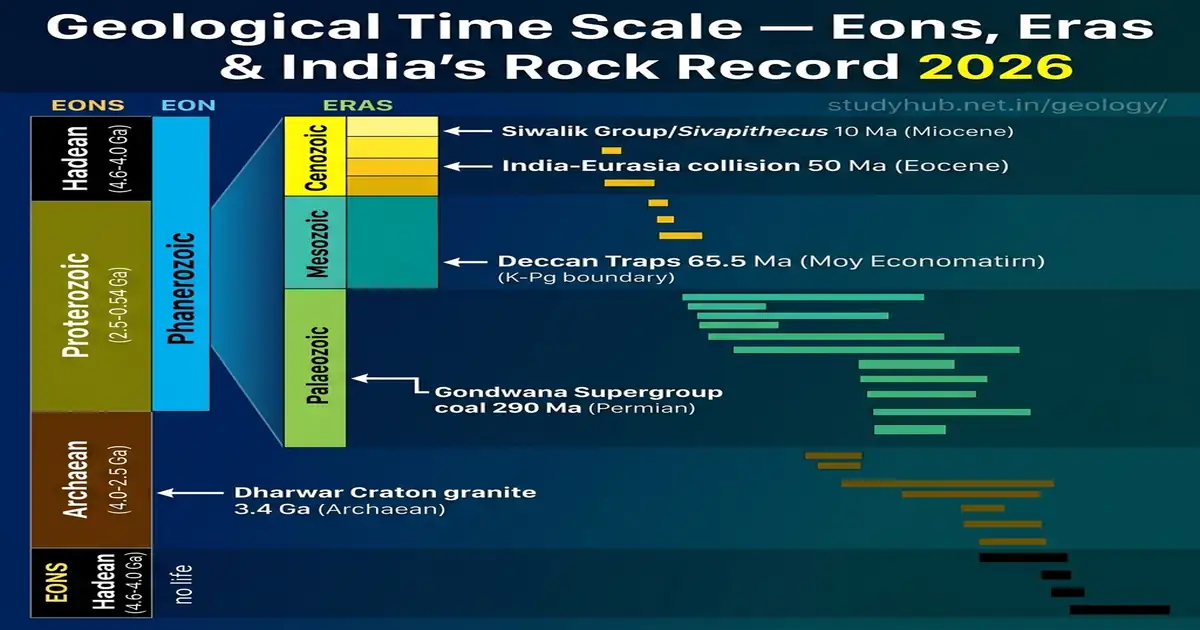
Geological Time Scale — Eons, Eras, Periods & India’s Complete Rock Record 2026
1. The Four Eons — Earth’s Master Timeline
| Eon | Duration | Key Characteristics | India’s Record |
|---|---|---|---|
| Hadean (Greek: Hades = underworld) | 4,600 Ma → 4,000 Ma (600 My duration). NOTE: “Hadean” not on official ICS chart — informal term above Archaean | No preserved rocks in India (none anywhere except Jack Hills zircon grains, Australia, 4.404 Ga). Intense meteorite bombardment. Late Heavy Bombardment (3.9 Ga — Moon’s craters date from this). Magma ocean cooling. First water ocean forming (4.2-4.4 Ga, based on geochemistry of ancient zircons). No O₂, mostly CO₂, H₂O, N₂ atmosphere. No life yet (or if any, no evidence preserved) | No Hadean rocks preserved in India. Most ancient Indian material: Jack Hills-type detrital zircons in Singhbhum Craton metasediments (claimed ~4.0 Ga but some debate). Oldest confirmed Indian rocks: Singhbhum Craton gneisses (~3.5 Ga, Jharkhand). Dharwar Craton basement (Karnataka) ~3.4 Ga |
| Archaean (Greek: Archaios = ancient) | 4,000 Ma → 2,500 Ma (1,500 My duration). ICS-defined Eon. Subdivided: Eoarchaean (4.0-3.6 Ga), Palaeoarchaean (3.6-3.2 Ga), Mesoarchaean (3.2-2.8 Ga), Neoarchaean (2.8-2.5 Ga) | Oldest preserved crustal rocks worldwide (Acasta Gneiss, Canada, 4.03 Ga). Greenstone belts = ancient volcanic-sedimentary successions in cratons (gold, chromite, nickel ore). First crust stabilisation (continental cratons form). First life = prokaryotic bacteria (3.5 Ga stromatolites in Pilbara, Australia). Banded Iron Formations (BIFs) deposited as oxygen from early photosynthesis oxidised dissolved iron. No free O₂ in atmosphere until Proterozoic. High heat flow (more radioactive isotopes). Granite-greenstone terrain develops | Dharwar Craton (Karnataka, 2.5-3.4 Ga): India’s most important Archaean craton. Contains Dharwar Supergroup greenstone belts hosting gold (Kolar Gold Field, Hutti mine), chromite, manganese, iron ore. Singhbhum Craton (Jharkhand/Odisha, 3.0-3.5 Ga): iron ore (BIF), copper ore, chromite (Sukinda ophiolite in Proterozoic). Bundelkhand Craton (MP/UP, Bundelkhand Granite ~2.5 Ga). Eastern Ghats Granulite Belt (Odisha/AP, ~2.5 Ga and older): khondalite, charnockite — remnants of India’s deep lower crust. Closepet Granite (Karnataka, 2.5 Ga — Late Neoarchaean — world-class example of Archaean composite batholith) |
| Proterozoic (Greek: Proteros = earlier + Zoe = life) | 2,500 Ma → 542 Ma (2,000 My duration — LONGEST EON). Subdivided: Palaeoproterozoic (2,500-1,600 Ma), Mesoproterozoic (1,600-1,000 Ma), Neoproterozoic (1,000-542 Ma) | Great Oxidation Event (GOE): 2,400 Ma — atmospheric O₂ rises rapidly, first “rust” (red beds), BIF deposition ends. Eukaryotes appear (~2.1 Ga single-celled). First multicellular animals = Ediacaran fauna (635-542 Ma — soft-bodied creatures, no hard shells, Namibia/Australia/India). Snowball Earth episodes (700-635 Ma — entire Earth frozen, 3 major glaciations: Sturtian, Marinoan, Gaskiers). Rodinia supercontinent forms (~1,100 Ma) and breaks apart (~750 Ma) — India was part of Rodinia. Cambrian Explosion at 542 Ma = sudden appearance of hard-shelled animals = base of Phanerozoic | Vindhyan Supergroup (MP/Rajasthan/Bihar/UP, 1,600-542 Ma — Mesoproterozoic to Neoproterozoic): most extensive Proterozoic sedimentary sequence in India. Includes: Kaimur Sandstone (red quartz arenite, important aquifer); Rohtas Limestone (cement industry); Rewa Sandstone (building stone — Agra Fort, Red Fort foundation courses at some sites). Total thickness 5,000 m. Minor diamonds in Panna district (within Vindhyan alluvial sequences). Aravalli Supergroup (Rajasthan, 2,100-1,700 Ma — Palaeoproterozoic): host for zinc-lead at Zawar mines, copper at Khetri. Delhi Supergroup (Rajasthan, 1,700-850 Ma): Khetri copper belt, garnet, emerald. Cuddapah (Kurnool) Supergroup (Andhra Pradesh, 1,600-600 Ma). Ediacaran fossils: Bhimbetka area (MP) and Raipur (Chhattisgarh) have yielded some of India’s oldest fossil evidence |
| Phanerozoic (Greek: Phaneros = visible + Zoe = life) | 542 Ma → Present (542 My so far). Subdivided: Palaeozoic (542-252 Ma), Mesozoic (252-66 Ma), Cenozoic (66 Ma-Present) | Abundant hard-shelled fossils → global rock correlation becomes possible. All major animal groups evolve. Mass extinctions shape biosphere (Big 5 mass extinctions). Continents drift from Gondwana through Pangaea breakup. Modern oceans form. Himalayas rise. Humans evolve (Quaternary) | See detailed Era table below. Gondwana Supergroup (Cambrian-Cretaceous continental strata of Peninsular India), Himalayan Tethyan sequences (Cambrian-Eocene marine strata), Deccan Traps (65.5 Ma), Siwaliks (Miocene-Pliocene), Indo-Gangetic alluvium (Quaternary) |
2. Phanerozoic Eras & Periods — with India’s Geological Events
| Era / Period | Age (Ma) | Key Global Events | India’s Rock Record & Events |
|---|---|---|---|
| PALAEOZOIC ERA Cambrian | 542–485 Ma | Cambrian Explosion — trilobites, brachiopods, arthropods appear. First vertebrates (jawless fish). India in Gondwana near South Pole | Tethyan Himalaya: Cambrian marine fossils (trilobites, small shelly fauna) in Zanskar / Spiti (Himachal Pradesh). Gondwana continent: no marine record — India was landlocked interior. Precambrian-Cambrian transition rocks: Salt Range (Pakistan-Punjab border area — important stratigraphic section) |
| Ordovician | 485–444 Ma | Great Ordovician Biodiversification Event. Marine invertebrates peak. First land plants (liverwort-like). Mass extinction at end-Ordovician (2nd largest: 85% species — Gondwana glaciation caused sea-level drop) | Everest summit limestone = Ordovician! (Ordovician marine shallow-sea carbonates, ~480 Ma, now pushed to 8,849 m by Himalayan uplift). Spiti — Ordovician graptolite shales. India near South Pole in Gondwana (glacial deposits) |
| Silurian | 444–419 Ma | First jawed fish. First vascular land plants (Cooksonia). Coral reef ecosystems recover post-extinction. Atmosphere O₂ rising. India moves slowly northward within Gondwana | Limited Silurian record in India. Spiti and Zanskar preserved Silurian marine carbonates. Peninsular India: no record (continental, no deposition). Talchir Formation (basal Gondwana) begins slightly later — late Carboniferous |
| Devonian | 419–359 Ma | “Age of Fishes”— jawed fish diversify. First amphibians (Tiktaalik). First forests (Archaeopteris). Devonian-Carboniferous mass extinction (3rd largest, 75% species — multiple pulses) | Spiti: Devonian marine sequences including fossil fish scales and plant debris. Peninsular India (on Gondwana interior) largely lacking marine Devonian; erosional surface. Kashmir: Devonian limestone in Pir Panjal range |
| Carboniferous | 359–299 Ma | “Coal Age” in Laurasian continents (Europe, N America). Giant insects (dragonfly wingspan 70cm). First reptiles. Pangaea begins assembling. Warm humid tropical forests → European/North American coal. India was ice-covered at Gondwana South Pole | India was near South Pole → GLACIATION (NOT coal like Europe). Talchir Formation (Gondwana Supergroup basal unit, ~299 Ma, latest Carboniferous-earliest Permian): glacial tillites, dropstones, varves — found in Damodar Valley, Mahanadi Valley, Godavari Valley. KEY EXAM POINT: India’s coal is Permian-age (NOT Carboniferous), unlike European coal which is Carboniferous |
| Permian | 299–252 Ma | Pangaea fully assembled. Permian-Triassic mass extinction = “Great Dying” (LARGEST mass extinction: 96% marine species, 70% terrestrial species). Siberian Traps LIP (volcanoes) + anoxia cause extinction | Gondwana Supergroup main coal measures: Barakar Formation (Permian, ~290 Ma — India’s MAIN coal seams; Jharia, Raniganj, Talcher, Singrauli, Ib River coalfields). Raniganj Formation (Late Permian). Panchet Formation (earliest Triassic — Lystrosaurus fossils, linking India to Antarctica+Africa). Glossopteris (Gondwana index plant fossil) in all Gondwana coal measures. India still in Gondwana. END-Permian mass extinction at 252 Ma — Panchet Formation records recovery fauna |
| MESOZOIC ERA Triassic | 252–201 Ma | Recovery after P-T extinction. First dinosaurs (~230 Ma). First mammals. First flying vertebrates (pterosaurs). Warm, dry climate. Tethys Sea separates Gondwana + Laurasia | Gondwana Supergroup: Panchet Formation (Lower Triassic — Lystrosaurus found in Panchet, connecting India to Gondwana fragments post-P-T extinction). Mahadeva Formation (Middle-Upper Triassic). Tethyan Himalaya: Triassic ammonites and brachiopods in Spiti (Tethys Sea was just north of Indian Gondwana margin). Rajmahal area: beginning of rift-related volcanism |
| Jurassic | 201–145 Ma | Dinosaurs dominant. First birds (Archaeopteryx, 150 Ma — feathered dinosaur). Pangaea breaks apart → Indian Ocean starts opening. Gondwana fragments: South America separates from Africa (~145 Ma). India-Antarctica-Australia still together | Gondwana Supergroup: Kota Formation (late Jurassic, Telangana) — dinosaur fossils (Kotasaurus, Barapasaurus = India’s oldest known sauropod). Jabalpur Formation (MP, Upper Jurassic-Cretaceous) — dinosaur eggs. Tethyan Himalaya: Jurassic ammonites (Spiti Shale, Himalayan marine sequence). India still part of Gondwana (southern hemisphere). Rajmahal Traps (Jharkhand, ~117 Ma — earliest Cretaceous but related to Jurassic-Cretaceous Kerguelen plume initiation) |
| Cretaceous | 145–66 Ma | Dinosaurs peak diversity then mass extinction (K-Pg, 66 Ma). First flowering plants (angiosperms) ~130 Ma. India separates from Gondwana ~130 Ma and races north. Deccan Traps erupt at K-Pg boundary. Chicxulub asteroid impact. | Rajmahal Traps (~117 Ma, Jharkhand — Kerguelen plume). India separates from Antarctica-Australia (~130 Ma). St. Mary’s Islands basalt (Karnataka, ~88 Ma — India-Madagascar rift marker). Dinosaur Egg sites: Jabalpur (MP), Balasinor (Gujarat — ~66 Ma). Intertrappean beds: dinosaur eggshells WITHIN Deccan Traps sequence. DECCAN TRAPS: 65.5 Ma, K-Pg boundary. K-Pg extinction: 75% species. Cretaceous marine record: Ariyalur (Tamil Nadu) — extensive marine Cretaceous fossils (ammonites, bivalves, echinoids). India drifted through tropics |
| CENOZOIC ERA Palaeogene (Palaeocene, Eocene, Oligocene) | 66–23 Ma | Mammals diversify rapidly (filling dinosaur niches). First primates (~55 Ma). India collides with Eurasia (~50 Ma, Eocene). Tethys Sea closes → Mediterranean remnant. Global cooling trend begins. Antarctica glaciates (~34 Ma, Eocene-Oligocene boundary) | India-Eurasia collision ~50 Ma (Eocene): Ladakh Batholith (60-45 Ma, granite arc — active subduction magmatism just before/during collision). Indus Yarlung Suture Zone (ophiolites = Tethys ocean floor). Nummulitic limestone: Eocene marine limestone formed in regression of Tethys Sea, found in Himachal Pradesh, Kashmir (Eocene = last marine Tethys sediments deposited on Indian-Eurasian margin before collision). Kutch (Gujarat): Eocene nummulitic limestone (petroleum-bearing). Kerala coast: Eocene-Oligocene beach terraces (sea level high stands) |
| Neogene (Miocene, Pliocene) | 23–2.6 Ma | Himalayas rising rapidly (Miocene uplift accelerates). Siwalik Group deposited as foreland basin. Grasslands spread globally. Sivapithecus (India, fossil ape, 12-7 Ma). Mediterranean desiccation event (5.9 Ma). Gibraltar Re-flood (5.3 Ma). Global cooling continues. | Siwalik Group (Miocene-Pliocene, Himalayan Foreland, Nepal terai, Punjab-Haryana-HP-UP-Arunachal): sandstone, conglomerate, clay deposited by rivers off rising Himalayas. Sivapithecus (12-7 Ma — fossil ape, possible ancestor of orangutan, found in Siwaliks, India = one of most important early primate fossil sites globally). LOWER Siwaliks (Miocene, ~14-7 Ma), MIDDLE Siwaliks (Late Miocene, ~10-5 Ma), UPPER Siwaliks (Pliocene, ~5-2 Ma). Deccan Traps long extinct. Active tectonism: MCT, MBT, MFT thrusting continues. Kerala: laterite formation (deep weathering in humid tropics — iron-rich hardpan). Rajasthan: wind-blown sand dune formation begins (Thar Desert) |
| Quaternary (Pleistocene, Holocene) | 2.6 Ma → Present | Ice Ages (Pleistocene glaciations — 20+ glacial/interglacial cycles). Homo sapiens evolve (300,000 BP). Sea level falls 120 m in glacial maxima (exposing land bridges). Last Glacial Maximum 21,000 BP. Holocene warm period 10,000 BP–Present. Sea level rise 120 m post-LGM. Human civilisation | Himalayan glaciations (multiple glacial advance-retreat cycles in Quaternary). Indo-Gangetic Plain (IGP): Bhangar (older terrace alluvium, Pleistocene) + Khadar (newer floodplain alluvium, Holocene) — NOT a rock, still unconsolidated sediment. Thar Desert sand dunes: active in Pleistocene-Holocene. Kerala heavy mineral beach placers: Quaternary sea-level control on placer deposits (ilmenite, garnet, zircon, monazite). Human evolution in India: Homo erectus tools at Attirampakkam (Tamil Nadu, 1.5 Ma). Early modern Homo sapiens tools ~75,000 BP in Jurreru Valley (Andhra Pradesh — survived Toba super eruption). Indus Valley Civilisation ~4,500-3,700 BP (Holocene) |
Key Stratigraphic Principles — Relative Dating Methods
| Principle | Statement | India Application / Exam Note |
|---|---|---|
| Superposition (Steno, 1669) | In undisturbed sedimentary sequences, the oldest layer is at the BOTTOM, youngest at TOP | Gondwana Supergroup: Talchir (glacial, oldest/bottom) → Barakar (coal, above) → Raniganj (coal, above) → Panchet (Triassic, top). Reading Gondwana sequence from bottom=OLDER to top=YOUNGER is fundamental |
| Original Horizontality (Steno, 1669) | Sediments are originally deposited in horizontal layers. Tilted beds = later deformation | Gondwana coalfield strata tilted and faulted by later tectonism. Vindhyan strata: gently tilted in Vindhyan basin. Himalayan strata: intensely folded and thrust-faulted (MCT, MBT) |
| Cross-Cutting Relationships (Hutton, 1788) | A feature that cuts across another MUST be younger than what it cuts | Deccan dyke swarms cut through older Gondwana and Precambrian rocks → dykes are younger (65-60 Ma). Granite plutons cutting Dharwar greenstone belts → granite is younger. Thrust faults (MCT, MBT) cut older metamorphic rocks |
| Inclusions | Fragments (inclusions) in a rock must be older than the rock that contains them | Xenoliths of Archaean gneiss in younger Deccan basalt intrusions → gneiss older. Clasts of granites in Gondwana conglomerates → granites older than Gondwana |
| Fossil Succession / Faunal Assemblages (William Smith, 1796-1815) | Each rock layer has a characteristic fossil assemblage. Same assemblage = same age globally (Index fossils) | Glossopteris (Permian Gondwana index fossil) in Damodar Valley coal → Permian age. Graptolites in Spiti shales → Ordovician-Silurian. Nummulites in Eocene Himalayan limestone → Eocene. Ammonites (Cretaceous index) in Ariyalur (TN). Sivapithecus in Siwaliks → Miocene |
| Unconformity | A gap (missing time) in the rock record = erosion surface between older and younger rocks. Angular unconformity = tilted older rocks + horizontal younger rocks above | Major unconformity between Archaean basement and unconformably overlying Gondwana Supergroup (Carboniferous) in Peninsular India — represents >1,500 Ma gap!. Vindhyan unconformably over Aravalli/Delhi sequences. Deccan Traps unconformably over older Gondwana strata in Madhya Pradesh |
Frequently Asked Questions
Why is India’s coal Permian-age when the “Coal Age” (Carboniferous) was 359–299 Ma? This is a critical exam point.
This is one of the most important and frequently confused facts in Indian geology exams. The global “Coal Age” is the Carboniferous Period (359–299 Ma) — named because enormous coal-forming tropical forests covered what is now Europe, North America, and parts of China during this time (Pennsylvanian sub-period of the Carboniferous). The famous European and North American coalfields (Saarland, Yorkshire, Pennsylvania, Ohio) are Carboniferous in age. But India’s coal is predominantly Permian-age (~290 Ma), NOT Carboniferous. The reason is tectonic and palaeoclimatic: During the Carboniferous, India was at or near the South Pole as part of the southern supercontinent Gondwana. The Carboniferous climate in India was not tropical-humid (coal-forming) — it was GLACIAL. India was covered by glaciers/ice sheets, as recorded by the Talchir Formation (basal Gondwana Supergroup, latest Carboniferous to earliest Permian age, ~299 Ma): the Talchir consists of glacial tillites (unstratified diamictite), dropstones (large boulders dropped into fine sediment from floating icebergs), and laminated glaciolacustrine varves. These are the definitive evidence that India was once at the South Pole — the same Talchir tillites are found in equivalent formations across all Gondwana landmasses (Africa, South America, Australia, Antarctica), which was one of Wegener’s key pieces of evidence for Continental Drift. After the glaciation ended in the early Permian, India’s climate warmed dramatically as Gondwana drifted northward — the meltwater lakes gave way to swampy tropical forests, producing the great Barakar Formation coal seams (early Permian, ~290 Ma — India’s most economically important coal horizon: Jharia coking coal, Raniganj thermal coal, Talcher Odisha coal, Singrauli coal all primarily come from Barakar Formation). The slightly younger Raniganj Formation (Late Permian) also contains important coal seams. So: Europe/North America coal = Carboniferous (~310 Ma). India’s coal = Permian Gondwana Supergroup (~290 Ma). Both formed in tropical swamp conditions — just at different times in different tectonic positions. For exam: “Why is Indian coal Permian not Carboniferous? — Because India was near the South Pole during the Carboniferous (glaciated, Talchir tillites) and drifted north to warmer tropical latitudes only in the Permian when coal-forming swamp forests developed.”
Important for Exams — Geological Time Scale UPSC, SSC & State PCS
4 Eons (oldest→youngest): Hadean (4.6-4.0 Ga, no rocks) → Archaean (4.0-2.5 Ga, first rocks/life) → Proterozoic (2.5-0.54 Ga, O₂ rise, multicellular life) → Phanerozoic (542 Ma-now, abundant fossils). 3 Eras of Phanerozoic: Palaeozoic (542-252 Ma) → Mesozoic (252-66 Ma) → Cenozoic (66 Ma-now). India Archaean rocks: Dharwar Craton (Karnataka, 2.5-3.4 Ga — gold, chromite). Singhbhum Craton (Jharkhand, 3.0-3.5 Ga — iron ore, copper). Bundelkhand Granite (MP/UP, 2.5 Ga). India Proterozoic: Vindhyan Supergroup (1.6-0.54 Ga — Red Fort/Agra Fort sandstone, Panna diamond). Aravalli-Delhi Supergroup (2.1-0.85 Ga — Zawar zinc, Khetri copper, Ajmer emerald). Gondwana Supergroup (Carboniferous-Cretaceous): Talchir (glacial tillite = South Pole evidence) → Barakar (main coal, Permian ~290 Ma) → Raniganj (coal, Late Permian) → Panchet (Triassic, Lystrosaurus) → Kota (Jurassic, dinosaurs). Key India Mesozoic: Rajmahal Traps (117 Ma, Jharkhand, Kerguelen plume). Dinosaur eggs (Jabalpur MP, Balasinor Gujarat). Deccan Traps (65.5 Ma = K-Pg boundary). Key India Cenozoic: India-Eurasia collision (50 Ma, Eocene). Nummulitic limestone (Eocene Himalayan). Siwalik Group (Miocene-Pliocene, foreland basin, Sivapithecus fossil ape). IGP Bhangar+Khadar alluvium (Pleistocene-Holocene). Exam traps: India’s coal = PERMIAN (NOT Carboniferous). India at South Pole during Carboniferous (Talchir glacial tillites). Everest summit = ORDOVICIAN limestone (from Tethys Sea). Lystrosaurus (K=Panchet Fm, Triassic) = proof Gondwana was connected. Sivapithecus (Siwaliks, Miocene) = fossil ape from India. Radioactive dating: C-14 max ~50,000 yr; U-Pb best for very old (>100 Ma) rocks; K-Ar for 100Ka-4.5 Ga.
What to Read Next
- Rock Cycle — India’s Archaean Granite to Gondwana Coal 2026
- Deccan Traps — K-Pg Boundary & Mass Extinction 2026
- Himalayan Formation — Eocene Collision to Modern Seismicity 2026
- Continental Drift — Glossopteris, Lystrosaurus & Talchir Tillites 2026
- Minerals — India’s Mineral Belts, Chromite & Lithium 2026
🎔 Exam Quick Reference — Geological Time Scale: 4 Eons: Hadean(4.6-4.0 Ga)→Archaean(4.0-2.5 Ga)→Proterozoic(2.5-0.54 Ga)→Phanerozoic(542 Ma-now). 3 Phanerozoic Eras: Palaeozoic(542-252 Ma)→Mesozoic(252-66 Ma)→Cenozoic(66 Ma-now). India Archaean: Dharwar Craton Karnataka (3.4 Ga, gold, chromite), Singhbhum Craton Jharkhand (3.5 Ga, iron, copper). India Proterozoic: Vindhyan Supergroup (1.6-0.54 Ga — Red Fort sandstone). Aravalli (2.1-0.85 Ga — zinc Zawar, copper Khetri). Gondwana Supergroup: Talchir (glacial, South Pole proof) → Barakar (Permian coal = Jharia/Raniganj) → Panchet (Triassic, Lystrosaurus) → Kota (Jurassic, Barapasaurus dinosaur). India coal = PERMIAN (NOT Carboniferous). Deccan Traps = 65.5 Ma (K-Pg, Cretaceous-Palaeogene). India-Eurasia collision = 50 Ma (Eocene). Siwaliks = Miocene-Pliocene (Sivapithecus primate). IGP = Quaternary alluvium (Bhangar=older Pleistocene, Khadar=newer Holocene). Everest summit = Ordovician limestone (Tethys Sea). Radiocarbon (C-14) max 50,000 yr. U-Pb dating for very old rocks. William Smith 1815 = Father of Stratigraphy. James Hutton 1788 = Father of Geology / Rock Cycle.
🌍 India’s 5 Major Geological Domains (Time-Based Summary): (1) Archaean Craton (pre-2.5 Ga): Dharwar (Karnataka), Singhbhum (Jharkhand), Bundelkhand (MP/UP) — oldest stable rock platforms; mineral-rich (gold, iron, chromite, copper). (2) Proterozoic Fold Belts & Basins (2.5-0.54 Ga): Aravalli-Delhi (Rajasthan), Vindhyan (MP/Rajasthan), Eastern Ghats (belt, Odisha/AP), Cuddapah (AP) — zinc, lead, copper, limestone, diamond, marble. (3) Gondwana Supergroup (Carboniferous-Cretaceous, ~299-65 Ma): Damodar Valley, Mahanadi Valley, Godavari Valley coalfields — coal (India’s most important energy mineral). (4) Deccan Traps (65.5 Ma): Maharashtra, MP, Gujarat, AP — basalt plateau (black cotton soil for agriculture, agate, building stone). (5) Cenozoic Himalayan & Foreland (50 Ma-present): Greater Himalaya (granite, schist), Siwalik Group (Miocene-Pliocene), Indo-Gangetic Plain alluvium (groundwater, agriculture). India’s mineral wealth is concentrated in domains 1, 2, 3.
About This Guide: Written by the StudyHub Geology Editorial Team (studyhub.net.in/geology/) based on NCERT Class 11 Physical Geography Chapter 3 (Landforms and their Evolution) and Chapter 5 (Minerals and Rocks), GSI (Geological Survey of India) “Geology and Mineral Resources of India” (5th edition), Wadia (1975) “Geology of India,” and International Commission on Stratigraphy (ICS) Chart v2023/04. Last updated: March 2026.