
Last Updated: March 2026 | Reading Time: 11 minutes | ~2,500 words | Category: Geomorphology & Glaciology
Glaciers are large, slow-moving masses of compacted ice that form over many years when snowfall exceeds snowmelt — the accumulated snow gradually compresses into dense ice under its own weight and begins to flow downslope under gravity. Glaciers are Earth’s largest freshwater reservoir after groundwater, storing ~69% of all fresh water on Earth. For India, Himalayan and Karakoram glaciers are existential: they feed the headwaters of the Ganga, Indus, Brahmaputra, and other major rivers that sustain ~600 million people across the Indo-Gangetic Plain, Pakistan, and Bangladesh. Glacial geomorphology is the study of landforms created by glacial erosion (cirques, U-valleys, arêtes, horns, hanging valleys, roche moutonnée) and glacial deposition (moraines, drumlins, eskers, kames, kettles, till plains). India’s glacier-sculpted landscapes — the high Himalayan peaks, deep U-shaped valleys of Kashmir and Uttarakhand, glacial lakes (tarns) and the spectacular waterfall-draped hanging valleys — are direct products of glaciation. Critically, Himalayan glaciers are retreating at accelerating rates due to climate change, creating a dual threat: (1) short-term increase in glacial melt → higher river flows + GLOF (Glacial Lake Outburst Flood) hazards; (2) long-term reduction in glacier volume → eventual decline in dry-season river flows → water scarcity crisis for South Asia. Understanding glacial processes, landforms, and India’s specific glacier inventory is essential for UPSC Civil Services (GS-I Geography + Environment), SSC CGL, UPSC NDA, and all State PCS examinations, as well as Current Affairs (glacier retreat + GLOF events are regularly in the news).
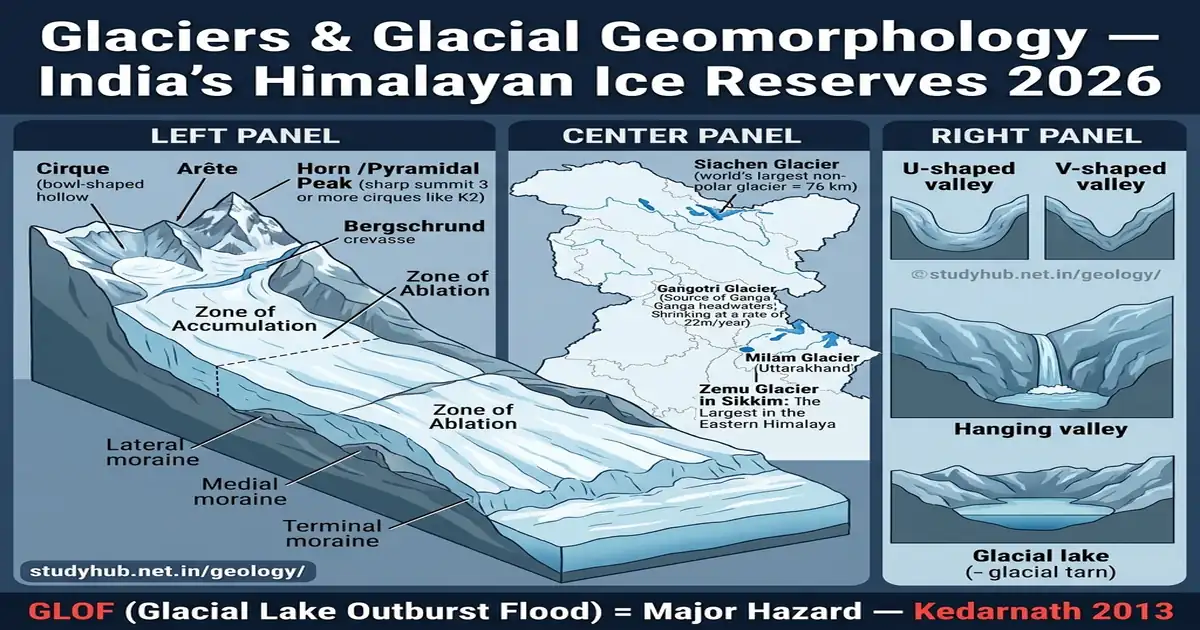
Glaciers & Glacial Geomorphology — India’s Himalayan Ice Reserves & Landforms 2026
1. How Glaciers Form & Move
| Concept | Explanation | Key Facts / India Context |
|---|---|---|
| Glacier Formation | Snowflakes accumulate in high-altitude basins (cirques) → under pressure and time, snow grains metamorphose: Fresh snow (density ~50-70 kg/m³) → Névé/Firn (partially compacted granular snow, ~550 kg/m³) → Glacier ice (interlocking crystals, density 830-917 kg/m³, blue-white colour from air bubble expulsion). Process takes decades to centuries depending on snowfall rate. Transition zone between accumulation zone (snow gains exceed losses) and ablation zone (snow losses exceed gains) = Equilibrium Line Altitude (ELA) | Himalayan glaciers: ELA typically 4,500–5,500 m elevation. Gangotri Glacier ELA ~5,000 m. Below ELA → ablation by melting, sublimation, calving. Annual mass balance = if accumulation > ablation → glacier advances; if ablation > accumulation → glacier retreats. India’s glaciers: almost all showing negative mass balance (retreating) since 1970s. Rate of retreat: Gangotri = ~22 m/yr; Zemu = ~10 m/yr average |
| Glacier Movement | Glaciers are NOT static — they flow downslope via two mechanisms: (1) Internal Deformation (Creep): ice crystals deform by slipping along crystal planes (like playing cards sliding) under gravitational stress. Rate: slow, fractions of mm to cm/day for deep cold ice. (2) Basal Sliding: ice at the base melts slightly due to pressure and geothermal heat → “lubricating” film of water allows entire glacier mass to slide on bedrock. Fast glaciers (warm-based glaciers) move mainly by basal sliding. Rates: 0.5 cm to several metres per day. Crevasses = tensile cracks where ice moves over irregular bedrock surface or changes speed | Siachen Glacier (Karakoram): moves ~70 cm/day. Gangotri Glacier (Garhwal Himalayas): moves ~22 m/year overall (ablation monitored). Himalayan glaciers = mostly polythermal (combination of cold ice in upper zone and warm/temperate ice at base). Glaciers flowing over cliff edges can calve (break off into lakes) → creating glacial lakes → GLOF risk. Indian Space Research Organisation (ISRO) and Geological Survey of India (GSI) jointly monitor Himalayan glaciers using satellite data |
| Types of Glaciers | (1) Valley (Alpine) Glaciers: flow down pre-existing river valleys, confined by valley walls. Most common in Himalayas and Karakoram. (2) Cirque Glaciers: small glaciers occupying bowl-shaped hollows (cirques) at mountain heads. (3) Piedmont Glaciers: valley glaciers that emerge from mountains and spread out on lowland plains. (4) Ice Sheets: continental-scale ice masses covering entire landmasses (Greenland, Antarctica — not in India). (5) Ice Fields: interconnected glacier network covering a highland area. (6) Hanging Glaciers: perched on steep mountain slopes, often feeding valley glaciers below. (7) Rock Glaciers: debris-mantled glaciers where surface rock insulates ice | India has predominantly Valley Glaciers (Himalayan and Karakoram mountain valleys). Siachen = largest valley glacier outside polar regions (76 km long). India has ~9,575 glaciers in the Himalayan-Karakoram region (ICIMOP 2023 estimate). Total glacier area: ~37,000 km². Total ice volume: ~3,200 km³ (equivalent to ~2,900 km³ freshwater). “Third Pole” concept: Himalayan-Tibetan Plateau = world’s third largest ice mass after Antarctica and Arctic, crucial for Asian monsoon system |
2. Glacial Erosion Landforms
| Landform | Formation Process | Shape & Features | India / World Example |
|---|---|---|---|
| Cirque (Corrie / Cwm) | Freeze-thaw weathering + rotational sliding of glacier scoops out a bowl-shaped hollow at the head of a glacier (where snow initially accumulates). The glacier’s rotational motion erodes the headwall and floor. When glacier melts, the cirque fills with water = Tarn (glacial lake) | Amphitheatre-shaped hollow with steep headwall and rock lip at lower end. Near-circular plan view from above | Common in Greater Himalayas: Har-ki-Dun (Uttarakhand), Roopkund Lake (tarn = cirque lake, Uttarakhand — famous for ancient skeletal remains). Kashmir Great Lakes (Vishansar, Krishansar tarns). Valley of Flowers (Uttarakhand — in a hanging glacial valley). European: Snowdon (Wales, “cwm”). Scottish corries |
| Arête | When two parallel glaciers erode cirques on opposite sides of a mountain ridge, the ridge between them is sharpened into a narrow, knife-edged ridge. Frost action continues to sharpen it further | Narrow, serrated, knife-sharp rocky ridge between two glacial valleys or cirques. Very thin, almost wall-like | Himalayan high ridges between Garhwal glaciers. Karakoram ridges (Pakistan). Classic Alps: Matterhorn approaches. In NW Himalayas: many arête ridges separate glacier valleys in Zanskar, Lahaul, Spiti |
| Pyramidal Peak / Horn (Glacial Horn, Nunatak) | When THREE or more cirques erode into the same mountain from different sides, the central peak is left as a sharp, pyramidal spike. Relentless freeze-thaw on the exposed peak sharpens it further. Also called “Glacial Horn” | Sharp, four-faced, pyramid-shaped peak. Steep faces on all sides | World’s most famous: Matterhorn (Switzerland/Italy, 4,478 m). India equivalent: Shivling Peak (Garhwal Himalayas, 6,543 m — natural pyramid beside Gangotri Glacier, often called “India’s Matterhorn”). K2 (Karakoram, 8,611 m — pyramidal). Trisul. Nanda Devi. Kedarnath Peak |
| U-Shaped Valley (Glacial Trough) | A pre-existing V-shaped river valley is deepened, widened, and straightened by a glacier. The glacier removes interlocking spurs (truncated spurs), erodes the valley floor flat, and creates characteristic parabolic (U-shaped) cross-section. Depth of erosion can be enormous — some glacial troughs eroded 1,000+ m deep. After glacier retreats, a long, deep glacial lake often fills the trough (fjord if sea-flooded) | Parabolic (U-shaped) cross-section. Flat wide floor. Steep, near-vertical walls. Truncated spurs (the interlocking spurs that existed in river valley are cut off flat by glacier). Very straight in plan view (glacier doesn’t meander like rivers) | Kashmir Valley: classic U-shaped glacial trough (Jhelum river now occupies the floor of a glacially-widened U-valley). Lahaul Valley (Himachal Pradesh). Zanskar Valley. Spiti Valley. Nun Kun Basin (Kashmir). European fjords: Norway (glacially widened river valleys flooded by sea). Yosemite Valley (USA) — classic glacial U-valley |
| Hanging Valley | A smaller tributary glacier joins a main glacier. The main glacier erodes much deeper (more ice, more erosive power) than the tributary. When ice retreats, the floor of the tributary valley is left “hanging” high above the main valley floor at a cliff-like junction. Waterfalls cascade down the cliff where hanging valley meets main valley | Side valley whose floor is significantly higher (50–300+ m) than the main valley floor. Waterfalls at junction mark the height difference | Yosemite: Bridalveil Fall from hanging valley. Kashmir: waterfalls along sides of U-shaped valleys. Lahaul-Spiti: hanging valleys with seasonal waterfalls. Valley of Flowers (Uttarakhand) is itself a hanging glacial valley above the main Bhyundar Valley. Some Uttarakhand waterfalls accessed by trekkers are from hanging valley junctions |
| Roche Moutonnée (Sheepback Rock) | Asymmetric bedrock knob formed as glacier overrides resistant rock. Upstream side (stoss): glacier abrades bedrock smooth (rock acts like sandpaper + glacier weight), creating gentle, polished, striated slope. Downstream side (lee): plucking (quarrying) by ice pulling away blocks creates rough, jagged, steep face. Glacial striations (parallel scratch marks) on stoss face record ice flow direction | Rounded, smooth, gently-sloping upstream face with striations. Steep, rough, jagged downstream face. Asymmetric drop | Found throughout former glacially-eroded zones: Spiti, Lahaul, Zanskar. Rohtang Pass area (Himachal). Glacially-polished granite slabs with striations in Kashmir. Classic examples: Yosemite (USA), Scottish Highlands |
| Fjord | Glacial trough eroded below sea level. When ice retreats, seawater floods the U-shaped valley, creating a long, narrow, deep arm of the sea with steep walls | Long (10s to 100s km), narrow, very deep (100–1,300 m), steep-walled sea inlet. Often with shallow threshold (rock sill) at mouth | Not found in India (India’s coast not beyond glacier reach during Quaternary). Classic: Norway (Sognefjord — 204 km long, 1,308 m deep), New Zealand, Chile, Alaska |
3. Glacial Deposition Landforms & India’s Major Glaciers
| Topic | Key Facts | India Context / Exam Relevance |
|---|---|---|
| Glacial Depositional Landforms | Till: unsorted, unstratified mixture of clay to boulders deposited directly by glacier (NOT sorted by water). Moraine = ridge/mound of till: Terminal/End moraine (at glacier’s furthest advance — marks maximum extent), Lateral moraine (along glacier sides — two lateral moraines merge to form Medial moraine when two glaciers join), Ground moraine (basal till sheet under glacier). Drumlin: streamlined, oval mound of till, elongated in direction of ice flow (swarm of drumlins = “basket of eggs” topography — stoss side blunt/upstream, tapered lee side). Esker: sinuous ridge of sand and gravel deposited in subglacial meltwater tunnel (river under ice). Kame: mound/hill of stratified drift deposited by meltwater in contact with stagnant ice. Kettle hole: depression left when buried ice block melts. Kettle lake: water-filled kettle | Himalayan moraines: extensive terminal and lateral moraines mark past maximum glacier extents — important for paleoclimate reconstruction. Siachen Glacier: large moraines at confluence zones. Gangotri Glacier: terminal moraine at Gaumukh (visible to trekkers = where glacier currently ends). Kashmir Valley floor: covered by glacial till and glacio-fluvial outwash (the flat fertile valley floor is on glacial sediment). Spiti, Lahaul: outwash plains (sandy, gravelly valleys below glacier snout). Glacial lake deposits: ancient lake beds (Kashmir Valley was glacially dammed lake in Pleistocene) |
| India’s Major Glaciers (inventory) | Siachen Glacier (Karakoram, Jammu & Kashmir/Ladakh): 76 km long, ~700 km² area. World’s largest non-polar glacier and second-largest glacier outside polar regions (after Fedchenko, Tajikistan). Elevation range: 3,620–7,672 m. Strategic importance: contested between India and Pakistan — Indian Army stationed at highest battlefield (6,000 m). Source of Nubra River (→ Shyok → Indus). Gangotri Glacier (Uttarkashi, Uttarakhand): 30 km long, ~286 km². Source of Bhagirathi River (one of the headwaters of the Ganga). Has retreated ~3 km since 1780 (first recorded observation). Rate: ~22 m/year average (variable). Gaumukh = snout where Bhagirathi emerges — melting point receding. Zemu Glacier (North Sikkim): ~26 km long, ~191 km². Largest glacier in eastern Himalayas. Feeds Teesta River headwaters. Milam Glacier (Pithoragarh, Uttarakhand): 19 km long, feeds Gori Ganga. Biafo Glacier (Pakistan-administered Karakoram): 67 km, joins Hispar Glacier (61 km) to form world’s longest glacier highway (Biafo-Hispar = 122 km combined). Kolahoi Glacier (Kashmir): source of Lidder River. Rohtang Pass glaciers (Himachal Pradesh): easily accessible, extensively studied. Pangi Valley glaciers (Chamba, HP) | UPSC exam importance: India has ~9,575 glaciers (Himalayan region only, not counting Karakoram fully). Siachen = world’s highest battlefield AND world’s longest non-polar glacier — both facts important. Gangotri is by far the most exam-tested glacier (source of Ganga, retreating, environmental concern). “Gaumukh” = snout of Gangotri Glacier = sacred source of Bhagirathi. GSI has been monitoring Indian glaciers since 1840s. ISRO’s National Glacier Monitoring Programme using Resourcesat, RISAT satellites. All Himalayan glaciers are retreating (negative mass balance) — “Third Pole” at risk. Chenab, Jhelum, Beas (Punjab) also source from glaciers in upper reaches |
| GLOF — Glacial Lake Outburst Flood | GLOFs occur when a glacial lake suddenly drains catastrophically. Causes: (1) Moraine dam failure — moraines are unconsolidated and can be breached by wave overtopping (from ice/rock avalanche into lake) or seepage-induced piping failure. (2) Ice dam failure — glacier blocking a valley can surge/melt suddenly. (3) Seismic triggering. Glacial lakes are forming rapidly as glaciers retreat — the receding glacier leaves behind a lake dammed by terminal moraine. These lakes are growing in size as the ice retreats further. Risk: if the moraine wall fails, the entire lake volume discharges catastrophically downstream — flood wave with enormous sediment + debris can travel 100s of km | India’s most catastrophic GLOFs: Kedarnath (Uttarakhand, June 2013): Chorabari Lake (glacial lake + moraine + rain) failed → catastrophic debris flow → ~6,000 deaths (official: 5,000+), entire town and highway devastated. Chamoli Flash Flood (February 2021): Ronti Peak rock-ice avalanche → River Rishiganga → Tapovan-Vishnugad hydropower plant debris completely overwhelmed (disaster killed ~200). Allegedly glacial lake/permafrost-related. National Disaster Management Authority (NDMA) 2023 report: 5,764 glacial lakes in Indian Himalayas, 188 identified as potentially dangerous GLOFs. States most at risk: Uttarakhand, Himachal Pradesh, Sikkim (South Lhonak Lake outburst, October 2023 — flooded Teesta basin, devastated Chungthang dam). NDMA + National Institute of Hydrology working on GLOF Early Warning Systems |
Frequently Asked Questions
Why are Himalayan glaciers retreating faster than glaciers elsewhere — and what does this mean for India’s water future?
Himalayan glacier retreat is one of the most consequential geological-climatic events of the 21st century for South Asia, and it requires understanding both the pace and the mechanism. First, the facts: Studies using multi-decadal satellite data (NASA’s GRACE mission measuring ice mass changes, ESA’s CryoSat, ISRO Resourcesat imagery) consistently show that Himalayan glaciers have lost ice mass at accelerating rates since the 1970s, with the rate roughly doubling between 2000–2019 compared to 1975–2000. Average retreat rates: Eastern Himalayas (Sikkim, Arunachal) and Central Himalayas (Uttarakhand) = fastest retreat (~0.5–2.0 km per decade). Western Himalayas (Himachal Pradesh, Kashmir) = slightly slower. Karakoram: anomalous — some glaciers here are actually advancing or stable (“Karakoram Anomaly”) — possibly due to increased winter snowfall or different regional climate patterns. Why faster than others? (1) Black Carbon / Soot Deposition: Industrial and vehicle emissions + crop burning in the Indo-Gangetic Plain create carbonaceous aerosol (black carbon/brown carbon) that deposits on glacier surfaces, darkening them → lower albedo (reflectivity) → absorb more solar radiation → accelerated melting. This is more intense in the Himalayas (downwind of heavily polluted IGP) than in Antarctica or the Alps. (2) South Asian Monsoon Amplification: Global warming is altering the monsoon — warmer, wetter summers in some parts increase ablation season length. Pre-monsoon warming (April-June) is melting glaciers before monsoon-triggered cloud cover arrives. (3) High Altitude Amplification (Elevation-Dependent Warming): The Himalayas are warming at 2× the global average rate at high elevations (>4,000 m) — this is a documented phenomenon called “elevation-dependent warming” or mountain amplification. (4) Permafrost Thaw: The frozen ground surrounding glaciers is also thawing, destabilising moraines and causing rock-ice avalanches that feed GLOF events. What does this mean for India’s water future? The “Peak Water” concept: as glaciers retreat, initially melt water contributions to rivers INCREASE (more ice melting). This peak melt period may last until 2050–2070 for many Himalayan glaciers. Beyond peak water: as glacier volumes decline, dry-season river flows (when glaciers provide most of their contribution = April-June before monsoon) will dramatically decrease. Rivers most at risk: Indus and its tributaries (Pakistan more vulnerable — ~50% of Indus annual flow is glacial melt). Ganga headwaters less vulnerable in absolute terms (most Ganga flow is monsoon-driven), but dry-season agricultural irrigation from snowmelt in UP/Bihar will be impacted. IPCC AR6 (2021) assessment: Hindu Kush Himalaya region will lose 50–80% of glacier volume by 2100 under high-emission scenarios. This would seriously threaten water security for 200+ million people in the Himalayan river basins.
Important for Exams — Glaciers & Glacial Geomorphology UPSC, SSC & State PCS
Glacier basics: Formed by snow compaction: Fresh snow → Névé/Firn → Glacier ice. Move by internal deformation + basal sliding. Accumulation zone (above ELA) vs Ablation zone (below ELA). Types: Valley (most common India/Himalaya), Cirque, Piedmont, Ice Sheet (not India), Hanging glacier. India’s major glaciers: Siachen (Karakoram, 76 km = world’s longest non-polar, highest battlefield). Gangotri (Uttarakhand, 30 km, source of Bhagirathi/Ganga, retreating ~22m/yr, snout=Gaumukh). Zemu (Sikkim, 26 km, largest in East Himalayas, Teesta source). Milam (Uttarakhand, Gori Ganga). Kolahoi (Kashmir, Lidder River source). Glacial erosion landforms: Cirque (bowl-shaped, tarn when water-filled — Roopkund Lake), Arête (knife-edge ridge between cirques), Horn/Pyramidal peak (3+ cirques converge — Shivling peak India’s “Matterhorn”), U-shaped valley (glacial trough — Kashmir Valley), Hanging valley (tributary glacier valley elevated above main valley floor — waterfalls), Truncated spurs (interlocking spurs cut off), Roche moutonnée (asymmetric polished+plucked bedrock knob, striations show ice direction), Fjord (flooded glacial trough — NOT in India). Glacial deposition: Till (unsorted sediment dumped by glacier). Moraines: Terminal (farthest extent), Lateral (sides), Medial (two glaciers merge), Ground moraine. Drumlins (streamlined oval till mounds — “basket of eggs”). Eskers (sinuous meltwater tunnel ridges). Kames (mounds by meltwater). Kettles (ice-block depressions). GLOF hazards India: Kedarnath 2013 (Chorabari Lake failure, 5,000+ deaths). South Lhonak Lake outburst, Sikkim 2023 (Teesta floods, Chungthang dam destroyed). Chamoli 2021 (rock-ice avalanche, 200 deaths, Tapovan tunnel). 5,764 glacial lakes in Indian Himalayas (NDMA 2023), 188 potentially dangerous. Karakoram Anomaly: Some Karakoram glaciers advancing while Himalayan glaciers retreat — due to different regional climate/increased winter snowfall. “Third Pole”=Himalayan-Tibetan Plateau = Earth’s 3rd largest ice mass.
What to Read Next
- Rivers & Fluvial Geomorphology — India’s River Systems Fed by Glacial Melt 2026
- Himalayan Formation — Why the Himalayas Have the World’s Largest Glaciers 2026
- Earthquakes — How Himalayan Seismicity Triggers GLOFs 2026
- Weathering — Frost Wedging in Himalayan Glacial Environments 2026
- Geological Time Scale — India’s Quaternary Glaciations in the Himalayas 2026
🎔 Exam Quick Reference — Glaciers & Glacial Geomorphology: Glacier formation: Snow → Névé/Firn → Glacier ice. Types: Valley (Himalaya), Cirque, Ice Sheet (Antarctica/Greenland, NOT India). Glaciers move by: Internal deformation + Basal sliding. India glaciers: Siachen (Karakoram, 76km = world’s longest non-polar glacier, highest battlefield, Nubra River source). Gangotri (Uttarakhand, 30km, Bhagirathi/Ganga source, retreating ~22m/yr, Gaumukh = snout). Zemu (Sikkim, largest East Himalaya, Teesta source). Milam (Uttarakhand). Kolahoi (Lidder River, Kashmir). Erosion landforms: Cirque (bowl, tarn when filled — Roopkund), Arête (knife ridge), Horn/Pyramidal peak (3+ cirques — Shivling = “India’s Matterhorn”), U-valley (glacial trough — Kashmir Valley), Hanging valley (waterfall), Truncated spur, Roche moutonnée (polished stoss + plucked lee face), Glacial striations. Deposition landforms: Till (unsorted), Terminal/Lateral/Medial/Ground moraines. Drumlins (oval till mounds, streamlined). Eskers (meltwater tunnel ridges). Kames, Kettles. GLOF: Kedarnath 2013 (5,000+ deaths, Chorabari Lake). Sikkim Oct 2023 (S. Lhonak Lake, Chungthang dam). Chamoli 2021 (200 deaths). 5,764 glacial lakes India (NDMA), 188 dangerous. Karakoram Anomaly: Karakoram glaciers advancing ≠ Himalayan retreat. Third Pole = Himalayan-Tibetan ice. Glacier retreat accelerating: black carbon from IGP pollution lowering albedo + elevation-dependent warming (Himalayas warm 2× global average).
🌍 Glacier Retreat Comparison Table (Key Himalayan Glaciers): Gangotri (Uttarakhand): 30 km long, retreated ~3 km since 1780, rate ~22 m/yr, Bhagirathi/Ganga source. Siachen (Karakoram): 76 km, relatively more stable than Himalayan glaciers (Karakoram Anomaly), massive strategic importance (India-Pakistan dispute). Zemu (Sikkim): 26 km, retreating ~10 m/yr, Teesta headwaters. Milam (Uttarakhand): 19 km, retreating ~10–15 m/yr. Kolahoi (Kashmir): 11 km², shrinking rapidly (lost ~22% area over last century). Dokriani (Uttarakhand): extensively monitored by Geological Survey of India-Wadia Institute, retreated ~580 m in 30 years. Satopanth & Bhagirathi Kharak (Uttarakhand): near headwaters of Alaknanda. Key institutions: Wadia Institute of Himalayan Geology (WIHG, Dehradun) — India’s premier glacier research centre. GSI’s Glacier Division. National Institute of Hydrology (NIH, Roorkee). ISRO Snow and Glacier (SG) group. ICIMOD (International Centre for Integrated Mountain Development, Kathmandu) — regional body for Hindu Kush Himalaya research.
About This Guide: Written by the StudyHub Geology Editorial Team (studyhub.net.in/geology/) based on NCERT Class 11 Physical Geography Chapter 7 (Geomorphic Processes — Glacial), Wadia Institute of Himalayan Geology Glacier Reports 2022-2023, NDMA Glacial Lake Outburst Flood Report 2023, IPCC AR6 Chapter 4 (Changing Ocean and Cryosphere), and GSI Himalayan Glaciers Inventory (2023). Last updated: March 2026.