
At 2,900 kilometres below Earth’s surface — deeper than any drill hole will ever reach — lies one of the planet’s most dramatic physical transitions: the Gutenberg Discontinuity, also known as the Core-Mantle Boundary (CMB). Named after German-American seismologist Beno Gutenberg (1889–1960), who deduced its existence in 1914 by analysing the behaviour of seismic waves from earthquakes recorded globally, this boundary marks the abrupt interface between the solid lower mantle (peridotitic rock — bridgmanite and ferropericlase) and the liquid outer core (molten iron-nickel alloy). The Gutenberg Discontinuity is physically even more dramatic than the Moho: at this boundary, P wave velocity drops abruptly from ~13.7 km/s to ~8.1 km/s — the largest single velocity drop of any seismic discontinuity on Earth — and S waves completely cease to propagate, because S waves cannot travel through liquids and the outer core is liquid iron. This total S wave disappearance beyond 103° angular distance from earthquakes provided Gutenberg with the definitive proof that the outer core is liquid — one of the most important deductions in the history of Earth science. For UPSC, SSC, NDA, and state PCS exams, the precise depth, the velocity values, and the distinction between the Gutenberg and Moho discontinuities are tested directly.
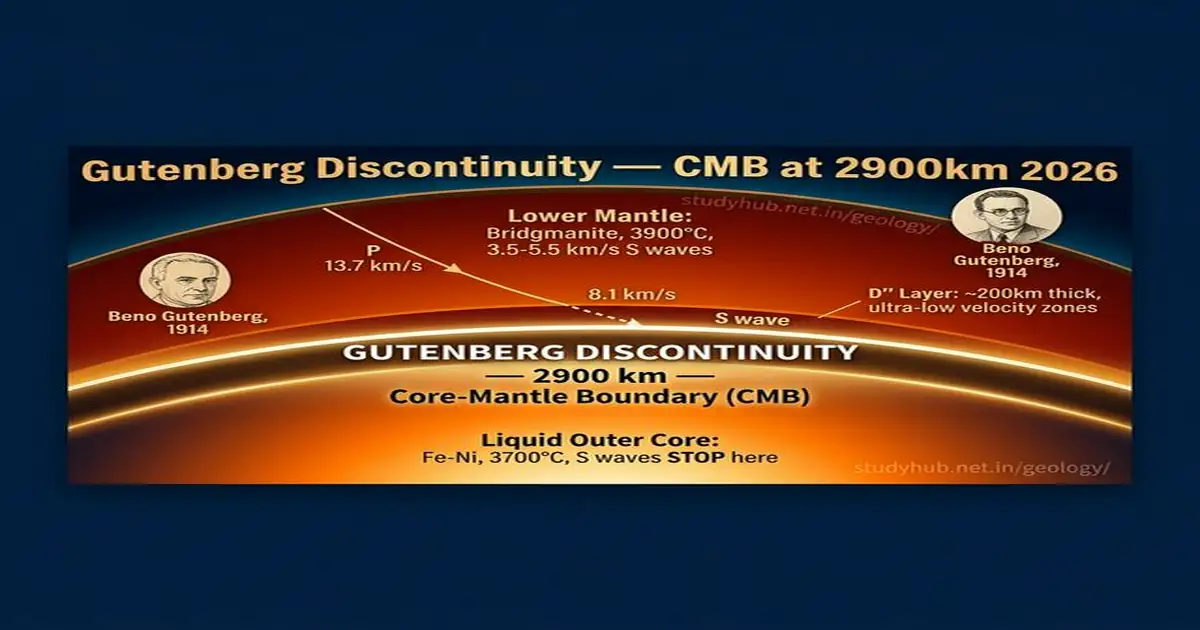
Gutenberg Discontinuity — Core-Mantle Boundary: Key Facts & Seismic Significance 2026
Gutenberg Discontinuity — Complete Reference Table
| Parameter | Value / Details |
|---|---|
| Full Name | Gutenberg Discontinuity (also: Core-Mantle Boundary, CMB) |
| Discovered By | Beno Gutenberg (1889–1960, German-American seismologist), working in Frankfurt/Göttingen at the time of publication |
| Discovery Year | 1914 — published as part of his systematic analysis of global P wave travel times and shadow zones |
| Depth | 2,900 km below Earth’s surface (accepted global value). This is ~54% of Earth’s radius from the surface |
| P Wave Velocity — Above (Lower Mantle) | ~13.5–13.7 km/s (very fast — bridgmanite lower mantle under enormous pressure) |
| P Wave Velocity — Below (Outer Core) | ~8.0–8.1 km/s — drops by ~5.5 km/s at the boundary. This dramatic slowdown is because although the outer core is denser than the mantle, it is liquid and has zero shear modulus; P (compressional) waves travel more slowly in liquid Fe-Ni than in solid bridgmanite under the same pressure conditions |
| S Wave Behaviour | S waves completely STOP at the CMB and do not penetrate the outer core. S waves require shear resistance to propagate; liquids have zero shear modulus. Result: total S wave shadow zone from 103°–180° angular distance from earthquakes. This is the definitive seismic proof that the outer core is liquid |
| Density Jump | Lower mantle: ~5.5 g/cm³ (bridgmanite+ferropericlase); Outer Core: ~9.9–10 g/cm³ at the top. A jump of ~4.5 g/cm³ — the single largest density jump at any internal Earth boundary. Total change: from 5.5 g/cm³ to 10 g/cm³ (nearly double) |
| Temperature at CMB | ~3,700–4,000°C (mantle side) / ~3,700°C (core side). Small temperature contrast across the boundary itself — the contrast is compositional (mantle rock vs liquid iron), not primarily thermal |
| Pressure at CMB | ~136 GPa (136 million atmospheres) — enormous pressure, yet the outer core remains liquid because iron’s melting point at this pressure is below the actual temperature |
| Seismic Shadow Zones | P wave shadow zone: 103°–143° (P waves refract around the core and arrive late/weak in this range). S wave shadow zone: 103°–180° (total disappearance). Discovery of these shadow zones = Gutenberg’s deduction method |
| Compositional Change | Mantle (above): solid silicate rock (bridgmanite MgSiO₃, ferropericlase MgO, Ca-perovskite) — rock chemistry. Core (below): liquid iron-nickel alloy (~80% Fe, ~5% Ni, ~10–15% lighter elements S, O, Si, C, H) — metallic chemistry. The most dramatic compositional change in Earth’s interior — from silicate to metallic iron |
| Related Feature — D″ Layer | The lowermost ~200 km of the mantle above the CMB is called the “D″” (D double-prime) layer — a region of anomalous seismic behaviour: ultra-low velocity zones (ULVZs: up to 30% velocity reduction in small zones), seismic anisotropy, possible partial melt (iron-enriched silicate melt). Source region of deep mantle plumes. Post-perovskite phase transition (bridgmanite → post-perovskite at 125 GPa, ~2,700 km) may explain some D″ properties |
Comparing All Three Major Earth Discontinuities
| Property | Mohorovičić (Moho) | Gutenberg | Lehmann |
|---|---|---|---|
| Discovered By / Year | Andrija Mohorovičić / 1909 | Beno Gutenberg / 1914 | Inge Lehmann / 1936 |
| Depth | 5–70 km (varies; ~35 km continental average) | 2,900 km (fixed, global) | 5,100 km (fixed, global) |
| Boundary Marks | Crust ↔ Upper Mantle | Lower Mantle ↔ Outer Core (CMB) | Outer Core ↔ Inner Core (ICB) |
| P Wave Change | 6.5 → 8.0 km/s (increase) | 13.7 → 8.1 km/s (dramatic decrease) | 8–10 km/s → 11–12 km/s (increase again) |
| S Wave Change | 3.6 → 4.5 km/s (increase) | ~7.3 → 0 km/s (STOPS — liquid outer core) | 0 → ~3.5 km/s (reappears — solid inner core) |
| Density Jump | 2.7–3.0 → 3.3 g/cm³ | 5.5 → 10.0 g/cm³ (largest jump) | 12.0 → 12.5 g/cm³ (slight increase) |
| Compositional Change | Silicate crust → Ultramafic peridotite | Silicate rock → Liquid Fe-Ni metal | Liquid Fe-Ni → Solid Fe-Ni (hcp iron) |
| State Change | Solid → Solid (both rigid) | Solid → LIQUID (biggest state change) | Liquid → SOLID (pressure solidification) |
| Seismic Method | Refracted P arrivals (direct + headwave) | P shadow zone + S total disappearance | Anomalous PKiKP/PKIKP in P shadow zone |
| Memory Trick | Moho = Mantle boundary (M for Moho, M for Mantle). “Mo-ho” = shallow boundary | Gutenberg = Greatest boundary (deepest mantle). S waves stop = outer core is liquid | Lehmann = discovered inner core from anomalous P waves (Lehmann’s “P'” paper 1936) |
The D″ Layer — Earth’s Most Mysterious Zone
Just above the Gutenberg Discontinuity — in the lowermost ~200–300 km of the mantle (approximately 2,600–2,900 km depth) — lies the D″ layer (pronounced “D double-prime”), one of Earth’s most enigmatic geological regions. First identified by Keith Bullen in 1950 from anomalies in seismic travel time data (he systematically labelled Earth’s layers A through G, with the innermost core “G”; the lowermost mantle became “D” and its anomalous basal portion “D″”), the D″ layer has become one of the most active areas of deep Earth research in the 21st century. Key anomalies of the D″ layer: Ultra-Low Velocity Zones (ULVZs) — localised patches (10s to 100s of km across) where P wave velocity is reduced by 10–30% from normal lower mantle values. These anomalously slow zones are detected by seismic waves grazing the CMB (SmKS phases). They likely represent iron-enriched partial melt — silicate rock with some iron from the outer core that has crystallised out or infiltrated upward into the lowermost mantle. ULVZs may overlie large low-shear-velocity provinces (LLSVPs) — broad thermochemical piles of ancient subducted or primitive mantle material. Post-Perovskite Phase Transition: In 2004, Japanese scientists (Murakami et al., Science) demonstrated using diamond-anvil cell experiments that bridgmanite (MgSiO₃ perovskite, the dominant lower mantle mineral) transforms to a denser post-perovskite phase at pressures corresponding to ~125 GPa (approximately 2,700 km depth) and temperatures relevant to the D″ layer. This phase transition has the correct seismic properties (especially anisotropy — directional velocity dependence) to explain the D″ layer’s distinctive seismic signature. Seismic Anisotropy: Seismic waves travel at different speeds depending on their polarisation direction in the D″ layer — suggesting preferential alignment of post-perovskite crystals by mantle flow. This provides direct evidence for horizontal flow in the D″ layer (driving heat from the CMB into upwelling plumes). Large Low-Shear-Velocity Provinces (LLSVPs): Seismic tomography (3D imaging of Earth’s interior from global earthquake data) reveals two continent-sized slow anomalies at the CMB — one under the Pacific Ocean, one under Africa/Atlantic. These “thermochemical piles” may be ancient reservoirs of geochemically distinct mantle material (possibly remnants of Earth’s early magma ocean), or they may be repositories of subducted slabs that have descended to the CMB over billions of years. They appear to be the sites where deep mantle plumes (including possibly the ancient Réunion plume that created India’s Deccan Traps at 65.5 Ma) originate.
Frequently Asked Questions
How did Gutenberg discover the CMB in 1914 without any supercomputers?
Beno Gutenberg’s 1914 discovery of the core-mantle boundary is one of the greatest feats of scientific detective work in the history of geoscience — achieved with nothing more than paper seismograms, mechanical clocks, and meticulous mathematical analysis. Here is how he did it:
Step 1 — Collecting global seismograms: By 1914, a global network of seismograph stations had been established following the 1906 San Francisco earthquake (which spurred investment in earthquake monitoring). Gutenberg systematically collected P wave arrival times from major earthquakes at hundreds of seismograph stations distributed at varying angular distances from earthquake epicentres.
Step 2 — Identifying the P wave shadow zone: Plotting P wave arrival times against angular distance (0° to 180°), Gutenberg noticed a dramatic anomaly: from approximately 103° to 143° angular distance, P waves arrived much later than expected (or were completely absent) compared to the smooth travel time curve applicable at closer distances. This “shadow zone” required an explanation — direct P waves should be detectable at all distances if Earth’s interior were a smoothly varying sphere.
Step 3 — Modelling the refraction: Using Snell’s Law for seismic waves (analogous to optical refraction of light at a glass-air boundary), Gutenberg calculated what kind of internal boundary could produce a shadow by refracting P waves away from the 103°–143° zone. His calculation placed a boundary of dramatically lower P wave velocity at approximately 2,900 km depth — remarkably close to the currently accepted value of 2,891 km. The P wave slowdown (13.7 → 8.1 km/s) caused waves to refract so strongly that none could reach the shadow zone by direct paths.
Step 4 — S wave evidence: Even more telling: S waves simply disappear beyond 103° — not just weakened but totally absent. This total extinction of S waves (not just shadow zone weakening as seen for P waves) conclusively proved that the outer core is liquid — the only physical explanation for zero S wave transmission. Gutenberg published these results in 1914, at age 25, while working at the Geophysical Institute in Göttingen. He later fled Nazi Germany (1930) and joined Caltech in Pasadena, where he continued transformative research in seismology and earthquake magnitude (the Gutenberg-Richter law on earthquake frequency distribution co-authored with Charles Richter). For exam: Gutenberg → CMB → 2,900 km → 1914 → P wave shadow zone 103°-143° + S wave total disappearance >103° → outer core = LIQUID.
Important for Exams — Gutenberg Discontinuity Facts for UPSC, SSC & State PCS
Core facts: Gutenberg Discontinuity = Core-Mantle Boundary (CMB) = 2,900 km depth. Discovered by Beno Gutenberg, 1914, from P wave shadow zone analysis.
Seismic signature (memorise): P wave: 13.7 km/s (lower mantle) → 8.1 km/s (outer core) = LARGEST P wave drop at any Earth boundary. S wave: disappears entirely beyond 103° = LIQUID outer core proof. P shadow zone: 103°–143°. S shadow zone: 103°–180°.
Physical changes at CMB: Solid silicate → Liquid Fe-Ni (most dramatic state change in Earth); Density 5.5 → 10 g/cm³ (nearly doubles — largest density jump); Temperature ~3,700–4,000°C (near constant across boundary); Pressure ~136 GPa. D″ layer: Lowermost 200–300 km of mantle above CMB. Features: Ultra-Low Velocity Zones (ULVZ, up to 30% velocity reduction); Post-perovskite phase (discovered 2004); Seismic anisotropy; LLSVPs (Large Low-Shear-Velocity Provinces) — source of deep mantle plumes.
Three discontinuities comparison: Moho (35 km, crust-mantle, Mohorovičić 1909); Gutenberg (2,900 km, mantle-outer core, Gutenberg 1914); Lehmann (5,100 km, outer core-inner core, Lehmann 1936).
Gutenberg-Richter Law: log N = a − bM (relationship between earthquake frequency and magnitude) — same Beno Gutenberg, with Charles Richter, 1956.
India context: Réunion mantle plume — possibly originated from LLSVP at CMB under Africa/Indian Ocean → rose to base of lithosphere → Deccan Traps eruption (65.5 Ma) → hotspot trail: Deccan → Lakshadweep → Réunion (active today).
What to Read Next
- Seismic Waves — How P Waves & S Waves Reveal Earth’s Hidden Interior 2026
- Earth’s Full Structure — Crust, Mantle, Outer Core & Inner Core Explained 2026
- Earth’s Core — Iron-Nickel, Geodynamo & Magnetic Field 2026
- Moho Discontinuity — Crust-Mantle Boundary, India Depths & Project Mohole 2026
- Earth’s Mantle — Composition, Asthenosphere, Convection & Deccan Traps Plume 2026
🎔 Exam Quick Reference — Gutenberg Discontinuity: Depth: 2,900 km. Discovered: Beno Gutenberg, 1914. Also called: Core-Mantle Boundary (CMB). P wave: 13.7 km/s (mantle) → 8.1 km/s (outer core) = LARGEST P wave drop. S wave: STOPS at CMB (outer core = LIQUID). P shadow zone: 103°-143°. S shadow zone: 103°-180°. Density: 5.5 → 10 g/cm³ = LARGEST density jump. Pressure: 136 GPa. D″ layer: 200-300km above CMB — post-perovskite, ULVZs, LLSVPs → source of mantle plumes. Three discontinuities: Moho (35km) | Gutenberg (2900km) | Lehmann (5100km). Gutenberg-Richter Law (earthquake magnitude frequency) = same Gutenberg.
🌍 India Connection — Déccan Traps & D″: Seismic tomography shows the LLSVP (Large Low-Shear-Velocity Province) under Africa-Indian Ocean sector of the CMB. This anomalous thermochemical pile may be the deep mantle reservoir from which the Réunion plume originated ~70 Ma. The plume rose from CMB (~2900km depth) through 2900km of mantle over ~5 million years → impinged on base of Indian lithosphere (~65.5 Ma) → Deccan Traps flood basalt eruption (500,000 km² basalt plateau). NGRI seismic tomography studies confirm low-velocity mantle beneath western India consistent with Réunion plume passage. The D″ layer → Deccan Traps link is a textbook example of deep mantle processes controlling surface geology.
About This Guide: Written by the StudyHub Geology Editorial Team (studyhub.net.in/geology/) based on NCERT Class 11 Physical Geography Chapter 3, Lay & Wallace “Modern Global Seismology” (1995), Gutenberg (1914) original CMB paper, Murakami et al. (2004) post-perovskite discovery (Science), and Garnero & McNamara (2008) LLSVP review (Science). Last updated: March 2026.