
Last Updated: March 2026 | Reading Time: 13 minutes | ~2,900 words | Category: Economic Geography — Agriculture of India
Agriculture is the backbone of India’s economy and the foundation of its civilisation. India is the world’s 2nd largest agricultural producer (by value, after China), the world’s largest producer of milk, pulses, spices, bananas, mangoes, and jute, the 2nd largest producer of wheat, rice, cotton, sugarcane, fruits, and vegetables, and a major exporter of rice (world’s largest rice exporter since 2012), spices, marine products, fruits, and cotton. Agriculture and allied sectors (forestry, fisheries) contribute approximately 18.3% of India’s GDP (2022-23), employ about 42% of India’s workforce, and feed 1.43 billion people. India has the world’s largest cultivated land area — approximately 182 million hectares (454 million acres) of net sown area, with a gross cropped area of ~200 million hectares when multiple-cropping is included. Yet despite these impressive numbers, Indian agriculture is characterised by profound challenges: small, fragmented landholdings (average 1.08 hectares per farmer family, 2015-16 Agricultural Census), heavy monsoon dependence (only 52% of cultivated land is irrigated, rest rainfed), low mechanisation (rapidly improving), high input costs, market inefficiencies, price volatility, chronic farmer indebtedness, and climate change risks. The Green Revolution (mid-1960s–1980s) transformed India from a famine-threatened “ship-to-mouth” import dependency to food self-sufficiency — one of 20th century India’s greatest achievements. But it also created new problems: soil degradation, groundwater depletion, crop monoculture, and regional inequalities (Punjab-Haryana-UP benefited far more than eastern and peninsular India). India’s food security architecture — the Public Distribution System (PDS), Food Corporation of India (FCI), Minimum Support Price (MSP) mechanism, and the National Food Security Act (NFSA) 2013 — represents one of the world’s largest food welfare systems, covering approximately 813 million beneficiaries. Understanding India’s agricultural geography — cropping seasons, major crop belts, irrigation systems, the Green Revolution’s legacy, and India’s policy framework — is essential for UPSC General Studies Paper I (Geography, Agriculture) and Paper II (Social Issues, Governance, Government schemes).
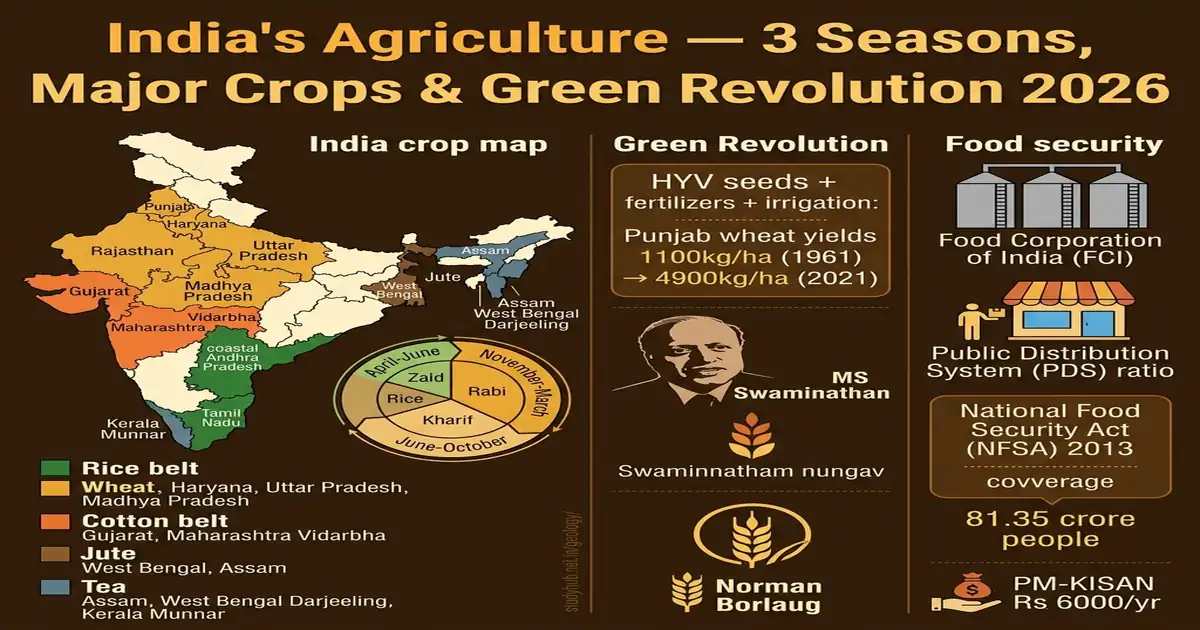
India’s Agriculture — Cropping Seasons, Major Crops, Green Revolution & Food Security 2026
1. Farming Types, Cropping Seasons & Major Crops
| Topic | Details | Key Examples & India Data |
|---|---|---|
| Types of Farming in India | SUBSISTENCE FARMING: farmer grows primarily for own consumption. Primitive subsistence: shifting cultivation (Jhum in NE India = Assam, Mizoram, Manipur — burning + planting, then shifting to new plot after 2-3 years. Also called: Podu in AP-Odisha, Bewar/Dahiya in MP-CG, Kumari in WG, Valre/Waltre in SE-WG, Kuruwa in Jharkhand, Dippa/Koman in Bastar CG). Intensive subsistence: small plots, maximum outputs, intensive labour use (Bengal, Kerala, TN — high population pressure, multi-cropping). COMMERCIAL FARMING: grown for market sale. Extensive commercial: large farms, high mechanisation, monoculture (Punjab wheat, Rajasthan mustard, Gujarat cotton). Plantation farming: large estate growing single cash crop using skilled + seasonal labour (Tea: Assam, WB Dooars-Terais, HP Kangra, Kerala Munnar; Coffee: WG Karnataka Coorg/Kodagu, Chikmagalur; Rubber: Kerala; Tobacco: Andhra Pradesh/TN). Mixed farming: crops + livestock together. Cooperative farming: AMUL = Anand Milk Union Ltd (Gujarat, world’s largest dairy cooperative) | Shifting cultivation: JH banned (Supreme Court 2000 order on forest burning) — but 10,000+ families still practise in NE (Mizoram has highest area under Jhum = 3-4% land). Debate: is Jhum sustainable? Traditional ecological knowledge — when rotation cycle is long (20+ years) = forests recover. But as population grows, cycle shortened (now 3-5 years) → forests don’t recover → degradation. AMUL (Anand Milk Union Ltd, founded 1946, Dr Verghese Kurien “Milk Man of India”): transformed India from milk-deficit to world’s LARGEST milk producer (221 MT/yr, 2022-23). White Revolution / Operation Flood (1970-1996): 3 phases of Indian dairy development → milk production 5x increased. National Dairy Development Board (NDDB, Anand, Gujarat). Tea: Assam = 53% India’s tea production. WB Darjeeling tea = world’s most expensive tea (GI tag). Munnar (Kerala) and Nilgiris (TN) for South India tea. India = 2nd largest tea producer (after China). India = 1st largest tea exporter until recently (now surpassed by Kenya in some years) |
| Cropping Seasons: Kharif, Rabi & Zaid | KHARIF (Autumn) CROPS: Sown: June-July (with SW Monsoon onset). Harvested: September-October. Weather: require warm, moist conditions + high rainfall. Chief Kharif crops: Rice (Oryza sativa — needs hot wet climate, 150-200cm rain or irrigation, transplanting method — WB, Assam, UP, Bihar, TN, AP, Karnataka, Kerala). Jowar (Sorghum, CE Deccan Plateau, Maharashtra-Karnataka-AP). Bajra (Pearl millet, drier semi-arid areas, Rajasthan-Haryana-UP). Maize (Bihar-UP-MP-Karnataka). Cotton (Gossypium, black cotton soil Deccan: Maharashtra Vidarbha-Marathwada, Gujarat Saurashtra, Punjab-Haryana, Rajasthan — India = 2nd largest cotton producer). Jute (WB lower Ganga delta, Assam — India = 2nd after Bangladesh). Sugarcane (UP = 40% India’s sugarcane, Maharashtra, Karnataka, TN — India = 2nd after Brazil). Soybean (MP = “Soya State”, Maharashtra). Groundnut (AP, Gujarat, Rajasthan, TN). RABI (Spring) CROPS: Sown: October-November (after monsoon withdrawal). Harvested: March-April. Weather: require cool dry winter + mild warm spring. Chief Rabi: Wheat (Punjab, Haryana, UP, MP, Rajasthan). Gram/Chickpea (MP, Rajasthan, UP). Mustard (Rajasthan, Haryana, UP — India = 2nd largest mustard producer). Barley (Rajasthan, UP, MP). Peas, Lentils (UP, MP). ZAID (Summer) CROPS: March-June (between Rabi harvest and Kharif sowing). Short-duration. Watermelon, Cucumber, Muskmelon, Pumpkin, Bitter gourd, Moong/Mung bean (short duration legume). Grown primarily in river flood plains and irrigated areas | Rice: India = world’s 2nd largest producer (after China), world’s LARGEST EXPORTER (2011 onwards). Basmati rice (GI: Punjab, Haryana, J&K, UK, HP, Delhi, UP — exported to Middle East, Europe with premium price). Non-Basmati (Parmal, Sona Masoori, etc). WB, UP, AP, Telangana, Odisha, Bihar, CG = major non-Basmati producers. Sugar: UP = “sugar bowl of India” (produces 40% sugarcane). Maharashtra = 2nd (Pune, Solapur, Kolhapur — Maharashtra cooperative sugar factories = political economy). Kolhapur: most cooperative sugar mills. Cotton: Maharashtra Vidarbha = cotton + farmer suicide crisis (2000s-present, 60%+ of India’s farm suicides from Vidarbha, cotton prices volatile, BT cotton input costs). India = 2nd largest cotton producer, 1st exporter. Jute: WB jute belt (lower Ganga = “Golden Fibre”). India = 2nd after Bangladesh. National Jute Board. NJC (National Jute Centre). Major uses: sacking, carpet backing, geo-textiles, biodegradable packaging → demand increasing with plastics ban. Groundnut: India = 2nd after China. Gujarat Saurashtra = “Groundnut State”. Used for oil (high quality, healthy). |
| Irrigation in India | Only 52% of India’s net sown area is irrigated. The rest (48%) is rain-fed. TYPES OF IRRIGATION: (1) Canal irrigation: largest area irrigated (31.6 M ha). Types: perennial canals (from dams/barrages, year-round flow) and inundation canals (only during monsoon floods). Major canal systems: Upper Ganga Canal (Haridwar, UK, 1854 = India’s oldest, 560 km), Indira Gandhi Canal (Rajasthan, 650 km = India’s longest canal, takes water from Harike Barrage on Sutlej-Beas, transforms W Rajasthan agriculture, SW—Bikaner-Barmer), Nagarjunasagar Canal (AP/Telangana, Krishna River), Bhakra Canal (Sutlej HEP + canal, Punjab-Haryana-Rajasthan). (2) Well/Tube well irrigation: largest by number of structures (21.6 M ha). Dominant in Punjab-Haryana-UP-Bihar where groundwater accessible. (3) Tank irrigation: South India (Andhra Pradesh, Tamil Nadu, Karnataka, Telangana — ancient tradition, 40,000+ tanks built over centuries by Chola/Vijayanagara/Nayak kingdoms). Major: National Water Mission (NWM), PMKSY (Pradhan Mantri Krishi Sinchayee Yojana, 2015): convergence of irrigation programmes, per drop more crop, watershed development | Punjab groundwater crisis: Punjab’s Green Revolution success came at a price. Intensive paddy cultivation requires 3,000-5,000 litres/kg rice. Punjab’s rice is mostly irrigated by tube wells. Water table dropping 1m/yr in many districts (Ludhiana, Jalandhar). Punjab groundwater = “critically over-exploited” status. Punjab government banned paddy transplanting before June 10 (forces delayed sowing → reduces total irrigation days → saves groundwater). Rajasthan → IGNP (Indira Gandhi Nahar Project) / IGNWDP: dramatically changed western Rajasthan from desert to farmland. Wheat and cotton now grown where only khejri grew. But also: waterlogging + soil salinisation in irrigated desert areas (classic irrigation-induced soil degradation). Tank irrigation decline: many South India tanks breached, silted, encroached upon. National Tank Revitalization Programme (Neeru-Chettu in AP, Kudimaramath in TN) for restoration. Micro-irrigation: drip (MIS = Micro Irrigation System) and sprinkler expanding under PMKSY. India = world’s 2nd largest irrigated area. Odisha, CG, Jharkhand = most irrigation-deficit states (80%+ rainfed). Eastern India Green Revolution (BGREI, Rashtriya Krishi Vikas Yojana) trying to expand irrigation in eastern India |
2. Green Revolution, Cash Crops & Food Security
| Topic | Details | Key Data & Significance |
|---|---|---|
| Green Revolution — Mechanism, Impact & Legacy | Background: 1943 Bengal Famine (2-3 million dead). 1965: severe drought + food crisis (India importing food on PL-480 “ship to mouth”). PM Indira Gandhi + Agricultural Minister C. Subramaniam took decision to adopt HYV (High Yielding Variety) seeds. Key figures: (1) Norman Borlaug (CIMMYT, Mexico): developed semi-dwarf wheat (Lerma Rojo, Sonora varieties) → adapted for Indian conditions by Dr MS Swaminathan. Nobel Peace Prize 1970. (2) MS Swaminathan “Father of the Green Revolution in India”: Indian botanist, IARI (Indian Agricultural Research Institute, New Delhi), developed India-adapted HYV wheat varieties (Sharbati Sonora, Kalyan Sona, PV-18). Also developed semi-dwarf rice (IR-8 = “Miracle Rice” from IRRI Philippines). Technology Package: HYV seeds + synthetic chemical fertilizers (N-P-K) + assured irrigation (tube wells, canal expansion) + pesticides/herbicides + mechanisation (tractors). Punjab-Haryana-Western UP = epicentre (flat IGP + canal irrigation + farmer education + prosperity). Phase 2 (1980s): expanded to other crops (rice, maize, bajra) and other states. The “Rainbow Revolution” aspiration: sub-revolutions in horticulture (second Green Revolution), fisheries (Blue Revolution), pulse/oilseed production, biofortification | Before Green Revolution: India wheat yield = 850 kg/hectare (1961). After GR: Punjab wheat yield = 4,900 kg/ha (2022). India went from 11 MT foodgrain production (1947) to 330 MT (2023-24 record). India = 2nd largest wheat producer. 1968: India burned 1 million tonnes surplus wheat (unprecedented). Punjab’s transformation: poorest agricultural state in 1950s → India’s richest farmer state by 1980s. Bhakra Nangal Canal + HYV wheat = Punjab miracle. NEGATIVE IMPACTS: (1) Soil health: monoculture wheat-rice rotation depleted micro-nutrients (Zn, Fe deficiency in Punjab soils, over-application N → nitrate pollution). (2) Groundwater depletion: Punjab tube-well explosion → water table falling 1m/year in many districts. (3) Pesticide overuse: Punjab cancer train (“cancer express” from Bathinda to Bikaner hospital — high cancer rates linked to pesticide use). (4) Regional inequality: GR concentrated in Punjab-Haryana-WUP. Eastern India, NE, tribal India mostly LEFT OUT. MS Swaminathan himself later came to regret some aspects of GR monoculture → “Evergreen Revolution” concept = sustainable high productivity without ecological damage |
| Major Cash Crops — Tea, Coffee, Rubber, Jute | TEA (Camellia sinensis): India = 2nd largest producer (after China), 3rd exporter (Kenya, China ahead now). Annual production: ~1,350 MT (2022). 49% of production consumed domestically. Types: CTC (Crush, Tear, Curl) = 80% India’s tea (Assam, Dooars). Orthodox (whole leaf = Darjeeling, Nilgiris, Kangra). Green tea: growing speciality segment. Assam tea: alluvial + tropical wet climate = strong, bold, malty flavour. Darjeeling: altitude + cool temperature + misty conditions + specific soil = “Champagne of teas” (GI, UNESCO intangible heritage proposed). 2024: Darjeeling tea production declining (climate change, prolonged dry spells). COFFEE: India = 8th largest producer. States: Karnataka (70% India’s coffee, Coorg/Kodagu = “Coffee Land of India”, Chikmagalur district = where Baba Budan first brought coffee seeds from Yemen in 1600 AD, Sakleshpur, Manjarabad), Kerala (Wayanad, 20%), Tamil Nadu (Nilgiris, Yercaud, Kodaikanal, 10%). Types: Arabica (shade-grown, higher quality, Karnataka hills) and Robusta (higher caffeine, Kerala). India’s Mysore coffee = first GI coffee in India. Coffee Board of India (Bengaluru). Indian coffee = “least commercially exploited luxury good” (shade-grown by small holders under forest canopy) | RUBBER: India = 4th largest natural rubber producer. State: Kerala = 92% India’s rubber (Kottayam, Ernakulam, Idukki, Thrissur districts). Introduction history: first planted in Kerala in 1895 (Periyar area). Rubber Plantation: tropical humid climate, latex from Hevea brasiliensis trees. Rubber Board of India (Kottayam). Challenge: synthetic rubber competition. Many Kerala rubber farmers switching to vanilla, cardamom due to price crashes. JUTE (Corchorus capsularis/olitorius): Golden Fibre of India. India = 2nd largest producer (after Bangladesh). Annual production: India ~2 MT (2022). States: WB (lower Ganga delta, Murshidabad, Nadia, Cooch Behar = 80%), Assam (15%), Bihar, Odisha. Uses: sacking (rice/flour bags), carpet backing, hessian cloth, geo-textiles. Market: global demand growing again (plastic replacement, sustainable packaging). SPICES: India = largest producer AND exporter of spices in the world. “Spice Capital”: Kochi (Kerala). Kerala = largest pepper producer (Malabar pepper, GI), Cardamom (Idukki, Kerala), Ginger (Meghalaya, Kerala, Karnataka). Rajasthan = largest cumin producer (85% India’s cumin, Jodhpur). AP = largest chilli producer (Guntur chilli = world’s hottest regions). Spices Board of India (Kochi). India’s spice exports = ₹30,000 crore/yr (2022-23) |
| Food Security — PDS, FCI, MSP & NFSA 2013 | MINIMUM SUPPORT PRICE (MSP): Government announces price below which it will not allow market price to fall for major crops. Purpose: protect farmers from price crash. 23 crops get MSP annually (announced by Cabinet Committee on Economic Affairs = CCEA on CACP = Commission for Agricultural Costs and Prices recommendation). Controversies: (1) Only wheat + rice MSP effectively implemented via FCI procurement (rest = only “announcement”). (2) 2020-21 farm laws intended to allow “one nation one market” + allow private procurement → farmer protests (Sept 2020–Nov 2021) = year-long Delhi borders protest → India’s largest farmer agitation → laws withdrawn Nov 2021 by PM Modi. (3) Demand for legal guarantee of MSP for all 23 crops continues. FCI (Food Corporation of India, 1965, HQ New Delhi): procures, stores, distributes foodgrains. Responsible for: price stabilisation, buffer stock, PDS supply. FCI = world’s largest food procurement and distribution organisation | NFSA 2013 (National Food Security Act): Rights-based food security. Coverage: 75% rural population + 50% urban = total 813 million (81.35 crore) beneficiaries. Entitlement: 5 kg foodgrain/person/month at highly subsidised rates (rice ₹3/kg, wheat ₹2/kg, coarse grain ₹1/kg). PM Garib Kalyan Anna Yojana (PMGKAY, 2020 COVID emergency → extended to 2023 → from Jan 2024 merged into NFSA with free food for all NFSA beneficiaries). Budget: ₹2.03 lakh crore subsidy 2023-24 (India’s single largest cash subsidy). One Nation One Ration Card (ONORC): migrant workers can access PDS from any state (technology-based). PDS (Public Distribution System): Jan 2024 reform = universalisation (all NFSA beneficiaries get FREE 5 kg/month). PM KISAN (2019): direct cash transfer of Rs 6,000/yr (Rs 2,000 × 3 instalments) to all landholding farm families (130 million beneficiaries). Total outlay: ₹20,000 crore/yr. PMFBY (Pradhan Mantri Fasal Bima Yojana, 2016): crop insurance. eNAM (National Agricultural Market): online trading platform for APMC mandis (2,000+ mandis linked). FPO (Farmer Producer Organisations): 10,000 FPO target by 2024 (aggregating small farmers for better market power). MSP data FY24: Wheat = ₹2,275/quintal. Rice (Common) = ₹2,183/quintal. Cotton (Long staple) = ₹7,521/quintal. Pulses (Tur/Arhar) = ₹7,000/quintal |
| Challenges & New Agriculture Initiatives | KEY CHALLENGES: (1) Small landholdings: 86% of India’s 145 million farm holdings are “small” or “marginal” (<2 ha). Average holding: 1.08 ha. Division over generations → fragmentation → uneconomical. (2) Soil degradation: 147 million ha degraded (ISRO 2021) = 29% of India’s land. Salinisation (canal-irrigated areas Punjab, Haryana, Rajasthan). Acidification (NE India intensive cultivation). Erosion (Himalayan foothills, WG slopes, Ravine lands Madhya Pradesh-UP). (3) Groundwater depletion: 15 states have over-exploited aquifers. Punjab, Rajasthan, Haryana, Tamil Nadu critically over-exploited. (4) Climate change: erratic monsoon, heat waves (wheat cycle disruption), unseasonal frost/hail, rising sea levels (coastal agriculture). (5) Input costs: fertiliser prices (import dependency for DAP, MOP = all imported). Seed prices (Bt cotton seed control by Monsanto/Bayer → royalty disputes). Pesticide overuse. (6) Market: APMC monopoly in many states (mandis control → middleman profits → farmer gets less). Interest + debt: average farm family debt = ₹74,121 (NSSO 2019). Suicides: 10-11,000 farm suicides/yr (NCRB — Maharashtra, Karnataka, MP worst). (7) Pulses deficit: India import 2-3 MT pulses/yr mainly from Myanmar, Canada, Australia (India = largest consumer + historically largest producer of pulses but demand exceeds supply) | New Initiatives: Natural Farming / Zero Budget Natural Farming (ZBNF): Andhra Pradesh pioneered state-wide natural farming (APASC = Andhra Pradesh Agroforestry Science Centre). Subhash Palekar (originator of ZBNF). Key inputs: local cow dung/urine, jaggery, pulse flour = locally sourced. Himachal Pradesh adopting. National Mission on Natural Farming (NMNF, 2024). Agroforestry: trees on farm → carbon sequestration + wood income + fruit. ICAR-Central Agroforestry Research Institute (Jhansi, UP). Nano Urea: IFFCO developed liquid nano urea (world’s first, 2021) = 1 bottle replaces 1 bag urea → 30% lower application → less groundwater leaching. PM Programme for Restoration, Awareness, Nourishment and Amelioration of Mother Earth (PM-PRANAM, 2023): states that reduce chemical fertiliser use get 50% of subsidy savings. Agri-export zones. Farmer-to-Farmer Extension. Digital Agriculture Mission (2021–2026). India AI in Agriculture: crop advisory apps (Kisan Suvidha, IFFCO Kisan, mKisan portal). Satellite-based precision farming (ISRO’s Fasal Bima Yojana satellite mapping). Food processing: Ministry of Food Processing Industries. PM-FME (PM Formalisation of Micro Food Enterprises, 2020–2025). PLI (Production Linked Incentive) for food processing. Cold chain: only 17% of fruits and vegetables pass through cold chain in India → 30–40% postharvest losses → massive economic waste → major opportunity |
Frequently Asked Questions
Why did the Green Revolution succeed in Punjab-Haryana but not in eastern India — and can it be replicated today sustainably?
The spatial selectivity of India’s Green Revolution — why it worked spectacularly in Punjab and Haryana but largely bypassed Bihar, West Bengal, Odisha, and Jharkhand — is one of the most important questions in Indian agricultural history and a recurring UPSC theme. Understanding this requires examining both the conditions that enabled the Green Revolution and the conditions that were absent in non-beneficiary regions. Why Punjab-Haryana Were Ideal for the Green Revolution: The Green Revolution’s technology package required four simultaneous inputs to function — each of which was abundantly available in Punjab and Haryana: (1) HYV Seeds: Available to all India, but required inputs (2, 3, 4) to work. (2) Reliable Irrigation: The HYV wheat varieties (Kalyan Sona, Sharbati Sonora) are NOT drought-tolerant — they REQUIRE 5-6 irrigation cycles per rabi season. Punjab had the Bhakra-Nangal Dam canal system (built 1963) providing perennial canal irrigation to ~4 million hectares. Punjab farmers also invested rapidly in electricity-powered tube wells (state-subsidised power). In contrast, Bihar and eastern UP had canal systems too, but they were poorly maintained and unreliable (Colonial-era canals not maintained post-independence). (3) Fertiliser Availability and Rural Infrastructure: Punjab’s proximity to road networks, grain markets, and fertiliser distribution (Green Revolution required 3-5x MORE fertiliser than traditional varieties) meant farmers could access inputs. Eastern India’s market infrastructure (roads, credit, input supply chains) were vastly inferior — fertiliser would sit in block headquarters while farmers in villages went without. (4) Land Tenure and Farmer Orientation: Punjab farmers were predominantly self-owning (jagirdari was abolished post-1947). Farmers with secure ownership rights → incentivised to invest in wells, tractors, fertiliser. In contrast, eastern UP and Bihar had dominant zamindari remnants until 1970s land reforms, share-cropping and tenant farming dominated → tenants had no incentive or credit access to invest in HYV technology. (5) Government Extension and Credit: Punjab had strong state government extension (Punjab Agriculture University, Ludhiana, 1962 = ASIA’S FIRST full agricultural university, specifically designed to support the Green Revolution). Agricultural credit available. In contrast, Bihar’s Cooperative system had collapsed. Result: Punjab wheat yield rose from 1,100 kg/ha (1965) to 5,200 kg/ha (2024) = 5x increase. Bihar wheat yield went from 580 kg/ha to ~2,800 kg/ha in the same period — significant growth, but from a much lower base. Can Green Revolution be replicated sustainably today?: The concept of a “Second” or “Evergreen” Green Revolution is now active policy discussion. Key differences from 1960s: (1) Target region: Eastern India (Bihar, Odisha, Jharkhand, WB, eastern UP, Assam) = most underperforming + most potential for yield improvement. Programmes: BGREI (Bringing Green Revolution to Eastern India, 2010), PM-KISAN (broader), modified RKVY. (2) Technology: Climate-resilient varieties (submergence-tolerant rice = Swarna Sub-1, developed by IRRI + IARI, works when flooded for 17 days — previously floods destroyed entire eastern India rice crop. Now 5 million farmers in eastern India grow Swarna Sub-1 = probably biggest eastern India agricultural success since 1970s). (3) Constraints: irrigation deficit in eastern India (dependence on Ganga-Brahmaputra floods + rainfall), poor road infrastructure, market access, fragmented landholdings even smaller than Punjab. (4) Sustainability concern: MS Swaminathan’s “Evergreen Revolution” framework demands: soil health maintenance (organic + inorganic balance), water use efficiency (micro-irrigation, system of rice intensification), biodiversity conservation (maintain seed diversity, not just 2-3 HYV), farmer-centric knowledge systems, fair market access. The challenge is that productivity growth without ecological sustainability → repeating Punjab’s water table crisis in eastern India. The ZBNF (Zero Budget Natural Farming) vs HYV debate is ongoing — neither extreme is complete. The consensus: sustainable intensification = higher yields + lower environmental footprint per tonne, through precision agriculture, smart irrigation, improved varieties, and retained soil health.
Important for Exams — India Agriculture UPSC, SSC & State PCS
Types of farming: Shifting cultivation (Jhum=NE India, Podu=AP-Odisha, Bewar=MP-CG) = primitive subsistence. Intensive subsistence = small plots, high labour (Bengal, Kerala). Plantation = large estate, single cash crop (Tea: Assam-WB-Kerala; Coffee: Karnataka-Kerala; Rubber: Kerala; Tobacco: AP). Cooperative = AMUL (White Revolution, Dr Verghese Kurien). Cropping seasons: Kharif (June-October, SW monsoon, rice/cotton/jute/sugarcane/soybean/groundnut). Rabi (October-March, cool winter, wheat/mustard/gram/barley). Zaid (April-June, short, watermelon/cucumber/mung bean). Major crop belts: Rice: WB-Assam-UP-Bihar-AP-TN-Kerala (needs 150-200cm rain or irrigation). Wheat: Punjab-Haryana-UP-MP-Rajasthan (cool dry winter). Cotton: Maharashtra Vidarbha + Gujarat + Punjab (black cotton soil + red laterite). Jute: WB lower Ganga + Assam (wet, humid, alluvial). Sugarcane: UP (40%, “sugar bowl”), Maharashtra, Karnataka, TN. Tea: Assam (53% production), WB Darjeeling (GI, best quality), Kerala Munnar, TN Nilgiris. Coffee: Karnataka Coorg/Kodagu (70%), Kerala Wayanad (20%). Rubber: Kerala 92% (Kottayam). Spices: India=largest producer+exporter. Pepper (Kerala Malabar, GI). Cardamom (Idukki Kerala). Cumin (Rajasthan). Chilli (Guntur AP). Green Revolution: 1965-70s. Norman Borlaug (Nobel 1970) → semi-dwarf wheat. MS Swaminathan = “Father of GR in India” → IARI. HYV seeds + N-P-K fertilizer + irrigation + pesticides. Concentrated in Punjab-Haryana-WUP. Punjab wheat: 1100→5200 kg/ha. India: 11MT(1947)→330MT(2024) foodgrain. Negatives: soil degradation, groundwater (Punjab falling 1m/yr), pesticide cancer link (cancer train Bathinda), regional inequality, monoculture. BGREI for eastern India expansion. Irrigation: 52% net sown area irrigated. Canals (31.6M ha): Upper Ganga Canal (1854=oldest India), IGNP/IGNWDP (Rajasthan=longest 650km), Nagarjunasagar (AP). Wells/Tube wells (21.6M ha): Punjab-Haryana dominant. Tank irrigation: South India tradition (AP, TN, Karnataka). PMKSY (2015). Food security: NFSA 2013: 81.35 crore beneficiaries, 5kg/month at subsidised rates. Free food from Jan 2024 (PMGKAY absorbed). MSP: 23 crops, effective only for wheat+rice. Farm law protests 2020-21 (withdrew Nov 2021). FCI=world’s largest food procurement org. PM-KISAN=Rs 6000/yr cash. PMFBY=crop insurance. eNAM=online mandi. India=largest exporter of rice (since 2012), milk (India=1st global producer 221MT/yr), spices, mangoes, bananas, pulses, shrimp.
What to Read Next
- Indian Soils — How Soil Type Determines Crop Choice in Every State 2026
- Natural Vegetation — How Forest Cover Supports India’s Agriculture 2026
- Indian Drainage — Canal Irrigation Systems That Made the Green Revolution 2026
- Indian Climate — How Monsoon Failures Trigger Agricultural Crises 2026
- Mineral Resources — Fertiliser Raw Materials & India’s Import Dependencies 2026
🎔 Exam Quick Reference — India Agriculture: 3 SEASONS: Kharif(Jun-Oct, monsoon: rice/cotton/jute/sugarcane/soybean/groundnut/jowar/bajra). Rabi(Nov-Mar, winter: wheat/mustard/gram/barley). Zaid(Apr-Jun, short: watermelon/cucumber/mung). GREEN REVOLUTION: 1965-70s. Borlaug(Nobel 1970)+Swaminathan(IARI, Father of GR India). HYV seeds+NPK fertilizer+irrigation→Punjab-Haryana-WUP. Punjab wheat: 1100→5200 kg/ha. India foodgrain: 11MT(1947)→330MT(2024). NEGATIVES: groundwater crisis(Punjab table –1m/yr), soil degradation, monoculture, pesticide overuse, regional inequality. NFSA 2013: 81.35cr beneficiaries, 5kg/month. Free food Jan 2024 (PMGKAY→NFSA). FCI=world’s largest food procurer. MSP=23 crops. Farm(law) protests 2020-21(withdrawn). MAJOR CROPS: Rice(WB-Assam-UP-Bihar, India=2nd producer=1st exporter). Wheat(Punjab-Haryana-UP=India=2nd producer). Sugarcane(UP=40%=Sugar Bowl, Maharashtra). Cotton(Gujarat-Maharashtra Vidarbha). Jute(WB lower Ganga, Golden Fibre). Tea(Assam=53%, Darjeeling=GI best, Munnar, Nilgiris). Coffee(Karnataka Coorg=70%, Kerala Wayanad). Rubber(Kerala=92%). SPICES: India=largest producer+exporter. Pepper(Kerala Malabar), Cardamom(Idukki Kerala), Cumin(Rajasthan), Chilli(Guntur AP). WORLD FIRSTS: India=1st milk(221MT), 1st rice exporter, 1st pulse producer-consumer, 1st spice exporter, 1st mango producer. TYPES: Shifting cultivation(Jhum=NE India). Plantation farming(Tea/Coffee/Rubber). Cooperative(AMUL=White Revolution). PM-KISAN: Rs 6000/yr(Rs 2000×3) to 130mn farmers. Nano Urea(IFFCO, 2021=world’s first liquid nano urea). PAU(Punjab Agricultural Univ, Ludhiana, 1962=India’s first+Asia’s first agricultural university). Swarna Sub-1(submergence-tolerant rice, IRRI+IARI=eastern India revolution). PMFBY=crop insurance. eNAM=online mandi platform. APMC=Agricultural Produce Market Committee.
🌍 India Agriculture World Rankings 2026: WORLD’S LARGEST PRODUCER: Milk (221 MT/yr = 24% world output, White Revolution), Pulses (24 MT = chickpea/lentil/peas/tur), Spices, Jute (co-1st with Bangladesh), Mango (24 MT = 45% world), Banana, Papaya, Pomegranate, Okra (ladyfinger), Ginger, Turmeric, Chilli (by area). WORLD’S 2ND LARGEST: Rice (209 MT paddy, after China), Wheat (110 MT, after China), Sugar (37 MT), Cotton (5.8M bales), Inland fisheries, Fruit (total), Vegetables (total). WORLD’S LARGEST EXPORTER: Rice (21 MT/yr = 35% world trade, since 2011), Spices, Shrimp/Prawn (value), Basmati rice (GI, premium, Middle East + Europe), Buffalo meat (buffalo = legal, exported to SE Asia, ME), Tea (3rd largest = behind Kenya, China). WORLD’s LARGEST IMPORTER: Edible oils (palm oil from Malaysia-Indonesia = India=world’s largest importer, ~17MT/yr, costs ₹1.5 lakh crore). Pulses (2-3MT/yr from Myanmar-Canada-Australia). INDIA MILK STATISTICS: India 221 MT (2022-23) → UP=1st (31%), Rajasthan=2nd, MP=3rd, AP=4th, Gujarat=5th. NDDB (National Dairy Development Board). AMUL = Rs 55,000 crore turnover (2022-23). Operation Flood (1970-1996, Dr V Kurien, NDDB). FISHERIES: India = 3rd largest fish producer (world). Andhra Pradesh = largest inland fish producer. Gujarat = largest marine fish producer. Kerala = Kochi = major fish landing centre. Blue Revolution (Pradhan Mantri Matsya Sampada Yojana, 2020, ₹20,050 crore). Zero Hunger: SDG Goal 2. National Food Security Act (NFSA) 2013 = India’s legislative framework for ZH. Indian Council of Agricultural Research (ICAR, New Delhi): apex body for agricultural research (65+ institutes, 700+ KVKs = Krishi Vigyan Kendras = farm science centres, one per district).
About This Guide: Written by the StudyHub Geology Editorial Team (studyhub.net.in/geology/) based on NCERT Class 11 Geography India Chapter 5 (Land Resources and Agriculture), Economic Survey of India 2023-24, Ministry of Agriculture & Farmers Welfare Annual Report 2023, ICAR Annual Report 2022-23, and Food and Agriculture Organization (FAO) India country report 2024. Last updated: March 2026.