
Last Updated: March 2026 | Reading Time: 13 minutes | ~2,900 words | Category: Economic Geography — Industries of India
India is the world’s 5th largest economy (by nominal GDP, USD 3.7 trillion, 2024) and the 3rd largest by Purchasing Power Parity (PPP). Industry and manufacturing contribute approximately 28% of India’s GDP and employ about 25% of the workforce. India’s industrial base — built from colonial-era cotton mills and post-independence heavy industry — has evolved into a complex, diversified manufacturing economy spanning iron and steel, automobile, pharmaceuticals, chemicals, textiles, food processing, electronics, and IT-enabled services. India is: the world’s 2nd largest steel producer (124 MT crude steel, 2022), 3rd largest automobile producer (by volume), 3rd largest pharmaceutical producer (by volume — “Pharmacy of the World”), one of the world’s largest software and IT services exporters (IT-BPM sector exports USD 245 billion, 2023), and the world’s 2nd largest textile producer. The Make in India initiative (2014), the Production Linked Incentive (PLI) scheme (2020, ₹1.97 lakh crore across 14 sectors), the National Manufacturing Policy 2011 (target: 25% of GDP from manufacturing), and the PM Gati Shakti National Master Plan (2021, multimodal logistics for manufacturing corridors) represent India’s ambition to become a global manufacturing hub by leveraging its demographic dividend, growing domestic market, and strategic location between East Asia and Europe. Understanding India’s industrial geography — where major industries are located and crucially WHY (raw material sources, power supply, transport, market access, labour, historical factors) — is a mandatory component of UPSC General Studies Paper I (Geography and Economic Development) and all competitive examinations.
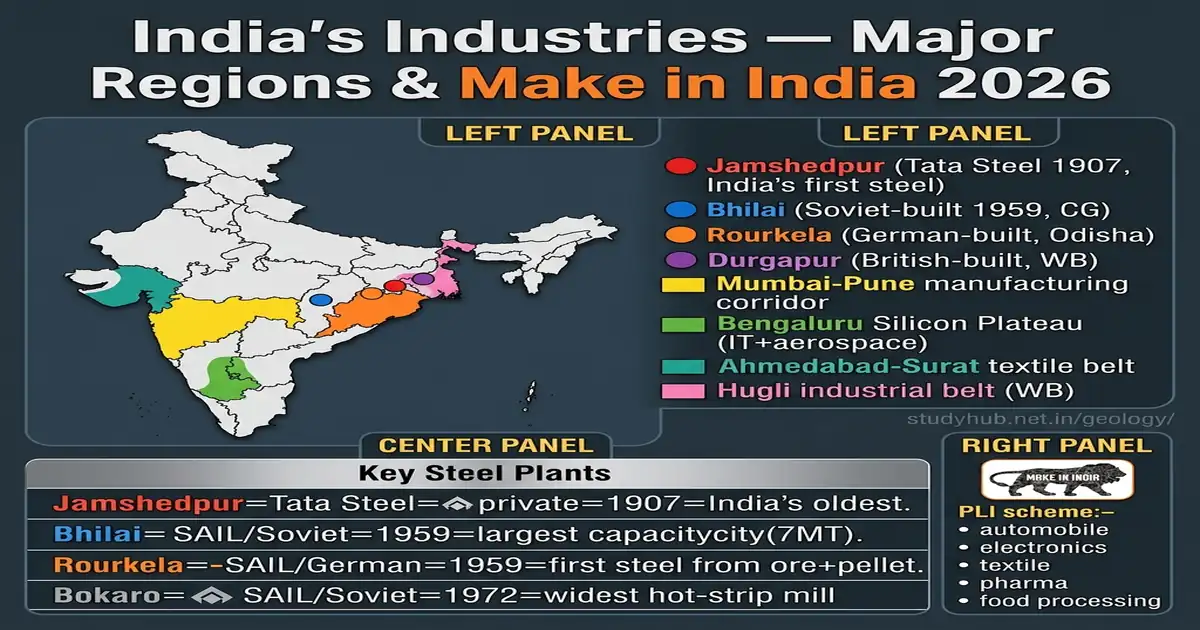
India’s Industries — Major Regions, Iron & Steel, Textiles & Make in India 2026
1. Classification of Industries & Major Industrial Regions
| Topic | Details | India Examples & Data |
|---|---|---|
| Classification of Industries | By RAW MATERIAL SOURCE: (1) Agro-based industries: raw material from agriculture. Examples: Cotton textiles, Jute textiles, Sugar, Edible oils, Silk, Woollen textiles, Rubber products, Food processing (dairy, beverages, canning). (2) Mineral-based industries: raw material from mining. Examples: Iron & Steel, Cement, Aluminium, Copper smelting, Petrochemicals. (3) Forest-based: timber, paper (pulp), plywood, lac, sericulture (silk). (4) Animal-based: leather, wool processing, dairy, poultry. (5) Marine-based: fish processing, fish meal. By CAPITAL SIZE: Small-Scale Industries (SSI, up to ₹1 crore investment) vs Large-Scale Industries. By OWNERSHIP: Public sector (SAIL, ONGC, BHEL, IOCL, HAL, BEL), Private sector (Tata Steel, Reliance, Mahindra, TVS, Bajaj, Infosys, HCL), Joint sector (MRPL = Mangalore Refinery, PSU + private), Cooperative sector (AMUL, IFFCO). By OUTPUT TYPE: Consumer goods industries (cloth, sugar, soap) vs Capital goods industries (machine tools, turbines, heavy machinery) | India’s industrial GDP: Manufacturing = 16-17% of GDP (well below 25% target of NMP 2011). Services = 58% GDP. Agriculture = 18%. Compare: China’s manufacturing = 28% GDP. Germany = 20%. USA = 11% (post-industrial). India’s manufacturing share has been STAGNANT at 15-17% for 30+ years = “premature deindustrialisation” concern. MSME sector (Micro, Small, Medium Enterprises): 63.4 million enterprises (2022), employ 111 million, contribute 30% of GDP, 45% of total exports. MSME crisis during COVID: 40% permanently shut in 2020. PLI scheme: aims to incentivise large-scale manufacturing to bring manufacturing share up. 14 sectors: Mobile phones (Apple, Samsung now assembling in India), Pharmaceutical APIs, Medical Devices, Automobiles, Advanced Chemistry Cell Battery, Textile Products, Food Processing, Telecom Networking, Specialty Steel, Solar PV Modules, White Goods (AC, Washing Machine), Drones. 2024: Apple manufactures ~15% of iPhones in India (Tamil Nadu – Chennai). Target: 25% by 2026 |
| Major Industrial Regions of India | 6 MAJOR INDUSTRIAL REGIONS (Khandelwal classification, standard NCERT): (1) Mumbai-Pune Cluster (Maharashtra): cotton textiles (historically), engineering, chemicals, pharmaceuticals, IT, automobiles (Pune = “Detroit of India”), refineries (Trombay BPCL), SEEPZ (Electronics). (2) Hugli Industrial Belt (West Bengal): Kolkata-Howrah-Rishra-Serampore-Belur-Hooghly (cotton textiles, jute mills historically; now engineering, chemicals, leather). (3) Ahmedabad-Surat Region (Gujarat): cotton textiles (Ahmedabad = “Manchester of India”), diamond polishing (Surat = polishes 80% of world’s rough diamonds), chemicals (GIDC). (4) Chhotanagpur Plateau Industrial Belt (Jharkhand-WB-Odisha): heavy industries: iron & steel (Jamshedpur, Burnpur, Durgapur), engineering, coal-mining. (5) Bengaluru-Tamil Nadu Industrial Region (Karnataka-TN): machine tools, aerospace (HAL Bengaluru), IT (Electronic City Bengaluru), automobiles (Chennai = “Detroit of India” competing with Pune), textiles (Tirupur knitwear). (6) Vishakhapatnam-Guntur Belt (AP): heavy engineering, fertilisers, shipbuilding (HSL = Hindustan Shipyard Visakhapatnam), petrochemicals, tobacco. SECONDARY REGIONS: Delhi-Meerut industrial region, Kollam-Thiruvananthapuram (Kerala, titanium, IT), Chhattisgarh (steel-coal), Rajasthan (marble, textiles, zinc smelting) | Mumbai-Pune: Maharashtra contributes ~14% of India’s GDP. Pune’s automobile belt: Tata Motors (Pimpri), Volkswagen/Skoda (Chakan), Force Motors, Bajaj Auto (Aurangabad). Pharmaceutical valley: 30+ pharma MNCs in Pune. Mumbai: India’s financial capital. JNPT (Nhava Sheva) = India’s busiest container port. Ahmedabad: once India’s cotton textile capital (now somewhat declined as mills closed, workers displaced). Surat: world’s diamond polishing capital → 92 of every 100 polished diamonds in the world pass through Surat’s cutting & polishing workshops (many tiny handcraft operations). Bengaluru: India’s IT capital (“Silicon Valley of India”). Electronic City, Whitefield. ISRO (Indian Space Research Organisation) HQ + UR Rao Satellite Centre. HAL (Hindustan Aeronautics Limited) = India’s largest aerospace company. ADE (Aeronautical Development Establishment). NAL (National Aerospace Laboratories). DRDO (Defence Research and Development Organisation) multiple labs in Bengaluru. Chennai: India’s 3rd largest city (Greater Chennai = 10M). Automobile manufacturing: Hyundai (Sriperumbudur), Ford (now closed), Renault-Nissan, BMW & Yamaha. IT: OMR (Old Mahabalipuram Road) = IT corridor |
| Iron & Steel Industry — India’s Heavy Industrial Backbone | India = 2nd largest steel producer (China #1, ~54% global; India #2, ~7%). Long history: Tata Steel, Jamshedpur, 1907 = India’s first integrated steel plant (private, JN Tata vision = “if Indians cannot run a steel plant, colonialism is proven right”). Post-independence: Nehru’s Industrial Policy Resolution (1956) = heavy industries in PUBLIC SECTOR. 3 major steel plants set up with foreign aid simultaneously: Bhilai (Soviet/Russian aid), Rourkela (German/West German aid), Durgapur (British aid). Later: Bokaro (Soviet aid, Jharkhand, 1972). SAIL (Steel Authority of India Limited): PSU, owns Bhilai, Rourkela, Durgapur, Bokaro, IISCO Burnpur (WB). RINL (Rashtriya Ispat Nigam): Vizag Steel, Visakhapatnam, Andhra Pradesh (1971 “steelman’s steel plant” — only coastal steel plant in India, no local iron ore/coal — uses imported raw material from Australia). Tata Steel: private, Jamshedpur + Kalinganagar (Odisha). JSW Steel: private, Bellary-Hospet (Karnataka), Dolvi (Maharashtra). JSPL (Jindal Steel): WB, CG, Odisha. Total capacity: ~160 MT/yr (2024). Production: 124 MT (2022). NMP steel target: 300 MT by 2030 (NITI Aayog) | IRON & STEEL PLANTS (EXAM TABLE): Jamshedpur (Jharkhand): 1907, TATA STEEL (private, with Tisco), Subarnarekha+Kharkai rivers, raw material: iron ore-Noamundi/Gua JH, coal-Jharia, manganese-Odisha, limestone-MP. Largest steel-cum-industrial township in India. Steel City. Bhilai (Chhattisgarh): 1959, SAIL (Soviet collaboration), raw material: iron ore-Bailadila CG (world-class), coal-Korba CG, limestone-Nandini near Bhilai, lime-Birra, dolomite-Hirri. India’s largest integrated steel plant (7 MT/yr). Rourkela (Odisha, Sundargarh district): 1959, SAIL (West German Demag collaboration), raw material: iron ore-Bonai Range Orissa, coal-Jharia JH, limestone-Birmitrapur, manganese-Bonai. First steel plant to produce wide-width flat-rolled products. Durgapur (West Bengal): 1959, SAIL (British consultancy), coal from Raniganj (nearby), iron ore from Odisha-Singhbhum, manganese. Damodar Valley Corporation power. Bokaro (Jharkhand): 1972, SAIL (Soviet collaboration), coal-Bokaro coalfields (nearby), iron ore-Noamundi JH + Kiriburu-Odisha. India’s first domestically certified steel plant (technical knowhow from USSR, but machinery and later stages by domestic engineers after 1974). Visakhapatnam/Vizag (Andhra Pradesh): RINL, 1992, only COASTAL steel plant, uses IMPORTED iron ore + coal (from Australia). Port advantage. Kalinganagar (Odisha): Tata Steel (2.9 MT/yr, Phase 1 complete, 5 MT planned) |
2. Cotton Textiles, Automobile, IT & Make in India Policy
| Industry | Overview & Location | Key Facts & Policy |
|---|---|---|
| Cotton Textile Industry | OLDEST major industry in modern India. First cotton mill: Bombay, 1854 (Cowasji Nanabhoy Davar — first Indian-owned steam mill). India = world’s 2nd largest textile producer and exporter. Annual exports: textile + apparel = ~USD 44 billion (2022-23). Total size: ₹12 lakh crore industry, 45 million direct employees (2nd largest employer after agriculture). Cotton grows in: Maharashtra, Gujarat, MP, AP, Rajasthan, Punjab, Haryana, Karnataka. Textile manufacturing traditionally near cotton-growing areas OR near ports. Mumbai cluster: Port + humid sea air (good for cotton spinning — reduces yarn breakage), colonial-era British investment, railway connections, skilled labour. 1980s-2000s: Mumbai’s famous textile mills (Girangaon = “mill village” in Dadar-Parel-Worli) — majority CLOSED (NTC = National Textile Corporation mills, 56+ mills). Mill lands → high-end real estate (One India Bulls, Kamala Mills, High Street Phoenix) — one of Mumbai’s greatest urban controversies. Ahmedabad: cotton-growing hinterland Gujarat + Sabarmati River, “Manchester of India” | KEY TEXTILE CENTRES: Mumbai (synthetic/blended, declining traditional cotton). Ahmedabad (cotton/synthetic, recovering post-mill closures with newer technology). Surat (man-made fibre fabrics, synthetic sarees, embroidery = 70% of India’s sari synthetic fabric). Coimbatore (T.Nadu “Manchester of South India”, cotton spinning, yarn = 33% of India’s spindles, exports to USA/UK). Tirupur (TN “knitwear capital of India”, T-shirts, hosiery, exports to EU+USA = USD 5 billion+). Ludhiana (Punjab = “Manchester of North India”, hosiery, woollen knitwear, cycle industry). Delhi NCR (apparel garments, Gurugram-Noida garment export zone). Bhilwara (Rajasthan = largest synthetic fabric centre, 70% of India’s PV blended fabrics). Jaipur (handloom, block printing, sanganer prints, jodhpuri bandhani textiles = craft export). SILK: Karnataka = 70% India’s mulberry silk (Kolar, Mysore — “Silk City”). Also: J&K=Pashmina wool (goat), Rajasthan=camel wool. JUTE TEXTILES: WB Hugli belt (Titagarh, Rishra, Serampore, George&Tom jute mills = “Golden Fibre”). NITI Aayog PM Mitra (Mega Integrated Textile Region and Apparel) Parks: 7 planned in 7 states (TN, TS, Karnataka, MP, Rajasthan, UP, Gujarat) to create integrated textile zones with plug & play factory sheds, dyeing + finishing common utilities, testing labs, workers’ hostels = try to replicate Bangladesh’s garment success. PLI textile scheme: ₹10,683 crore for Man-Made Fibre (MMF) + Technical Textiles. ROSL (Rebate on State and Central Taxes and Levies) for textile exporters. Bharatmala/Sagarmala for logistics |
| Automobile Industry (India’s “Detroit”) | India = 3rd largest automobile producer worldwide (after China and USA). Annual production: ~25 million vehicles (2022-23 = historic record). Annual domestic sales: ~21 million. Automobile exports: USD 21.2 billion (2022-23). India = world’s largest 2-wheeler market (81% of total vehicle sales are 2-wheelers). EV revolution: India EV sales = 1.53 million units (2022-23, +50% YoY). Two-Wheeler EVs = Ola Electric, Ather, Hero Electric, TVS iQube. Electric 3-wheelers = dominant EV segment (60% EV sales). Cars EV: Tata Nexon EV (India’s #1), MG ZS EV, Tata Tiago EV, BYD Atto 3 (Chinese), newer. Maruti-Suzuki = India’s largest car company (42% market share, 2018). FAME II (2019): ₹10,000 crore for EV adoption. PM E-DRIVE (2024): ₹10,900 crore, subsidise EV 2-wheelers + 3-wheelers + electric buses. PLI Auto + Auto components: ₹57,042 crore. Battery: ACC (Advanced Chemistry Cell) PLI ₹18,100 crore → attract Li-ion battery gigafactory | MAJOR AUTOMOBILE HUBS: Pune Metro-region (“Detroit of India”): Tata Motors (Pimpri-Chinchwad, buses+trucks), Bajaj Auto (Chakan), Mercedes-Benz India (Chakan), FORCE Motors, Volkswagen-Skoda (Chakan), Fiat-Jeep (Ranjangaon), John Deere tractors. Chennai (“Chennai Auto City”, Tamil Nadu “Detroit”): Hyundai (Sriperumbudur = India’s largest car plant, 700,000 units/yr). Renault-Nissan (Oragadam). BMW India (Chennai plant). Royal Enfield (Oragadam, motorcycles = classic “Bullet”). Ashok Leyland (HQ Chennai). TVS Motor (Hosur). Karnataka (Bengaluru-Hosur belt): Toyota Kirloskar (Bidadi, Bengaluru). Volvo India (Bengaluru). Harley Davidson India (Bawal). Hosur (TN-Karnataka border): TVS. Gurugram-Haryana-Manesar: Maruti Suzuki (Manesar+Gurugram = 50% India’s car production). Hero MotoCorp. NCR belt: Honda, Bajaj, Yamaha in UP Noida-Greater Noida. Gujarat: Tata Motors (Sanand — moved from Singur WB in 2010 due to land protests). Ford (Sanand — closed 2021). MG Halol (Gujarat). Suzuki (new plant Kharkhoda, Haryana). ANCILLARY INDUSTRY: ~10,000 auto ancillary companies (ACMA). Tamil Nadu, Maharashtra, Karnataka = major clusters. Auto components exports = USD 20 billion/yr |
| Pharmaceutical, Chemical & IT Industries | PHARMACEUTICALS: India = “Pharmacy of the World.” 3rd largest pharmaceutical producer by volume. Annual pharma exports: USD 25 billion (2022). 60% of global vaccine supply from India. 40% of generics sold in USA are India-made. 25% of UK prescription market = Indian generics. 8 of the world’s top 20 biosimilars = India-manufactured. Major clusters: Hyderabad (“Pharma City”, “Hyderabad as Pharmacy of World” — Genome Valley, 1,500+ pharma companies, NATCO, Dr Reddy’s, Hetero, Mylan India). Mumbai pharma cluster (Cipla HQ, FDC, Wockhardt). Ahmedabad-Vadodara (Torrent Pharma, Zydus Cadila). Bengaluru (Biocon = Asia’s largest biotech). Tamil Nadu (pharma API). Aurangabad (pharma manufacturing, USP approved). CHEMICALS: Dahej and Bharuch (Surat, Gujarat) = India’s largest industrial chemical zone. GIDC estates. IFFCO (fertilizer). Reliance Industries (Mumbai, Jamnagar petrochemical). CHEMICALS + CHEMICALS: Fertiliser plants: IFFCO (cooperative, Phulpur-UP, Aonla-UP, Kandla-Gujarat, Kalol-Gujarat). NFL (National Fertilisers Ltd). RIL (Hazira-Surat + Jamnagar + Dahej) | IT AND SOFTWARE SERVICES: India IT-BPM = USD 245 billion (2022-23 = record, FY24 estimate USD 254 billion). World’s largest IT services exporter. Major IT hubs: Bengaluru (30% India’s IT exports, largest), Hyderabad (25%), Chennai (15%), Pune, Mumbai, NCR. Infosys (HQ Bengaluru), Wipro (HQ Bengaluru), TCS = Tata Consultancy Services (HQ Mumbai = India’s largest + market cap USD 170 billion = largest Indian company by market cap). HCL Technologies (Noida NCR). Tech Mahindra (Pune). LTI Mindtree, Mphasis = Bengaluru. Indian IT Clients: 61% revenue from USA. 18% from Europe. IT employment: 5.4 million direct + 13 million indirect. UPSC relevance: IT sector’s spatial concentration (major cities) + employment patterns + skewness toward urban-educated workers vs agrarian India = inequality question. SEMICONDUCTORS: India wants to build chip fabrication (fab). Micron Technology (Sanand, Gujarat = backed by CHIPS Act equivalent, USD 825M fab) — 2023 groundbreaking = India’s first semiconductor fab assembly. Vedanta-Foxconn chip fab (Pune) = cancelled (Foxconn withdrew). India Semiconductor Mission (ISM): ₹76,000 crore total incentive package. Target: produce chips by 2025 (likely delayed). 2024: Government approved 3 semiconductor facilities: Tata Electronics (Assam + Gujarat), ISMC (Mysuru — with Tower Semiconductor USA). This would make India one of the few countries with domestic chip fab by 2027 |
| Make in India, PLI & Industrial Policy | MAKE IN INDIA (2014): PM Modi’s flagship manufacturing initiative. Goal: increase manufacturing GDP share from 15% to 25% by 2022. 25 priority sectors. Single-window clearance. India Ease of Doing Business rank improved from 142 (2014) to 63 (2023). PLI SCHEME (Production Linked Incentive, 2020): Rs 1.97 lakh crore across 14 sectors. Mechanism: companies receive % of incremental sales as incentive (4-6% over 5 years). Key PLI sectors: Mobile phones (Apple, Samsung manufacturing India), Solar PV, Specialty Steel, Pharmaceuticals APIs, ACC Battery, Textile MMF. PM GATI SHAKTI (2021): National Master Plan for multi-modal connectivity, 1,600+ projects on GIS. Reduce logistics cost from 13-14% GDP to 8%. PM MITRA (Mega Integrated Textile Region and Apparel parks): 7 parks in 7 states. Dedicated Freight Corridors (DFC): Eastern DFC (Ludhiana-Dankuni) + Western DFC (Dadri-JNPT) = operational 2023. India Industrial Corridors: DMIC (Delhi-Mumbai), CBIC (Chennai-Bengaluru). SEZ: 374 operational (2022). National Logistics Policy (NLP, 2022). | PLI results 2023-24: Investment Rs 1.06 lakh crore. Production Rs 8 lakh crore. Employment 740,000+ direct jobs. Mobile phone: India now 2nd largest manufacturer (after China). Apple Supplier: Tata Electronics (acquired Wistron India 2024), Foxconn (Sriperumbudur TN), Samsung (Noida UP). Defence exports: USD 2.63 billion (2023-24 = record). INS Vikrant (2022) = India’s first indigenous aircraft carrier (Cochin Shipyard). Tejas fighter (HAL Bengaluru). BrahMos supersonic missile (India-Russia JV). AK-203 rifles (Amethi UP). SEMICONDUCTOR: Micron Technology (Sanand Gujarat = India’s first assembly+test). Tata Electronics (Assam+Gujarat). ISMC (Mysuru, with Tower Semiconductor). India Semiconductor Mission (ISM): Rs 76,000 crore incentive. STARTUP INDIA (2016): 100+ unicorns, India = world’s 3rd largest startup ecosystem. Bengaluru, Mumbai, Delhi NCR, Hyderabad top cities. |
Frequently Asked Questions
Why was Jamshedpur chosen for India’s first steel plant in 1907 and why were Bhilai, Rourkela and Durgapur built where they were in 1959?
The locations of India’s major iron and steel plants are one of the most tested questions in UPSC Geography, requiring Alfred Weber’s industrial location theory (least-cost theory) as applied to heavy industries. Jamshedpur (Tata Private, 1907): Chief geologist Charles Page Perin identified Sakchi (now Jamshedpur) as optimal. Weber’s least-cost theory for steel = RAW MATERIAL ORIENTATION (2.5 tonnes inputs per 1 tonne steel = weight-losing = locate near raw materials). Jamshedpur advantages: (1) Iron ore: Noamundi-Gua mines (Singhbhum JH, 70 km). (2) Coking coal: Jharia (100-150 km). (3) Manganese: Odisha nearby. (4) Limestone: Birmitrapur, Odisha. (5) Water: Subarnarekha + Kharkai rivers. (6) Level land: Chhotanagpur plateau edge. (7) Transport: Bengal-Nagpur Railway (BNR). Bhilai, Rourkela, Durgapur (1959): Cold War Geopolitics + Economics. Nehru’s Second Five Year Plan (1956) needed rapid heavy industrialisation. Three simultaneous plants, three foreign donors = a non-alignment masterstroke. Bhilai (CG): Soviet aid. Between Bailadila iron ore (CG, 100 km south) and Korba coal (250 km north). Soviet engineers = 7 MT capacity = India’s largest. Rourkela (Odisha): West German (Demag) aid. Sundargarh district iron ore nearby. Jharia coal via rail. First flat-rolled products technology. Durgapur (WB): British aid. Raniganj coal (20 km). DVC power. Odisha-JH iron ore via rail. Political geography lesson: Nehru wanted BOTH superpowers (Soviet + UK/Germany) investing in India = classic non-alignment economic diplomacy. Vizag/RINL (1992) breaks all rules: located on COAST to use IMPORTED raw material = purely political (AP demanded it as state pride + port advantage).
Important for Exams — India Industries UPSC, SSC and State PCS
STEEL PLANTS EXAM TABLE: Jamshedpur(JH, Tata Steel, private, 1907=FIRST India, Subarnarekha+Kharkai rivers, Noamundi iron, Jharia coal). Bhilai(CG, SAIL+Soviet, 1959, LARGEST 7MT, Bailadila iron+Korba coal). Rourkela(Odisha, SAIL+German, 1959, Bonai iron, first flat-rolled). Durgapur(WB, SAIL+British, 1959, Raniganj coal nearby, DVC power). Bokaro(JH, SAIL+Soviet, 1972). Vizag-RINL(AP, 1992, COASTAL, IMPORTED raw material). Kalinganagar(Odisha, Tata Steel, newest). COTTON TEXTILE: Ahmedabad=Manchester India. Coimbatore=Manchester South India. Tirupur=Knitwear Capital(USD 5B exports). Ludhiana=Manchester North India. Surat=Synthetic+diamond polishing(92% world diamonds). AUTOMOBILE: India=3rd globally, 25M vehicles/yr. Pune=Detroit India. Chennai=Auto City. Maruti=42% market share. EV=PM E-DRIVE(Rs 10,900cr). PHARMA: 3rd producer(vol). Hyderabad=Pharma City. 60% world vaccines. IT: USD 254B(FY24). Bengaluru(30%); TCS=largest market cap India. DEFENCE: INS Vikrant(2022, first indigenous carrier). Tejas=HAL. AK-203(Amethi). BrahMos missile. Defence exports USD 2.63B(record). POLICY: Make in India(2014). PLI=Rs 1.97 lakh cr, 14 sectors. PM GATI SHAKTI(2021). DFC operational(2023). PM MITRA=7 textile parks. 100+ unicorns=India 3rd startup ecosystem. India GDP=USD 3.7T(5th). Manufacturing=16-17% GDP(target 25%).
What to Read Next
- Mineral Resources — Raw Materials That Power India’s Steel Plants 2026
- Physiographic Divisions — Chhotanagpur Plateau as India’s Industrial Heartland 2026
- Agriculture — Agro-Based Industries and India’s Food Processing Sector 2026
- Indian Drainage — River Water for Industrial Cooling and Navigation 2026
- Deccan Traps — How Basalt Geology Shaped Maharashtra’s Industrial Geography 2026
About This Guide: Written by the StudyHub Geology Editorial Team (studyhub.net.in/geology/) based on NCERT Class 11 Geography India Chapter 8 (Manufacturing Industries), Annual Survey of Industries (ASI) 2021-22, Ministry of Heavy Industries PLI Reports 2023, DPIIT Annual Report on Make in India 2023, and National Steel Policy 2017. Last updated: March 2026.