
Last Updated: March 2026 | Reading Time: 13 minutes | ~2,900 words | Category: Economic Geography — Transport of India
India’s transport network is one of the largest and most complex in the world — connecting 1.43 billion people across 3.29 million square kilometres of diverse terrain, from the Himalayan passes to the Gangetic plain, from the Thar Desert to the coastal deltas of South India. The transport sector is both the foundation of economic activity and one of India’s greatest infrastructure challenges: India’s logistics cost (13-14% of GDP) is among the world’s highest — compared to 8% in the USA, 8-9% in Germany, and 10% in China — representing a massive competitive disadvantage for Indian manufacturing and agriculture. Reducing logistics cost is the central goal of India’s transport policy, with the PM Gati Shakti National Master Plan (2021), the Sagarmala Programme (2015, for port-led development), the Dedicated Freight Corridor (DFC, Eastern + Western, operational 2023), the Bharatmala Pariyojana (2017), and the UDAN Scheme (2016, for regional air connectivity) all targeting an integrated multimodal network that reduces cost and time for moving goods and people. India’s transport modes in rank of network size: Roadways (largest, 63 lakh km total road length, 2nd largest road network globally), Railways (4th largest railway network, 68,000 km, 22 zones), Waterways (106 declared National Waterways, NW-1 Ganga = 1,620 km), Pipelines (gas + oil pipelines, GAIL + IOCL), and Airways (29 international airports, 100+ domestic, rapidly expanding under UDAN). Understanding India’s transport geography — the spatial patterns of the networks, the major nodes, the policy initiatives, and their economic implications — is a mandatory topic for UPSC General Studies Paper I, II, and III, and all major competitive examinations.
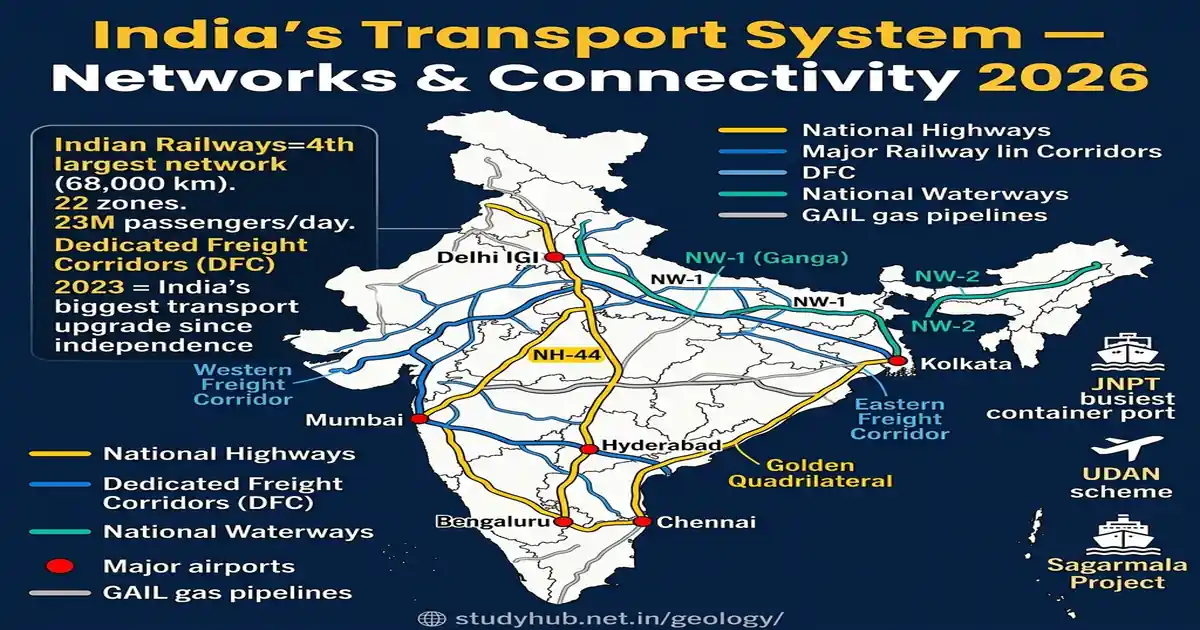
India’s Transport System — Roadways, Railways, Waterways, Airways & Pipelines 2026
1. Roadways & Railways — India’s Two Largest Transport Networks
| Mode | Network & Key Statistics | Major Projects & Policy Significance |
|---|---|---|
| Roadways | India’s total road network: 63.32 lakh km (2023) = 2nd largest road network in the world (after USA). Types: National Highways (NH): 1,44,955 km (2023) — only ~2.5% of total road length but carry 40% of road traffic. State Highways (SH): 1.86 lakh km. Major District Roads (MDR): medium connectivity. Rural roads: ~40 lakh km backbone (PMGSY). Road Density: 169 km per 100 sq km (low for India’s population density — target increase). NH numbering: post-2010 system (NHs are numbered 1, 2, 3… with evens = E-W, odds = N-S, generally). New NH numbering: NH-44 = India’s longest NH (3,745 km, Srinagar to Kanyakumari, formerly NH-1A + NH-7 segments). NH-27 = 2nd longest. Major agencies: NHAI (National Highways Authority of India, 1995 established, builds+maintains NHs). BRO (Border Roads Organisation): road building in strategic border areas (J&K, H.P., Arunachal, Sikkim, Uttarakhand). Established 1960. Built Atal Tunnel (Manali-Leh, 9.2 km, world’s longest highway tunnel above 10,000 feet, 2020). MoRTH (Ministry of Road Transport and Highways) | GOLDEN QUADRILATERAL (GQ): NHAI’s first mega project. 5,846 km 4-6 lane highway connecting Delhi-Mumbai-Chennai-Kolkata (India’s 4 largest cities). Forms a quadrilateral (roughly). Cost ~₹65,000 crore. By far India’s most important highway project (connects 28% of India’s territory + 63% of its industry + majority of traffic). Largely complete since 2012. NORTH-SOUTH EAST-WEST (NSEW) CORRIDOR: 7,142 km highway from Srinagar (J&K) to Kanyakumari (TN) [N-S axis] and Silchar (Assam) to Porbandar (Gujarat) [E-W axis]. Forming a cross pattern + part of GQ diagonal = total reaches all four geographical extremes of India. BHARATMALA PARIYOJANA (Phase 1, 2017): 34,800 km of highways in Phase 1. Rs 5.35 lakh crore investment. Economic Corridors, Inter Corridors, Ring Roads, National Corridor Efficiency Improvements. Ring roads around major cities. PMGSY (Pradhan Mantri Gram Sadak Yojana, 2000): Connect all unconnected habitations above 500 population (plain) / 250 population (Hill/tribal) with all-weather roads. Total roads built: 7.28 lakh km (2024). Transformed rural mobility especially in UP, Bihar, Odisha, Rajasthan. PMGSY = voted as most impactful rural scheme by multiple surveys. ATAL TUNNEL (Rohtang, HP, 2020): 9.2 km = world’s longest highway tunnel above 10,000 feet. Year-round connectivity Manali-Lahaul Spiti (previously snowbound Oct-June). J-K Zojila Tunnel (ongoing, 14.2 km, will provide year-round Srinagar-Leh connectivity by 2026-27). Sela Tunnel (Arunachal Pradesh, 2024, 1.79 km, world’s longest twin-lane tunnel at 13,000+ feet, connects Tawang year-round) |
| Railways | Indian Railways (IR): one of world’s largest railway systems. Statistics: Total route km: 68,000 km (4th largest in world after USA ~225,000 km, Russia~85,000 km, China~155,000 km). Daily passengers: 23 million (IR = largest single-day passenger mover on Earth). Daily goods: 3.5 million tonnes. Employees: 1.26 million (India’s largest employer = largest employer in world after US Dept Defense, China PLA, Walmart). Annual revenue: Rs 2.40 lakh crore (2022-23). Gauge types: Broad Gauge (BG, 1676 mm = 5’6″ = standard for Indian main lines), Metre Gauge (MG, 1000 mm = being converted to BG under Project Unigauge), Narrow Gauge (NG, 762mm or 610mm = hill railways, Darjeeling, Nilgiris, Matheran, Kalka-Shimla). Organisation: Ministry of Railways → IR Board → 18 Zones (increased from 16). Zones: Central (Mumbai), Eastern (Kolkata), Northern (Delhi), Southern (Chennai), Western (Mumbai), South Central (Secundrabad), NE (Gorakhpur), NER (Maligaon=Guwahati), SE (Kolkata), SWR (Hubli), NWR (Jaipur), WCR (Jabalpur), NCR (Prayagraj), ECR (Hajipur), ECoR(Bhubaneswar), SCR (Secunderabad), KRCL (Konkan Railway), Metro Railway Kolkata. Plus: SER (Kolkata), NFR (Maligaon Assam) | DEDICATED FREIGHT CORRIDORS (DFC) — India’s biggest railway project since independence: TWO DFCs: (1) Western DFC: Dadri (UP) to JNPT (Navi Mumbai), 1,504 km. Largely complete-operational by 2023. Serves: Industrial corridors of Rajasthan-Gujarat-Maharashtra. Container trains to JNPT port. Key stations: Palanpur, Ahmedabad, Surat, Vapi. (2) Eastern DFC: Sahnewal (Ludhiana, Punjab) to Dankuni (WB), 1,875 km. Mostly complete by 2024. Serves: Coal from Jharkhand-UP coalfields to power plants in UP-Punjab. Fertiliser from UP plants eastward. Wheat + rice from Punjab-Haryana to eastern India. DFC Technology: Double-stacked container trains (trains 2x taller = 2x cargo per train). Trains at 100 km/h (vs 25-30 km/h on crowded shared tracks). 3.5 km long trains possible. DFC impact: Freight removed from passenger-goods shared track → passenger trains can now be faster + more frequent too. VANDE BHARAT EXPRESS (“Train 18”): India’s fastest train (top speed 180 km/h, operating at 130-160 km/h). Self-propelled (EMU = Electric Multiple Unit) — no separate locomotive. Indigenous design and manufacture (ICF Chennai = Integral Coach Factory). 102 Vande Bharat trains running (March 2024). Delhi-Varanasi, Delhi-Bhopal, Mumbai-Solapur, Chennai-Mysuru routes. BULLET TRAIN PROJECT: Mumbai-Ahmedabad HSR (High Speed Rail) = 508 km. Japanese Shinkansen technology (JICA loan Rs 88,000 crore = Japan’s largest ever overseas loan). Target completion originally 2023 (severely delayed, now 2028-30 realistic). Surat-Bilimora section (50 km) may open first. Stations: 12 (including Bandra-Kurla Complex underground station). METRO RAIL: 21 cities have operational metro (Delhi metro = 392 km = India’s largest, 2nd largest in Asia. Other cities: Mumbai, Bengaluru, Hyderabad, Chennai, Kolkata, Ahmedabad, Nagpur, Pune, Kochi, Jaipur, Lucknow, Kanpur, Agra, Bhopal, Indore, Surat). TEJAS EXPRESS: first private train operated on Indian Railways network (IRCTC-operated, Lucknow-Delhi + Mumbai-Ahmedabad). WORLD HERITAGE RAILWAYS: Darjeeling Himalayan Railway (DHR, Toy Train = UNESCO World Heritage, 1881 = India’s first mountain railway), Nilgiri Mountain Railway (NMR, Ooty, 1908), Kalka-Shimla Railway (1903). All three UNESCO World Heritage Sites under “Mountain Railways of India.” |
2. Waterways, Airways, Pipelines & Major Ports
| Mode | Network & Key Data | Significance & Major Projects |
|---|---|---|
| Inland Waterways | India has 14,500 km of navigable waterways (rivers, canals, backwaters, creeks, tidal inlets) — but only ~5,685 km used for mechanised transport. 106 National Waterways (NW) declared under NW Act 2016 (earlier only 5 NWs). Major NWs: NW-1 (Ganga-Bhagirathi-Hooghly, 1,620 km, Allahabad/Prayagraj to Haldia) = India’s largest NW. NW-2 (Brahmaputra, 891 km, Dhubri to Sadiya) = very important for Assam connectivity. NW-3 (West Coast Canal, Kottapuram to Kollam, Kerala, 205 km) = most commercially active backwater route. NW-4 (Kakinada-Puducherry canal system + Godavari + Krishna). NW-5 (East Coast Canal + Brahmani + Mahanadi). NW-16 (Barak River, Assam-Manipur). Inland Waterways Authority of India (IWAI, HQ Noida): statutory body, develops+maintains. Jal Marg Vikas Project (JMVP): World Bank assisted, Rs 5,369 crore, develop NW-1 (Ganga) for commercial navigation (cargo + Ro-Ro vessels). First cargo vessel sailed Varanasi-Haldia (2018). India-Bangladesh Protocol on Inland Water Transit and Trade (PIWTT): using Brahmaputra + Barak rivers for bilateral trade. Northeast India connectivity (Assam river trade revived post-partition) | IWAI significance for UPSC: Waterways carry ~1/7th the energy cost of road transport per tonne-km. Huge potential for carbon-neutral freight. Ganga NW-1 can serve: Varanasi, Patna, Bhagalpur, Sahibganj, Farakka, Tribeni, Haldia. SAGARMALA PROJECT (2015, Ministry of Ports Shipping and Waterways): Rs 6 lakh crore, 2015-2035. Components: (1) Port Modernisation (create new ports, increase capacity). (2) Port-Led Industrialisation (Special Economic Zones near ports). (3) Coastal Community Development (fishermen livelihoods). (4) Coastal Shipping + IWT (coastal shipping between major ports to reduce road congestion). Total: 802 projects, 199 completed (2024). India’s 12 Major Ports (under Union List, Ministry operated by Port Trusts/Authorities): Deendayal (Kandla, Gujarat = India’s largest Major Port by cargo volume, 149 MT/yr), JNPT (Navi Mumbai = India’s busiest container port, 6.3 million TEU/yr), Mumbai Port, Chennai Port, Kolkata Port (with dock at Haldia), Visakhapatnam, Paradip (Odisha, Paradeep = India’s fastest growing major port, 132 MT/yr), Ennore (now Kamarajar, TN, exclusively handles coal), Mormugao (Goa), New Mangalore, Kochi (ICTT = International Container Transshipment Terminal, Vallarpadam), V.O. Chidambaranar Port (Tuticorin/Thoothukudi). JNPT: India’s gateway for container trade. 6.3 million TEU (Twenty-foot Equivalent Units). Serves Mumbai-Pune-Ahmedabad industrial heartland. GIFT City (Gujarat International Finance Tec-City): near Kandla/JNPT axis. India’s first IFSC (International Financial Services Centre). |
| Airways | India’s civil aviation: rapid post-COVID boom. Statistics 2023-24: Total passengers: 152 million domestic + 67 million international = 219 million total. India = 3rd largest domestic aviation market (after USA and China). Total airports: 148 operational (AAI = Airport Authority of India manages 125). International airports: 29. Major airports by traffic: Delhi IGI (Indira Gandhi International) = India’s busiest (72M passengers/yr, 2023, T1+T2+T3). Mumbai Chhatrapati Shivaji Maharaj International = 2nd (50M). Bengaluru KIA (BIAL, private) = 3rd (37M). Hyderabad RGIA (GHIAL, private) = 4th (21M). Chennai MAA = 5th. Kolkata NSCBI = 6th. Airlines: IndiGo = India’s largest (by market share, 58-60% domestic, 2024). Air India (privatised 2022, sold to Tata Group = was nationalised 1953 → revived through JRD Tata, then nationalised → sold back to Tata in 2022 = full circle. Air India merging with Vistara = Tata’s restructured flag carrier). SpiceJet (struggling finances 2023). Akasa Air (Rakesh Jhunjhunwala-backed, 2022 launch). Air India Express. IndiGo = India’s aviation success story. Started 2006. Low-cost model. 300+ A320 aircraft. India’s most on-time airline. World’s largest airline by Airbus A320 order (500+ jets ordered) | UDAN SCHEME (Ude Desh ka Aam Naagrik = Let the Common Man Fly, 2016): Ministry of Civil Aviation. Goal: Connect Tier 2 and Tier 3 cities through subsidised airline routes. Mechanism: Government subsidises airlines to operate on unserved/underserved routes for 10 years. Caps ticket price at Rs 2,500/ticket. By 2024: 500+ routes operational, 70+ new airports connected. Greenfield airports under UDAN: Dholera (Gujarat), Itanagar (Arunachal), Sindhudurg (Maharashtra), Deoghar (JH), Kushinagar (UP = Buddha Circuit), Durgapur, Shirdi, Jewar (Noida International Airport — under construction, become India’s largest airport when complete). NAVI MUMBAI INTERNATIONAL AIRPORT: under construction (Navi Mumbai, Maharashtra). New Delhi IARI AIRPORT: none (existing IGI expanding). Key aviation policy: Open Sky Policy — bilateral agreements allow foreign airlines unlimited capacity on routes. Cape Town Convention on aircraft assets (India signatory) = aircraft repossession in case of default. PMIS (Performance Management Information System) for aviation. CIVIL AVIATION POLICY 2016: National Civil Aviation Policy. Target 1 billion passenger trips by 2040. 220 airports by 2025. MIDFLIGHT REPAIR INDIA: Aviation MRO (Maintenance, Repair, Overhaul): India importing MRO services (most aircraft serviced in Sri Lanka, Malaysia, Singapore). Tax changes (2021) to incentivise MRO in India. GIFT City IFSC for aircraft leasing. 700+ aircraft on order by Indian airlines (largest aviation order book in Asia). |
| Pipelines & Trade | OIL AND GAS PIPELINES: India = 3rd largest global petroleum refiner but imports 85% crude oil. Oil pipelines: crude oil transported from ports (Salaya, Mundra, Paradip) to inland refineries. IOCL (Indian Oil Corporation) Salaya-Mathura crude pipeline (1,200 km), Mundra-Panipat pipeline, Paradip-Haldia-Barauni pipeline. Gas pipelines: GAIL (Gas Authority of India Ltd, HQ Delhi) operates India’s largest gas pipeline network: HVJ (Hazira-Vijaipur-Jagdishpur, Gujarat→UP, 1,750 km = India’s first major gas pipeline). DVPL (Dahej-Vijaipur, 2.67 MMSCFD). City gas distribution (CGD) networks in 290+ cities. LPG pipelines. DFPL (Dadri-Panipat LPG). DJV (Dahej-Uran pipeline). Jagdishpur-Haldia-Bokaro-Dhamra (JHBDPL = “Pradhan Mantri Urja Ganga” = Rs 13,000 crore, 2,635 km, brings natural gas to Eastern India = Bihar, Jharkhand, Odisha, Pashchim Bengal = previously deprived of piped gas). PM Urja Ganga: PIL-gas to eastern India cities (Varanasi, Patna, Jamshedpur, Bhubaneswar, Cuttack, Kolkata). Kochi-Koottanad-Bangalore-Mangaluru pipeline (KSPL, 450 km, Kerala-Karnataka). India’s total gas pipeline network: 22,900 km (GAIL + other companies). CGD target: 550+ cities/districts by 2030 | INDIA’S TRADE GEOGRAPHY: India’s total merchandise trade (2022-23): Exports = USD 447 billion. Imports = USD 714 billion. Trade deficit = USD 267 billion. Top Export items: Petroleum products (processed), Engineering goods, Gems and Jewellery, Chemicals, Pharmaceuticals, Cotton textiles, Marine products, Electronic goods (growing with PLI). Top Import items: Crude petroleum (largest, ~USD 230B), Gold (2nd largest), Electronic components, Coal (coking coal from Australia), Edible oils (palm oil from Malaysia-Indonesia), Fertilisers, Chemicals. MAJOR TRADE PARTNERS (Exports from India): USA = largest export destination (USD 78B). UAE = 2nd. Netherlands = 3rd (transit via Rotterdam). Singapore. UK. Saudi Arabia. Bangladesh. China (despite political tensions, bilateral trade = USD 136 billion 2022-23, India imports from China far more than exports). NEIGHBOUR TRADE: India-Bangladesh: USD 14B, India-Sri Lanka: USD 7.7B, India-Myanmar: USD 2.1B. NEIGHBOURING PORT ACCESS: India uses Chabahar Port (Iran, built with Indian investment = India’s FIRST overseas port development = key for Central Asia + Afghanistan trade bypassing Pakistan). India-Nepal: Raxaul-Kathmandu road+rail. India-Bhutan: Jaigaon-Phuentsholing. EXIM BANK (Export-Import Bank of India): facilitates India’s trade finance + outbound investment. India’s share in world merchandise trade: 1.8% (low but growing). Target: 5% by 2030. India is world’s largest remittance recipient: USD 111.22 billion (2022 World Bank data = India’s single largest forex inflow, from Indian diaspora in USA, UAE, UK, Saudi, Qatar) |
Frequently Asked Questions
Why does India have the world’s 4th largest railway network yet one of the world’s highest logistics costs — and what does the DFC solve?
This paradox — massive railway network yet poor logistics performance — is one of the most important and nuanced questions in India’s economic geography, with direct relevance to UPSC General Studies Papers I, II, and III. Understanding it requires separating NETWORK SIZE from NETWORK EFFICIENCY. Why India’s logistics cost is high despite large railways: (1) Freight speed disaster: India’s average freight train speed before DFC = 24 km/h (yes, 24 km/h — a cyclist can nearly keep pace!) vs China’s DFC freight = 80-100 km/h, Germany = 80-100 km/h. The reason: India’s tracks are SHARED between passenger and freight trains. Priority always goes to passenger trains (political sensitivity). Freight trains wait for hours at red signals for passenger trains to pass. A coal train from Jharkhand to Delhi Power Plant = 4-5 days journey instead of 1 day. (2) Network congestion: India’s Golden Quadrilateral accounts for only 16% of rail route length but carries 65% of freight + 55% of passenger traffic. These Golden Diagonal routes are saturated → no slots for additional freight trains → shippers switch to road. Road costs 3-4x more per tonne-km than rail, but road is faster and door-to-door. Shippers prefer road despite higher cost! This is the great Indian logistics dysfunction. (3) Gauge fragmentation: Broad gauge (converted from metre gauge under Project Unigauge) means tonnes of old MG wagons unusable on new BG tracks. Hill railways still NG. Containers can’t freely transfer between gauge types. (4) Underinvestment in wagons and locomotives: Historical underfunding meant shortage of rakes → wagons were old, slow, frequently broken → low utilisation rate. (5) Terminal inefficiency: Goods sheds (loading/unloading points) outdated; trucks wait days at ports; container train turnaround slow. What the DFC Solves: The Dedicated Freight Corridors (Eastern DFC: Ludhiana-Dankuni, 1,875 km; Western DFC: Dadri-JNPT, 1,504 km) solve almost ALL the above problems simultaneously: (1) Dedicated track = no passenger conflict: Freight trains never wait for passenger trains. Speed = 100 km/h sustained. (2) Double-stack containers: Two containers stacked vertically per flatcar = 2x cargo volume per train = dramatic cost reduction per tonne. (3) Longer and heavier trains: 1.5 km long trains (vs 0.8 km previously) = more cargo per movement. (4) Parallel passenger line upgrade: When freight vacates old shared tracks → passenger trains on existing routes can run faster (many Rajdhani/Shatabdi speeded up). (5) 24×7 operations: DFC freight terminals designed for continuous operations, not 9-to-5 goods offices. (6) Industrial corridor integration: Western DFC aligns with Delhi-Mumbai Industrial Corridor (DMIC) → factories built along DFC → just-in-time manufacturing possible. Estimated impact: India’s logistics cost to drop from 13% to 8% GDP when DFC + Bharatmala + Sagarmala are fully operational (NITI Aayog estimate). Manufacturing competitiveness equivalent to a 5-6% cost reduction for all goods made in India. This is why the Dedicated Freight Corridor is considered “India’s most transformative infrastructure project since the completion of the National Highway system.”
Important for Exams — India Transport UPSC, SSC & State PCS
ROADWAYS: Total = 63.32 lakh km (2nd largest globally, after USA). NH = 1,44,955 km (only 2.5% roads but 40% traffic). NH-44 = India’s LONGEST (3,745 km, Srinagar-Kanyakumari, formerly NH-7). Golden Quadrilateral (GQ) = 5,846 km, Delhi-Mumbai-Chennai-Kolkata (NHAI). NSEW Corridor = 7,142 km cross from Srinagar-Kanyakumari and Silchar-Porbandar. Bharatmala Phase 1 = 34,800 km, Rs 5.35 lakh crore. PMGSY (2000) = rural roads, 7.28 lakh km built, connects habitations 500+ pop. BRO (Border Roads Organisation, 1960) = builds strategic border roads. Atal Tunnel (Rohtang HP, 2020) = 9.2 km = world’s longest highway tunnel above 10,000 ft. Sela Tunnel (Arunachal, 2024) = connects Tawang year-round. RAILWAYS: 68,000 km = 4th largest. 23 million passengers/day = world’s largest daily mover. 1.26 million employees = India’s largest employer. 18 zones. Gauge: Broad (1676mm, main; Metre (1000mm, being converted via Project Unigauge); Narrow (762mm/610mm, hill railways). DFC: Eastern (Ludhiana-Dankuni, 1,875 km) + Western (Dadri-JNPT, 1,504 km) = double-stack containers, 100 km/h freight speed. Vande Bharat Express = 180 km/h, EMU, indigenous (ICF Chennai). Bullet Train = Mumbai-Ahmedabad 508 km, Japanese Shinkansen, JICA loan. UNESCO Railway Heritage: Darjeeling (1881, first mountain railway), Nilgiris (1908), Kalka-Shimla (1903). Metro: Delhi = 392 km (2nd largest Asia). 21 cities with metro. Tejas Express = first private train by IRCTC. WATERWAYS: 14,500 km navigable total. 106 NWs declared (NW Act 2016). NW-1 (Ganga, Prayagraj-Haldia, 1,620 km = India’s LARGEST NW). NW-2 (Brahmaputra, 891 km). NW-3 (West Coast Canal, Kerala, 205 km). IWAI = Inland Waterways Authority of India (Noida). Jal Marg Vikas (World Bank, NW-1). Sagarmala (2015, Rs 6 lakh crore, ports + coastal shipping + IWT). 12 Major Ports under Union List. Deendayal-Kandla = largest by cargo (149 MT). JNPT = largest container port (6.3M TEU). AIRWAYS: India = 3rd largest domestic market (152M domestic passengers 2023). 148 airports. 29 international. Delhi IGI = India’s busiest (72M pax). IndiGo = 58-60% market share = India’s largest airline. Air India privatised (Tata Group, 2022). UDAN scheme (2016): Rs 2,500 capped tickets, 500+ routes, 70+ new airports. Jewar (Noida) airport = upcoming India’s largest. PIPELINES: GAIL HVJ pipeline (Gujarat-UP, 1,750 km = India’s FIRST major gas pipeline). PM Urja Ganga (JHBDPL, 2,635 km = piped gas to eastern India). Chabahar Port (Iran) = India’s FIRST overseas port development. TRADE: Exports USD 447B. GDP = 3.7T. Remittances = USD 111B (world’s largest recipient). India’s share world trade = 1.8%.
What to Read Next
- Industries of India — How DFC Enables Manufacturing Competitiveness 2026
- Agriculture — How Transport Infrastructure Determines Agricultural Market Access 2026
- Mineral Resources — How Railway Corridors Move Coal & Iron Ore to Steel Plants 2026
- Indian Drainage — Rivers as National Waterways for Freight Transport 2026
- Physiographic Divisions — How Terrain Shapes Transport Route Planning 2026
🎔 Exam Quick Reference — India Transport: ROADWAYS: 63.32 lakh km(2nd globally). NH-44=LONGEST(3,745 km, Srinagar-Kanyakumari). Golden Quadrilateral(GQ)=5,846 km, Delhi-Mumbai-Chennai-Kolkata (NHAI). NSEW=7,142 km. Bharatmala Phase 1=34,800 km. PMGSY(2000)=7.28 lakh km rural roads. Atal Tunnel(Rohtang, 9.2 km, world’s longest highway tunnel above 10,000 ft, 2020). Sela Tunnel(Arunachal 2024, Tawang connectivity). BRO(1960)=border roads. RAILWAYS: 68,000 km=4th globally. 23M pax/day. 1.26M employees=India’s largest employer. 18 zones. DFC: Eastern(Ludhiana-Dankuni, 1875 km)+Western(Dadri-JNPT, 1504 km). Double-stack containers. 100 km/h freight. Vande Bharat=180 km/h, EMU, ICF Chennai. BulletTrain=Mumbai-Ahmedabad 508 km, Japan Shinkansen, JICA. Metro: Delhi=392 km(Asia’s 2nd largest). PROJECT UNIGAUGE=convert MG to BG. UNESCO Heritage: Darjeeling(1881=first mountain railway), Nilgiris, Kalka-Shimla. Tejas=first private train IRCTC. WATERWAYS: NW-1(Ganga, 1620 km=LARGEST NW). NW-2(Brahmaputra, 891 km). NW-3(Kerala, 205 km). IWAI(Noida). 106 NWs total. Jal Marg Vikas(World Bank+NW-1). Sagarmala(2015, Rs 6L cr). 12 Major Ports: Deendayal-Kandla(largest cargo, Gujarat), JNPT(largest containers, 6.3M TEU). Paradip(fastest growing). Chabahar(Iran, India’s FIRST overseas port). AIRWAYS: 3rd largest domestic market. Delhi IGI=72M pax=India’s busiest. IndiGo=58-60% share. Air India=Tata(privatised 2022). UDAN(2016)=Rs 2500 capped fare, 500+ routes. TRADE: Exports USD 447B. Remittances=USD 111B=world’s LARGEST recipient. India logistics cost=13-14% GDP(target 8% with DFC+Bharatmala). PM Gati Shakti(2021)=multimodal GIS platform. National Logistics Policy(2022).
🌍 India’s 12 Major Ports — Quick Reference 2026: All under Union List, controlled by Ministry of Ports, Shipping and Waterways (MoPSW). Previously managed by Port Trusts, now converting to Port Authorities under Major Port Authorities Act 2021. (1) Deendayal Port (Kandla, Gujarat): renamed from Kandla Port (renamed 2017 after Deendayal Upadhyaya). India’s LARGEST major port by cargo volume (149 MT/yr). Also India’s FIRST major port built after independence (1947). (2) JNPT = Jawaharlal Nehru Port Trust (Navi Mumbai, Maharashtra): India’s BUSIEST CONTAINER PORT (6.3 million TEU). Handles 55-60% of India’s container trade. Container train DFC connection. (3) Mumbai Port: historic, declining bulk cargo, city-side constraints. (4) Mormugao (Goa): iron ore exports (controversial post-2018 SC ban). (5) New Mangalore (Karnataka): petroleum, fertiliser. (6) Kochi (Kerala): ICTT (International Container Transshipment Terminal, Vallarpadam) enabling deep-draft vessels. BPCL refinery. LNG terminal. (7) V.O. Chidambaranar (Tuticorin/Thoothukudi, TN): container, coal, copper (Sterlite smelter, now closed). (8) Chennai (TN): passengers + automobiles (car exports hub). (9) Ennore (Kamarajar, TN): India’s ONLY fully corporate port. Exclusively handles coal + LNG. Near Chennai. (10) Visakhapatnam (AP): iron ore, coal, petroleum. India’s deepest major port. Navy base. (11) Paradip (Odisha): crude oil, fertiliser, coal. India’s FASTEST GROWING major port (ranked 3rd by cargo recently). (12) Syama Prasad Mookerjee Port (Kolkata, WB): Haldia Dock Complex (added 1977). Konkan Railway route: Roha (Mumbai suburb) to Mangaluru, 741 km. Built 1998. Passes through 91 tunnels + 2,000 bridges = India’s most challenging railway construction project. Konkan = coastal strip of Maharashtra, Goa (Panaji, Vasco), Karnataka (Udupi, Mangaluru). Sangola-Mohol extension proposed for connecting sugarcane belt.
About This Guide: Written by the StudyHub Geology Editorial Team (studyhub.net.in/geology/) based on NCERT Class 11 Geography India Chapter 9 (Transport & Communication), Ministry of Railways Annual Report 2023-24, NHAI Annual Report 2023, DGCA Annual Report 2023, IWAI Annual Report 2023, Ministry of Ports Shipping and Waterways Annual Report 2023, and India Economic Survey 2023-24. Last updated: March 2026.