
Last Updated: March 2026 | Reading Time: 13 minutes | ~2,900 words | Category: Physical Geography — Water Resources of India
Water is India’s most critical and contested natural resource. India is home to approximately 17% of the world’s population but possesses only 4% of the world’s freshwater resources. The country receives 4,000 billion cubic metres (BCM) of precipitation annually — one of the world’s largest in absolute terms — yet extreme spatial and temporal unevenness makes water scarcity a defining challenge: Mawsynram (Meghalaya) receives 11,871 mm of rainfall annually, while Jaisalmer (Rajasthan) receives only 31 mm. Of 4,000 BCM annual precipitation, only 1,123 BCM is utilised (rivers+groundwater); the remaining flows to the sea, evaporates, or remains inaccessible. India’s utilizable water: 690 BCM surface water + 433 BCM groundwater = 1,123 BCM total utilisable. India is the world’s largest user of groundwater — extracting 251 BCM/year = 25% of global groundwater extraction (CGWB 2022). In 2019, NITI Aayog’s Composite Water Management Index delivered a stark warning: 21 Indian cities including Delhi, Bengaluru, Chennai, and Hyderabad will run out of groundwater by 2030, affecting 100 million people. India’s water challenge is not shortage alone — it is the triple crisis of unsustainable extraction (groundwater depletion in Punjab, Haryana, Rajasthan), poor water quality (arsenic in Bengal aquifers, fluoride in Rajasthan, nitrate in agricultural areas), and inequitable access (urban rich have 24×7 piped water; rural poor walk kilometres to seasonal ponds). India’s water governance architecture — the Jal Shakti Ministry (formed 2019, merging MoWR + Drinking Water), Jal Jeevan Mission (2019, Rs 3.60 lakh crore, 100% rural tap water by 2024), PMKSY (Pradhan Mantri Krishi Sinchayee Yojana), the National Hydrology Project, and the ambitious but controversial River Interlinking Project (ILR) — represents India’s multi-pronged response to this crisis. Knowing India’s major dams, irrigation systems, water disputes, and conservation traditions is mandatory for UPSC, SSC, and all competitive examinations.
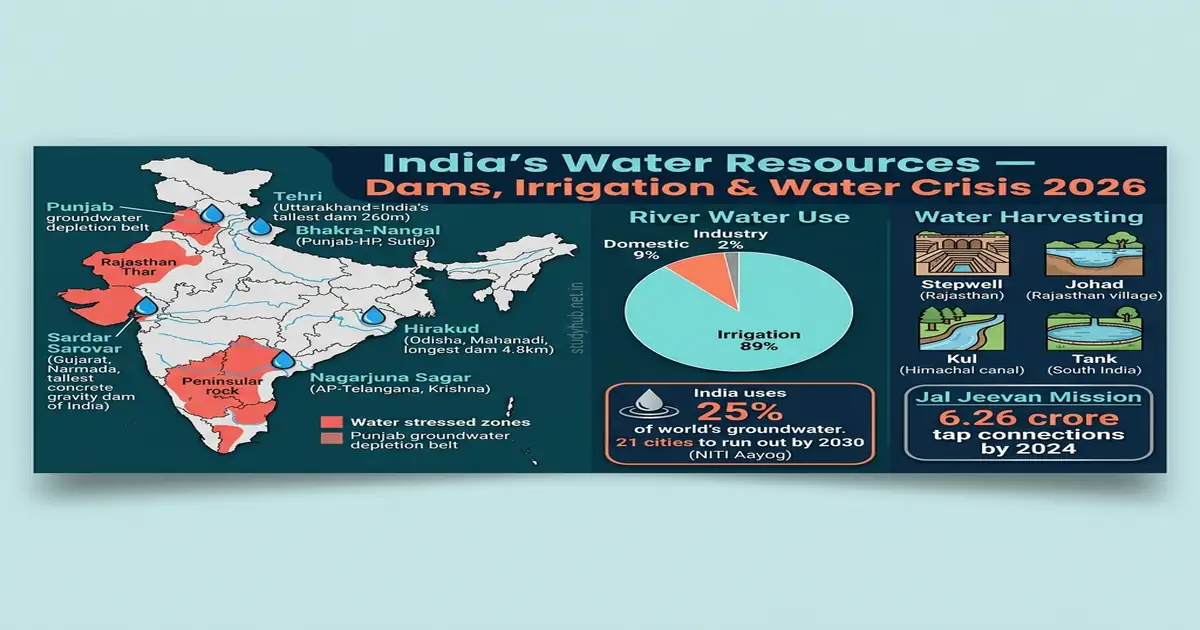
India’s Water Resources — Dams, Irrigation, Water Crisis & Conservation 2026
1. Major Dams, Multipurpose River Projects & Irrigation
| Topic | Details | Key Data & Exam Facts |
|---|---|---|
| Major Dams & Multipurpose River Valley Projects | India has 5,745 large dams (2021 = world’s 3rd largest number of large dams after USA and China). 411 dams under construction. India built most of its major dams in 1950s-1980s under Nehru’s vision of “Temples of Modern India” (Nehru called dams “the temples of modern India” at the Bhakra Dam inauguration 1963). KEY MULTIPURPOSE PROJECTS AND DAMS (EXAM TABLE): (1) BHAKRA-NANGAL (Punjab-Himachal Pradesh): River Sutlej. Dam at Bhakra = 226 m height = India’s highest gravity dam. Reservoir: Gobind Sagar (largest reservoir by storage in India, 9.34 BCM). Provides irrigation to Punjab, Haryana, Rajasthan, HP, Delhi. Power generation: 1,325 MW. BEA (Bhakra-Beas Management Board) manages. (2) HIRAKUD DAM (Odisha): River Mahanadi. 1956 = India’s first major multipurpose river valley project after independence. World’s longest earthen dam: 4.8 km. Reservoir: 746 sq km. Irrigation + flood control for Mahanadi delta, power (347.5 MW), flood moderation. Significance: prevented catastrophic Mahanadi floods (historically devastating). (3) TEHRI DAM (Uttarakhand): River Bhagirathi (tributary of Ganga). India’s tallest dam: 260.5 m. World’s 8th tallest dam. Reservoir: Tehri Lake. Power: 2,400 MW (1,000 MW pumped storage). Controversy: displaced 100,000+ people (old Tehri town submerged), seismic risk (Himalayan seismic zone 4-5). (4) SARDAR SAROVAR DAM (Gujarat): River Narmada. India’s tallest concrete gravity dam: 163 m. Reservoir: 9.5 BCM. Benefits: irrigation for Gujarat, Rajasthan, MP, Maharashtra (30 lakh hectares). Power. Major CONTROVERSY: Narmada Bachao Andolan (NBA), Medha Patkar’s movement. 320,000+ people displaced. Supreme Court intervention (1994 Narmada Disputes Tribunal). Final height raised to 138.68 m allowing completion (2017, PM Modi). (5) NAGARJUNA SAGAR (AP/Telangana border): River Krishna. World’s largest masonry dam (at construction, 1967). 125 m height. Two canals: Lal Bahadur Shastri (LB) Canal (left) and Nagarjuna Sagar (right/Krishna) Canal. Irrigates 8.7 lakh hectares. Power: 815.6 MW. (6) KOYNA (Maharashtra): River Koyna. 103 m. Major power dam (1,960 MW). 1967 Koyna earthquake (6.5M) caused by reservoir-induced seismicity = India’s deadliest reservoir-triggered earthquake (177+ deaths). (7) INDIRA SAGAR (MP): River Narmada. India’s largest reservoir by water storage capacity (12.22 BCM = surpasses Gobind Sagar). Height 92 m. Power 1,000 MW. Part of Narmada basin development. (8) KRISHNA SAGAR / KRS DAM (Karnataka): River Cauvery, near Mysuru. 1931 (British era). Irrigates Mandya-Mysuru agriculture. Famous scenic reservoir. Source of Cauvery water dispute (Karnataka vs Tamil Nadu). (9) METTUR DAM (Tamil Nadu): River Cauvery. 1934 (British era). 65 m. Major irrigation source for Cauvery delta (Thanjavur = rice bowl of TN). Opening of Mettur is ceremonially linked to Cauvery delta kharif sowing season. (10) TUNGABHADRA (Karnataka-AP): River Tungabhadra. 1953. 49 m. Major irrigation source for rice/cotton in northern Karnataka and AP. Near Hampi (UNESCO World Heritage). (11) UKAI (Gujarat): River Tapi/Tapti. GJ’s largest reservoir. (12) BANSAGAR (MP/UP border): River Son. Shares irrigation across MP, CG, UP. | DAMS QUICK REFERENCE TABLE (EXAM): Bhakra(Punjab/HP, Sutlej, 226m height, Gobind Sagar reservoir=largest storage 9.34BCM). Hirakud(Odisha, Mahanadi, 4.8km=world’s LONGEST earthen dam, 1956=India’s FIRST post-independence project). Tehri(Uttarakhand, Bhagirathi, 260.5m=India’s TALLEST dam, 2400MW). Sardar Sarovar(Gujarat, Narmada, 163m=India’s tallest CONCRETE GRAVITY dam, displaced 320k+). Nagarjuna Sagar(AP-Telangana border, Krishna, world’s largest masonry dam at construction, 1967). Indira Sagar(MP, Narmada, 12.22BCM=India’s LARGEST reservoir by storage). KRS/Krishna Sagar(Karnataka, Cauvery, 1931=British era). Mettur(TN, Cauvery, 1934=British, Cauvery delta irrigation). Koyna(Maharashtra, 1960MW, 1967 earthquake=reservoir seismicity). Tungabhadra(Karnataka-AP, Tungabhadra). NARMADA DISPUTES TRIBUNAL (NWDT, 1969-1979): First major inter-state water tribunal. Allocated Narmada water among Gujarat(9 MAF), MP(18.25 MAF), Rajasthan(0.5 MAF), Maharashtra(0.25 MAF). Total 28 MAF allocated (slightly exceeds average annual flow). MULTIPURPOSE BENEFITS: (1) Irrigation. (2) Flood control. (3) Power generation (hydroelectricity). (4) Drinking water supply. (5) Navigation (some). (6) Fisheries (reservoir fisheries). (7) Recreation/tourism. CRITICISMS OF BIG DAMS: Displacement (displaced 4.5 crore people in India since 1947 = WCD World Commission on Dams 2000 estimate). Ecological damage (blocks fish migration, changes downstream sediment). Sedimentation (reservoir silting = reduces life of dams). Seismic risk. Cultural heritage loss (temples, towns submerged). Dry season = downstream farmers get less silt = reduced soil fertility. Reservoir-induced seismicity (Koyna 1967). Benefits rarely reach displaced communities (tend to be tribal, SC areas). |
| Irrigation Systems & Water Use Patterns | India’s GROSS IRRIGATED AREA: 97.77 million hectares (2020-21 = 3rd largest irrigated area globally after China and USA). NET IRRIGATED AREA: 68.4 million hectares. India’s irrigation intensity = 142% (gross/net = some land irrigated twice). IRRIGATION SOURCES (% of irrigated area): (1) CANALS: 26.3% of irrigated area. Largest source in Punjab, Haryana, UP western districts, Rajasthan (IGNP), Bihar. Canal types: (a) Inundation canals (seasonal = only when river floods, no headwork). (b) Perennial canals (headworks/barrages ensure year-round flow). Major canal systems: Upper Ganga Canal (Haridwar → western UP, since 1854 = India’s first major modern irrigation canal). Sirhind Canal (HP Sutlej → Punjab). IGNP (Indira Gandhi Nahar Pariyojana / Rajasthan Canal, 1,649 km = world’s longest canal, brings Sutlej-Beas water to Thar Desert Rajasthan). Narmada Main Canal (Gujarat). Periyar Canal (Tamil Nadu, Periyar diversion). (2) WELLS AND TUBEWELLS: 55.2% of irrigated area = India’s dominant irrigation source. Groundwater revolution: 1970s-1990s = Green Revolution + tubewell spread + electricity subsidy → massive groundwater extraction. Punjab: 73% of irrigated area via tubewells. Haryana: 68%. Western UP: 70%+. Rajasthan: growing tubewell dependence even in arid Thar. CRISIS: Punjab water table dropping 0.5-1 m/year in some districts. At current extraction rates, Punjab groundwater will be unviable for irrigation in 20-25 years (CGWB). (3) TANKS: 1.6% of current irrigated area (was 30-40% in South India historically). Traditional tanks (cheruvu in TN/AP, kere in Karnataka, sarovar in north) = crucial for South India. Decline due to neglect, encroachment, urbanisation. Tamil Nadu = 39,000 tanks (2001) → many defunct now. Revival programmes underway (NABARD Tank Rehabilitation). | MAJOR IRRIGATION FACTS (EXAM): India’s utilizable water: 1,123 BCM (690 surface + 433 groundwater). Actual use: 761 BCM (irrigation 650BCM=85%+, domestic 56BCM, industry 55BCM). SHARE OF CROPS by irrigation source: Canal crops = wheat (UP, Punjab), sugarcane (UP-Maharashtra canal belts), rice (coastal canal areas, Godavari-Krishna delta). Tubewell crops = wheat (Punjab, Haryana, WU), paddy (Punjab = paddy is water-intensive=crisis!), vegetables (NW India). Tank crops = paddy, groundnut, vegetables in South India. IRRIGATION COMMANDS (area served): Bhakra = 1.02 million ha. Indira Gandhi Canal = 1.96 million ha. Nagarjuna Sagar left+right = 0.87M ha. Hirakud = 1.55M ha. EFFICIENCY CRISIS: India’s canal irrigation efficiency = 35-40% (60-65% water LOST to seepage, evaporation, inefficient field application). Compare: Israel drip irrigation efficiency = 89%. This means India uses 2.5x more water per hectare than necessary. PM KRISHI SINCHAYEE YOJANA (PMKSY, 2015): “Har Khet Ko Paani, Paani Ka Sahi Istemal” (water to every farm, proper use of water). Components: AIBP (Accelerated Irrigation Benefits Programme) — completes stalled irrigation projects. PMKSY-WDC (Watershed Development) — rainwater harvesting, soil moisture. PMKSY-PDMC (Per Drop More Crop) — micro-irrigation (drip + sprinkler). Pradhan Mantri Paani Bachao Andolan. MICRO-IRRIGATION: Drip (suitable for fruits, vegetables, plantation) and Sprinkler (field crops, hilly terrain). National Mission for Sustainable Agriculture (NMSA): soil health, micro-irrigation. PMKSY-PDMC target: 2021-26 = micro-irrigate 35 lakh ha. Current: ~15M ha under micro-irrigation (India world’s largest drip irrigation area by installed base after Israel at field level — by volume). State achievements: Maharashtra leads micro-irrigation adoption (sugarcane-grape-pomegranate belt). Gujarat drip success (cotton, groundnut). |
| Water Scarcity, Groundwater Crisis & Inter-State Disputes | GROUNDWATER CRISIS: India extracts 251 BCM/year groundwater = 25% of global groundwater extraction (making India the world’s LARGEST groundwater user). Annual recharge: 432 BCM. Net: 251 BCM extracted vs 432 BCM recharge = seems sustainable, but reality is FAR more complex: (1) SPATIAL MISMATCH: Recharge happens mostly in high-rainfall areas (NE, Himalayas, Western Ghats) but extraction happens most intensively in water-scarce agricultural areas (Punjab, Haryana, Rajasthan, interior Gujarat). (2) OVEREXPLORED BLOCKS: CGWB classifies groundwater blocks as “safe,” “semi-critical,” “critical,” and “over-exploited.” Over-exploited blocks (extraction > recharge): 1,186 blocks as of 2022 (increasing). Punjab = 76% blocks over-exploited. Haryana = 65%. Rajasthan = significant. Delhi = over-exploited. (3) FREE ELECTRICITY for agriculture: In 17 states, free/subsidised electricity for farmers = no price signal to conserve water → farmers pump indiscriminately → groundwater crashes. Punjab’s free electricity policy + rice cultivation = greatest agricultural water misuse in India. Punjab farmers pump water to grow paddy in a SEMI-ARID zone (natural vegetation = dry scrub, not paddy). NITI AAYOG COMPOSITE WATER MANAGEMENT INDEX (CWMI 2018): India ranked 120 out of 122 countries in water quality. 21 cities to run out of groundwater by 2030: Delhi, Bengaluru, Chennai, Hyderabad, Amritsar, Jodhpur, etc. This will affect 100 million people. INTER-STATE WATER DISPUTES: India has 7 major inter-state river water disputes under the Inter-State River Water Disputes Act 1956: (1) Cauvery dispute (Karnataka vs Tamil Nadu, + Kerala + Puducherry): oldest, bitterest dispute. Karnataka built KRS dam (1931) and Hemavati, Kabini, Harangi dams → reduced Cauvery flow to TN. Cauvery Water Disputes Tribunal (CWDT): established 1990, final award 2007. Karnataka = 270.0 TMC (thousand million cubic feet). TN = 419.0 TMC. Kerala = 30.0 TMC. Puducherry = 7.0 TMC. Supreme Court modified (2018): TN receives 177.25 TMC during normal monsoon. Karnataka = 284.75 TMC. Periodic riots at Karnataka-TN border during Cauvery water release disputes. Cauvery Water Management Authority (CWMA) constituted 2018. (2) Krishna water dispute (AP-Telangana-Maharashtra-Karnataka): Bachawat Tribunal (1973): AP gets 811 TMC, Karnataka 700, Maharashtra 560. After Telangana bifurcation (2014): TS and AP still disputing share. (3) Ravi-Beas waters (Punjab vs Haryana + Rajasthan): SYL canal (Sutlej-Yamuna Link) controversy. Canal to carry Punjab’s share of Ravi-Beas water to Haryana = half-built since 1982, Punjab refuses to complete (supreme court said complete, Punjab passes law terminating canal). Politically most explosive water dispute. (4) Narmada: resolved by NWDT 1979 but Sardar Sarovar height dispute ran decades. (5) Mahanadi: Odisha vs Chhattisgarh (new dams in CG reducing Mahanadi flow to Odisha). | WATER QUALITY CRISIS: (1) Arsenic contamination: Bengal aquifers (West Bengal, Bihar, UP alluvial plain) = natural arsenic leaching from sedimentary layers. 6 crore+ people at risk. Arsenic causes skin lesions, cancer, peripheral neuropathy. (2) Fluoride: Rajasthan, AP, Telangana, Gujarat. Excess fluoride (>1.5 mg/L) causes dental/skeletal fluorosis. 6.6 crore people vulnerable. (3) Nitrate: from agricultural fertiliser overuse. Punjab, Haryana soils. Groundwater nitrate excess = “Blue Baby Syndrome” (methaemoglobinaemia in infants). (4) Iron: Odisha, WB, NE India = high iron in surface/groundwater. (5) Heavy metals: industrial effluents (Ganga near Kanpur leather factories, Vapi-Ankleshwar GIDC Gujarat = India’s most polluted industrial belt). WATER POLICIES: JAL SHAKTI MINISTRY (2019): merged Ministry of Water Resources + Ministry of Drinking Water and Sanitation. Signals government’s integrated view of water. JAL JEEVAN MISSION (2019): Har Ghar Jal (Every Home Water). Target: provide tap water connection to every rural household by 2024. Investment: Rs 3.60 lakh crore (2019-24). Progress (March 2024): 14.28 crore (142.8 million) of 19.17 crore (191.7 million) rural homes connected = 74.5% coverage. Remaining 25.5% = mostly in UP, Bihar, Rajasthan, Odisha, MP = hardest to reach areas. Target extended to 2024 December. RIVER INTERLINKING PROJECT (ILR — Inter-Linking of Rivers): Ken-Betwa Link (MP): first ILR project. Links Ken River (MP) to Betwa River (UP) via 77-km canal. Foundation stone 2017, construction ongoing. Transfers water from water-surplus Ken to water-deficit Betwa. Bundelkhand irrigation. Environmental concern: Ken river crocodile sanctuary flooded. Ken-Betwa ILR first inter-state ILR operationalised (construction 2022-). Full ILR: 30 links total (14 Himalayan + 16 Peninsular). Total investment: Rs 11-13 lakh crore (economist critique: unproven, ecologically risky). Supporters: water redistribution from surplus to deficit basins = solve India’s water geography mismatch. Critics: messes with river ecosystems, seawater intrusion at diverted ends, disputes between states (source state resists diversion). Ganga-Cauvery linkage (peninsular part) = most controversial proposed link. |
2. Traditional Water Conservation, Rainwater Harvesting & Policy
| System | Region & Description | Significance |
|---|---|---|
| Traditional Water Harvesting Systems | India’s ancient communities developed extraordinary water-harvesting wisdom that sustained civilisations in areas that modern engineering now struggles with. Key systems: (1) BAORI / VAPI / STEPWELL (Rajasthan, Gujarat): Underground step-wells with stairs descending to water table. Water stays cool even in summer. Examples: Chand Baori (Abhaneri, Rajasthan = 3,500 steps = world’s largest stepwell, 13 floors deep). Rani ki Vav (Patan, Gujarat = UNESCO World Heritage 2014 = 7 stories deep, intricately carved). Queen’s stepwell. Used since 7th century CE. Function: water storage + social gathering space + cooling architecture. (2) JOHAD (Rajasthan): Small earthen check dam creating a pond behind it to collect monsoon rainwater. Revived by Rajendra Singh (“Water Man of India” = Ramon Magsaysay Award winner) in Alwar district → raised water table, rivers Arvari-Ruparel-Sarsa revived from dry to perennial. Johad revival = textbook example of participatory watershed development. (3) KUL (Himachal Pradesh, J&K): channels cut from mountain streams, guided around hillsides to terraced fields. Used for centuries by Spiti and Lahaul valley communities. Gravity-fed. Used even in winter. (4) ZING (Ladakh): Small tank collecting glacial meltwater at night (glaciers melt during day, water collected in zing at night when stream volume is low, released at dawn for field irrigation). Traditional solution to the paradox: glacier water rushes in daytime when fields are too hot to irrigate, so it’s stored overnight. (5) AHAR-PYNE (Bihar): Ahar = catchment basin (rectangular embankment), Pyne = artificial rivulet carrying water from river to ahar. Used for centuries in south Bihar plains. Largely fallen into disuse after government canal and tubewell expansion. (6) TANKS (South India): Cheruvus (AP/Telangana), Keres (Karnataka), Eris (Tamil Nadu) = earthen tanks/ponds collecting monsoon runoff. Linked in cascading systems: water overflows from one tank fills the next = highly efficient in low-rainfall Deccan. 39,000+ tanks in TN historically. (7) PHAD (Maharashtra, Vidarbha): Collective irrigation management system on rivers like Panzara, Mosam. A weir diverts water into phads (large fields). Community manages water distribution. | TRADITIONAL vs MODERN COMPARISON: Johad (participatory, local, zero electricity, maintains water quality) vs Tubewell (requires electricity, depletes shared aquifer, causes subsidence, NO community management). The groundwater crisis in Punjab = essentially a modern tubewell-driven failure of commons management. Rajendra Singh (Water Man): rebuilt 11,800+ johads in Rajasthan (Tarun Bharat Sangh NGO) → groundwater table rose 6 metres in parts of Alwar → five rivers that had gone dry since 1980s revived to perennial status. AWARD: Stockholm Water Prize 2015 (world’s most prestigious water award), Ramon Magsaysay Award. LEGAL STATUS: No formal legal framework for traditional water systems in most Indian states. Many have been encroached. Chand Baori, Rani ki Vav = protected (ASI/UNESCO). REVIVAL PROGRAMMES: MGNREGA (Mahatma Gandhi National Rural Employment Guarantee Act) = used to desilting tanks, building check dams, reviving johads (social + environment). Amrit Sarovar (2022): Azadi ka Amrit Mahotsav = 75,000 ponds/water bodies renovated/created (one per village block of 75,000 blocks). 67,000+ Amrit Sarovars completed (2024) = largest water body conservation programme in India’s history. Atal Bhujal Yojana (2019, Rs 6,000 crore, World Bank assisted): community groundwater management in 7 water-stressed states (Gujarat, Maharashtra, Rajasthan, MP, UP, Karnataka, Haryana). Pani Panchayat (Maharashtra, pioneer: Vilasrao Salunke, Pune): farmer water user associations manage canal water allocation. Reduces disputes, increases efficiency. Model adopted in Maharashtra Irrigation Act. JAL SAKHI: Women water warriors trained under Jal Jeevan Mission in villages to maintain tap water pipes, detect leaks, manage water committees. 20 lakh Jal Sakhis planned. |
Frequently Asked Questions
Why is the Cauvery water dispute between Karnataka and Tamil Nadu so persistent — and what does it reveal about India’s water governance?
The Cauvery dispute (also spelled Kaveri) is India’s most emotionally charged and longest-running inter-state water conflict — active for over 130 years (since 1892 when Mysore sought British permission to build irrigation canals on the Cauvery, and Madras Presidency objected). Understanding it reveals deep structural problems in how India manages shared river resources. The Physical Geography: The Cauvery River originates in Talakaveri, Kodagu (Coorg), Karnataka, at 1,341 m elevation. Flows 800 km through Karnataka and Tamil Nadu before emptying into the Bay of Bengal at Thillai (near Cuddalore, TN). Major tributaries: Hemavati, Shimsha, Arkavati (KN-side); Bhavani, Noyyal, Amaravati (TN-side). Catchment area: 81,155 sq km (Karnataka = 41%, Tamil Nadu = 54%, Kerala = 3%, Puducherry = 0.14%). Annual average flow at Biligundlu (gauging station, KN-TN border): 21.36 BCM (TMC 754 billion cubic feet). Why Karnataka and Tamil Nadu Both Need It Desperately: Karnataka: Mandya, Mysuru, Chamarajanagar, Hassan, Kodagu, Tumkur, Bengaluru districts = dependent on Cauvery for drinking water (Bengaluru’s primary water source) + Mandya sugarcane-paddy cultivation (1.5 million acres irrigation). KRS dam (1931), Hemavati (1979), Kabini, Harangi = Karnataka’s constellation of dams controlling Cauvery storage. Tamil Nadu’s Cauvery delta: Thanjavur, Tiruvarur, Nagapattinam = India’s “rice bowl” of the south. This deltaic zone has been under CONTINUOUS PADDY CULTIVATION for 2,000+ years. Chola kings built grand irrigation systems (Grand Anicut at Kallanai = 1st century CE = one of world’s oldest water diversion structures still in use!). Mettur Dam (1934) is TN’s primary Cauvery storage. TN’s argument: “We have prior rights — we were farming the Cauvery delta for 2,000 years before Karnataka built its first dam.” Karnataka’s counter-argument: “We are the upper riparian state and have the right to develop our own basin. TN overestimates what was historically allocated.” The Tribunal Award and Supreme Court: Cauvery Water Disputes Tribunal (CWDT): established May 1990 under ISRWD Act. Gave final award 2007 (took 17 years): Karnataka=270 TMC, TN=419 TMC, Kerala=30 TMC, Puducherry=7 TMC. Karnataka refused full implementation. TN moved Supreme Court. Supreme Court modified (2018): fine-tuned allocations, reduced TN’s share marginally (to 404.25 TMC in normal years). Directed formation of Cauvery Water Management Authority (CWMA) and Cauvery Water Regulation Committee (CWRC). Annual Conflict Pattern: Every June-September monsoon: depending on rainfall in Karnataka’s catchment (Kodagu) → KRS + Hemavati reservoirs fill to varying levels. When TN demands release and Karnataka’s reservoirs are low → Karnataka refuses or delays. SC has had to issue emergency orders for release in deficit years (2016, 2017 = particularly acute). Result: periodic violence at Karnataka-TN borders, Kannada/Tamil TV channels drive public hysteria. TN farmers protest in Chennai. Bengaluru Kannadigas protest. Karnataka bandhs. What It Reveals About India’s Water Governance: (1) No functioning river basin authority: Rivers ignore state boundaries but governance is state-based. India needs a Cauvery River Basin Authority with real teeth (monitoring, enforcement, real-time flow data sharing). CWMA was created in 2018 but states resist full cooperation. (2) Legal system too slow: CWDT took 17 years to give an award. SC appeal ran another decade. By then: population doubled, agriculture intensified, groundwater also depleted. (3) Climate change as new variable: Kodagu (Coorg) rainfall becoming increasingly erratic. Karnataka’s reservoirs fill unpredictably. TN’s groundwater-dependent backup also failing. Both states face water crisis regardless of how the Cauvery is shared. (4) Politics over science: In election years, water sharing becomes impossible to compromise on. No politician can be seen “giving away” water. (5) Demand management ignored: Both states focus on getting MORE water, but have done little to: reduce irrigation losses (TN canal efficiency = 35-40%), switch to less water-intensive crops, promote drip irrigation. The solution to Cauvery lies not just in allocation but in efficiency. India needs to produce the same food with 40% less water = “more crop per drop” (PM’s phrase).
Important for Exams — India Water Resources UPSC, SSC & State PCS
WATER STATISTICS: India annual precipitation = 4,000 BCM. Utilisable = 1,123 BCM (690 surface + 433 groundwater). India groundwater extraction = 251 BCM = 25% of global = LARGEST user. 21 cities to run out by 2030 (NITI Aayog 2018). DAMS: Bhakra-Nangal(Punjab-HP, Sutlej, 226m, Gobind Sagar = largest storage 9.34BCM). Hirakud(Odisha, Mahanadi, 4.8km = world’s LONGEST earthen dam, 1956 = India’s FIRST post-independence project). Tehri(Uttarakhand, Bhagirathi, 260.5m = India’s TALLEST). Sardar Sarovar(Gujarat, Narmada, 163m = India’s tallest CONCRETE GRAVITY dam, displaced 320k). Nagarjuna Sagar(AP-TG, Krishna, world’s largest masonry dam 1967). Indira Sagar(MP, Narmada, 12.22BCM = LARGEST reservoir by storage). KRS Dam(Karnataka, Cauvery, 1931 British). Mettur(TN, Cauvery, 1934 British). Koyna(Maharashtra, 1960MW, 1967 reservoir earthquake). IRRIGATION SOURCES: Tubewells = 55.2% (dominant; Punjab 73% by tubewell). Canals = 26.3% (IGNP = 1,649km = world’s LONGEST canal). Tanks = 1.6% (historically 30-40% South India; now declining). India gross irrigated area = 97.77 million ha. Irrigation efficiency = 35-40% (Israel drip = 89%). PMKSY(2015): Har Khet Ko Paani + Per Drop More Crop. WATER DISPUTES: Cauvery(Karnataka vs TN, CWDT 1990-2007 award, SC modified 2018, CWMA 2018). Krishna(Bachawat Tribunal 1973). Narmada(NWDT 1979). Ravi-Beas SYL Canal(Punjab vs Haryana-Rajasthan, most politically explosive). Mahanadi(Odisha vs CG, new). TRADITIONAL SYSTEMS: Baori/Stepwell(Rajasthan-Gujarat; Chand Baori=world’s largest, Rani ki Vav=UNESCO 2014). Johad(Rajasthan; Rajendra Singh=Water Man, revived 5 rivers in Alwar). Kul(HP, J&K gravity canals). Zing(Ladakh glacial meltwater). Ahar-Pyne(Bihar). Tank/Kere/Cheruvu/Eri(South India). Phad(Maharashtra). POLICY: Jal Shakti Ministry(2019). Jal Jeevan Mission(2019, Rs 3.60L cr, 100% rural tap, 74.5% complete March 2024). Atal Bhujal Yojana(2019, Rs 6000cr World Bank). Amrit Sarovar(2022, 75,000 water bodies). Ken-Betwa ILR(first river link, MP-UP). GROUND WATER: Over-exploited blocks = 1,186(2022). Punjab 76% OE. Free electricity = primary cause Punjab/Haryana depletion. WATER QUALITY: Arsenic(WB, Bihar alluvial). Fluoride(Rajasthan, AP, Gujarat). Nitrate(Punjab, Haryana). Cauvery = Grand Anicut at Kallanai(TN, 1st century CE = one of world’s OLDEST water diversion structures in use!). Kallanai/Grand Anicut = Chola dynasty. Nehru called dams “Temples of Modern India” (Bhakra inauguration 1963).
What to Read Next
- Agriculture — How Irrigation Systems Drive India’s Cropping Patterns 2026
- Indian Drainage — The Rivers That Feed India’s Dams & Canals 2026
- Physiographic Divisions — Why Himalayan Rivers Carry India’s Largest Water Volume 2026
- Indian Monsoon — How Monsoon Variability Drives India’s Annual Water Crisis 2026
- Indian Soils — How Soil Type Determines Irrigation Efficiency & Water Retention 2026
🎔 Exam Quick Reference — India Water Resources: PRECIPITATION: 4,000 BCM/yr. Utilisable=1,123 BCM(690 surface+433 GW). India GW extraction=251BCM=25% global=LARGEST USER. NITI Aayog: 21 cities run out GW by 2030. DAMS EXAM TABLE: Bhakra(Punjab-HP, Sutlej, 226m height, Gobind Sagar=largest reservoir storage 9.34BCM). Hirakud(Odisha, Mahanadi, 4.8km=WORLD’S LONGEST earthen dam, 1956=India’s FIRST post-independence multipurpose project). Tehri(UK, Bhagirathi, 260.5m=India’s TALLEST dam). Sardar Sarovar(Gujarat, Narmada, 163m=India’s tallest CONCRETE GRAVITY dam). Nagarjuna Sagar(AP-TG, Krishna, 1967). Indira Sagar(MP, Narmada, 12.22BCM=India’s LARGEST reservoir by storage). KRS(Karnataka, Cauvery, 1931 British). Mettur(TN, Cauvery, 1934 British). Koyna(Maharashtra, 1967 reservoir earthquake=177 deaths). IRRIGATION: Tubewells=55.2% dominant. IGNP=world’s LONGEST canal(1,649km, Rajasthan). Canals=26.3%. Tanks=1.6%(declining). Efficiency=35-40%(very low). PMKSY=Har Khet Ko Paani. TRADITIONAL WATER: Baori/Stepwell(Chand Baori=world’s largest, Rani ki Vav=UNESCO). Johad(Rajasthan, Rajendra Singh revived 5 rivers, Ramon Magsaysay+Stockholm Water Prize). Kul(HP-JK). Zing(Ladakh glacial). Ahar-Pyne(Bihar). Tanks/Kere/Eri(South India). WATER DISPUTES: Cauvery(KN vs TN, CWDT 1990-2007, SC 2018, CWMA). Krishna(Bachawat 1973). SYL Canal(Punjab vs Haryana-Rajasthan, most explosive). Mahanadi(Odisha vs CG). ILR=Ken-Betwa=first link POLICY: Jal Shakti Ministry(2019). JJM(Rs 3.60Lcr, 74.5% rural tap). Atal Bhujal(Rs 6000cr, WB). Amrit Sarovar(75,000 ponds, 2022). WATER QUALITY: Arsenic(WB-Bihar). Fluoride(Rajasthan-AP). Nitrate(Punjab-Haryana). Grand Anicut Kallanai(TN, 1st century CE=world’s oldest water diversion structure in use). Nehru=”Temples of Modern India”(dams). India =3rd largest irrigated area globally.
About This Guide: Written by the StudyHub Geology Editorial Team (studyhub.net.in/geology/) based on NCERT Class 12 Geography Chapter 6 (Water Resources), Central Ground Water Board (CGWB) Annual Report 2022, National Water Policy 2012, NITI Aayog Composite Water Management Index 2018, Jal Jeevan Mission Dashboard (March 2024), Cauvery Water Management Authority notifications, and World Commission on Dams Report 2000. Last updated: March 2026.