
Last Updated: March 2026 | Reading Time: 12 minutes | ~2,700 words | Category: Climatology & Monsoon Science
India’s climate is defined by one of the world’s most dramatic and consequential weather systems: the South Asian Monsoon (Southwest Monsoon) — a seasonal reversal of winds that transforms the subcontinent from blistering, dust-laden heat into the life-giving rains that have shaped Indian civilization for 5,000+ years. The word “monsoon” derives from Arabic mausim (season), used by Arab traders who observed the pattern of seasonal wind reversal over the Indian Ocean. India receives approximately 75–80% of its total annual rainfall during the four months of the Southwest Monsoon (June–September), making the timing, onset, quantum, and spatial distribution of this monsoon the single most important climatic event for 1.4 billion Indians. Good monsoon = bumper agricultural harvest, full reservoirs, lower food prices, higher GDP growth. Failed/deficient monsoon = drought, crop failure, water crisis, rural distress. Scientifically, India’s climate is Tropical Monsoon type (Aw or BSh in Köppen classification for most of India), modified by its extraordinary geographic diversity: the Himalayas act as a thermal and physical barrier (blocking cold Central Asian Arctic air in winter; trapping monsoon moisture in summer); the Indian Ocean moderates temperatures on the coasts; vast latitudinal extent (8°N to 37°N) creates distinct climatic zones; and local geographical controls (Western Ghats orographic rainfall, Thar Desert heat-driven low pressure, Tibetan Plateau thermal heating) all shape regional climate. India recognizes four distinct seasons: (1) Cold Weather Season (December–February), (2) Hot Weather Season (March–May), (3) Southwest Monsoon / Rainy Season (June–September), and (4) Retreating Monsoon / Northeast Monsoon (October–November). Understanding the mechanism of each season, the teleconnections that affect monsoon variability (El Niño, La Niña, Indian Ocean Dipole), and the spatial distribution of rainfall across India is essential for UPSC General Studies, SSC, and all competitive examinations in India.
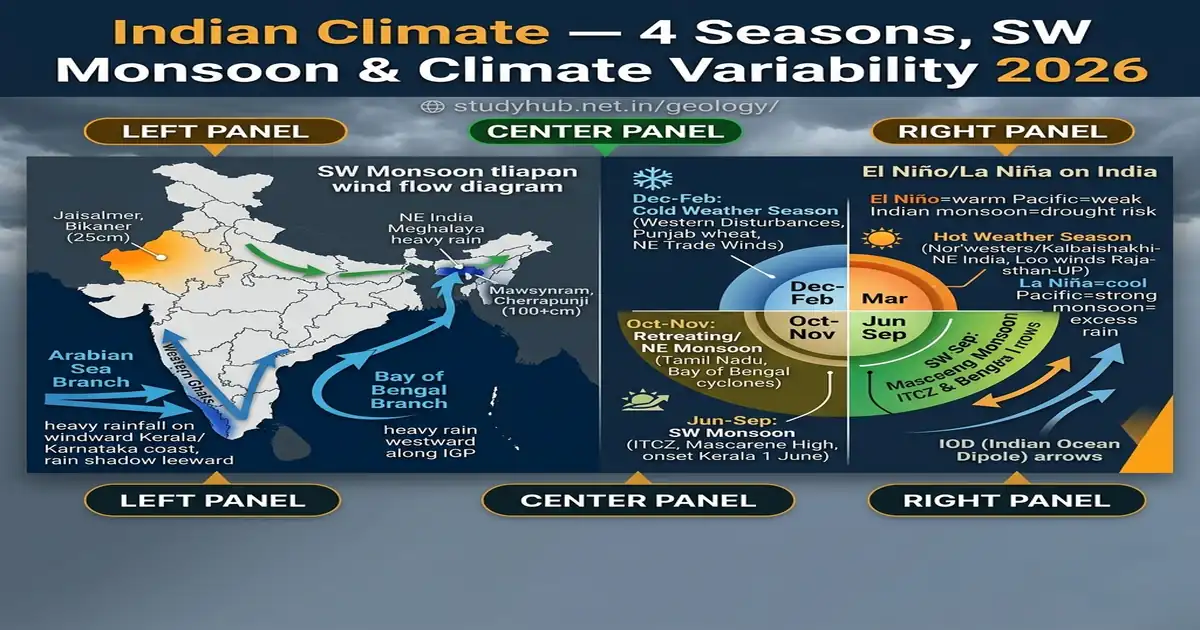
Indian Climate — 4 Seasons, Monsoon Mechanism & Climate Variability 2026
1. Controls of India’s Climate & Four Seasons
| Season / Climate Control | Mechanism | Regional Weather Events | Significance |
|---|---|---|---|
| Climate Controls of India | Six major controls: (1) Latitude: 8°N–37°N → India spans tropical to subtropical. Southern India = tropical (no winter). Northern India = subtropical (distinct winter). Tropic of Cancer (23.5°N) passes through Rajasthan-MP-Jharkhand-WB. (2) Altitude: Himalayan zones = alpine. Deccan = 600–1,200m = moderated temperature. Coastal plains = tropical. (3) Pressure & Winds: In winter, high pressure in central Asia → cold dry continental air flows south → NE Trade Winds over India (N to S direction) = dry, cold. In summer, low pressure forms over Thar Desert + Tibetan Plateau heating → pulls in moist oceanic air from Indian Ocean = SW Monsoon. (4) Distance from Sea: Coastal areas = maritime climate (moderate range). Interior = continental (extreme summer-winter range). (5) Ocean Currents: No cold current on India’s coast (unlike western continental margins). Warm Arabian Sea + Bay of Bengal = moisture source for monsoon. (6) Himalayas as Barrier: SOUTH of Himalayas = warm, moderated. WITHOUT Himalayas, North India would be as cold as Central Asia in winter AND monsoon clouds would cross and India would get much less rain | Continental interior (UP, MP, Rajasthan): extreme temperature range (summer 45–48°C, winter below 5°C). Coastal areas (Mumbai, Chennai): narrow temperature range year-round (~28–32°C). Tibetan Plateau: heats up dramatically in summer → creates strong atmospheric pressure gradient → “pumps” the monsoon circulation (the Tibetan Plateau heating is considered one of the primary drivers of the South Asian monsoon). Himalayas: (a) block cold winter winds from Central Asia → N India winter is mild compared to same latitude w/o mountains. (b) block monsoon clouds → heavy rainfall on south face, dry leeward. (c) form catchment for perennial rivers (Ganga, Brahmaputra = Himalayan rivers fed by snow/glacier) | Spatial contrasts: Mawsynram (Meghalaya) = 11,872 mm/yr = world’s highest average annual rainfall. Jaisalmer (Rajasthan) = 162 mm/yr = India’s driest location. Bengaluru (1,000m plateau, interior Karnataka) = moderated climate despite 12°N latitude. North India plain: most extreme climate (45°C summer, sometimes below 0°C winter at Amritsar/Chandigarh). Rajasthan: 50°C recorded temperatures. Himalayan climate: Leh/Ladakh = cold desert (-20°C winter, 30°C summer). Dras (Ladakh) = coldest inhabited place in India (-45°C recorded) |
| Season 1: Cold Weather Season (December–February) | High pressure in Central Asia/North India → cold dry NE Trade Winds blow from NE to SW over India → mostly dry weather over most of India. Temperature in North India: 10–15°C days, 5–10°C nights. South India remains warm (18–22°C). Continental north = possibility of frost/fog (Terai fog belt: dense fog, December-January, UP-Bihar-Rajasthan = major transport disruption). Western Disturbances: extratropical cyclones originating over Mediterranean Sea, moving eastward along jet stream (subtropical westerly jet at 27°N) → bring snowfall to Jammu & Kashmir, Himachal Pradesh, Uttarakhand → bring rainfall to Punjab, Haryana, UP plains (RABI CROP — wheat — critically depends on this winter rainfall!). 4–7 Western Disturbances per month | Fog: Dense fog belt (VORTAC fog) over IGP (UP, Bihar, Delhi, Punjab) in December-January — India’s worst transport disruption zone (flight cancellations, train delays, road accidents). Months of continuous fog at 0 visibility. Western Disturbances: Shimla/Manali snowfall (tourist destination). Punjab/Haryana winter wheat crop needs 45–50 cm of rainfall from WDs + groundwater irrigation to survive. Jammu receives WD rain in winter. J&K, HP mountains: 2–5 m snowfall. Kashmir Valley: Dal Lake may partly freeze in Feb. Cold wave: Rajasthan (Churu = -2.5°C records). Delhi: periodic cold waves (<10°C for 3+ days = CWC definition). North-East Monsoon: during this season, Tamil Nadu + SE coast receive NE Monsoon rainfall (Bay of Bengal winter disturbances). Chennai gets 60% of its annual rainfall from NE Monsoon! | Agriculture: RABI CROPS (winter-sown): Wheat (Punjab, Haryana, UP), Mustard (Rajasthan, Haryana), Gram/Chickpea, Barley, Peas. All depend on cool temperature + winter rainfall. Western Disturbances = crucial for rabi crop success. AVIATION: most disrupted season (fog). Tourism: Northwest India (Rajasthan forts, Delhi monuments) = peak tourist season. Snowfall = Himalayan ski tourism. Shillong, NE India = pleasant cool weather. South India: dry but comfortable = peak tourist season (beaches, heritage sites TN-Kerala) |
| Season 2: Hot Weather Season (March–May) | Sun’s apparent northward migration → ITCZ (Inter-Tropical Convergence Zone) shifts northward → low pressure develops over Thar Desert (intense heating reaches 45–50°C) → NE Trade Winds weakened → shifting to southwesterly winds. Temperature: up to 48°C in Rajasthan. Loo: hot, dry, dust-laden wind (west-to-east) in Rajasthan-UP-Bihar plains (March-May). Can cause heat stroke, deaths. Mango rains: pre-monsoon convectional showers in Kerala-Karnataka (beneficial for mango crops). Blossom showers (Kerala): pre-monsoon showers in April-May. Heat waves: long-duration extreme heat (NDMA definition: departure of +4.5°C from normal for 2+ consecutive days). India’s heat waves killing 1,000s every year (Andhra Pradesh, Rajasthan, MP, UP worst) | Phenomena: Loo (hot dry wind, N-India plains). May–June: 45–48°C Rajasthan/MP/UP. Nor’westers / Kalbaishakhi (Bengali: “storm that comes from the northwest”): violent thunderstorms in NE India (Bengal, Assam, Odisha) in late afternoon/evening from March-May. Caused by convection + interaction with Bay of Bengal moisture. Hail, strong winds (up to 100 km/h), flash flooding. Damage to mango orchards, jute, standing wheat. ALSO beneficial: tea plants in Assam (break of weather). Andhis: dust storms in Rajasthan-UP (50m high dust walls). Kerala: “mango showers” (pre-monsoon convective rains — beneficial for coastal fisheries). Uttarakhand: forest fires (dry + hot = ignition risk). ENSO: if El Niño is developing → summer pre-monsoon temp even higher → delayed monsoon onset | Agriculture: Crops harvested in March-April (Rabi harvest season). Zaid/Summer crops planted: watermelon, cucumber, muskmelon in March-June. Horticulture: mango harvest (April-June). HEAT STRESS on animals + humans. Labour productivity falls in agriculture during extreme heat. Water bodies: lakes/ponds drying. Groundwater: rapid depletion by irrigation. Pre-monsoon preparedness: India Meteorological Department (IMD) issues heat wave warning alerts. India has National Heat Action Plan. Ahmedabad (Gujarat) = first city in India (2013) to develop Heat Action Plan after 2010 heat-wave + flood killed 1,344. Health: heat-related mortality (mostly elderly, outdoor workers) |
| Season 3: Southwest Monsoon (June–September) — India’s most important season | Full mechanism (detailed in next section). Wind reversal: during summer, intense heating of Thar Desert + Tibetan Plateau → huge low pressure forms over NW India + Central Asia. Simultaneously: strong high pressure centre (Mascarene High) persists over SW Indian Ocean (near Mascarene Islands/Mauritius region). Pressure gradient too large → air rushes north = SW Monsoon onset. Onset: Kerala (~June 1, ±1 week) → progressive northward advance. Withdrawal: September 1 (Rajasthan) → November 1 (Tamil Nadu coast). Total rainfall over India: average 880 mm in 4 months. But enormous spatial variation: 11,000 mm (Mawsynram) to 162 mm (Jaisalmer). Bay of Bengal Branch + Arabian Sea Branch | June 1 Kerala onset: India’s most-anticipated annual event. IMD forecasts onset date every year (critical for agricultural planning). Break in Monsoon: occasional dry spells within monsoon season (~1-2 weeks of weak monsoon). Flood years: excess rainfall (2005 Mumbai 944 mm in 24 hours = highest 24-hour rainfall recorded in an Indian city). Khetri, Rajasthan: received 400 mm in 2 hours = extreme localized rain. Cloudburst: rapid intense rainfall >100 mm/hr over small area (common in Himalayas = landslides, floods). Northeast India: highest rainfall: Mawsynram 11,872 mm/yr, Cherrapunji 11,777 mm/yr (adjacent locations in Meghalaya East Khasi Hills). Both have highest recorded 24hr rainfall: 1,563 mm in July 1995 (Cherrapunji). Why NE India so wet: Bay of Bengal Branch curves northward → hits MEGHALAYA KHASI HILLS (1,500m high) = perfect funnel for orographic rainfall | Agriculture: KHARIF CROPS: Rice (Assam, WB, AP, TN, Punjab), Jowar, Bajra, Cotton, Jute (WB, Assam), Soybean (MP), Maize, Sugarcane, Groundnuts. GDP sensitivity: India’s agriculture (~16% GDP, 42% employment) → strongly tied to monsoon. 1% deviation in monsoon = 0.7% change in agricultural output. IMD seasonal forecast (April, June): released every year, watched by stock markets, government, farmers. Flood control: Ganga, Brahmaputra, Mahanadi, Godavari, Krishna — all prone to monsoon floods. Assam floods: annual event (2022 = 60% Assam flooded). Bihar Kosi floods: nearly annual. Mumbai urban floods: flash floods from intense rain on concrete + old drainage |
| Season 4: Retreating / NE Monsoon (October–November) | SW Monsoon withdrawal: retreats from NW India (September 1) → southward → withdraws from entire India by November-December. As SW Monsoon retreats, pressure reverses → NE Trade Winds re-establish → Bay of Bengal warms (the sea retains heat longer than land) → pick up moisture as they travel SW → NE Monsoon rainfall on COROMANDEL COAST (TN + SE Andhra). ITCZ retreats south. Bay of Bengal cyclones: October-November = peak cyclone season in Bay of Bengal (warm sea, favourable upper atmospheric conditions). Bay of Bengal has more cyclones than Arabian Sea (Bay = funnel shape, warm SST, lower wind shear) | NE Monsoon events: Chennai gets 60% annual rain in Oct-Nov-Dec (NE Monsoon) — one of few large cities where monsoon comes TWICE (June SW, October NE). December 2015 Chennai floods (1,049 mm in Nov = unprecedented, triggered by El Niño year excess NE monsoon). Cyclones: Cyclone Amphan (2020, most powerful ever recorded in Bay of Bengal, 185 km/h wind, Odisha-WB). Cyclone Fani (2019, Category 5, Odisha). Cyclone Tauktae (2021, Arabian Sea, Gujarat coast). IMD cyclone naming: regional framework (WMO ESCAP, India names assigned). Arabian Sea: fewer but increasingly intense cyclones (climate change = warmer Arabian Sea). ITCZ position: retreats to 5–8°N by November; by December = southern hemisphere | Agriculture: Zaid crop harvest. Rabi crop sowing (October-November after monsoon withdraws). TN rice crop (Samba paddy = long-duration variety, harvested February). Cyclone damage: coastal AP, Odisha, WB most affected. 2020 Amphan = ₹1 lakh crore damage (WB, Bangladesh). Odisha NDRF model: advance evacuation before cyclone (Orissa cyclone 1999 killed 10,000 → Phailin 2013: killed 23 despite same intensity → 99.9% reduction due to preparedness). Tamil Nadu: NE Monsoon failure → water crisis (Palar, Cauvery low → Chennai water crisis recurring) |
2. Southwest Monsoon Mechanism, Teleconnections & Climate Variability
| Topic | Mechanism & Details | India Impact |
|---|---|---|
| SW Monsoon — Full Mechanism | Step-by-step: (1) Summer insolation heats the Asian landmass more than the Indian Ocean (land heats faster than sea). (2) TIBETAN PLATEAU heating: the plateau (average 4,500m) acts as a high-altitude heat source in summer → heats the troposphere above → creates UPPER-LEVEL ANTICYCLONE over Tibet → generates the TROPICAL EASTERLY JET STREAM (TEJ) at ~150 hPa over India (flowing east to west at 9–12 km altitude). (3) LOW PRESSURE develops over Thar Desert (NW India) and Pakistan as surface temperatures reach 45–50°C. (4) MASCARENE HIGH: a semi-permanent subtropical high-pressure system in the SW Indian Ocean (near Mascarene Islands, lat 30°S). This pushes SW winds northward. (5) The pressure gradient between Mascarene High (high P, 30°S) and Indian Low (low P, 30°N) drives the monsoon circulation. (6) SOMALI JET: a low-level jet stream (925 hPa, ~1 km altitude) that carries the monsoon moisture from the SW Indian Ocean along the East African coast → across the Arabian Sea → to India. This is the “express highway” of monsoon moisture. (7) Differentiation: Arabian Sea Branch hits Western Ghats → heavy western Ghats rain (windward) → moves into interior. Bay of Bengal Branch turns north along Bangladesh coast → curves west → hits Meghalaya Khasi Hills → then spreads westward across IGP | Arabian Sea branch: Kerala, Goa, Maharashtra coastal (very heavy), then moves northeast along Western Ghats. Heavy rain: Agumbe (7,000mm), Mahabaleshwar (6,000mm), Cherrapunji (11,777mm, Bay branch). Rain shadow: Eastern Karnataka, AP interior (500-700mm only, despite being 100-200km east of heavy rain zone — orographic rain shadow). Bay of Bengal branch: Orissa coast, Bengal coast, then curves NW into Assam → hits Meghalaya → orographic = Mawsynram/Cherrapunji maxima. Then moves westward along IGP (decreasing eastward from east to west: Kolkata 1,600mm, Patna 1,050mm, Varanasi 1,000mm, Lucknow 880mm, Delhi 650mm, Jaipur 530mm, Jodhpur 360mm, Jaisalmer 162mm = moisture decreasing westward as monsoon penetrates inland). ONSET: Kerala June 1 → Mumbai June 10-15 → Delhi June 29 → Rajasthan July 1 weeks |
| El Niño & La Niña Effects on Indian Monsoon | ENSO (El Niño-Southern Oscillation): periodic warming (El Niño) or cooling (La Niña) of central-eastern Pacific Ocean SST (Sea Surface Temperature) around the equator. El Niño mechanism: abnormally warm SST in central-eastern Pacific → changes in Walker Circulation → reduces moisture supply to Indian Ocean → weakens Indian monsoon → India gets BELOW-NORMAL rainfall (drought risk). La Niña: abnormally COOL pacific SST → enhanced Walker circulation → MORE moisture to Indian Ocean → India gets ABOVE-NORMAL monsoon rainfall. Historical link: Every major Indian drought (1877, 1899, 1972, 1982, 2002, 2009) = associated with El Niño. BUT: the correlation is not 100% — some El Niño years India gets good monsoon (1997 = strong El Niño but India had good monsoon due to positive IOD). SOI (Southern Oscillation Index): positive = La Niña, negative = El Niño. ENSO affects India’s monsoon with ~6-18 month lag | Recent ENSO impacts: 2002 El Niño: Major drought (8.5% below normal rainfall), food inflation 10%+. 2009 El Niño: Deficient monsoon (23% below normal). 2022 La Niña: Strong monsoon, floods in Pakistan, India excess in some states, deficit in others (northeast excess, Bihar-Jharkhand deficit). 2023: El Niño declared April 2023 → IMD warned of below-normal monsoon. 2023 actual = near-normal overall but uneven distribution. August 2023 = driest August in Kerala in 120 years (deficit). Simultaneously: Himachal Pradesh = catastrophic landslides + floods (different region). 2024: La Niña conditions → above normal monsoon predicted → IMD April forecast: 106% of LPA (Long Period Average). July 2024: Kerala, Assam floods, Andhra Pradesh excess floods. ENSO-IOD combined: when both El Niño + negative IOD = very high drought risk for India |
| Indian Ocean Dipole (IOD) | Also called Indian Niño. IOD = difference in SST between: WESTERN Indian Ocean (Arabian Sea near Somalia-Gulf of Aden — WP) and EASTERN Indian Ocean (near Indonesia, Java-Sumatra coast — EP). Positive IOD: Western IO warmer than usual, Eastern IO cooler → enhanced evaporation over Arabia/India → EXCESS INDIAN MONSOON. Negative IOD: Western IO cooler, Eastern IO warmer → reversed circulation → DEFICIT MONSOON for India + excess for Australia/Indonesia. IOD cycles: roughly 3-year periods. Can partially COUNTERACT El Niño: if El Niño + Positive IOD simultaneously → IOD partially cancels drought effect (as in 1997: El Niño + strong Positive IOD → India normal monsoon). IOD discovered in 1999 (Saji et al., Nature 1999). Increasingly important in Indian monsoon forecasting | 2019: Positive IOD + El Niño → India’s SW monsoon was ABOVE NORMAL despite active El Niño. Excess rainfall in peninsular India (October-November floods in AP, Karnataka, Kerala). 2022: Negative IOD + La Niña → mixed results for Indian monsoon. IOD applications: IMD’s seasonal forecast now explicitly includes IOD + ENSO combined index for better accuracy. Climate models: coupled ocean-atmosphere models (COUPLED MODEL INTERCOMPARISON PROJECT = CMIP6) being tested for Indian monsoon forecasting improvement at IMD. IMD forecasting accuracy improvement: IMD skill in predicting seasonal total has improved significantly (correlation 0.73) but spatial and temporal sub-seasonal prediction remains challenging (weekly/district-level rainfall = active research area) |
| Western Disturbances & Other Climate Systems | Western Disturbances (WDs): Extratropical cyclones (mid-latitude low pressure systems) originating over Mediterranean Sea, moving eastward along the Subtropical Westerly Jet (STWJ) at ~27°N, 200 hPa. Arrive over NW India (J&K, HP) in winter → bring snowfall. As WD weakens → brings rain to Punjab-Haryana-Delhi-UP plains. Frequency: 4-7 WDs per month November-March. SNOW AVALANCHES from WD snowfall → Himalayan highways blocked (NH-44 Srinagar, Manali-Leh NH-3). Monsoon climatic variations: Break in monsoon: periods of weak monsoon during June-September (ITCZ temporarily over Himalayas instead of plains → subdued rain over most of India). Active monsoon: ITCZ over plains = heavy rain. Intra-seasonal Oscillation (ISO / MJO = Madden-Julian Oscillation): 30-90 day oscillation in tropical convection that passes over Indian Ocean → modulates active/break cycles of Indian monsoon | Western Disturbances significance: Without WDs, North India’s rabi crop would fail (wheat needs 45-50 cm winter rainfall). WD rain = “wheat bonus” for Punjab-Haryana farmers. WDs also trigger fog episodes as moisture interacts with cold conditions. Heat island effect: Urban areas (Delhi, Mumbai, Bengaluru, Hyderabad) experiencing warmer temperatures — “Urban Heat Island” — local climate modified by buildings/roads/cars. EXTREME EVENTS: India’s climate is increasingly extreme (IPCC AR6 South Asia chapter, 2022): More intense, erratic monsoon. Longer dry spells within monsoon. More intense extreme rain events. Earlier and more intense heat waves. Higher sea surface temperatures = more intense cyclones. Increased melting of Himalayan glaciers (water tower of Asia). India’s NDC (Nationally Determined Contribution) under Paris Agreement: 45% reduction in emission intensity of GDP by 2030 (vs 2005). 50% electric power from renewables. Net-zero by 2070 |
Frequently Asked Questions
Why does Mawsynram receive 11,872 mm of rain per year while Jaisalmer gets only 162 mm — though both are in India?
This extraordinary contrast — India’s wettest and driest locations separated by approximately 2,500 km — perfectly illustrates how the Southwest Monsoon’s interaction with India’s topography creates extreme spatial rainfall gradients. Understanding this requires tracing the monsoon’s journey from the Bay of Bengal to Rajasthan. Why Mawsynram is the world’s rainiest place: Mawsynram (and neighbouring Cherrapunji, just 15 km away) are located in the East Khasi Hills of Meghalaya, at approximately 1,401 m elevation. The moisture-laden Bay of Bengal Branch of the Southwest Monsoon enters the Bay of Bengal, curves northward along the Bangladesh coast, and then suddenly encounters the steep southern escarpment of the Meghalaya Plateau (Khasi Hills). The geographic configuration is essentially a perfect funnel: (1) the Bay of Bengal Branch carries enormous moisture content (warm, humid air at 28–30°C with very high dewpoint). (2) This air mass hits the south-facing slope of the Khasi Hills (which rise steeply from sea level to 1,500m in just 50 km). (3) The air is forced to rise rapidly (orographic/relief lifting) → adiabatic cooling → condensation → precipitation → enormous rainfall. (4) The concave shape of the Khasi Hills acts as a funnel, concentrating the monsoon airflow. (5) Mawsynram sits slightly further back from Cherrapunji in an even more optimal funnel position → slightly higher rainfall than Cherrapunji. Mawsynram’s average: 11,872 mm/yr. Cherrapunji: 11,777 mm/yr. Cherrapunji holds the record for highest rainfall in a single year: 22,987 mm (1861) and highest in a single month: 9,300 mm (July 1861). These are world records. Remarkably, Cherrapunji also experiences severe water shortage in winter (October–May) when the NE monsoon doesn’t reach this area and there is no rain for 6 months — local communities face acute water stress despite living in the world’s rainiest place. This is called the “Cherrapunji Paradox.” Why Jaisalmer is India’s driest place: Jaisalmer (Rajasthan, Thar Desert) receives just 162 mm/year — not because the monsoon doesn’t try to reach here, but because by the time it does, it has exhausted its moisture: (1) The Bay of Bengal Branch travels from Bengal along the IGP westward, progressively losing moisture at each interaction with the landmass (compelled to give up rain as it moves inland over 2,000+ km). By the time it reaches Delhi (650mm), Jaipur (530mm), Jodhpur (360mm), the moisture is drastically reduced. By Jaisalmer, less than 160mm remains. (2) The Arabian Sea Branch hits the Western Ghats and drops most of its moisture there (3,000–6,000mm on windward side). It then descends leeward (east of Ghats) as dry and warm air (Föhn effect/rain shadow) → interior Karnataka-AP gets 500-700mm only from this branch. The branch tries to move into Rajasthan but mountains and distance prevent significant rainfall. (3) The Thar Desert itself is a feedback amplifying dryness: no vegetation → no evapotranspiration → no local moisture recycling → hot dry convective air → inhibits further rain. (4) The Southwest Monsoon withdraws from Rajasthan FIRST (September 1 from NW Rajasthan) — shortest monsoon duration in India. The conclusion: Topography × Monsoon branch × Distance from ocean = rainfall distribution in India. This simple formula explains every rainfall anomaly — Western Ghats windward (heavy), Eastern Ghats leeward (moderate), Vidarbha/Maharashtra-Telangana interior (deficient), Meghalaya (maximum), Rajasthan (minimum). The rain shadow east of Western Ghats explains why Karnataka’s eastern Bellary-Raichur belt is drought-prone while Coorg-Kodagu just 80 km west gets 5,000+ mm.
Important for Exams — Indian Climate UPSC, SSC & State PCS
4 Seasons of India: Cold Weather (Dec-Feb): NE Trade Winds, dry, Western Disturbances (Mediterranean → J&K snow, Punjab rain = wheat), Rabi crops. Hot Weather (Mar-May): Loo (hot dry wind, Rajasthan-UP), Kalbaishakhi/Nor’westers (NE India thunderstorms), mango showers Kerala, heat waves. Southwest Monsoon (Jun-Sep): wind reversal, Kerala onset June 1, ITCZ northward, Mascarene High + Somali Jet + Tibetan Plateau heating. Retreating/NE Monsoon (Oct-Nov): Tamil Nadu/Coromandel coast rain, Bay of Bengal cyclones. SW Monsoon mechanism: Thar desert low + Tibetan Plateau heating → Mascarene High pressure (SW Indian Ocean) → Somali Jet (low-level jet, moisture highway) → Two branches: Arabian Sea (Western Ghats heavy) + Bay of Bengal (Bay of Bengal branch → Meghalaya Khasi Hills = Mawsynram, then westward along IGP). Monsoon variability: El Niño = warm Pacific = weak Indian monsoon = drought. La Niña = cool Pacific = strong monsoon = excess rain. IOD (Indian Ocean Dipole): Positive IOD = excess rain India. Negative IOD = deficit. IOD can counteract El Niño (1997 El Niño + positive IOD = India normal monsoon). Key rainfall data: India average: 880 mm in 4 monsoon months (75-80% annual). Wettest: Mawsynram (11,872mm), Cherrapunji (11,777mm), Meghalaya. Driest: Jaisalmer (162mm). Western Ghats windward = huge rain (Agumbe, Mahabaleshwar, Cherrapunji). Rain shadow east of Ghats = less. Monsoon progresses west to east from Bay of Bengal → precipitation decreases westward (Kolkata 1,600mm → Delhi 650mm → Jodhpur 360mm → Jaisalmer 162mm). Cyclones: Bay of Bengal = more cyclones (funnel shape, warm SST). Arabian Sea = fewer but intensifying. Oct-Nov = peak season. Odisha model: advance evacuation success (Cyclone Phailin 2013: 1 million evacuated, 23 died vs 1999 cyclone 10,000 died). Key confusions: Western Disturbances originate from Mediterranean (NOT from Bay of Bengal). They affect NW India in WINTER (NOT monsoon season). Tamil Nadu gets NE Monsoon rain (Oct-Dec) — rest of India gets SW Monsoon. Cherrapunji paradox = wettest in SW monsoon but water scarce in dry winter. Southwest Monsoon = June to September NOT June to December.
What to Read Next
- Natural Vegetation — How Monsoon Rainfall Determines Forest Types 2026
- Rivers — How the Monsoon Floods Shape India’s Floodplains 2026
- Glaciers — Himalayan Glaciers as Water Towers & Their Climate Change Threat 2026
- Deserts — The Thar Desert’s Climate: Why Rain Stops at Jaisalmer 2026
- Coastal Geomorphology — Bay of Bengal Cyclones & Coastal Erosion 2026
🎔 Exam Quick Reference — Indian Climate: 4 SEASONS: (1) Cold Weather (Dec-Feb): NE Trade Winds, Western Disturbances (Mediterranean→JK snow+Punjab rain), Rabi crops (wheat). (2) Hot Weather (Mar-May): Loo wind (Rajasthan-UP, west-to-east), Kalbaishakhi/Nor’westers (NE India), mango showers (Kerala), heat waves. (3) SW Monsoon (Jun-Sep): wind reversal, Kerala onset June 1, Mascarene High+Somali Jet+Tibetan heating, Arabian Sea Branch (Western Ghats heavy) + Bay of Bengal Branch (Meghalaya maximum then IGP westward). Kharif crops. (4) Retreating/NE Monsoon (Oct-Nov): Tamil Nadu Coromandel rain (Chennai=60% annual), Bay cyclones. MONSOON MECHANISM: Thar Desert low pressure + Tibetan Plateau heating → Mascarene High → Somali Jet → Two branches. RAINFALL: India avg=880mm in monsoon. Wettest=Mawsynram (11,872mm, Meghalaya). Driest=Jaisalmer (162mm, Rajasthan). Rainfall decreases westward in IGP: Kolkata(1,600mm)→Delhi(650mm)→Jodhpur(360mm)→Jaisalmer(162mm). Heavy: Western Ghats windward. Light: Eastern rain shadow. Very heavy: Meghalaya+NE India. EL NIÑO=weak Indian monsoon=drought. LA NIÑA=strong monsoon=excess. IOD: Positive=excess India, Negative=deficit. 1997: El Niño + Positive IOD = normal monsoon. CYCLONES: Bay of Bengal=more (Oct-Nov peak). Arabian Sea=fewer+intensifying. Western Disturbances: Mediterranean→jet stream→NW India winter→Rabi crucial. Cherrapunji paradox: wettest in SW monsoon, water scarce in dry season. Tamil Nadu NE Monsoon = Oct-Dec (Chennai gets SW+NE both). KÖPPEN: Tropical Monsoon (Aw) = most India. Cold arid = Ladakh. Temperate = North+NE. HOT ARID = Rajasthan (BShw).
🌍 India Cyclone Quick Reference 2026: Bay of Bengal cyclone frequency: ~5-6 cyclones per year (vs 1-2 Arabian Sea). WHY BAY > ARABIAN SEA: Bay of Bengal = enclosed/funnel-shaped (lower latitude funnel = Andaman + Myanmar coast + Bangladesh funnel). Arabian Sea = more open. Bay SST = warm year-round. Arabian Sea = lower wind shear normally. However CLIMATE CHANGE: Arabian Sea cyclones INTENSIFYING (Tauktae 2021 = strongest Arabian Sea cyclone in 20 years, hit Gujarat). Bay of Bengal peak: October-November (post-SW monsoon, warm SST, low wind shear, ITCZ retreating). Bay cyclone tracks: typically strikes Odisha-WB (from SE to NW) or Andhra Pradesh-TN coastline. KEY HISTORICAL CYCLONES: 1999 Orissa Super Cyclone: Cat 5, 10,000+ killed. 2013 Fani precursor: Phailin (Cat 4) → 1 million evacuated, 23 dead (Odisha model of preparedness). 2019 Cyclone Fani: Cat 5 (equivalent), 185 km/h winds, Odisha → 1.4 million evacuated, 64 dead (massive improvement). 2020 Cyclone Amphan: Bay of Bengal, most powerful ever, 185 km/h, Odisha-WB coast, ~80 dead (WB). 2021 Cyclone Tauktae: Arabian Sea, Gujarat, 22 dead + 26 oil rig workers (ONGC barge). INDIAN OCEAN cyclone naming: ESCAP/WMO panel names. 2020 onwards: India/regional countries take turns naming. CYCLONE MONITORING: IMD National Cyclone Risk Mitigation Project (NCRMP). NDRF pre-positioning. EWS (Early Warning System): improved from 72 hrs to 5-day advance tracking. India coast: most cyclone-vulnerable coast after Philippines and China globally.
About This Guide: Written by the StudyHub Geology Editorial Team (studyhub.net.in/geology/) based on NCERT Class 11 Geography India Chapter 4 (Climate), Climatological Atlas of India (IMD 2010), India Meteorological Department (IMD) Monsoon Reports 2023–2024, IPCC AR6 (2022) South Asia chapter, and Lal & Harasawa “Future Climate Change and its Impacts over Small Island States” (updated for Indian context). Last updated: March 2026.