
The Indian Ocean is the world’s third largest ocean (after the Pacific and Atlantic), covering about 70.56 million km². More importantly, it is the world’s most strategically significant ocean — nearly 80% of global seaborne oil trade passes through it, over $5 trillion in trade transits annually, and it connects the world’s most populous nations (India, China, Bangladesh, Indonesia) with oil-rich Arabia/Persian Gulf and resource-rich Africa. For India, the Indian Ocean is not just a geographic fact — it is the foundation of India’s geopolitics, security, and economic prosperity. Understanding the Indian Ocean’s geography, chokepoints, trade routes, marine resources, and India’s SAGAR vision is essential for UPSC, SSC, and international relations examinations.
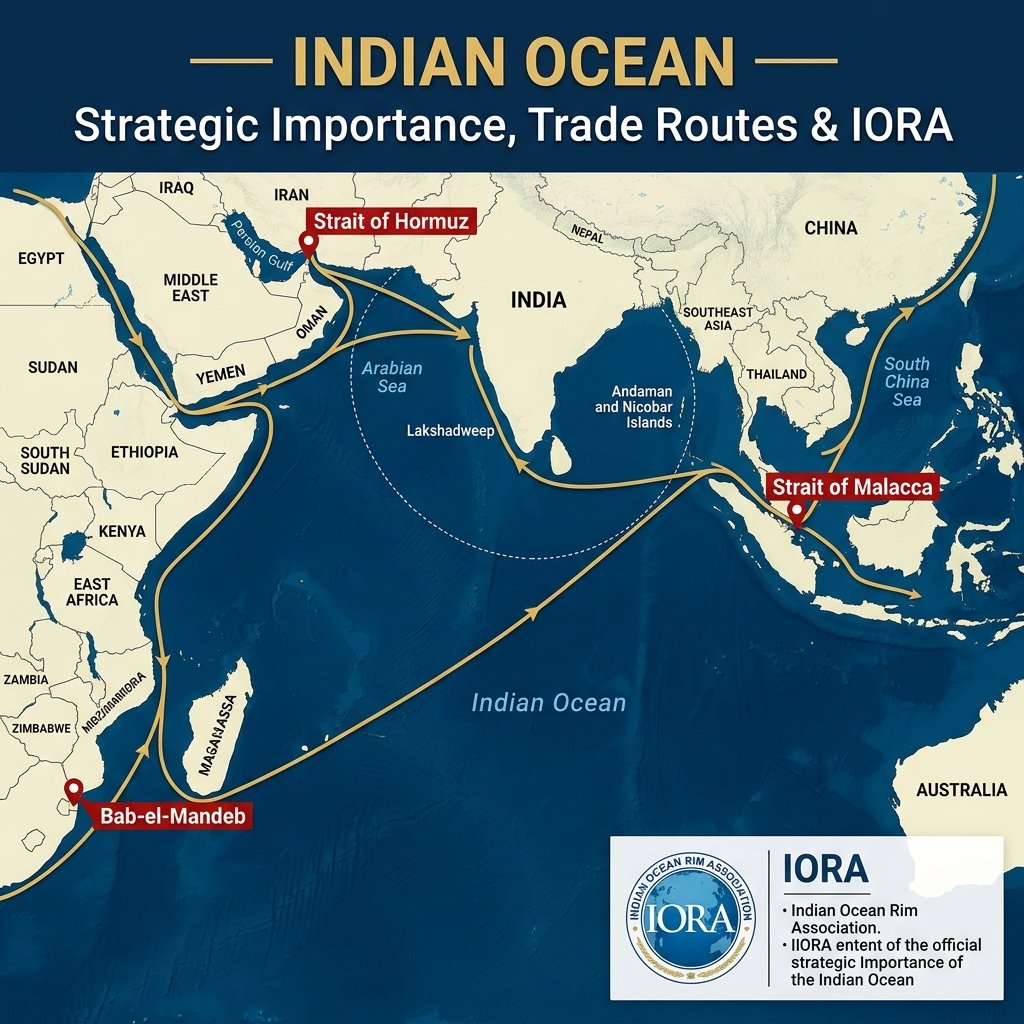
Indian Ocean — Key Geographic Facts
| Feature | Detail |
|---|---|
| Area | 70.56 million km² — 3rd largest ocean (20% of Earth’s water surface) |
| Average depth | 3,741 m |
| Deepest point | Java Trench (Sunda Trench) — 7,187 m depth; off Java, Indonesia; caused 2004 tsunami |
| Borders | Africa (west), Asia (north), Australia (east), Southern Ocean (south) |
| Unique feature | Only ocean named after a country (India); no opening to Arctic Ocean |
| Islands — India | Andaman & Nicobar Islands (Bay of Bengal), Lakshadweep (Arabian Sea) |
| Major seas/gulfs | Arabian Sea, Bay of Bengal, Red Sea, Persian Gulf, Gulf of Oman, Gulf of Aden |
| Ocean floor feature | Mid-Indian Ocean Ridge — tectonic spreading centre; 2004 earthquake at Sunda trench subduction zone |
Strategic Chokepoints of the Indian Ocean
A chokepoint is a narrow strait through which large volumes of trade must pass — making it strategically critical. Controlling or blocking a chokepoint can cripple global trade and energy supplies. The Indian Ocean’s chokepoints are among the most vital in the world.
| Chokepoint | Location | Significance | Threats |
|---|---|---|---|
| Strait of Hormuz | Between Iran & Oman (Persian Gulf exit) | ~21 million barrels of oil/day (~20% global supply); LNG from Qatar/UAE; India imports 85% oil — much passes here | Iran periodically threatens to block; Houthi tensions; US 5th Fleet stationed in Bahrain |
| Strait of Malacca | Between Malaysia, Singapore & Indonesia | World’s busiest shipping lane; ~80,000 ships/year; crucial for China’s oil imports from Middle East; connects Indian Ocean to Pacific; Singapore = world’s 2nd busiest port | Piracy (now reduced); China’s “Malacca Dilemma” — China fears US could blockade it; China building CPEC partly to bypass Malacca |
| Bab-el-Mandeb | Between Yemen & Djibouti/Eritrea (Red Sea entry) | Entry to Suez Canal; ~6 million barrels oil/day + huge container trade; Europe-Asia shipping route key | Houthi attacks (2023–2024) caused 60%+ drop in Suez traffic; vessels rerouting around Africa (+10–14 days journey) |
| Strait of Lombok | Between Bali & Lombok (Indonesia) | Alternative to Malacca for larger vessels; deep water allows supertankers | Relatively safe; less piracy |
| Mozambique Channel | Between Madagascar & Mozambique/Africa | Critical for traffic between East Africa and India; oil from Persian Gulf to Africa | Piracy historically; Mozambique’s LNG discoveries strategic |
Indian Ocean Trade — Why It Matters to India
- ⛽ ~85% of India’s oil imports pass through the Indian Ocean (from Persian Gulf/Middle East)
- 🚢 ~90% of India’s total trade by volume is seaborne (Indian Ocean routes)
- 🌊 India has a 7,516 km coastline with 12 major ports + 200+ minor ports
- 💰 India’s maritime trade value: ~$1.2 trillion/year
- 🐟 India is the world’s 2nd largest fish producer — most from Indian Ocean waters
- 🔌 Undersea cables: 95% of global internet traffic runs through undersea fibre-optic cables — most trans-continental cables transit the Indian Ocean floor; India has 17 international submarine cable landings
India’s Strategic Vision — SAGAR Doctrine
PM Modi announced India’s Indian Ocean vision — SAGAR (Security And Growth for All in the Region) — in Mauritius in 2015. SAGAR reflects India’s aspiration to be the preferred security partner and net security provider in the Indian Ocean Region.
- 🛡️ Collective security: Protect trade routes, counter piracy, disaster response
- 🤝 Blue economy: Sustainable development of ocean resources for all littoral nations
- 🔗 Connectivity: Maritime infrastructure (ports, shipping lanes, undersea cables)
- 🌊 Maritime domain awareness: India shares real-time sea traffic/safety data with IOR nations through White Shipping Agreements and Information Fusion Centre-IOR (IFC-IOR, Gurugram)
- ⚓ Navy presence: Indian Navy maintains permanent presence — anti-piracy patrols off Somalia, humanitarian deployments, island nation partnerships (Mauritius, Maldives, Seychelles, Sri Lanka)
IORA — Indian Ocean Rim Association
- 🌐 IORA (Indian Ocean Rim Association) — intergovernmental forum for Indian Ocean economic, social, and regional cooperation
- 📅 Founded: 1997; 23 member states; 10 dialogue partners (including China, USA, UK, Japan, Egypt)
- 🏛️ Secretariat: Ebène, Mauritius
- 🗺️ Members: India, Australia, Bangladesh, Comoros, Djibouti, France (Réunion), Indonesia, Iran, Kenya, Madagascar, Malaysia, Maldives, Mauritius, Mozambique, Oman, Pakistan, Seychelles, Singapore, Somalia, South Africa, Sri Lanka, Tanzania, Thailand, UAE, Yemen
- 🎯 6 priority areas: Maritime safety/security, trade facilitation, fisheries management, disaster risk management, academic/science/technology cooperation, tourism
- ✅ India hosted IORA Conclave on Blue Economy 2023; major proponent of Blue Economy framework
China’s Indian Ocean Presence — The “String of Pearls”
India’s biggest strategic concern in the Indian Ocean is the growing presence of China. The concept of China’s “String of Pearls” (initially a US defense research term, 2005) describes China’s network of ports, military bases, and diplomatic relationships along the Indian Ocean rim — surrounding India.
- 🪩 Gwadar Port (Pakistan) — CPEC (China-Pakistan Economic Corridor) terminus; China has long-term lease; 70 km from Strait of Hormuz; Chinese naval access
- 🪩 Hambantota Port (Sri Lanka) — Sri Lanka leased to China (99-year lease, 2017) after failing to repay Chinese loans; “debt-trap diplomacy” concern
- 🪩 Chittagong Port (Bangladesh) — China has infrastructure investments
- 🪩 Kyaukphyu Port (Myanmar) — CMEC (China-Myanmar Economic Corridor); pipeline for oil/gas to Yunnan bypassing Malacca
- 🪩 Djibouti — China’s FIRST overseas military base (2017); at Bab-el-Mandeb chokepoint
- 🪩 Seychelles, Tanzania, Kenya — Chinese port infrastructure investments
India’s Counter-Strategy — “Necklace of Diamonds”
- 💎 Chabahar Port (Iran) — India’s gateway to Afghanistan & Central Asia bypassing Pakistan; India-developed; strategic counterweight to Gwadar
- 💎 Duqm Port (Oman) — Indian Navy has access agreement; strategic location near Arabian Sea
- 💎 Assumption Island (Seychelles) — India building naval base/listening post
- 💎 Agaléga Islands (Mauritius) — India building airstrip + jetty for naval access in south Indian Ocean
- 💎 Andaman & Nicobar Command — India’s only tri-services command; 572 islands; sits astride Malacca Strait approaches; can monitor any movement between Indian Ocean and Pacific
Marine Resources of the Indian Ocean
| Resource | Significance for India |
|---|---|
| Fish & Seafood | India = world’s 2nd largest fish producer; ~8.3M tonnes/year; 14 million fisherfolk; shrimp, tuna, mackerel |
| Petroleum & Gas | Offshore oil: Mumbai High, KG Basin; potential in Andaman Sea; deep-water blocks |
| Polymetallic Nodules | India has exclusive rights to mine 75,000 km² in Central Indian Ocean Basin (ISRO+NIO); rich in manganese, cobalt, nickel, copper |
| Cobalt-rich Crusts | Indian Ocean seamounts have cobalt-rich crust; critical for EV batteries |
| Methane Hydrates | Vast deposits on Indian Ocean floor/continental shelf; potential future energy source (India is researching) |
| Coral Reefs | Andaman & Nicobar, Lakshadweep coral reefs — biodiversity + fisheries + coastal protection; severely threatened by warming/bleaching |
| Tidal & Wave Energy | India has 8,000 MW tidal potential (Gulf of Kutch, Gulf of Khambhat); largely untapped |
Key Takeaways
| Topic | Key Fact |
|---|---|
| Indian Ocean size | 3rd largest ocean; 70.56 million km²; 20% of Earth’s water |
| Deepest point | Java/Sunda Trench — 7,187 m; caused 2004 Indian Ocean tsunami |
| Most critical chokepoint | Strait of Hormuz (21 Mb oil/day); Strait of Malacca (80,000 ships/year) |
| Houthi impact | Attacks at Bab-el-Mandeb → 60%+ drop in Suez Canal traffic (2023–24) |
| India’s coastline | 7,516 km; 12 major ports; 90% of trade by volume seaborne |
| SAGAR doctrine | PM Modi 2015; Security And Growth for All in the Region; India as net security provider IOR |
| IORA | 23 members + 10 dialogue partners; Secretariat in Mauritius; founded 1997 |
| String of Pearls | China’s port network: Gwadar(Pak), Hambantota(SL), Djibouti(1st overseas base) |
| India’s Necklace of Diamonds | Chabahar(Iran), Duqm(Oman), Agaléga(Mauritius), A&N Command |
| Deep-sea mining | India has rights to 75,000 km² in Central Indian Ocean Basin for polymetallic nodules |
⭐ Important for Exams — Quick Revision
- 🔑 Indian Ocean = 3rd largest; only ocean named after a country; no Arctic opening
- 🔑 Deepest point: Java/Sunda Trench (7,187m) — triggered 2004 Indian Ocean Tsunami
- 🔑 Strait of Hormuz = 21M barrels oil/day = 20% global oil; Iran can threaten blockade
- 🔑 Strait of Malacca = world’s busiest lane; 80,000 ships/year; China’s Malacca Dilemma (fear of US blockade)
- 🔑 Bab-el-Mandeb = Red Sea entry → Suez Canal; Houthi attacks 2023–24 disrupted global trade
- 🔑 India: 7,516 km coastline; 85% oil imports through Indian Ocean; 90% trade by volume is seaborne
- 🔑 SAGAR = Security And Growth for All in the Region; PM Modi 2015 (Mauritius); India as net security provider IOR
- 🔑 IORA = Indian Ocean Rim Association; 23 members; Mauritius secretariat; founded 1997; 6 priority areas
- 🔑 String of Pearls = China’s port network: Gwadar (Pak), Hambantota (Sri Lanka), Djibouti (military base), Kyaukphyu (Myanmar)
- 🔑 Hambantota = Sri Lanka gave 99-yr lease to China (2017) = “debt-trap diplomacy” example
- 🔑 Chabahar Port (Iran) = India’s gateway to Central Asia bypassing Pakistan; India-developed
- 🔑 Andaman & Nicobar Command = India’s only tri-services command; sits astride Malacca approaches
- 🔑 India deep-sea mining rights: 75,000 km² in Central Indian Ocean Basin (polymetallic nodules)
- 🔑 IFC-IOR = Information Fusion Centre-Indian Ocean Region; Gurugram; India’s maritime awareness hub
Frequently Asked Questions (FAQs)
1. What is China’s “Malacca Dilemma” and why does it shape China’s Indian Ocean strategy?
The “Malacca Dilemma” is a strategic vulnerability acknowledged by Chinese President Hu Jintao in 2003: China imports ~80% of its oil through the Strait of Malacca — a narrow, 2.8 km wide channel controlled by Malaysia, Singapore, and Indonesia, and easily dominated by the US Navy. In a conflict, the US could blockade the Strait, cutting off China’s energy supplies. China’s responses: (1) CPEC (China-Pakistan Economic Corridor) — pipeline from Gwadar (Pakistan) to Kashgar (Xinjiang) bypasses Malacca entirely for Arabian Gulf oil; (2) CMEC (China-Myanmar Economic Corridor) — pipeline from Kyaukphyu port in Bay of Bengal to Yunnan bypasses the Malacca and Andaman Sea; (3) Building a blue-water navy — aircraft carriers, submarines, overseas base in Djibouti; (4) Ports across IOR (String of Pearls) to project power and maintain presence along oil supply lines.
2. Why did India develop Chabahar Port despite US sanctions on Iran?
India invested in Chabahar Port (Iran) primarily to gain an alternative land route to Afghanistan and Central Asia bypassing Pakistan, which does not allow India-Afghanistan transit trade. Normally, India must ship goods to Afghanistan through the Pakistan Overland Route — but Pakistan refuses this. Chabahar offers: India → ship to Chabahar → road/rail through Iran → Afghanistan/Central Asian Republics. The US granted Chabahar a sanctions waiver for years, recognising it as a stabilising humanitarian project for Afghanistan. However, after the US Taliban-Afghanistan peace deal collapsed and US withdrawal, and as Iran-US tensions rose, the US threatened to remove the waiver. India proceeded anyway given the strategic importance — and the US-India strategic partnership generally accommodates India’s Iran engagement within limits. Chabahar also directly counters Gwadar Port (China-Pakistan), located just 72 km away, giving India a parallel strategic footprint on the Arabian Sea.
3. What is the “Blue Economy” and why is it important for India?
The Blue Economy refers to the sustainable use of ocean resources for economic growth, improved livelihoods, jobs, and ocean ecosystem health. For India, the Blue Economy includes: fisheries (14 million fisherfolk, 8.3M tonnes fish/year), shipping, ports, offshore oil & gas, deep-sea mining, marine tourism, desalination, marine biotechnology, and renewable ocean energy. India’s Exclusive Economic Zone (EEZ) is 2.37 million km² — the country’s 200 nautical mile zone beyond its coastline where it has sovereign rights over all resources. The government has a dedicated PM Gati Shakti National Master Plan integrating maritime infrastructure + the Sagarmala Programme (port-led development; 800+ projects worth ₹6 lakh crore). India aims to double its fisheries exports, expand coastal employment, and develop offshore renewable energy (wave, tidal, offshore wind) as part of its Blue Economy vision.
Related Geology Articles on StudyHub
- ➡️ 2004 Indian Ocean Tsunami — Java Trench Earthquake
- ➡️ Energy Resources — India’s Oil Import Dependence on Indian Ocean
- ➡️ Natural Disasters — Indian Ocean Cyclone Origins
- ➡️ Coral Reefs — Andaman & Lakshadweep Marine Biodiversity
- ➡️ Coastal Geomorphology — How Indian Ocean Shapes India’s Coast