
India’s industrial journey is one of the most dramatic transformations in modern economic history. In 1947, India inherited a largely deindustrialised economy from British colonial rule — the British had systematically dismantled India’s traditional textile and manufacturing industries to create captive markets for Lancashire mills. Today, India is the world’s 5th largest economy (by nominal GDP, 2024), the world’s 3rd largest steel producer, the “Pharmacy of the World” (supplying 20% of global generic medicines), and has the world’s 2nd largest IT services industry — a remarkable industrial transformation achieved in 75 years. India’s industrial landscape spans heavy industries (steel, defence, chemicals) built under the Nehruvian state-led model, labour-intensive light industries (textiles, garments), and knowledge-economy sectors (IT, pharma, fintech) that emerged from the 1991 liberalisation. Understanding India’s industrial geography, major industries, industrial policies, and economic corridors is critical for UPSC, SSC, State PSC, and all competitive examinations.
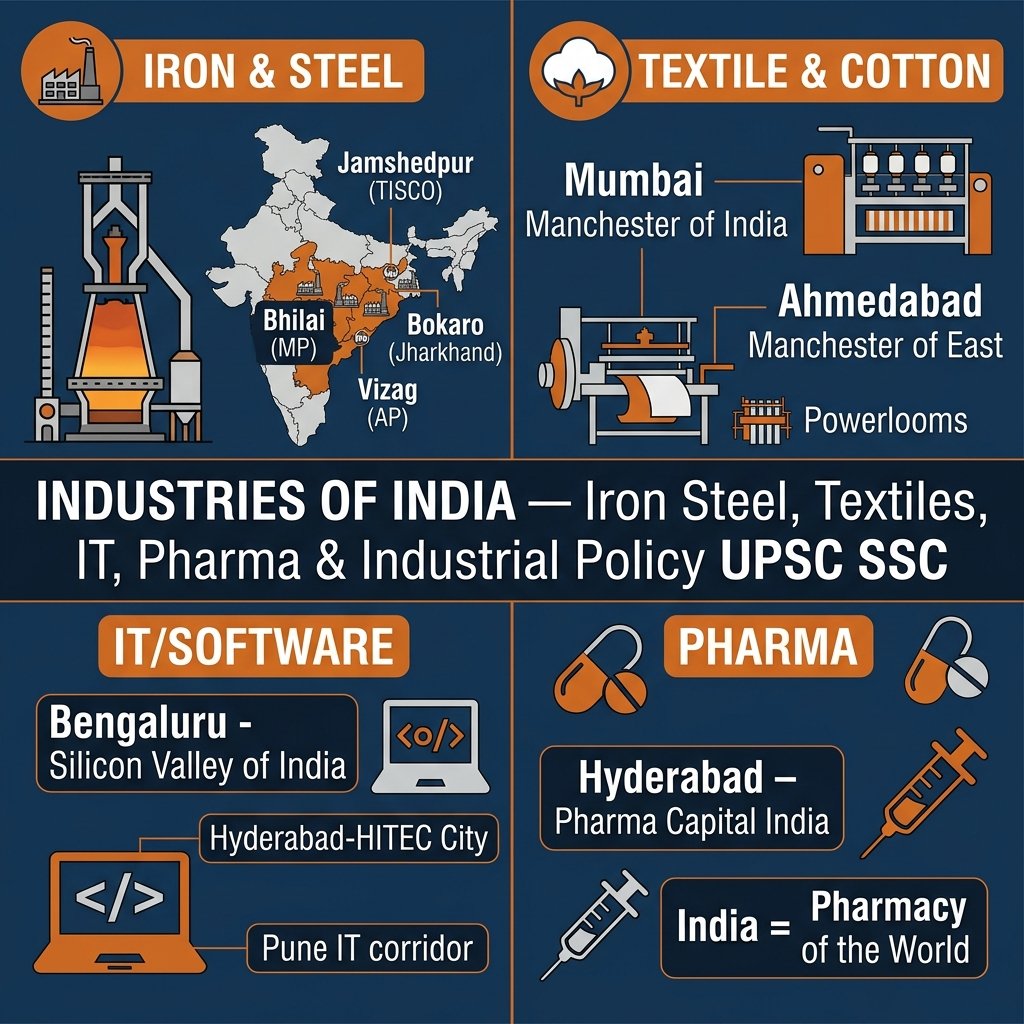
India’s Industrial Profile — Overview
| Sector | India’s Global Position | GDP Contribution | Employment |
|---|---|---|---|
| Manufacturing overall | 6th largest manufacturer globally | ~17% of GDP | ~12% of workforce |
| Steel | 3rd largest producer (after China, India, Japan); 2nd largest crude steel producer in Asia | 2% of GDP | ~2.5 million direct |
| Textiles & Apparel | 2nd largest exporter (after China) | 2.3% of GDP | ~45 million (2nd largest employer after agriculture) |
| IT & Software Services | 2nd largest globally; $245 billion revenue (2023–24) | 7.4% of GDP | ~5.4 million directly |
| Pharmaceuticals | 3rd largest by volume; 14th by value; 20% global generic supply | 1.72% of GDP | ~3 million |
| Automobiles | 3rd largest vehicle market; 4th largest vehicle manufacturer | 7.1% of GDP | ~4 crore direct+indirect |
| Construction | 3rd largest construction market globally | 8% of GDP | ~55 million |
1. Iron & Steel Industry
- ⚙️ India’s steel production: 125.3 MT (2022–23); 3rd largest globally; target 300 MT by 2030–31 (National Steel Policy 2017)
- 🏭 Raw material advantage: India has vast reserves of iron ore (Odisha, Jharkhand, Chhattisgarh, Karnataka, Goa), coking coal (Jharia coalfield, Jharkhand = India’s only coking coal), limestone, manganese, and dolomite — essential inputs for steel making
- 📍 Location principle: Iron and steel plants are located near raw materials (iron ore + coking coal) or at coastal sites for imported coal access; the classic triangle — Jamshedpur (equidistant from Jharia coal + Odisha iron ore) was the model
| Plant | Location | State | Owner / Key Facts |
|---|---|---|---|
| TISCO / Tata Steel | Jamshedpur (Tatanagar) | Jharkhand | Private (Tata Group); established 1907 = India’s first integrated steel plant; Dorabji Tata founded; Sakchi village on Subarnarekha river; near Jharia coal + Noamundi/Gua iron ore; capacity ~13 MT; Tata Steel also owns Port Talbot (UK) and Bhushan steel plants |
| SAIL Bhilai | Bhilai | Chhattisgarh | Public (SAIL — Steel Authority of India Ltd); established 1954 with Soviet/USSR collaboration; largest SAIL plant; capacity ~7.5 MT; known for high-quality rails and structural steel; near Bailadila iron ore (Chhattisgarh) and Korba coal |
| SAIL Rourkela | Rourkela | Odisha | Public (SAIL); established 1955 with West German (FRG) collaboration; specialises in flat products (sheets, strips); capacity ~4.5 MT; Sundargarh district; uses Odisha iron ore + outbid coal from Jharkhand |
| SAIL Durgapur | Durgapur | West Bengal | Public (SAIL); established 1956 with British collaboration; capacity ~5 MT; Bardhaman district; used Jharia coal + Odisha iron ore; specialises in alloy steel |
| SAIL Bokaro | Bokaro | Jharkhand | Public (SAIL); established 1964 with Soviet collaboration; capacity ~6 MT; largest SAIL plant by capacity (with Bhilai); known as “Steel City”; produces flat products; Damodar Valley coal nearby |
| Vizag Steel / RINL | Visakhapatnam | Andhra Pradesh | Public (RINL — Rashtriya Ispat Nigam Ltd); India’s first shore-based integrated plant; capacity ~7.3 MT; imports coking coal; privatisation proposed (Cabinet decision 2021) but pending; specialises in wire rods, structurals |
| JSW Steel | Vijayanagar (Toranagallu), Dolvi (Maharashtra), Salem (TN) | Karnataka, Maharashtra, TN | Private (JSW Group — Sajjan Jindal); India’s largest private steel company; capacity ~28 MT across plants; Vijayanagar = uses Bellary-Hospet iron ore (Karnataka); JSW also has Ispat Steel Dolvi |
| ArcelorMittal Nippon Steel | Hazira (Gujarat) | Gujarat | Joint venture ArcelorMittal + Nippon Steel Japan; took over Essar Steel (Hazira) in 2019 via insolvency resolution; capacity ~9 MT; coastal plant (imports coking coal); flat product specialist |
2. Textile Industry
- 🧵 India’s position: World’s largest producer of cotton yarn; 2nd largest textile exporter; ~$44 billion exports (2022–23); employs 45 million people = 2nd largest employer in India
- 📌 Mumbai = “Manchester of India”: From 1850s onwards, Mumbai (then Bombay) developed as India’s cotton textile hub; proximity to cotton-growing Deccan; Surat-Mumbai coastline cotton trade; Bai Avabai Framji Patel opened first cotton mill 1854 (actually one of the first cotton mills); at peak Mumbai had 60+ mills employing 2.5 lakh workers; most mills closed 1982–2000 (after historic 18-month textile workers’ strike of 1982 led by Datta Samant); mill lands sold for real estate (BKC, Lower Parel redevelopment)
- 📌 Ahmedabad = “Manchester of the East”: Gujarat’s cotton capital; first cotton mill 1861; Ranchhodlal Chhotalal established first mill; historically 60+ mills; Gandhi’s 1918 Mill Workers’ Strike; synthetic and blended fabric dominance now
- 🌿 Jute Industry: Bengal’s heritage industry; India is world’s largest jute producer (98% in West Bengal, primarily in Hugli district — “Jute Capital” = Rishra, Serampore, Ranigunj area); Kolkata = “Jute City of the World” historically; demand fell sharply post-plastics era; now revival for eco-friendly packaging, carpet backing, geotextiles
- 🕌 Silk and Handloom: Varanasi (Banarasi silk), Kanchipuram (TN — Kanjivaram silk), Mysuru (Karnataka — Mysore silk), Assam (Muga silk = golden silk, GI tagged), Manipur, Odisha; handloom weaving supports ~4.3 million weavers; each GI-tagged silk is a distinct regional craft product
- 👗 Garment Clusters: Tiruppur (TN) = “Knitwear Capital of India” (70% of India’s cotton knitwear exports); NCR Gurugram-Noida = garment hub; Bengaluru = largest garment exporting city; Ludhiana (Punjab) = woollen hosiery
3. Information Technology (IT) Industry
- 💻 India’s IT scale: $245 billion revenue (2023–24); exports = $194 billion; employs 5.4 million; contributes 7.4% to GDP; India processes ~55% of global IT outsourcing (BPO/KPO/ITES)
- 🌆 Bengaluru = “Silicon Valley of India”: Home to ~40% of India’s IT companies; Electronics City (HAL Airport area) developed from 1970s; Texas Instruments India (first MNC to set up in Bengaluru, 1985); Infosys, Wipro HQ; over 1,000 startups; ISRO also based here; IISc = world-class research; IIM Ahmedabad vs IIM Bengaluru-Koramangala innovation ecosystem
- 🏙️ Hyderabad = “Cyberabad”: HITEC City (Hyderabad Information Technology and Engineering Consultancy City); Microsoft, Google, Amazon, Facebook India campuses all here; TCS, Infosys, Tech Mahindra; Genome Valley (biotech cluster); city became “Pharma + IT” twin hub after TN Seshan HITEC City development
- 🏙️ Other IT hubs: Pune (Hinjewadi IT Park, Kharadi); Chennai (OMR= Old Mahabalipuram Road = “IT Corridor of South India”); NCR (Gurugram, Noida); Kochi (INFOPARK); Thiruvananthapuram (Technopark = Asia’s largest IT park by employment)
- 🚀 Startup ecosystem: India = 3rd largest startup ecosystem globally (after USA, China); 100+ unicorns (startups valued >$1 billion); Bengaluru = largest startup city; key sectors: fintech (Paytm, Razorpay, PhonePe), edtech (BYJU’S, Unacademy), healthtech, e-commerce (Flipkart, Meesho)
- 🌐 Why Bengaluru succeeded: IISc (1909) + ISRO + HAL + BHEL + ITI = government science/engineering ecosystem created a skilled workforce pool in the 1950s–80s; proximity to engineering colleges; tolerant cosmopolitan culture attracting pan-India talent; pleasant climate (altitude 920m); lower real estate costs than Mumbai/Delhi in 1990s when IT boom began
4. Pharmaceutical Industry
- 💊 India = “Pharmacy of the World”: Supplies ~20% of global generic medicines by volume; exports to 200+ countries; $25 billion pharma exports (2022–23); 60% of WHO’s vaccine requirements supplied by India; Serum Institute of India (Pune) = world’s largest vaccine manufacturer by dose volume
- 🏙️ Hyderabad = “Pharma Capital of India”: ~40% of India’s pharma exports originate here; Genome Valley (30+ biotech companies); major companies: Dr. Reddy’s, Aurobindo Pharma, Hetero, Shilpa Medicare, Granules India; bulk drugs (Active Pharmaceutical Ingredients = APIs) manufacturing cluster in Medak, Nalgonda districts
- 🏙️ Other pharma clusters: Bengaluru (Biocon — India’s largest biopharmaceutical company; insulin, cancer biologics); Mumbai (Sun Pharma = India’s largest pharma co; Cipla); Ahmedabad (Zydus Lifesciences, formerly Cadila); Baddi (HP) = largest pharma manufacturing cluster by number of plants; Himachal Pradesh = pharma hub for finished formulations
- ⚗️ Patents Act 1970 vs TRIPS: India’s 1970 Patents Act allowed process patents but NOT product patents for drugs — this allowed Indian companies to reverse-engineer and manufacture generic copies of patented drugs at a fraction of the original price. Under TRIPS Agreement (WTO, 1995), India had to amend its Patents Act by 2005 to include product patents; however, India inserted Section 3(d) — preventing patent evergreening (companies cannot get new patents by making minor modifications to existing drugs); India’s Section 3(d) became globally influential as a tool for developing nations to protect access to affordable medicines
5. Key Industrial Policies
| Policy / Programme | Year | Key Features |
|---|---|---|
| Industrial Policy Resolution (IPR) | 1956 | Nehruvian socialist model; divided industries into 3 schedules: Schedule A (17 industries — state monopoly: defence, railways, atomic energy, steel, heavy machinery, coal); Schedule B (12 industries — mixed sector); Schedule C (remaining — private sector); laid foundation for PSU-dominated heavy industry |
| New Industrial Policy | 1991 | LPG Reforms (Liberalisation, Privatisation, Globalisation); abolished industrial licensing (except 6 industries); reduced public sector reservation; invited FDI; dismantled MRTP Act; opened economy = birth of India’s IT boom and export-led growth |
| Make in India | 2014 | Targets 25% manufacturing share of GDP (from ~17%); 25 focus sectors; FDI liberalisation in defence, railways, insurance; Production Linked Incentive (PLI) scheme = ₹1.97 lakh crore incentives across 14 sectors (electronics, pharmaceuticals, telecom, white goods, food processing, textiles, auto, speciality steel) |
| National Manufacturing Policy | 2011 | National Investment and Manufacturing Zones (NIMZ) — large integrated manufacturing townships; target 100 million manufacturing jobs; partially superseded by Make in India |
| Delhi-Mumbai Industrial Corridor (DMIC) | 2007 (ongoing) | 1,483 km corridor along Western Dedicated Freight Corridor (DFC); 7 smart industrial cities planned: Dholera (Gujarat) — first greenfield, Vikram Udyogpuri (MP), Shendra-Bidkin (Maharashtra near Aurangabad/Sambhajinagar), Khushkhera-Bhiwadi (Rajasthan), Manesar-Bawal (Haryana), Greater Noida, AURIC Pune; Japan-funded |
| Production Linked Incentive (PLI) | 2020–21 | 14 sectors; cash incentive of 4–20% on incremental production above a base year; designed to attract global supply chain relocation from China (China+1 strategy); biggest success: Apple iPhone — Foxconn, Tata Electronics, Pegatron manufacturing in India; India shipped $17.4 billion iPhones in 2024 (5x growth in 3 years) |
6. Industrial Regions of India
| Industrial Region | States | Key Industries | Key Cities |
|---|---|---|---|
| Mumbai-Pune Region | Maharashtra | Petrochemicals (Trombay refinery), engineering, pharmaceuticals, textiles (historical), auto (Pune = Chakan/Pimpri-Chinchwad), IT, financial services | Mumbai, Pune, Nashik, Thane |
| Hugli Industrial Belt | West Bengal | Historically jute, cotton; engineering; chemicals; now diversifying; declining relative to other regions | Kolkata, Howrah, Rishra, Serampore, Haldia (petrochemicals) |
| Chota Nagpur | Jharkhand, Odisha, WB | Iron & steel (Jamshedpur, Bokaro, Rourkela), heavy engineering, mining, cement; “Ruhr of India” | Jamshedpur, Dhanbad, Bokaro, Rourkela |
| Vishakhapatnam-Guntur | Andhra Pradesh | Steel (RINL/Vizag Steel), fertilisers, shipbuilding (Hindustan Shipyard, Vizag), petrochemicals | Visakhapatnam, Vijayawada, Guntur |
| Gujarat Industrial Region | Gujarat | Petrochemicals (Jamnagar = world’s largest oil refinery complex — Reliance), textiles (Ahmedabad), chemicals, pharmaceuticals, diamond polishing (Surat), salt | Ahmedabad, Surat, Vadodara, Jamnagar, Ankleshwar (GIDC) |
| Bengaluru-Tamil Nadu | Karnataka, Tamil Nadu | IT (Bengaluru), aerospace (HAL, NAL, Airbus MRO), textiles (Tiruppur knitwear, Coimbatore), auto (Chennai = “Detroit of India”), leather (Chennai), heavy engineering | Bengaluru, Chennai, Coimbatore, Tiruppur, Salem |
⭐ Important for Exams — Quick Revision
- 🔑 India = 3rd largest steel producer (125.3 MT, 2022–23); target 300 MT by 2030–31
- 🔑 TISCO Jamshedpur (1907) = India’s first integrated steel plant; private (Tata); near Jharia coal + Odisha iron ore; Subarnarekha river
- 🔑 SAIL plants collaboration: Bhilai = USSR; Rourkela = West Germany; Durgapur = Britain; Bokaro = USSR (all 1950s–60s public sector plants)
- 🔑 Vizag Steel (RINL) = India’s only shore-based integrated steel plant; privatisation proposed 2021
- 🔑 JSW Steel = India’s largest private steel company; Vijayanagar (Karnataka) = flagship plant
- 🔑 Mumbai = “Manchester of India”; Ahmedabad = “Manchester of East”; Coimbatore = “Manchester of South India”; 1982 Datta Samant textile strike = broke Mumbai’s mill economy
- 🔑 Jute: India’s largest producer; 98% in West Bengal (Hugli); Kolkata = “Jute City”; eco-packaging revival
- 🔑 Tiruppur (TN) = “Knitwear Capital”; 70% of India’s cotton knitwear exports; Chennai = largest garment exporter city
- 🔑 IT: $245 billion revenue (2023–24); Bengaluru = “Silicon Valley of India”; Hyderabad = “Cyberabad” (HITEC City); Thiruvananthapuram Technopark = Asia’s largest IT park by employment
- 🔑 India = 3rd largest startup ecosystem; 100+ unicorns; Bengaluru = largest startup city
- 🔑 Pharma: 20% global generic supply; “Pharmacy of World”; Hyderabad = Pharma Capital; Serum Institute Pune = world’s largest vaccine manufacturer; Sun Pharma = India’s largest pharma company
- 🔑 Patents Act Section 3(d): India’s anti-evergreening provision; prevents new patents for minor modifications; globally influential for generic medicine access
- 🔑 1991 New Industrial Policy: LPG reforms; abolished industrial licensing; FDI opened; dismantled MRTP; birth of India’s globalised economy
- 🔑 Make in India (2014): 25 sectors; PLI scheme = ₹1.97 lakh crore; Apple iPhone manufacturing success (India shipped $17.4B iPhones in 2024)
- 🔑 DMIC = 1,483 km; 7 smart industrial cities; Japan-funded; Dholera (Gujarat) = first greenfield smart city under DMIC
- 🔑 Chennai = “Detroit of India” (auto hub); Jamnagar (Reliance) = world’s largest oil refinery complex; Surat = diamond polishing capital (90% world’s diamonds cut and polished here)
Frequently Asked Questions (FAQs)
1. Why did Jamshedpur become India’s steel city — and how does industrial location theory explain it?
The story of Jamshedpur (also called Tatanagar) is a classic case study in industrial location theory that explains why steel plants are located where they are. In 1900, Jamsetji Nusserwanji Tata (founder of the Tata industrial empire) was already convinced that India needed its own integrated steel plant — not just to supply India’s railways and construction, but as a matter of national industrial dignity. The challenge was finding the right location. Tata commissioned American geologist C.M. Weld to survey potential sites. The ideal steel plant location required: (1) Iron ore deposits, (2) Coking coal for smelting, (3) Water (rivers for cooling and process water), (4) Land (flat, large area for plant), (5) Transport connectivity, and (6) Labour access. Weld identified the confluence of the Subarnarekha and Kharkai rivers near the village of Sakchi (in present-day Jharkhand, then Bengal Province) as ideal because it sat at roughly equal distances from: the Jharia coalfields (Jharkhand — India’s only coking coal source, ~65 km away) and the Gurumahisani-Noamundi-Gua iron ore deposits (Odisha-Jharkhand border, ~200 km away). The Weber’s Least Cost Theory of industrial location predicts that industries locate at the point that minimises total transport costs for raw materials and finished products. Since iron and steel plants shed enormous weight in the production process (it takes ~1.7 tonnes of iron ore + 0.7 tonnes of coking coal to produce 1 tonne of steel = significant weight loss), the plant should locate BETWEEN the raw material sources (not at either source) to minimise transportation — precisely what Sakchi/Jamshedpur achieves. The Bengal-Nagpur Railway connected the site. Tata Steel’s Jamshedpur plant opened February 16, 1912 — the first integrated steel plant in Asia outside Japan. Today Jamshedpur is entirely a company-built town (managed by Tata Steel Urban Infrastructure, not a municipal corporation), with planned infrastructure, greenery, housing for workers, and amenities rare in India’s industrial towns — a legacy of the Tata philosophy of worker welfare and community development.
2. How did India become the world’s pharmacy — and what does Section 3(d) of the Patents Act mean for global health?
India’s emergence as the world’s generic medicine provider is rooted in a 1970 legislative decision that was, at the time, primarily about reducing India’s pharmaceutical import bill — but ended up having global consequences for medicine access. The Patents Act of 1970, passed during Indira Gandhi’s government, made a crucial distinction: it allowed patents on processes (how a drug is made) but NOT on products (the drug molecule itself). This meant that Indian pharmaceutical companies could legally manufacture the same drug molecule as a patented product, as long as they used a different synthesis process — essentially reverse engineering. Indian chemists proved extraordinarily skilled at this. Companies like Cipla, Ranbaxy, Dr. Reddy’s, and Sun Pharma developed alternative synthesis routes for virtually every major drug, producing them at costs 5–30x cheaper than the original patent holders. The result by the 1980s–90s: India was supplying cheap generic medicines to Africa, Southeast Asia, and Latin America; Indian generic ARVs (anti-retroviral drugs for HIV) priced at $40/year helped make HIV treatment accessible in sub-Saharan Africa when originator drug makers were charging $10,000–15,000/year. When India joined the WTO in 1995 and signed TRIPS (Trade-Related Aspects of Intellectual Property Rights), it was required to introduce product patents for pharmaceuticals by 2005. This threatened to end the generic medicine model. India’s response was strategic: it amended its Patents Act in 2005 to comply with TRIPS, but simultaneously inserted Section 3(d) — a uniquely Indian innovation stating that new forms of a known substance (polymorphs, isomers, salts, new delivery mechanisms) cannot be patented unless they demonstrate “significantly enhanced efficacy.” This targeted patent evergreening — the pharmaceutical industry practice of making minor tweaks to existing drugs to extend patent protection for another 20 years. The landmark legal battle: Novartis vs Union of India (Supreme Court, 2013) — Novartis challenged Section 3(d) after the Indian Patent Office rejected its patent for Gleevec (imatinib mesylate, cancer drug) as an evergreened form of a previously known compound. India’s Supreme Court upheld Section 3(d), ruling that Novartis’s new form did not show significantly enhanced therapeutic efficacy. This ruling — celebrated by global health activists and condemned by the pharmaceutical industry — has become a template for developing nations seeking to balance IP protection with public health access. Countries from Brazil to South Africa to Thailand have modelled provisions on India’s Section 3(d).
3. Is India’s “China+1” manufacturing opportunity real — and will PLI actually deliver?
The China+1 thesis argues that global companies, burned by supply chain disruptions (COVID), US-China trade war tariffs (2018–2024), and geopolitical risks from China concentration, are seeking to diversify manufacturing to a second country — and India is the primary candidate given its scale, democratic stability, and English-speaking technical workforce. The evidence is ambiguous. Where China+1 is working for India: Electronics — Apple’s supply chain acceleration is the strongest data point: India’s smartphone exports rose from $2.35 billion (2020–21) to $17.4 billion (2024–25), driven by iPhone manufacturing at Foxconn (Sriperumbudur, Tamil Nadu), Tata Electronics (taking over Wistron plant in Karnataka + Pegatron’s HP plant + building new Hosakote factory), and Pegatron. Apple now manufactures 14–16% of iPhones in India and plans to reach 25–30% by 2027. Semiconductors — India is investing heavily (India Semiconductor Mission, ₹76,000 crore); Tata Electronics signed agreement with PSMC (Taiwan) for 28nm fab in Dholera, Gujarat; Micron Technologies setting up $825M OSAT (assembly and test) facility in Sanand, Gujarat. Where challenges remain: Deep manufacturing supply chains — China built over 40 years the world’s most integrated manufacturing ecosystem for electronics (component makers for Foxconn are a 2-hour truck ride away within Guangdong province); India lacks this ecosystem (most components still imported from China → defeats supply chain diversification purpose). India’s manufacturing cost compared to China has converged but India’s logistics costs are 2x China’s (infrastructure deficit); labour productivity in formal manufacturing is lower; regulatory complexity (though improving under GST + DPIIT Single Window). Land acquisition and power quality remain challenges in most states except Tamil Nadu and Gujarat. PLI’s scorecard: Of ₹1.97 lakh crore PLI committed across 14 sectors, actual disbursements by 2023–24 have been a fraction (electronics PLI = disbursed ~₹4,000 crore of ₹40,951 crore committed); this partly reflects the incentive’s performance-linked nature (companies invest first, claim incentives after meeting targets) — which is structurally sound, but a rush to declare PLI a success may be premature. The honest assessment: China+1 is real but partial — India will gain some manufacturing (electronics, defence components, chemicals, pharmaceuticals) but is unlikely to replace China as the world’s manufacturing hub within the next decade. The window of opportunity exists — but requires consistent execution on logistics (PM Gati Shakti infrastructure), power quality, and land availability.
Related Geology Articles on StudyHub
- ➡️ Mineral Resources India — Raw Materials for Industries
- ➡️ Chota Nagpur Plateau — India’s Industrial Mineral Belt
- ➡️ Water Resources — Rivers Supporting Industrial Clusters
- ➡️ Agriculture India — Farm to Factory Economy
- ➡️ Climate Change — Industrial Emissions & Green Transition