
Last Updated: March 2026 | Reading Time: 11 minutes | ~2,500 words | Category: Petrology — Metamorphic Rocks
Metamorphic rocks (Greek: meta = change, morphe = form) are rocks that have been transformed from pre-existing rocks (protolith) by heat, pressure, and/or chemically active fluids, without melting — metamorphism operates in the solid state. They form at depth in Earth’s crust, wherever temperatures or pressures significantly exceed those at which the original rock was stable. When conditions change sufficiently — most commonly during tectonic events (subduction, continental collision, rifting) or from proximity to igneous intrusions — the minerals in the protolith become thermodynamically unstable and recrystallise into new, stable mineral assemblages. The resulting rock often shows characteristic textures (foliation = planar alignment of minerals under directed pressure) that distinguish metamorphic rocks from their igneous and sedimentary precursors. Metamorphic rocks are the “engine room” of continental crust — they form the crystalline basement of all ancient cratons (Archean-Proterozoic shields), the cores of mountain belts, and almost all “deep earth” geological provinces. India has some of the world’s most scientifically significant metamorphic terranes: the Greater Himalayan Crystallines (high-grade schist, gneiss, and migmatite — the roots of the Himalayan orogeny), the Eastern Ghats Granulite Belt (world-class ultra-high-temperature granulites and khondalites — among Earth’s deepest-formed exposed rocks), the ancient Dharwar Craton (Archean greenstone belts with amphibolite-grade metamorphism), and the economically vital Rajasthan metamorphic sequences (Makrana marble, garnet schists, talc deposits). The crown economic jewel of India’s metamorphic rocks: Makrana Marble (Rajasthan) — the same white crystalline marble used to build the Taj Mahal.
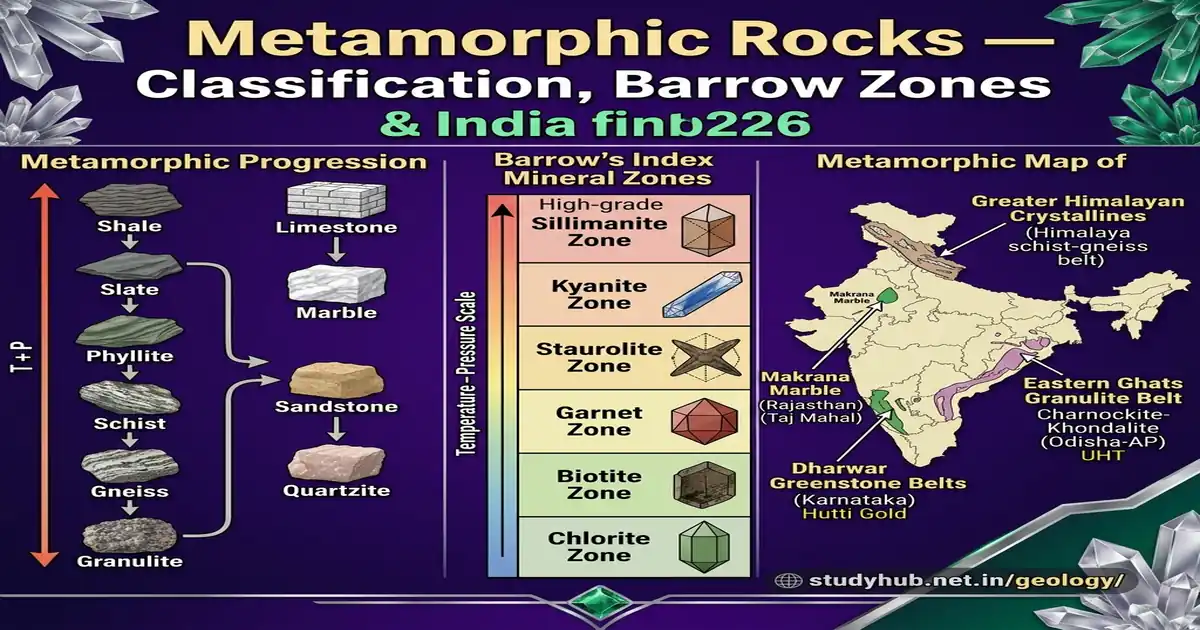
Metamorphic Rocks — Classification, Barrow’s Zones & India’s Metamorphic Terranes 2026
1. Types of Metamorphism & Metamorphic Processes
| Type of Metamorphism | Agent / Setting | Texture & Characteristics | India / World Example |
|---|---|---|---|
| Contact (Thermal) Metamorphism | Heat from igneous intrusion (magma body heats surrounding country rock). Pressure = LOW (not deep burial — the intrusion comes to the country rock, which is already at relatively shallow depth). The heated zone around the intrusion = aureole. Width depends on: magma temperature, intrusion size, and country rock conductivity. Typically narrow (metres to km) | Non-foliated (because directed tectonic pressure is absent — just heat). Rocks recrystallise into fine to medium granoblastic texture. Hornfels: the typical contact metamorphic rock — hard, dense, granular, non-foliated (named from German “hornstone”). Other products: Marble (limestone contact zone), Quartzite (sandstone contact), Skarn (reactive limestone + siliceous intrusion fluids → calc-silicate minerals: wollastonite, grossularite garnet, diopside, vesuvianite) | Rajasthan: contact aureoles around Malani Igneous Suite rhyolite intrusions. Deccan Traps contact metamorphism of Gondwana coal seams (coal seams near dyke contacts = “natural coke” — metamorphosed coal). Jharia coalfield: coal seams metamorphosed by Cretaceous-Jurassic dolerite dykes (Rajmahal-age) → natural coke formation (some Jharia coke may be natural metamorphic product). Classic: Skaergaard Intrusion aureole (Greenland). Skarn deposits: Rajasthan (minor wollastonite, Rajsamand district). Chhattisgarh kimberlite aureoles (minor) |
| Regional (Dynamothermal) Metamorphism | Both temperature AND pressure elevated together over large areas — the most common and important type. Occurs during continental collision (orogenesis), subduction zone metamorphism. Large-scale, covering 100s to 1,000s km². Progressive metamorphism from low-grade at margins to high-grade at depth/core. Directed tectonic pressure (stress) causes mineral alignment = foliation. P-T conditions range from greenschist facies (low grade) to amphibolite facies (medium-high) to granulite facies (high T, lower P) or eclogite facies (high P, subduction) | Foliated (due to directed pressure): slaty cleavage (lowest grade), phyllitic texture, schistosity (well-developed), gneissic banding (highest). Mineral assemblages define metamorphic grade — the concept of index minerals (Barrow Zones) tracks grade progression. Migmatite: at highest grade, rock partially melts & re-solidifies = hybrid between metamorphic and igneous rock (leucocratic veins in dark matrix = “lit-par-lit” migmatite) | Greater Himalayan Crystallines (India): low-grade at MCT (Main Central Thrust) base → high-grade (sillimanite, kyanite, garnet bearing gneiss and schist) at core. Zanskar, Lahaul, Spiti, Uttarakhand, Sikkim crystalline sequences. Eastern Ghats: extreme high P-T regional metamorphism (UHT — ultra-high temperature, 900–1,100°C). Dharwar Craton: Archean greenstone belt greenschist to amphibolite grade. Classic: Scottish Highlands (Barrow’s original study area, 1893). Himalayas = Barrow’s Zones of India |
| Dynamic (Cataclastic) Metamorphism | Mechanical stress along fault zones or shear zones. Temperature = moderate. Pressure = HIGH directed stress. Rock is crushed, ground, and sheared. Occurs in ductile (deep) or brittle (shallow) fault zones | Brittle: Fault breccia (angular rock fragments in fault zone), Cataclasite (crushed rock, semi-coherent). Ductile: Mylonite (finely crushed, foliated, S-shaped mineral tails around porphyroclasts — rock flows like toothpaste under extreme shear). Ultramylonite = extremely fine-grained mylonite. No new metamorphic minerals (just crushing and shearing of existing minerals) | Main Central Thrust (MCT, Himalayas): one of world’s most studied mylonite zones. The MCT is a major shear zone separating Lesser Himalaya rocks from Greater Himalayan Crystallines — mylonites along MCT are kilometres thick. South Tibet Detachment System (STDS): upper shear zone of Greater Himalayan Crystallines. Narmada-Son Lineament (central India): old mylonite zone. Deccan: numerous fault-related cataclasite zones within Deccan Traps |
| Hydrothermal Metamorphism | Hot water-rich fluids (hydrothermal fluids) percolating through rock, transporting heat and reactive chemical components, causing mineral changes. Temperature: 100–400°C. Pressure: variable. Common at oceanic spreading ridges, volcanic arcs, root zones of hydrothermal ore deposits | Non-foliated or weakly foliated. Introduces new minerals from fluid: chloritisation (converts mafic minerals to chlorite — greenish alteration), sericitisation (K-feldspar→sericite/muscovite), silicification (quartz veining), carbonation (calcite veining), serpentinisation (olivine/pyroxene → serpentine minerals, antigorite, chrysotile = asbestos). GREENSCHIST facies rocks at mid-ocean ridges = product of submarine hydrothermal metamorphism + H₂O reactions | Kolar Gold Field (KGF, Karnataka): gold-bearing quartz veins = hydrothermal veins in Archaean greenstone belt. Hutti gold mine (Raichur, Karnataka): same process. Singhbhum copper belt (Odisha-Jharkhand): hydrothermal copper veins. Serpentinite (from peridotite + water): Nagaland-Manipur ophiolite serpentinites. Deccan: zeolite fill in vesicular basalt = low-T hydrothermal precipitation. Classic: Mid-ocean ridge (Carlsberg Ridge, Indian Ocean) black smoker hydrothermal systems |
2. Metamorphic Grade — Barrow’s Zones & Protolith-to-Product Progression
| Protolith (Parent Rock) | Low Grade | Medium Grade | High Grade | Description / Key Minerals |
|---|---|---|---|---|
| Shale / Mudstone (pelitic = Al-rich) | Slate (fine, hard, perfect slaty cleavage, no visible minerals, grey/black/purple/green) | Phyllite (shiny silky lustre from fine muscovite/chlorite, phyllitic texture, crenulation cleavage). Schist (coarser, well-developed schistosity, visible mica flakes — biotite, muscovite, garnet porphyroblasts) | Gneiss (coarse, alternating light felsic and dark mafic bands = gneissic banding, no perfect cleavage). Granulite (very high T, pyroxene-bearing, anhydrous minerals). Migmatite (partially melted — leucosomes + melanosomes) | Key index minerals (Barrow Zones, going up in grade): Chlorite Zone → Biotite Zone → Garnet Zone → Staurolite Zone → Kyanite Zone → Sillimanite Zone. Each zone defined by the FIRST appearance of that index mineral. Note: Kyanite and Sillimanite are both Al₂SiO₅ polymorphs (same composition, different crystal structure) — Kyanite=high P, Sillimanite=high T. Andalusite=low P contact |
| Limestone / Dolomite | Marble (low-grade): fine-grained, white calcite marble. Recrystallised CaCO₃ loses fossils and becomes crystalline. Often pure white if original limestone was pure | Marble with calc-silicate minerals (tremolite, diopside entering from SiO₂ impurity in limestone reacting with CaCO₃). Skarn: when siliceous fluid from intrusion reacts with limestone. Calc-silicate minerals: wollastonite (CaSiO₃), grossular garnet (Ca₃Al₂Si₃O₁₂), diopside (CaMgSi₂O₆) | Coarse-grained crystalline marble (saccharoidal texture — sugar-like). Further recrystallisation. Forsterite (Mg₂SiO₄) in high-grade dolomitic marble. Pure calcite annealing → large transparent calcite crystals (optical calcite used in polarimeters) | India: Makrana Marble (Rajasthan, Nagaur district) = undoubtedly India’s most famous metamorphic rock, used for: Taj Mahal (Agra, UP — begun 1632, completed 1653), Victoria Memorial (Kolkata), Dilwara Temples (Mount Abu, Rajasthan), Birla Mandir temples nationwide. Also: Slaty marble of Rajsamand. Marble quarrying at Kishangarh (Rajasthan) — India’s largest marble market. White Makrana marble = crystalline dolomitic marble. Kashmir marble (minor). Odisha marble. Marble = high-purity CaCO₃ = acid test (fizzes with HCl) |
| Sandstone / Quartzose rock | Quartzite (low to high grade — pure quartz recrystallises at all grades). Fine-grained quartzite = low grade. Coarser = higher grade. Extremely hard (quartz=7 hardness). Non-foliated unless originally had clay minerals. Meta-quartzite = metamorphic, Ortho-quartzite = sedimentary (quartz cement) | Quartzite with muscovite (if clay was present in original sandstone). Distinctive granoblastic texture (interlocking quartz grains with no pore space → very hard) | High-grade quartzite: may develop sillimanite if Al₂O₃ present. Quartzofeldspathic gneiss if feldspars present. Itabirite: metamorphosed Banded Iron Formation — BIF recrystallises to quartz + hematite layers = important iron ore | India: Vindhyan Quartzite (Rajasthan-MP — very pure, building stone). Aravalli Quartzite (Rajasthan, forms prominent ridges — Delhi Ridge = Precambrian Aravalli quartzite). Banded Iron Formation (BIF) + metamorphism = itabirite: Kudrumukh BIF (Karnataka, Archaean Dharwar), Bailadila (Chhattisgarh — world-class iron ore), Singhbhum (Jharkhand). Rajasthan garnet-bearing quartzite and schist (Rajsamand, Ajmer) = garnet export. Quartzite mined for: Silica for glass/silicon industry, refractory bricks, ferro-silicon alloys |
| Basalt / Mafic rock | Greenstone / Greenschist: low-grade metamorphism of basalt → chlorite, epidote, actinolite — all green minerals → “greenstone.” Classic in Archaean greenstone belt terranes | Amphibolite: hornblende + plagioclase — medium-high grade. Dark, coarsely foliated. Amphibolite facies = most common in the cores of Archaean-Proterozoic cratons | Eclogite: very high pressure (subducted oceanic crust). Pyrope garnet (red) + omphacite (Na-pyroxene) — ultra-dense. Granulitic mafic rock: two-pyroxene granulite | India: Dharwar Craton greenstones (Karnataka) = Archaean metamorphosed basalt/komatiite sequences. Eastern Ghats: amphibolite and granulite grade mafic layers. Naga Hills-Manipur ophiolite: metamorphosed oceanic crust (greenschist to amphibolite facies). Singhbhum: metabasalts in Iron Ore Group. Eclogite: rare in India (some high-P pods reported in Western Himalaya — Indus Suture Zone) |
| Ultra-High Temperature (UHT) / Granulite | Granulite facies: T > 700°C, P = 5–10 kbar (deep crustal conditions ~20–35 km depth). Anhydrous minerals (no water in crystal structure) dominate: two-pyroxene (orthopyroxene + clinopyroxene), garnet + pyroxene, sillimanite + K-feldspar, sapphirine. Charnockite: orthopyroxene-bearing granitoid (a distinctive Indian rock type named by T.H. Holland 1900 for tombstone of Job Charnock, founder of Calcutta — the stone is a charnockite!). Khondalite: garnet+sillimanite+graphite+quartz+K-feldspar rock (named after “Khond” tribe of eastern India) — a high-grade pelite. India’s Eastern Ghats Province = world-class UHT metamorphic belt | Eastern Ghats Granulite Belt (Odisha, Andhra Pradesh, Telangana, Tamil Nadu, extending to Sri Lanka as Highland Complex): charnockite, khondalite, garnet-sillimanite gneiss, anorthosite (Bobbili anorthosite AP). Peak T estimated 900–1,050°C (UHT!). Some of Earth’s highest recorded metamorphic temperatures. Age: ~1,000–500 Ma (Proterozoic EGMB = Eastern Ghats Mobile Belt). Kyanite: Lapsa Buru (Jharkhand, Singhbhum district), Khamamm (Telangana) = India’s kyanite deposits (refractory industrial mineral). Garnet: Rajasthan (Tonk, Ajmer, Rajsamand) = India’s largest garnet producer, world’s largest garnet exporter (abrasive garnet for water-jet cutting + garnet sandpaper) | ||
3. India’s Major Metamorphic Terranes & Economic Significance
| Terrane / Province | Location | Rock Types & Grade | Economic & Scientific Significance |
|---|---|---|---|
| Greater Himalayan Crystallines (GHC) | Central Himalayan belt: Zanskar (Ladakh), Himachal Pradesh (Kullu, Lahaul, Spiti), Uttarakhand (Garhwal, Kumaon), Sikkim, Arunachal Pradesh. Between MCT (Main Central Thrust, base) and STDS (South Tibet Detachment, top) | High-grade regional metamorphic: Garnet-mica schist (common rock of trekking routes — schist peaks). Kyanite-sillimanite gneiss (pressure-temperature indicators). Migmatite (partially melted — leucogranite veins). Two-mica leucogranite (Himalayan granite = S-type, from melting of continental crust = “fifth lava” — no mantle contribution!). Amphibolite, eclogite (rare, high-P subducted material brought up) | Scientific: MCT = one of world’s most studied shear zones. Exhumation paradox: hot high-grade rocks at top of Himalaya — Channel Flow model (ductile channel flowing south). Leucogranite: Manaslu Granite (Nepal), Zanskar Granite, Baltoro Granite (Pakistan Karakoram). Economic: GHC rocks = the “basement” of India’s Himalayan rivers. Glacial eroded GHC rocks supply coarse sand to IGP rivers. Tourmaline (blue indicolite) and beryl in Himalayan pegmatites. Gem minerals from alpine weathered schist: garnet, kyanite, tourmaline crystals found by shepherds in Zanskar-Lahaul |
| Eastern Ghats Granulite Belt (EGMB) | Coastal Andhra Pradesh, Odisha, Tamil Nadu (Nilgiri Hills), extending to Meghalaya (Shillong Plateau) and Sri Lanka (Highland Series). The “Eastern Ghats” name refers to the uplifted escarpment, but the metamorphic belt is the EGMB | Ultra-high temperature (UHT) granulite facies: Charnockite (orthopyroxene-bearing granitoid, named from Job Charnock’s tombstone in St. John’s Church, Kolkata/Calcutta). Khondalite (garnet+sillimanite+quartz, named for Khond tribe, Odisha). Garnet-pyroxene granulite. Anorthosite (massive plagioclase rock, Bobbili area AP). Calc-granulite (high-grade marble equivalents). Peak T estimated >1,000°C at some localities | Scientific: India-Antarctica connection — EGMB was continuous with East Antarctica’s Prydz Bay metamorphic belt before Gondwana breakup. Comparable T-t (temperature-time) path reconstructed. Economic: Garnet (abrasive) from garnet schist adjacent to EGMB — Rajasthan equivalent. Kyanite deposits (Khammam, Telangana). Graphite (from high-grade metapelites with carbon) — AP-TN graphite. Dunite/chromite (ultramafic blocks in EGMB). Nilgiri Hills (TN) = charnockite landscapes. The EGMB includes Koraput district (Odisha) — area around Nalco aluminium plant is underlain by EGMB rocks. Visakhapatnam Steel Plant area underlain by EGMB granulite terrain |
| Makrana Marble & Aravalli Metamorphics | Rajasthan: Nagaur-Makrana area (Nagaur district, ~150 km north of Ajmer). Aravalli Range: Udaipur, Rajsamand, Ajmer, Pali districts (garnet schist, mica schist, quartzite) | Crystalline marble (recrystallised dolomitic limestone — Proterozoic Aravalli Supergroup metamorphism). Garnet-mica schist (phengite garnet). Mica schist (muscovite, biotite). Quartzite ridges (Aravalli quartzite = some of India’s oldest rocks ~1,800–2,500 Ma). Rajasthan = medley of metamorphic grades (greenschist to amphibolite facies in Aravalli) | Makrana Marble = globally famous. Full heritage: Taj Mahal (Agra, UP). Victoria Memorial (Kolkata, 1921). Dilwara Jain Temples (Mount Abu, Rajasthan — 10th-13th century, finest marble carving). Birla Mandirs (all across India). Parliament House renovation. Exports worldwide as premium white marble (competing with Carrara marble, Italy). Rajasthan = India’s dominant marble state and world’s leading raw marble exporter. Garnet: Rajasthan (Tonk, Ajmer, Rajsamand) = India’s largest garnet exporter (red almandine garnet — water-jet cutting abrasive, sandpaper, gemstone). Talc: Rajasthan (Udaipur area) = India’s leading talc producer (cosmetics, baby powder, industrial lubricants, ceramics). Slate: Kangra (Himachal Pradesh), Kurnool (Andhra Pradesh) = roofing slate |
| Dharwar Craton Greenstone Belts | Karnataka (Kolar, Chitaldrug, Bababudan, Sandur belts), Andhra Pradesh (Cuddapah margin) | Greenschist to lower amphibolite facies. Greenstone (chlorite schist, actinolite schist, epidote-bearing metabasalt). Banded Iron Formation (BIF) = magnetite + quartz alternating layers (itabirite). Ultramafic komatiite sequences (olivine-chromite). Quartz vein systems (gold-bearing) | Gold mining: KGF (Kolar Gold Field, Kolar district Karnataka) = mined 1875–2001, depth 3.2km, total ~800 tonnes gold extracted in 126 years — one of world’s deepest mines. Now closed by Supreme Court order (uneconomic). KGF gold was in quartz reefs in greenstone belt shear zones. Hutti Gold Mine (Raichur district, Karnataka) = ONLY currently active gold mine in India producing at scale. Iron ore: BIF in greenstone belt metamorphosed to itabirite (Kudremukh, Bababudan Hills Karnataka → Kudremukh National Park + NMDC iron ore mine, now curtailed). Chromite (Nuggihalli belt, Karnataka). Manganese (Sandur belt, Karnataka = Sandur Manganese & Iron Ores Ltd) |
Frequently Asked Questions
How does the Taj Mahal’s marble differ from ordinary limestone — and why doesn’t it dissolve in rainwater?
The Taj Mahal’s marble is Makrana White Marble from Nagaur district, Rajasthan, and it differs from ordinary limestone in fundamental ways that reflect the metamorphic transformation process. Starting material: the Makrana marble originated as a relatively pure dolomitic limestone (CaMg(CO₃)₂) in the Proterozoic Aravalli Supergroup, approximately 1,800–2,500 million years ago. Over geological time, this limestone was buried during Aravalli orogenesis, heated to 400–600°C, and subjected to regionally elevated pressures (amphibolite grade metamorphism). During this metamorphic event: (1) The original microcrystalline limestone calcite/dolomite recrystallised into coarser, interlocking calcite and dolomite crystals (saccharoidal = sugar-like texture in cross-section). (2) Fossils that were present in the original limestone were completely destroyed — marble has no fossils. (3) Original bedding planes and sedimentary structures were obliterated. (4) Minor impurities in the original limestone (iron oxides, silicates) segregated and were drawn into veins or produced coloured marble varieties. The result: pure white crystalline marble with interlocking calcite/dolomite grain mosaic — structurally stronger than sedimentary limestone, harder, more lustrous. Now, the critical question: does the Taj Mahal’s marble dissolve in rain? Unfortunately, YES — it does, slowly, and this is a major conservation challenge. Marble (CaCO₃) dissolves in acid: CaCO₃ + H₂SO₄ → CaSO₄ (gypsum) + H₂O + CO₂. The equation is: acid rain (H₂SO₄ + HNO₃ from SO₂ and NOₓ emissions from factories, vehicles, and formerly the Mathura Oil Refinery near Agra) dissolves the marble surface and converts it to crumbly calcium sulphate (gypsum). This process is called sulfation and produces the “marble cancer” or “black crust” visible on the Taj Mahal’s exterior — dark streaks and yellowing from gypsum (which is soft and structurally weak) forming on the marble surface, combined with deposited black carbon soot. The Supreme Court of India intervened in the landmark M.C. Mehta vs Union of India case (1996–2000): the court ordered: (1) The Mathura Oil Refinery to switch to low-sulphur fuel. (2) Industries within the Taj Trapezium Zone (TTZ — 10,400 km² buffer around the Taj Mahal) to use clean fuel or relocate. (3) Diesel vehicles banned near Taj Mahal compound. Conservation: INTACH (Indian National Trust for Art and Cultural Heritage) and ASI (Archaeological Survey of India) regularly apply multani mitti (fuller’s earth clay) poultice paste to the marble surface — the clay absorbs gypsum and pollutants and is peeled off, cleaning the surface. Note: the Taj Mahal marble is still being damaged slowly by tourism-related pollution and atmospheric acids, despite these measures. Climate change (more variable rain, extreme heat) is also contributing to differential thermal expansion cracks in the marble. This is an ongoing environmental crisis of cultural heritage significance.
Important for Exams — Metamorphic Rocks UPSC, SSC & State PCS
Metamorphic rocks definition: Pre-existing rock (protolith) transformed by heat, pressure, fluids — without melting (solid-state). Types of metamorphism: Contact (heat from intrusion, non-foliated, hornfels), Regional (temperature+pressure, foliated, most common), Dynamic/Cataclastic (shear/fault zones, mylonite), Hydrothermal (hot fluids, gold veins, serpentinisation). Protolith → Metamorphic rock: Shale → Slate (lowest grade) → Phyllite → Schist → Gneiss → Granulite (highest grade). Limestone → Marble. Sandstone → Quartzite. Basalt → Greenstone → Amphibolite → Eclogite (high P). Barrow’s Index Mineral Zones (low→high grade): Chlorite → Biotite → Garnet → Staurolite → Kyanite → Sillimanite. Kyanite=high pressure, Sillimanite=high temperature, Andalusite=low pressure (contact). All three are Al₂SiO₅ polymorphs. Foliation types: Slaty cleavage (slate), Phyllitic texture (phyllite), Schistosity (schist — visible mica), Gneissic banding (gneiss). India’s key metamorphic provinces: Greater Himalayan Crystallines: garnet-kyanite-sillimanite schist, migmatite, leucogranite. Between MCT (base shear) and STDS (top). Eastern Ghats Granulite Belt (EGMB): Charnockite (orthopyroxene bearing — named from Job Charnock’s tombstone, Kolkata), Khondalite (garnet+sillimanite, named Khond tribe Odisha), UHT 900–1,050°C, Odisha-AP-TN. Was connected to East Antarctica’s Prydz Bay before Gondwana. Aravalli Metamorphics (Rajasthan): Makrana Marble (Nagaur district, Taj Mahal, Victoria Memorial, Dilwara Temples, Birla Mandirs), Garnet schist (Rajasthan = world’s largest garnet exporter), Talc (Udaipur). Dharwar greenstone belts: KGF gold (closed), Hutti gold (active), BIF iron ore (Kudremukh Karnataka). MCT (Main Central Thrust) = India’s most famous mylonite zone. Economic minerals: Marble (Rajasthan — Makrana, Kishangarh), Garnet (Rajasthan = world leader for abrasive garnet), Talc (Rajasthan, Udaipur), Kyanite (Lapsa Buru, Jharkhand — refractory), Slate (Kangra HP, Kurnool AP), Graphite (MP, AP-TN from high-grade metapelite), Sillimanite (high-T indicator, AP-Odisha). Confusion to avoid: Slate ≠ Shale (slate = metamorphic, shale = sedimentary). Marble ≠ Limestone (marble = metamorphic, limestone = sedimentary). Quartzite ≠ Quartzose sandstone (quartzite = metamorphic, strongly interlocked). Gneiss ≠ Granite (gneiss = metamorphic banded; granite = igneous unlayered — though both often have similar composition).
What to Read Next
- Rock Cycle — How Metamorphic Rocks Fit in the Full Rock Cycle 2026
- Igneous Rocks — Granite vs Gneiss: What’s the Difference? 2026
- Sedimentary Rocks — Limestone vs Marble: Sedimentary Origins 2026
- Himalayan Formation — Greater Himalayan Crystallines & Metamorphic Belts 2026
- Minerals — Economic Minerals in India’s Metamorphic Terranes 2026
🎔 Exam Quick Reference — Metamorphic Rocks: Definition: pre-existing rock transformed by heat+pressure+fluids (solid state, NO melting). Types: Contact (heat-only, hornfels, non-foliated), Regional (T+P, foliated, most common = Himalayas), Dynamic (cataclastic/mylonite = MCT Himalayas), Hydrothermal (hot fluids = gold veins, Hutti Karnataka). PROTOLITH→PRODUCT: Shale→Slate→Phyllite→Schist→Gneiss→Granulite. Limestone→Marble. Sandstone→Quartzite. Basalt→Greenstone→Amphibolite→Eclogite. BARROW’S ZONES (low→high grade): Chlorite→Biotite→Garnet→Staurolite→Kyanite→Sillimanite. All three: Kyanite (high P), Sillimanite (high T), Andalusite (low P) = Al₂SiO₅ polymorphs. FOLIATION: Slaty cleavage (slate), Phyllitic texture, Schistosity (schist=visible mica), Gneissic banding. INDIA PROVINCES: Greater Himalayan Crystallines (garnet-kyanite-sillimanite schist, migmatite, MCT base to STDS top). Eastern Ghats Granulite Belt (Charnockite=named Job Charnock tombstone Kolkata, Khondalite=named Khond tribe Odisha, UHT 900-1050°C). Dharwar greenstones (KGF gold closed, Hutti gold active, BIF iron ore). Makrana Marble (Nagaur Rajasthan = Taj Mahal, Victoria Memorial, Dilwara Temples). MCT (Main Central Thrust) = mylonite zone. ECONOMIC: Marble (Rajasthan), Garnet (Rajasthan = world’s largest exporter), Talc (Udaipur Rajasthan), Kyanite (Lapsa Buru Jharkhand), Slate (Kangra HP, Kurnool AP), Graphite (high-grade metapelite). CONFUSIONS: Slate=metamorphic (NOT shale=sedimentary). Marble=metamorphic (NOT limestone=sedimentary). Quartzite=metamorphic (NOT pure sandstone). MCT=India’s major thrust shear zone.
🌍 Charnockite — India’s Most Unique Metamorphic Rock: Story & Facts: Charnockite is a distinctive metamorphic rock: characterised by the presence of ORTHOPYROXENE (hypersthene) in a broadly granitic composition. Named by T.H. Holland (1900) after JOB CHARNOCK (c.1630–1693) — British merchant and administrator credited with founding the city of Calcutta (now Kolkata) in 1690. Holland noticed that Charnock’s black stone tombstone in ST. JOHN’S CHURCH, KOLKATA was a rock of granitic appearance but with brownish-green orthopyroxene — not normally found in ordinary granite. He named this rock type “charnockite.” The tombstone is the ORIGINAL charnockite type locality. Charnockite forms in GRANULITE FACIES conditions: T > 700°C, P = 5–10 kbar (equivalent to 20–35 km crustal depth). The presence of orthopyroxene indicates the rock was metamorphosed under essentially ANHYDROUS conditions (no water available to form hydrous minerals like amphibole or biotite — water driven off at these extreme depths and temperatures). Distribution in India: Eastern Ghats (Odisha-AP-TN — major charnockite terrain, one of world’s best-exposed). Nilgiri Hills (Tamil Nadu) — Nilgiri charnockite = the rock that forms Ooty, Coonoor, Kotagiri highlands. Shevaroy Hills (Salem, TN). Karnataka Eastern part. Significance: Eastern Ghats charnockites are among the best-preserved examples of PROTEROZOIC collisional metamorphism (EGMB = formed during assembly of Rodinia supercontinent ~1,000 Ma). They record the DEEPEST CRUSTAL CONDITIONS exposed at India’s surface. Connected to Antarctica: the same charnockite continues into East Antarctica before Gondwana breakup — evidence of India-Antarctica connection in geological record.
About This Guide: Written by the StudyHub Geology Editorial Team (studyhub.net.in/geology/) based on NCERT Class 11 Physical Geography Chapter 5 (Minerals and Rocks), Spear (1993) “Metamorphic Phase Equilibria and Pressure-Temperature-Time Paths,” B.P. Radhakrishna “Archaean Cratons of Peninsular India” (1989), Geological Survey of India (GSI) Eastern Ghats reports 2021, and ASI (Archaeological Survey of India) Taj Mahal Conservation Reports. Last updated: March 2026.