
Metamorphic rocks are the Earth’s transformed rocks — created when pre-existing rocks (igneous, sedimentary, or earlier metamorphic) are subjected to intense heat, pressure, or chemically active fluids deep within the crust, causing their minerals to recrystallise and their textures to change — all without the rock melting. The word metamorphic derives from Greek: meta (change) + morphe (form). Comprising about 27% of Earth’s crust by volume, metamorphic rocks record the intense geological forces that have shaped continents, built mountains, and buried rocks to extraordinary depths. From the white Makrana marble of the Taj Mahal to the slate of Andhra Pradesh’s rooftops, the quartzite ridges of the Aravalli (one of Earth’s oldest mountain systems), the schists and gneisses exposed along Himalayan trekking routes — metamorphic rocks are everywhere in India and hold crucial economic value. This complete guide covers types of metamorphism, metamorphic grade, foliation, key rock types, and Indian occurrences — essential for UPSC, SSC, Class 9–11 NCERT, and all geology examinations.
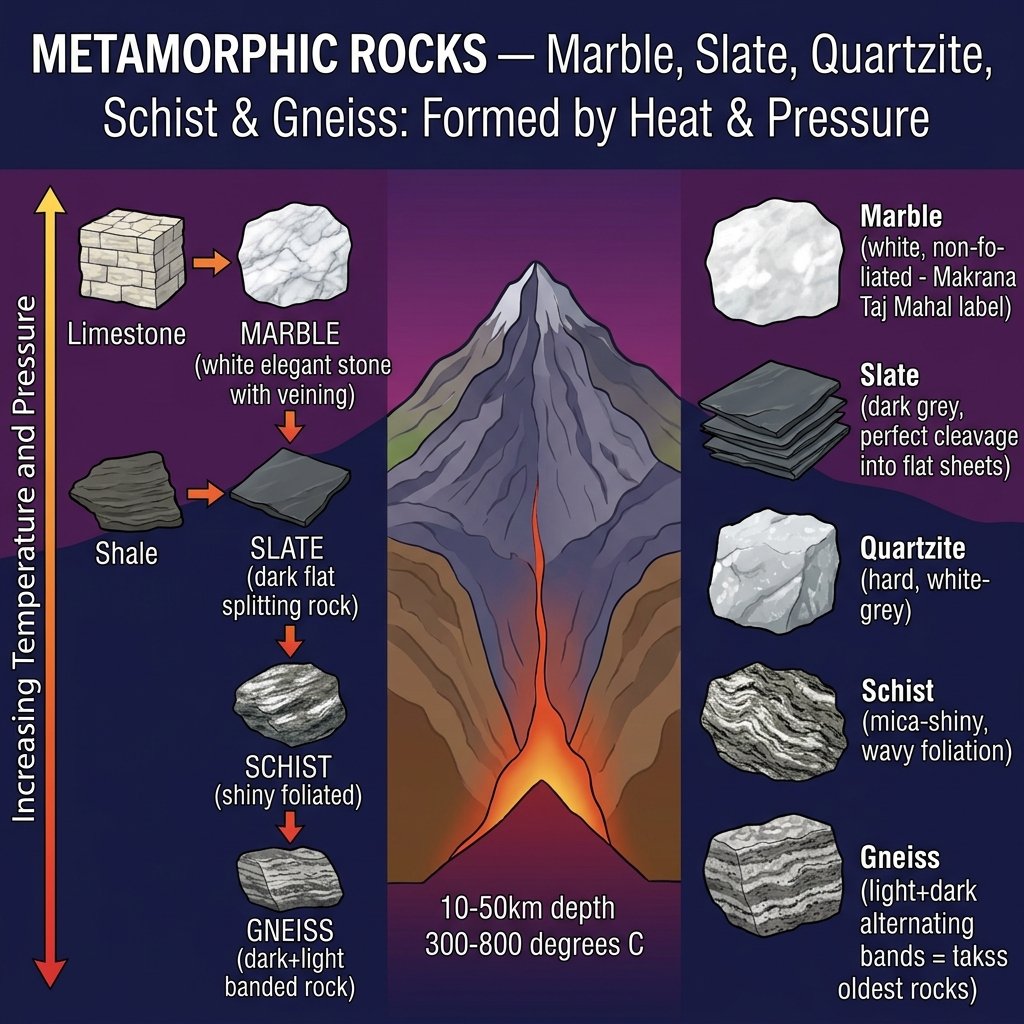
How Metamorphic Rocks Form — Key Agents
- 🌡️ Heat — drives mineral reactions; causes atoms to migrate and recrystallise into new, more stable minerals at high temperature; sources: (a) geothermal gradient (~25–30°C/km depth in normal crust), (b) magma intruding nearby rock (contact metamorphism), (c) radioactive decay in crust
- 💪 Pressure — drives mineralogical changes by favouring denser mineral structures; two types: (a) lithostatic/confining pressure = equal from all directions = weight of overlying rock = controlled by burial depth, (b) directed/differential stress = unequal pressure from one direction (tectonic forces) = causes foliation (mineral alignment)
- 💧 Chemically Active Fluids (Hydrothermal fluids) — hot water + dissolved ions travelling through rock; transports ions to reactant sites; essential catalyst for most metamorphic reactions; also responsible for ore deposit formation around intrusions (skarn deposits: limestone + magma fluids = ore minerals)
- ⚠️ Critical condition: NO melting — if the rock melts, it becomes magma and forms igneous rock on cooling; metamorphism occurs entirely in the solid state (sub-solidus conditions), though partial melting to form migmatite marks the transition zone
Types of Metamorphism
| Type | Driving Force | Scale | T & P Conditions | Rocks Produced | Setting |
|---|---|---|---|---|---|
| Regional (Barrovian) | Both heat + directed pressure (tectonics) | Very large (100s of km²) | High T + High P; increases with depth | Slate, Phyllite, Schist, Gneiss, Granulite (grade increases with depth) | Convergent plate boundaries; mountain building; subduction zones; Himalayan metamorphic zones; Scottish Highlands |
| Contact (Thermal) | Heat only (from magma intrusion) | Local (metres to km) | High T, Low P; decreases away from intrusion | Hornfels (fine-grained non-foliated); Marble (limestone contact), Quartzite (sandstone contact) | Around igneous intrusions (batholiths, stocks); zone called aureole |
| Dynamic (Cataclastic) | Directed pressure/shear along faults | Linear (fault zones) | Low T, Very High differential stress | Mylonite (fine-grained, strongly foliated), Cataclasite, Fault breccia | Along major fault zones and shear zones; Main Central Thrust (Himalayas) |
| Hydrothermal | Hot chemically active fluids | Variable | Moderate T + fluid activity | Skarn (calc-silicate rocks); serpentinite (from peridotite + water) | Ocean floor spreading centres; around intrusions; ore deposit formation |
| Burial Metamorphism | Pressure + modest heat (burial only) | Regional | Low T, Moderate-High P | Zeolite facies rocks; weak recrystallisation; transition from diagenesis to metamorphism | Sedimentary basins with thick deposits; back-arc basins |
| Impact (Shock) | Meteorite impact shock wave | Local | Extremely high T + P for microseconds | Shatter cones, Suevite, Shocked quartz (planar deformation features in quartz grains) | Meteor impact craters; Lonar Crater (Maharashtra, India = basalt impact structure) |
Metamorphic Grade & Zones (Barrow’s Zones)
Scottish geologist George Barrow (1893) mapped zones of increasing metamorphic grade in schists of the Scottish Highlands, identifying characteristic index minerals that appear at specific temperature-pressure conditions — providing a regional map of burial depth and intensity. The same index mineral sequence is used worldwide:
| Grade | Index Mineral | T Range | P Range | Rocks Present | Key Features |
|---|---|---|---|---|---|
| Very Low | Zeolites → Prehnite | <200°C | Low | Slightly altered rocks | Barely distinguishable from diagenesis; burial metamorphism |
| Low — Zone 1 | Chlorite | 200–350°C | Low-Medium | Slate, Phyllite | Green colour from chlorite; fine-grained; slaty cleavage develops; fossils may still be preserved (deformed) |
| Low-Medium — Zone 2 | Biotite | 350–450°C | Medium | Phyllite, Garnet Schist | Biotite mica appears; foliation coarsens; phyllitic sheen (silky luster from fine mica) |
| Medium — Zone 3 | Garnet | 450–550°C | Medium-High | Garnet Schist | Red-brown garnet porphyroblasts in schist; clear foliation; fossils destroyed |
| Medium-High — Zone 4 | Staurolite | 550–620°C | High | Staurolite Schist | Brown cross-shaped staurolite crystals; strong schistosity |
| High — Zone 5 | Kyanite/Sillimanite | 620–700°C | High | Kyanite Schist, Gneiss | Aluminium silicate polymorphs; coarsening of texture; transition to gneiss fabric |
| Very High | Sillimanite + K-feldspar | >700°C | Very High | Gneiss, Granulite, Migmatite | Partial melting begins; layered appearance (migmatite = mixed metamorphic+igneous appearance) |
Foliation — The Hallmark of Metamorphic Rocks
Foliation = the parallel arrangement of platy or elongate minerals (especially mica) in a metamorphic rock, produced by directed pressure (differential stress). Minerals grow perpendicular to the direction of maximum stress, creating a planar fabric. Foliation is the most characteristic feature of regionally metamorphosed rocks.
- 📄 Slaty cleavage — finest foliation; very thin, parallel planes in slate; microscopically aligned clay/chlorite; produced at lowest metamorphic grade; splits into flat sheets
- ✨ Phyllitic texture — coarser than slate; fine mica visible; produces characteristic silky/satiny sheen on cleavage surfaces; rock is phyllite
- 🌊 Schistosity — individual mica/biotite flakes visible to naked eye; rock shows clearly wavy, platy fabric; rock is schist; moderately to highly metamorphosed
- 📏 Gneissic banding (Compositional layering) — alternating light (quartz + feldspar) and dark (biotite, amphibole) layers; coarse-grained; NOT true foliation (it’s compositional segregation); rock is gneiss; highest metamorphic grade
- 🔵 Non-foliated rocks — some metamorphic rocks lack foliation because they formed under equal pressure (not directed stress) OR because they contain only one mineral type that doesn’t form platy crystals: Marble (calcite = equidimensional, no platy habit), Quartzite (quartz = equidimensional)
Key Metamorphic Rocks — Detailed Guide
Slate — Lowest-Grade Metamorphic Rock
- 🪨 Protolith: Shale or mudstone (fine-grained clay-rich sedimentary rock)
- 🌡️ Grade: Low (200–350°C, chlorite zone)
- 🔬 Texture: Fine-grained; crystals not visible to naked eye; strong slaty cleavage (splits cleanly into flat, even sheets); cleavage planes may cut across original bedding
- 🎨 Colour: Dark grey, black, green, purple, red (depending on mineral impurities)
- 🏗️ Uses: Roofing tiles (traditional; lightweight, weather-resistant, long-lasting), flooring, blackboards (school slates), snooker/billiard tables, decorative wall cladding
- 🇮🇳 India: Andhra Pradesh (Nellore, Kurnool), Himachal Pradesh (Kangra Valley), Rajasthan (Alwar); Andhra slate exported globally for roofing
Phyllite
- 🪨 Protolith: Shale (higher grade than slate but lower than schist)
- 🌡️ Grade: Low-medium (350–450°C; chlorite-biotite zone transition)
- 🔬 Texture: Fine to medium grained; characteristic silky/satiny sheen on cleavage surface (from fine muscovite mica); wavy/crenulated foliation; more lustrous than slate
- 🎨 Colour: Grey, green, silvery (muscovite mica shimmer)
- 🇮🇳 India: Himalayan Lesser Himalayas; Rajasthan Aravalli; some southern India Precambrian terrains
Schist — Medium-Grade Metamorphic Rock
- 🪨 Protolith: Shale/mudstone (most commonly), basalt (greenschist), or impure limestone — various parent rocks can produce schist at medium grade
- 🌡️ Grade: Medium (450–650°C; biotite to staurolite zones)
- 🔬 Texture: Schistose — clearly visible platy mica minerals (biotite, muscovite) define strong foliation; may contain distinctive porphyroblasts (large well-formed crystals grown within the foliation): garnet (red-brown, gem quality), staurolite (cross-shaped), kyanite (blue blades)
- 🎨 Colour: Silvery/shiny (muscovite-dominated), dark grey/brown (biotite-dominated); often glittery
- 🏗️ Uses: Decorative building stone; flagging; some garnet schists mined for industrial abrasive garnet
- 🇮🇳 India: Delhi Ridge (quartzite and schist of Aravalli), Rajasthan (Aravalli metamorphic belt), Himalayas (Lesser and Greater Himalayan schists), Meghalaya basement, Odisha-Jharkhand metamorphic terrains; Rajasthan garnet schist = industrial garnet abrasive export
Gneiss — High-Grade Metamorphic Rock
- 🪨 Protolith: Granite (orthogneiss) or shale/greywacke that has reached high grade (paragneiss)
- 🌡️ Grade: High (600–800°C; sillimanite zone)
- 🔬 Texture: Coarse-grained; characteristic gneissic banding — alternating light (quartz + feldspar) and dark (biotite, amphibole, pyroxene) layers; NOT truly foliated (it’s compositional segregation); may be folded
- 🎨 Colour: Banded grey-and-white or grey-and-black; visually striking
- 🏗️ Uses: Building stone (“black granite” commercially = some gneisses), road aggregate, dimension stone, cemetery monuments
- 🇮🇳 India: Peninsular gneissic complex = ancient Archaean basement of southern India (Karnataka, Tamil Nadu, Telangana, Andhra Pradesh); 2.5–3.5 billion years old = among some of Earth’s oldest surviving rock material; Charnockite = a specific granulite-grade gneiss found in southern India; Shillong Plateau gneiss (Meghalaya) = ~2.7 billion years; Greater Himalayan Crystallines = high-grade gneiss and schist exposed by Himalayan uplift
Marble — Non-Foliated Metamorphic Rock
- 🪨 Protolith: Limestone or dolostone (carbonate rocks)
- 🌡️ Grade: Low to high (200–700°C; can form at contact or regional metamorphism)
- 🔬 Texture: Non-foliated (no platy minerals); granoblastic texture — interlocking equidimensional calcite crystals of roughly equal size; smooth, uniform appearance; takes a high polish
- 🎨 Colour: White (pure calcite marble), cream, pink, grey, black, green, or swirled/coloured (impurities: iron oxides = pink/red; graphite = grey/black; silicates = green/coloured)
- 🏗️ Uses: Sculpture (Michelangelo’s David = Carrara marble), floor/wall tiles, countertops, architecture, lime production for agriculture
- 🇮🇳 India — Makrana Marble (Rajasthan): World-famous white Makrana marble = Taj Mahal facing stone; also used in Victoria Memorial (Kolkata), Birla temples, many government buildings; extremely pure, fine-grained calcite marble; ~500 million years old (Aravalli metamorphic belt); Rajasthan = India’s largest marble producer; other types: green marble (Rajasthan), black marble (MP), pink marble (Bundi), coloured Rajnagar marble
Quartzite — Non-Foliated Metamorphic Rock
- 🪨 Protolith: Sandstone (quartz-rich)
- 🌡️ Grade: Low to medium (contact or regional)
- 🔬 Texture: Non-foliated; interlocking quartz grains fused together (grains completely recrystallised — no original pore space or cement remains); extremely hard and resistant; distinctive sugary/granular surface appearance; fractures THROUGH grains (not around them, unlike sandstone which breaks around grains)
- 🎨 Colour: White, light grey, pink, yellow (depending on iron impurities)
- 💪 Properties: Very hard (quartz = Mohs 7, no weak cement planes); extremely resistant to weathering; forms prominent ridges in landscape
- 🏗️ Uses: Road aggregate, railway ballast, glass-making (when pure), ferrosilicon production, refractory bricks, floor tiles, wall cladding
- 🇮🇳 India — Aravalli Range: Aravalli quartzites form the backbone of India’s oldest mountain system (Aravalli orogeny ~1,600 Ma); Raisina Hill (on which Rashtrapati Bhavan sits) = Delhi Ridge = quartzite ridge of the Aravalli; Rajasthan, Haryana, Delhi NCR = Aravalli quartzite ridges; Odisha, Jharkhand quartzite in Eastern Ghats mobile belt
Granulite & Migmatite
- 🔴 Granulite = highest-grade metamorphic rock (T > 700°C, high P); very coarse-grained; composed of quartz + feldspar + pyroxene + garnet; low water content (all fluids driven out); Charnockite (India) = a specific orthopyroxene-bearing granulite found abundantly in southern India (Tamil Nadu, Karnataka, AP); named after Job Charnock (founder of Calcutta), whose tombstone is made of this rock
- 🌋 Migmatite = mixed rock = partial melting zone = “begin of the end” of metamorphism; combination of metamorphic host rock (dark, foliated = paleosome) + injected igneous-looking leucosome (light-coloured granitic veins); technically marks transition from metamorphic to magmatic processes; forms deep in continental crust at convergent margins
⭐ Important for Exams — Quick Revision
- 🔑 Metamorphic rocks = formed by heat + pressure + fluids (NO melting); 27% of Earth’s crust; protolith = original rock before metamorphism
- 🔑 3 agents: Heat, Pressure (lithostatic + directed), Chemically active fluids
- 🔑 Regional metamorphism = largest scale; heat + directed pressure; mountain building; produces slate → phyllite → schist → gneiss with increasing grade
- 🔑 Contact metamorphism = local; heat only from magma; produces hornfels, skarn, marble, quartzite; forms aureole around intrusion
- 🔑 Barrow’s Zones (index minerals): Chlorite → Biotite → Garnet → Staurolite → Kyanite/Sillimanite (increasing grade)
- 🔑 Foliation = parallel mineral alignment from directed pressure; Slaty cleavage (finest) → Phyllitic texture → Schistosity → Gneissic banding (coarsest)
- 🔑 Non-foliated = Marble (from limestone) + Quartzite (from sandstone) — no platy minerals to align
- 🔑 Slate = lowest grade; from shale; perfect slaty cleavage; roofing tiles; Andhra Pradesh India export
- 🔑 Marble = from limestone; non-foliated; Makrana (Rajasthan) = Taj Mahal
- 🔑 Quartzite = from sandstone; non-foliated; extremely hard; Aravalli Range India = oldest quartzite hills; Delhi Ridge = Aravalli quartzite
- 🔑 Schist = medium grade; visible mica foliation (schistosity); garnet/staurolite porphyroblasts; Himalayan schists
- 🔑 Gneiss = highest grade; banded (light + dark layers); Peninsular India gneissic complex = 2.5–3.5 billion years old
- 🔑 Charnockite = India’s special high-grade granulite; found in South India; Job Charnock’s tombstone made of it
- 🔑 Migmatite = partial melting zone; transition between metamorphic and igneous
- 🔑 Lonar Crater (Maharashtra) = impact metamorphism; shocked quartz; basalt impact structure; ~52,000 years old
Frequently Asked Questions (FAQs)
1. Why is the Taj Mahal turning yellow, and can geology explain it?
The Taj Mahal is clad in Makrana white marble from Rajasthan — a metamorphic rock of extraordinary purity (~99% calcite, CaCO₃). Its yellowing/browning is a direct geological-chemical process: acid rain and air pollution are slowly dissolving and staining the marble. The chemistry: Sulphur dioxide (SO₂) from vehicle and industrial emissions reacts with water vapour to form sulphuric acid (H₂SO₄). This acid reacts with calcite: CaCO₃ + H₂SO₄ = CaSO₄ (gypsum) + H₂O + CO₂. The gypsum produced is white initially but then absorbs dust, soot, and particulates, turning grey-yellow-brown (called “marble cancer” by conservators). Additionally, particulate matter (PM2.5, PM10) from diesel vehicles and coal plants physically deposits on and embeds into the porous marble surface. The Supreme Court has repeatedly ordered a Taj Trapezium Zone (TTZ) — a 10,400 km² restricted industrial zone around Agra — banning coal/coke-using industries and restricting diesel vehicles near the monument. The Archaeological Survey of India periodically applies multani mitti (Fuller’s Earth) poultices to draw out stains. But the fundamental threat — air pollution in the Ganga plain — continues, making Taj Mahal one of the world’s most pollution-threatened heritage sites. This is a classic case where atmospheric chemistry + geology + human activity combine to damage geological heritage.
2. How old are the Aravalli mountains, and why are they so eroded?
The Aravalli Range is one of Earth’s oldest surviving mountain systems — the rocks that compose them formed approximately 1,500–2,100 million years ago (Proterozoic eon) during what geologists call the Aravalli orogeny. The dominant rock types are quartzite (highly resistant metamorphic rock from ancient sandstones) and phyllite/schist. The mountains were once truly massive — potentially Himalayan scale — when they formed during an ancient continental collision 1.5–2 billion years ago. But they have since been subjected to erosion for nearly 2 billion years — the longest erosion time of any mountain system still visible on Earth. The result: what was once a vast mountain range is now gently rolling hills and ridges, with maximum elevation of only ~1,722m (Guru Shikhar, Rajasthan). The quartzites are so resistant to erosion that they still stand as ridges after billions of years — everything else has been stripped away. The Aravallis represent Nature’s long-term experiment in mountain erosion: given enough time (2 billion years), even the most massive mountain range is reduced to gentle hills. They also mark the boundary between the ancient Bundelkhand craton (east, ~2.5 billion years old) and the marginal zones of the ancient Indian shield — a suture zone from an ancient continental collision predating the Himalayan collision by 1.5 billion years.
3. What makes the Himalayan metamorphic zones special, and what do they tell us?
The Himalayas expose a spectacular natural cross-section through a collisional metamorphic belt — making them one of the world’s best natural laboratories for studying mountain-building metamorphism. As you travel from the Himalayan foothills to higher elevations, you cross distinct metamorphic zones of increasing grade (a pattern similar to Barrow’s zones but on a grander India-specific scale): The Sub-Himalayas and Siwaliks = youngest, least metamorphosed; mostly sediments of the Indo-Gangetic Plain. The Lesser Himalayas = low to medium grade metamorphics (phyllites, schists, some marbles); age of rocks: 1,500–500 million years (Proterozoic). The Main Central Thrust (MCT) = one of the world’s most significant fault systems — separates Lesser from Greater Himalayas; at this boundary, high-grade metamorphic rocks were thrust OVER lower-grade rocks (inverted metamorphism — higher grade rocks structurally above lower grade, opposite of normal). The Greater Himalayas / Higher Himalayan Crystallines = high-grade schists, gneisses, migmatites (500–650°C, 600–800 MPa); these were buried 25–35 km deep during India-Eurasia collision (started 50 Ma) and have since been rapidly exhumed (a phenomenon called channel flow model). The Tethyan Himalaya = uppermost, paradoxically lowest-grade rocks (limestones, shales, sandstones from the ancient Tethys Sea that once separated India from Asia) — now at highest physical elevation (Everest’s summit = Ordovician limestone!). This pattern of decreasing grade with increasing elevation in the Tethyan Himalayas (inverse of what you’d expect) represents one of geology’s great puzzles — explaining it led to the revolutionary Channel Flow hypothesis (Beaumont et al. 2001): that partially-molten mid-crustal material flows like a fluid channel between the rigid Indian shield below and the Tibetan Plateau above.
Related Geology Articles on StudyHub
- ➡️ What is a Rock? — Introduction to All Three Rock Types
- ➡️ Sedimentary Rocks — The Protoliths for Marble & Slate
- ➡️ Rock Cycle — Where Metamorphism Fits In
- ➡️ Himalayan Formation — The Ultimate Metamorphic Laboratory
- ➡️ Mineral Resources — Garnet, Mica & Slate from Metamorphic Rocks