
Last Updated: March 2026 | Reading Time: 11 minutes | ~2,400 words | Category: Mineralogy & India’s Mineral Wealth
A mineral is a naturally occurring, inorganic, solid substance with a definite chemical composition and a characteristic crystalline structure. This definition has five essential parts: (1) Naturally occurring — formed by geological processes, not manufactured; (2) Inorganic — not produced by living organisms (coal and amber are organic but classified differently); (3) Solid — at standard temperature and pressure (mercury is a liquid, so technically not a mineral by strict definition); (4) Definite chemical composition — either a fixed formula (like quartz, SiO₂) or a composition varying within defined limits (solid solution series — like olivine, (Mg,Fe)₂SiO₄); (5) Crystalline structure — atoms arranged in a regular, repeating three-dimensional lattice pattern. Over 5,700 minerals have been formally recognised by the International Mineralogical Association (IMA), though fewer than 30 make up >99% of Earth’s crust by volume — these are called the rock-forming minerals. Minerals are the fundamental constituents of rocks, and understanding mineral properties (hardness, cleavage, luster, colour, streak, specific gravity), mineral groups (silicates, oxides, carbonates, sulfides, etc.), and the distribution of economically important minerals in India is central to competitive exam preparation. India’s mineral wealth is immense — iron ore (4th largest reserves globally), coal (2nd largest producer), bauxite (5th), chromite (2nd), manganese, limestone, mica (was world’s largest producer), garnet (world’s largest exporter), and newly discovered lithium (Reasi, J&K, 2023) make India a globally significant mining nation. For UPSC, SSC, NDA, and state PCS exams, minerals and mineral belts are among the highest-frequency topics.
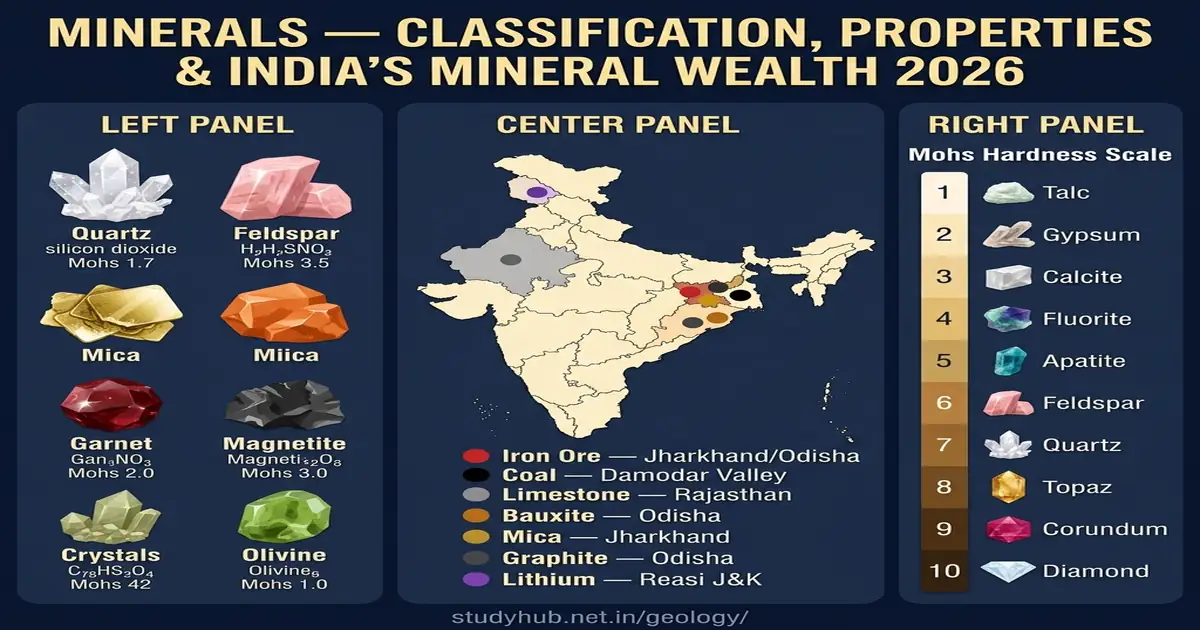
Minerals — Classification, Properties & India’s Mineral Wealth 2026
Physical Properties of Minerals — Identification Guide
| Property | Definition | Examples / Scale | Exam Relevance |
|---|---|---|---|
| Hardness (Mohs Scale) | Resistance of a mineral to scratching. Measured by the Mohs Hardness Scale (Friedrich Mohs, 1812): a relative scale 1–10 where each mineral can scratch all below it and is scratched by all above it. NOT a linear scale — Diamond (10) is ~1,500× harder than Corundum (9) in absolute terms (Vickers hardness) | 1=Talc (softest — soapy feel); 2=Gypsum (fingernail ~2.5 scratches it); 3=Calcite (copper coin ~3.5 scratches it); 4=Fluorite; 5=Apatite (steel knife ~5.5); 6=Orthoclase/Feldspar (glass plate ~5.5 scratches it); 7=Quartz (scratches glass easily); 8=Topaz; 9=Corundum (ruby, sapphire — scratched only by diamond); 10=Diamond (hardest natural substance known) | Mohs scale 1-10 often asked directly. Diamond=10. Corundum=9 (ruby+sapphire). Quartz=7 (scratches glass). Talc=1 (softest). Exam trick: fingernail hardness ~2.5, copper coin ~3.5, steel knife ~5.5, glass ~5.5. Diamond’s absolute hardness vs Mohs relative hardness frequently confused |
| Cleavage | Tendency of a mineral to break along flat, planar surfaces that reflect crystalline structure (planes of weak atomic bonding). Described by number of cleavage directions and angle between them. NOT same as fracture (irregular break) | Perfect cleavage: Mica (1 direction = perfect basal cleavage, splits into thin flexible sheets). Calcite (3 directions at oblique angles = rhombohedral cleavage). Halite/Rock salt (3 directions at right angles = cubic cleavage — produces perfect cubes). Galena (3 directions at right angles). Feldspar (2 directions at ~90°). Fluorite (4 directions = octahedral). Diamond (4 directions = octahedral cleavage — jewellers exploit this to “cleave” diamonds) | Mica’s perfect basal cleavage = reason it splits into thin flexible sheets (useful for electronics insulation). Calcite vs quartz: calcite has cleavage (rhombohedral), quartz has NO cleavage (conchoidal fracture only). Identifying minerals by cleavage number and angle is standard lab technique |
| Luster | Quality and intensity of light reflected from a mineral’s surface. Two main categories: Metallic (opaque, high reflectivity like polished metal) and Non-metallic (subdivided further) | Metallic: Pyrite (FeS₂ — “fool’s gold”), Galena, Magnetite, Hematite (specular), Native gold, Native copper. Non-metallic types: Vitreous/Glassy (most silicates — quartz, glass-like sheen). Resinous (sphalerite). Pearly (talc, mica — pearl-like iridescence). Silky (fibrous minerals — asbestos, gypsum var. satin spar). Adamantine (diamond — brilliant high luster). Earthy/Dull (kaolinite, chalk). Greasy (nepheline, some quartz) | Fool’s gold (pyrite) metallic luster vs real gold. Adamantine luster = diamond-like brilliance = identification mark for diamond. Mica’s pearly luster on cleavage surfaces |
| Colour & Streak | Colour = optical appearance of mineral surface (UNRELIABLE for identification — most minerals occur in multiple colours due to trace impurities). Streak = colour of mineral’s powder, obtained by rubbing mineral on unglazed porcelain streak plate (Mohs 6.5) — MORE RELIABLE than colour because streak removes the effect of impurities and surface oxidation | Colour variable: Quartz occurs in dozens of colours (colourless/white, purple=amethyst, pink=rose quartz, yellow=citrine, black=morion, smoky grey). Fluorite: green, purple, yellow, blue, colourless. Streak reliable: Hematite = always red-brown streak even if specimen is shiny metallic silver. Pyrite = black streak (NOT gold). Magnetite = black streak. Gold = yellow streak. Galena = lead-grey streak. Malachite = always green streak | Hematite’s red streak = diagnostic regardless of hand-specimen colour. Pyrite’s black streak distinguishes it from gold (gold streak = gold). Streak test hardness limit: only works for minerals harder than streak plate material (Mohs <6.5). Gem corundum colour = impurities: ruby=red (Cr³⁺), sapphire=blue (Fe²⁺/Ti⁴⁺), also yellow, green, orange sapphires |
| Specific Gravity (Density) | Ratio of mineral’s weight to weight of equal volume of water (= density in g/cm³ approximately). Indicates mineral composition — heavy elements (iron, lead, barium) give high SG; light elements (oxygen, silicon, aluminium) give low SG | Low SG (<3): Quartz 2.65, Feldspar 2.56–2.76, Calcite 2.71, Gypsum 2.32, Ice 0.92. Average SG (3–4): Olivine 3.3, Pyroxene ~3.3, Fluorite 3.18, Biotite 2.8–3.4. High SG (>4): Magnetite 5.2, Hematite 5.3, Pyrite 5.0, Galena 7.6, Native gold 15–19.3, Native platinum >21 (highest SG of any natural element) | Gold’s extremely high SG (15-19) = why gold panning/placer deposits work (gold sinks while lighter quartz washes away). Galena (7.6) = lead ore, very heavy for hand-size specimen. Earth’s overall density (5.51) implies heavier core (12-13 g/cm³) than mantle (~3.3) since crust/mantle average ~2.7–3.3 |
| Crystal System | Classification of minerals by symmetry of their crystal structure into 7 systems based on crystal axes and angles between them: Cubic (Isometric), Tetragonal, Orthorhombic, Hexagonal, Trigonal (Rhombohedral), Monoclinic, Triclinic | Cubic: Halite (NaCl), Galena, Diamond, Fluorite, Pyrite. Hexagonal: Quartz, Calcite, Graphite, Apatite, Beryl (emerald). Orthorhombic: Olivine, Sulfur. Monoclinic: Mica (biotite, muscovite), Pyroxene (augite), Gypsum, Hornblende. Triclinic: Plagioclase feldspar, Kyanite. Tetragonal: Zircon, Cassiterite (tin ore) | Diamond crystal system = cubic (forms perfect octahedra). Quartz = hexagonal (6-sided prism with pyramidal terminations). Recognising crystal habit helps mineral identification in field. Zircon (tetragonal) = most important mineral for U-Pb geochronology (dating oldest rocks) |
Mineral Groups — Classification by Chemistry
| Group | Chemistry | Key Minerals | % Earth’s Crust | India Significance |
|---|---|---|---|---|
| Silicates | Si-O framework: SiO₄ tetrahedra sharing corners in chains, sheets, or 3D networks. Most abundant mineral group on Earth (~92% of crust by volume). Classified by degree of Si-O polymerisation: Nesosilicates (isolated tetrahedra), Inosilicates (chains), Phyllosilicates (sheets), Tectosilicates (3D framework) | Quartz (SiO₂, tectosilicate, Mohs 7), Orthoclase (K-feldspar, KAlSi₃O₈, Mohs 6), Plagioclase (Ca-Na feldspar), Muscovite+Biotite mica (phyllosilicate, Mohs 2-3), Olivine ((Mg,Fe)₂SiO₄, nesosilicate), Pyroxene (augite), Amphibole (hornblende), Garnet ((Mg,Fe,Ca)₃Al₂Si₃O₁₂, nesosilicate, Mohs 6.5-7.5), Kyanite (Al₂SiO₅), Topaz (Al₂SiO₄(F,OH)₂, Mohs 8), Beryl (Be₃Al₂Si₆O₁₈ — emerald=green Cr-doped), Zircon (ZrSiO₄ — geochronology), Talc (Mg₃Si₄O₁₀(OH)₂, Mohs 1) | ~92% | Quartz = glass + electronics (Rajasthan silica sand). Mica (muscovite) = electronics insulation, cosmetics, paint (Jharkhand-Bihar-Rajasthan — India was world’s #1 mica producer until 1980s). Garnet (almandine) = industrial abrasives (India = world’s #1 garnet exporter — TN, Rajasthan). Beryl/Emerald (Rajasthan, Ajmer district). Kyanite (Odisha — refractories, ceramics). Talc (Rajasthan — cosmetics, pharmaceuticals). Topaz (Rajasthan). |
| Oxides | Metal cation + oxygen anion (O²⁻). Simple binary compounds or more complex spinels | Hematite (Fe₂O₃ — iron ore, red streak), Magnetite (Fe₃O₄ — magnetic iron ore, black), Corundum (Al₂O₃ — ruby=red/Cr, sapphire=blue/Fe-Ti; Mohs 9), Ilmenite (FeTiO₃ — titanium ore), Rutile (TiO₂), Cassiterite (SnO₂ — tin ore), Chromite (FeCr₂O₄ — chromium ore), Bauxite (Al(OH)₃ mixture — aluminium ore), Pyrolusite (MnO₂ — manganese ore), Spinel (MgAl₂O₄), Ice (H₂O — technically an oxide mineral!) | ~8% (ignoring water) | Iron ore: hematite+magnetite (Jharkhand-Odisha iron belt — Singhbhum, Mayurbhanj — world-class BIF iron ores; India=4th largest iron ore reserves). Chromite: Sukinda Valley (Odisha) = India’s largest chromite mine, one of world’s largest chromite deposits. Corundum/ruby-sapphire: Rajasthan (Ajmer), Karnataka. Ilmenite+Rutile = titanium (heavy mineral sand placer deposits on Kerala-Tamil Nadu coast = world-class deposit). Bauxite: Odisha/Jharkhand/Gujarat (Koraput district — India=5th largest bauxite reserve). Manganese: Odisha/Maharashtra (India=5th largest manganese producer) |
| Carbonates | CO₃²⁻ anion + metal cations. Dissolve in dilute HCl (acid test = effervescence = calcite identification) | Calcite (CaCO₃ — limestone/marble/chalk — effervesces in cold HCl), Dolomite (CaMg(CO₃)₂ — effervesces only in hot HCl or when powdered), Siderite (FeCO₃), Magnesite (MgCO₃), Malachite (Cu₂(CO₃)(OH)₂ — green copper ore), Azurite (Cu₃(CO₃)₂(OH)₂ — blue copper ore), Rhodochrosite (MnCO₃ — pink), Smithsonite (ZnCO₃) | ~1.5% | Limestone: cement industry (India = 2nd largest cement producer globally; major deposits: Rajasthan, AP, Karnataka, MP — Lime Stone Belt of India). Dolomite: steel industry refractory flux (Rajasthan, Bihar, Odisha). Magnesite: refractories (Uttarakhand and TN deposits). Malachite: decorative stone, minor copper ore (Rajasthan-Gujarat copper belt) |
| Sulfides | Metal + sulfur (S²⁻). Majority of important metallic ore minerals belong here — generally heavy, often metallic luster, dense | Pyrite (FeS₂ — “fool’s gold,” sulfuric acid production, Mohs 6–6.5), Galena (PbS — lead ore, Mohs 2.5, very high SG 7.6), Sphalerite (ZnS — zinc ore, resinous luster), Chalcopyrite (CuFeS₂ — most important copper ore mineral, yellow-gold, iridescent tarnish), Molybdenite (MoS₂ — molybdenum ore, very soft/greasy), Cinnabar (HgS — mercury ore, bright red), Arsenopyrite (FeAsS — arsenic + gold associations), Bornite (Cu₅FeS₄ — “peacock ore,” iridescent) | <1% | Chalcopyrite+Galena+Sphalerite: Zawar mines (Rajasthan) = one of world’s oldest known zinc mines (zinc smelting ~9th century CE at Zawar!). Khetri Copper Belt (Rajasthan) — India’s largest copper reserve. Pyrite: used in sulfuric acid production. Galena: potential lead ore (Rajasthan). Note: India is DEFICIENT in copper, lead, zinc domestically relative to demand |
| Sulfates | SO₄²⁻ anion + metal cations. Generally soft, light-coloured, formed by evaporation or oxidation of sulfide zones | Gypsum (CaSO₄·2H₂O — Mohs 2, plaster of Paris, fertiliser), Anhydrite (CaSO₄ — dehydrated gypsum), Barite/Baryte (BaSO₄ — very high SG 4.5, used in drilling mud for oil wells), Alunite (KAl₃(SO₄)₂(OH)₆ — alum ore) | <0.5% | Gypsum: Rajasthan (largest Indian deposits — Bikaner, Barmer, Nagaur — used in cement, plaster, fertiliser). Barite: Andhra Pradesh (Mangampet, AP = world’s largest barite deposit — India exports globally for oil drilling mud). India = major barite producer and exporter. |
| Halides | Halogen anion (F⁻, Cl⁻, Br⁻) + metal cation | Halite (NaCl — rock salt), Fluorite (CaF₂ — “fluorspar,” Mohs 4, perfect octahedral cleavage, fluorescence namesake), Sylvite (KCl — potassium fertiliser/potash), Carnallite (KMgCl₃·6H₂O) | <0.1% | Halite: rock salt deposits not extensive in India (salt mainly from sea evaporation in Gujarat coast and Rajasthan lakes). Fluorite: Rajasthan deposits (fluorite = flux for steel/aluminium, HF acid production). Sambhar Lake (Rajasthan) = India’s largest inland salt lake — halite from evaporation |
| Native Elements | Occur as pure elements without bonding to other elements. Rare but economically hugely important | Gold (Au), Silver (Ag), Copper (Cu), Platinum (Pt), Diamond (C — cubic allotrope), Graphite (C — hexagonal allotrope), Sulfur (S), Arsenic (As) | Trace | Gold: Kolar Gold Field (Karnataka, now closed — was India’s deepest mine, ~3.2 km depth, 800 tonnes of gold produced over 120 years). Hutti Gold Mine (Raichur, Karnataka — currently India’s largest producing gold mine). Placer gold: Sona Nadi tributaries of Godavari, Subansiri River (Arunachal). Diamond: Panna (Madhya Pradesh) = India’s only active diamond mine (alluvial+primary kimberlite pipe); Golconda mines (historically produced Kohinoor, Hope Diamond, Pitt/Regent Diamond). Graphite: Eastern Ghats (Odisha — critical for EV batteries). Platinum: VERY limited in India (small chromite body PGM traces in Sukinda Odisha) |
India’s Key Mineral Belts — State-wise Distribution
| Mineral | Leading States | Key Deposit / Mine | India’s Global Rank | Main Use |
|---|---|---|---|---|
| Coal | Jharkhand, Odisha, Chhattisgarh, West Bengal, MP, Telangana | Jharia (coking coal, oldest coalfield), Raniganj (WB, oldest producing), Talcher (Odisha, largest reserves), Singrauli (MP/UP border, thermal) | 2nd largest producer (after China); 5th largest reserves | Thermal power (55% of electricity), coking coal for steel, chemicals |
| Iron Ore | Odisha, Jharkhand, Chhattisgarh, Karnataka, Goa | Singhbhum (Jharkhand — BIF haematite); Bailadila (Chhattisgarh — highest grade); Bellary-Hospet (Karnataka); Kudremukh (Karnataka — magnetite) | 4th largest reserves globally | Steel production (SAIL, TATA Steel, JSW Steel); exports |
| Bauxite | Odisha, Jharkhand, Gujarat, Maharashtra, Chhattisgarh | Koraput (Odisha); Ranchi plateau (Jharkhand); Amarkantak plateau (MP/Chhattisgarh) | 5th largest reserves globally | Aluminium production (NALCO, Hindalco) |
| Manganese | Odisha, Karnataka, Maharashtra, Madhya Pradesh | Bonai (Odisha); Sandur (Karnataka); Balaghat (MP) | 5th largest producer globally | Steel alloy (ferro-manganese), dry-cell batteries |
| Chromite | Odisha (>95% of India’s production) | Sukinda Valley (Odisha, Jajpur district) = one of world’s largest chromite deposits (layered mafic intrusion — Sukinda ophiolite) | 2nd largest reserves globally (after Kazakhstan) | Stainless steel (ferrochrome), refractory brickwork |
| Copper Ore | Rajasthan, Jharkhand, MP | Khetri (Rajasthan — India’s largest copper mine); Malanjkhand (MP) | Domestic production far below demand — India is a net copper importer | Electrical wiring, electronics, plumbing |
| Mica | Jharkhand, Bihar, Rajasthan | Jharkhand Mica Belt (Hazaribagh, Giridih, Dhanbad); Nellore Mica Belt (AP) | Was world’s #1 (1940s-80s); now significantly lower production | Electronics (insulation), cosmetics, paint, automotive |
| Limestone | Rajasthan, AP/Telangana, Karnataka, MP, Gujarat | Jodhpur-Barmer limestone (Rajasthan); Nalgonda (Telangana); Gulbarga (Karnataka) | Sufficiently large for domestic cement demand | Cement (primary), lime, steel flux, chemicals |
| Garnet | Tamil Nadu (largest), Rajasthan, Odisha, Kerala | Manavalakurichi (TN, placer beach garnet); Rajasthan metamorphic schist garnet | World’s #1 exporter of garnet | Industrial abrasive (garnet sandpaper, waterjet cutting), gemstone |
| Titanium (Ilmenite+Rutile) | Kerala, Tamil Nadu (heavy mineral sand beaches) | Chavara (Kerala — IREL); Manavalakurichi (TN); heavy mineral sand shore deposits | One of world’s largest ilmenite deposits | Titanium metal (aerospace), TiO₂ white pigment (paint, paper, plastics) |
| Graphite | Odisha, Jharkhand, Tamil Nadu, Rajasthan | Paralakhemundi (Odisha — flake graphite in khondalite); Aravalli (Rajasthan) | Significant reserves; growing strategic importance | EV battery anodes (lithium-ion cell graphite anode), lubricants, refractories, pencils |
| Diamond | Madhya Pradesh (only producing state currently) | Panna (MP) — alluvial + Majhgawan kimberlite pipe (India’s only active diamond mine). Historically: Golconda (Telangana, now exhausted) | Negligible current production; historically most famous (Kohinoor, Hope, Pitt) | Jewellery; industrial cutting/drilling (India dominates diamond CUT & POLISHING at Surat — 90% of world’s diamonds polished in India) |
| Lithium (NEW 2023) | Jammu & Kashmir (Reasi district) | Salal-Haimana, Reasi (J&K) — inferred resource of 5.9 million tonnes in pegmatitic granite (GSI February 2023 announcement) | Not yet assessed globally (new find); if confirmed = among world’s largest | Electric vehicle batteries (lithium-ion), energy storage, electronics |
Frequently Asked Questions
What is the difference between a mineral and a rock, and why does it matter?
This is one of the most fundamental distinctions in geology, frequently confused in common usage and in exams. A mineral is a single, naturally occurring inorganic solid with a definite chemical composition and crystalline structure — it is a specific chemical compound or element. A rock is an aggregate (mixture) of one or more minerals (and occasionally organic material or glass) bound together. Key distinctions: (1) Composition: A mineral has a fixed or defined-range chemical formula. A rock has no fixed chemical formula — it is a mixture. Example: Granite is a rock composed of three main minerals: quartz (SiO₂) + K-feldspar (KAlSi₃O₈) + plagioclase feldspar (NaAlSi₃O₈) + biotite mica (K(Mg,Fe)₃(AlSi₃)O₁₀(OH)₂) in varying proportions. Each of these minerals has a precise crystal structure and chemistry — granite as a whole does not. (2) Crystalline structure: Every mineral has a characteristic atomic arrangement (unit cell) that produces consistent physical properties. Rocks inherit the physical properties of their constituent minerals but do not have a single uniform crystal structure. (3) Purity vs. aggregate: A pure diamond crystal = a mineral (native carbon). Granite = a rock that contains no diamond but contains quartz, feldspar, and mica minerals. (4) Special cases: Some rocks are monomineralic (made of essentially one mineral): Pure marble = essentially calcite (CaCO₃) mineral. Quartzite = essentially quartz (SiO₂). Rock salt = essentially halite (NaCl). These are rocks (aggregates of many grains) but made of effectively one mineral species. Coal is a rock (organic origin, not a mineral). Obsidian (volcanic glass) is a rock — it has no crystalline structure, so it is NOT a mineral. Pearl = not a mineral (produced by living organism). Amber = not a mineral (organic, hardened tree resin). For examination: Is gold a mineral? Yes — native gold, element Au, cubic crystal system, natural, inorganic, solid. Is coal a mineral? No — organic origin (plant material), mixture, not crystalline in the strict mineralogical sense. Is ice a mineral? Technically yes — H₂O, hexagonal crystal system, naturally occurring, inorganic, solid, definite composition. Is water a mineral? No — liquid at standard conditions.
Important for Exams — Minerals Facts for UPSC, SSC & State PCS
Mohs scale (memorise): 1=Talc, 2=Gypsum, 3=Calcite, 4=Fluorite, 5=Apatite, 6=Feldspar/Orthoclase, 7=Quartz, 8=Topaz, 9=Corundum (ruby/sapphire), 10=Diamond. Practical: fingernail~2.5, copper coin~3.5, steel knife~5.5. Mineral groups: Silicates (~92% crust — quartz, feldspar, mica, olivine, pyroxene, amphibole, garnet). Oxides (hematite, magnetite, corundum, bauxite, chromite, ilmenite). Carbonates (calcite/limestone, dolomite, malachite). Sulfides (galena=lead, sphalerite=zinc, chalcopyrite=copper, pyrite=fool’s gold). Sulfates (gypsum, barite). Halides (halite=salt, fluorite). Native elements (gold, diamond, graphite). Key mineral-rock links: Limestone = calcite mineral → marble when metamorphosed → cement when heated industrially. Bauxite = hydrated Al oxides → aluminium through Bayer process → Hall-Héroult electrolysis. Iron ore (hematite/magnetite) + coking coal + limestone flux → pig iron → steel. India mineral wealth: Chrome=Sukinda (Odisha, 2nd globally). Garnet=TN/Rajasthan (1st exporter globally). Mica=Jharkhand/Bihar/Rajasthan. Titanium/Ilmenite=Kerala coast. Barite=Mangampet AP (world’s largest single deposit). Diamond mine=Panna MP (Kohinoor from Golconda, AP historically). Lithium=Reasi J&K (2023 discovery, 5.9 Mt). Surat diamond polishing: India cuts/polishes 90% of world’s diamonds in Surat (Gujarat) — world’s diamond cutting capital despite minimal domestic diamond mining. Kolar Gold Field (Karnataka): was deepest mine in India (3.2 km depth), now closed (economic depletion). Hutti mine (Raichur, Karnataka) = India’s current largest gold producer. Zawar mines (Rajasthan): one of world’s oldest zinc mines — ancient zinc smelting technology (9th century CE). India = net importer: of copper, gold, crude oil, natural gas, many fertiliser minerals despite large coal/iron/garnet/limestone reserves.
What to Read Next
- Rock Cycle — Igneous, Sedimentary & Metamorphic Rocks India 2026
- Gondwana Coalfields — Jharia, Raniganj, Talcher & India’s Coal Story 2026
- Deccan Traps — Basalt, Black Cotton Soil & India’s Mineral Wealth Connection 2026
- Geological Time Scale — Dharwar Craton, Gondwana & Vindhyan Supergroup 2026
- Himalayan Formation — Mineral Resources of J&K (Lithium, Sapphire, Marble) 2026
🎔 Exam Quick Reference — Minerals: Mohs: 1Talc→2Gypsum→3Calcite→4Fluorite→5Apatite→6Feldspar→7Quartz→8Topaz→9Corundum(ruby/sapphire)→10Diamond. Silicates=92% crust. Oxides: hematite (Fe₂O₃, red streak), magnetite (Fe₃O₄, magnetic), corundum (Al₂O₃ Mohs 9). Sulfides: galena=Pb ore, chalcopyrite=Cu ore, pyrite=fool’s gold (black streak NOT gold). Carbonates: calcite effervesces in cold HCl; dolomite only in hot HCl. India minerals: Iron ore=Jharkhand/Odisha (4th reserves). Chromite=Sukinda Odisha (2nd globally). Coal=Jharkhand/Odisha/CG (2nd producer). Bauxite=Odisha (5th reserves). Mica=Jharkhand/Bihar. Garnet=TN (world #1 exporter). Ilmenite=Kerala coast. Barite=Mangampet AP (world’s largest deposit). Diamond mine=Panna MP (historically Golconda produced Kohinoor). Lithium=Reasi J&K 2023 (5.9 Mt). Surat=90% world’s diamonds cut/polished. India is mineral-rich but NET IMPORTER of copper, gold, oil/gas.
🌍 India’s Critical Minerals (National Critical Minerals List 2023): Ministry of Mines India identified 30 critical minerals: Lithium, Cobalt, Nickel, Graphite, Vanadium, Tungsten, Molybdenum, Niobium, Titanium, REEs (Rare Earth Elements), PGMs (Platinum Group Metals), Germanium, Gallium, Indium, Tellurium, Selenium, Silicon, Manganese, Chromium, Copper, Potash, Phosphorus, Beryllium, Rhenium, Bismuth, Tantalum, Strontium, Barium. Emerging India finds: REEs (monazite in Kerala-TN heavy mineral sands = significant thorium+REE resource, IREL manages). Cobalt (small occurrences in Rajasthan+Karnataka). Silicon metal (Rajasthan silica). Vanadium (some Precambrian black shale occurrences). Goal: reduce import dependence for EV batteries, renewable energy, defence electronics. Critical Mineral Mission (Budget 2024-25): ₹16,300 crore outlay for exploration, processing, recycling of critical minerals in India.
About This Guide: Written by the StudyHub Geology Editorial Team (studyhub.net.in/geology/) based on NCERT Class 11 Physical Geography Chapter 5 (Minerals and Rocks), NCERT Class 12 India People and Economy Chapter 7 (Mineral and Energy Resources), Ministry of Mines India Annual Report 2023-24, GSI National Mineral Inventory 2023, and IBM (Indian Bureau of Mines) Statistical Profile of Mineral Industry. Last updated: March 2026.