
Last Updated: March 2026 | Reading Time: 12 minutes | ~2,700 words | Category: Biogeography & Natural Vegetation
Natural vegetation refers to the plant communities that develop naturally in an area without direct human interference, shaped by the interaction of climate (rainfall, temperature, seasonality), soil type, topography, and their geological parent material. India is one of the world’s twelve megadiverse countries — it spans 8°N to 37°N latitude, receives rainfall from 50 mm/year (western Rajasthan) to over 11,000 mm/year (Mawsynram, Meghalaya), and contains every major biome from tropical rainforest and mangroves to alpine tundra and cold deserts. The result is extraordinary vegetative diversity: India contains approximately 45,000+ plant species (~7% of the world’s total flora) including 16,000 species of flowering plants. India has two globally recognized Biodiversity Hotspots (out of 36 worldwide): the Western Ghats and Sri Lanka hotspot, and the Himalayas / Indo-Myanmar hotspot. For forest classification, India officially follows the Champion and Seth (1936) classification (revised by Champion 1968) — the scientific basis for India’s forest policy and timber royalty structure, which recognizes 16 major forest types and 221 sub-types. For examination purposes, this is simplified into 7 major natural vegetation types. India’s total forest cover as of the India State of Forest Report (ISFR) 2023 (released by Forest Survey of India, Dehradun): 7,15,343 sq km = 21.76% of India’s geographic area — consistently below the National Forest Policy 1988 target of 33% forest cover. The Sundarbans mangrove (West Bengal-Bangladesh) is not only India’s largest mangrove but the world’s largest mangrove ecosystem. Forest cover, biodiversity conservation, tribal forest rights, and deforestation are perennially important topics in UPSC General Studies Papers I, III, and Environment & Ecology.
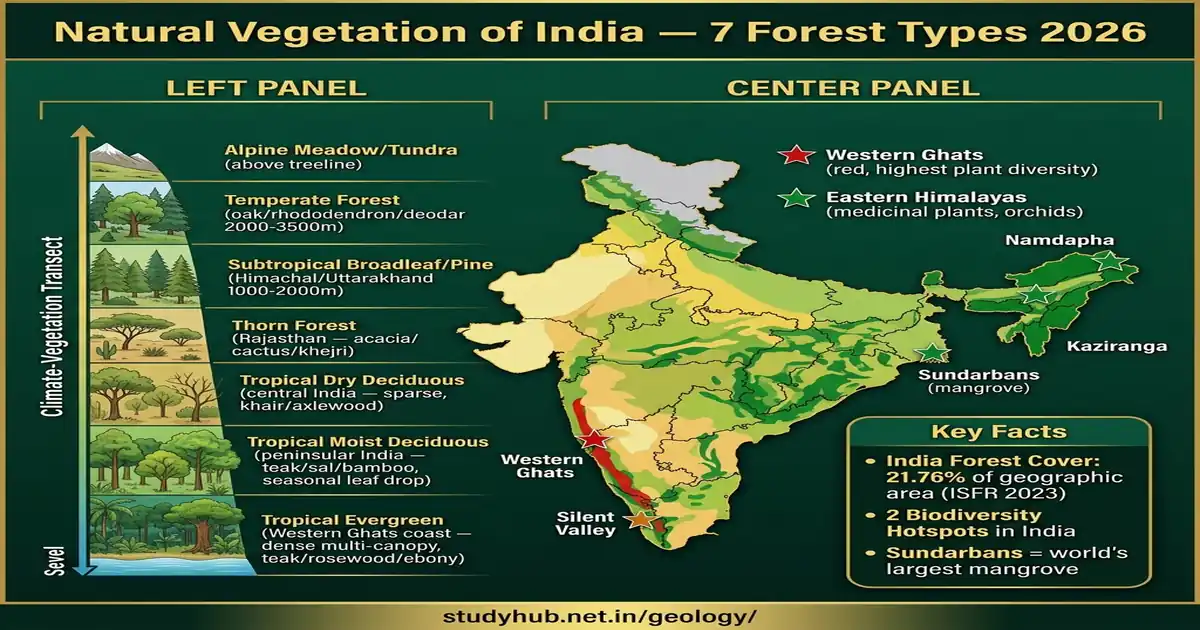
Natural Vegetation of India — 7 Forest Types, Champion & Seth Classification & Biodiversity 2026
1. India’s Major Vegetation Types — Champion & Seth Classification
| Vegetation Type | Climatic & Soil Conditions | Key Species | Distribution & Facts |
|---|---|---|---|
| 1. Tropical Evergreen & Semi-Evergreen Forest (Champion Type 1 & 2) | Rainfall: >200–250 cm/yr (Evergreen) or 100–200 cm/yr (Semi-evergreen). Temperature: 24–27°C year-round. No distinct dry season (or very short, <2 months). High humidity. Soil: Laterite (well-drained, acidic) and alluvial forest soils. Dense multi-canopy structure (emergent layer, canopy, sub-canopy, shrub layer, herb layer). Biodiversity hotspot forests | Evergreen trees: Mesua (Indian Rose Chestnut / Mesua ferrea = Indian State tree of Meghalaya), Dysoxylum, Vateria (White Dammar / Piney Resin), Calophyllum (Punnaga), Dipterocarpus (Gurjun), Cinnamomum (Cinnamon), Artocarpus (Jack fruit), Hopea, Garcinia. High timber value: Rosewood (Dalbergia latifolia, Shisham), Indian Ebony (Diospyros melanoxylon), Teak (Tectona grandis — more in semi-evergreen transition). Bamboo species: Bambusa, Dendrocalamus. Palms, ferns, epiphytes, orchids, lianas (climbing plants) | Distribution: Western Ghats (Western slopes of Karnataka-Kerala-Goa-Maharashtra coast — Agumbe, Silent Valley, Kodagu/Coorg). Andaman & Nicobar Islands (lush tropical rainforest, 95% islands forested, highest in Andaman). Assam (Assam Valley, Brahmaputra plains, Namdapha NP = India’s easternmost large evergreen forest). Meghalaya (E Khasi Hills — Cherrapunji, Mawsynram area = highest rainfall on Earth, unique cloud forest). NE India (Arunachal, Nagaland hills). Area: Relatively small in India. Key NPs: Silent Valley (Kerala) = no roads, no dams, pristine evergreen. Namdapha (Arunachal) = India’s biodiversity crown. Agumbe (Karnataka) = rain capital of South India. Critically endangered species: Lion-tailed Macaque (Western Ghats endemic), Malabar Giant Squirrel |
| 2. Tropical Deciduous Forest (Moist & Dry) (Champion Type 3 & 5) — Largest forest type in India | Moist Deciduous: Rainfall 100–200 cm. Distinct dry season (4–6 months). Trees shed leaves in dry season (water conservation). Soil: Red and yellow, laterite margins, moist alluvial. Dry Deciduous: Rainfall 70–100 cm. Longer dry season (6–8 months). Open woodland structure, more light reaches ground. Soil: Red and yellow or black cotton soil margins | Moist Deciduous: Teak (Tectona grandis = India’s most commercially important timber, Teakwood). Sal (Shorea robusta = North-East India, “Sal belt”). Shisham/Sheesham (Dalbergia sissoo), Mahua (Madhuca indica — flowers used for toddy), Tendu (Diospyros melanoxylon — leaves used for bidis = tendu patta). Bamboo (all species). Dry Deciduous: Axlewood (Anogeissus latifolia), Dhak/Flame of the Forest (Butea monosperma), Khair (Acacia catechu = catechu for paan), Indian Gooseberry (Amla, Phyllanthus emblica), Achar (Buchanania lanzan), Palas (Butea monosperma) | Distribution: largest forest type in India — covers most of peninsular India and sub-Himalayan belt. Moist Deciduous: Maharashtra-Chhattisgarh-Odisha-MP (Teak belt). Eastern India (Bengal-Jharkhand-Bihar, Sal belt). Himalayan foothills (Terai Sal forests — Dudhwa, Corbett area). Dry Deciduous: Central India (MP, Rajasthan-UP-Bihar margins). Andhra Pradesh (Nallamala Hills). Deccan Plateau interior. Famous Protected Areas: Jim Corbett NP (Uttarakhand, India’s FIRST National Park, 1936, Terai Sal+Riverine). Melghat TR (Maharashtra, Tiger Reserve). Kanha TR (MP, teak+bamboo great. Sal tiger habitat). Panna TR (MP, diamond + teak). Bandhavgarh TR (MP, teak forest). Simlipal BR (Odisha). Economic products: Teak lumber (global export). Sal resin (dhup). Tendu patta (forest-based bidi industry — ~650 million bidis/day in central India use tendu leaf). Mahua flowers (tribal livelihoods, country liquor). Bamboo (paper industry, cottage crafts) |
| 3. Tropical Thorn Forest (Champion Type 6) | Rainfall: <70 cm/yr. High temperature, low humidity. Long dry season (8–10 months). Soil: Desert/arid or red sandy. Open scrub woodland or grassland with scattered thorny trees. Very sparse canopy, fully deciduous or leafless (extreme xerophytes). High resilience to drought and grazing | Khejri/Khejdi (Prosopis cineraria = Rajasthan’s sacred state tree — every part used: pods for fodder, bark for tanning, leaves for fodder, gum, shade). Babool/Senegalia nilotica (Acacia). Ber (Ziziphus jujuba = Indian jujube). Cactus (especially Opuntia = prickly pear, introduced but naturalized). Wild Date Palm (Phoenix sylvestris). Rohira (Tecomella undulata = Rajasthan state flower). Euphorbia (succulent cactus-like). Palas (Butea). Salvadora (pilu/toothbrush tree) | Distribution: Rajasthan (Thar Desert and semi-arid margins), Gujarat (Saurashtra, Kutch), southern Punjab-Haryana (semi-arid), western MP, Andhra Pradesh (dry interior). Also: Jammu semi-arid plains. Area: ~6% of India’s geographic area. Key fact: Khejri = Rajasthan state tree. Bishnoi community (Rajasthan) fiercely protects khejri — 363 Bishnois martyred in 1730 in Khejarli village hugging khejri trees to stop them being cut by King of Jodhpur’s men = ORIGINAL Chipko Movement, 270 years before Uttarakhand’s 1973 Chipko. Protected areas: Desert National Park (Jaisalmer, home of Great Indian Bustard — most endangered bird in India). KhichanTown (Rajasthan): winter home of Demoiselle Crane (Kurja birds). Wildlife: Indian Bustard (GIB), Chinkara, Desert Fox, Indian Spiny-tailed Lizard (Saara hardwickii) |
| 4. Mountain / Montane Vegetation (Champion Types 9–13) | Three elevation zones with distinct vegetation: Subtropical Broadleaf (1,000–2,000 m): Higher rainfall than plains, cooler. Pine (Chir Pine / Pinus roxburghii dominant). Temperate (2,000–3,500 m): 100–150 cm rainfall (snowfall), cold winters. Oak-Rhododendron-Deodar belt. Alpine (3,500–5,000 m): Short growing season, extreme cold, wind. Alpine meadows (Bugyals in Uttarakhand — summer grazing pastures). Above ~5,500 m = permanent ice/rock (no vegetation). Eastern Himalayas wetter than Western Himalayas (more species diversity per km²) | Subtropical: Chir Pine (Pinus roxburghii), Jamun (Syzygium), Rhododendron (lower). Temperate: Himalayan Cedar/Deodar (Cedrus deodara = state tree of Himachal Pradesh — lightest, finest timber, traditional temple/house building). Kail/Blue Pine (Pinus wallichiana). Fir (Abies spectabilis). Spruce (Picea smithiana). Oak (Quercus species — several dozen). Rhododendron (Rhododendron arboreum = tree-sized, red flowers, state tree of Uttarakhand). Horse Chestnut. Maple. Alpine: Edelweiss, Gentian, Primula, Saussurea (Brahma Kamal — state flower Uttarakhand). Medicinal herbs (Himalayan herb belt = most important medicinal plant zone in India) | Distribution: Entire Himalayan belt (J&K, Himachal Pradesh, Uttarakhand, Sikkim, Arunachal Pradesh, Meghalaya highlands). Western Ghats Shola forests at high elevations (shola = stunted evergreen forest patches in sheltered valleys surrounded by grassland, Nilgiris, Anaimalai, Palani Hills — unique ecosystem, critically endangered, source of perennial streams). Protected Areas: Valley of Flowers (Uttarakhand, UNESCO World Heritage — alpine meadow). Nanda Devi Biosphere Reserve (Uttarakhand). Khangchendzonga NP (Sikkim = India’s first “Mixed” UNESCO WHS). Arunachal Pradesh NPs (Namdapha, Dibang, Mouling). Shola: Eravikulam NP (Kerala, Nilgiri Tahr — endemic mountain ungulate). Mukurthi NP (TN). Great Himalayan NP (Himachal Pradesh, WHS) |
| 5. Littoral & Swamp Vegetation (Mangroves) (Champion Type 4) | Saline to brackish tidal conditions along coastline and river deltas. Specialised adaptations: pneumatophores (aerial breathing roots = “pencil roots” that protrude above waterlogged soil). Prop roots (arch-shaped). Viviparous seedlings (germinate on parent tree, drop as propagules). Salt-secreting leaves. High seedling survival in hostile conditions. Intertidal zone vegetation — flooded at high tide, exposed at low tide. Extremely high biodiversity including fish nurseries | Sundari (Heritiera fomes = dominant in Sundarbans, from which “Sundarbans” is named — “beautiful forest/forest of sundari trees”). Rhizophora (Red Mangrove — prop roots). Avicennia (Sea/White Mangrove — pneumatophores, most salt-tolerant). Aegiceras. Ceriops (Yellow Mangrove). Bruguiera. Excoecaria agallocha (Blinding tree — poisonous latex). Phoenix (Mangrove Date Palm). Salicornia (glasswort), salt-tolerant grasses | Distribution: West Bengal coast (Sundarbans — largest), Andaman & Nicobar Islands, Odisha (Bhitarkanika, 2nd largest), Maharashtra (Raigad, Thane Creek — largest mangrove on west coast), Gujarat (Gulf of Kutch, Gulf of Khambhat), Kerala (backwater systems). Key facts: Sundarbans (India+Bangladesh): ~10,000 km² = world’s largest mangrove forest. UNESCO WH. Sundarbans Tiger Reserve (India’s part = 4,262 km²). Home of Bengal Tiger (only population that swims regularly at sea). Bhitarkanika (Odisha): 2nd largest mangrove in India, Olive Ridley turtle nesting (Gahirmatha Beach = world’s largest mass nesting, Arribada). Bhitarkanika NP. Total India mangrove cover (ISFR 2023): 4,991 km² (0.15% of geographic area) — slight increase from 4,975 km² in 2021. Ecological services: coastal storm buffer, fish nursery, carbon sink (blue carbon) |
| 6. Grasslands (Champion Types & non-forest) | Natural grasslands develop where rainfall is insufficient for trees (semi-arid) or where seasonal waterlogging prevents tree establishment (Terai). Also: degraded forest areas converted to grasslands. India has both tropical savannah grasslands (Deccan) and temperate/alpine grasslands (Himalayan bugyals and meadows) | Peninsular grasslands: Chrysopogon (Golden Beard Grass), Heteropogon (Black spear grass), Dichanthium, Saccharum (wild sugarcane). Terai grasslands: Tall elephant grass (Saccharum spontaneum, Phragmites). Alpine meadows: Diverse flowering herbs (Primula, Gentiana, Potentilla, Saussurea). Shola grasslands (TN/Kerala heights): species-rich heath grassland | Distribution: Banni Grasslands (Gujarat, Rann of Kutch area — India’s largest natural grassland, critically threatened by invasive Prosopis juliflora). Terai grasslands (Dudhwa, Corbett, Kaziranga flood grasslands — critical for Indian Rhinoceros habitat). Deccan plateau grasslands (Andhra, Karnataka — Great Indian Bustard habitat, now severely fragmented). Shola-grassland mosaic (Nilgiris, Anaimalai, Palani). Alpine: Bugyals (Uttarakhand — Roopkund, Bedni, Dayara). Key wildlife: Indian Rhinoceros (Kaziranga, Assam = world’s largest population), Great Indian Bustard (Desert NP + Grasslands NP Maharashtra), Lesser Florican, Wolf (Deccan grassland), Blackbuck (Velavadar NP, Gujarat) |
| 7. Subtropical & Shola Forest (Separate classification) | Subtropical Broadleaf Humid Forest: 1,000–2,000 m elevation. Subtropical Pine Forest: 1,000–2,000 m on lower Himalayan slopes (Pinus roxburghii belt). Shola Forest: Highly specific to high-elevation (1,800–2,700 m) valleys in the southern Western Ghats (Nilgiris, Anaimalai, Palani, Agasthyamalai). Each patch = unique micro-ecosystem | Subtropical pines, oaks. Shola forest: species-rich but stunted (6–10 m tall) evergreen mix: Rhododendrons, Syzygium (wild Jamun), Mahonia, Berberis, Ilex (holly), tree ferns. Extremely dense species packing in tiny patches. Surrounded by open high-elevation grassland (endemic grass species) | Shola-Grassland mosaic (Nilgiris, TN-Kerala): supports Nilgiri Tahr, Sambar, Gaur, Nilgiri Marten, Pied Bush Chat. Critical water catchment: every shola patch feeds perennial streams (Nilgiri tea estates depend on shola-fed streams). Shola trust: conservation NGO. Subtropical pine forests: Simla hills, Mussoorie, Nainital Pinus roxburghii belt (resin tapping for turpentine industry — HP). Rhododendron forests: Sikkim (State tree), Arunachal Pradesh = world’s highest rhododendron diversity (40+ species) |
2. India’s Biodiversity Hotspots, Forest Cover & Conservation
| Topic | Details | Key Facts for Exams |
|---|---|---|
| Biodiversity Hotspots | A Biodiversity Hotspot (concept by Norman Myers, 1988, updated Conservation International) = region with: (1) ≥1,500 endemic vascular plant species. (2) Having lost ≥70% of its original vegetation. India has TWO official Biodiversity Hotspots: (1) Western Ghats & Sri Lanka: ~170,000 km² in India (Karnataka-Kerala-Tamil Nadu-Goa-Maharashtra Western Ghats). 4,780 endemic plant species. High endemism in amphibians (89%), reptiles (62%), freshwater fish. Critically threatened: 27 species extinct. (2) Himalayas / Eastern Himalayas / Indo-Burma: includes north-east India (Sikkim, Arunachal, Assam, Meghalaya, Manipur, Nagaland, Mizoram) → Indo-Myanmar hotspot. 3,160 endemic plant species | World has 36 Biodiversity Hotspots total (CI 2023 update). India has 2. Western Ghats hotspot: Lion-tailed Macaque (most endangered primate India), Malabar Giant Squirrel, Nilgiri Tahr (mountain ungulate, Eravikulam NP). Silent Valley NP (Kerala) = most pristine undisturbed tropical rainforest in India (no roads). Eastern Himalayas hotspot: One-horned Rhinoceros (Kaziranga), Red Panda (Sikkim-Arunachal), Snow Leopard (above treeline), Himalayan Black Bear. Andaman & Nicobar: proposed to be part of Sundaland hotspot. Northeast India: most of India’s orchid species (Arunachal = highest orchid diversity globally for a single Indian state — 700+ species). Namdapha NP (Arunachal): India’s only park with 4 big cats (tiger, leopard, snow leopard, clouded leopard) |
| India Forest Cover — ISFR 2023 | India State of Forest Report (ISFR) 2023 released by Forest Survey of India (FSI/FSoI), Dehradun: Total forest cover = 7,15,343 km² = 21.76% of geographic area (up from 21.71% in ISFR 2021). Forest + Tree cover combined = 25.17%. Forest cover definitions: Dense forest (>70% canopy) = 99,779 km². Moderately dense (40–70%) = 3,06,890 km². Open forest (10–40%) = 2,91,419 km². Scrub = 17,255 km² (not counted in “forest”). States with highest forest cover %: Lakshadweep (91.33%), Mizoram (85.34%), Andaman & Nicobar (81.49%), Manipur (78.92%), Meghalaya (76%). States with highest absolute forest cover: MP (77,073 km², largest), Arunachal Pradesh (66,688 km²), Chhattisgarh (55,717 km²), Odisha (53,025 km²), Maharashtra (61,939 km²) | National Forest Policy 1988 target = 33% forest cover (2/3 of hills, 1/3 of plains). India at 21.76% is significantly below target. CAMPA (Compensatory Afforestation Fund Management and Planning Authority): compensatory afforestation fund from developers who divert forest land → used for afforestation. ~Rs 55,000 crore CAMPA funds. India gained 1,445 km² net forest cover in 2019-2021. Deforestation threats: mining, infrastructure, agriculture encroachment, urbanisation. FSI ISFR uses satellite data + field surveys. “Deemed forest” legal category important for conservation. Van Panchayat (Village Forest Council) = community forest governance in Uttarakhand. Joint Forest Management (JFM) = community participation in forest management |
| Key National Parks/ Biosphere Reserves | India has 106 National Parks (NPs) and 567 Wildlife Sanctuaries (as of 2023). UNESCO Man and Biosphere Reserves: 18 (2023 — latest added: Panna BR, MP, 2020). Tiger Reserves under Project Tiger: 53 Tiger Reserves covering ~75,000 km². Project Tiger started: 1973. India Tiger count (Tiger Census 2022): 3,167 tigers = world’s largest tiger population (75% of world’s wild tigers in India). Key NPs: Jim Corbett (Uttarakhand, 1936 = India’s FIRST NP = Asia’s FIRST). Kaziranga (Assam, WHS = 75%+ of world’s one-horned rhino). Sundarban (WB, WHS, Bengal Tiger swimming). Manas (Assam, WHS, Project Tiger, Project Elephant). Gir (Gujarat = ONLY home of Asiatic Lion, Panthera leo persica, ~674 lions 2020). Keoladeo/Bharatpur (Rajasthan, WHS = bird paradise, Siberian Crane). Nanda Devi (Uttarakhand, WHS = highest biosphere). Great Himalayan NP (Himachal, WHS). Khangchendzonga (Sikkim, India’s first “Mixed” cultural + natural WHS) | Project Tiger (1973) = world’s most successful tiger conservation programme. Tigers: 1,827 (1973 census) → 3,167 (2022) = major success. India has 30 UNESCO World Heritage Sites (2023) = 7 Natural WHS. Biosphere Reserves: Nilgiri (India’s first, 1986, Karnataka-Kerala-TN). Nanda Devi (Uttarakhand). Gulf of Mannar (TN-India’s first Marine BR). Sundarbans (WB). Panna (MP, newest, 2020). Project Elephant (1992): 30,000 elephants, 33 Elephant Reserves. NTCA (National Tiger Conservation Authority). WII (Wildlife Institute of India, Dehradun). Ramsar Convention: India has 75 Ramsar Wetland Sites (as of 2023) — highest for any country in Asia. Gujarat coast: Flamingo City (Pulicat + Khichan + Nal Sarovar = flamingo habitats) |
Frequently Asked Questions
Why does India have such diverse natural vegetation — and what determines which forest type grows where?
India’s extraordinary vegetative diversity — from tropical rainforests with 300+ species per hectare to bare alpine tundra with 5–10 specialist plants — results from the uniquely complex interaction of three geographic gradients: a latitudinal climate gradient, an orographic rainfall gradient, and an altitudinal gradient, all operating simultaneously over India’s large geographic area. Understanding this gives you the key to predict which forest type grows where, a skill directly tested in UPSC Geography. (1) The Rainfall Gradient (Most Important): The primary determinant of forest type is annual rainfall. This follows a clear gradient in India: >250 cm/yr → Tropical Evergreen (Western Ghats windward, Assam, Andaman): year-round moisture → broad-leaved multi-canopy evergreen. 100–250 cm/yr → Tropical Moist Deciduous (most of peninsular India, sub-Himalayan belt): enough rain for trees but distinct dry season → trees drop leaves in dry season (water conservation). 70–100 cm/yr → Tropical Dry Deciduous (central India, Andhra interior): lower rainfall, open woodland, more deciduous species. <70 cm/yr → Tropical Thorn Forest (Rajasthan, Gujarat semi-arid): not enough water for trees → thorny xerophytic scrub. The rainfall gradient goes: Western coast → high (3,000+ mm from SW monsoon hitting Western Ghats) → interior Deccan → 700–900 mm → Vidarbha-Marathwada → <600 mm → Rajasthan → <200 mm. This exactly mirrors: Evergreen → Moist Deciduous → Dry Deciduous → Thorn forest. (2) The Orographic Effect (Western Ghats): The Western Ghats act as a wall perpendicular to the SW monsoon. Windward (west = Kerala/Karnataka/Goa coast): 2,000–5,500 mm rain → dense tropical evergreen forest. Leeward (east = Karnataka Deccan, AP interior): 600–800 mm → moist/dry deciduous. This creates India’s sharpest vegetation boundary within just 50–60 km, from lush rainforest to dry scrub as you cross the Ghats. (3) The Altitudinal Zonation (Mountain Forests): Temperature decreases ~6.5°C per 1,000 m elevation (adiabatic lapse rate). So Himalayan and Western Ghats forests show clear vertical zonation: 0–1,000 m: Tropical (depending on rainfall — evergreen to deciduous). 1,000–2,000 m: Subtropical (Chir Pine in Himalayas, Shola in Western Ghats). 2,000–3,500 m: Temperate (Deodar, Oak, Rhododendron). 3,500–5,000 m: Alpine (meadow, herbs, dwarf shrubs). >5,000 m: Permanent snow/ice. (4) Soil Connection: Soil type reinforces climate. Laterite soil under high-rainfall areas → supports evergreen and plantation forest (tea/coffee/rubber) but not crops. Black cotton soil → grassland/dry deciduous in natural state. Alluvial → moist productive forests in Terai/flood plains. Red soil → dry deciduous, millets. Desert soil → thorn scrub. This is why understanding soil (Geo-30) is directly connected to vegetation type. (5) Topography: North-facing slopes (less solar radiation in India’s NH location) → moister, denser forest. South-facing → drier, more open. Valley floors → moister. Ridge crests → wind-exposed, drier. River plains → moist riparian forest. Together, these gradients produce India’s 16 major forest types (Champion & Seth) which simplify into 7 major types for exams.
Important for Exams — Natural Vegetation UPSC, SSC & State PCS
Forest types (rainfall controlling factor): >200cm → Tropical Evergreen (Western Ghats windward, Assam, Andaman). 100–200cm → Tropical Moist Deciduous (Teak = most important timber; Sal = NE India). 70–100cm → Tropical Dry Deciduous (Axlewood, Khair, Dhak). <70cm → Tropical Thorn (Khejri, Babool, Ber — Rajasthan). Mountain → Subtropical Pine (Chir Pine 1,000–2,000m) → Temperate Oak-Deodar (2,000–3,500m) → Alpine Meadow (3,500–5,000m). Littoral/Mangrove → Sundari (Sundarbans), Rhizophora, Avicennia. Key species: Teak = moist deciduous, most commercial timber. Sal = moist deciduous (NE India, Terai). Deodar = state tree HP, finest Himalayan timber. Chir Pine = 1,000–2,000m Himalayas. Khejri = Rajasthan state tree (thorn forest). Sundari = Sundarbans mangrove. Rhododendron arboreum = Uttarakhand state tree. ISFR 2023: Forest cover = 7,15,343 km² = 21.76%. Target = 33% (National Forest Policy 1988). Most forested state (%) = Lakshadweep (91%), Mizoram (85%). Most forested (area) = MP (77,073 km²). Biodiversity Hotspots: India has 2 (of 36 world total): Western Ghats+Sri Lanka, Himalayas/Indo-Myanmar. Silent Valley (Kerala) = pristine evergreen. Namdapha (Arunachal) = 4 big cats. Project Tiger (1973): 53 Tiger Reserves, 3,167 tigers (census 2022). Gir (Gujarat) = ONLY Asiatic Lion. Kaziranga (Assam) = 75%+ world’s one-horned rhino. Jim Corbett = India’s FIRST NP (1936). Sundarban = world’s largest mangrove, Bengal Tigers swim in sea. Bhitarkanika (Odisha) = 2nd largest India mangrove + Olive Ridley Gahirmatha. Ramsar Sites: India=75 (highest in Asia). Khangchendzonga (Sikkim)=India’s first Mixed WHS. Key confusions: Champion & Seth = India’s official forest classification. Teak grows in MOIST deciduous (NOT evergreen). Sal = NE India moist deciduous (NOT same region as Teak). Mangrove = coastal (+estuarine), NOT river-inland. Sundarbans = named after SUNDARI tree (not sundara = beautiful, debated). Shola = stunted evergreen forest in high Western Ghats valleys (NOT all tropical forest = shola). Chipko (1973) = Uttarakhand. Original Chipko = Bishnoi (1730, Rajasthan).
What to Read Next
- Indian Soils — How Soil Type Determines Which Vegetation Grows 2026
- Coastal Geomorphology — Mangroves, Coral Reefs & India’s Coastal Ecosystems 2026
- Glaciers — Alpine Meadows Above the Himalayan Tree Line 2026
- Rivers — Riparian Forest & the Ganga-Brahmaputra Floodplain Ecosystems 2026
- Deserts — Thorn Forest of the Thar & Bishnoi Conservation Tradition 2026
🎔 Exam Quick Reference — Natural Vegetation India: RAINFALL CONTROLS FOREST TYPE: >200cm=Evergreen (WG windward, Assam, Andaman). 100–200cm=Moist Deciduous TEAK/SAL (peninsular India, Terai). 70–100cm=Dry Deciduous (Axlewood, Khair). <70cm=Thorn Forest (Khejri, Babool, Rajasthan/Gujarat). Mountain: 1000-2000m=Chir Pine subtropical. 2000-3500m=Deodar/Oak/Rhododendron temperate. 3500-5000m=Alpine meadow (bugyals). Littoral=Mangrove (Sundari, Rhizophora, Avicennia). KEY SPECIES: Teak=moist deciduous (most commercial). Sal=moist deciduous NE (Shorea robusta). Deodar=state tree HP (Cedrus deodara). Khejri=state tree Rajasthan (Prosopis cineraria, thorn). Sundari=Sundarbans (Heritiera fomes). Rhododendron=state tree Uttarakhand. FOREST COVER (ISFR 2023)=7,15,343 km²=21.76% (target=33%). Highest %=Lakshadweep, Mizoram, A&N. Most area=MP (77,073 km²). BIODIVERSITY HOTSPOTS: India=2 (of 36): Western Ghats+Sri Lanka, Himalayas/Indo-Myanmar. PROJECT TIGER (1973): 53 Tiger Reserves, 3,167 tigers (2022)=world’s best tiger conservation. GIR=ONLY Asiatic Lions (Gujarat, 674 lions). KAZIRANGA (Assam)=75%+ world one-horned rhino (WHS). JIM CORBETT=India’s FIRST NP (1936). SUNDARBANS=world’s largest mangrove + WHS + Bengal Tiger (swims). BHITARKANIKA (Odisha)=2nd largest mangrove+Olive Ridley Gahirmatha. RAMSAR=75 wetland sites India (most in Asia). KHANGCHENDZONGA=India’s first Mixed WHS (Sikkim). SILENT VALLEY (Kerala)=pristine evergreen, no roads. NAMDAPHA (Arunachal)=4 big cats. BISHNOI (1730)=original Chipko (363 martyrs, Khejri trees, Khejarli Rajasthan). CHIPKO (1973)=Uttarakhand (Sunderlal Bahuguna, Chandi Prasad Bhatt).
🌍 India’s Tiger Reserves & Wildlife — Quick Reference 2026: Project Tiger launched: April 1, 1973 (Indira Gandhi government). First 9 Tiger Reserves (1973): Corbett (Uttarakhand), Kanha (MP), Manas (Assam), Palamau (Jharkhand), Ranthambore (Rajasthan), Simlipal (Odisha), Sundarbans (WB), Melghat (Maharashtra), Bandipur (Karnataka). Current (2023): 53 Tiger Reserves. National Tiger Conservation Authority (NTCA): statutory body under Wildlife Protection Act 1972, constituted under Wildlife Protection Amendment 2006. Tiger Census methodology: Camera traps + pugmark analysis + paw ID. Major tiger reserves: Nagarhole (Karnataka) + Bandipur (Karnataka) = Nilgiri BR tigers. Pench (MP-Maharashtra). Tadoba (Maharashtra). Annamalai/Anaimalai TR (TN). Satkosia (Odisha). Bor (Maharashtra). Kawal (Telangana). Sathyamangalam (TN). Project Elephant (1992): 30,000 elephants, 33 Elephant Reserves. Elephant corridors: critical as elephants migrate 100s-km but habitat fragmentation causes human-elephant conflict (Kerala, Coimbatore, North Bengal, Odisha). Wildlife Protection Act (WPA) 1972: India’s primary wildlife law. Schedule I = highest protection (tiger, leopard, rhino, elephant, snow leopard). National Board for Wildlife (NBWL) chaired by PM. Major zoos: National Zoological Park (Delhi). Arignar Anna Zoo (Chennai = India’s largest zoo by area). Nehru Zoological Park (Hyderabad). Mysore Zoo (oldest managed zoo in India, 1892).
About This Guide: Written by the StudyHub Geology Editorial Team (studyhub.net.in/geology/) based on NCERT Class 11 Geography India Chapter 5 (Natural Vegetation), Champion & Seth “A Revised Survey of the Forest Types of India” (1968), India State of Forest Report (ISFR) 2023 by Forest Survey of India (FSI, Dehradun), NTCA Tiger Census Report 2022, Wildlife Institute of India (WII) reports, and Conservation International Biodiversity Hotspot database. Last updated: March 2026.