
About 335 million years ago, all the continents of Earth were joined together in a single massive supercontinent called Pangaea (also spelled Pangaia). Surrounded by a single global ocean called Panthalassa, this supercontinent slowly broke apart over millions of years through the process of continental drift, eventually forming the seven continents we know today. Understanding Pangaea is the key to understanding why continents fit together, why similar fossils appear on opposite sides of the ocean, and why the Indian subcontinent collided with Asia to form the Himalayas.
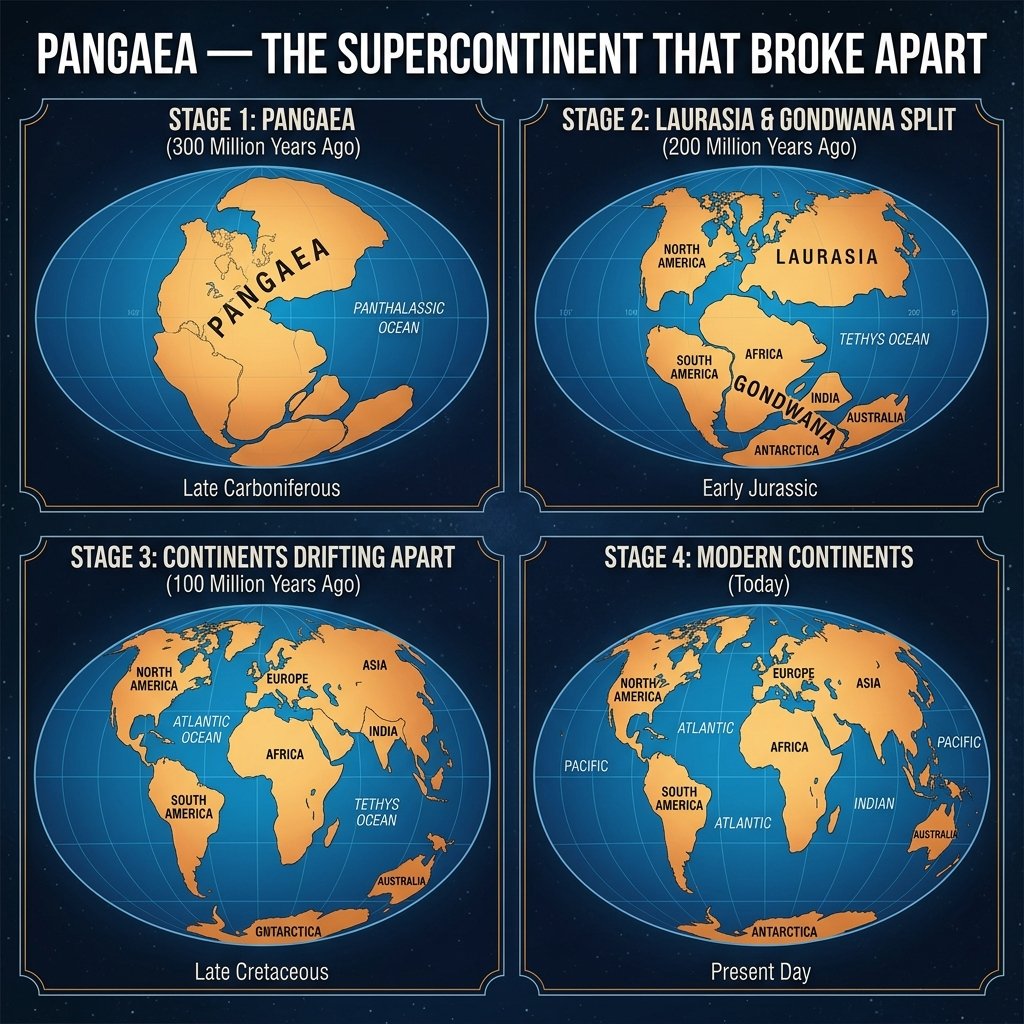
What is Pangaea? — Definition
Pangaea (Greek: pan = all + gaia = Earth) was the supercontinent that existed from approximately 335 million years ago (Carboniferous Period) to about 175 million years ago (Jurassic Period), when it began breaking apart. The concept was first proposed by German meteorologist and geophysicist Alfred Wegener in 1912 in his theory of Continental Drift.
🌍 Key Fact: Pangaea was not the first supercontinent. Before Pangaea came Rodinia (~1.1 billion years ago) and before that Columbia/Nuna (~1.8 billion years ago). Earth has had multiple supercontinent cycles over its 4.5-billion-year history.
Alfred Wegener & the Theory of Continental Drift
In 1912, Alfred Wegener (1880–1930) published his landmark paper proposing that the continents were once joined and had since drifted apart. His evidence was revolutionary but initially rejected because he could not explain the mechanism — how could continents actually move through ocean rock?
Wegener’s Five Lines of Evidence
- Jigsaw Fit of Continents: The coastlines of South America and Africa fit together remarkably well — like puzzle pieces. Particularly the bulge of Brazil fits into the Gulf of Guinea in Africa. Wegener noticed this on a world map and realised they must have once been connected.
-
Identical Fossil Records Across Oceans:
- Glossopteris — an extinct seed fern found in India, South America, Africa, Antarctica, and Australia. No marine dispersal mechanism could explain this — the continents must have been connected.
- Mesosaurus — a freshwater reptile found in both Brazil and South Africa. It could not have swum the Atlantic Ocean.
- Cynognathus and Lystrosaurus — land reptiles found across Gondwana continents.
- Matching Rock Formations: Mountain ranges that end at one coastline pick up again on the other side of the ocean at the matching coastline. The Appalachian Mountains (USA/Canada) match the Caledonian Mountains (Scotland/Scandinavia). Rock types and ages match perfectly.
-
Palaeoclimatic Evidence (Ancient Climates):
- Evidence of ancient glaciation (ice sheets) found in tropical Africa, India, South America, and Australia — only explainable if these continents were once near the South Pole.
- Evidence of tropical coal swamps (warm climate) found in Arctic Norway and Spitsbergen — only if Spitsbergen was once near the equator.
- Continuity of Geological Structures: Iron ore formations, ancient mountain belts, and shield rocks match across Gondwana continents — the Dharwar Craton of India matches parts of Australian and Antarctic cratons.
The Breakup of Pangaea — Stage by Stage
| Time (Ma = Million Years Ago) | Stage | What Happened |
|---|---|---|
| ~335 Ma (Carboniferous) | Pangaea assembled | All continents join; surrounded by Panthalassa Ocean |
| ~200 Ma (Triassic–Jurassic) | First rifting begins | Pangaea begins splitting — Laurasia (north) separates from Gondwana (south) along the proto-Tethys Sea |
| ~180 Ma (Jurassic) | Gondwana breaks up | Africa-South America separate; India begins moving north |
| ~150 Ma (Late Jurassic) | Atlantic opens | North Atlantic Ocean begins opening; South America + Africa still connected |
| ~100 Ma (Cretaceous) | South Atlantic widens | South America + Africa fully separate; Indian Ocean widens |
| ~65 Ma (K-Pg boundary) | India racing north | Indian Plate moving at record 15–20 cm/year toward Eurasia |
| ~50 Ma (Eocene) | India-Eurasia collision | Indian Plate hits Eurasian Plate → Himalayan orogeny begins |
| ~35 Ma (Oligocene) | Australia separates | Australia + New Zealand split from Antarctica; Antarctica freezes |
| Today | 7 continents | Continents still moving; Atlantic widening at 2–3 cm/year |
Laurasia and Gondwana — The Two Daughter Continents
Laurasia (Northern Supercontinent)
- Comprised of: North America, Europe, Asia (excluding India)
- Separated from Gondwana by the growing Tethys Sea
- Eventually broke apart to form the northern continents
- The opening of the North Atlantic (between North America and Europe) is one of the youngest major ocean basins
Gondwana (Southern Supercontinent)
- Comprised of: South America, Africa, India, Antarctica, Australia + New Zealand
- Named after the Gondwana region of central India (Gondi tribal homeland in present-day Jharkhand, Chhattisgarh, MP)
- India was part of Gondwana until ~130 Ma when it began moving north
- The Gondwana Supergroup rocks in India (Permian coal deposits) are direct evidence of this ancient connection
🇮🇳 India’s Gondwana Heritage: The name “Gondwana” itself comes from India! The Gondwana region of central India (Gondi tribal areas of Madhya Pradesh, Chhattisgarh, Jharkhand) is where the fossil evidence for the Gondwana supercontinent was first studied in the 19th century. India’s Permian coal deposits (Jharia, Raniganj, Talcher) are called Gondwana coalfields and were formed in the swampy tropical forests of this ancient continent.
India’s Journey from Gondwana to the Himalayas
India’s plate tectonic journey is one of the most dramatic in Earth history:
- ~500 Ma: India part of Gondwana, sitting near the South Pole (with Antarctica, Australia, Africa)
- ~180 Ma: Gondwana begins breaking up; India starts separating from Antarctica
- ~130 Ma: India fully separated; begins rapid northward drift across Tethys Ocean
- ~65 Ma: India moving at 15–20 cm/year — the fastest tectonic plate movement ever recorded by geologists (Deccan Trap volcanism also at this time as India passed over Réunion hotspot)
- ~50 Ma (Eocene): Indian Plate collides with Eurasian Plate → Himalayan orogeny begins; Tethys Sea closes
- Today: India still moving north at 5 cm/year; Himalayas still rising at 5 mm/year
Tethys Sea — The Ocean That Disappeared
The Tethys Sea (or Tethys Ocean) was the ancient ocean that separated Gondwana from Laurasia. As India moved north, the Tethys Sea closed and its sedimentary rocks got compressed and uplifted into the Himalayas. This is why:
- 🐚 Marine fossils (ammonites, belemnites) are found in Himalayan rocks — at 5,000–8,000 metres altitude! These were once ocean floor sediments that got pushed up during the collision.
- 🌊 The Tethys Sea sediments now form the Tethyan Sedimentary Zone (TSZ) — the exposed ancient seafloor visible in the upper Himalayas
- 🏔️ Limestone and shale from the Tethys Sea form the upper Himalayan peaks (including parts of Everest’s summit)
Modern Proof — What Confirmed Continental Drift?
Wegener was ridiculed in his lifetime (he died in 1930 on a Greenland expedition). The proof for continental drift came after his death:
- 🧲 1950s–60s — Palaeomagnetism: As lava cools at mid-ocean ridges, iron minerals align with Earth’s magnetic field, creating symmetric magnetic stripes on either side of the ridge — proving seafloor is spreading outward from the ridge. This became the key proof of plate tectonics.
- 🌊 Seafloor spreading (Harry Hess, 1962): The ocean floor is not permanent — it is created at mid-ocean ridges and destroyed at subduction zones. New ocean floor at ridges proved the mechanism Wegener lacked.
- 📡 GPS measurements today: We can now directly measure continental movement. North America moves ~2–3 cm/year away from Europe. India moves ~5 cm/year toward Asia. GPS proves continents are still moving RIGHT NOW.
- 🌍 Hotspot trails (J. Tuzo Wilson): Hawaii’s chain of volcanic islands forms a trail showing the Pacific Plate’s movement direction and speed over a fixed hotspot — direct measurement of plate motion.
The Next Supercontinent — Pangaea Ultima / Amasia
Plate tectonics is ongoing. Scientists have proposed that in approximately 250–300 million years, a new supercontinent will form. Two competing models:
- 🌍 Pangaea Ultima (Pangaea Proxima): The Atlantic Ocean closes; Americas collide back with Europe-Africa; new supercontinent centred near the equator
- 🌏 Amasia: The Atlantic remains open; Asia-America merge at the North Pole as the Pacific Ocean closes
- 🌐 Aurica: Both Atlantic and Pacific close; new continent around equator
- India will continue pushing into Asia, the Himalayas will continue, Africa’s Rift Valley will split creating a new ocean
Key Takeaways
| Topic | Key Fact |
|---|---|
| What is Pangaea | Single supercontinent; ~335 Ma; proposed by Alfred Wegener 1912 |
| Surrounding ocean | Panthalassa (precursor to Pacific) |
| First split | Laurasia (north) + Gondwana (south) separated by Tethys Sea |
| Gondwana name origin | Gondwana region of central India (Gondi tribal areas) |
| India’s journey | Part of Gondwana → broke off ~130 Ma → collided with Eurasia ~50 Ma |
| India’s peak speed | 15–20 cm/year (~65 Ma) — fastest plate movement ever recorded |
| Tethys Sea | Ancient ocean between Laurasia and Gondwana; sediments = Himalayas today |
| Key Wegener evidence | Jigsaw fit, Glossopteris fossil, matching mountains, palaeoclimate, rock match |
| Confirming proof | Palaeomagnetism + seafloor spreading (1950s–60s) + GPS today |
| Next supercontinent | Pangaea Ultima/Amasia — in ~250 Ma |
Frequently Asked Questions (FAQs)
1. Was Pangaea the first supercontinent on Earth?
No. Pangaea was the most recent supercontinent but not the first. Before Pangaea came Rodinia (~1,100–750 million years ago), before that Columbia/Nuna (~1,800–1,500 Ma), and the earliest proposed supercontinent is Vaalbara (~3,600 Ma — early Archaean Eon). Earth appears to cycle through supercontinent assembly and breakup roughly every 500 million years — a concept called the Supercontinent Cycle (Wilson Cycle).
2. Why was Wegener’s theory rejected in his lifetime?
Wegener’s evidence was compelling but he could not explain the mechanism — the force that would physically move continents through solid oceanic rock. The geophysics of his time showed that continental rocks were not strong enough to plough through oceanic rocks. The mechanism (mantle convection driving seafloor spreading at mid-ocean ridges) was only understood decades later. Wegener died in 1930 and never saw his theory vindicated — but today he is recognized as geology’s greatest visionary.
3. Why does the name “Gondwana” come from India?
The term Gondwana was coined by Austrian geologist Eduard Suess in 1861, based on the Gondi tribal region of central India (which he called “Gondwana Land”). The unique sequence of rocks there — especially the Glossopteris-bearing coal measures — was the type locality for what became recognized as a global southern supercontinent. So the ancient supercontinent that once included South America, Africa, India, Antarctica, and Australia is named after a forest tribe in what is now Madhya Pradesh and Jharkhand!
4. How do we know India was once part of Gondwana?
Multiple lines of evidence: (1) Glossopteris fossils in India’s Gondwana coalfields (Jharia, Raniganj) match those in Antarctica, Africa, Australia, South America; (2) India’s Dharwar Craton rocks match cratons in Australia and Antarctica — same age, composition, structural style; (3) India’s Permian glacial deposits show it was once near the South Pole; (4) Palaeomagnetism records in Indian rocks show India’s latitude progressively changed from ~60°S (Permian) to its current position.
⭐ Important for Exams — Quick Revision
- 🔑 Pangaea = Greek: pan (all) + gaia (Earth); proposed by Alfred Wegener, 1912
- 🔑 Pangaea existed: ~335 Ma to ~175 Ma (Carboniferous to Jurassic)
- 🔑 Two halves: Laurasia (N. America + Europe + Asia) + Gondwana (S. America + Africa + India + Antarctica + Australia)
- 🔑 Gondwana name from India — Gondi tribal area of central India (MP/CG/JH)
- 🔑 India in Gondwana — broke off ~130 Ma; hit Eurasia ~50 Ma → Himalayas
- 🔑 India’s fastest speed: 15–20 cm/year at ~65 Ma (fastest recorded plate speed)
- 🔑 Tethys Sea = ocean between Laurasia and Gondwana; closed when India hit Eurasia → became Himalayas
- 🔑 Marine fossils in Himalayas = former Tethys Sea floor pushed up by collision
- 🔑 Glossopteris = key fossil that linked Gondwana continents; found in India, Africa, Antarctica, Australia, S. America
- 🔑 Proof of drift: Palaeomagnetism + Seafloor spreading (Harry Hess, 1962) + GPS measurements
- 🔑 India currently moving: 5 cm/year northward; Himalayas rising: ~5 mm/year
- 🔑 Next supercontinent: Pangaea Ultima or Amasia — in ~250 million years
Related Geology Articles on StudyHub
- ➡️ What is Plate Tectonics? — Types of Boundaries & Plate Movement
- ➡️ How Himalayas Formed — Indian Plate Collision with Eurasian Plate
- ➡️ Continental Drift — Wegener’s Theory, Evidence & Sea Floor Spreading
- ➡️ Deccan Traps — India’s Flood Basalt & Dinosaur Extinction Link
- ➡️ Geological Time Scale — Eons, Eras, Periods & India’s Geological History