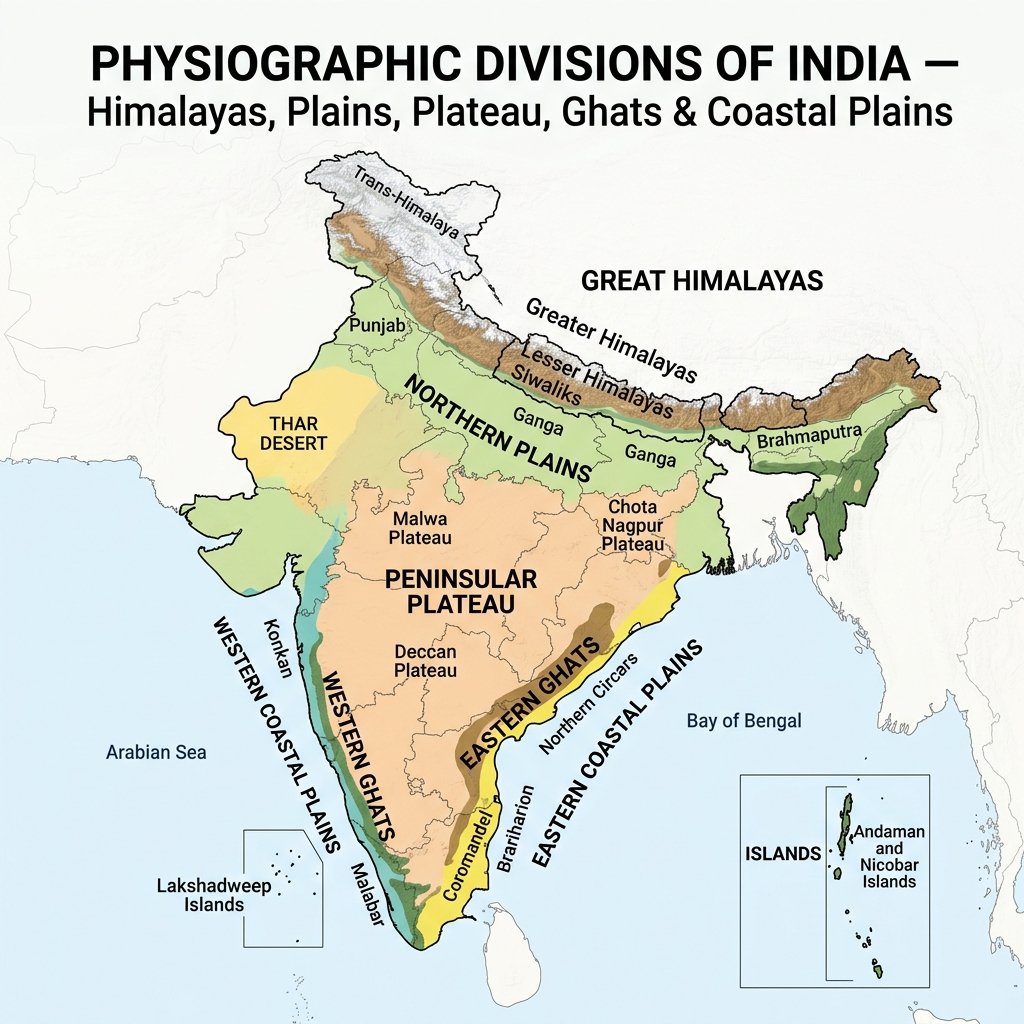
India’s remarkable physical diversity — from the world’s highest mountain peaks to flat alluvial plains, ancient plateaus, lush coastal strips, and remote island chains — is the product of billions of years of geological evolution and millions of years of geographical shaping. Geographers divide India into six major physiographic divisions (also called physical/relief divisions), each with distinct origin, geology, landforms, and human significance. These divisions are not arbitrary boundaries; they reflect underlying geology, climate, and the actions of rivers, glaciers, and oceans over geological time. Understanding India’s physiographic regions is essential for grasping why minerals are found where they are, why rivers flow as they do, why certain soils develop, and why specific crops are grown in specific areas. This complete guide — covering all six physiographic divisions with formation, characteristics, key features, and exam-critical facts — is essential for UPSC, SSC, Class 9–11 NCERT Geography, and all competitive examinations.
Physiographic Divisions of India — Himalayas, Northern Plains, Peninsular Plateau, Ghats & Coastal Plains | StudyHub Geology
The Six Physiographic Divisions of India
Division
Area (approx.)
% India’s Area
Age / Origin
1. The Himalayan Mountains
~5 lakh km²
~16.2%
Cenozoic (50 Ma–present); active fold mountains from India-Eurasia collision
2. The Northern Plains
~7 lakh km²
~21.3%
Quaternary (recent, <2.6 Ma); alluvial deposits from Himalayan rivers filling ancient foredeep
3. The Peninsular Plateau
~16 lakh km²
~48.7%
Precambrian (3.5 Ga–600 Ma); ancient stable craton; oldest landmass in India
4. The Indian Desert (Thar)
~1.75 lakh km²
~5.3%
Quaternary; wind-deposited sand on ancient Aravalli basement
5. The Coastal Plains
~0.5 lakh km²
~1.5%
Recent; formed by marine deposition; differential between Western and Eastern coast
🏔️ Formed by collision of Indian plate (moving NNE at ~5cm/year) with Eurasian plate starting ~50 million years ago; ancient Tethys Sea floor sediments crumpled into fold mountains
🌍 Young fold mountains — geologically active, tectonically unstable, still rising (~5mm/year in some areas); earthquakes, landslides, glaciation ongoing
🗺️ The Himalayan arc stretches ~2,500 km from Nanga Parbat (Pakistan, west) to Namche Barwa (Arunachal Pradesh, east); width 150–400 km
Sub-divisions (North to South — 4 parallel ranges)
Range
Also Called
Avg. Altitude
Key Features
Trans-Himalaya (Tibetan Himalaya)
Tethys Himalaya / Zaskar-Ladakh range
3,000–6,000m
North of main Himalayan ranges; rain-shadow desert (Ladakh, Lahaul-Spiti); ancient Tethys Sea sediments; Indus + Sutlej + Brahmaputra originate here; Karakoram Range (technically separate) has K2 (8,611m = 2nd highest world)
Greater Himalayas (Himadri)
Inner Himalayas / High Himalayas
6,000m average; peaks 7,000–8,848m
Highest, most continuous range; perennially snow-covered; major peaks: Everest (8,848.86m, Nepal side), Kanchenjunga (8,586m, India-Nepal border = India’s highest point), Makalu, Lhotse, Cho Oyu; composed of ancient crystalline rocks (granite, gneiss); major glaciers (Siachen, Gangotri)
Lesser Himalayas (Himachal)
Middle Himalayas
1,000–4,500m
South of Himadri; includes major hill stations: Shimla, Mussoorie, Nainital, Darjeeling, Ooty (Nilgiris in South), Kodaikanal; important for tea cultivation and tourism; Pir Panjal Range (J&K), Dhaula Dhar (HP), Mahabharat Range (Nepal side)
Outer Himalayas (Shiwaliks)
Sub-Himalayan Range
900–1,800m
Southernmost and youngest Himalayan range; composed of unconsolidated sediments (conglomerate, sandstone, clay); highly erosion-prone; separated from Lesser Himalayas by dun valleys (Dehradun, Patli Dun, Kotah Dun); forms northern edge before Indo-Gangetic Plain
🗺️ Himalayan Passes (important for UPSC): Zoji La (J&K–Ladakh, NH 1D), Rohtang Pass (HP, Manali-Leh), Baralacha La (HP), Shipki La (HP–Tibet), Nathu La (Sikkim–Tibet = India-China trade route reopened 2006), Bomdi La (Arunachal Pradesh)
❄️ Glaciers: Siachen (70 km, world’s longest outside polar regions; India-Pakistan military standoff), Gangotri (30 km, Ganga source), Zemu (Sikkim), Bara Shigri (HP); Himalayan glaciers receding at alarming rate due to climate change
🌿 Duns (longitudinal valleys): Flat fertile valleys between Himachal and Shiwalik ranges; Dehradun (Uttarakhand) = India’s capital of education and research institutes; Patli Dun (Uttarakhand), Kotah Dun
🌊 Formed by deposition of alluvial material (silt, sand, clay) by three major river systems: Indus (west), Ganga (central), Brahmaputra (east)
🏔️ As the Himalayas rose, they created a foredeep (geosyncline/subsidence zone) between themselves and the peninsular craton; this depression was gradually filled with Himalayan river sediments over millions of years
📏 Alluvial depth varies from 150–300m in west to 1,000–2,000m+ in Bengal delta — some of the deepest alluvial deposits on Earth
🌾 Result: one of the world’s largest, flattest, most fertile plains; length ~2,400 km, width 150–300 km
Sub-regions of the Northern Plains
Sub-region
States
Key Features
Punjab-Haryana Plain
Punjab, Haryana, NW Delhi
Between and west of rivers (doab = land between two rivers; Punjab = land of 5 rivers = Jhelum, Chenab, Ravi, Beas, Sutlej); fertile “wheat bowl”; highly irrigated; major Green Revolution success
Ganga Plain
UP, Bihar, WB (and Nepal terai)
Largest sub-region; densest population belt on Earth (400–1,000 people/km²); major rivers Ganga, Yamuna, Ghaghra, Gandak, Kosi; subdivided into Upper Ganga Plain (UP) and Lower Ganga Plain (Bihar-WB)
Brahmaputra Plain
Assam, Arunachal Pradesh
Narrow flood plain (50–100 km wide); annual flooding; braided Brahmaputra; Majuli river island; tea gardens; Kaziranga (one-horned rhino); alluvium only 10–30m deep
Rajasthan Plain (Trans-Aravalli)
Rajasthan (west of Aravallis)
Transitional between plains and Thar Desert; very flat; low rainfall; transitions into desert westward
🟡 Bhabar — narrow zone (8–16 km wide) at foot of Himalayas; porous, coarse alluvium; rivers disappear underground; forested; hunting grounds historically
🌿 Terai — just south of Bhabar; fine alluvium; waterlogged; dense forests; rivers reappear from underground; malaria historically; now cleared for agriculture + wildlife parks (Corbett, Dudhwa)
🟤 Khadar — younger alluvium in active floodplains (lower, lighter coloured, more fertile); floods regularly
⬛ Bhangar — older alluvium on higher ground above floodplain (darker, denser, kankar nodules); less fertile than khadar
🌾 Doab — land between two rivers; especially fertile because gets water from both; major doabs: Bari Doab (Beas-Ravi), Bist Doab (Beas-Sutlej), Ganga-Yamuna Doab (Delhi area)
3. The Peninsular Plateau
Formation & Geology
🪨 Ancient, stable, rigid block (craton) formed from some of Earth’s oldest rocks (Precambrian: 600 Ma to 3.5 Ga)
🌍 Originally part of Gondwanaland supercontinent; drifted north for millions of years; collided with Eurasia forming Himalayas
🌋 Covered by Deccan Trap basalt lava flows (66–60 Ma) over much of western-central peninsula; rest exposes ancient gneiss, schist, granite, quartzite
📐 Triangular shape; higher in west, slopes gently eastward (hence most rivers flow east into Bay of Bengal; exception: Narmada + Tapi flow west)
🏔️ Average elevation 600–900m above sea level; Western Ghats form the western escarpment (sharp drop to coast); Eastern Ghats = discontinuous, more eroded
North of Narmada; includes Malwa Plateau (MP), Vindhya Range (sandstone), Bundelkhand Plateau, Baghelkhand; drained northward by Chambal, Betwa, Son rivers into Ganga
Basalt-covered (Deccan Traps); famous Black Cotton Soil; average 500–700m elevation; rivers drain east (Godavari, Krishna, Mahanadi); important cotton and soybean growing region
Western Ghats (Sahyadri)
Gujarat to Kerala (along entire west coast)
Continuous escarpment; highest point = Anamudi (2,695m, Kerala = highest point in Peninsula and South India); UNESCO World Heritage (biodiversity hotspot); Ghats = “steps” in Hindi; receives heavy orographic rainfall on western (windward) side; rain-shadow to east; source of Godavari, Krishna, Cauvery; Passes = Thal Ghat (Mumbai-Nashik), Bhor Ghat (Mumbai-Pune), Pal Ghat (Palakkad Gap, Kerala = only major break = important railway route)
Eastern Ghats
Odisha, AP, TN
Discontinuous, broken, lower (max 1,600m at Mahendragiri); highly eroded; cut by major east-flowing rivers (Godavari, Krishna, Mahanadi, Cauvery); not a continuous range like Western Ghats
Chota Nagpur Plateau
Jharkhand (core), WB, Odisha, Bihar, Chhattisgarh
Archaean rocks; richest mineral region in India (“Ruhr of India”); iron ore, coal, mica, copper, bauxite; underlain by Singhbhum craton (3.5 Ga); Damodar Valley industrial corridor; Netarhat Plateau
Northeastern Plateau
Meghalaya, Assam hills, Tripura, Manipur hills
Shillong Plateau (Meghalaya = separated from main peninsular plateau); Archaean gneiss; highest rainfall (Cherrapunji, Mawsynram = world’s wettest); limestone cave systems; coal in NE India
4. The Indian Desert (Thar Desert)
🟡 Location: Northwestern India — western Rajasthan, parts of Gujarat and Haryana; extends into Pakistan (Great Indian Desert)
📏 Area: ~3.2 lakh km² (India portion ~1.75 lakh km²); world’s 9th largest desert
☀️ Climate: Extremely arid (<250mm annual rainfall); extreme temperatures (summer up to 50°C; winter below freezing at night); strong hot winds (loo)
🏜️ Landscape features: Sand dunes (barchans, seif dunes); salt lakes (Sambhar = India’s largest inland saltwater lake); saline depressions (called thals); rocky outcrops (reg); Luni River = only significant river (loses itself in the Rann of Kutch)
🧱 Geology: Built on ancient Aravalli basement (Precambrian); covered by wind-blown sand (aeolian deposits); Aravallis act as eastern barrier preventing monsoon moisture from reaching western Rajasthan
🌱 Transformed: Indira Gandhi Canal (from Harike Barrage, Punjab) = transformed Jaisalmer and Barmer districts; agricultural colonies established; but concerns about waterlogging and soil salinisation in canal command area
5. The Coastal Plains
Feature
Western Coastal Plains
Eastern Coastal Plains
Location
West coast between Western Ghats and Arabian Sea
East coast between Eastern Ghats and Bay of Bengal
Width
Narrow, 10–80 km
Wider, 100–130 km; broader plains
Rivers
Short, fast, not navigable; direct steep Western Ghats drainage
Long navigable rivers with deltas (Mahanadi, Godavari, Krishna, Cauvery = fertile deltas)
Landforms
Few deltas; estuaries; rocky coast; sea cliffs; backwaters (Kerala lagoons)
Well-developed deltas; beaches; lagoons; Chilika Lake (Odisha, India’s largest coastal lagoon)
Rainfall
Very heavy SW monsoon orographic rainfall (2,000–4,000+ mm)
Receives NE monsoon (Oct–Dec); less SW monsoon; Coromandel Coast = often cyclone-hit
Sub-regions
Konkan (Goa, Maharashtra), Malabar (northern Kerala), Kerala backwaters
Northern Circars (AP, Odisha coast), Coromandel Coast (TN, South AP)
Key features
Backwaters (Vembanad Lake = India’s longest lake; Ashtamudi); fishing; spices; Mangalore port, Kochi port
Rice cultivation in deltas; aquaculture; Kakinada, Visakhapatnam, Chennai ports; Pulicat Lake (TN-AP border)
States
Gujarat coast, Maharashtra (Konkan), Goa, Karnataka coast, Kerala
Odisha, Andhra Pradesh, Tamil Nadu
6. The Islands
Feature
Andaman & Nicobar Islands
Lakshadweep Islands
Location
Bay of Bengal; 1,200–1,500 km east of mainland India
Arabian Sea; 200–440 km west of Kerala coast
Number of islands
572 islands; only ~38 inhabited
36 islands; only 11 inhabited
Origin/geology
Part of Andaman-Nicobar volcanic arc (subduction of Indian plate under Burmese microplate); some islands have active/dormant volcanoes; Barren Island = India’s only active volcano
Coral atolls built on submerged volcanic seamounts; entirely coral (calcium carbonate); no volcanic rock
Highest point
Saddle Peak (732m, North Andaman)
Near sea level; highest point ~4–5m
Capital
Port Blair (South Andaman) — Cellular Jail (Kala Pani) historical significance
Kavaratti
Southernmost point India
Indira Point (Great Nicobar Island) = India’s southernmost tip; submerged partially in 2004 Tsunami
—
Proximity to other nations
Only 90 km from Indonesia (Sumatra); strategic importance
🔑 Kanchenjunga (8,586m) = India’s highest peak (on India-Nepal border, Sikkim side); K2 (8,611m) = in Pakistan-administered territory
🔑 Siachen Glacier = world’s longest glacier outside polar regions (70 km); Gangotri = Ganga source
🔑 Dun valleys = between Lesser Himalayas and Shiwaliks; Dehradun = most famous; fertile longitudinal valleys
🔑 Bhabar (porous, rivers disappear) → Terai (waterlogged, rivers reappear) → Bhangar (old alluvium) → Khadar (new alluvium); N to S then elevation differences
🔑 Doab = land between two rivers; Punjab has multiple doabs; Ganga-Yamuna Doab = most important
🔑 Anamudi (2,695m) = highest peak in peninsular India and South India; in Kerala’s Western Ghats
🔑 Palakkad Gap / Pal Ghat = only major break in Western Ghats; important railway route; Kerala climate divided by gap
🔑 Chota Nagpur Plateau (Jharkhand) = “Ruhr of India” = richest mineral belt; Singhbhum craton (3.5 Ga)
🔑 Western Ghats = UNESCO World Heritage (biodiversity); receives heavy SW monsoon; rain-shadow to east; source of Godavari, Krishna, Cauvery
🔑 Eastern Ghats = discontinuous (cut by east-flowing rivers); lower than Western Ghats; Mahendragiri = highest point
1. Why do most peninsular rivers flow eastward while Narmada and Tapi flow westward?
The drainage direction of peninsular rivers reveals deep structural geology. The Peninsular Plateau tilts gently eastward — its highest point is along the Western Ghats (which form a sharp, steep escarpment on the western edge) and it slopes progressively lower toward the Bay of Bengal in the east. This eastward tilt is the product of the Deccan’s geological history: the peninsula was originally a flat ancient craton, and when it collided with Asia and the Western Ghats uplifted (partly due to rifting as India separated from Africa/Madagascar before 65 Ma), the entire plateau was tilted so the west stands higher. Water naturally flows downhill — eastward in this case — creating the major eastward-draining rivers: Mahanadi, Godavari, Krishna, Cauvery. These rivers have long courses, gentle gradients in their lower reaches, and build extensive deltas at the Bay of Bengal. The exception — Narmada and Tapi (Tapti) — reveals a completely different geological story. Both rivers flow through rift valleys: elongated, faulted depressions (grabens) formed when the crust stretched and dropped along parallel fault systems. The Narmada graben (between Vindhya hills to the north and Satpura hills to the south) and the Tapi graben (between Satpura and Ajanta/Satmala ranges) funnelled these rivers westward toward the Arabian Sea — not because the regional slope forced it, but because the valley topography created by faulting created a westward channel. The contrast is dramatic: Narmada (1,312 km) flows west to the Arabian Sea, while rivers barely 100 km to its south (like headwaters of Godavari) flow east to the Bay of Bengal. The Western Ghats escarpment further reinforces this asymmetry — the extremely steep western face means rivers descending the Ghats’ western slope are very short, fast, and powerful, draining directly to the narrow western coastal plain.
2. What are the Sentinelese and why is North Sentinel Island protected?
North Sentinel Island in the Andaman archipelago is home to the Sentinelese — one of the world’s last truly isolated uncontacted tribes and perhaps the most protected human community on Earth. The Sentinelese have lived on their island for an estimated 50,000–65,000 years — one of the longest continuous habitations of any people in any specific location. They have consistently and aggressively rejected all contact with the outside world. Historical attempts at contact — by the British colonial administration and later Indian scientists — were met with arrows, spears, and weapons. The Indian government officially adopted a “non-contact” policy in the 1990s after recognising that forcible contact would expose the Sentinelese to diseases (measles, flu, common cold) for which they have zero immunity — contact would almost certainly be fatal to the entire population. Under the Andaman and Nicobar Protection of Aboriginal Tribes Regulations (1956 + amendments), it is illegal to approach within 3 nautical miles (5.5 km) of North Sentinel Island. In 2018, American Christian missionary John Allen Chau illegally paid local fishermen to take him to the island; he was killed by Sentinelese arrows. The Indian government chose not to pursue prosecution of the Sentinelese and did not attempt to recover his body — correctly recognising that any contact to recover remains would risk epidemic disease. The Sentinelese case is geologically interesting: they live on a volcanic island whose ecosystem has supported a self-sufficient hunter-gatherer society for 60,000 years. They survived the 2004 tsunami (observed by helicopter flying over after to check = Sentinelese appeared alive and shot arrows at the helicopter). Their isolation represents the purest possible natural experiment in human sustainability — 60,000 years on one island without resource depletion is a profound statement about sustainable carrying capacity.
3. Why is the Chota Nagpur Plateau called the “Ruhr of India” — and what does it mean for India’s future?
The Ruhr valley in Germany was the industrial heartland of 19th–20th century Europe — densely packed with coal mines, steel mills, chemical factories, and industrial cities that powered German economic rise. The Chota Nagpur Plateau (primarily in Jharkhand, extending into Odisha, Chhattisgarh, and Bihar) earned the same sobriquet because of its extraordinary concentration of heavy industries and minerals. The geological basis: Chota Nagpur’s foundation is the Singhbhum craton — one of Earth’s most ancient stable continental blocks at ~3.5 billion years old. Over this vast geological timespan, multiple geological processes enriched this craton with diverse minerals: Banded Iron Formations (BIFs) deposited ~2.5–3 billion years ago when ancient oceans oxidised = source of India’s haematite iron ore (Jharkhand-Odisha); ancient igneous intrusions carried copper, uranium, and gold into shear zones of the Singhbhum copper belt; regional metamorphism created the world-famous mica deposits of Koderma (Jharkhand = Mica Capital), plus garnets and graphite; the overlying Gondwana sedimentary sequences (deposited 300–250 Ma) contain the Damodar Valley coalfields (Jharia = only coking coal, Bokaro, Dhanbad) — the foundation of Indian steel (TISCO at Jamshedpur uses Jharia coking coal + Odisha iron ore = model location at midpoint of two raw materials). The concentration of coal + iron + copper + mica + bauxite in one plateau by three different geological processes over 3.5 billion years makes Chota Nagpur unique globally. The future challenge: the wealth of this “Ruhr of India” has historically not translated into human development for the Adivasi (tribal) communities who constitute 26% of Jharkhand’s population; these communities have the legal rights to their ancestral land under the Forest Rights Act (2006) and PESA (1996), yet mining has caused mass displacement without adequate compensation — making Jharkhand’s mineral wealth simultaneously its greatest asset and greatest social flashpoint. The growth of Maoist (Naxalite) movements in Jharkhand and Chhattisgarh’s mineral belts is directly linked to this development paradox: mineral wealth above ground, poverty and displacement below.