
Plate tectonics is geology’s grand unifying theory — the framework that explains why earthquakes cluster along certain belts, why volcanoes erupt where they do, why mountains rise and ocean basins open, why fossils of the same plants appear on continents now separated by thousands of kilometres of ocean, and how the face of Earth has continually transformed over billions of years. The theory holds that Earth’s lithosphere (crust + rigid uppermost mantle) is divided into approximately 7 major and several minor tectonic plates that move slowly over the weak, ductile asthenosphere below — driven by mantle convection, slab pull, and ridge push. The interactions at plate boundaries — divergence, convergence, and transform sliding — produce virtually all of Earth’s geological activity at the surface. For India, plate tectonics is not an abstract theory; it is the living explanation for the Himalayas (India-Eurasia collision now ongoing at 5 cm/yr), for the Deccan Traps (Réunion plume + Indian Plate motion), for the Andaman volcanoes (Indian oceanic slab subducting under Burma Plate), and for India’s entire geological evolution since it was part of Gondwana ~700 million years ago. For UPSC, SSC, NDA, and state PCS exams, plate tectonics — including the evidence for continental drift and sea floor spreading — is a cornerstone topic of physical geography.
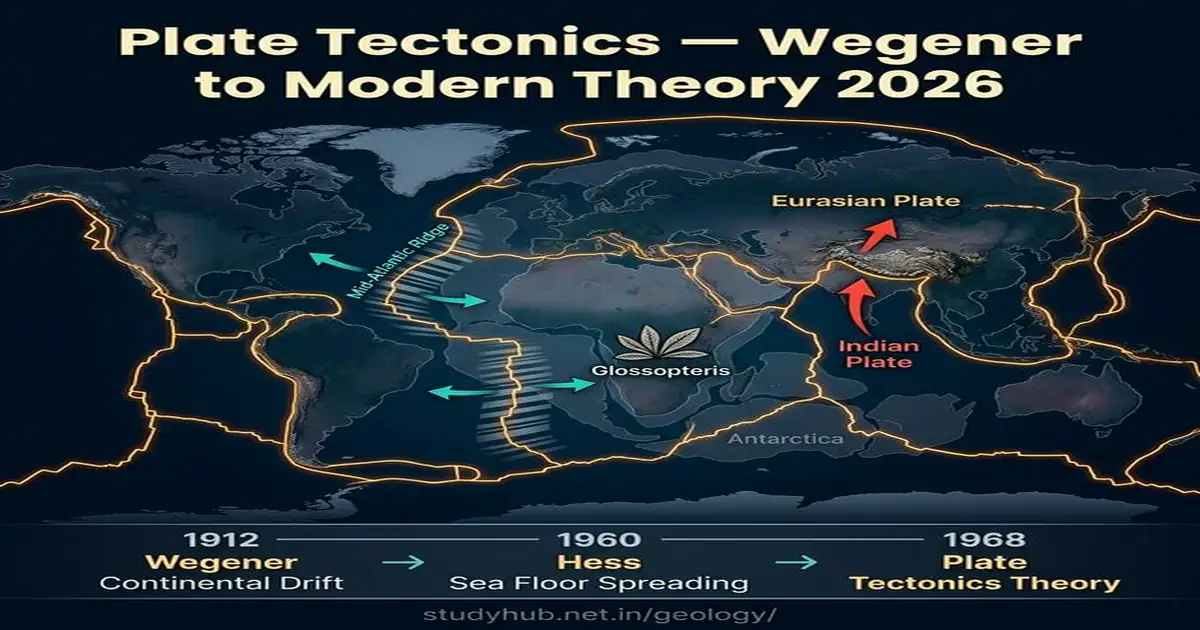
Plate Tectonics — Theory, History & Evidence 2026
History of Plate Tectonics — From Controversy to Revolution
| Year | Scientist / Event | Contribution | Significance |
|---|---|---|---|
| 1596 | Abraham Ortelius (Flemish cartographer) | First noted the “jigsaw fit” of the Americas and Africa in his atlas Thesaurus Geographicus — suggested the continents had once been joined and were separated by “earthquakes and floods” | First published observation of continental fit — 316 years before Wegener formalised it. Shows how long the idea had been percolating |
| 1858 | Antonio Snider-Pellegrini (French geographer) | Published a map showing the Americas and Europe-Africa fitting together, proposing they were once one continent. Also noted matching fossils on both sides of the Atlantic | First explicit fossil evidence cited for continental connection — but his mechanism (Noah’s Flood) was not scientifically accepted |
| 1912 | Alfred Wegener (German meteorologist-geophysicist, 1880–1930) | Published “Die Entstehung der Kontinente und Ozeane” (The Origin of Continents and Oceans), proposing Continental Drift theory. Proposed all continents were once united as Pangaea (~300 Ma) which broke apart. Evidence: jigsaw fit of coastlines; identical fossils (Glossopteris, Mesosaurus) on separated continents; matching geology; paleoclimate evidence (glacial striations in tropical Africa; coal = tropical forests now in Antarctica) | The foundational idea of continental drift — revolutionary but rejected by mainstream geology for ~50 years because Wegener could not explain a convincing mechanism for how continents “ploughed” through oceanic crust |
| 1929 | Arthur Holmes (British geologist, 1890–1965) | Proposed mantle convection as the driving mechanism for continental drift in his textbook “Principles of Physical Geology.” Described convection cells dragging continents apart | Provided the missing mechanism Wegener lacked — but still mostly ignored until sea floor spreading confirmed it |
| 1953–1956 | Maurice Ewing, Bruce Heezen, Marie Tharp (Lamont Geological Observatory) | Mapped the Mid-Atlantic Ridge using echo-sounding data — revealed a continuous underwater mountain range with a central rift valley running its length. Marie Tharp created the first detailed ocean floor map. Heezen noted the rift valley coincided with earthquake epicentres | First detailed evidence that ocean floors have active tectonic structure — not featureless plains as previously assumed. The ocean floor was geologically young and tectonically lively |
| 1960 | Harry Hess (American geologist, Princeton, 1906–1969) | Proposed Sea Floor Spreading in his landmark paper “History of Ocean Basins” — new oceanic crust is continuously created at mid-ocean ridges as mantle material wells up, solidifies, and spreads away from ridges; old oceanic crust is destroyed at subduction zones (trenches) | The mechanistic breakthrough that vindicated Wegener. Sea floor spreading explained why ocean floors are geologically young (no crust older than ~200 Ma), why mid-ocean ridges exist, and how continents can move without ploughing through ocean floor |
| 1963 | Vine & Matthews (Cambridge) / Morley (Canada) | Discovered magnetic anomaly stripes on the ocean floor — parallel symmetric bands of normal and reversed magnetic polarity on either side of mid-ocean ridges — predicted by sea floor spreading + geomagnetic reversals. The ocean floor is “tape-recording” Earth’s magnetic polarity history | Definitive proof of sea floor spreading. The symmetric stripes could only be explained by new crust forming at ridges while old crust spreads away. Vindicated Hess’s model conclusively |
| 1965 | J. Tuzo Wilson (Canadian geophysicist) | Proposed transform faults (a new category of fault where plates slide horizontally past each other); proposed the concept of mantle hotspots (fixed heat sources below moving plates) explaining the Hawaii-Emperor seamount chain; introduced the term “plate” | Wilson completed the conceptual toolkit of plate tectonics: three types of plate boundaries (divergent, convergent, transform) + hotspots. His 1965 paper in Nature introduced “plate” as a technical term |
| 1967–1968 | Jason Morgan (Princeton), Dan McKenzie & Robert Parker (Scripps/Cambridge), Xavier Le Pichon (Paris) | Independently formalised Plate Tectonics Theory — quantifying plate motions using Euler rotations on a sphere; defining 6–7 major plates; calculating plate velocities from magnetic anomaly ages. Le Pichon (1968) published the first quantitative model of global plate motions | The theory became formally established and mathematically rigorous — the “annus mirabilis” of plate tectonics. By 1970, the scientific community had accepted plate tectonics almost universally |
| 1970–Present | Global seismology networks, GPS satellite geodesy, ocean drilling (DSDP, ODP, IODP) | GPS directly measures plate motion velocities in real time (India moving 5 cm/yr NNE confirmed). Ocean drilling recovered dated basalts confirming age-distance relationship from ridges. Seismic tomography images subducting slabs and mantle plumes in 3D | Plate tectonics moves from theory to observation — every major prediction confirmed. Modern GPS (e.g., India CORS network) detects mm-level annual plate motion |
Evidence for Plate Tectonics — Complete Summary
| Evidence Type | Details | India / Gondwana Connection |
|---|---|---|
| Jigsaw Fit of Continents | South America’s east coast and Africa’s west coast fit remarkably when continental shelves (not just coastlines) are matched. Bullard, Everett & Smith (1965) made the first computer-assisted fit at the 500-fathom isobath — confirming a statistically near-perfect match across the Atlantic | India’s western continental margin (present-day Arabian Sea coast) fits against Somalia/Tanzania/Madagascar eastern margins. The separation occurred ~130 Ma (Gondwana breakup) |
| Matching Fossils (Biogeography) | Glossopteris (a seed fern, 300–250 Ma, Permian): found in India, South America, Africa, Australia, Antarctica — impossibly separated by deep oceans if continents were always fixed. Mesosaurus (a freshwater reptile, Permian): found only in South America and South Africa — could not cross the South Atlantic Ocean. Lystrosaurus (a mammal-like reptile): found in Africa, India, and Antarctica | India’s Gondwana coalfields (Damodar Valley, Singrauli, Son-Mahanadi, Godavari valleys) contain Glossopteris fossils — definitive proof India was part of Gondwana (with Africa, Australia, Antarctica, S. America). Same Permian coal-bearing sequences (Gondwana Supergroup) found in all Gondwana continents with matching stratigraphy |
| Matching Geology / Rock Sequences | Precambrian mountain belts match across the Atlantic: the Appalachian Mountains (eastern North America) align with Caledonian Mountains (Scotland/Scandinavia) when the Atlantic is closed. Brazilian shield geology matches West African cratons in age, composition, and structural fabric | Dharwar Craton (India) has Archean geology (3.0–3.4 Ga) matching East African cratons (Tanzania Craton and similar). The Eastern Ghats granulite belt aligns with Mozambique Belt (East Africa) when Gondwana is assembled |
| Paleoclimate Evidence | Glacial striations (scratches on bedrock from ice sheet movement) found in tropical Africa, South America, India, Australia — proving these regions were once polar; Coal (= ancient tropical forests) found in Antarctica and sub-polar regions — proving these were once tropical. Wegener used these as key evidence | Gondwana tillites (glacial deposits) found in Talchir Formation (Odisha, India) — evidence that India lay near the South Pole ~300 Ma. Talchir tillites correlate exactly with Dwyka tillites (South Africa), Itararé Group (Brazil), Bacchus Marsh tillites (Australia) — all Gondwana glaciation |
| Magnetic Anomaly Stripes | Ocean floor basalts record Earth’s magnetic polarity at time of eruption. Because polarity reverses periodically (last reversal: 780,000 years ago), the seafloor near mid-ocean ridges shows symmetric parallel bands of normal (black) and reversed (white) magnetism — a “bar code” record of spreading history. Vine-Matthews-Morley (1963) explained this as sea floor spreading | Indian Ocean floor shows clear magnetic anomaly patterns on either side of the Carlsberg Ridge (NW Indian Ocean) and Southwest Indian Ridge — confirming Indian Plate is separating from Africa/Antarctica at measurable rates. Ocean drilling confirmed ages from magnetic anomalies |
| Age of Ocean Floor | Ocean drilling (DSDP, ODP) confirmed the age-distance relationship: ocean floor sediment gets progressively older with distance from mid-ocean ridges. Oldest ocean floor: ~180–200 Ma (western Pacific, off Japan). No ocean floor older than 200 Ma survives — all older oceanic crust has been subducted | Arabian Sea: 0–80 Ma (young, still spreading from Carlsberg Ridge). Bay of Bengal: sediment-covered, 0–130 Ma. Indian Ocean floor = entirely Cretaceous-Recent. The ancient Tethys Ocean floor (that India crossed during its northward journey) has been entirely subducted under Eurasia — only slivers survive as ophiolites (Ladakh Ophiolite) |
| Earthquake & Volcano Distribution | 95% of all earthquakes occur at plate boundaries (mid-ocean ridges, subduction zones, transform faults). 80% of all volcanism occurs at plate boundaries. The “Ring of Fire” (Pacific Ocean rim) = world’s most seismically/volcanically active zone = convergent + transform boundaries encircling the Pacific Plate | India: Himalayan zone (convergent, Zone IV–V) = most destructive earthquakes. Andaman-Nicobar (subduction zone, Zone V) = most frequent earthquakes + Barren Island active volcano. Deccan Plateau (stable craton, Zone II) = least seismic. Latur 1993 (6.2 Mw) = rare intraplate event in Zone III craton |
| GPS Plate Motion Measurement | Since the 1990s, space geodesy (GPS) has directly measured plate velocities: Indian Plate moving NNE at 44–52 mm/yr (~5 cm/yr). Pacific Plate moving NW at 7–9 cm/yr. Arabian Plate moving NE at ~2.5 cm/yr. Direct real-time confirmation of plate tectonics that would have astonished Wegener | Indian GPS networks (CORS — Continuously Operating Reference Stations, operated by Survey of India + ISRO) document the Indian Plate’s NNE motion at 5 cm/yr. Himalayan GPS stations measure shortening at 1–2 cm/yr across the Himalayan arc = ongoing collision and mountain building |
Frequently Asked Questions
Why was Wegener’s Continental Drift theory rejected for 50 years?
Alfred Wegener’s 1912 Continental Drift hypothesis had compelling evidence — the jigsaw fit of continents, identical fossils on separated landmasses, matching geology, and paleoclimate anomalies. Yet the geological establishment (particularly in Britain and the USA) rejected it almost universally for approximately 50 years, until sea floor spreading was proven in the early 1960s. Why? The primary reason was the absence of a plausible mechanism. Wegener proposed that continents drift through the ocean floor by “Polfluchtkraft” (pole-fleeing force) and tidal forces — but physicists immediately calculated that these forces are many orders of magnitude too weak to move continents through solid oceanic basalt. The forces required were simply not physically available. Without a credible mechanism, the theory seemed to violate basic physics. Additionally, the geological establishment at the time was dominated by the doctrine of permanentism (the idea that ocean basins and continents are essentially permanent features — continents do not move) and by the competing theory of geosynclines (mountain ranges form when linear swaths of crust subsided, were filled with sediment, and then were squeezed upward). Geosyncline theory fit existing observations well enough to not need continental drift. Also: Wegener was not a professional geologist — he was a meteorologist — which contributed to the dismissal of his ideas by the geological community as the work of an outsider who did not fully understand geological principles. The key turning point was technology: World War II-era echo-sounding of ocean floors (by Harry Hess among others, surveying the Pacific for submarines) revealed the global system of mid-ocean ridges — which had no explanation in fixed-continent theory. When Hess proposed sea floor spreading (1960) as the mechanism, and Vine-Matthews-Morley (1963) confirmed it with magnetic anomaly evidence, the mechanism problem was solved. Within a decade, Wegener’s core insight was vindicated — though he had died in Greenland in 1930, unable to see his theory accepted.
Important for Exams — Plate Tectonics History for UPSC, SSC & State PCS
Key scientists (memorise): Wegener (1912, Continental Drift, Pangaea); Holmes (1929, mantle convection mechanism); Heezen-Tharp (1953-56, Mid-Atlantic Ridge mapping); Hess (1960, Sea Floor Spreading); Vine-Matthews-Morley (1963, magnetic anomaly stripes); Wilson (1965, transform faults, hotspots, “plate” term); Morgan-McKenzie-Le Pichon (1967-68, Plate Tectonics Theory quantified).
Evidence types (6): Jigsaw fit; Fossil matching (Glossopteris, Mesosaurus, Lystrosaurus); Rock sequence matching; Paleoclimate (glacial striations, coal); Magnetic anomaly stripes; Ocean floor age (no crust >200 Ma); Earthquake-volcano distribution; GPS direct measurement.
Pangaea: All continents united ~300 Ma. Broke into Laurasia (N) + Gondwana (S) ~200 Ma. Gondwana = India + Africa + Australia + Antarctica + South America. India separated from Gondwana ~130 Ma; travelled northward at up to 20 cm/yr; collided with Eurasia ~50 Ma → Himalayas.
India specific: Gondwana coalfields (Damodar, Singrauli) = Glossopteris fossils. Talchir tillites (Odisha) = Gondwana glaciation. Ladakh Ophiolite = Tethys Ocean remnant. Indian Plate velocity: 5 cm/yr NNE today (GPS confirmed). Carlsberg Ridge = India-Africa spreading. Andaman Trench = India-Burma subduction. Himalayas still rising 5 mm/yr. Barren Island active volcano = arc volcanism above subducting Indian slab.
What to Read Next
- Lithosphere — Tectonic Plates, Plate Boundaries & Indian Plate 2026
- Types of Plate Boundaries — Divergent, Convergent & Transform Detailed 2026
- Continental Drift — Wegener’s Theory, Evidence & Why It Was Rejected 2026
- Sea Floor Spreading — Harry Hess, Magnetic Anomaly Stripes & Vine-Matthews-Morley 2026
- Himalayan Formation — How India-Eurasia Collision Created the World’s Highest Mountains 2026
🎔 Exam Quick Reference — Plate Tectonics History: Wegener 1912 = Continental Drift + Pangaea (all continents united ~300 Ma). Rejected 50 yrs (no mechanism). Holmes 1929 = mantle convection mechanism. Hess 1960 = Sea Floor Spreading (mid-ocean ridges = new crust source). Vine-Matthews-Morley 1963 = magnetic anomaly stripes = proof of spreading. Wilson 1965 = transform faults + hotspots + “plate” term. Morgan/McKenzie/Le Pichon 1967-68 = modern Plate Tectonics Theory. Evidence: jigsaw fit, Glossopteris (India+Africa+Australia+Antarctica+S.America), Mesosaurus (S.America+S.Africa), paleoclimate, magnetic stripes, ocean floor age <200 Ma, GPS. India: 5 cm/yr NNE, Himalayan collision 50 Ma, Gondwana origin.
🌍 India’s Plate Tectonic Story: Part of Gondwana (united supercontinent 500-130 Ma). Separated from Africa ~130 Ma, Madagascar ~88 Ma, Seychelles ~65 Ma. Northward voyage at up to 20 cm/yr (fastest plate motion in geological history, possibly aided by Réunion plume thinning lithosphere). Tethys Ocean between India and Eurasia fully subducted by 50 Ma as India-Eurasia collision began. Gondwana coalfields (Damodar, Singrauli, Son-Mahanadi, Godavari = Glossopteris fossils). Talchir tillites (Odisha) = Gondwana glaciation. Ladakh Ophiolite = Tethys Ocean upper mantle remnant shard preserved at 4000m. GPS today: Survey of India CORS network confirms 44-52 mm/yr (NNE). Himalayas: still rising 5mm/yr, seismic Zones IV-V.
About This Guide: Written by the StudyHub Geology Editorial Team (studyhub.net.in/geology/) based on NCERT Class 11 Physical Geography Chapters 3-4, Tarbuck & Lutgens “Essentials of Geology” (13th Ed.), Le Pichon (1968) global plate kinematics paper, Vine & Matthews (1963) original Nature paper, and GSI Special Publications on Indian Plate tectonics and Gondwana geology. Last updated: March 2026.