
Last Updated: March 2026 | Reading Time: 11 minutes | ~2,500 words | Category: Geomorphology & Fluvial Systems
Fluvial geomorphology is the study of rivers (Latin: fluvius = river) as agents of landscape formation — how rivers erode bedrock, transport sediment, and deposit it to create characteristic landforms across three stages of river development. Rivers are Earth’s most powerful surface geomorphic agent, responsible for shaping most continental landscapes over geological time. India has two fundamentally different categories of rivers: Himalayan (Antecedent) Rivers — born before the Himalayas rose, they have maintained their courses by cutting down as the mountains uplifted, creating spectacular gorges; they are perennial (year-round flow from snowmelt and glaciers) and carry enormous sediment loads; and Peninsular (Consequent) Rivers — younger rivers flowing away from the Western Ghats across the ancient stable Deccan Plateau and Eastern Ghats; they depend almost entirely on monsoon rainfall and tend to be seasonal (ephemeral in dry season). Understanding river characteristics, drainage patterns, and the landforms rivers create at each stage (youth → maturity → old age) is essential for UPSC Civil Services mains (Geography-optional and GS-I), SSC CGL, UPSC NDA, and all state PSC examinations. India’s major rivers — the Ganga, Brahmaputra, Indus, Godavari, Krishna, Cauvery, Mahanadi, Narmada, and Tapti — are among the most geologically and culturally significant waterways on Earth, each with distinctive characteristics reflecting their geological history, catchment lithology, and tectonic setting.
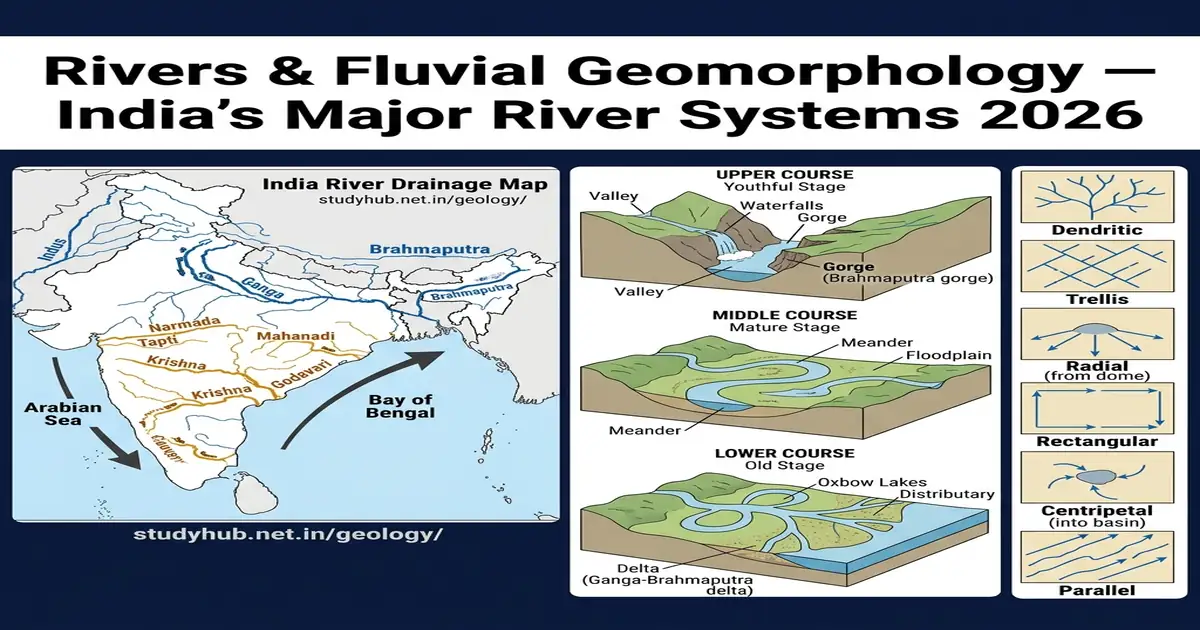
Rivers & Fluvial Geomorphology — India’s River Systems, Drainage Patterns & Landforms 2026
1. River Stages & Landforms — Youth, Maturity, Old Age
| Stage | Characteristics | Key Landforms | India Examples |
|---|---|---|---|
| Youthful Stage (Upper Course) | Steep gradient, fast velocity, high erosive energy. Dominant process: VERTICAL EROSION (downcutting into bedrock). Narrow, deep V-shaped valleys. River runs straight in many sections. High turbulence, coarse bed load (boulders, cobbles). Waterfalls where resistant rock creates a knickpoint. Gorges where river cuts through hard rock faster than valley walls widen. Potholes (cylindrical holes drilled by swirling abrasion). Rapids. No floodplain. Interlocking spurs (hills projecting alternately from opposite sides of valley — river winds between them) | V-shaped valley, Gorge, Canyon, Waterfalls, Rapids, Potholes, Interlocking spurs, Knickpoints | Brahmaputra Gorge (Namcha Barwa/Tsangpo Gorge, Arunachal Pradesh): deepest gorge in the world (~5,300 m deep, 160–200 km long — river cuts through the Himalayan syntaxis). Ganga headwaters (Gangotri to Haridwar) — deeply incised V-shaped valleys. Indus gorge (Ladakh — very deep). Narmada gorge at Amarkantak. Jog Falls (Karnataka — Sharavathi River, 253 m drop, India’s highest plunge waterfall). Chitrakote Falls (Chhattisgarh — widest, Indravati River, “Niagara of India”). Dudhsagar Falls (Goa/Karnataka). River Teesta gorge (Sikkim) |
| Mature Stage (Middle Course) | Gradient decreasing, velocity moderate. Dominant process: LATERAL EROSION (sideways, widening of valley) replacing vertical erosion. River begins to MEANDER — curves because of helical water flow (secondary circulation). Meanders migrate laterally, widening the valley floor. Floodplain begins to develop (flat land on either side of river, built from deposited sediment during floods). River cliff (steep outer bank, cut bank — erosion) vs Point bar (gentle inner bank — deposition of sand/gravel). Meanders gradually migrate downstream. River competence (ability to carry given particle size) and capacity (total load) both decrease | Meanders (free meanders, incised meanders), River cliff (undercut slope), Point bar (slip-off slope), Floodplain, Alluvial fans, River terraces, Braided channels (multiple threads in coarse sediment) | Ganga floodplain (Uttar Pradesh, Bihar): classic meanders. Rapti, Gomti, Ghaghara rivers: well-developed active meanders. Braided channels: Kosi River (Bihar — notorious for frequent course changes, “Sorrow of Bihar”) — extremely high sediment load from Himalayan erosion → deposition → braiding. Mahanadi middle course (Odisha). Narmada middle course (MP — incised meanders in Vindhyan plateau). River terraces: Ganga and Yamuna terraces in Delhi/UP |
| Old Age Stage (Lower Course) | Very low gradient, slow velocity, dominated by DEPOSITION. River carries fine sediment (silt, clay — coarse material already deposited upstream). Water table nearly at surface level. Very wide, flat floodplain. River meanders freely over plain — large sweeping curves. Oxbow lakes form when meanders become so looped they get cut off. Natural levées (raised banks from repeated flood deposition along river edge) form. River eventually meets sea/lake — velocity drops to zero → deposits all sediment → DELTA forms. Delta: triangular/fan-shaped depositional landform at river mouth | Oxbow lakes (cut-off meanders), Natural levées, Floodplain, Delta (arcuate/bird’s foot/cuspate), Estuary (funnel-shaped tidal mouth), Back swamps (behind levées), Yazoo streams (parallel to main river behind levée) | Ganga-Brahmaputra Delta (Sundarbans): world’s largest delta (~80,000 km²). Active distributaries (split channels). World’s largest mangrove ecosystem (Sundarbans — UNESCO World Heritage Site). Mahanadi Delta (Odisha — active progradation). Godavari Delta (AP — large, rice bowl). Krishna Delta (AP — very fertile). Cauvery Delta (Tamil Nadu — Kaveri delta, intensive paddy). Note: Narmada and Tapti form ESTUARIES (not deltas — tidal forces > sediment supply in Arabian Sea. Also: relatively straight rivers with less sediment in shorter course to west coast) |
2. Drainage Patterns — What Rock Structure Tells Us
| Drainage Pattern | Shape & Formation | Rock/Structure Control | India Example |
|---|---|---|---|
| Dendritic (most common) | Tree-like branching, tributaries meet main river at acute angles (like tree branches). Random, irregular branching — no structural control | Horizontally layered rocks of uniform resistance — no one direction favoured. Flat-lying sedimentary plains, homogeneous crystalline basement | Indo-Gangetic Plain rivers on flat alluvium. Deccan Plateau rivers on uniform basalt. Most common in India |
| Trellis | Main rivers run parallel to each other (along weak rock/valleys), short tributaries join at right angles. Rectangular grid-like pattern when viewed from above | Alternating bands of hard and soft rock (fold mountains, ridge-and-valley). Tributaries follow weak rock (shale, limestone dissolve) while main rivers cut through ridges along strike valleys | Himalayan fold belts in Jammu & Kashmir, Himachal Pradesh foothills (Siwalik ridges and valleys). Aravalli fold belt (Rajasthan) |
| Radial | Rivers radiate outward in all directions from a central high point (like spokes on a wheel) | Dome-shaped topographic high: volcanic cone, batholithic uplift, structural dome | Amarkantak Plateau (MP/CG): Narmada, Sone, Mahanadi all originate from same plateau and flow in different directions (Narmada → west/Arabian Sea; Mahanadi → east/Bay of Bengal; Sone → north/Ganga). Mikir Hills (Assam). Girnar Hill (Gujarat) |
| Rectangular | Rivers make abrupt right-angle bends, creating rectangular grid pattern. Both main rivers and tributaries show right-angle turns | Two sets of joints or faults at approximately right angles to each other — rivers follow these structural weaknesses | Vindhyan plateau rivers (MP). Some rivers in the Deccan where two joint sets control drainage |
| Centripetal | Rivers flow inward toward a central low point (basin, depression, lake) from all directions. Opposite of radial pattern | Structural/topographic basin or internal drainage area — no outlet to sea | Loktak Lake basin (Manipur). Sambhar Lake basin (Rajasthan — internal drainage, saline lake). Lonar Lake (Maharashtra — meteorite impact crater, closed drainage) |
| Annular | Rivers flow in concentric ring pattern around a dome, dipping down one direction then curving. Tributaries join main rings from outside | Eroded structural dome where rocks of different resistance form concentric rings (like a bulls-eye pattern) | Some Chota Nagpur Plateau areas (Jharkhand — eroded dome structures) |
| Parallel | Rivers run roughly parallel to each other, often down a slope. Little tributary development | Uniformly sloping terrain (escarpments), coastal plains, recently exposed land | Western Ghats west-facing escarpment rivers (Kerala coast): short, steep, parallel rivers rushing to Arabian Sea (Periyar, Bharathapuzha, Pamba). Eastern Ghats coast rivers also show some parallelism |
3. India’s Major River Systems — Himalayan vs Peninsular
| River | Origin / Source | Drainage Basin km² | Type | Key Tributaries | Mouth / Landform | Key Facts for Exams |
|---|---|---|---|---|---|---|
| Ganga | Gangotri Glacier (Uttarakhand, 3,892 m): Bhagirathi + Alaknanda meet at Devprayag = Ganga. Total length 2,525 km | ~861,000 km² (largest in India) | Himalayan, Antecedent, Perennial | Right bank: Yamuna (Yamunotri), Ghaghra/Karnali, Gandak, Kosi (Nepal). Left bank: Ramganga, Gomti, Gomati, Chambal (Deccan), Betwa (Deccan), Ken, Son (Deccan — joins near Varanasi area) | Ganga-Brahmaputra Delta (Bay of Bengal, ~80,000 km² delta). Major distributaries: Hooghly (Hugli), Padma, Meghna (Bangladesh). Sundarbans mangroves | Largest river basin in India. Ganga Action Plan (1985, 1993). Namami Gange (2015). National River of India. Haridwar (Ganga enters plains), Allahabad/Prayagraj (Yamuna confluence = Triveni Sangam with mythical Saraswati). Varanasi. Ganga declared “living entity” by Uttarakhand HC (overturned by SC). Himalayan tributaries (Kosi, Gandak, Ghaghra) carry enormous Nepal-sourced sediment |
| Brahmaputra | Chemayungdung Glacier, Tibetan Plateau (Angsi Glacier, China — 5,300 m elevation). Flows east as Tsangpo (Tibet) → makes sharp U-turn at Namcha Barwa → flows west as Dihang → Brahmaputra in Assam. Total length ~2,900 km (ranks 9th world) | ~580,000 km² (India portion ~194,000 km²) | Himalayan, Antecedent, Perennial | In Assam: Dibang, Lohit, Subansiri, Kameng, Manas, Sankosh, Teesta (joins near Bangladesh border) | Joins Ganga → Padma → Meghna → Bay of Bengal. Brahmaputra-Ganga-Meghna Delta (world’s largest) | World’s deepest river gorge (Tsangpo Gorge, 5,300 m deep). Highest river island: Majuli Island (Assam — largest river island in world, ~880 km²). “Sorrow of Assam” — annual floods. Carries world’s highest suspended sediment load (4× Amazon). Braided channel in Assam plains. China-India dispute over Tsangpo hydro projects. Rising concern: China dam on Tsangpo could affect India’s water security |
| Indus | Bokhar Chu (near Sengge Kangri peak, Tibet, near Mansarovar Lake). Flows west through Ladakh, makes enormous bend → Pakistan. Length 3,180 km (India portion ~1,114 km) | ~1,165,000 km² (total, mostly Pakistan). India portion ~321,289 km² | Himalayan, Antecedent, Perennial | In India: Zanskar, Suru, Shyok, Nubra, Gilgit. In Pakistan: Jhelum, Chenab, Ravi, Beas, Sutlej (5 Punjab = “Punch-Nad” = land of five rivers) | Arabian Sea (Karachi, Pakistan). No delta in India | Indus Waters Treaty (1960, India-Pakistan, World Bank mediated): India gets eastern rivers (Ravi, Beas, Sutlej). Pakistan gets western rivers (Indus, Jhelum, Chenab). Leh (Ladakh) on Indus. Mohenjo-Daro and Harappa = Indus Valley Civilisation on Indus tributaries. Indus cuts through Himalayas before they fully rose = classic antecedent drainage. Indus-Ganga Divide (watershed) at Rohtang Pass area |
| Godavari | Trimbakeshwar, Nashik (Maharashtra), 1,067 m. Western Ghats. Length 1,465 km | ~312,812 km² (2nd largest in India) | Peninsular, Consequent, Seasonal (monsoon-fed, but large basin) | Pravara, Manjira, Pranhita (Wardha+Wainganga), Indravati (Chhattisgarh — Chitrakote Falls), Sabari | Bay of Bengal (AP coast). Large arcuate delta (AP — very fertile “rice bowl”) | “Dakshin Ganga” (South Ganga / Ganga of the South). Passes through Dharmapur, Nashik, Nanded, Rajahmundry. Bhor Ghat gorge (Maharashtra). Largest peninsular river by basin area. Godavari Water Dispute Tribunal. Rajahmundry on delta |
| Krishna | Mahabaleshwar (Satara, Maharashtra), 1,337 m. Length 1,400 km | ~258,948 km² | Peninsular, Consequent, Seasonal | Koyna, Bhima (Ghod, Nira, Sina), Tungabhadra (Tunga + Bhadra in Karnataka), Musi (Hyderabad), Peddavagu, Munneru | Bay of Bengal (AP). Delta shared with Godavari | Nagarjuna Sagar Dam (one of world’s largest masonry dams, on Krishna, Telangana/AP). Srisailam Dam. Krishna Water Disputes Tribunal (Maharashtra, Karnataka, AP, Telangana). Hampi = on Tungabhadra, a Krishna tributary. Aihole-Badami-Pattadakal = on tributary Krishna watershed |
| Cauvery (Kaveri) | Talakaveri, Kodagu (Coorg, Karnataka), Western Ghats, 1,341 m. Length 800 km | ~81,155 km² | Peninsular, Consequent, Seasonal (but perennial in Karnataka) | Harangi, Hemavathi, Shimsha, Arkavathi, Bhavani, Noyyal, Amaravathi | Bay of Bengal (Tamil Nadu). Extensive delta (“granary of Tamil Nadu”) | “Ganga of the South” (also applied to Godavari — both called this). Cauvery Water Dispute: Karnataka vs Tamil Nadu (Supreme Court verdict 2018, CWMA formed 2018). Mettur Dam (Tamil Nadu — highest dam on Cauvery). Kaveri River Authority. Shivanasamudra Falls (Karnataka, 98 m — Asia’s first hydroelectric power station 1902). Ranganathittu Bird Sanctuary on Cauvery island |
| Narmada | Amarkantak Plateau (MP-CG boundary), 1,057 m. Flows WEST (unusual for Peninsular river — fault-controlled). Length 1,312 km | ~98,796 km² | Peninsular, Rift Valley river, Seasonal (monsoonal) but relatively reliable | Hiran, Barna, Kolar, Tawa, Machna, Shakkar, Dudhi | Gulf of Khambhat (Cambay), Arabian Sea. ESTUARY (not delta — tidal). Bharuch (Broach) at mouth | Flows through Narmada Rift Valley (fault-controlled graben between Vindhyan Plateau N and Satpura Range S). NOT a consequent river from Western Ghats — a rift valley river flowing W-E contrary to normal Peninsular drainage. Sardar Sarovar Dam (Gujarat — one of India’s most controversial dams, NBA Narmada Bachao Andolan). Marble Rocks (Bhedaghat, Jabalpur — spectacular white marble gorge). Omkareshwar, Maheshwar, Jabalpur on Narmada. Narmada-Sone Divide = India’s interfluve |
| Mahanadi | Raipur-Bhatgaon, Chhattisgarh (near Sihawa, 442 m). Length 858 km | ~141,600 km² | Peninsular, Consequent, Seasonal | Ib, Seonath, Jonk, Hasdeo, Mand, Ong, Tel | Bay of Bengal (Odisha). Active delta — one of India’s fastest-prograding deltas | “Sorrow of Odisha” (historical floods). Hirakud Dam (Sambalpur, Odisha — one of India’s longest dams, 25.8 km including dykes). Chilika Lake = near Mahanadi Delta (Asia’s largest brackish lagoon, Ramsar site). Satkosia Tiger Reserve on Mahanadi gorge |
Frequently Asked Questions
Why do Himalayan rivers (Indus, Ganga, Brahmaputra) flow THROUGH the Himalayas — didn’t the mountains block them?
This is one of the most fascinating questions in Indian geomorphology and it has a profound answer rooted in the concept of antecedent drainage. The answer is: the rivers are OLDER than the Himalayas. The Indus, Ganga-Brahmaputra, and their headwater tributaries were established as rivers on a pre-existing landscape millions of years before the Himalayas began rising (~50 Ma). As the Indian Plate collided with Eurasia, the land that would become the Himalayas was uplifted — but the rivers had already established their courses. A river’s ability to erode downward (incise) is directly controlled by the rate of tectonic uplift vs the stream’s erosive power: if uplift is slow enough, or if the river carries sufficient abrasives and power (which these massive rivers certainly did, draining the Tibetan Plateau with enormous discharge and sediment load), the river can cut through rock as fast as the mountains rise, maintaining its position. This is called antecedent drainage (Latin: ante = before + cedere = go): the river was there FIRST, and the mountain grew around it — so the river cuts a gorge through the rising range rather than being deflected. Evidence: (1) The Himalayan rivers flow in deep gorges RIGHT THROUGH the main Himalayan ranges — the Tsangpo/Brahmaputra gorge at Namcha Barwa is 5,300 m deep — far deeper than any river could cut by normal erosion → the gorge depth represents cumulative uplift matched by river incision. (2) The rivers show their antecedent nature by the geometry of their headwaters — the Tsangpo flows east for 1,200 km in Tibet (clearly pre-established direction) before making a nearly 180° U-turn at Namcha Barwa to flow through the Himalayas as the Brahmaputra. The entire river system’s original east-flowing direction predates the syntaxes. (3) River capture / beheading: some Peninsular rivers show evidence of having been “captured” by more aggressive rivers that eroded headward through divides — Narmada and Tapi flow west through rift valleys, while most peninsular rivers were originally consequent on the Deccan Trap surface. The contrast between Himalayan antecedent rivers (perennial, gorge-cutting, huge sediment loads, large basins extending into Tibet and Nepal) and Peninsular consequent rivers (seasonal, shallow, rainfall-dependent, shorter) reflects fundamentally different geological origins.
Important for Exams — Rivers & Fluvial Geomorphology UPSC, SSC & State PCS
River stages: Youth (V-valley, waterfall, gorge, vertical erosion — Brahmaputra gorge = world’s deepest, Jog Falls = India’s highest), Mature (meanders, floodplain, lateral erosion — Ganga meanders UP/Bihar, Kosi braided river), Old age (oxbow lakes, delta, deposition — Ganga-Brahmaputra = world’s largest delta ~80,000 km²). Drainage patterns: Dendritic (most common, IGP/Deccan Plateau), Trellis (Himalayan fold belts, Siwaliks), Radial (Amarkantak — Narmada+Sone+Mahanadi all originate), Rectangular (joint-controlled, Vindhyan), Centripetal (Sambhar Lake, Lonar Lake), Parallel (Western Ghats west-flowing rivers). Antecedent rivers (Himalayan): Indus, Ganga headwaters, Brahmaputra/Tsangpo, Teesta — older than Himalayas, cut gorges as mountains rose. Perennial (glaciers + snowmelt). Consequent rivers (Peninsular): Godavari, Krishna, Cauvery, Mahanadi — flow direction determined by post-Deccan Trap land surface slope. Seasonal (monsoon-dependent). River-specific key facts: Ganga: longest in India (2,525 km), largest basin (861,000 km²), National River. Brahmaputra: Majuli = world’s largest river island. Narmada = rift valley river, flows WEST, forms estuary NOT delta. Godavari = “Dakshin Ganga,” 2nd largest basin. Cauvery dispute = Karnataka vs TN (SC 2018). Indus Waters Treaty 1960 (India gets Ravi+Beas+Sutlej; Pakistan gets Indus+Jhelum+Chenab). Kosi = “Sorrow of Bihar” (frequent course changes, high sediment from Nepal Himalayas). Mahanadi = “Sorrow of Odisha.” Chilika Lake (Odisha) = Asia’s largest brackish lagoon (near Mahanadi delta), Ramsar site. East-flowing vs West-flowing: Most Peninsular rivers flow east (Bay of Bengal) because Western Ghats watershed is close to west coast, creating asymmetric drainage. West-flowing: Narmada (rift valley), Tapti (rift valley), Western Ghats coastal rivers (short, steep, parallel). Deltas vs Estuaries: Ganga/Godavari/Krishna/Cauvery/Mahanadi = deltas (Bay of Bengal, slow backwater, sediment dominates). Narmada/Tapti = estuaries (Arabian Sea, tidal force dominates over sediment supply).
What to Read Next
- Weathering — Laterite, Black Cotton Soil & Karst in India 2026
- Himalayan Formation — How Antecedent Rivers Cut Through the Himalayas 2026
- Plate Tectonics — How Tectonic Setting Controls River Drainage 2026
- Geological Time Scale — When India’s River Systems Formed 2026
- Earthquakes — How Himalayan Tectonics Affects River Courses 2026
🎔 Exam Quick Reference — Rivers & Fluvial Geomorphology: 3 stages: Youth (V-valley, waterfall, gorge, vertical erosion), Mature (meanders, floodplain, lateral erosion), Old age (oxbow lakes, delta, deposition). Landforms: Waterfalls (Jog Falls=253m highest India, Chitrakote=widest), Gorge (Brahmaputra=world’s deepest 5,300m), Meander, Oxbow lake, Delta (Ganga-Brahmaputra=world’s largest ~80,000 km²), Estuary (Narmada, Tapti). Drainage patterns: Dendritic (most common), Trellis (Himalayan fold belt), Radial (Amarkantak), Rectangular (Vindhyan joints), Centripetal (Sambhar/Lonar), Parallel (Western Ghats west coast). Himalayan rivers (antecedent, perennial): Ganga (largest basin 861,000 km², National River), Brahmaputra (Majuli world’s largest river island, highest sediment load, world’s deepest gorge), Indus (Indus Waters Treaty 1960). Peninsular rivers (consequent, seasonal): Godavari (Dakshin Ganga, 2nd largest basin), Krishna, Cauvery (dispute Karnataka-TN SC 2018), Mahanadi (Hirakud Dam), Narmada (rift valley, flows W, estuary NOT delta, Sardar Sarovar). Key: Kosi=Sorrow of Bihar. Mahanadi=Sorrow of Odisha. Narmada=rift valley river, only major W-flowing Peninsular river. East flowing rivers→Bay of Bengal (longer, lower gradient), West-flowing coastal rivers→Arabian Sea (short, steep, parallel). Delta=Ganga/Godavari/Krishna/Cauvery; Estuary=Narmada/Tapti.
🌍 India’s Major Dams & River Facts 2026: Sardar Sarovar (Narmada, Gujarat — 163 m height, tallest gravity dam in Asia). Hirakud (Mahanadi, Odisha — 25.8 km = world’s longest earthen dam including dykes). Tehri Dam (Bhagirathi/Ganga tributary, Uttarakhand — 260 m = India’s highest dam & 5th highest in world). Bhakra-Nangal (Sutlej, Himachal-Punjab — 225 m, one of Asia’s largest). Nagarjuna Sagar (Krishna, Telangana/AP — one of world’s largest masonry dams). Idukki (Periyar, Kerala — 168 m arch dam). River Islands: Majuli (Brahmaputra, 880 km² — world’s largest river island), Srirangam (Cauvery, Tamil Nadu). River Tributaries trick: Left vs Right bank tributaries — always given relative to flow direction looking downstream. Yamuna meets Ganga at Prayagraj (Right bank tributary). Son meets Ganga near Patna (Right bank). Chambal meets Yamuna (Right bank of Yamuna). Teesta meets Brahmaputra (Right bank) near Bangladesh. Water disputes: Cauvery (Karnataka-TN-Kerala-Puducherry), Krishna (Maharashtra-Karnataka-AP-Telangana), Godavari (Maharashtra-AP-Telangana-Odisha-MP), Mahandai/Mandovi (Goa-Karnataka-Maharashtra).
About This Guide: Written by the StudyHub Geology Editorial Team (studyhub.net.in/geology/) based on NCERT Class 11 Physical Geography Chapter 7 (Landforms and their Evolution — Fluvial), NCERT Class 11 Geography India Chapter 3 (Drainage), CWC (Central Water Commission) India River Basins Report 2023, Strahler & Strahler “Physical Geography”, and NIH (National Institute of Hydrology) River Data. Last updated: March 2026.