
Last Updated: March 2026 | Reading Time: 11 minutes | ~2,500 words | Category: Petrology — Sedimentary Rocks
Sedimentary rocks form at or near Earth’s surface through the accumulation and lithification (hardening into rock) of sediment — the fragmented products of weathering and erosion of pre-existing rocks, or material precipitated from solution, or organic material accumulated biologically. They cover approximately 75% of Earth’s surface (as a thin veneer over older igneous and metamorphic basement) but represent only about 8% of total crust volume — because the sedimentary layer is thin compared to the thick igneous/metamorphic crust beneath. Sedimentary rocks are geologically unique in that they: (1) preserve fossils — the only rock type where life’s history is recorded; (2) contain sedimentary structures (bedding, cross-bedding, ripple marks, mud cracks) that reveal ancient environments; (3) host most of the world’s economic resources — coal, petroleum, natural gas, salt, potash, phosphate, limestone (cement), iron ore (BIF), and placer minerals all occur in sedimentary sequences; and (4) follow stratigraphic principles that allow geologists to reconstruct Earth’s history. For India specifically, sedimentary rocks are economically critical: the Gondwana Supergroup (Permian-Jurassic, ~290–145 Ma) contains India’s entire coal reserve in the Damodar, Mahanadi, Godavari, and Son basins; the Vindhyan Supergroup (Proterozoic, ~1,700–540 Ma) provides the sandstone and limestone used across northern India and may hold significant oil reserves; and the offshore Krishna-Godavari Basin and various onshore basins contain India’s petroleum and natural gas. The process by which loose sediment becomes solid rock is called diagenesis — a series of physical and chemical changes (compaction, cementation, recrystallisation) occurring at low temperatures and pressures as sediment is buried.
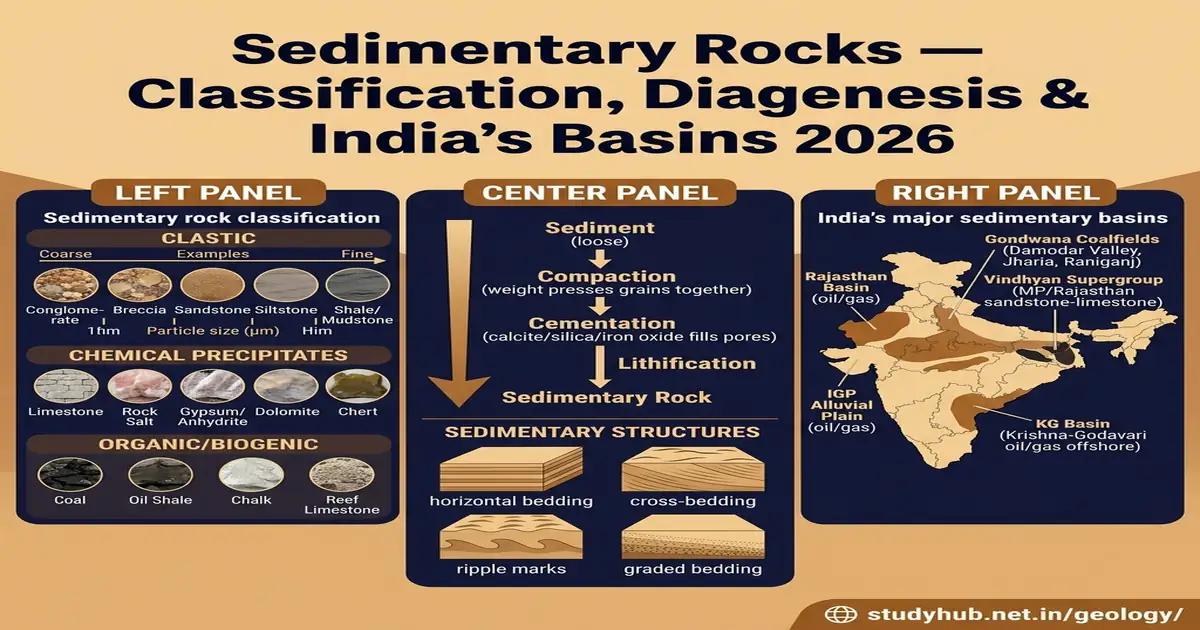
Sedimentary Rocks — Classification, Diagenesis & India’s Sedimentary Basins 2026
1. Classification of Sedimentary Rocks
| Type | Subtypes & Grain Size | Formation / Characteristics | India Examples & Uses |
|---|---|---|---|
| Clastic (Terrigenous / Detrital) Formed from fragments of pre-existing rocks transported by water, wind, ice, or gravity and deposited | Conglomerate (rounded pebbles >2mm, water-rounded — high energy deposition). Breccia (angular fragments >2mm — landslide, fault scarp — short transport). Sandstone (sand grains 0.0625–2mm — river channels, beaches, dunes). Greywacke (poorly sorted, dark sandstone — deep-sea turbidites). Siltstone (silt 0.004–0.0625mm). Shale / Mudstone / Claystone (clay <0.004mm, fissile=shale; massive=mudstone) — Most abundant sedimentary rock (~60% of all sedimentary rocks). Argillite (indurated/hardened mudstone, non-fissile) | Transport distance + energy controls grain size and sorting. Conglomerate = high energy (river channel, beach). Shale = low energy (deep lake, deep ocean). Sorting: well-sorted = similar grain sizes (wind-blown = best sorted). Poorly sorted = mixed grain sizes (glacial till, mass-wasting deposits). Roundness: well-rounded = long transport (river/beach); angular = short transport (talus, breccia) | Vindhyan Sandstone (MP-Rajasthan, ~1,700–540 Ma): Red Fort (Delhi), Agra Fort, Fatehpur Sikri, Gwalior Fort — all built from Vindhyan sandstone. India’s most important building stone historically. Jodhpur sandstone (Dhauda group) = famous “pink city” buildings. Deccan shale intercalations. Gondwana shale (Barren Measures Formation between coal seams). Rajasthan desert greywackes. Gas-bearing tight sandstone (Rajas than Basin). Shale gas potential: KG Basin shale, Damodar Valley shale |
| Chemical (Precipitate) Formed by chemical precipitation from supersaturated solution, often in marine or lacustrine (lake) settings | Limestone (CaCO₃, massive or bedded — from direct precipitation or biogenic). Dolomite/Dolostone (CaMg(CO₃)₂ — replacement of limestone by Mg-rich fluids). Rock Salt / Halite (NaCl — evaporite). Gypsum (CaSO₄·2H₂O — evaporite). Anhydrite (CaSO₄). Chert (SiO₂ — siliceous ooze lithified). Ironstone/Oolitic Ironstone (iron-rich chemical precipitate). Travertine (CaCO₃ precipitated in springs/caves = stalactites) | Evaporites (salt, gypsum, anhydrite) form in restricted basins where evaporation exceeds inflow (hot arid climate + restricted inland sea = evaporite sequence). Limestone: forms in warm shallow tropical seas from carbonate-secreting organisms OR direct chemical precipitation. Chert: from siliceous plankton (radiolaria, diatoms) shells accumulating on ocean floor → lithified. Dolomitisation: Mg-rich brine replaces Ca in limestone → dolomite (secondary) | Vindhyan Limestone (Rajasthan, MP): Cement raw material — Satna (MP) = major cement cluster. Rajasthan limestone (Jaisalmer Formation, Bikaner area) = major cement industry. Rock salt: Mandi Salt Mines (Himachal Pradesh — sub-Himalayan salt range equivalent). Khewra Salt Mine (Pakistan — Himalayan foreland, same salt range). Rajasthan: Sambhar Lake salt (from dissolution of subsurface salt deposits). Gypsum: Rajasthan (Bikaner, Barmer) = India’s largest gypsum deposits. Dolomite: Rajasthan, Bihar. Chert layers in Vindhyan Supergroup. Limestone for lime/cement: India is world’s 2nd largest cement producer (Rajasthan, AP, Karnataka, MP quarries) |
| Organic / Biogenic Formed from accumulation of biological material (plant debris, marine organisms) | Coal (compressed plant material — peat → lignite → bituminous → anthracite: increasing carbon % and metamorphic grade). Oil Shale (fine-grained with kerogen — immature petroleum). Chalk (pure biogenic CaCO₃ from coccoliths — unicellular algae shells, white, fine-grained). Reef Limestone (coral/shell CaCO₃). Coquina (shell fragments loosely cemented). Phosphorite (phosphate-rich rock from marine organic — fertiliser raw material). Diatomite (siliceous diatom shells) | Coal: Peat (bog, undegraded plant material, <60% C) → Lignite/Brown Coal (poorly consolidated, 60-70% C, high moisture) → Sub-bituminous → Bituminous / Steam coal (70-86% C, most common, most produced) → Semi-anthracite → Anthracite (86-98% C, hard, highest grade, rare). Grade increases with depth of burial and heat. Oil shale: rock containing kerogen (insoluble organic polymer) that can be converted to oil by heating (retorting). Chalk: pure biogenic limestone (Cretaceous — “Chalk” age named for Cretaceous chalk beds of England-France) | Indian coal = PERMIAN age (Gondwana coalfields, NOT Carboniferous — see Geo-21). Jharia coalfield (Jharkhand — India’s most important coking coal). Raniganj coalfield (West Bengal — oldest mined, thermal coal). Korba coalfield (Chhattisgarh — large thermal coal, SECL). Talcher coalfield (Odisha — massive reserves). Singrauli coalfield (MP-UP — thermal coal, NCL). India = 5th largest coal producer globally. Lignite: Neyveli Lignite Corporation (NLC), Tamil Nadu — Tertiary lignite from Cauvery Basin. Rajasthan minor lignite. Oil shale: Jammu = minor. Phosphorite: Jhamarkotra (Rajasthan, near Udaipur) = India’s largest phosphate deposit (Proterozoic Aravalli formation rock-phosphate). Also: Mussoorie Phosphate (Uttarakhand, Himalayan foreland). Diatomite: Rajasthan minor deposits |
2. Diagenesis & Sedimentary Structures
| Process / Structure | Description | Significance | India / Exam Relevance |
|---|---|---|---|
| Diagenesis | All physical, chemical, and biological changes that occur in sediment after initial deposition and before metamorphism (i.e., at relatively low temperatures <200°C and pressures <300 MPa). Key diagenetic processes: (1) Compaction: weight of overlying sediment compresses pore space, expelling pore water (shale from 80% porosity → 10% as buried). (2) Cementation: minerals precipitate from pore water and bind grains together → lithification. Common cements: calcite (CaCO₃), silica (quartz overgrowths), iron oxide (hematite, limonite = gives red/yellow sandstone). (3) Recrystallisation: unstable minerals convert to stable forms (aragonite→calcite in limestone). (4) Dissolution: some minerals dissolve under burial (creating secondary porosity — important for oil reservoirs). (5) Dolomitisation: Mg-rich brine replaces Ca in limestone = dolomite. Biodegradation: bacterial decomposition of organic matter in sediment early in burial → produces CO₂, methane (early diagenetic gas) | Porosity and permeability of the resulting rock depends on degree of cementation: Heavy cementation → tight rock (low porosity, poor reservoir). Light cementation → porous rock (good reservoir). Diagenesis creates reservoir rock for petroleum. Secondary porosity (dissolution) can restore porosity lost to early cementation. Overpressure: if pore fluids cannot escape during compaction (sealed by impermeable shale cap) → abnormally high pore pressure → drilling hazard in oil exploration. Rank of coal: increasing burial depth → temperature → maturation of organic matter = increasing coal rank | KG Basin (Krishna-Godavari offshore): diagenesis of Cretaceous-Paleogene sandstones and carbonates → petroleum reservoir formation (porosity 10-25%). Damodar Valley coalfields: burial depth controls coal rank — Jharia deepest seams = coking coal (highest rank bituminous). Rajasthan (Barmer Basin): diagenetic porosity in Jurassic sandstones = oil reservoir (Cairn Energy/Vedanta discovery 2004). Vindhyan chert and limestone: diagenetic recrystallisation obscures original textures. Deccan Intertrappean beds: lacustrine sediments between lava flows = freshwater limestone + siliceous sinter + plant fossil beds (MP-Maharashtra) |
| Bedding / Stratification | Most fundamental sedimentary structure. Horizontal layers (beds/strata) of different grain size, composition, or colour, each representing a depositional episode. Lamination = very thin beds (<1 cm). Bed = 1 cm to 1 m. Formation = multiple beds with similar character (mappable unit). Member/Group = larger groupings. Principle of Original Horizontality (Steno, 1669): sediment originally deposited horizontally — if beds are now tilted or folded, deformation has occurred after deposition | Stratigraphy: the relative age of rock units determined from bed relationships. Law of Superposition (Steno): in undisturbed sequence, OLDER beds are BELOW younger beds. Unconformity: a gap in the geological record where some time interval is missing (erosion surface between different rock-age sequences). Types: Angular unconformity (older beds tilted, eroded, younger beds deposited horizontally on top), Disconformity (both sets horizontal but hiatus), Nonconformity (sediment on igneous/metamorphic basement) | Classic Indian example: Vindhyan Supergroup (Rajasthan-MP) unconformably overlies Archaean basement (1,700 Ma old Vindhyan sits on 2,500 Ma Archaean granites = Great Unconformity of India). Gondwana Supergroup: unconformably overlies Archean basement in Damodar Valley (300 Ma sits on 3,000+ Ma). Himalayan folded sedimentary beds: originally horizontal marine limestones (Tethys Sea) now steeply tilted in Tethyan Himalaya (visible at Everest, Spiti). Saltora Group (West Bengal-Jharkhand boundary) angular unconformity |
| Cross-Bedding (Cross-Stratification) | Inclined beds within a larger horizontal bed set, formed by lateral migration of bedforms (dunes, ripples) — sand avalanches down the slip face of a moving dune or ripple. The angle of cross-beds indicates direction of flow (paleocurrent direction). Small-scale: ripple cross-lamination. Large-scale: dune cross-bedding (sets can be metres thick in eolian/aeolian environments). Herringbone cross-bedding: bidirectional cross-beds (formed by reversing tidal currents) | Paleocurrent analysis: direction of cross-bed dip = direction of ancient current flow. Used to reconstruct ancient river systems, wind directions, and tidal environments from rock record. Aeolian (wind) cross-bedding: very well sorted, large-scale, high angle (30–34°) — Vindhyan sandstones, Rajasthan Jurassic sandstones. Fluvial cross-bedding: moderate-scale, well sorted, slightly lower angle. Tidal: herringbone, bimodal directions | Vindhyan Sandstone (Rajasthan-MP): beautiful large-scale cross-bedding visible in quarry faces — indicates ancient aeolian/river transport directions. Gondwana sandstones (Damodar Valley): fluvial cross-bedding records ancient river channels. Jurassic Jaisalmer Formation (Rajasthan) sand dune cross-beds = records ancient Thar-area desert dunes. Himalayan Tethyan Limestone: graded bedding in turbidite sequences in Spiti/Lahaul |
| Ripple Marks, Graded Bedding & Other Structures | Ripple marks: wave-like undulations on bedding surfaces. Symmetric ripples = oscillating waves (sea floor, shallow marine). Asymmetric ripples = unidirectional current. Graded bedding: within a single bed, grain size decreases upward from coarse at base to fine at top — formed by turbidity currents (submarine avalanches of sediment-laden water thundering down continental slope). Good “way-up” indicator in deformed sequences. Mud cracks (desiccation cracks): polygonal cracks in dried muddy surface (indicate tidal flat, lake margin = periodic exposure to air). Flute casts: scour marks at base of turbidite beds (indicate current direction). Load casts and flame structures: soft-sediment deformation. Sole marks, tool marks | Graded bedding (Bouma sequence) = turbidite sequence: Ta (massive sand) → Tb (plane lamination) → Tc (ripple cross-lamination) → Td (upper lamination) → Te (pelagic mud). Used extensively in Himalayan Tethyan sequences to determine paleoenvironments. Mud cracks and ripple marks = indicators of shallow-water/tidal flat environments = used to interpret India’s ancient past environments (Vindhyan tidal flat, Gondwana river floodplain) | Vindhyan Supergroup (Rajasthan): spectacular ripple marks, mud cracks, raindrop impressions = among world’s best-preserved shallow marine + tidal flat sedimentary structures (Proterozoic!). These prove that 1,700–540 Ma ago, the Vindhyan basin was a shallow sea to tidal flat environment. Himalayan Tethyan Limestone (Spiti, Lahaul, Zanskar): graded bedding in calcareous turbidites. Gondwana shales: mud cracks visible in exposed outcrops = ancient fluvial floodplain |
3. India’s Major Sedimentary Basins & Economic Resources
| Basin / Supergroup | Age & Rock Types | Location | Economic Resources & Key Facts |
|---|---|---|---|
| Gondwana Supergroup (Coalfields) | Permian-Jurassic (~290–145 Ma). Talchir Formation (Permian, glacial tillite at base — India was near South Pole). Karharbari Formation (coal seams, Permian). Barakar Formation (MAIN COAL SEAM, Permian ~290 Ma — India’s most important coal). Barren Measures (sandstone-shale, no coal). Raniganj Formation (coal seams, Late Permian). Panchet Formation (Triassic, Lystrosaurus fossils). Supra-Panchet (Jurassic sandstone). Lameta Formation (Late Cretaceous, dinosaur fossil beds in Madhya Pradesh) | Gondwana sedimentary basins = N–S rift-related valleys: Damodar Valley (Jharkhand-West Bengal — Jharia, Raniganj, Bokaro, Ramgarh, Giridih). Mahanadi Valley (Odisha — Talcher, Ib Valley). Son Valley (MP-Jharkhand, Singrauli). Godavari Valley (AP-Telangana — Singareni). Satpura Basin (MP — Pench, Kanhan). Rajmahal (Jharkhand — Rajmahal traps above Gondwana) | India’s entire coal reserves = Gondwana Barakar Formation (Permian). India has 5th largest coal reserves globally (~315 billion tonnes proven). Key coalfields: Jharia (Jharkhand) = India’s MOST IMPORTANT coking coal. Raniganj (West Bengal) = India’s OLDEST coal mine (1774). Talcher (Odisha) = India’s LARGEST coalfield by reserves. Singrauli (MP-UP) = major power generation hub. Korba (CG) = large thermal coal. Key companies: Coal India Limited (CIL = world’s largest coal company). SECL, NCL, CCL, BCCL = CIL subsidiaries. Lystrosaurus fossil (Panchet Formation) = evidence of India-Antarctica-Africa connection in Gondwana. IMPORTANT: India’s coal is Permian BARAKAR formation (NOT Carboniferous = exam critical point) |
| Vindhyan Supergroup | Proterozoic (~1,700–540 Ma). Lower Vindhyan: Semri Group (shale, limestone, chert, phosphorite). Upper Vindhyan: Kaimur Group (sandstone), Rewa Group (sandstone, shale), Bhander Group (limestone, sandstone). Quartzite, shale, limestone. NO FOSSILS above Proterozoic grade (few trace fossils in uppermost Vindhyan). Conformably overlies lower Proterozoic basement, unconformably below Cambrian-Ordovician in some areas | Vindhyan Plateau: Rajasthan (Chittorgarh, Kota, Baran, Jhalawar), Madhya Pradesh (Panna, Satna, Jabalpur), Uttar Pradesh (Mirzapur, Sonbhadra, Banda), Bihar (Rohtas), Jharkhand (Palamu) | Building stone: Dholpur Stone (Dholpur, Rajasthan = buff/pink sandstone used for Rashtrapati Bhavan, many Delhi monuments, Agra area). Fatehpur Sikri red sandstone. Agra Fort. Red Fort (Delhi area — Agra quarries). Cement limestone: Satna (MP) = India’s largest cement cluster (ACC, Ultratech, Shree Cement plants). India’s limestone economic deposits mostly from Vindhyan + Deccan + Cuddapah + Himalayan foreland. Diamond: Panna Diamond Mines (MP) = ONLY active diamond mine in India. Diamonds occur in Vindhyan kimberlite pipes cutting through Vindhyan Supergroup (Majhgawan kimberlite pipe, Panna). Kohinoor diamond was originally mined from Golconda (Andhra Pradesh) kimberlite-related deposits (now exhausted). Petroleum potential: Vindhyan Supergroup has minor oil shows — potential frontier basin. Son Valley: diamond and precious stone mining (minor) |
| Krishna-Godavari (KG) Basin | Cretaceous-Tertiary marine and deltaic sediments (120–0 Ma). Thick Cretaceous shale + sandstone + carbonate sequences. Paleogene deltaic deposits (Godavari delta progradation). Deepwater Pliocene-Pleistocene sands (D1-D6 block reservoirs) | Offshore Bay of Bengal between Krishna and Godavari deltas (Andhra Pradesh coast). Also onshore portion. Operated by ONGC (Oil and Natural Gas Corporation) + private companies (Reliance Industrial Ltd) | Natural gas: KG-D6 block (Reliance Industries — discovered 2002, peak production 2010, now declining). Asia’s second-largest gas discovery at time of announcement. Gas fields also operated by ONGC in the basin. Deepwater gas potential remains enormous (unexplored). Controversy: KG-D6 production decline dispute between Reliance Industries and government. ONGC’s KG offshore fields. Estimated reserves: KG Basin = India’s most prospective offshore sedimentary basin. Also: phosphorite deposits in onshore Vindhyan equivalents |
| Rajasthan Sedimentary Basin (Barmer-Sanchore & Jaisalmer) | Jurassic-Cretaceous continental sediments (Barmer Basin). Jurassic marine carbonates and evaporites (Jaisalmer Formation — the limestone of Jaisalmer Fort and Sam Dune area). Also Kambhat/Khambhat Formation (Tertiary, Gujarat coast) | Barmer District (Rajasthan) — onshore. Jaisalmer District (Rajasthan) — onshore. Cambay Basin (Gujarat — shared, major oil basin) | Barmer Basin: Cairn Energy (now Vedanta) discovered Mangala oil field (2004, Barmer Rajasthan) — India’s largest onshore oil discovery in decades. Mangala + Bhagyam + Aishwarya (MBA) fields. Peak production ~175,000 barrels/day. Rajasthan became India’s largest onshore oil-producing state. Jaisalmer Formation: natural gas fields (ONGC Jaisalmer gas — city gas supply). Cambay Basin (Gujarat): petroleum + Khambat natural gas (older producing basin). Jaisalmer Limestone: heritage stone for Jaisalmer Fort construction (golden/yellow limestone) |
| Indo-Gangetic Alluvial Plain (IGP) | Quaternary-Recent (last ~2 million years to present). Bhangar (older alluvium — slightly elevated, calcareous nodules/kankar). Khadar (newer alluvium — low-lying, flood-plain, renewed each monsoon). Terai (poorly drained swampy belt at Himalayan foothills). Reh/Usar (saline, impeded drainage soils in UP-Rajasthan transition) | Entire Indo-Gangetic Plain: Punjab, Haryana, Uttar Pradesh, Bihar, West Bengal (Indian portion). Nepal Terai. Bangladesh deltaic plain. Total ~700,000 km² (India portion) | Agricultural wealth: IGP soils = most fertile in India (fresh alluvium replenished each flood season). India’s “food basket” — produces most wheat (Punjab, Haryana, UP), rice (Bihar, WB, Assam), sugarcane (UP), pulses (UP, MP). Groundwater: huge aquifer storage in IGP alluvium — but rapidly depleting (Punjab-Haryana water table falling 0.5–1 m/yr from irrigation). Brick clay: IGP clay = India’s brick industry raw material. Sand: river bed sand for construction (increasingly scarce/illegal mining issue). Kankar (calcareous nodules in Bhangar) = traditional local road material. Khadar soil = highest agricultural productivity (annual renewal by floods) |
Frequently Asked Questions
How does a petroleum trap form — and why is most of India’s oil found where it is?
Understanding petroleum geology requires grasping four essential components that must all be present for an economically viable oilfield: Source rock, Reservoir rock, Seal/Cap rock, and a Trap structure — the “SRST” framework. (1) Source Rock: Organic-rich sedimentary rock (typically black shale or mudstone with >2% total organic carbon = TOC) that, when buried to sufficient depth (3–5 km) and heated to 60–120°C (the “oil window”), generates liquid petroleum from the kerogen by a process called catagenesis. Deeper burial (120–200°C) generates only natural gas (the “gas window”). For India: the source rocks in the KG Basin are Cretaceous black shales rich in marine organic matter. In the Barmer Basin (Rajasthan), the Jurassic Fatehgarh Formation shales are the source. (2) Reservoir Rock: A porous and permeable rock that can store and allow flow of oil and gas (petroleum fluid). Best reservoir rocks: coarse-grained sandstone (20–35% porosity, high permeability), fractured limestone or dolomite, fractured basement. For India: KG Basin = Cretaceous sandstones + carbonates. Barmer Basin = Jurassic sandstone. Cambay Basin (Gujarat) = Tertiary sandstones. (3) Cap Rock (Seal): An impermeable layer directly above the reservoir that prevents petroleum from migrating upward and escaping at the surface. Best cap rocks: evaporites (rock salt, anhydrite = almost zero permeability — best seal), shale/mudstone, tight limestone. The oil and gas, being less dense than formation water, migrate upward (primary migration) and accumulate below the cap rock (secondary migration). (4) Trap: A geometric configuration of reservoir and cap rock that concentrates the migrating petroleum in one place. Types: Structural traps (most common): Anticline trap (upward fold — cap rock arches over reservoir rock, oil/gas collect at crest = India’s Ankleshwar anticline, Gujarat; Barmer anticlines, Rajasthan). Fault trap (reservoir displaced along fault, sealed against impermeable rock). Stratigraphic traps: Pinch-out (reservoir rock thins laterally and disappears into impermeable facies), Unconformity trap (reservoir truncated at unconformity and sealed by overlying cap rock). Combination traps: mix of structural and stratigraphic. Why is most of India’s oil where it is? India’s petroleum is concentrated in: (1) Western offshore (Mumbai High — ONGC’s largest producing field, Mumbai Basin, continental shelf, Cretaceous-Tertiary source and Eocene carbonate reservoir, structural anticline trap). (2) Rajasthan onshore (Barmer Basin — Cairn/Vedanta Mangala field, Jurassic sandstone reservoir). (3) Cambay Basin, Gujarat (Ankleshwar — India’s oldest continuously producing field, Eocene sandstone, anticline trap). (4) KG Basin offshore (natural gas dominant — Cretaceous-Paleogene reservoir). (5) Assam fields (Digboi, Naharkatia, Moran — India’s OLDEST oil field, Digboi 1889 = first oil well in Asia, still producing; Tertiary sandstones, faulted anticline). India is NOT self-sufficient in petroleum (produces ~800,000 barrels/day vs consumption ~5 million barrels/day) — imports 82-85% of its crude oil. Top oil suppliers: Iraq, Saudi Arabia, UAE, Russia, USA.
Important for Exams — Sedimentary Rocks UPSC, SSC & State PCS
Sedimentary rocks cover 75% of Earth’s surface. Three types: Clastic (from rock fragments — conglomerate, sandstone, shale), Chemical (from precipitation — limestone, rock salt, gypsum, chert), Organic/Biogenic (from biological material — coal, chalk, reef limestone, phosphorite). Diagenesis = compaction + cementation + recrystallisation → converts loose sediment to solid rock. Stratigraphic principles: Law of Superposition (older beds below younger). Principle of Original Horizontality (beds deposited horizontal). Cross-cutting relationships (dykes/faults younger than rocks they cut). Principle of Faunal Succession (fossils in definite sequence). Sedimentary structures: Bedding/stratification, Cross-bedding (ancient current direction), Ripple marks (symmetric=wave, asymmetric=current), Graded bedding (turbidite — coarse to fine upward), Mud cracks (tidal flat/desiccation), Unconformity (gap in record). India sedimentary basins: Gondwana Supergroup: Talchir (tillite bottom) → Karharbari → BARAKAR (India’s main coal) → Barren Measures → Raniganj coal. Coalfields: Jharia (coking coal, Jharkhand), Raniganj (WB, oldest 1774), Talcher (largest reserves, Odisha), Singrauli (MP-UP, thermal power), Korba (CG). Coal India Ltd = world’s largest coal company. India = 5th largest coal producer. Vindhyan Supergroup: Rajasthan-MP sandstone (Red Fort, Agra Fort, Rashtrapati Bhavan = Dholpur/Bharatpur stone), Panna Diamond (only active diamond mine India, Majhgawan kimberlite). KG Basin (AP offshore): natural gas (RIL KG-D6). Barmer Basin (Rajasthan): Mangala oilfield (Cairn/Vedanta, India’s largest onshore). Assam (Digboi = first oil in Asia, 1889). Mumbai High (offshore, ONGC, largest producer). Bhangar vs Khadar: Bhangar = older alluvium (kankar), Khadar = newer alluvium (fertile, flood plain). IGP = India’s food basket (wheat, rice, sugarcane). Key confusions to avoid: India’s coal = PERMIAN (Barakar Formation, NOT Carboniferous). Only active diamond mine = Panna (Madhya Pradesh). Tallest dam India = Tehri (260m, Bhagirathi). Largest coal reserve state = Jharkhand. Largest coalfield by reserves = Talcher (Odisha). Largest coalfield by production historically = Jharia (coking coal, value > production). Oldest oil well Asia = Digboi, Assam (1889).
What to Read Next
- Rock Cycle — How Sedimentary Rocks Fit in the Full Rock Cycle 2026
- Igneous Rocks — How Basalt and Granite Contrast with Sedimentary Rocks 2026
- Geological Time Scale — Gondwana Supergroup in the Permian Period 2026
- Himalayan Formation — Tethys Sea Marine Sediments on Everest Summit 2026
- Minerals — Economic Minerals in India’s Sedimentary Basins 2026
🎔 Exam Quick Reference — Sedimentary Rocks: Cover 75% Earth’s surface. THREE TYPES: Clastic: Conglomerate (rounded pebbles >2mm), Breccia (angular, short transport), Sandstone (0.0625-2mm, most building stone India — Vindhyan sandstone = Red Fort/Agra/Fatehpur Sikri), Siltstone, Shale (most abundant sedimentary rock, ~60%). Chemical: Limestone (CaCO₃, cement raw material — Satna MP), Dolomite, Rock Salt (evaporite), Gypsum (Rajasthan = India’s largest), Chert (SiO₂). Organic/Biogenic: Coal, Chalk, Reef limestone, Phosphorite (Jhamarkotra Rajasthan). DIAGENESIS: Compaction → Cementation (calcite/silica/iron oxide) → Lithification. STRATIGRAPHIC PRINCIPLES: Superposition (older=below), Original Horizontality (beds horizontal originally), Cross-cutting (dyke younger than rock it cuts), Faunal Succession. SEDIMENTARY STRUCTURES: Bedding, Cross-bedding (paleocurrent direction), Ripple marks, Graded bedding (turbidite), Mud cracks (desiccation), Unconformity. GONDWANA COALFIELDS: Talchir (tillite base) → Barakar Formation (Permian = INDIA’S MAIN COAL, NOT Carboniferous!). Jharia=coking coal (Jharkhand). Raniganj=oldest mine 1774 (WB). Talcher=largest reserves (Odisha). Coal India Ltd=world’s largest coal company. VINDHYAN SUPERGROUP: Sandstone (Red Fort, Agra, Fatehpur Sikri, Rashtrapati Bhavan). Limestone (Satna cement). Panna Diamond mine (Madhya Pradesh = India’s ONLY active diamond mine). PETROLEUM: Digboi Assam=first Asia 1889. Mumbai High=largest ONGC producer. Barmer Mangala=largest onshore (Rajasthan, Cairn/Vedanta). KG Basin=natural gas (RIL KG-D6). Petroleum trap = Source rock + Reservoir rock + Cap rock + Anticline/fault trap.
🌍 India’s Coal — State-wise Quick Reference 2026: Jharkhand: Jharia (most important coking coal — Jharia Coalfield Development Authority controversy about town sitting on burning underground seams), Bokaro, Giridih, Ramgarh. BCCL (Bharat Coking Coal Ltd) operates Jharia. Odisha: Talcher Coalfield (Mahanadi Coalfields Ltd, MCL — India’s largest coalfield by reserves ~51 billion tonnes). Ib Valley coalfield. West Bengal: Raniganj (oldest, 1774). Eastern Coalfields Ltd (ECL). Chhattisgarh: Korba (SECL — South Eastern Coalfields). Raigarh. Madhya Pradesh: Singrauli (Northern Coalfields Ltd, NCL). Sohagpur, Umaria, Johilla. Andhra Pradesh/Telangana: Singareni Collieries Company Ltd (SCCL — state PSU, not CIL subsidiary) — Godavari coalfield, Khammam-Karimnagar. Maharashtra: Wardha Valley coalfield (WCL — Western Coalfields Ltd). Yavatmal, Nagpur district. Assam: Margherita, Makum small coalfields. Total India coal reserves: ~315 billion tonnes (as per GSI 2022). Proven reserves: ~160 billion tonnes. India’s coal rank: mostly bituminous (middle rank). Very low quality: high ash content (35-45% ash in Indian coal vs 10-15% in international benchmarks) — this is a major environmental and efficiency concern.
About This Guide: Written by the StudyHub Geology Editorial Team (studyhub.net.in/geology/) based on NCERT Class 11 Geography India Chapter 5 (Natural Vegetation and Coal/Mineral Resources), NCERT Class 11 Physical Geography Chapter 5 (Minerals and Rocks), GSI Geological Map of India 2023, Coal India Ltd Annual Report 2022-23, DGH (Directorate General of Hydrocarbons) India Report 2023, and Tucker (2001) “Sedimentary Petrology: An Introduction.” Last updated: March 2026.