
India is home to the world’s largest tribal population outside Africa — approximately 10.45 crore Scheduled Tribe (ST) persons constituting 8.6% of India’s total population (Census 2011), spread across 705 officially notified ST communities in 30 of 36 states and union territories. Yet tribal communities remain among India’s most economically marginalised, least educationally served, and most geographically isolated population groups — with ST poverty rates (32.9%) nearly double the national average (21.9%), ST literacy rates still significantly below national norms, and tribal lands continuously threatened by mining, dam construction, and forest diversion. India’s constitutional and legal response — Articles 342, 5th Schedule, 6th Schedule, PESA 1996, Forest Rights Act 2006, and the recently launched PM JANMAN scheme (2023) — represents the most complex affirmative governance framework for any minority group in the world. Understanding tribal communities, their geography, constitutional protections, key issues (displacement, land rights, cultural loss), and landmark judicial decisions is essential for UPSC, SSC, and all competitive examinations.
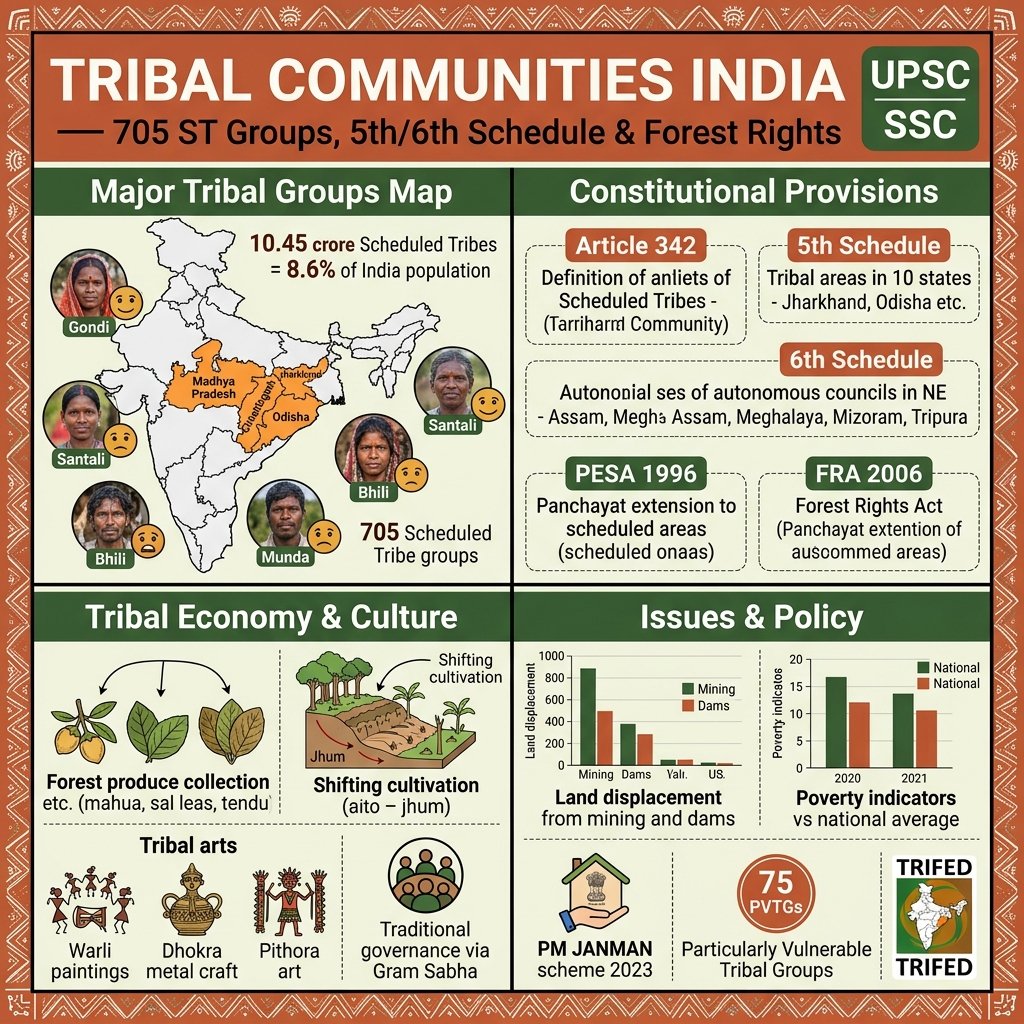
Who Are Scheduled Tribes? — Definition & Scale
- 📋 Definition (Article 342): The President of India, in consultation with state governors, notifies communities as Scheduled Tribes based on five criteria established by the Lokur Committee (1965): (1) Primitive traits — distinct cultural/linguistic identity; (2) Geographical isolation — living in forest/hill areas, difficult terrain; (3) Distinct culture — customs, beliefs, and art forms different from mainstream; (4) Shyness of contact — reluctance to interact with outside population; (5) Backwardness — economic and educational underdevelopment; no single criterion is necessary or sufficient — communities are notified based on combination of these factors; the lack of a constitutional definition means some groups are ST in one state but not another (e.g., Gonds are ST in MP/Chhattisgarh but not all parts of Maharashtra)
- 📋 Scale: 705 scheduled tribe communities; 10.45 crore ST persons (2011 Census); largest ST populations in: Madhya Pradesh (1.53 crore), Odisha (0.95 crore), Maharashtra (1.05 crore), Rajasthan (0.92 crore), Jharkhand (0.86 crore), Gujarat (0.90 crore); tribal concentration highest in: Mizoram (94.4% ST!), Nagaland (86.5%), Meghalaya (86.1%), Arunachal Pradesh (68.8%); in absolute terms tribal heartland = central India (Jharkhand, Odisha, Chhattisgarh, MP belt)
- 📋 Linguistic diversity: ST communities speak approximately 270+ distinct languages; most belong to Austroasiatic (Munda family — Santali, Mundari, Ho, Kharia), Dravidian (Gondi, Kurukh, Oraon), or Tibeto-Burman linguistic families; Santali has 7.6 million speakers and is recognised in the 8th Schedule of the Constitution (one of India’s 22 scheduled languages)
Major Tribal Groups of India
| Tribe / Group | States | Population (approx.) | Key Features |
|---|---|---|---|
| Gond | MP, Chhattisgarh, Telangana, Maharashtra, UP | ~1.3 crore (largest single tribal group) | Dravidian-speaking; agricultural; magnificent Gond painting tradition (Jangarh Singh Shyam = pioneer of Bhopal Gond art movement); Gondi language; historically ruled Gondwana kingdom (14th–18th century); divided across multiple states |
| Bhil | Rajasthan, MP, Gujarat, Maharashtra, Dadra & NH | ~1.1 crore (2nd largest) | Indo-Aryan speakers (Bhili is closest to Gujarati/Rajasthani); archers historically (Ekalavya = Bhil legend in Mahabharata); Pithora paintings (ritual wall paintings for good harvest); tribal resistance leader Govind Guru (Mangarh massacre 1913 — 1,500 Bhils killed by British = India’s own Jallianwala Bagh) |
| Santali | Jharkhand, WB, Odisha, Assam, Bihar | ~0.73 crore | Austroasiatic (Munda family) speakers; Santali language has its own script (Ol Chiki, invented by Pandit Raghunath Murmu, 1925; now 8th Schedule); Hul Revolt (1855) — Sidhu and Kanhu Murmu led uprising against British and moneylenders = first major tribal uprising; Sohrae, Karam = major festivals |
| Munda | Jharkhand, WB, Odisha, Assam | ~0.22 crore | Munda language (Austroasiatic family); legendary leader Birsa Munda (1875–1900) — “Dharti Aaba” (Father of the Earth) — led Ulgulan (Great Tumult) revolt against British land grabbing; 9th November (Birsa Munda’s birthday) = Janjatiya Gaurav Diwas (Tribal Pride Day) since 2021; Khuntkatti land rights system (community land rights) |
| Oraon / Kurukh | Jharkhand, WB, Odisha, Chhattisgarh | ~0.21 crore | Dravidian speakers (Kurukh language); related to South Indian Dravidians but geographically isolated in central India = evidence of pre-Indo-Aryan settlement; Sarna religious belief (worship of sacred groves); Tana Bhagat movement (1914) — Gandhian-style tribal reform movement before Gandhi; Karma festival |
| Khasi, Jaintia, Garo | Meghalaya | ~0.18 crore collectively | Matrilineal societies; Austroasiatic (Khasi, Jaintia) and Sino-Tibetan (Garo) speakers; Living Root Bridges (Cherrapunji); sacred groves; heavily Christianised; 6th Schedule Autonomous District Councils govern traditional areas |
| Naga tribes (16 groups) | Nagaland, Manipur, Arunachal, Assam | ~0.19 crore collectively | Multiple distinct tribes (Angami, Ao, Sumi, Lotha, Konyak, Phom, Tangkul etc.) each with separate language, headgear, and traditions; warrior culture; Naga morung (bachelor’s hall = community institution); Hornbill Festival (December); NSCN insurgency; 88% Christian; each tribe = separate ethnicity, NOT a monolith |
| Scheduled Tribes of Andaman | Andaman & Nicobar Islands | ~0.03 crore (includes uncontacted) | Great Andamanese, Onge, Jarawa, Sentinelese (uncontacted), Shompen; Negrito racial stock — genetically distinct from mainland India STs; hunter-gatherer; some of world’s most isolated humans; discussed in Geo-90 |
Constitutional Framework for Tribal Protection
5th Schedule — Tribal Areas in Central India
- 📜 Application: Applies to 10 states with significant central Indian tribal populations — Andhra Pradesh, Telangana, Chhattisgarh, Gujarat, Himachal Pradesh, Jharkhand, MP, Maharashtra, Odisha, Rajasthan; covers “Scheduled Areas” within these states deemed predominantly tribal
- 📜 Tribes Advisory Council (TAC): Each 5th Schedule state must have a TAC (minimum 3/4 members = ST MLAs) advising the Governor on tribal affairs; Governor has special powers to direct that central laws do not apply or apply with modifications in Scheduled Areas
- 📜 Limitations of 5th Schedule: The Governor’s power to modify laws is discretionary and rarely exercised; TACs have been largely rubber-stamp bodies in practice; industrial and mining interests regularly obtain land in 5th Schedule areas through legal manoeuvring; Bhuria Committee (1993) and other committees have recommended strengthening the 5th Schedule’s actual implementation
6th Schedule — Autonomous District Councils (Northeast)
- 📜 Application: Assam, Meghalaya, Mizoram, Tripura — the northeastern states; creates Autonomous District Councils (ADCs) with legislative and judicial powers over tribal matters
- 📜 Powers of ADCs: Can make laws on land, forests (community forests), water, regulation of moneylending, regulation of cultivation including jhum (shifting cultivation), social customs, marriage and divorce; Village Courts can try cases under customary tribal law; significantly stronger than 5th Schedule TACs
- 📜 Examples: Bodoland Territorial Council (Assam — part of Bodo Peace Accord 2020); Khasi Hills Autonomous District Council (Meghalaya); Chakma Autonomous District Council (Mizoram)
PESA 1996 — Extending Self-Governance to Fifth Schedule Areas
- 📜 Panchayats (Extension to Scheduled Areas) Act, 1996: Extended the Panchayati Raj system to 5th Schedule areas with specific tribal-protective modifications; key provisions: Gram Sabha (village assembly of all adults) given paramount power — must approve any acquisition of land, must be consulted for any extraction of minor forest produce, has power to prohibit sale of liquor; land cannot be alienated (sold) to non-tribals without gram sabha consent; mandatory ST reservation in panchayats proportional to tribal population
- 📜 Gap between PESA and implementation: Despite passing in 1996, all 10 PESA states have failed to fully bring their state panchayat acts in line with PESA — gram sabhas in most states lack real power, land alienation continues despite legal protections, forest produce collection rights routinely denied; PESA Rules 2022 (notified by Central Government) attempt to re-energise the framework
Forest Rights Act (FRA) 2006 — Landmark Legislation
- 📜 Recognition of individual forest rights: Any tribal family living in the forest on or before December 13, 2005 is entitled to a pattas (land title) for up to 4 hectares of forest land they have been cultivating; this corrects a “historic injustice” — millions of tribal families living in forests were technically encroachers under colonial-era forest laws despite generations of occupation
- 📜 Community forest rights: Gram Sabha can assert community rights over forests used for grazing, collection of minor forest produce (bamboo, mahua, tendu leaves, seeds, mushrooms, honey), water bodies, and sacred groves; these community rights override forest department administrative control within the claimed area after verification
- 📜 Implementation status: As of 2024: ~45 lakh individual claims filed; ~22.5 lakh titles distributed (50% recognition rate); ~22.5 lakh claims rejected; community claims = only ~122,000 recognised; massive under-implementation — state forest departments resisting claims, bureaucratic processing failures, gram sabhas lacking capacity; Supreme Court 2019 ordered eviction of 10 lakh+ rejected claimants (later stayed after protests)
- 📜 FRA vs Conservation: Forest departments and wildlife conservationists argue FRA rights conflict with tiger reserve core areas (where human presence is restricted for conservation); tribal groups argue they are the original conservators of forests and their eviction worsens biodiversity loss; the Niyamgiri case (Vedanta mining, Odisha) = famous instance where Kondh tribal gram sabhas invoked FRA rights to reject a mining project in their sacred hills (2013 Supreme Court ruling upheld their right to decide)
Particularly Vulnerable Tribal Groups (PVTGs)
- 🔴 Definition: A sub-category of STs identified as especially vulnerable; criteria: pre-agricultural stage of development (still hunting-gathering or shifting cultivation), stagnant or declining population, extremely low literacy, subsistence economy; originally called Primitive Tribal Groups (PTGs), renamed PVTGs in 2006
- 🔴 Numbers: 75 PVTGs in 18 states/UTs; examples: Shompen (Andaman), Birhor (Jharkhand — “rope people,” one of last surviving nomadic hunter-gatherer communities on mainland India), Chenchu (AP/Telangana — forest-dependent hunter-gatherers in Nallamala Forest), Toda (Nilgiri Hills, Tamil Nadu — buffalo herders, distinctive circular grass temples), Jarawa (Andaman — recently contacted), Baigas (MP/Chhattisgarh — “physicians of the forest”), Bhunjia, Bondas (Odisha — distinctive appearance, traditional beaded necklaces reaching waist)
- 🔴 PM JANMAN (Nov 2023): Pradhan Mantri Janjati Adivasi Nyaya Maha Abhiyan; Rs 24,104 crore; specifically targets 75 PVTGs across 220 districts in 18 states; components: housing (PMAY), drinking water (Jal Jeevan Mission fast-tracking), roads (BRO + PMGSY), mobile medical units, hostels, anganwadis, mobile connectivity; first PM-level programme focused exclusively on the most marginalised tribal groups
Key Issues Facing Tribal Communities
| Issue | Scale / Data | Constitutional / Policy Response |
|---|---|---|
| Land Displacement | STs = 40% of all displaced by dams and mining in India (estimate, WCD); ~5 crore tribal people displaced since Independence (Walter Fernandes estimate); only 20–25% rehabilitated adequately | LARR Act 2013: mandatory gram sabha consent in 5th Schedule areas for land acquisition; SIA (Social Impact Assessment) required; rehabilitation package mandated; PESA and FRA gram sabha consent requirements; however, emergency provisions allow bypassing gram sabha |
| Forest Land Encroachment | Millions of tribal families cultivating forest land classified as “encroachments” under Indian Forest Act 1927; Forest Rights Act 2006 intended to regularise this but implementation falters | FRA 2006 individual and community land title; gram sabha-led verification process; state-level district-level committees; FRA Rules 2012; however forest department bureaucratic resistance is systematic |
| Mining Displacement (Particularly in Chhattisgarh / Jharkhand) | Paradox: tribal heartland = India’s richest mineral zone; 80% of India’s coal, iron ore, bauxite, uranium lies under tribal land; tribals get displacement without proportionate economic benefit | PESA gram sabha consent (often bypassed); District Mineral Foundations (DMF) — 30% of royalty to tribal areas (PMKKKY scheme); scheduled area restrictions on non-tribals buying land; in practice, 5th Schedule’s weak gram sabha provisions allow land acquisition to proceed |
| Poverty & Health | ST poverty rate 32.9% vs national 21.9%; ST IMR (Infant Mortality Rate) = 44.4 vs national 40.7 (NFHS-5); ST stunting 40.3% vs national 35.5%; malaria burden disproportionately tribal (80% of malaria deaths in tribal-dominated states) | Sub-Plan framework (Tribal Sub-Plan = proportional budget allocation for tribal areas); TRIFED (Tribal Co-operative Marketing Development Federation); PM JANMAN 2023 for PVTGs; Eklavya Model Residential Schools (EMRS); Scholarship programmes; National Tribal Health Program |
| Cultural Erosion | ~270 tribal languages compared to ~1,600 total Indian languages; many tribal languages losing speakers; traditional knowledge (medicinal plants, seed varieties, forest management) disappearing with elder generation; conversion to Christianity/Hinduism changing social practices | Tribal languages in school education (NEP 2020 mother tongue instruction); TRIFED tribal art promotion; Geographical Indications (GI) for tribal crafts (Dhokra, Dokra metalwork, Warli art, Pattachitra); National Commission for STs (Article 338A) monitoring |
Tribal Revolts in Indian History
- ⚔️ Santhal Hul (1855–56): Sidhu and Kanhu Murmu led approximately 60,000 Santhals in an armed uprising against British authority, zamindars, and moneylenders in the Rajmahal Hills (now Jharkhand/WB); crushed by British military; thousands killed; first large-scale organised tribal revolt in British India; commemorated as Hul Diwas (June 30)
- ⚔️ Birsa Munda’s Ulgulan (1899–1900): Birsa Munda (called Dharti Aaba = Father of Earth; also believed by followers to be a divine messenger) organised Mundas in Chota Nagpur Plateau to resist land alienation by dikus (outsiders); demanded restoration of Khuntkatti (communal land rights); raised white flag of revolt; arrested, died in Ranchi jail (1900) at age 25; his birth anniversary = Janjatiya Gaurav Diwas (National Tribal Pride Day since 2021); Birsa Munda Airport (Ranchi) named after him; Parliament Tribal Museum
- ⚔️ Rampa Rebellion (1922–24): Alluri Sitarama Raju (Telugu hero) led Koyas and Kondhs in Agency area (now AP) against British Forest Act restrictions on traditional forest access; used guerrilla warfare; Alluri Sitarama Raju is featured on Indian currency (Rs 2 government of India note design); died in 1924
- ⚔️ Mangarh Massacre (1913): Bhil tribal followers of Govind Guru (who led a spiritual-social reform movement called Sampat Sabha) gathered at Mangarh Hill (Rajasthan-Gujarat border); British forces opened fire killing approximately 1,500 Bhils — India’s deadliest single colonial-era massacre (more than Jallianwala Bagh’s ~379-1,000 estimates); declared National Memorial in 2022
⭐ Important for Exams — Quick Revision
- 🔑 STs in India: 10.45 crore = 8.6% population; 705 notified communities; 30 states/UTs; largest by population = MP (1.53 crore); highest % = Mizoram (94.4%)
- 🔑 ST definition criteria (Lokur Committee): Primitive traits + Geographical isolation + Distinct culture + Shyness of contact + Backwardness; notified by President under Article 342
- 🔑 Largest tribal groups: Gond (~1.3cr, largest), Bhil (~1.1cr), Santali (~0.73cr), Munda, Oraon
- 🔑 Santali language: In 8th Schedule; Ol Chiki script (invented Pandit Raghunath Murmu, 1925); 7.6 million speakers
- 🔑 Birsa Munda (1875–1900): “Dharti Aaba”; Ulgulan revolt (Chota Nagpur); Khuntkatti land rights; death in Ranchi jail; birth anniversary = Janjatiya Gaurav Diwas
- 🔑 Santhal Hul (1855): Sidhu and Kanhu Murmu; 60,000 Santhals; first major tribal revolt British India; Hul Diwas June 30
- 🔑 Mangarh Massacre (1913): Govind Guru + Bhils; 1,500 killed; Rajasthan; National Memorial 2022; deadlier than Jallianwala Bagh
- 🔑 5th Schedule: 10 central Indian states; Tribes Advisory Council (TAC); Governor’s special powers; Scheduled Areas
- 🔑 6th Schedule: NE states (Assam, Meghalaya, Mizoram, Tripura); Autonomous District Councils (ADCs) with legislative + judicial powers; much stronger than 5th Schedule
- 🔑 PESA 1996: Panchayats Extension to Scheduled Areas; Gram Sabha = supreme; consent needed for land acquisition + forest produce + liquor policy; state laws must conform; PESA Rules 2022
- 🔑 FRA 2006: Forest Rights Act; individual rights (up to 4 ha, pre-13 Dec 2005 occupation); community forest rights; gram sabha-verified; ~45L claims filed, ~22.5L titles given
- 🔑 Niyamgiri case (2013): Kondh tribal gram sabhas rejected Vedanta mining in their sacred hills; SC upheld gram sabha’s right to decide under FRA
- 🔑 PVTGs: 75 groups; 18 states; pre-agricultural existence; PM JANMAN (Nov 2023, Rs 24,104 crore) first exclusively PVTG-focused scheme
- 🔑 STs displaced by dams/mining = 40% of total displaced; ~5 crore since Independence; Walter Fernandes estimate
- 🔑 District Mineral Foundation (DMF): 30% of mining royalty must flow to tribal areas under PMKKKY (Pradhan Mantri Khanij Kshetra Kalyan Yojana)
- 🔑 TRIFED: Tribal Co-operative Marketing Development Federation; promotes tribal art, minor forest produce marketing, Van Dhan Vikas Kendras
- 🔑 National Commission for STs: Article 338A; safeguards rights; reports to President; monitors all matters relating to STs
- 🔑 Ol Chiki script: Santali’s own script; 8th Schedule recognition; invented 1925 — one of few modern scripts for any Indian tribal language
Frequently Asked Questions (FAQs)
1. Why do tribal communities disproportionately suffer from displacement by mining and dams — and what does Indian law say about it?
India’s tribal heartland and India’s mineral wealth occupy virtually the same geography — a profound geographic coincidence that has driven the most enduring structural injustice against tribal communities since Independence. The central Indian tribal belt (Jharkhand, Odisha, Chhattisgarh, eastern MP) sits atop approximately 80% of India’s known coal reserves, 100% of its chromite, 60% of its iron ore, 70% of its bauxite, significant uranium deposits (Jadugoda, Jharkhand), and much of its copper and manganese. The Scheduled Areas where these minerals lie are also the homeland of Gonds, Mundas, Santhals, Oraons, Hos, Kondhs, Saoras, Bhils, and dozens of other tribal communities whose livelihoods — farming, forest-gathering, artisanal work — depend directly on the land and forest above those mineral deposits. The displacement machine: From Independence through 2000, India built 4,291 large dams, displacing an estimated 4–5 crore people (Walter Fernandes’ systematic study). Of these, STs constituted approximately 40% of the displaced despite being only 8.6% of the population — a displacement rate nearly 5x their population share. The largest dam projects (Sardar Sarovar on Narmada displacing 200,000+ with 58% tribal; Hirakud Dam displacing Adivasis of Odisha; Polavaram Project in AP displacing 250,000+ tribal families) concentrated displacement on the most vulnerable. Mining displacement compounds this: coal mining in Jharia (Dhanbad), iron ore mining in Keonjhar (Odisha), and bauxite mining in Odisha’s Niyamgiri hills have repeatedly displaced tribal communities — often without adequate notice, meaningful compensation, or genuine alternative livelihood. The Chilika Fishing conflict (displacement of tribal fisher communities for aquaculture and tourism) and the Vedanta/POSCO steel plant controversies (massive tribal displacement in Odisha) are landmark cases of the pattern. Why displacement is so damaging for tribal communities specifically: Unlike urban or even rural farming communities, tribal communities have a totemic relationship with specific land — their sacred places (groves, hills, river confluences), ancestral burial grounds, seasonal migration paths, forest patches with specific medicinal or nutritional plants, and community identity are inseparable from particular geography. “Rehabilitation” in a new area is not equivalent — it is cultural uprooting. The Kondhs’ refusal of Vedanta mining (Niyamgiri, 2013) was not simply about economics; it was about Niyam Raja (their sacred deity of the hill) whose presence in that specific mountain defined their cosmology. What Indian law says: The law has progressively strengthened tribal protection: (1) PESA 1996 requires gram sabha consent for any land acquisition in Scheduled Areas; (2) Forest Rights Act 2006 requires gram sabha verification of forest rights before diversion; (3) LARR Act 2013 (Land Acquisition, Rehabilitation and Resettlement): mandatory Social Impact Assessment, consent of 70–80% of affected families in Scheduled Areas (effectively gram sabha consent); R&R provision includes land for land (not just cash) as first preference; (4) Environment Impact Assessment (EIA) notifications require public hearings including tribal communities before major projects; (5) Supreme Court Vedanta-Niyamgiri Judgment (2013) held that gram sabhas were competent under FRA to decide mining projects on their sacred forest land. In practice, these legal protections are routinely bypassed through: declaring “emergency” provisions that waive consent; administrative pressure on gram sabhas; appointing gram sabha members who are not genuine community representatives; corporate-funded resettlement surveys that undercount genuine tribal claimants. The gap between India’s world-class tribal protection law and tribal reality on the ground remains among the largest in any democratic legal system.
2. Who was Birsa Munda — and why is he considered India’s greatest tribal hero?
Birsa Munda (1875–1900) is the most celebrated figure in India’s tribal history — a revolutionary, spiritual leader, and social reformer who led the Munda community of Chota Nagpur Plateau (now Jharkhand) in a profound armed resistance against British colonisation, landlordism, and Christian missionary cultural erasure. He died in British custody at age 25, having compressed more revolutionary action into his short life than most historical figures manage in decades. His story is one of the most extraordinary in modern Indian history — and understanding it reveals the structural forces that still shape tribal life in India today. The context of Munda dispossession: The Mundas of Chota Nagpur had a distinctive land rights system called Khuntkatti — communal clan ownership of land cleared by their ancestors from forest, with land rights tied to participation in community labour and ritual obligations (not marketable or alienable). The British colonial administration’s imposition of the Permanent Settlement and survey-settlement procedures did not recognise Khuntkatti; instead, it recognised individual land titles — allowing dikus (outsiders, primarily upper-caste Hindus and moneylenders) to acquire Munda land through debt, court decrees, and outright forgery of revenue records. By the 1870s, the Mundas had lost much of their ancestral land and were working as labourers on land their ancestors had cleared as forest. Christian missionaries (German Lutherans, then Catholics) were simultaneously converting Mundas — offering education and social mobility but at the cost of traditional Sarna religious practices (forest spirit worship, sacred grove traditions). Birsa’s emergence: Birsa Munda was born November 15, 1875 in Ulihatu village (now Jharkhand). He received some missionary education, briefly converted to Christianity, then decisively rejected it. In 1895, he announced himself as a divine messenger (a “Singhbonga” — sun deity — prophet) and began preaching a syncretic religion emphasising: worship of the supreme creator Singhbonga without idols or intermediaries; rejection of diku domination; restoration of Khuntkatti land tenure; rejection of indentured labour contracts; abstinence from liquor (a major tool of tribal economic exploitation). His followers — who painted themselves white and worshipped at sacred groves — were called Birsaites or Birsait. By 1899, Birsa was ready for armed revolt. The Ulgulan (Great Tumult): On Christmas Eve 1899–January 1900, Birsa’s followers launched coordinated attacks on police stations, churches, and properties of landlords across the Munda region. Armed with traditional bows and arrows (against British rifles), the uprising was militarily unequal. British forces and loyal police crushed the rebellion within months. Birsa was arrested in February 1900, imprisoned in Ranchi Jail, and died in custody on June 9, 1900 — officially of cholera, though many historians believe he was poisoned or died of brutal punishment. He was 25 years old. His legacy: The Ulgulan’s immediate political achievement was the Chota Nagpur Tenancy Act 1908 — which the British enacted specifically in response to the Munda movement, restricting transfer of tribal land to non-tribals and partially recognising Khuntkatti rights. This act remains the legal basis for tribal land protection in Jharkhand today. Birsa Munda’s birth anniversary (November 15) was declared Janjatiya Gaurav Diwas (National Tribal Pride Day) in 2021 — the first PM-level recognition of tribal history. He is the only tribal leader whose portrait hangs in the Central Hall of Parliament of India. Ranchi Airport is named “Birsa Munda International Airport.” A statue of Birsa Munda was installed in Parliament’s new premises (2023). He has become a pan-tribal icon — not just for Mundas but for all 705 ST communities — symbolising determination to resist dispossession while retaining cultural identity.
3. What is the Forest Rights Act 2006 — and why has it failed to deliver on its promise in most states?
The Scheduled Tribes and Other Traditional Forest Dwellers (Recognition of Forest Rights) Act, 2006 — commonly called the Forest Rights Act (FRA) — is arguably the most important piece of legislation affecting tribal land rights since the abolition of zamindari in the 1950s. The Act’s preamble is explicit: it is enacted to address the “historic injustice” done to forest-dwelling tribal communities and other traditional forest dwellers by colonial-era forest laws that classified tribal communities as “encroachers” in the very forests their ancestors had nurtured for generations. What FRA promises: (1) Every tribal family with evidence of occupation of forest land before December 13, 2005, is entitled to a patta (land rights title) for the land they cultivate — up to 4 hectares. (2) Community forest rights — the gram sabha can assert collective ownership over community forests, water bodies, minor forest produce (bamboo, mahua flowers, tendu leaves, honey, medicinal plants, seeds), and sacred groves used by the village for generations. (3) Right to nistar (traditional community use of forest for grazing, collection of fuel wood, building materials). (4) Right to conservation and management of community forest reserve (CFR) — the most powerful provision: a gram sabha can declare a Community Forest Resource and be the authority managing it, overriding forest department administrative control. (5) Critically: before any forest land is diverted for non-forest purposes (mining, infrastructure, dam submergence), the gram sabha of affected villages must consent and certify that affected tribal families’ rights have been settled. The gap — why it fails: Nearly 20 years after enactment, FRA’s implementation record is one of India’s most documented institutional failures: (a) Mass rejection of claims without reasoning: Of ~45 lakh individual claims filed by tribal families, only ~22.5 lakh titles have been issued (50% rejection rate); many claims were rejected without the legally required three-tier review process (gram sabha → sub-divisional level committee → district level committee); the Supreme Court in 2019 ordered eviction of ~10 lakh families whose claims were rejected — a landmark crisis that triggered mass protests and subsequent stay of the order. (b) Forest department obstruction: India’s Forest Department (under both state and central governments) is institutionally opposed to FRA implementation — historically, forest land is forest department territory; FRA’s community rights provisions directly threaten departmental control and patronage; individual forest officers have actively suppressed claims, planted false evidence of non-occupation, and coached tribal families to withdraw applications. (c) Gram sabha incapacitation: The FRA’s rights-verification process begins with the gram sabha — which in most tribal villages is poorly constituted, lacks legal literacy, is manipulated by local revenue/forest officials, and doesn’t have access to satellite maps or GPS tools needed to demarcate claimed boundaries. (d) Absence of political will in most states: States with strong mining lobbies (Chhattisgarh, Jharkhand, Odisha) have systematically under-implemented FRA because CFR (Community Forest Resource) rights, if properly implemented, would give tribal gram sabhas veto power over mining in those forests. A tribal CFR gram sabha can legally say “no” to a coal mine — which is why the state bureaucracy ensures CFR rights are minimally implemented. (e) The Success cases — what they show: In states that have implemented FRA seriousl (notably Chhattisgarh’s CFR implementation in Gadchiroli district Maharashtra, and Odisha’s Niyamgiri model), tribal communities with legally recognised CFR rights show dramatically better forest protection outcomes than comparable forests under formal forest department management — vindicating the decade of academic research arguing that local community stewardship is more effective than centralised state conservation. This is the FRA’s ultimate promise: that tribal communities, as the original custodians of India’s forests, are the most effective conservators when given secure legal rights. Realising that promise requires overcoming the institutional resistance of the forest-industrial complex — one of India’s most entrenched bureaucratic-commercial power structures.
Related Geology Articles on StudyHub
- ➡️ Northeast India — NE Tribal Communities & 6th Schedule
- ➡️ Andaman Islands — Sentinelese & Andamanese Tribes
- ➡️ Natural Vegetation — Tribal Communities & Forest Governance
- ➡️ Mineral Resources — Mining in Tribal Heartland
- ➡️ Wildlife Conservation — Tribal Communities & Protected Areas