
Last Updated: March 2026 | Reading Time: 10 minutes | ~2,200 words | Category: Volcanology & Indian Geology
A volcano is an opening (vent) in Earth’s surface through which molten rock (magma), gases, and ash are expelled from the interior. When magma reaches the surface it is called lava. Volcanoes are among the most powerful geological forces shaping the planet’s surface, atmosphere, and climate. Most volcanoes occur at plate boundaries — at divergent boundaries (mid-ocean ridges, where MORB basalt erupts continuously onto the ocean floor) and at convergent subduction boundaries (where the subducting slab releases water de-hydrating from its minerals, which lowers the melting point of the overlying mantle wedge, generating magma that rises to produce explosive arc volcanoes). A smaller but significant number form above mantle plumes (hotspots) far from plate boundaries — such as Hawaii (Pacific Plate) and Réunion Island (Indian Ocean). India has one of the most geologically interesting volcanic situations in the world: Barren Island (Andaman Islands) — India’s only historically active volcano, built above the subducting Indian Plate; Narcondam Island — India’s only dormant stratovolcano; the massive extinct Deccan Traps flood basalt field; and relict volcanic features across the Dharwar Craton. For UPSC, SSC, NDA, and state PCS exams, volcano types (shield, stratovolcano, cinder cone, lava dome), distribution (Ring of Fire, Mid-Ocean Ridges, Hotspots), and India-specific volcanic information are standard geography questions.
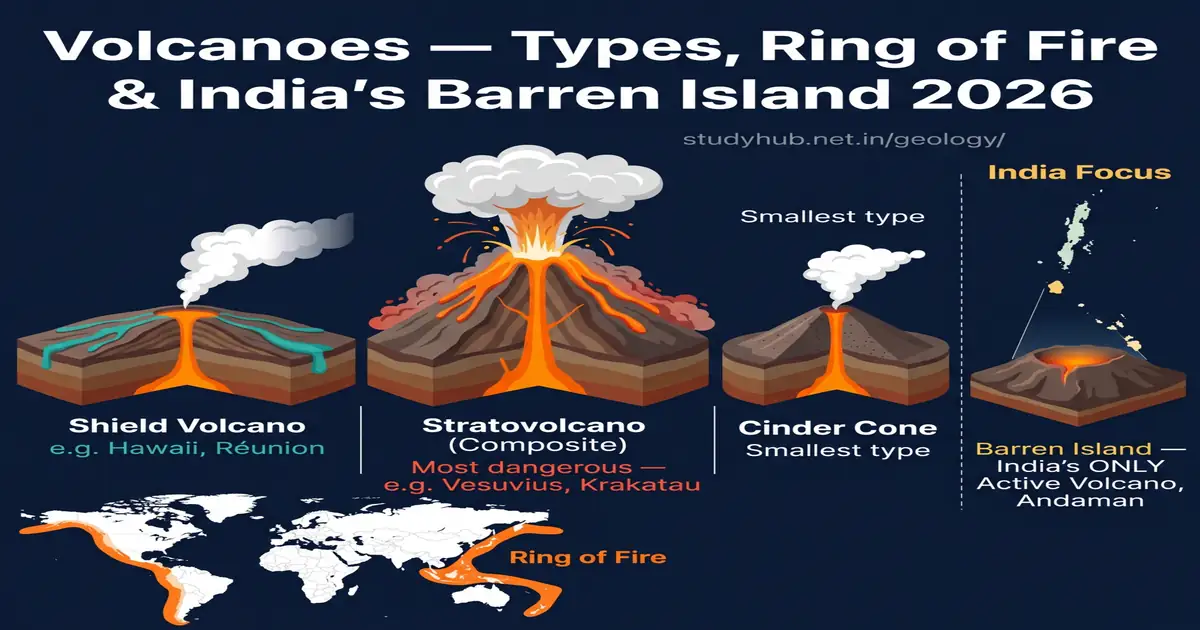
Volcanoes — Types, Distribution, Ring of Fire & India’s Barren Island 2026
Types of Volcanoes — Comparison Table
| Type | Shape | Lava Type | Eruption Style | Hazards | Global Examples | India Links |
|---|---|---|---|---|---|---|
| Shield Volcano | Broad, gently sloping dome; low height:width ratio; resembles a warrior’s shield lying flat. Built by accumulation of many thin, wide-spreading lava flows. Slopes typically 2–10° | Basaltic (mafic): low silica (~50%), low viscosity, gas easily escapes, lava flows freely for long distances (up to 50 km from vent) | Effusive (non-explosive): lava fountains, lava tubes, persistent lava lake in summit caldera. Relatively gentle eruptions. Continuous low-level activity possible for years | Lava flows (slow-moving, destroy property but rarely kill); lava tubes; subsidence of caldera. Rarely kills people directly. Volcanic gases (SO₂, CO₂) hazard in rift zones | Mauna Loa, Kilauea (Hawaii, USA — world’s most active shield volcanoes); Réunion Island (Piton de la Fournaise — Indian Ocean, active continuously); Galápagos Islands; Olympus Mons, Mars (solar system’s largest volcano) | Réunion Island (Réunion plume = same plume that created Deccan Traps 65.5 Ma). Piton de la Fournaise erupts nearly every year — living successor of the volcano that built the Deccan Plateau |
| Stratovolcano (Composite Volcano) | Steep-sided cone; high height:diameter ratio; alternating layers of lava flows, ash, and pyroclastic deposits (hence “composite”). Slopes 25–35°. Symmetrical cone visible from great distances | Andesitic to rhyolitic (intermediate to felsic): high silica (55–75%), high viscosity, gas cannot escape easily → pressure builds → explosive eruptions. SiO₂ polymerises melt into gel-like chains | Explosive (Plinian, Vulcanian, Pelean): pyroclastic flows (hot gas + ash + rock fragments at 200–700°C, up to 700 km/hr — most lethal volcanic hazard), ash fall (global spread), volcanic bombs, lahars (volcanic mudflows on flanks), pyroclastic surges, lateral blasts (Mount St. Helens 1980) | Pyroclastic flows (most deadly — killed 2,000 at Soufrière Hills 1902; destroyed Pompeii 79 AD); Lahars (mudflows — can travel 100+ km, destroyed Armero Colombia 1985); Ashfall (aviation, agriculture, infrastructure); Volcanic winter (stratospheric aerosols — Pinatubo 1991 cooled global temperature 0.5°C for 2 years) | Mt. Fuji (Japan); Vesuvius (Italy, destroyed Pompeii 79 AD); Krakatau (Indonesia, 1883 — 36,000 deaths, global volcanic winter, heard 4,800 km away); Pinatubo (Philippines, 1991 — lowered global temps); Mount St. Helens (USA, 1980); Popocatépetl (Mexico); Merapi (Indonesia) | Barren Island (Andaman Islands): India’s ONLY historically active volcano = a stratovolcano above the subducting Indian Plate. Narcondam Island (Andaman): dormant stratovolcano, covered in dense tropical forest |
| Cinder Cone (Scoria Cone) | Small, steep-sided cone (100–400 m tall); simplest and most common volcano type. Built from accumulation of cinders (scoria = vesicular basaltic rock fragments) ejected from a single vent during brief eruption. Bowl-shaped crater at summit | Basaltic to andesitic: moderate viscosity. Tephra (airborne volcanic debris): lapilli (2–64 mm fragments), scoria (vesicular), basaltic bombs | Strombolian: rhythmic explosive bursts from vent, ejecting glowing cinders and bombs to hundreds of metres. Short-lived eruptions (days to years). Often form as parasitic cones on flanks of larger volcanoes | Ballistic projectiles (volcanic bombs up to 1 km from vent); lava flows from base of cone; scoria ashfall near vent. Relatively localised hazard. Can erupt in unexpected locations (monogenetic fields) | Parícutin (Mexico, 1943 — grew from a farm field in 1 week, 424 m tall when eruption ended 9 years later); Cerro Negro (Nicaragua); Sunset Crater (Arizona, USA); cinder cones on flanks of Etna (Sicily); Lanzarote cinder cones (Canary Islands) | No major cinder cones in India. Barren Island has produced scoria deposits during eruptions. Some minor volcanic plugs exist in Deccan region |
| Lava Dome (Volcanic Dome) | Rounded, steep-sided mound; grows by extrusion of very viscous lava that piles up over the vent rather than flowing away. Can grow inside craters of stratovolcanoes after major explosive eruption | Rhyolitic to dacitic: very high silica (>65%), extremely viscous, rich in gas — catastrophic potential if dome collapses | Extrusive dome growth: lava too viscous to flow, solidifies near vent. Highly explosive if pressurised gas accumulates beneath: dome collapse → pyroclastic density current (most dangerous outcome) | Dome collapse → pyroclastic flows with unpredictable direction. Very dangerous to monitor (volcanologists have died near growing domes — Galeras 1993, Merapi 2010). Constant collapse risk | Soufrière Hills (Montserrat, Caribbean, ongoing since 1995 — destroyed capital Plymouth); Mount St. Helens (lava dome in crater after 1980 eruption); Merapi (Java, Indonesia — repeated dome collapses kill people); Novarupta (Alaska, 1912) | No lava domes actively forming in India currently. Narcondam Island (Andaman) may have dacitic dome components |
| Caldera | Large, roughly circular depression >1 km diameter formed by collapse of magma chamber roof after a major eruption (not created by explosion but by subsidence into void left by evacuated magma). Can be 5–100 km diameter | Rhyolitic ignimbrite / welded tuff large volumes — the world’s most catastrophic eruptions are caldera-forming “supervolcanic” events (VEI 8) | Caldera-forming super-eruptions: rare (recurrence ~100,000 years globally); deposit thick ignimbrite sheets over huge areas. Post-collapse: hydrothermal activity, potential for renewed lava dome eruptions within caldera | Yellowstone super-eruption (hypothetical): could deposit 1 m+ ash across North America. Toba super-eruption (74,000 years ago, Sumatra): VEI 8 — may have caused human population bottleneck (disputed); cooled global temperature 3–5°C for years | Yellowstone Caldera (USA — supervolcano, last major eruption ~640,000 years ago); Toba Caldera (Indonesia — 74,000 year BP); Crater Lake (Oregon, USA — former Mt. Mazama caldera, now filled with water); Long Valley Caldera (California) | Lonar Crater (Maharashtra): NOT a volcanic caldera — a meteorite impact crater (50,000 years BP, 1.8 km diameter). Barren Island has a summit caldera ~2 km wide. Toba super-eruption (74,000 BP) deposited ash in India — detectable in Indian Ocean sediment cores and across Indian subcontinent |
Global Distribution of Volcanoes — Ring of Fire, Mid-Ocean Ridges & Hotspots
| Zone | % of World’s Volcanoes | Tectonic Setting | Key Examples | India Relevance |
|---|---|---|---|---|
| Ring of Fire (Circum-Pacific Belt) | ~75% of all active volcanoes | Subduction zones around Pacific Ocean margins; both oceanic-oceanic (island arcs) and oceanic-continental (continental arcs) subduction. Slab dehydrates → lowers mantle wedge melting point → andesitic arc magmatism | Aleutians (Alaska); Cascades (USA — Mount St. Helens, Rainier); Mexico; Central America; Andes (South America); Japan (Mt. Fuji and 100+ others); Philippines (Pinatubo, Mayon); Indonesia (Krakatau, Merapi, Tambora); New Zealand (Ruapehu, Taupo). Deepest subduction = Mariana (Pacific under Philippine Sea Plate) | Andaman-Nicobar subduction is the eastern extension of the Sunda Arc (Indonesia-Andaman-Myanmar), which is part of the broader Indo-Pacific convergence zone. Barren Island volcano is the northernmost active volcano of the Sunda subduction arc system |
| Mid-Ocean Ridge System | ~20% of eruptions (mostly submarine, not counted in surface catalogues) | Divergent plate boundaries. Decompression melting of asthenosphere → MORB basalt (MidOcean Ridge Basalt). Mostly submarine, episodic eruptions along axial rift of ridge crests. Iceland = only place MOR breaks the surface above sea level | Mid-Atlantic Ridge (Iceland = above sea level, Eyjafjallajökull 2010, Eldgjá, Laki 1783 — 14 km³ eruption + volcanic winter); East Pacific Rise (EPR — mostly submarine); Southwest Indian Ridge; Carlsberg Ridge; Juan de Fuca Ridge (eruption 2015, submarine) | Carlsberg Ridge (NW Indian Ocean, 2.5 cm/yr, Indian-African boundary): submarine basaltic volcanism along this ridge is continuous but not visible from surface. SWIR (India-Antarctic boundary): similarly submarine. Indian Ocean ridge volcanism covers ~500 km² per million years |
| Intraplate Hotspot Volcanoes | ~5% | Fixed mantle plume beneath moving tectonic plate → chain of volcanoes getting progressively older away from hotspot. Volcanism not related to plate boundaries. Basaltic shield volcanism typical (low silica, effusive) unless continental hotspot (then rhyolitic — Yellowstone) | Hawaii (Pacific Plate moving NW over Hawaiian hotspot → Hawaiian-Emperor seamount chain); Réunion (Indian Ocean, Réunion plume → Deccan Traps 65.5 Ma trail); Kerguelen (Kerguelen plume → Rajmahal Traps 117 Ma trail, Ninetyeast Ridge); Galápagos; Yellowstone (continental = rhyolitic super-eruptions); Iceland (both MOR + mantle plume) | Réunion hotspot trail (oldest to youngest): Deccan Traps (65.5 Ma, India) → Lakshadweep (55-60 Ma) → Maldives (35-50 Ma) → Chagos → Réunion (active). Kerguelen hotspot trail: Rajmahal Traps (117 Ma, Jharkhand) → Sylhet Traps → Ninetyeast Ridge → Kerguelen Island (active, S. Indian Ocean) |
Barren Island — India’s Only Active Volcano: Complete Profile
| Parameter | Details |
|---|---|
| Location | Andaman Sea, ~135 km NE of Port Blair (South Andaman district, Andaman & Nicobar Islands UT). Coordinates: ~12.28°N, 93.86°E. A remote uninhabited island, accessible only by boat/research vessel. No permanent human settlement |
| Type | Stratovolcano (composite volcano). Summit caldera ~2 km wide with active central vent. Island dimensions: ~3 km diameter, summit elevation ~354 m (varies after eruptions) |
| Tectonic Setting | Subduction of Indian oceanic plate beneath the Burma Plate (Sunda Arc). Indian plate descends northward into the Andaman Trench at ~4,000 m depth. At ~100 km depth below Barren Island, the subducting slab releases fluids (water from hydrated minerals dehydrating under pressure and heat) → lowers melting point of overlying mantle wedge → andesitic magma forms → rises to surface. Barren Island is the northernmost active subduction arc volcano of the Sunda/Andaman-Java arc system |
| Known Eruptions | First recorded eruption: 1787 (British survey records). Dormant for ~180 years. Reactivated dramatically in 1991. Eruptions since 1991: 1991, 1994–1995, 2005, 2008, 2009, 2010, 2012–2013, 2015–2016, 2017–2018, 2022 (ongoing intermittent activity). The 1991 eruption after long dormancy: Strombolian→Vulcanian style, lava flows reached the sea. The 2017-2018 activity: most violent in recent history; lava flows visible from satellite and aircraft; activated during September 2017 post-Irma/Maria season. IMD and GSI monitor continuously via satellite imagery and remote seismographs |
| Products | Andesitic to basaltic andesitic lava flows; Scoria and ash deposits; Volcanic bombs; SO₂ gas plumes (detectable by satellite — TROPOMI instrument, Sentinel-5P). Lava flows from flank vents reach the sea, creating hydrovolcanic explosions (laze = lava + sea water steam plume = hydrochloric acid + fine glass particles) |
| Associated Volcano: Narcondam | Narcondam Island (~150 km NE of Barren Island): India’s only dormant stratovolcano. ~710 m elevation. Densely forested with tropical vegetation (unlike bare Barren Island). Narcondam hornbill (Aceros narcondami) = critically endangered bird found ONLY on Narcondam Island. The island is a wildlife sanctuary. GSI classifies Narcondam as “dormant” — may have last erupted centuries ago. Also a subduction arc volcano (same tectonic setting as Barren Island) |
| Scientific Significance | Barren Island = India’s natural laboratory for subduction-related volcanism. Research by GSI, NGRI, and INCOIS monitors SO₂ emissions, seismicity, ground deformation (InSAR). Important for understanding: (1) Andaman subduction dynamics; (2) volcanic hazard assessment for Andaman Islands; (3) link between 2004 Sumatra earthquake (which altered stress on Andaman subduction zone) and subsequent increased Barren Island activity |
Frequently Asked Questions
What is the Volcanic Explosivity Index (VEI) and which eruptions were the most powerful in history?
The Volcanic Explosivity Index (VEI), developed by Chris Newhall and Steve Self in 1982, is a logarithmic scale (0–8) that measures the explosivity of volcanic eruptions based on the total volume of erupted material (tephra — all airborne volcanic products), plume height, and eruption duration. Like the earthquake magnitude scale, each VEI unit represents approximately a 10-fold increase in erupted volume. VEI 0–1: Non-explosive to gentle; lava flows, small ash puffs. Strombolian eruptions. Continuous activity like Kilauea (Hawaii) or Stromboli (Italy). VEI 1–2: Continuous Stromboli, Etna. VEI 2–3: Moderate explosive (Vulcanian). Soufrière Hills (Montserrat, ongoing). Galeras 1992. VEI 4: Large; Eyjafjallajökull (Iceland, 2010 — grounded European aviation for 6 days despite relatively modest eruption by geological standards). Galunggung (Indonesia, 1982 — caused two Boeing 747 engine failures from ash). VEI 5: Major; Mount St. Helens (USA, 1980 — 1 km³ erupted; lateral blast destroyed 600 km² of forest); Hudson (Chile, 1991). VEI 6: Colossal; Pinatubo (Philippines, 1991 — 10 km³ erupted; global temperature dropped 0.5°C for 2 years; largest 20th century eruption); Krakatau (Indonesia, 1883 — 20 km³; 36,000 deaths from tsunami; heard globally; “year without summer” 1884). VEI 7: Super-colossal; Tambora (Indonesia, 1815 — 160 km³ erupted; deadliest volcanic eruption in recorded history: 71,000+ direct deaths; “Year Without a Summer” (1816) — crop failures globally, famine in Europe and North America; Lord Byron and Mary Shelley wrote in a ash-darkened Geneva summer that year — Frankenstein was conceived during this eruption’s impact). VEI 8 (“Supervolcanic”): Mega-colossal; Toba (Indonesia, 74,000 years BP — 2,800 km³ erupted; ash deposited across South Asia including India; global temperature may have dropped 3–5°C; possibly caused human population bottleneck to ~10,000 individuals — controversial “Toba catastrophe theory”). Yellowstone (last major: 640,000 years BP, 1,000 km³). India connection to major eruptions: Toba ashfall detected in India (Toba ash layers found in archaeological/geological deposits in southern India, Jwalapuram site — Andhra Pradesh/Telangana border — showing humans survived the eruption). Krakatau 1883: shockwave from eruption caused barometers across India to spike twice as the pressure wave circled the Earth twice.
Important for Exams — Volcano Facts for UPSC, SSC & State PCS
Volcano types: Shield (basaltic, effusive, broad dome — Hawaii, Réunion). Stratovolcano/Composite (andesitic, explosive, steep cone — Fuji, Krakatau, Barren Island). Cinder cone (smallest, Strombolian, Parícutin). Lava dome (rhyolitic, very viscous, Soufrière Hills). Caldera (post-eruption collapse — Yellowstone, Toba). Ring of Fire: ~75% of world’s active volcanoes; Pacific Ocean margins; subduction-related. Mid-ocean ridge: ~20% of eruptions; basaltic, submarine, MORB; Iceland = only surface expression. Hotspot: ~5%; fixed plume; chain of progressively older volcanoes (Hawaii, Réunion). India volcanoes: Barren Island = India’s ONLY historically active volcano; Andaman Islands; stratovolcano; Indian plate subducting under Burma plate; eruptions since 1787; major eruptions 1991, 2005, 2009, 2017-2018. Narcondam = dormant; NE Andaman; stratovolcano; Narcondam hornbill habitat. Deccan Traps = extinct flood basalt (65.5 Ma, Réunion plume). Rajmahal Traps = extinct (117 Ma, Kerguelen plume, Jharkhand). VEI scale: 0-8, logarithmic. Tambora (1815)= VEI 7 = deadliest. Toba (74,000 BP) = VEI 8 = supervolcano. Pinatubo 1991 = VEI 6 = cooled Earth 0.5°C. Eyjafjallajökull 2010 = VEI 4 = grounded Europe’s aviation. Lonar Crater (Maharashtra): NOT volcanic — meteorite impact crater, 50,000 years BP, 1.8 km diameter, saline lake. Often confused with volcanic caldera. Pyroclastic flow: Most lethal volcanic hazard. Hot gas + ash + rock (200-700°C, up to 700 km/hr). Destroyed Pompeii 79 AD. Lahar: Volcanic mudflow — Mt. Pinatubo lahars continued for years after 1991 eruption. Volcanic winter: Tambora 1815 = “Year Without a Summer” 1816 globally. Toba 74,000 BP = possible near-extinction event for humans.
What to Read Next
- Deccan Traps — Flood Basalts, Réunion Plume & K-Pg Extinction 2026
- Plate Boundaries — Subduction, Trenches & Why Arc Volcanoes Form 2026
- Earthquakes — India Seismic Zones & Andaman-Nicobar Subduction 2026
- Sea Floor Spreading — Mid-Ocean Ridge Basalt & Submarine Volcanism 2026
- Asthenosphere — Where Mantle Plumes Originate & Hotspot Tracks Form 2026
🎔 Exam Quick Reference — Volcanoes: Shield = basaltic, effusive, broad dome (Hawaii, Réunion). Stratovolcano = andesitic, explosive, steep cone, pyroclastic flows (Krakatau, Fuji, Barren Island). Cinder cone = smallest, Strombolian, scoria (Parícutin). Lava dome = rhyolitic, very viscous (Soufrière Hills). Caldera = collapse depression post-eruption (Toba, Yellowstone). Ring of Fire = 75% of active volcanoes. India: Barren Island (ONLY active, Andaman, stratovolcano, subduction, eruptions since 1787, major 1991, 2017-18). Narcondam = dormant stratovolcano. Lonar Crater (Maharashtra) = meteorite impact, NOT volcanic. VEI scale 0-8: Toba = VEI 8 (supervolcano, 74,000 BP, ash across India). Tambora = VEI 7 (1815, deadliest, Year Without Summer 1816). Pinatubo = VEI 6 (1991, cooled Earth 0.5°C). Eyjafjallajökull = VEI 4 (2010, grounded Europe). Pyroclastic flow = deadliest hazard. Lahar = volcanic mudflow.
🌍 India Volcanic Features — Complete List: ACTIVE: Barren Island (Andaman, stratovolcano, subduction arc). DORMANT: Narcondam (Andaman, stratovolcano, subduction arc). EXTINCT FLOOD BASALTS: Deccan Traps (65.5 Ma, Réunion plume, Maharashtra/MP/Gujarat/AP/Karnataka — 500,000 km², 3,000 m thick). Rajmahal Traps (117 Ma, Kerguelen plume, Jharkhand). Sylhet Traps (117 Ma, Kerguelen plume, Meghalaya-Bangladesh border). VOLCANIC HOTSPOT TRAILS IN INDIAN OCEAN: Réunion trail (Deccan → Lakshadweep → Maldives → Chagos → Réunion). Kerguelen trail (Rajmahal Traps → Ninetyeast Ridge → Kerguelen Island). RELICT VOLCANIC: Dhosi Hill (Haryana, Precambrian volcanic plug). St. Mary’s Islands (Karnataka, 88 Ma columnar basalt, India-Madagascar rift). Archaean komatiites (Dharwar Craton, Karnataka, very high-Mg basalts from 3.0-3.3 Ga). NOTE: Lonar Crater = meteorite impact, NOT volcanic caldera (a very common exam confusion — officially confirmed by ISRO and geologists).
About This Guide: Written by the StudyHub Geology Editorial Team (studyhub.net.in/geology/) based on NCERT Class 11 Physical Geography Chapter 3 (Interior of Earth), GSI (Geological Survey of India) Annual Reports on Barren Island volcanism (2017-2022), Newhall & Self (1982) VEI scale original paper, Oppenheimer (2011) “Eruptions That Shook the World,” and ITEWC/INCOIS monitoring data. Last updated: March 2026.