
Last Updated: March 2026 | Reading Time: 11 minutes | ~2,500 words | Category: Geomorphology & Surface Processes
Weathering is the in-situ (in-place) breakdown and alteration of rocks and minerals at or near Earth’s surface by physical, chemical, and biological agents — without significant transport of material. It is the essential first step in the rock cycle’s surface branch: weathering disintegrates and decomposes rocks into regolith (the mantle of loose material above bedrock), which is then available for erosion (removal and transport by water, wind, ice, or gravity) and ultimately deposition to form sedimentary rocks. Weathering and its products are among the most consequential geological processes for human civilisation: the fertile black cotton soils (regur) of Maharashtra and the rich red lateritic soils of Kerala both owe their formation to intense weathering of underlying bedrock. Weathering is controlled by five key factors — rock type (mineral composition, crystal structure, permeability), climate (temperature and precipitation are the most powerful controls — wet tropical climates produce vastly more chemical weathering than cold-arid ones), relief/topography (steep slopes → rapid erosion → fresh rock exposed → weathering continues; flat areas → deep weathering profiles develop), time (longer exposure = deeper alteration), and organisms (plants, fungi, bacteria both physically and chemically attack rock). Geologists distinguish three main categories: (1) Physical/Mechanical Weathering — rock broken into smaller pieces without change in mineral chemistry; (2) Chemical Weathering — rock minerals dissolved, hydrated, oxidised or altered producing new secondary minerals; (3) Biological Weathering — living organisms drive both physical and chemical breakdown. For UPSC, SSC, NDA, and State PCS exams, weathering types, India-specific weathering landforms (laterite, regur, inselbergs, karst), and the factors controlling weathering intensity are standard Physical Geography/Geology topics.
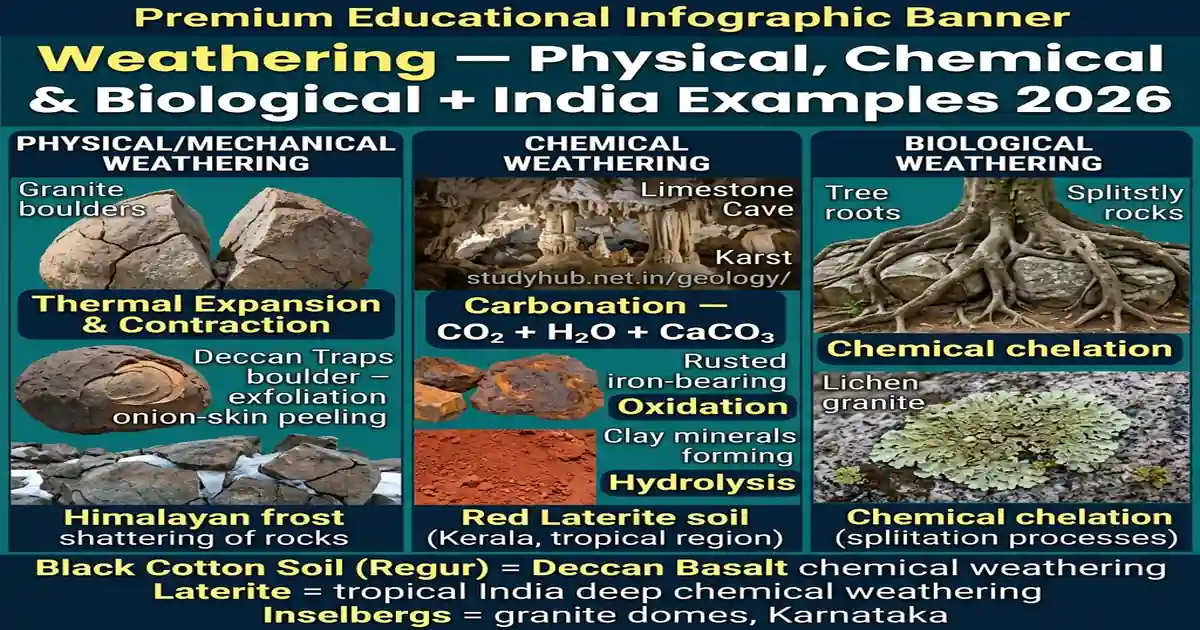
Weathering — Physical, Chemical & Biological Types with India Examples 2026
1. Physical (Mechanical) Weathering — Rock Breaks Without Chemical Change
| Process | Mechanism | Rocks Affected | India Examples / Landforms |
|---|---|---|---|
| Thermal Expansion & Contraction (Insolation Weathering) | Repeated daily heating (expansion) and cooling (contraction) cycles cause differential stress within rock because minerals have different expansion coefficients. Over time, micro-cracks develop and widen. Most effective in hot-arid climates with large diurnal temperature ranges (day vs night) — desert environments. Also called “thermoclastis” | Coarse-grained rocks with multiple minerals of different colours (dark minerals heat faster, light minerals less so = differential heating within same rock): Granite (dark biotite + pale quartz/feldspar = high differential stress). Gabbro. Not very effective in fine-grained rocks | Thar Desert (Rajasthan): thermal weathering produces desert pavement, sand, and rock fragments. Deccan Plateau: extreme summer temperatures (45°C+ in May) combined with basalt’s dark colour → surface heating. Note: experimental evidence for purely thermal weathering is actually debated — most thermal weathering in field is enhanced by hydration |
| Frost Wedging (Freeze-Thaw / Gelifraction) | Water expands 9% when it freezes (0°C → ice). If water fills cracks in rocks and then freezes, the 9% volume increase exerts enormous pressure (up to 200 MPa) on crack walls → cracks widen → rock splits. Requires: (1) water present; (2) temperatures repeatedly crossing 0°C (freeze-thaw cycling). Most powerful physical weathering process in periglacial and alpine environments | All rocks with pre-existing joints, cracks, and bedding planes allow water infiltration. Most effective in jointed rocks: Granite, Quartzite, Limestone, Sandstone. Less effective in massive unfractured rocks | Himalayas (above 3,000 m elevation): major geomorphic agent. Spiti Valley, Ladakh, Uttarakhand alpine zones: angular frost-shattered rock debris (felsenmeer), talus slopes (scree) below cliffs — angular blocks produced by frost wedging. Siachen Glacier area: frost shattering produces rock flour. High-altitude mountain passes: shattered rock surfaces and frost polygons in soil. India: frost wedging operates above ~3,500 m in Greater Himalayas year-round |
| Salt Crystal Growth (Haloclasty) | Dissolved salts carried in water penetrate rock pores; when water evaporates, salt crystals grow in pore spaces and joint walls, exerting growth pressures (similar mechanism to frost — crystal growth pushes rock apart). Most important in coastal areas (sea spray) and arid/semi-arid environments (capillary rise of saline groundwater) | Porous sedimentary rocks most vulnerable: Sandstone, Limestone, Mudstone. Also affects building stone (sulphate attack) | Coastal India: sea spray salt weathering on sandstone/limestone coastal outcrops (Tamil Nadu, Odisha, Gujarat coasts). Rajasthan desert: saline groundwater rises and evaporates at surface → salt crystals destroy soil aggregates. Many historical monuments suffer from salt weathering: Red Fort (Delhi — Vindhyan sandstone pitting from salt crystal growth) |
| Exfoliation / Onion-Skin Weathering (Sheeting) | Large-scale spalling of concentric shells from rock surfaces. Two mechanisms: (1) Pressure Release (Unloading): as overlying rock removed by erosion, confining pressure drops → rock expands upward, creating sheet joints parallel to surface. (2) Thermal + chemical weathering combination creates dehydrated surface layers that contract differently from rock interior. Produces characteristic rounded domes (inselbergs, bornhardts) | Massive homogeneous plutonic rocks: Granite and Granite-gneiss (classic). Quartzite. Massive basalt | Deccan Plateau and Peninsular India: excellent inselberg (isolated rock domes) development in Dharwar Craton granites (Karnataka, Andhra Pradesh). Famous examples: Savandurga (Karnataka — one of Asia’s largest monolithic rocks, granite dome ~1,226 m). Shivagange (Karnataka). Nandi Hills granite dome. Arunachala (Tamil Nadu — sacred Shaivite granite inselberg). Deccan basalt exfoliation: surface spheroidal weathering rind development in heavy monsoon areas |
| Hydraulic Action & Abrasion | Running water forces air into cracks (hydraulic action), expanding and widening them mechanically. River-transported rocks abrade bedrock (corrasion). Wave action on sea cliffs. Sand-blasting by wind (abrasion) in deserts | All rocks at surface exposed to running water, waves, or wind-blown sand | Western Ghats rivers: intense hydraulic action in monsoon waterfalls. Eastern Ghats: abrasion in potholes on hard granite-gneiss. Kutch (Gujarat): wave abrasion on limestone cliffs. Thar desert wind abrasion: ventifacts (wind-polished rocks), yardangs |
2. Chemical Weathering — Mineral Composition Changes
| Process | Chemical Reaction | Products | India Significance |
|---|---|---|---|
| Carbonation | CO₂ dissolves in rainwater → carbonic acid (H₂CO₃, weak acid, pH ~5.6). Carbonic acid attacks calcium carbonate (CaCO₃) limestone: CaCO₃ + H₂CO₃ → Ca²⁺(aq) + 2HCO₃⁻(aq). Highly soluble calcium bicarbonate removed in solution (dissolution). Process reverses underground in caves: CO₂ loss → CaCO₃ reprecipitates as stalactites/stalagmites (calcite speleothems) | Dissolution of limestone → Karst landscape (sink holes, caves, dolines, poljes, disappearing rivers, blind valleys). Caves: stalactites (ceiling), stalagmites (floor), columns, flowstone | Meghalaya: important karst landscape. Mawsmai Cave (Cherrapunji area, one of India’s best karst systems — Cherrapunji ~11,700 mm rain/year = world’s highest rainfall and intense karst). Kutch (Gujarat): limestone karst. Bastar (Chhattisgarh): Kailash Cave in limestone. Andaman Islands: coral limestone karst. Vindhyan limestone (MP/Rajasthan): minor karst features. NOTE: Humankind’s heaviest groundwater extraction in India is often from karst limestone aquifers |
| Hydrolysis | Most important chemical weathering process for silicate rocks (which make up ~92% of Earth’s crust). Water dissociates into H⁺ + OH⁻ ions; H⁺ ions are extremely small and reactive — they substitute for cations (K⁺, Na⁺, Ca²⁺, Mg²⁺, Fe²⁺) in mineral crystal lattices, breaking them down. K-feldspar + H₂O + H₂CO₃ → Kaolinite (clay mineral) + K⁺(aq) + H₄SiO₄(aq). Product = clay minerals (kaolinite, illite, smectite/montmorillonite) + silica in solution + released cations | Clay minerals (kaolinite = china clay/kaolin — basis of ceramsite, porcelain, paper production; montmorillonite/smectite = swelling clay of black cotton soil; illite). Silica (SiO₂) released into groundwater. Soluble cations (K⁺, Ca²⁺, Na⁺, Mg²⁺) in solution | Black Cotton Soil (Regur = Vertisol): Deccan Traps basalt hydrolysis in alternating wet-dry monsoonal climate → montmorillonite-rich smectite clay = expansive; swells when wet (sticky, waterlogged) and shrinks/cracks when dry (deep cracks 1-2 m). Maharashtra, Madhya Pradesh, Karnataka, Gujarat = major cotton growing region on regur. Kaolin clay: Eastern India (Rajmahal area, Jharkhand — kaolinite from granite hydrolysis). Kerala laterite: advanced hydrolysis + leaching = gibbsite (aluminium hydroxide) production. India ranks among top 5 global kaolin producers |
| Oxidation | Minerals containing Fe²⁺ (ferrous iron — reduced) or Mn²⁺ react with atmospheric oxygen (O₂) or dissolved oxygen in water to form Fe³⁺ (ferric iron — oxidised) oxides and hydroxides. Fe²⁺ → Fe³⁺: FeS₂ (pyrite) + O₂ + H₂O → Fe(OH)₃ + H₂SO₄ (acid mine drainage also). Ferrous silicates (olivine, pyroxene, biotite) oxidise to produce iron (hydr)oxides | Hematite (Fe₂O₃, red, gives red soil colour), Goethite (FeOOH, yellow-brown, gives yellow laterite), Limonite (FeOOH·nH₂O, rusty/yellow-brown). These coat mineral surfaces and accumulate in soil and weathering profiles as iron oxides. RED COLOUR of tropical and subtropical soils = iron oxidation products | Red soils of Deccan Plateau, Eastern Ghats, Tamil Nadu, Karnataka: reddish colour entirely from hematite/goethite produced by oxidation of iron-bearing minerals in granite/gneiss/basalt. Iron ore (BIF = haematite) further concentrated by weathering and enrichment in Jharkhand-Odisha (supergene enrichment). Laterite formation: intense tropical oxidation → all silica and bases leached, iron + aluminium concentrate as Fe oxides + Al hydroxides = laterite |
| Hydration | Minerals absorb water molecules into their crystal structure, expanding and weakening the structure. Anhydrite (CaSO₄) + H₂O → Gypsum (CaSO₄·2H₂O) — expanding up to 60% volume increase (can fracture overlying rock). Hematite (Fe₂O₃) + H₂O → Goethite/Limonite. Feldspars hydrate before full hydrolysis. Clays swell on hydration (montmorillonite) | Gypsum (from anhydrite hydration — Rajasthan gypsum deposits partly formed by subsurface anhydrite hydration). Goethite (from hematite). Volume changes can heave and fracture rock | Rajasthan: anhydrite → gypsum hydration in evaporite sequences (Barmer, Bikaner). Deccan basalt: hydration of olivine/pyroxene = serpentinisation in some areas. Smectite clay swelling in black cotton soil = hydration of montmorillonite. Foundation engineering problems: swelling/shrinking black cotton soil = major civil engineering challenge in Maharashtra, MP |
| Chelation (Complexation) | Organic acids (humic acids, fulvic acids, oxalic acid) produced by decaying organic matter and living organisms (lichen, fungi, plant roots) form stable soluble organic complexes (chelates) with Fe, Al, Mn ions — pulling them out of minerals in solution. More powerful than inorganic weathering alone, especially in boreal forests and tropical environments. Lichen on rock surfaces = classic chelation agent | Metal complexes removed in solution — leaving behind silica-rich residue. Contributes to podzolisation (boreal soil formation). In tropics → accelerates ferralitisation/laterisation | Western Ghats tropical forest floor: intense biological chelation combined with heavy rainfall → rapid deep weathering profiles. Organic-rich soils of Assam/Arunachal Pradesh: high chelation activity. Nilgiri hills: deep laterite profiles partly from biological chelation + tropical rainfall |
| Solution (Direct Dissolution) | Some minerals dissolve directly in water without chemical reaction: Halite (NaCl → Na⁺ + Cl⁻), Gypsum, Calcite (in acid water). Rate depends on mineral solubility, water flow, temperature, and CO₂ content (for carbonates) | Removal of soluble minerals, leaving insoluble residue (clay, iron oxides) | Rajasthan salt lakes (Sambhar, Pachpadra — dissolution of salt-bearing rock + evaporite deposits). Rock salt dissolution in Himalayan foothills (Punjab Salt Range equivalent strata). Manganese dissolution in tropical conditions → residual Mn concentration |
3. Biological Weathering & Weathering Products of India
| Topic | Details | India Example / Exam Relevance |
|---|---|---|
| Biological Weathering mechanisms | Physical bio-weathering: Tree roots grow into cracks, expanding them physically (biomechanical). Burrowing organisms (worms, termites, ants) lift and loosen rock. Chemical bio-weathering: Lichens (symbiosis of fungi + algae) secrete acids (oxalic, gluconic) that dissolve mineral surfaces. Bacteria: iron-oxidising bacteria (Thiobacillus) oxidise pyrite → sulfuric acid → aggressive rock dissolution. Mycorrhizal fungi: release organic acids, minerals from rocks dissolve to feed plants. Root exudates: plant roots release CO₂, organic acids that locally acidify soil pore water, intensifying hydrolysis | Western Ghats dense tropical forest: most intense biological weathering in India. Jharkhand-Odisha forest: biological weathering contributes to deep saprolite (chemically rotted) layer over iron-rich granites/BIF. Termite mounds in Central India: significant soil mixing and bioturbation |
| Laterite — India’s Tropical Weathering Product | Laterite (from Latin “later” = brick) is a highly weathered residual material formed in hot, humid tropical climates with alternating wet-dry seasons. Process: extreme chemical weathering (hydrolysis + oxidation + leaching) over millions of years → silica, alkalies, and alkaline earths all leached away → iron and aluminium oxides/hydroxides concentrated as residue. Composition: Fe₂O₃ (hematite, goethite — gives red-brown colour) + Al(OH)₃ (gibbsite) + kaolinite. When Al(OH)₃ concentration is very high → bauxite (aluminium ore). Hard when dry (can be cut into blocks when moist = traditional building material), soft and friable in wet state. Laterite grades: Low iron → High aluminium (bauxite) with increasing intensity of leaching. Laterisation occurs on flat to gently sloping terrain where weathering profile is undisturbed for millions of years | Kerala (Malabar coast, Western Ghats foothills): world-class laterite development. Malabar laterite = traditional house building material (soft when cut, hardens on exposure). Goa laterite: extensively quarried. Odisha-Jharkhand Plateau: bauxite on Koraput, Kalahandi laterite cappings (NALCO, Hindalco aluminium). Karnataka: laterite caps on Deccan Traps and Archaean granites. Meghalaya: red lateritic soils. Andaman-Nicobar: intense laterisation in tropical conditions. EXAM NOTE: Laterite = NOT a soil type alone, it’s a residual weathering product. India’s bauxite (Al ore) = formed from intense laterisation of aluminium-rich rocks |
| Black Cotton Soil (Regur) — Deccan Basalt Weathering | Black Cotton Soil (Regur, Vertisol group) forms from chemical weathering (hydrolysis) of Deccan Traps basalt in alternating wet-dry monsoonal climate. The dominant clay mineral is montmorillonite (smectite) — an expanding lattice clay. Behaviour: (1) Wet season: absorbs water → swells (volume increase 20-60%) → plastic, sticky, waterlogged, difficult to plough. (2) Dry season: loses water → shrinks → deep cracks (up to 2 m deep, 1-5 cm wide) — the diagnostic feature of Vertisols. The self-mulching nature (crumbling soil falls into cracks, mixing subsoil into topsoil) maintains soil fertility and depth. Rich in plant nutrients: Ca, Mg, Fe. Black colour: organic matter accumulation + iron-titanium oxides. Depth: up to 5 m in places. Excellent water retention capacity | Maharashtra (entire Vidarbha region, Marathwada), Madhya Pradesh (Malwa Plateau, Narmada Valley), Gujarat (Saurashtra, Kachchh), Karnataka (northern districts), Andhra Pradesh (Telangana plateau), Rajasthan (Mewar plateau — minor): Combined Deccan Basalt region = ~500,000 km² of black cotton soil. EXAM: Black cotton soil = Vertisol = regur (NOT “black soil” from coal/organic matter — the colour is misleading!). Formed over Deccan basalt (NOT granite, NOT sandstone). Best for: cotton, soybean, jowar, wheat, sugarcane. Problems: waterlogged in rains, iron-hard in dry season, cracks cause foundation/road damage |
| Weathering & Relief — Factors Controlling Depth | Climate is dominant control: Tropical humid = deep weathering profiles (10-100 m), intensely leached. Arid = shallow weathering, physical dominates. Alpine/periglacial = frost weathering, thin profiles. Rock type: Limestone weathers fastest (carbonation), followed by marble; next feldspar-rich rocks (granite) under humid conditions; slowest = quartzite (nearly pure resistant quartz). Time: Older stable surfaces (old Deccan Plateau) = deeply weathered; young Himalayan surfaces = thin profiles. Relief: Steep slopes = thin soils (rapid erosion removes weathering products). Flat old surfaces = deep profiles (Deccan Plateau) | India’s deep laterite profiles (Kerala, Goa) = millions of years of tropical weathering on ancient stable Precambrian craton surface (Western Ghats). Thin soils of steep Himalayan slopes = rapid erosion removes weathering products faster than they form. Deccan Plateau: deep black cotton soil (5 m+) on flat basalt surface = long weathering time on stable plateau. Thar Desert: minimal chemical weathering, physical dominant, thin rocky desert pavements. UPSC: factors controlling weathering = Climate (most important), Rock type, Relief, Time, Organisms |
Frequently Asked Questions
What is the difference between weathering, erosion, and mass wasting — and why does it matter for India?
These three terms are frequently confused in examinations, but they describe distinct processes operating in a connected system. Weathering is in-situ rock breakdown — the rock or mineral is broken down or chemically altered at its original location, with no (or minimal) transport of the products. The products of weathering (clay minerals, iron oxides, residual sand, soluble salts) remain in place and form the regolith (the unconsolidated mantle of weathered material above solid bedrock) and ultimately soil. Weathering alone cannot carve valleys or reshape landscapes — it merely prepares material for transport. Erosion is the removal and transport of weathered material (and sometimes fresh rock) by a geomorphic agent — running water (rivers, sheet wash), wind, ice (glaciers), or waves. Erosion is the process that actively shapes landscapes: rivers erode valleys, glaciers carve U-shaped valleys and cirques, wind erodes desert rocks into yardangs and pediments. Mass wasting (mass movement) is the downslope movement of rock, soil, and debris under gravity, with or without a significant fluid medium. It includes landslides (rapid, sudden — rock falls, debris slides), creep (very slow, imperceptible), solifluction (slow flow of water-saturated soil over permafrost), and earthflows, mudflows, rockfalls. Why this matters for India critically: The Himalayas are extremely vulnerable to mass wasting — tectonically active, rapidly uplifting, steep slopes, heavy monsoon rainfall, frequent earthquakes, and increasing deforestation and road construction all combine to produce landslides regularly. Major mass wasting events: 2013 Kedarnath disaster (Uttarakhand) — a glacial lake outburst triggered catastrophic debris flow killing 5,000+; annual landslide seasons in Himachal Pradesh, Uttarakhand, northeastern India, Western Ghats. The Western Ghats (Kerala, Karnataka, Goa) also experience significant monsoon-triggered landslides: 2018 Kerala floods triggered thousands of landslides. Deccan Plateau: relatively stable (flat, consolidated basalt), minimal mass wasting. For exam: Weathering = in-place breakdown. Erosion = transport by geomorphic agent. Mass wasting = gravitational downslope movement. The relationship is sequential: Weathering → creates loose material → Erosion + Mass Wasting → transport → Deposition → eventual lithification to sedimentary rock.
Important for Exams — Weathering Facts for UPSC, SSC & State PCS
3 types of weathering: Physical (mechanical — rock broken without chemistry change), Chemical (mineral chemistry changed — hydrolysis, oxidation, carbonation, hydration, solution, chelation), Biological (physical + chemical driven by organisms). Physical weathering processes: Frost wedging (freeze-thaw, Himalayas above 3,500 m), Thermal expansion/contraction (Thar Desert, Deccan Plateau), Exfoliation/sheeting (granite domes — Savandurga Karnataka), Salt crystal growth (coastal, arid areas). Chemical weathering processes: Hydrolysis = MOST important for silicates (produces clay minerals — kaolinite, montmorillonite). Carbonation = limestone dissolution → karst (Meghalaya, Kutch). Oxidation = iron and manganese → red/brown hematite/goethite (red soils). Hydration = anhydrite → gypsum (expands, fractures rock). India weathering products: Black Cotton Soil (Regur, Vertisol) = Deccan basalt hydrolysis → montmorillonite clay (Maharashtra, MP, Gujarat — best for cotton). Laterite = intense tropical weathering → Fe₂O₃ + Al(OH)₃ residue (Kerala, Goa, Odisha — when Al-rich → bauxite ore). Red Soil = Fe oxidation of granite/gneiss (Tamil Nadu, Karnataka, AP). Kaolin/China clay = advanced kaolinite from granite hydrolysis (Rajmahal, Jharkhand). Key India karst: Mawsmai Cave (Meghalaya-Cherrapunji), Kailash Cave (Bastar, Chhattisgarh), Borra Caves (Vizag, AP), Kutch limestone karst. Factors controlling weathering: Climate (most important — tropical humid = deepest, most intense chemical weathering), Rock type (limestone weathers fastest chemically; quartzite most resistant), Relief (steep = thin soils, flat old surfaces = deep profiles), Time (older stable surfaces = deeper weathering — Deccan Plateau), Organisms. Mass wasting in India: Himalayas most vulnerable (steep slopes + monsoon + earthquakes + deforestation). Kedarnath 2013 disaster. Landslide zones: Uttarakhand, HP, NE India (Assam, Meghalaya), Western Ghats (Kerala 2018). Confusion to avoid: Black cotton soil colour = Fe-Ti oxides + organic matter (NOT from coal/carbon as the name implies). Laterite is NOT a soil type — it’s a weathering residue that develops INTO soil (lateritic soil). Regur and Vertisol are used interchangeably for black cotton soil.
What to Read Next
- Minerals — Mohs Scale, 7 Mineral Groups & India’s Mineral Wealth 2026
- Rock Cycle — Igneous, Sedimentary & Metamorphic Rocks India 2026
- Geological Time Scale — Gondwana Coal, Deccan Traps & India Stratigraphy 2026
- Rivers & Fluvial Geomorphology — India’s River Systems & Landforms 2026
- Himalayan Formation — Landslide Hazards & Mass Wasting in Himalayas 2026
🎔 Exam Quick Reference — Weathering: 3 types: Physical (frost wedging, thermal, exfoliation, salt crystal), Chemical (hydrolysis=most important, carbonation, oxidation, hydration, chelation, solution), Biological (roots, lichens, bacteria). India physical: Frost wedging=Himalayas above 3,500m. Exfoliation=Savandurga granite dome (Karnataka). Thermal=Thar Desert. India chemical: Hydrolysis of Deccan basalt → Montmorillonite → BLACK COTTON SOIL (Regur/Vertisol — Maharashtra, MP, Gujarat). Hydrolysis of granite → Kaolinite → China clay (Rajmahal, Jharkhand). Oxidation → red soil colour (TN, Karnataka, AP). Carbonation of limestone → Karst (Meghalaya caves, Kutch). Laterite = tropical chemical weathering residue (Fe₂O₃+Al(OH)₃) = Kerala, Goa, Odisha. Bauxite = Al-rich laterite (Koraput Odisha, NALCO). Factors: Climate > Rock type > Relief > Time > Organisms. Mass wasting: Kedarnath 2013, Kerala 2018 landslides. Weathering ≠ Erosion (weathering=in place; erosion=transport). Black cotton soil colour NOT from coal — from Fe-Ti oxides + OM. Laterite NOT a soil type in itself.
🌍 India’s Major Soil Types & Their Geological Origin: Black Cotton Soil (Regur/Vertisol): chemical weathering of Deccan Traps basalt → montmorillonite clay. States: Maharashtra, MP, Gujarat, Karnataka, AP. Best for: cotton, soybean, wheat. Problem: swells wet, cracks dry. Laterite/Lateritic Soil: intense tropical weathering (hydrolysis+oxidation+leaching) on ancient stable surfaces. States: Kerala, Goa, Odisha, Jharkhand, Meghalaya, Andaman. Economic: bauxite ore when Al-rich. Red Soil: oxidation of Fe-bearing minerals in granite-gneiss terrain. States: Tamil Nadu, Karnataka, AP, Odisha, Maharashtra (eastern districts). Best for: groundnuts, pulses, millets. Sandy Desert Soil: minimal weathering, wind transport dominant. States: Rajasthan (Thar). Alluvial Soil: not a weathering product — river-transported sediment. States: IGP (UP, Bihar, WB, Assam), river deltas. Best for: most crops. Mountain Soil: thin profile on steep slopes, rapid erosion. States: Himachal, Uttarakhand, Sikkim, NE India. Forest Soil: rich in organic matter, high chelation. Note: India has 8 major soil types (ICAR classification) — all ultimately derived from geological processes.
About This Guide: Written by the StudyHub Geology Editorial Team (studyhub.net.in/geology/) based on NCERT Class 11 Physical Geography Chapter 6 (Geomorphic Processes), NCERT Class 11 Geography India Chapter 2 (Structure and Physiography), NBSS&LUP (National Bureau of Soil Survey & Land Use Planning) India Soil Classification, and Strahler & Strahler “Physical Geography” (4th edition). Last updated: March 2026.