
Minerals are the fundamental building blocks of all rocks and, ultimately, of Earth itself. A mineral is defined as a naturally occurring, inorganic, solid substance with a definite chemical composition and an ordered internal crystal structure. Of the ~5,800 known mineral species, only about 30–40 minerals make up the bulk of Earth’s crust — these are called the rock-forming minerals. Understanding what defines a mineral, how minerals are identified (the 7 physical properties), the Mohs Hardness Scale, crystal systems, and the major mineral groups is foundational for geology, Class 9–11 NCERT, UPSC, SSC, and all competitive science and geography examinations.
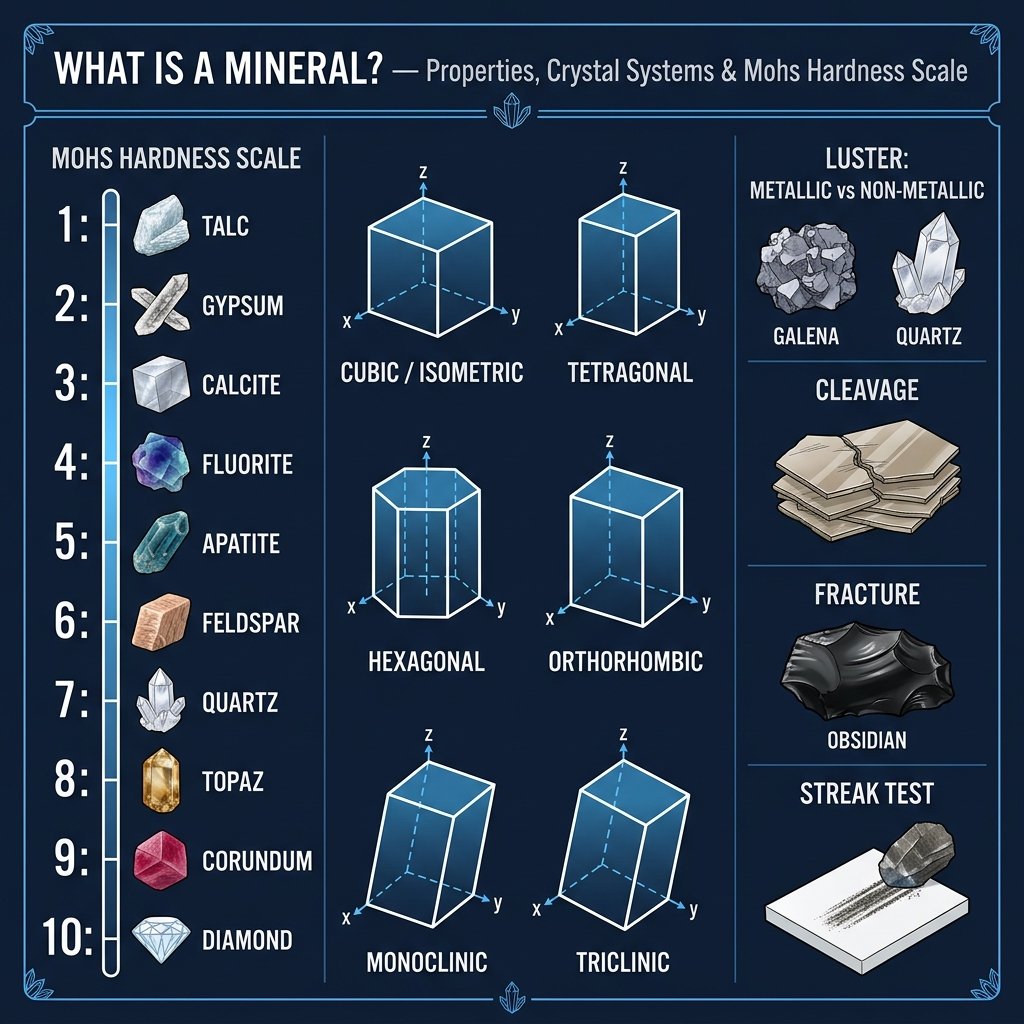
Definition of a Mineral — 5 Criteria
For a substance to be classified as a mineral, it must satisfy ALL five criteria:
| Criterion | Explanation | Example of Exception (not a mineral) |
|---|---|---|
| 1. Naturally occurring | Must form in nature without human manufacture | Synthetic ruby (lab-grown) — not a mineral; natural ruby → mineral |
| 2. Inorganic | Not produced by biological processes of living organisms | Coal, amber, pearl — organic, NOT minerals; coal = rock |
| 3. Solid | Must be solid at standard temperature/pressure (25°C, 1 atm) | Mercury (Hg) is a naturally occurring inorganic substance but is liquid → NOT a mineral (though mercuric ore cinnabar HgS IS a mineral) |
| 4. Definite chemical composition | Can be expressed by a specific chemical formula (may have some variation) | Rocks have variable composition — no fixed formula; coal = variable; NOT mineral |
| 5. Ordered internal structure (crystalline) | Atoms arranged in a regular, repeating 3D lattice | Opal, obsidian volcanic glass — amorphous (no crystal structure) = mineraloids, not true minerals |
💡 Quick trick: Remember the 5 criteria as NISODC — Naturally occurring, Inorganic, Solid, Ordered (crystalline), Definite Chemical composition. All five must be satisfied.
7 Physical Properties Used to Identify Minerals
Geologists identify minerals in the field using physical properties — observable characteristics that arise from a mineral’s composition and crystal structure. No single property uniquely identifies every mineral, so geologists use multiple properties together.
1. Crystal Form (Habit)
- The characteristic external shape a mineral develops as it grows in an unrestricted space
- Examples: Cubic (halite/salt, pyrite), Hexagonal prisms (quartz, calcite), Needle-like (actinolite), Platy (mica, graphite), Prismatic (tourmaline)
- Determined by the internal crystal lattice arrangement
2. Hardness
3. Cleavage
- The tendency of a mineral to break along flat, smooth planes of weakness (along planes of weak atomic bonding)
- Described by number of directions and angle: mica = 1 direction (perfect basal cleavage → peels in sheets); halite = 3 directions at 90° (breaks into perfect cubes); calcite = 3 directions NOT at 90° (rhombohedra)
- Cleavage planes are always parallel to crystal faces
- Diamond has PERFECT cleavage in 4 directions (octahedral) — diamond cutters exploit this to cleave diamonds precisely
4. Fracture
- How a mineral breaks when it does NOT break along cleavage planes
- Conchoidal fracture — smooth, curved surfaces like broken glass (quartz, obsidian, flint) — produces the sharpest natural edges
- Irregular/uneven — rough, jagged surfaces (most metals)
- Fibrous/splintery — wood-like splinters (asbestos, selenite gypsum)
5. Luster
- How a mineral’s surface reflects light
- Metallic luster: looks like polished metal → pyrite (fool’s gold), galena, magnetite, native gold, copper
- Non-metallic luster types: Vitreous/glassy (quartz, tourmaline); Resinous (sulfur); Pearly (mica, talc); Silky (fibrous gypsum, asbestos); Adamantine/brilliant (diamond); Greasy (nepheline); Dull/earthy (kaolin)
6. Streak
- The colour of a mineral’s powder when scratched across an unglazed porcelain plate (streak plate)
- More reliable than surface colour because mineral surface colour can vary (impurities, weathering) but streak is consistent
- Examples: Hematite (Fe₂O₃) = reddish-brown streak regardless of surface colour (may look grey/metallic); Pyrite (FeS₂) = greenish-black streak (despite golden surface — this distinguishes it from real gold whose streak is yellow); Magnetite = black streak
- Only works for minerals softer than the streak plate (~6.5 Mohs)
7. Specific Gravity (Density)
- Ratio of a mineral’s weight to weight of equal volume of water; essentially = density in g/cm³
- Most common silicate minerals: SG = 2.5–3.5 (quartz = 2.65, feldspar = 2.56)
- Heavy/metallic minerals: galena (SG = 7.6), gold (SG = 19.3), magnetite (SG = 5.2)
- Useful for distinguishing minerals of similar appearance: real gold (SG 19.3) vs pyrite/fool’s gold (SG 5.0) — feel the difference in your hand!
Other Diagnostic Properties
- 🧲 Magnetism — magnetite is naturally magnetic; pyrrhotite weakly magnetic
- 💡 Fluorescence — calcite, scheelite, willemite glow under UV light
- 🫧 Effervescence — calcite fizzes when acid (HCl) dropped on it (CO₂ released); diagnostic for carbonate minerals
- 👅 Taste — halite (NaCl) tastes salty; sylvite (KCl) = bitter
- 🔥 Double refraction — calcite shows double image when light passes through (birefringence)
Mohs Hardness Scale — Complete Guide
The Mohs Hardness Scale was devised by German mineralogist Friedrich Mohs in 1812 — one of geology’s most used tools. It ranks minerals on a scale of 1 (softest) to 10 (hardest) based on scratch resistance. A mineral with higher Mohs number will scratch a mineral with a lower number.
| Mohs # | Mineral | Chemical Formula | Key Facts / Common Use |
|---|---|---|---|
| 1 | Talc | Mg₃Si₄O₁₀(OH)₂ | Softest mineral; greasy feel; used in talcum powder, ceramics; can be scratched by a fingernail |
| 2 | Gypsum | CaSO₄·2H₂O | Plaster of Paris, drywall (wallboard); selenite variety = large transparent crystals; fingernail = ~2.5 |
| 3 | Calcite | CaCO₃ | Main mineral in limestone and marble; fizzes with HCl; double refraction; copper coin = ~3.5 |
| 4 | Fluorite | CaF₂ | Fluorescent under UV; source of fluorine; flux in steel-making; octahedral cleavage |
| 5 | Apatite | Ca₅(PO₄)₃(OH,F,Cl) | Main mineral in teeth and bone; phosphate fertiliser source; glass barely scratches it |
| 6 | Orthoclase Feldspar | KAlSi₃O₈ | Most abundant crustal mineral group; in granite; steel knife = ~5.5 (can barely scratch orthoclase) |
| 7 | Quartz | SiO₂ | Most common mineral; scratches glass; used in electronics (piezoelectric); river sand = mostly quartz |
| 8 | Topaz | Al₂SiO₄(F,OH)₂ | Gemstone; silicate mineral; used in jewellery; scratches quartz easily |
| 9 | Corundum | Al₂O₃ | Ruby (red corundum) + Sapphire (blue corundum); used as abrasive (emery paper = impure corundum) |
| 10 | Diamond | C (pure carbon) | Hardest natural substance; industrial cutting/drilling; used in jewellery; only diamond scratches diamond |
🧠 Memory trick (1–10): The Girl Called Felicia Ate Oranges Quite Tastefully Choking Down → Talc, Gypsum, Calcite, Fluorite, Apatite, Orthoclase, Quartz, Topaz, Corundum, Diamond
Crystal Systems — 6 Types
Minerals crystallise into one of six crystal systems based on the symmetry of their internal atomic arrangement. The crystal system determines the external shape (habit) of the mineral when it grows freely.
| Crystal System | Axes | Angles | Examples |
|---|---|---|---|
| Isometric (Cubic) | 3 equal axes | All 90° | Halite (salt), Pyrite, Galena, Diamond, Gold, Fluorite — forms cubes, octahedra, dodecahedra |
| Tetragonal | 2 equal + 1 unequal axis | All 90° | Zircon, Cassiterite (tin ore), Rutile (TiO₂) — forms square prisms, pyramids |
| Hexagonal | 3 equal horizontal + 1 vertical | Horizontal 60°/120°, vertical 90° | Quartz, Calcite, Apatite, Beryl (emerald), Ice — forms hexagonal prisms with pyramidal ends |
| Orthorhombic | 3 unequal axes | All 90° | Olivine, Topaz, Sulfur, Barite — forms rhombic prisms, pyramids |
| Monoclinic | 3 unequal axes | One ≠ 90° (β angle oblique) | Gypsum, Orthoclase feldspar, Augite, Hornblende — most common crystal system for minerals |
| Triclinic | 3 unequal axes | None at 90° | Plagioclase feldspar (albite, anorthite), Kyanite — lowest symmetry; most complex shapes |
Major Mineral Groups
| Group | Chemistry | % of Crust | Key Minerals |
|---|---|---|---|
| Silicates | SiO₄ tetrahedron as basic unit | ~92% | Quartz (SiO₂), Feldspar, Mica, Pyroxene (augite), Amphibole (hornblende), Olivine — dominant rock-forming minerals |
| Carbonates | CO₃²⁻ ion | ~2% | Calcite (CaCO₃), Dolomite [CaMg(CO₃)₂], Aragonite — fizz with HCl; limestone/marble minerals |
| Oxides | Metal + oxygen | ~1.5% | Hematite (Fe₂O₃), Magnetite (Fe₃O₄), Corundum (Al₂O₃), Ilmenite (FeTiO₃), Rutile (TiO₂) — major ore minerals |
| Sulfides | Metal + sulfur | <1% | Pyrite (FeS₂ = fool’s gold), Galena (PbS = lead ore), Chalcopyrite (CuFeS₂ = copper ore), Sphalerite (ZnS = zinc ore) — most metal ores |
| Halides | Metal + halogen (F, Cl, Br) | <1% | Halite (NaCl = rock salt), Fluorite (CaF₂), Sylvite (KCl) — evaporite minerals |
| Phosphates | PO₄³⁻ ion | <1% | Apatite [Ca₅(PO₄)₃(OH,F,Cl)] — in bone, teeth, fertiliser ore |
| Native Elements | Single element | Trace | Gold (Au), Silver (Ag), Copper (Cu), Diamond (C), Graphite (C), Sulfur (S), Platinum (Pt) |
| Sulfates | Metal + SO₄²⁻ | <1% | Gypsum (CaSO₄·2H₂O), Barite (BaSO₄), Anhydrite (CaSO₄) — evaporite deposits |
Most Important Rock-Forming Minerals
- 🔵 Quartz (SiO₂) — Mohs 7; most common mineral; glassy luster; conchoidal fracture; in granite, sandstone, quartzite; river sand = mostly quartz; piezoelectric (used in watches, electronics)
- 🟠 Feldspar group — most abundant mineral group (~60% of crust); two types: Orthoclase (KAlSi₃O₈, pink — in granite) + Plagioclase (NaAlSi₃O₈ to CaAl₂Si₂O₈, white/grey — in basalt, andesite); weathers to form clay minerals and aluminum ore (bauxite)
- ✨ Mica group — sheet silicates; perfect basal cleavage → peels in thin flexible sheets; Muscovite (K-mica, colourless/pale) + Biotite (Fe-Mg mica, dark brown/black); used in electronics (insulator), cosmetics (shimmer), India’s Jharkhand mica belt
- 🟢 Olivine [(Mg,Fe)₂SiO₄] — olive-green; Mohs 6.5–7; most abundant mineral in Earth’s upper mantle; in basalt and gabbro; weathers rapidly to iron-rich soils
- ⬛ Pyroxene (Augite) — dark; short prisms; in basalt and gabbro; common in oceanic crust; two cleavage planes at ~90°
- 🔷 Amphibole (Hornblende) — black/dark green; elongated crystals; in granite, diorite; two cleavage planes at ~120°/60° — key distinction from pyroxene
- ⬜ Calcite (CaCO₃) — Mohs 3; rhombohedral cleavage; fizzes with HCl; white; in limestone, marble, chalk; double refraction; stalactites/stalagmites in caves
- 🟡 Gypsum (CaSO₄·2H₂O) — Mohs 2; pearly luster; in evaporite deposits; used for plaster of Paris, drywall, agriculture (soil amendment)
⭐ Important for Exams — Quick Revision
- 🔑 5 criteria for mineral: Naturally occurring, Inorganic, Solid, Ordered (crystalline), Definite Chemical composition (NISODC)
- 🔑 Coal, pearl, amber = NOT minerals (organic origin)
- 🔑 Obsidian, opal = mineraloids (no crystal structure)
- 🔑 Mohs Scale 1–10: Talc→Gypsum→Calcite→Fluorite→Apatite→Orthoclase→Quartz→Topaz→Corundum→Diamond
- 🔑 Diamond (Mohs 10) = hardest natural substance; pure carbon (C); cubic crystal system; 4 directions perfect cleavage
- 🔑 Quartz (Mohs 7) = most common mineral; SiO₂; scratches glass; conchoidal fracture; river sand = quartz
- 🔑 Corundum (Mohs 9) = Ruby (red) + Sapphire (blue) = same mineral, different colours; emery paper = impure corundum
- 🔑 Streak = powder colour on porcelain plate = more reliable than surface colour; pyrite (FeS₂) → green-black streak (NOT gold) = distinguishes fool’s gold
- 🔑 Luster: Metallic (pyrite, galena) vs Non-metallic subtypes (vitreous=quartz; adamantine=diamond; pearly=mica; silky=fibrous gypsum)
- 🔑 Silicates = 92% of Earth’s crust — SiO₄ tetrahedron building block; quartz + feldspar + mica + pyroxene + amphibole + olivine
- 🔑 Feldspar = most ABUNDANT mineral group (~60% of crust); orthoclase (pink, granite) + plagioclase (white, basalt)
- 🔑 Mica = perfect basal cleavage (1 direction) → peels in sheets; muscovite (white) + biotite (black); Jharkhand = India’s mica capital
- 🔑 Hematite (Fe₂O₃) = iron ore; reddish-brown streak; metallic luster; Odisha-Jharkhand = India’s largest deposits
- 🔑 Calcite = fizzes with HCl; Mohs 3; in limestone/marble; rhombohedral cleavage (3 planes NOT at 90°)
Frequently Asked Questions (FAQs)
1. How did Friedrich Mohs create his hardness scale and what are its limitations?
Friedrich Mohs (1773–1839), an Austrian mineralogist, created his hardness scale in 1812 by simply finding which minerals scratched which other minerals. He tested minerals available in his collection and arranged them in scratch order, calling the sequence 1 to 10. The scale is entirely relative, not absolute — the intervals between steps are NOT equal. For example, the difference between 9 (corundum) and 10 (diamond) is enormous in absolute hardness: diamond is actually about 4× harder than corundum in absolute terms (measured by Vickers or Knoop hardness tests), even though they’re just one step apart on Mohs. Between 1 and 9, the absolute hardness differences are relatively small. Mohs scale limitations: (1) Not linear; (2) Cannot distinguish small hardness differences within a step (e.g., all Mohs 7 minerals); (3) Doesn’t apply to anisotropic minerals where hardness varies by crystal direction (kyanite = 4.5 parallel to one axis, 7 perpendicular). Despite these limitations, Mohs scale remains invaluable because it requires NO equipment — a geologist can test minerals in the field using fingernail, coins, and a knife.
2. What is the difference between cleavage and fracture in minerals?
Cleavage and fracture are both ways minerals break — but they reflect completely different aspects of mineral structure. Cleavage is the tendency to break along specific, flat, smooth planes of weakness that are parallel to atomic bond planes. When a mineral cleaves, it always produces the same flat surfaces at specific angles — determined by which planes of atoms are most weakly bonded. The number and angles of cleavage planes are characteristic: mica has 1 perfect cleavage direction (basal); halite has 3 perfect cleavages at 90° (makes cubes); calcite has 3 perfect cleavages NOT at 90° (makes rhombohedra); hornblende has 2 cleavages at 60°/120°; pyroxene has 2 cleavages at ~90°. Fracture occurs when a mineral breaks WITHOUT following a cleavage plane — it breaks irregularly, governed by how tightly atoms are bonded in the bulk structure rather than along specific atomic planes. Quartz shows classic conchoidal fracture — smooth curved surfaces like a shell (from Greek: choncha = shell). Diamond, despite being the hardest mineral, breaks easily along its perfect cleavage planes — hardness (resistance to scratching) is very different from toughness (resistance to breaking). This is why diamonds can be cleaved into smaller pieces by a sharp blow.
3. Why is silicate the dominant mineral group in Earth’s crust?
Silicate minerals dominate Earth’s crust (~92%) because silicon (Si) and oxygen (O) are the two most abundant elements in Earth’s crust: oxygen = 46% by weight, silicon = 28% by weight. Together they constitute ~74% of Earth’s crust by weight. The SiO₄ tetrahedron (one silicon atom surrounded by 4 oxygen atoms) is extraordinarily stable — the Si-O bond is one of the strongest in common minerals. From this basic unit, an enormous variety of silicate minerals form by linking SiO₄ tetrahedra in different ways (isolated tetrahedra in olivine; chains in pyroxene; double chains in amphibole; sheets in mica; 3D frameworks in feldspar and quartz). The variety of structures explains why silicates range from soft talc (Mohs 1) to hard quartz (Mohs 7) — same chemistry, completely different atomic arrangements. Non-silicate minerals (carbonates, sulfides, oxides) form from elements present in smaller abundances (C, S, Fe) — they are economically important (iron ores, copper ores, salt) but volumetrically minor. Earth’s mantle below the crust is even more silicate-dominated — olivine is the most abundant mineral in the upper mantle.
Related Geology Articles on StudyHub
- ➡️ What is a Rock? — Rocks Made of Minerals
- ➡️ Mineral Resources of India — Economic Minerals Explained
- ➡️ Igneous Rocks — Rock-Forming Minerals in Granite & Basalt
- ➡️ Plate Tectonics — How Minerals Form at Boundaries
- ➡️ Earth’s Core — Minerals Under Extreme Pressure