Last Updated: March 2026 | Reading Time: 8 minutes | ~1,900 words
Acute diarrhoeal disease remains one of India’s most significant preventable causes of death — particularly in children under five. India records approximately 40 million diarrhoeal episodes annually, with diarrhoea accounting for approximately 13% of under-5 mortality in India (UNICEF/WHO data) — approximately 100,000–120,000 child deaths per year. Adults are also severely affected: cholera outbreaks (due to Vibrio cholerae O1/O139), typhoid fever, food poisoning, and travellers’ diarrhoea cause significant morbidity and economic disruption. The cornerstone of diarrhoea management — Oral Rehydration Solution (ORS) — is one of the most cost-effective medical interventions ever developed and has saved an estimated 50–70 million lives globally since WHO/UNICEF promoted it from the 1970s. Despite this, ORS use is paradoxically low in India — surveys consistently show only 30–40% of Indian children with diarrhoea receive ORS; antibiotics are given unnecessarily in up to 60–70% of cases (worsening antimicrobial resistance without improving outcomes in most diarrhoeas); and intravenous fluids are over-prescribed when ORS would suffice. The critical messages — ORS first, zinc in children, antibiotics only for specific indications, and the ability to assess and manage dehydration correctly — remain inadequately disseminated across India’s health system.
Acute Diarrhoea — Classification, Causes and Treatment
| Category / Cause | Features | WHO Dehydration Assessment | Treatment India |
|---|---|---|---|
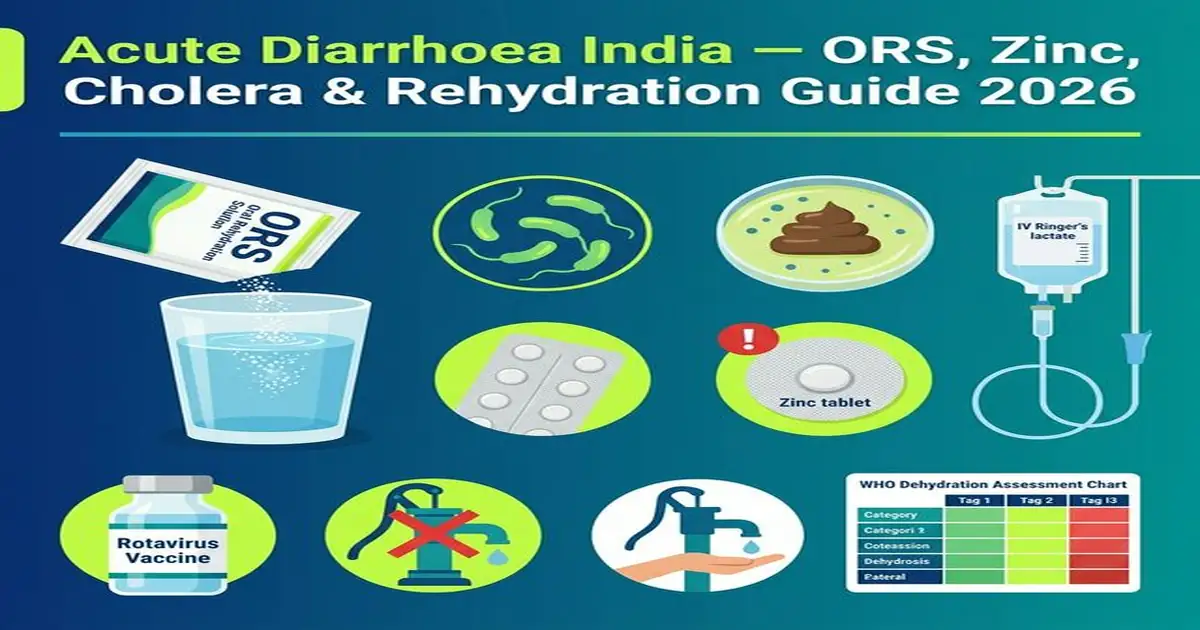
| Self-limiting Watery Diarrhoea (Viral / ETEC) | Most common acute diarrhoea India; causes: Rotavirus (leading cause under-5 — watery, vomiting, fever), Norovirus, ETEC (enterotoxigenic E. coli — travellers’ diarrhoea; profuse watery), Cryptosporidium (immunocompromised + children + contaminated water); 3+ loose/liquid stools per day; usually resolves in 3–7 days; NO blood in stool; antibiotics NOT indicated (self-limiting) | Plan A (No dehydration): increased thirst, normal; give ORS after each loose stool; continue feeding; Plan B (Some dehydration): sunken eyes, skin pinch slow to recoil, restless; give 75mL/kg ORS over 4 hours (supervised); Plan C (Severe dehydration): lethargic/unconscious, cannot drink, very sunken eyes, skin pinch very slow; immediate IV Ringer’s Lactate (RL) 100mL/kg rapidly (infants 1hr; children 3hr) → switch to ORS when can drink | ORS (oral rehydration solution — WHO low-osmolarity formula: 75mEq/L sodium, 13.5g/L glucose, 65mEq/L chloride, 20mEq/L potassium, 10mEq/L citrate; osmolarity 245 mOsm/L): dissolve 1 ORS sachet in 1 litre of clean water; give continuously; low-osmolarity ORS reduces stool output and vomiting compared to old high-osmolarity formula; available as Electral, Enerzal, Neopeptide, Pedialyte India; government free ORS sachets at ASHA/ANM/PHC; Zinc tablets (elemental zinc): children 6 months–5 yrs: 20mg/day × 14 days; infants <6m: 10mg/day × 14 days; reduces diarrhoea duration by 25%, severity by 30%, prevents recurrence 3 months; IMNCI protocol mandated; Rotavirus vaccine (Rotarix — 2 dose; Rotavac — 3 dose; India manufactured): in Universal Immunisation Programme (UIP) from 2016 — dramatically reduces rotavirus diarrhoea hospitalisation; Continue feeding: breastfeed throughout; do NOT withhold food (starving worsens mucosal recovery) |
| Cholera (Vibrio cholerae O1/O139) | Rice-water stools: profuse, painless, watery stools with characteristic “rice-water” appearance (mucus flecks without faeces — classic cholera appearance); can lose 10–20 litres of fluid per day; rapid profound dehydration → death in hours if untreated; abdominal cramps; vomiting; NO fever (cholera is afebrile — fever suggests another diagnosis or co-infection); “washerwoman’s hands” — skin wrinkling from fluid loss; lab: stool dark-field microscopy (shooting-star motility of vibrio); stool culture (TCBS agar); rapid cholera RDT (Crystal VC — sensitivity 80%); cholera outbreaks India: common in disaster settings (Bengal floods, Odisha, Bihar — contaminated water after floods); IDSP outbreak reporting mandatory | Most cholera patients develop Plan C (severe dehydration) rapidly; rapid assessment essential; do NOT delay IV fluids if severely dehydrated; Ringer’s Lactate (RL) preferred over normal saline (cholera causes metabolic acidosis + hypokalaemia — RL contains lactate + potassium — better physiological replacement); rate: 30mL/kg in first 30 minutes (adults) → 70mL/kg next 2.5 hours; continuous ORS running parallel once vomiting stops; monitor: pulse, BP, urine output hourly; intake-output charts critical | IV Ringer’s Lactate: mainstay of severe cholera; single most important intervention; Oral Rehydration: switch to ORS as soon as patient can drink (ORS is as effective as IV in moderate dehydration — even in cholera); Antibiotics (cholera ONLY — reduces duration and fluid loss): WHO-recommended: Doxycycline 300mg single dose (adults; not children <8yr, pregnancy); Azithromycin 1g single dose (adults) or 20mg/kg (children) — preferred in children, pregnancy; Ciprofloxacin 1g single dose (alternative); antibiotic resistance surveillance: azithromycin resistance emerging in some Indian cholera strains; antibiotic reduces cholera duration by ~50%; Oral Cholera Vaccine (OCV): Shanchol (India-manufactured — oral, killed — WHO prequalified); 2-dose schedule; used in outbreak control and high-risk endemic areas; Potassium monitoring: cholera depletes potassium severely → cardiac arrhythmia risk; give KCl supplementation in severe cases |
| Dysentery (Bloody Diarrhoea — Shigella / Amoeba / EHEC) | Bloody + mucoid stool; tenesmus (painful straining); fever (Shigella, Campylobacter — fever prominent; E. histolytica — mild fever); abdominal cramps; Shigella: most common cause of dysentery India; highly contagious (very low infectious dose — 10–100 organisms); important complication: haemolytic uraemic syndrome (HUS) — particularly Shigella dysenteriae type 1 and EHEC O157:H7 (rare India but serious) → AKI + haemolytic anaemia + thrombocytopenia; E. histolytica (amoebiasis): gradual onset; bloody mucoid stool; caecal/right colonic; liver abscess (RUQ pain + fever) as extra-intestinal spread; stool microscopy: E. histolytica trophozoites with ingested RBCs (pathognomonic) | Clinical assessment for dehydration (same WHO criteria); fever workup; stool microscopy (Shigella: white cell-rich stool; amoeba: trophozoites); stool culture (MacConkey agar + XLD); complete blood count (HUS: haemolytic anaemia + thrombocytopenia + rising creatinine — dangerous combination) | Dysentery (presumed Shigella): Ciprofloxacin 500mg twice daily × 3 days (adults); Azithromycin 10–12mg/kg/day × 3 days (children — resistance less); Ceftriaxone IV for severe/hospitalised; do NOT give loperamide (antimotility) in dysentery — prolongs haemorrhagic colitis and HUS risk; HUS: no antibiotics if EHEC/HUS suspected (antibiotic triggers toxin release → worsens HUS); supportive care + haemodialysis; EHEC O157 India: rare but BSL-3 nationally notifiable; Amoebic dysentery: Metronidazole 500–750mg TDS × 7–10 days → followed by Diloxanide furoate 500mg TDS × 10 days (luminal agent — eradicates intestinal cyst); Amoebic liver abscess: metronidazole IV + ultrasound-guided drainage if large (>5cm) or not responding |
| Antibiotic-Associated Diarrhoea (AAD) / C. difficile | Diarrhoea during or after antibiotic use; Clostridioides difficile (C. diff): toxin-mediated colitis; watery to bloody diarrhoea; pseudomembranous colitis in severe; risk: recent hospitalisation, broad-spectrum antibiotics (cephalosporins, fluoroquinolones, clindamycin), immunocompromised, elderly; India C. diff: increasingly recognised as hospital-acquired diarrhoea | Stool C. difficile toxin (GDH + Toxin A/B EIA); stool PCR (most sensitive); colonoscopy if pseudomembranes suspected (STOP if toxic megacolon) | STOP causative antibiotic immediately (if possible); Vancomycin 125mg oral QDS × 10 days (1st line — superior to metronidazole in 2022 ESCMID guidelines); Fidaxomicin (if available, lower recurrence); Metronidazole 400mg TDS × 10 days (second-line if vancomycin unavailable — still widely used India given cost); Bezlotoxumab (monoclonal anti-toxin B): prevents recurrence (limited India access); Faecal microbiota transplantation (FMT): recurrent CDI — available at tertiary centres India (AIIMS, CMC Vellore) |
| Food Poisoning (Pre-formed Toxin) | Rapid onset (1–6 hours): Staphylococcus aureus (processed food — rice/cream); Bacillus cereus (fried rice — emetic type); Clustered cases after shared meal; typically vomiting-dominant; short duration (12–24 hours); NO fever; Slower onset (12–72 hours): Salmonella (raw eggs, undercooked poultry); C. botulinum (home-canned food — descending paralysis — rare India); India: mass food poisoning events common at weddings/community events/midday meal schemes → FSSAI/IDSP report | Clinically apparent from history; stool culture (Salmonella); outbreak investigation: lab testing of food samples | Supportive: ORS/IV fluids; most resolve within 24–48 hours without specific treatment; antibiotics NOT indicated for Staph/B. cereus/ETEC food poisoning; Salmonella non-typhoidal: antibiotics only if severe/bacteraemic (azithromycin, ciprofloxacin); botulism: antitoxin (Heptavalent HBAT) — national stockpile ICMR; India: MIDDAY MEAL food poisoning outbreaks — Chhapra Bihar 2013 (23 school children died) — FSSAI regulations for school meal inspection |
Frequently Asked Questions
Why is ORS more important than IV drip — and how is it prepared correctly?
Oral Rehydration Solution (ORS) is one of the greatest medical achievements of the 20th century — and yet it remains dramatically underused in India, while IV drips are over-prescribed and often incorrectly administered. Understanding why ORS works — and how to make and give it correctly — is essential knowledge for every Indian parent, ASHA worker, and healthcare provider: The science behind ORS — the sodium-glucose cotransporter: The gut’s sodium-glucose cotransporter (SGLT1) on the intestinal enterocyte remains functional even during severe diarrhoea (even cholera — the SGLT1 transporter is unaffected by cholera toxin’s cyclic AMP-mediated chloride hypersecretion); when glucose and sodium are present together in the intestinal lumen in the correct ratio → SGLT1 actively co-transports 1 glucose + 1 sodium into the enterocyte → water follows osmotically; ORS exploits this intact absorptive mechanism to drive net water absorption even in the presence of active secretory diarrhoea; this is why 1 glass of ORS is absorbed by the gut even as 1 litre of rice-water stool is being secreted; glucose alone (plain 7-Up/cola drinks — NOT suitable ORS substitutes — wrong sodium:glucose ratio) or water alone (may worsen hyponatraemia in salt-depleted children) do not work; the WHO low-osmolarity formula (75mEq/L sodium + 75mmol/L glucose; total osmolarity 245 mOsm/L) has been scientifically designed and validated. ORS preparation in India — common errors to avoid: Correct: dissolve 1 standard ORS sachet (Electral, Neopeptide, WHO-ORS) in exactly 1 litre of clean water (boiled and cooled is best; filtered acceptable; river/well water NOT); stir until fully dissolved; give sip by sip continuously; Common errors: dissolving in less water (500mL instead of 1L → hypertonic ORS → worsens diarrhoea); adding extra sugar (increases osmolarity → worsens); adding extra salt (hypernatraemia risk); using Glucon-D (glucose drinks — insufficient sodium); using Sprite/cola (non-physiological sodium:glucose ratio; carbonation); reusing prepared ORS after 24 hours (bacterial contamination risk — discard unused portion after 24h). Homemade ORS (when sachets unavailable): WHO formula for homemade ORS: 6 level teaspoons of sugar + 1/2 level teaspoon of salt in 1 litre of clean water; this approximates the sodium:glucose ratio adequately for mild-moderate dehydration; can add banana (potassium) or rice water (less diarrhoea — slow starch absorption); coconut water (natural electrolytes) is acceptable adjunct; rice-based ORS (rice water + salt): traditional India — demonstrated to reduce stool output in cholera by 30% vs glucose-based ORS. ORS vs IV drip — when each is needed: ORS Plan A (no dehydration): home management, no hospital; ORS Plan B (some dehydration): supervised at health facility; 75mL/kg over 4 hours → reassess; ORS can be given by NG tube if child refuses oral; IV Ringer’s Lactate Plan C (severe dehydration): necessary — cannot wait for oral route when severely dehydrated (unconscious, shock, unable to drink); IV is a BRIDGE to ORS — as soon as patient can drink → switch to ORS; over-prescribing IV drips in mild-moderate dehydration: causes hypernatraemia (if normal saline given incorrectly), fluid overload in elderly/cardiac patients, hospital-associated infections (IV line infection), unnecessary cost and hospitalisation — major problem in Indian private healthcare.
When do antibiotics help in diarrhoea — and when do they cause harm?
India faces a severe antimicrobial resistance (AMR) crisis, and irrational antibiotic use in diarrhoea is a major contributor — yet most Indian patients expect and demand antibiotics for any diarrhoeal episode, and most private practitioners prescribe them reflexively: When antibiotics are indicated in diarrhoea (SPECIFIC indications only): Cholera: single-dose doxycycline 300mg (adults) or azithromycin 1g (adults/children/pregnancy) — reduces severity, duration, and infectivity of cholera; mandatory in confirmed/suspected cholera outbreaks; Shigella dysentery: ciprofloxacin or azithromycin × 3 days — reduces severity and transmission; Travellers’ diarrhoea (ETEC) — severe cases: azithromycin 500mg once daily × 3 days (fluoroquinolone resistance high in India); Giardiasis: metronidazole 400mg TDS × 7–10 days OR tinidazole 2g single dose; Amoebic dysentery: metronidazole + diloxanide furoate (see above); C. difficile: vancomycin oral or fidaxomicin; Severe Salmonella non-typhoidal with bacteraemia/fever: azithromycin or ciprofloxacin; Immunocompromised patients with ANY bacterial diarrhoea: lower threshold for antibiotics. When antibiotics are NOT indicated and cause harm: Viral diarrhoeas (Rotavirus, Norovirus — majority of paediatric diarrhoea in India): antibiotics have zero effect on viral pathogens; expose child to antibiotic side effects; accelerate AMR development; ETEC/EPEC mild watery diarrhoea in immunocompetent adults: self-limiting within 3–5 days; ORS alone sufficient; Food poisoning (Staph aureus toxin, B. cereus): pre-formed toxin disease; antibiotic cannot neutralise already-present toxin; useless; EHEC/HUS suspected: antibiotics INCREASE risk of HUS (antibiotic kills EHEC → massive Shiga toxin release → HUS triggering); DO NOT GIVE antibiotics if haemolytic uraemic syndrome is suspected; Metronidazole for all diarrhoeas: extremely common irrational practice in Indian private practice — metronidazole appropriate ONLY for confirmed/suspected amoeba, giardia, C. diff; not for routine watery diarrhoea; widespread misuse has contributed to metronidazole resistance in E. histolytica in India. India’s antibiotic resistance in gut pathogens — 2025 status: Shigella: 70–80% ciprofloxacin resistance in India → azithromycin preferred empirically; Multi-drug resistant (MDR) typhoidal Salmonella: XDR typhoid (extensively drug-resistant — resistant to ampicillin, CMP, TMP-SMX, fluoroquinolones, ceftriaxone) emerging: azithromycin oral (mild-moderate XDR typhoid) or cephalosporins; ESBL-producing E. coli (diarrhoeal strains): carbapenems if severe; high prevalence India; V. cholerae azithromycin resistance: sporadic India strains — susceptibility testing increasingly important in outbreak management.
What to Read Next
- Typhoid — Related Waterborne Disease; Ceftriaxone for Severe Typhoid; XDR Typhoid Azithromycin; Vi Polysaccharide Vaccine in UIP
- Child Malnutrition — Diarrhoea + Malnutrition Cycle: Diarrhoea Worsens Malnutrition; IMNCI ORS+Zinc Protocol; RUTF + ORS Simultaneously
- Leptospirosis — Also Waterborne (Contaminated Floodwater); Monsoon Season Peak Same as Cholera/Diarrhoea — Differentiate by Calf Tenderness + Jaundice
- Kidney — Severe Dehydration from Diarrhoea Causes Prerenal AKI; Ringer’s Lactate + ORS Restores — Distinguishes from Intrinsic AKI
- IBS/IBD — Chronic Bloody Diarrhoea Lasting >4 Weeks Requires Colonoscopy; Distinguish from Infectious Dysentery; Ulcerative Colitis + Crohn’s
Bihar. A 2-year-old develops watery diarrhoea and vomiting during the monsoon. The local RMP (rural medical practitioner) gives an antibiotic injection and IV drip. The next morning the child is moribund — sodium 155 mEq/L (hypernatraemia from incorrect IV fluid). The district hospital ORT corner treats her with ORS and corrects the hypernatraemia slowly over 48 hours. She survives. ₹8 — the cost of an ORS packet that might have avoided the entire cascade if given at home at the first loose stool. The antibiotic she received was unnecessary. The IV drip caused harm. The ORS would have cured her without either. Fifty years of evidence. Still unused at scale in India.
About This Guide: Written by the StudyHub Health Editorial Team (studyhub.net.in) based on WHO/UNICEF Management of Diarrhoeal Diseases (updated 2023), India IMNCI protocol, IDSP cholera outbreak guidance 2022, and ICMR AMR surveillance data 2024. Last updated: March 2026.
💧 ORS First — Always: For any watery diarrhoea in adults or children: 1 ORS packet (Electral ₹8) dissolved in 1 litre of clean water → give continuously after every loose stool. Continue feeding. Children under 5: add Zinc 20mg/day × 14 days (available free at ASHA/PHC). Do NOT withhold food. You do NOT need an antibiotic for watery diarrhoea unless your doctor specifically prescribes it for cholera, Shigella, or Giardia.
🚨 Go to Hospital If: Diarrhoea + cannot drink at all (severe vomiting); OR sunken eyes + lethargy + very dry mouth + no tears when crying (severe dehydration); OR blood in stool + high fever (dysentery); OR diarrhoea in infant <6 months (high-risk); OR rice-water profuse stool (cholera). These require IV fluids and hospital assessment urgently.
⚕️ Medical Disclaimer: This article provides general educational information about diarrhoeal disease management. Severe dehydration, cholera, and bloody diarrhoea require qualified healthcare professional assessment. Do not self-prescribe antibiotics for diarrhoea without medical advice.