Last Updated: March 2026 | Reading Time: 9 minutes | ~2,100 words
India has the world’s third-largest HIV burden — approximately 2.4 million people living with HIV (PLHIV) as of 2023 (NACO India HIV Estimates 2023). India’s HIV epidemic has undergone a dramatic transformation over three decades: from an uncontrolled epidemic in the 1990s–2000s (driven by heterosexual transmission, injecting drug use, commercial sex networks) to a declining prevalence epidemic — new HIV infections declined by 46% and AIDS-related deaths by 76% between 2010 and 2022 — one of the world’s most successful HIV programme turnarounds. India’s national ART (antiretroviral therapy) programme — among the world’s largest free antiretroviral programmes — provides free ART to approximately 1.8 million PLHIV through a network of 700+ ART centres, 3,000+ Link ART centres, and community-based centres. The current standard first-line regimen — TDF + 3TC + DTG (Tenofovir Disoproxil Fumarate + Lamivudine + Dolutegravir) — is the most potent, best-tolerated, and highest-barrier-to-resistance ART ever developed, and is provided free at government ART centres under NACO (National AIDS Control Organisation). Despite these achievements, significant gaps remain: approximately 20–25% of PLHIV in India remain undiagnosed; treatment coverage among diagnosed individuals is approximately 75–80%; viral suppression rates are approximately 90% among those on ART — but the cascade of care “leaks” at diagnosis and linkage stages. The paradigm-shifting concept of U=U (Undetectable = Untransmittable) — scientifically confirmed by the PARTNER, PARTNER2, and Opposites Attract studies — has transformed HIV prevention discourse: a person on ART with undetectable viral load (<50 copies/mL) cannot transmit HIV sexually.
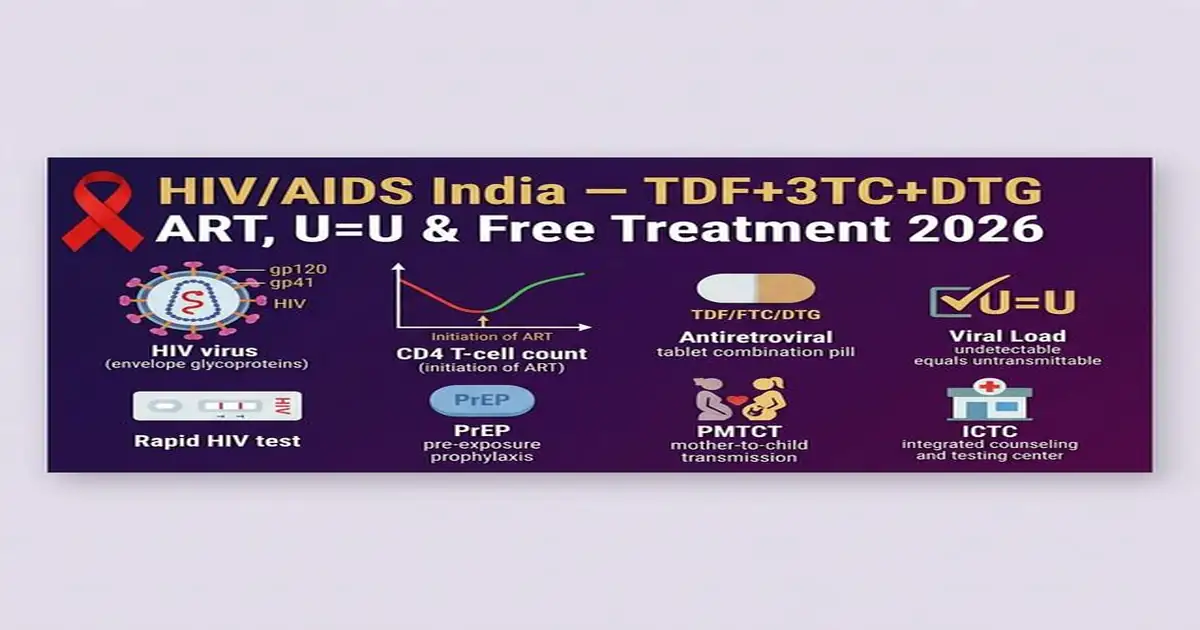
HIV India — ART Regimens, Treatment Cascade and Prevention
| Category | Current Standard (NACO 2023) | Key Endpoints | India Access & Cost |
|---|---|---|---|
| First-Line ART — Treatment-Naive Adults | TDF (300mg) + 3TC (300mg) + DTG (50mg): once-daily single tablet combination (or co-packaged); current NACO first-line standard from 2022 (replaced older TDF+3TC+EFV); DTG (dolutegravir) advantages: high genetic barrier to resistance (requires 2+ mutations to fail vs 1 for NNRTI); no food restriction; excellent tolerability; minimal CNS effects (vs EFV — nightmares, dizziness); pan-genotypic HIV coverage; rapid viral load decline; alternative (DTG contraindicated or unavailable): TDF + 3TC + EFV 600mg (older regimen — still used in some settings); ABC+3TC+DTG (if TDF contraindicated — renal disease); TAF+3TC+DTG (if TDF + renal compromise — TAF safer kidney/bone profile) | Viral load target: <50 copies/mL at 6 months (WHO viral suppression threshold); viral load monitoring: NACO recommends at 6 months, 12 months, then annually; CD4 count: baseline + 6 months + annually; U=U (Undetectable = Untransmittable): viral load <200 copies/mL → cannot transmit HIV sexually (WHO/UNAIDS 2019 consensus); CD4 recovery: rises 100–200 cells/µL/year with effective ART; immune reconstitution inflammatory syndrome (IRIS): paradoxical worsening of opportunistic infection 4–8 weeks after ART initiation in CD4 <100 — most common in TB-HIV coinfection (TB-IRIS) | Generic TDF+3TC+DTG: ₹70–150/month (Cipla, Aurobindo, Mylan — Indian-manufactured generics under voluntary licence from ViiV Healthcare/Gilead); world’s most affordable ART; Government free ART: NACO provides TDF+3TC+DTG FREE at all ART centres (hospital + Link ART centres); ART centre network: 700+ ART centres + 3000+ Link ART centres + community ART centres; ART collection: monthly collection at Link ART centre (multi-month dispensing/3-month collection increasingly available); branded DTG (Tivicay ViiV): ₹10,000+/month; generic: ₹150/month — transformative global health equity |
| Second-Line ART (First-Line Failure) | First-line failure definition: viral load >1000 copies/mL on two consecutive measurements 3 months apart while on 1st-line ART with confirmed adherence; Second-line (after TDF+3TC+DTG failure): PI-based: Lopinavir/ritonavir (LPV/r) 400/100mg twice daily + 2 NRTIs (AZT+3TC or TDF+3TC based on genotypic resistance); Darunavir/ritonavir (DRV/r) 800/100mg once daily + optimised background (preferred PI 2nd-line globally — higher genetic barrier); Dolutegravir-based 2nd-line: if initial regimen was EFV-based + suspected NRTI resistance — use DRV/r + DTG + 2 NRTIs; Atazanavir/ritonavir (ATV/r): NACO 2nd-line option; genotypic resistance testing (HIV drug resistance — GRT): NACO ART centres refer to Regional Reference Labs for GRT if 2nd line failing to guide 3rd line selection | Second-line viral load monitoring: at 3, 6, 12 months; resistance testing if 2nd-line fails; CD4 recovery post-2nd-line; metabolic monitoring: PIs increase TG, cholesterol, glucose → lipid panel + fasting glucose monitoring; DRV/r: excellent tolerability; fewer metabolic effects than LPV/r | Generic LPV/r: ₹200–400/month (Cipla, Aurobindo); Generic DRV/r: ₹400–600/month; NACO provides 2nd-line ART free at State ART Plus (SAC+) centres and tertiary hospitals; ART Plus centres India: at medical college hospitals — AIIMS, PGIMER, JIPMER, SGPGI, NIMHANS; genotypic resistance testing: available at NARI Pune (ICMR), AIIMS Delhi — NACO refers complex treatment failure cases; 3rd-line ART (integrase inhibitor-based salvage): Bictegravir/TAF/FTC or DRV + boosted PI salvage — extremely limited India access; NACO covers on case-by-case compassionate basis |
| PMTCT (Prevention of Mother-to-Child Transmission) | PMTCT India — Option B+ (universal ART for all HIV-positive pregnant women): All HIV-positive pregnant women start lifelong ART regardless of CD4 count (option B+); regimen: TDF+3TC+DTG (EFV previously — DTG now preferred from 2nd trimester; neural tube defect concern with DTG in 1st trimester periconception resolved — NACO updated 2022); Infant prophylaxis: Nevirapine (NVP) syrup for 6 weeks (standard risk infant) or 12 weeks (high-risk — mother VL detectable at delivery); breastfeeding: NACO recommends exclusive breastfeeding + maternal ART (mother’s suppressed VL protects infant — supported by PROMISE trial); elective caesarean: if VL detectable near delivery; HIV DNA PCR at 6 weeks (infant diagnosis); repeat at 18 months + 6 weeks post-breastfeeding cessation | PMTCT goal: <2% MTCT at 6 weeks (WHO target); India MTCT rate: approximately 5–8% overall (much lower in states with strong PPTCT programmes — AP, Tamil Nadu <2%); PPTCT programme: all antenatal women screened for HIV at first ANC visit (rapid HIV test); discordant couples: HIV-negative partner: PrEP recommended | PPTCT (Prevention of Parent-to-Child Transmission): India government programme — free ART to all HIV-positive pregnant women; NVP infant syrup: free at government hospitals; HIV DNA PCR for infants: available at NACO ICTC labs; ICTC (Integrated Counselling and Testing Centres): >25,000 ICTCs across India — free HIV testing + counselling; free rapid HIV tests (HIV 1+2 antibody); NACP (National AIDS Control Programme) — Phase V: 2021–2026 focuses on reaching undiagnosed PLHIV and improving viral suppression rates |
| PrEP (Pre-Exposure Prophylaxis) | PrEP India (NACO 2023 guidelines): TDF+FTC (Truvada equivalent) once daily (standard oral PrEP) OR TDF+3TC (where FTC unavailable — equivalent efficacy); efficacy: 99%+ reduction in HIV transmission risk if taken daily (PROUD, iPrEx, Partners PrEP trials); approved populations: MSM (men who have sex with men — highest risk India), transgender persons, female sex workers (FSW), serodiscordant couples (HIV+ partner), injecting drug users, high-risk heterosexuals; Kenya/Oral PrEP: Cabotegravir LA (long-acting injectable PrEP — 2-monthly injection — superior efficacy to oral TDF in cisgender women — HPTN 084; in MSM — HPTN 083): approved globally; NACO awaiting roll-out India; event-driven PrEP (2-1-1 schedule): 2 tablets 2–24h before sex + 1 tablet 24h after + 1 tablet 48h after — for MSM (iPrEx sub-study) — not recommended women | PrEP monitoring: HIV test at baseline (must be HIV negative) + every 3 months on PrEP; renal function (creatinine, eGFR) at baseline + 3 months + 6 monthly; STI screening every 3 months; viral load if HIV acquired on PrEP; adherence counselling: daily adherence critical for efficacy; side effects: mild GI (first 2–4 weeks — resolves); mild creatinine rise (TDF); monitor eGFR especially if CKD risk | Generic TDF+3TC PrEP India: ₹1,000–2,000/month (private); free through NACO at ICTC/targeted intervention (TI) sites for key populations (MSM, FSW, IDU, TG); NACO TI programme: 900+ targeted intervention projects for key populations in high-prevalence states (AP, TN, MH, KA, MN); private clinics: increasingly offering PrEP as standalone prevention service; awareness gap: PrEP remains largely unknown to at-risk heterosexuals in India; community organisations (Humsafar Trust, Vathsalya, SAATHII): PrEP counselling and access support in major cities |
| HIV Testing, OI Prophylaxis & TB-HIV Coinfection | HIV testing: India NACO recommends provider-initiated HIV testing and counselling (PITC) at all healthcare encounters; rapid HIV test (3rd generation — ELISA/immunochromatographic — OraQuick, Alere, First Response): results in 15–20 minutes; reactive rapid → confirm with 2nd different rapid test; confirmatory: Western Blot (4th gen — p24 antigen + antibody) at NACO ICTC reference; window period: 4th gen tests 18–45 days; older 3rd gen: 3 months; Opportunistic Infection (OI) prophylaxis (CD4-guided): CD4 <200: Cotrimoxazole DS twice daily (prevents PCP, Toxo, isospora); CD4 <100: Add Fluconazole weekly (cryptococcal meningitis prophylaxis); Azithromycin weekly (MAC prophylaxis — optional India); TB-HIV coinfection: India = highest TB-HIV burden globally; all PLHIV should be screened for TB (W4SS — 4-symptom screen); TB preventive therapy (TPT): Isoniazid 300mg + Pyridoxine 25mg daily × 6 months OR 3HP (Isoniazid + Rifapentine weekly × 3 months — preferred) for all PLHIV without active TB; ART + anti-TB treatment (ATT) sequencing: start ATT first → start ART within 2 weeks (CD4 <50) or 8 weeks (CD4 >50) | Viral load suppression target: <50 copies/mL; CD4 recovery: >200 cells/µL within 1–2 years; OI prophylaxis can be stopped: cotrimoxazole when CD4 >200 for 6+ months; fluconazole when CD4 >100; TB-IRIS: paradoxical worsening after ART — prednisolone 1.5mg/kg/day × 2 weeks (CAMELIA/SAPiT-IRIS data) | CD4 testing: NACO ART centres — free; CD4 <50 at ART initiation: high risk IRIS + OIs → co-trimoxazole mandatory; cotrimoxazole DS: ₹5–10/day generic; fluconazole: ₹10–20/day generic; TB-HIV treatment: DOTS (ATT free) + ART (free at NACO); RNTCP + NACO integration: TB-HIV nodal officers; HIV-TB comanagement at RNTCP-ART centre level; India 2023: approximately 100,000 TB-HIV coinfected patients on concurrent ART + ATT |
Frequently Asked Questions
What is U=U — and how has it changed HIV prevention in India?
U=U — Undetectable = Untransmittable — is the most important HIV prevention message of the past decade, endorsed by WHO, UNAIDS, NACO India, and every major HIV medicine professional society globally: The science behind U=U: PARTNER study (2014): 888 serodiscordant couples (one HIV+, one HIV-) in Europe; 22,000 acts of condom-less sex; HIV+ partner on ART with undetectable VL (<200 copies/mL); result: ZERO HIV transmissions (0/888); PARTNER2 (2019): extended to MSM couples; 77,000 condom-less anal sex acts; result: ZERO transmissions; Opposites Attract (2016, Thailand/Australia): heterosexual and MSM serodiscordant; result: ZERO transmissions with undetectable VL; mathematical models: HIV transmission risk with VL <200 copies/mL = 0% per act (lower confidence interval); WHO 2019 Statement: “A person living with HIV on ART with an undetectable viral load cannot pass HIV to their sexual partners”; NACO India: officially endorsed U=U in programme communication 2021. Why U=U matters for India — the transformative implications: Stigma reduction: the most pernicious aspect of HIV stigma in India is the assumption that PLHIV are inherently “dangerous” to others — U=U scientifically demolishes this if on ART with suppressed VL; PLHIV who know they are undetectable can have relationships, marry, have children without fear of transmitting HIV; disclosure is transformatively de-pressured when partner can be told “I am on treatment and cannot transmit the virus”; treatment as prevention (TasP): each person on suppressive ART removes from the transmission network; India’s ART programme is simultaneously treatment AND prevention; reducing HIV stigma in India: a major NACO priority — HIV-related discrimination documented in healthcare settings (30–40% PLHIV experience discrimination in healthcare — PLHIV Stigma Index India 2022); U=U as anti-stigma tool: healthcare worker training on U=U dramatically reduces discriminatory behaviour toward PLHIV. U=U applies ONLY with confirmed viral suppression: VL must be consistently <200 copies/mL — not just “on ART”; adherence is critical — missing doses → VL blips → U=U no longer protective; VL monitoring (NACO recommends 6-monthly) is essential to confirm U=U status; VL >200 → U=U does NOT apply → resume condom use until suppressed again; India VL monitoring gap: approximately 40–50% of PLHIV in India have not had a VL test in the past 12 months — a major programme priority; point-of-care VL testing: scaling under NACO to district ART centres (Cepheid GeneXpert HIV-1 VL — 90-minute result); U=U message must include: “It only works if you take your pills every day and get your viral load checked.”
How does NACO’s free ART programme work — and what should a newly diagnosed HIV-positive person in India do?
Being diagnosed HIV-positive in India in 2026 is fundamentally different from being diagnosed in 2006 or 1996 — and the practical pathway from diagnosis to lifelong free treatment and a near-normal life expectancy is now well-established through NACO’s infrastructure: Step-by-step pathway for newly diagnosed PLHIV in India: Step 1 — Confirm HIV diagnosis: reactive rapid HIV test → confirm with second different rapid test (NACO algorithm) → confirmatory Western Blot at ICTC reference lab if needed; Step 2 — ICTC counselling: mandatory pre/post-test counselling at ICTC; counsellors provide HIV basics, transmission, treatment information, partner notification support; Step 3 — Enrol at nearest ART centre: ICTC refers to ART centre; ART centre registration with unique ART ID number (nationwide tracking); CD4 count + viral load at baseline; full blood count + liver/renal function; hepatitis B (HBsAg) screening → if HBV+: TDF-containing ART covers both (added advantage); hepatitis C (anti-HCV) screening; TB screening (4-symptom screen — W4SS); RPR (syphilis screen); Step 4 — Start ART (immediately or within 7 days — treat all, regardless of CD4): TDF+3TC+DTG once daily (free); cotrimoxazole prophylaxis (if CD4 <200 — free); TPT (TB preventive therapy) if not active TB; Step 5 — Follow-up: monthly review initially (side effects, adherence); viral load at 6 months → 12 months → annually; CD4 6-monthly → annually; ART collection: from Link ART centre (nearer to home — do not need to come to main ART centre monthly); multi-month dispensing (3-month supply): increasingly available → reduces travel burden. Special entitlements for PLHIV in India: Free ART (TDF+3TC+DTG) + cotrimoxazole + fluconazole: government programme — no charge; free CD4 count and viral load testing at all NACO ART centres; free OI treatment (PCP, cryptococcal, CMV — drugs available at ART centres); disability certificate (if CD4 <200 or AIDS-defining illness): eligible for disability benefits under Rights of Persons with Disabilities Act 2016; NACO nutrition support: supplementary nutrition for malnourished PLHIV; school admission: children born to HIV-positive parents cannot be denied school admission (NACO/HRD Ministry directive 2008); employment protection: no employer can discriminate on basis of HIV status (HIV and AIDS Prevention and Control Act 2017); PLHIV networks: India Network for People living with HIV (INP+), Positive Women Network (PWN+): peer support, treatment literacy, stigma reduction advocacy; free ART for prisoners: NACO provides ART to HIV-positive prisoners at government jails; migrant PLHIV: ART transfer across states — unique ART ID allows collection from any Indian ART centre regardless of original registration state.
What to Read Next
- TB-HIV Coinfection — India’s Dual Burden: ATT + ART Within 2 Weeks (CD4<50); TPT for All PLHIV; TB-IRIS Prednisolone; RNTCP-NACO Integration
- Hepatitis B — HBV+HIV Coinfection: TDF in ART Covers Both HBV & HIV; If HBV+: Do NOT Use HBV-active NRTI Monotherapy; Full HBV DNA Monitoring
- Hepatitis C — HCV+HIV: DAA SOF-Based Safe With Most ART; DDI Check; Free at NACO ART Centres; SVR12 = HCV Cure Even in HIV
- Depression — PLHIV Have 2-3x Higher Depression Prevalence; NACO Integrates Mental Health at ART Centres; ART Adherence Impaired by Depression
- Kidney — TDF Nephrotoxicity: Monitor Creatinine/eGFR 3-Monthly; Switch to TAF if eGFR<60; HIV Nephropathy (HIVAN) in Untreated High-VL HIV
A 28-year-old man in Chennai is diagnosed HIV-positive at an ICTC following a routine antenatal HIV test of his pregnant wife (who tests negative). He is terrified. The ICTC counsellor takes an hour. She explains: “You will start one tablet once a day — free. In six months, the virus will be undetectable. You cannot give it to your wife if undetectable. Your child will be HIV-negative (PMTCT). You will live a normal life.” He enrolls at the ART centre. At 6 months: VL undetectable. CD4: 720 cells/µL. His wife is on PrEP and is HIV-negative. Their daughter, born at 9 months, is HIV-negative by DNA PCR at 6 weeks. He picks up his ART monthly from his local Link ART centre, 500 metres from his home. He is alive, working, fathers a healthy child. In 1998, this story ended differently.
About This Guide: Written by the StudyHub Health Editorial Team (studyhub.net.in) based on NACO India ART Guidelines 2023, WHO Consolidated HIV Guidelines 2023, UNAIDS Global AIDS Update 2024, and HIV and AIDS Prevention and Control Act India 2017. Last updated: March 2026.
🔴 HIV Positive? Start Free ART Today at Your Nearest ART Centre: If you are HIV-positive — no matter your CD4 count — enrol at your nearest government ART centre immediately. TDF+3TC+DTG (one tablet once daily) is FREE under NACO. With consistent treatment, you can live a normal lifespan. U=U: with undetectable viral load, you cannot transmit HIV to your partner. Call the NACO helpline: 1097 (free, 24 hours, confidential).
💊 PrEP Available — Ask If You Are at High Risk: If you are HIV-negative but at ongoing risk (serodiscordant couple, MSM, sex worker, IDU) — ask your doctor or ICTC about PrEP (TDF+3TC once daily). It is >99% effective when taken daily. Free through NACO targeted intervention sites. HIV test mandatory every 3 months on PrEP. NACO helpline for PrEP access: 1097.
⚕️ Medical Disclaimer: This article provides general educational information about HIV/AIDS management. All ART initiation, monitoring, and switching decisions (including TB-HIV coinfection, PMTCT sequencing, and second-line therapy) require qualified HIV medicine specialist assessment at a NACO ART centre.